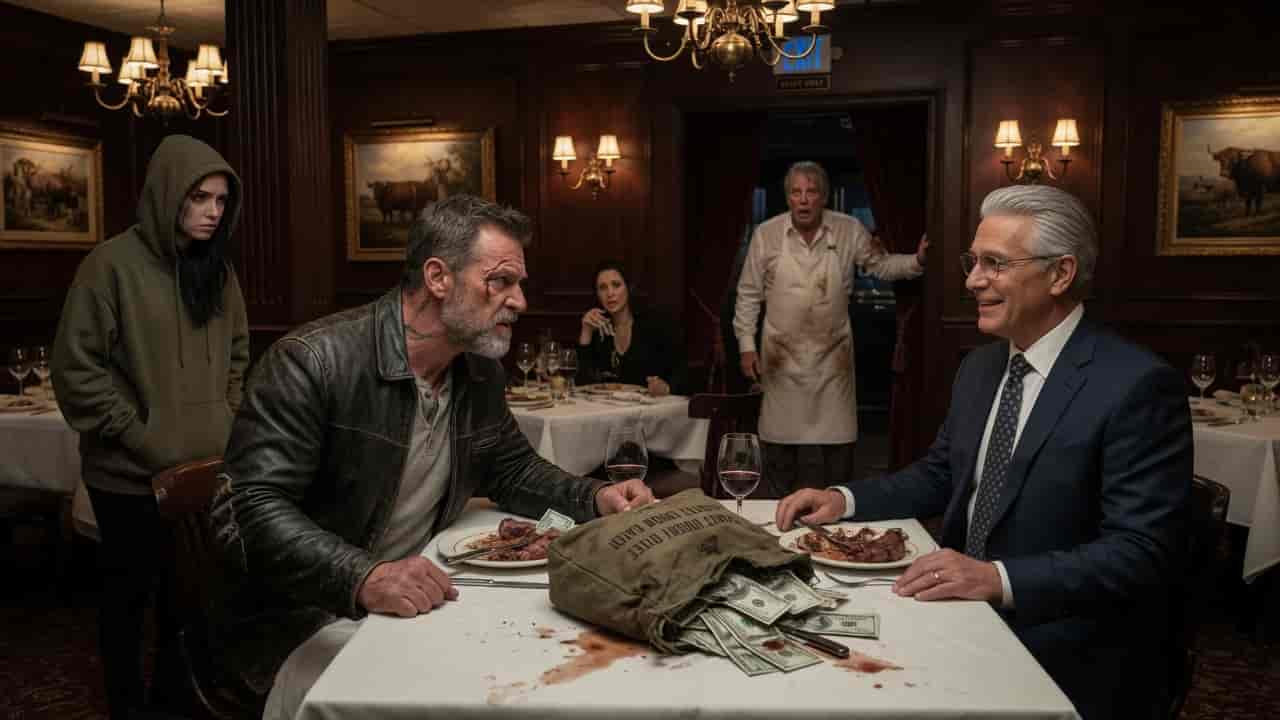
“Open it, Harrison.”
The restaurant was the kind of place where the silver was real and the whispers were expensive. Gabe didn’t belong here. He smelled of old oil, cold rain, and the decade of life that had been stolen from him. He stood over the District Attorney’s table, a ghost in a leather jacket that fit a little looser than it used to.
DA Harrison didn’t even look up at first. He just sat there with his expensive wine and his even more expensive reputation, acting like the man who had sent Gabe to prison was beneath his notice.
“You’re a ghost, Gabe,” Harrison sneered, his voice loud enough for the neighboring tables to hear. “Go back to the hole you crawled out of before I have the deputies remind you where you belong.”
The room went silent. The elite of Clear Creek watched as Gabe was publicly dismissed, treated like a stray dog in a five-star dining room. But Gabe didn’t flinch. He reached into his jacket and pulled out a heavy, stained bag—the kind that held the “slush fund” everyone suspected but no one could prove.
He slammed it onto the white linen. The thud silenced the clinking of forks.
“Interest is due,” Gabe said, leaning in.
The color drained from Harrison’s face. He knew what was in that bag. He knew exactly where it had come from, and he knew that everyone in this room was about to see the truth behind the family empire he’d built on Gabe’s sacrifice.
Chapter 1: The Weight of Cold Iron
The air in Clear Creek, Pennsylvania, didn’t just smell like rain; it smelled like wet coal and the slow, rhythmic rot of a town that had forgotten how to thrive. Gabe “Anvil” Castor sat on his 2004 Heritage Softail, the engine idling with a throatiness that felt like a heartbeat against his thighs. He hadn’t been back in ten years, but the potholes on Main Street were exactly where he’d left them.
He pulled up to The Broken Spoke, a dive bar that looked like it was being held together by rust and bad intentions. He killed the engine, and the sudden silence was worse than the noise. It was the kind of silence that invited memories you spent a decade trying to drown in prison cafeteria coffee.
Gabe dismounted, his joints popping. He wasn’t the man who had left. The “Anvil” used to refer to his fists; now it felt like a description of the weight he carried in his chest. He pushed through the heavy oak doors, the smell of stale beer and sawdust hitting him like a physical blow.
“We’re closed, pal,” a voice rasped from behind the bar.
Gabe squinted through the dim light. Leo was there, hunched over a sink. He looked smaller, his hair gone entirely white, but the empty sleeve pinned to his shoulder was the same. Leo had lost that arm in a factory accident twenty years ago, and Gabe had been the one to drive him to the hospital when the foreman tried to hide the incident.
“Since when do you close at four on a Tuesday, Leo?” Gabe said.
Leo froze. He didn’t look up for a long time. When he finally did, his eyes were watery and rimmed with a fear that Gabe didn’t recognize.
“Gabe?” Leo whispered. “Jesus, Gabe. You’re supposed to be in Camp Hill for another two years.”
“Good behavior,” Gabe said, though they both knew that was a lie. He’d been let out early because the state’s key witness had finally confessed to perjury on his deathbed—a witness DA Harrison had coached into existence. “I’m looking for a place to stay.”
Leo looked toward the door, then back at Gabe, his movements frantic. “You can’t stay here. Not in town. The Iron Cross… they took over the Spoke three years ago. I’m just the guy they let keep the lights on so they have a place to piss.”
“I don’t care about the Cross,” Gabe said, sliding onto a stool. The vinyl was cracked. “I want a beer. And I want to know where Harrison lives now.”
“Gabe, don’t,” Leo pleaded, leaning over the bar. His one hand was trembling. “He’s the DA. He’s the golden boy. He’s got the police, the council, and the Cross in his pocket. He turned this town into a closed circuit. You touch one wire, and the whole thing shocks you.”
Before Gabe could answer, the front door swung open with a violence that made the glass rattle. Three men walked in, wearing leather vests with the Iron Cross patch—a jagged, ugly thing that looked like it had been designed by someone who hated the world. The man in the lead was younger, maybe thirty, with a face full of cheap tattoos and eyes that were too bright, too hungry.
“Who’s the vintage model on the stool, Leo?” the leader asked, his voice dripping with the kind of casual cruelty that only comes from knowing you won’t be challenged.
“Just a traveler, Jax,” Leo said quickly, his voice climbing an octave. “He was just leaving.”
Jax walked up to Gabe, stopping inches away. He smelled like cheap peppermint and exhaust. He looked Gabe up and down, lingering on the faded “President” ghost-stitch on Gabe’s jacket where his old club’s patch used to be.
“A traveler with an old patch-hole,” Jax said, grinning. He reached out and flicked the collar of Gabe’s jacket. “You used to be someone, huh? A big man in a little club that doesn’t exist anymore.”
Gabe didn’t move. He didn’t blink. He just stared at the rows of bottles behind the bar. “I’m just a guy having a beer, Jax.”
“You’re a guy sitting in my seat,” Jax said. He grabbed Gabe’s shoulder, his fingers digging into the muscle. “And you’re sitting in my bar. Around here, we don’t like relics. We like things that know their place.”
He shoved Gabe. It wasn’t a hard shove, but it was designed to humiliate, to see if the old dog still had teeth. Gabe stumbled off the stool, his boots scuffing the floor. The other two bikers laughed—a sharp, jagged sound that filled the room.
“Look at that,” Jax said, turning to his friends. “The Anvil is more like a paperweight now. Why don’t you head back to the retirement home, old man? Before you get hurt.”
Gabe felt the familiar heat rising in his throat, the old roar of the engine in his blood. But then he saw Leo’s face—the sheer, unadulterated terror that Gabe’s presence was going to get the old man’s other arm broken. He looked at the floor, swallowed the pride that had nearly cost him his life a dozen times, and walked toward the door.
“That’s right,” Jax called out. “Keep walking. And don’t let me see that bike in this town tomorrow. I’ll have it turned into scrap metal by noon.”
Gabe stepped out into the grey afternoon. He didn’t feel relieved. He felt like he’d left a piece of his soul on that barroom floor. But he had work to do. He had a bag to find, and a debt to collect that didn’t involve fists.
As he reached for his handlebars, he noticed a shadow in the alleyway beside the bar. A girl, no older than seventeen, was huddled in the corner, her hoodie pulled low. She was watching him with eyes that were too old for her face.
“You’re Gabe,” she said. It wasn’t a question.
“Who’s asking?”
“Maya,” she said. She stepped into the light, and Gabe saw the bruise on her cheek, the way she held her arm close to her body. “You’re the one my mom told me about. Before she… before she went away.”
Gabe froze. He remembered Maya’s mother—Sarah. She had been the only one who tried to tell the truth ten years ago. And then she had disappeared, her car found at the bottom of the quarry, empty.
“Your mom was a good woman, Maya,” Gabe said, his voice thick.
“My mom was a witness,” Maya said, her voice hard as flint. “And you’re the only one who knows why they really took her.”
She reached into her oversized pocket and pulled out a small, rusted key on a dirty string. “She told me if I ever saw the man with the anvil on his hands, I should give him this. She said it opens the box in the garage. The one they couldn’t find.”
Gabe took the key. It felt heavy in his palm, colder than the Pennsylvania rain. He looked at the girl, then back at the bar where Jax’s laughter was still echoing. The humilitation in the bar hadn’t been an ending. it had been the start of the pressure.
“Stay close to me, Maya,” Gabe said. “The weather’s about to get a lot worse.”
Chapter 2: The Ghost in the Garage
The garage was a corrugated tin shack three miles outside of town, tucked behind a screen of dying hemlocks. It had belonged to Gabe’s father, a man who believed that if you couldn’t fix it with a wrench or a shotgun, it wasn’t worth owning. The lock was stubborn, but the key Maya gave him turned with a satisfying, oily click.
Inside, the air was thick with the smell of old grease and abandonment. Maya stood in the doorway, her silhouette thin against the grey sky. She looked like a bird waiting for a reason to fly away.
“Why are you helping me, kid?” Gabe asked, clearing a thick layer of dust off a workbench.
“Because I have nowhere else to go,” she said. Her voice didn’t have any self-pity in it; it was just a statement of fact. “After they took her, the state put me in a home in Erie. I ran away three weeks ago. I’ve been sleeping in the woods, watching the Spoke, waiting for you.”
“You knew I was coming back?”
“I heard Harrison talking to the Sheriff at the diner,” she said. “They were worried. Harrison said you were a loose end that should have stayed tied. He told the Cross to handle it quietly.”
Gabe felt a cold ripple of anger. Handling it quietly. That’s what they’d called it when they framed him for the warehouse fire that took the lives of three people—people Gabe had tried to save. Harrison had been a young, hungry prosecutor then, looking for a win to launch his career. He’d used Gabe as the sacrificial lamb, and the Iron Cross had provided the wood for the fire.
He found the box in the crawlspace, beneath a stack of rotted tires. It was a heavy steel ammunition can, welded shut at the seams except for a small, reinforced keyhole. He slid the key in.
When the lid popped, there was no golden light, no dramatic music. Just a stack of ledgers and a canvas bank bag.
Gabe opened the bag. It wasn’t just cash. It was a collection of receipts, handwritten notes, and photographs. One photo showed a younger Harrison, smiling, shaking hands with the former president of the Iron Cross—the man Gabe had replaced. The notes were worse: dates, amounts, and names of “donors” to a slush fund that fueled Harrison’s political rise.
“Is that it?” Maya asked, stepping closer. “The thing that gets them?”
“This is the thing that gets us killed if we’re not careful,” Gabe said. He looked at her, really looked at her. Her hands were steady, but she was vibrating with a repressed energy, a need for movement. “You said you’ve been living in the woods?”
“I’m fast,” she said. “And I don’t miss.” She pulled a small, sharpened screwdriver from her belt. It wasn’t a weapon; it was a tool she’d turned into a fang.
Gabe realized then that Maya wasn’t just a victim. She was a survivor who had been forged in the same fire that had consumed her mother. And he was about to do something terrible. He was about to take that survival and sharpen it.
“I’m going to teach you how to move, Maya,” Gabe said. “Not just run. Move with purpose. If we’re going to do this, we don’t get to be victims anymore.”
The next three days were a blur of cold mornings and whispered instructions. Gabe showed her how to watch a house without being seen, how to read the body language of a man who thought he was alone, and how to stay silent when the world was screaming. He hated himself for it. He should have been taking her to a school, or a library, or a safe house three states away. Instead, he was building a ghost.
“Why did you stay in prison?” Maya asked one night, huddled over a small camp stove. “If you knew they lied?”
“Because I thought I deserved it,” Gabe said. “Not for the fire. But for being part of the world that allowed it to happen. I was the President, Maya. I thought I was protecting my people. But I was just providing cover for the monsters.”
“And now?”
“Now I’m the monster they forgot to kill.”
On the fourth day, the pressure broke. Gabe rode into town alone, leaving Maya in the woods with instructions to watch the garage. He needed to see Harrison. He needed to see the man who had bought his career with Gabe’s life.
He found him at The Gilded Rail, the town’s only upscale restaurant. It was a place where the waiters wore vests and the patrons pretended the coal dust didn’t exist. Gabe walked in, his boots tracking mud onto the plush carpet.
The hostess tried to stop him, her face a mask of practiced politeness. “Sir, we have a dress code—”
“I’m here to see an old friend,” Gabe said, pushing past her.
He saw Harrison at a corner table, flanked by two men in suits who looked like they’d been grown in a lab for “Security Personnel.” Harrison was laughing, a glass of expensive Cabernet in his hand. He looked prosperous. He looked untouchable.
Gabe walked straight to the table. The security men stood up, their hands moving toward their jackets, but Harrison held up a hand. He looked at Gabe, and for a second, the mask slipped. Just a flicker of something—guilt, maybe, or just the annoyance of a man seeing a ghost he thought he’d exercised.
“Gabe,” Harrison said, his voice smooth as silk. “I heard you were back. I assumed you’d be halfway to California by now.”
“I missed the weather, Silas,” Gabe said. He used Harrison’s first name, watching the way the DA’s jaw tightened. “And I missed the company.”
“You look tired, Gabe. Prison wasn’t kind to you,” Harrison said. He leaned back, his confidence returning. He looked around the room, making sure the other diners were watching. “But then again, you were always a man who struggled with his surroundings. Why don’t you go back to the Spoke? I’m sure Jax can find a floor for you to sweep.”
The room chuckled. It was a soft, polite sound, but it felt like a serrated edge against Gabe’s skin. He was being belittled in front of the people who ran the town—the same people who had looked the other way for a decade.
“I found a box, Silas,” Gabe said. He kept his voice low, intimate. “In my father’s garage. It had some interesting reading material. About a fund. About a warehouse fire. About a woman named Sarah.”
The silence that followed wasn’t polite. It was heavy. Harrison’s eyes went cold. “I have no idea what you’re talking about. But I do know that a parolee making threats against a District Attorney is a very short path back to a cell.”
“It’s not a threat,” Gabe said, leaning over the table. He could smell the expensive wine on Harrison’s breath. “It’s an audit. And I think you’re overdrawn.”
He turned and walked out, his heart hammering a rhythm against his ribs. He’d poked the wire. Now he just had to wait for the shock.
He didn’t make it to his bike.
Two SUVs pulled up, blocking the exit of the parking lot. Jax and four other Cross members piled out. They weren’t laughing this time. They had chains and brass knuckles, and their eyes were full of the mindless violence of men who had been given a green light.
“Jax said he didn’t want to see you again,” the biggest one said.
Gabe felt the first blow land in his ribs. He went down, the asphalt cold and unforgiving against his cheek. He didn’t fight back. He knew how this worked. He let them kick him, let them vent the anger Harrison had directed at them. He shielded his head, tasting copper in his mouth, listening to the wet thud of boots against his body.
“Leave him,” Jax’s voice came from somewhere above. “Let him crawl back to his hole. If he’s still in town by morning, we finish it.”
They left him there, a broken heap in the shadows of the Gilded Rail. Gabe waited until the sound of their engines faded. He rolled onto his back, looking up at the grey Pennsylvania sky. His ribs were screaming, and his left eye was swelling shut.
But as he reached into his inner jacket pocket, his fingers touched the cold steel of the key. He’d let them humiliate him. He’d let them think he was a broken old man.
Because while they were busy kicking him, they hadn’t noticed Maya. They hadn’t noticed the shadow that had slipped into the back of Harrison’s SUV while the DA was still inside eating his steak.
Gabe stood up, spitting a mouthful of blood onto the pavement. The audit had begun.
Chapter 3: Interest is Due
The next morning, the sun didn’t rise so much as the sky just turned a lighter shade of slate. Gabe sat at the workbench in the garage, his breath coming in shallow, painful hitches. He’d taped his ribs, but every movement felt like a hot needle.
Maya was sitting on the floor, cleaning the screwdriver. Her hands were perfectly still.
“You got it?” Gabe asked.
She reached into her hoodie and pulled out a leather-bound planner. “It was in the glove box. He’s meeting someone at the steakhouse tonight. Eight o’clock. He marked it with a star.”
Gabe opened the planner. The star was next to the name V. Vincent. The head of the Iron Cross. The man who had taken the club Gabe built and turned it into a drug-running syndicate for Harrison.
“Tonight’s the night, Maya,” Gabe said. “I’m going in. You stay at the perimeter. If I don’t come out in twenty minutes, you take the ledgers and you head for the state police barracks in Harrisburg. Don’t stop for anyone. Not even the lights.”
“I’m going in with you,” she said. It wasn’t a request.
“No. You’re the backup. You’re the one who survives if I don’t. That’s the deal.”
He spent the afternoon preparing. He didn’t take a gun. A gun made it a crime; what he was doing was an execution of a different kind. He took the canvas bag. He took the photographs. And he took the heavy, stained bank bag from the steel box.
Eight o’clock came with a sudden downpour that turned the roads into black glass. Gabe rode the Softail through the center of town, his headlight cutting through the gloom. He didn’t hide. He wanted them to see him. He wanted Harrison to know the ghost wasn’t staying in the graveyard.
He pulled up to the steakhouse. It was the premier spot in Clear Creek—The Hearth. Valet parking, gold-leaf signs, and a window display of dry-aged beef that cost more than Gabe’s first bike.
He didn’t wait for the valet. He rode the bike right onto the sidewalk, the tires screeching on the wet stone. He kicked the kickstand down and left the engine running, the low rumble vibrating through the glass front of the restaurant.
He walked through the front doors. The hostess didn’t even try to stop him this time. The look on his face—the bruised eye, the bloody knuckles, the sheer, cold intent—was enough to make her step back into the coat closet.
The restaurant was packed. The “who’s who” of Clear Creek was there, celebrating another year of successful rot. Harrison was at a central table, seated with Vincent. Vincent was older, his face a map of scars and bad decisions, wearing a leather vest over a dress shirt. It was a visual representation of the town’s corruption: the law and the lawless sharing a bottle of Scotch.
Gabe walked into the center of the room. Every conversation died. The only sound was the muffled roar of his bike outside and the rain hitting the roof.
He stopped at Harrison’s table.
Vincent started to stand, his hand going to his waist, but Gabe didn’t even look at him. He kept his eyes on Harrison.
“I told you, Gabe,” Harrison said, his voice tight with a fear he couldn’t quite mask this time. “You’re a ghost.”
“And ghosts don’t have anything to lose, Silas,” Gabe said.
He reached into his jacket and pulled out the stained canvas bag. He slammed it onto the table. The sound was like a gunshot in the silent room. A few hundred-dollar bills, stained with what looked like old oil and something darker, spilled out onto the white cloth.
“What is this?” Harrison hissed, looking around at the staring diners.
“It’s the interest, Silas,” Gabe said. “On the ten years you stole from me. On the life you took from Sarah. On every dollar you took from the Cross to keep your hands clean.”
Gabe leaned down, his face inches from the DA’s. “This bag was in the warehouse, Silas. The one that burned. My father pulled it out before the roof came down. He knew you’d come looking for it, so he hid it where only I could find it.”
Harrison’s face went the color of ash. He looked at the bag as if it were a coiled snake.
“Open it,” Gabe said. His voice was a low growl that carried to the back of the room. “Open it and tell everyone in here that this money didn’t come from the fire. Tell them it’s not the payout Vincent gave you to make sure the investigation died with the victims.”
“You’re insane,” Harrison stammered. “This is a stunt. Security!”
“Look at the photos, Silas,” Gabe said, dropping a stack of glossies onto the table. They were the shots of Harrison and Vincent, years apart, the same handshake, the same smiles. “Look at the dates. Look at the ledger entries.”
Vincent lunged across the table then, his fingers clawing for Gabe’s throat. Gabe caught him by the wrist, the old “Anvil” strength returning in a surge of adrenaline. He twisted Vincent’s arm back, forcing the biker’s face down onto the table, right next to the stained money.
“You’re done, Vincent,” Gabe said. “The club is gone. The DA is gone. And the town is watching.”
The room was in chaos now. People were standing, some filming with their phones, others backing away in terror. Leo appeared in the doorway of the kitchen, his one hand clutching a dishtowel, his eyes wide. He saw Gabe holding the man who had terrorized him for years, and for the first time, Leo didn’t look afraid. He looked like he was witnessing a miracle.
“Get out,” Harrison screamed, his composure finally shattering. “Get out of my sight!”
“I’m going,” Gabe said. He let go of Vincent, who slumped back into his chair, gasping. Gabe looked around the room, meeting the eyes of the people who had stayed silent for a decade. “But the bag stays. Along with the truth.”
He turned and walked out, his boots heavy on the carpet. He stepped out into the rain, the cold air hitting his face like a benediction. He hopped onto the Softail and kicked it into gear, the roar of the engine echoing off the buildings.
He didn’t see the black SUV pull out of the alleyway behind him. He didn’t see the muzzle flash from the passenger window.
He felt the impact in his shoulder, a hot, searing bloom of pain that knocked him sideways. The bike skidded, the metal screaming against the asphalt as it went down. Gabe tumbled, the world spinning in a blur of grey and black.
He came to rest in the gutter, the rain washing the blood from his jacket. He looked up, his vision blurring. The SUV was idling twenty feet away. The door opened, and Jax stepped out, a pistol in his hand.
“Harrison said to make it look like a robbery,” Jax said, his voice flat.
He raised the gun.
A shadow moved in the darkness behind him. A thin, fast shadow.
There was no sound, just a sudden, wet gasp. Jax froze. He looked down at his chest, where the tip of a sharpened screwdriver was protruding through his leather vest.
He fell forward, revealing Maya standing behind him. Her hood was up, her face a mask of cold, predatory focus. She didn’t look like a girl. She looked like the ghost Gabe had built.
“I told you,” she whispered, looking at Gabe. “I don’t miss.”
Chapter 4: The Residue of Justice
The basement of the old priest’s rectory smelled of incense and damp stone. Father Thomas, a man who had seen Gabe through his first communion and his first arrest, moved with a quiet efficiency as he cleaned the wound in Gabe’s shoulder.
“You’re a lucky man, Gabriel,” the priest said, his voice a gentle rasp. “The bullet passed through. Another inch, and you’d be seeing your father sooner than planned.”
Gabe grunted, his teeth clenched against the sting of the antiseptic. Maya was sitting in the corner, her back against the wall, watching the door. She hadn’t spoken since the alleyway. The screwdriver was gone, buried somewhere in the woods along with Jax’s body.
“What happens now, Father?” Gabe asked.
“Now, the world wakes up,” Thomas said. “The videos from the steakhouse are already on the news. The state police are at Harrison’s house. They found the bag you left. And they found the ledgers.”
“It’s not enough,” Gabe said. “Harrison will have lawyers. He’ll say the bag was planted. He’ll say I’m an ex-con looking for revenge.”
“He might,” Thomas agreed. “But he can’t explain the girl.”
He looked at Maya. “Sarah didn’t die in that quarry, Gabe. She was taken to a private clinic in Maryland. Harrison couldn’t kill her—he didn’t have the stomach for it—so he paid to have her kept in a chemical fog. He thought she was a vegetable. But she’s been talking. The state police found her an hour ago.”
Gabe felt a wave of nausea hit him. Sarah was alive. Ten years of life, stolen not by a grave, but by a man’s cowardice. He looked at Maya, whose eyes were suddenly bright with tears she refused to let fall.
“She’s coming home, Maya,” Gabe said, his voice breaking.
The girl didn’t move for a long time. Then, she stood up and walked over to Gabe, placing her small, cold hand on his uninjured shoulder. “We did it?”
“We started it,” Gabe said.
But the price was already being tallied. The Iron Cross wasn’t going quietly. Vincent had disappeared before the police arrived at the steakhouse, and three of his top lieutenants were still at large. The town was a tinderbox. The police were overwhelmed, the local government was in a state of collapse, and the people who had lived in fear for so long were starting to realize that the monsters were vulnerable.
Gabe stood up, the movement sending a fresh jolt of pain through his shoulder. He looked at the priest. “Where is Vincent?”
“He’s at the old foundry,” Thomas said, his face grave. “He knows it’s over. He’s gathering whatever he can carry and heading for the border. He’s got two of the girls from the Spoke with him. He’s using them as shields.”
Gabe reached for his jacket. It was torn and blood-stained, but it felt like armor.
“Gabe, you can’t,” the priest said. “You’re hurt. Let the police handle it.”
“The police are busy protecting Harrison from the mob outside his house,” Gabe said. “And the girls don’t have time for a warrant.”
He looked at Maya. “You stay here. With Father Thomas. This isn’t your fight anymore.”
“Yes, it is,” she said.
“No,” Gabe said, his voice firm. “You got your mom back. That’s your victory. Don’t let Vincent take that away from you. Stay here. That’s an order.”
He didn’t wait for her to argue. He walked out of the rectory and into the night.
The rain had stopped, leaving the town dripping and dark. He found his bike where the police had left it—on the sidewalk in front of the steakhouse. It was banged up, the chrome scratched and the mirrors gone, but when he hit the starter, it roared to life.
He rode toward the foundry. It was a massive, skeletal structure on the edge of the river, a monument to the industry that had once sustained the town. Now, it was just a graveyard of steel and shadows.
As he approached, he saw the flickering lights of torches inside. Vincent was there. Gabe could hear the shouting, the sound of glass breaking. He pulled his bike into the tall grass fifty yards away and dismounted, moving through the shadows with the silence he’d taught Maya.
His shoulder was a dull, throbbing weight, but he ignored it. He reached into his boot and pulled out a heavy iron pipe he’d picked up from the rectory’s yard. It wasn’t a gun. It was an anvil.
He saw Vincent in the center of the main floor, standing over two terrified women who were huddled on a pile of rusted slag. Vincent was holding a gasoline can, his face twisted in a mask of desperate, final rage.
“If I’m going down, this whole town goes with me,” Vincent screamed, his voice echoing off the corrugated roof. “I built this! I own this!”
Gabe stepped into the light.
“You don’t own anything, Vincent,” Gabe said. “Not even your own soul.”
Vincent turned, the gasoline can sloshing. He looked at Gabe, and for a second, he looked like a cornered rat. “You. You just won’t stay dead.”
“I’ve been dead for ten years,” Gabe said, stepping closer. “Tonight, I’m just a ghost finishing a job.”
Vincent reached for the lighter in his pocket. “One spark, Gabe. That’s all it takes. You want to be a hero? You can burn with them.”
Gabe didn’t stop. He kept walking, the iron pipe heavy in his hand. He could feel the heat of the conflict, the weight of the secrets, the residue of the decade of lies. He was the Anvil. And the hammer was about to fall.
He was ten feet away when the first shot rang out. Not from Vincent. Not from Gabe.
From the catwalks above.
Gabe looked up and saw the flash of the muzzle. And then he saw the shadow—the thin, fast shadow he’d told to stay behind.
Maya.
The bullet hit the gasoline can in Vincent’s hand.
The world turned into a roar of orange and yellow.
Chapter 5: The Forge of Consequence
The explosion wasn’t a clean, cinematic boom. It was a wet, heavy whump that felt like being punched in the lungs by a giant. The pressure wave rolled through the foundry, vibrating Gabe’s teeth and sending a rain of soot and rusted flakes down from the rafters. The air, already thick with the smell of stagnant water and industrial rot, was suddenly replaced by the searing, oily stench of vaporized gasoline.
Gabe was thrown backward, his injured shoulder slamming into a steel support beam. The pain was a white-hot spike that momentarily short-circuited his vision. He gasped, sucking in heat and smoke, his ears ringing with a high, thin whine that drowned out the world. Through the orange haze of the fire, he saw the gasoline can—or what was left of it—lying on the concrete, a jagged flower of flame blooming from its center.
Vincent was down. He’d been closest to the blast, and the force had sent him skidding into a pile of iron slag. He was moving, a low, animalistic groan rising from his throat, but he wasn’t standing. The two women who had been huddled on the floor were screaming, a raw, piercing sound that cut through the ringing in Gabe’s ears. They were unscratched by the blast, but the fire was spreading fast, licking at the dry wooden pallets stacked against the far wall.
“Maya!” Gabe croaked. His voice felt like it was passing over broken glass.
He looked up toward the catwalks. The smoke was thick up there, a swirling black curtain that obscured the metal railings. For a terrifying five seconds, there was no movement. Then, a small, hooded figure swung over the railing and began to climb down the access ladder with the fluid, desperate speed of a panicked cat.
Gabe didn’t wait for her to reach the floor. He ignored the fire in his shoulder and lunged toward the two women. He grabbed them by the arms, hauling them to their feet with a strength that felt borrowed from a younger, angrier man.
“Out! Get out!” he yelled, shoving them toward the main bay doors. They didn’t need further encouragement; they vanished into the night, their shadows stretching long and distorted across the burning floor.
Gabe turned back to Vincent. The leader of the Iron Cross was trying to push himself up, his face blackened by soot, his eyes wide and unfocused. The fire was already surrounding him, a ring of orange teeth closing in.
“Gabe,” a small voice whispered beside him.
Maya was there, her oversized hoodie singed at the cuffs, her face pale beneath the grime. She was staring at Vincent, the screwdriver still clutched in her hand. She wasn’t shaking. That was the part that chilled Gabe to the bone—she was perfectly, terrifyingly still.
“We have to go, Maya,” Gabe said, reaching for her.
“He’s still alive,” she said. It wasn’t a question or a concern. It was a statement of a problem that needed solving.
“The fire will handle it. We’re leaving.”
“He killed my mom,” she said, finally looking at Gabe. The light from the flames danced in her pupils. “He didn’t just hide her. He killed the person she was. Ten years, Gabe. You were in a cage, but she was in a coffin that breathed.”
Gabe felt the weight of the last decade settle on him, a crushing pressure that threatened to buckle his knees. He looked at Vincent, who had managed to get to his knees, his hands clawing at the slag. Vincent looked at them, and for the first time, the arrogance was gone. There was only the base, pathetic fear of a man who realized the world had finally caught up to his tab.
“Please,” Vincent wheezed, a string of bloody saliva hanging from his lip. “Castor… help me.”
Gabe looked at the man he had once called a brother, the man who had helped turn a club into a cult of greed and cruelty. He thought about the warehouse fire. He thought about the three people who hadn’t made it out. He thought about Sarah, trapped in a chemical haze in some Maryland basement while her daughter slept in the Pennsylvania woods.
He looked at the iron pipe in his hand. He could finish it. He could end the threat of the Iron Cross with one swing, right here in the temple of the industry they’d helped destroy.
“No,” Gabe said, more to himself than to Maya.
He grabbed the girl by the shoulder and forced her to turn away. “If you do this, you never get to be Maya again. You stay a ghost forever. Is that what your mom wants to wake up to?”
Maya’s jaw tightened. She looked at the fire, then at the screwdriver, then back at the man on the floor. For a heartbeat, Gabe thought she was going to lung anyway. Then, her hand relaxed. The tool clattered onto the concrete.
“Let’s go,” she said.
They ran. They cleared the bay doors just as the pallet stack collapsed, sending a fresh roar of sparks into the rafters. The night air was freezing, the sudden drop in temperature making Gabe’s lungs ache. He didn’t stop until they reached the Softail. He swung a leg over, the movement a agony of torn muscle and bruised ribs.
“Get on,” he told Maya.
She climbed onto the pillion, her small arms wrapping around his waist. As they pulled away, Gabe saw the blue and red flickers of sirens in the distance, heading toward the foundry. The law was finally showing up, but the justice had already been hammered out.
They didn’t go back to the rectory. Gabe knew the police would be there eventually, and he wasn’t ready to talk. Not yet. He rode to a small, secluded turnaround overlooking the Susquehanna River—a place where he used to take Sarah when they were twenty and the world felt like it belonged to them.
He killed the engine and sat there, the heat of the bike’s motor the only warmth in the world. Maya slid off and walked to the edge of the overlook, staring down at the black, churning water.
“Is she really alive?” Maya asked, her voice small and fragile now, the ghost mask finally cracking.
“Father Thomas doesn’t lie,” Gabe said. He climbed off the bike, his legs feeling like they were made of lead. He walked over to her, keeping a respectful distance. “She’s in a hospital in Harrisburg now. They’re moving her to a specialized clinic.”
“Will she know me?”
Gabe didn’t answer right away. He couldn’t. He thought about the “chemical fog” the priest had mentioned. He thought about the residue of ten years of isolation and drugging. “I don’t know, Maya. But we’re going to be there when she wakes up. Both of us.”
“You’re going to jail, aren’t you?” she asked, turning to look at him. “For the steakhouse. For… for Jax.”
“I was already in jail, kid,” Gabe said, a tired smile touching his lips. “The steakhouse was just me delivering the bill. As for Jax… I didn’t see anything in that alley. Did you?”
She shook her head slowly.
“Then it was just a robbery gone wrong,” Gabe said. “The town’s full of desperate people. Sometimes they turn on each other.”
The silence that followed was heavy with the residue of what they’d done. Gabe felt a profound sense of exhaustion, an emotional depletion that made the physical pain feel distant. He’d spent ten years wanting to burn it all down, but now that the fire was out, all he felt was the cold.
“I liked it,” Maya said suddenly. Her voice was flat, clinical. “When the screwdriver went in. I liked seeing the look on his face. Does that make me like them?”
Gabe felt a cold shiver that had nothing to do with the wind. He looked at the girl—really looked at her. She was a child who had been forced to become a weapon. And that was his fault as much as Harrison’s. He’d taught her how to hunt. He’d sharpened the fang.
“It makes you angry, Maya,” Gabe said, stepping closer. He put a hand on her head, his large, scarred fingers clumsy but gentle. “And you have every right to be. But the liking it… that’s the part you have to fight. That’s the part that turns a victim into a bully. You don’t want to be the one holding the screwdriver when there’s no more monsters left.”
She leaned into him then, her forehead resting against his leather jacket. She didn’t cry—Gabe suspected she’d forgotten how—but he felt the tension leave her shoulders, the wire-tight survival instinct finally beginning to fray.
They stayed there for an hour, watching the river, until the first hint of a grey dawn began to bleed into the eastern sky. Gabe knew the next few days would be a nightmare of depositions, hospital corridors, and the slow, grinding machinery of a legal system trying to fix a decade of its own corruption. Harrison would be ruined, the Cross would be dismantled, and the town of Clear Creek would have to figure out how to breathe again.
But as he looked at the girl standing beside him, Gabe realized that the “Anvil” wasn’t just about striking. It was about what remained after the heat was gone. It was about the shape of the thing you left behind.
“Come on,” Gabe said, his voice stronger now. “Let’s go find your mother.”
They rode toward Harrisburg as the sun finally broke through the clouds—not a brilliant, hopeful light, but a hard, clear morning that showed every crack in the pavement and every rust spot on the bridge. It was a light you could work by.
The hospital was a fortress of glass and white tile, a place that felt too clean for a man who smelled like a foundry fire. Gabe left Maya in the waiting room with a bag of chips and a promise that he’d be right back. He found Sarah’s room on the fourth floor, guarded by two state troopers who looked like they hadn’t slept since the fire.
“Castor?” one of them asked, his hand moving toward his belt.
“I’m just here to see her,” Gabe said. He raised his hands, showing the bruises, the burns, and the lack of a weapon. “The DA’s office sent word I was allowed.”
The trooper hesitated, then nodded. “Five minutes. She’s… she’s coming around. But she’s confused.”
Gabe stepped into the room.
The woman in the bed looked nothing like the Sarah he remembered. Her hair was thin and grey, her skin the color of old parchment. She was tiny, swallowed by the hospital gown and the white sheets. But when she turned her head toward him, her eyes were the same. A deep, clear green that had always reminded Gabe of the woods after a storm.
“Gabe?” she whispered. The name was a ghost, a sound that hadn’t been spoken in a decade.
Gabe sat in the chair beside the bed, his heart hammering against his taped ribs. He reached out and took her hand. It felt as light as a bird’s wing.
“I’m here, Sarah,” he said.
“The fire,” she said, her eyes darting toward the window. “Is the warehouse still burning?”
“No,” Gabe said, his voice thick. “The fire’s out. Everyone’s safe.”
“Maya?” she asked, her voice rising in panic. “Where is she? They said she was… they said she was gone.”
“She’s right outside, Sarah. She’s grown up. She’s beautiful. And she’s waiting for you.”
Sarah closed her eyes, a single tear tracing a path through the wrinkles on her cheek. “I thought I was dreaming you. For so long, I thought you were just a dream I had in the dark.”
“I’m real, Sarah,” Gabe said, leaning down to kiss her forehead. “And the dark is over.”
He stayed for the full five minutes, talking to her about things that didn’t matter—the weather, the river, the way the Softail still ran. He didn’t talk about Harrison. He didn’t talk about the foundry. He didn’t talk about the decade he’d spent in a cage or the man he’d had to become to get out.
When he walked back into the waiting room, Maya was standing by the window. She turned to look at him, her face unreadable.
“Is she… is she okay?”
“She’s your mom, Maya,” Gabe said. “She’s waiting for you.”
He watched the girl walk toward the room, her steps hesitant, her shoulders hunched. He stayed in the hallway, leaning against the cold wall, listening to the sound of his own breathing. He felt a sudden, sharp pang of loneliness—the realization that his role in this story was almost finished. He’d been the hammer. He’d been the anvil. But now the work was done.
A man in a suit approached him from the elevator. He was older, with a tired face and a badge clipped to his belt. “Gabriel Castor?”
“Yeah.”
“I’m Detective Miller, State Police. We need to talk about what happened at the foundry. And about a certain canvas bag you left at the steakhouse.”
Gabe looked at the door to Sarah’s room. He could hear a low murmur of voices, a sob, a laugh.
“I have some time,” Gabe said. He stood up, his joints popping, the weight of the last few days finally settling into a manageable ache. “I have all the time in the world.”
Chapter 6: The Cooling of the Steel
The interrogation room at the State Police barracks was exactly what Gabe expected: grey walls, a buzzing fluorescent light, and a table that had seen too many desperate men. But the coffee was hot, and Detective Miller didn’t look like a man who enjoyed pulling teeth.
“The DA is finished, Gabe,” Miller said, leaning back in his chair. He’d been talking for three hours, going over the ledgers, the photos, and Gabe’s own account of the warehouse fire. “Harrison’s been indicted on twelve counts of racketeering, six counts of witness tampering, and three counts of negligent homicide related to the fire. His lawyers are trying to cut a deal, but the Attorney General wants his head on a platter.”
Gabe nodded, his eyes fixed on the steam rising from his cup. “And Vincent?”
“He survived the blast,” Miller said, his mouth twisting in a grimace. “Burned pretty bad, but he’ll live long enough to testify. He’s already singing. He wants to trade Harrison for a shorter sentence in a medium-security facility. He’s terrified of going back to the general population.”
“He should be,” Gabe said.
“We found Jax’s body in the alley,” Miller continued, his eyes narrowing. “Shot from behind. Then stabbed with… something sharp. A screwdriver, the coroner thinks.”
Gabe didn’t flinch. He just took a sip of the bitter coffee. “Desperate town, Detective. Like I said.”
Miller stared at him for a long time. Gabe didn’t look away. He had nothing left to hide, but he also had nothing to give. He’d delivered the truth; the details were for the men with badges to sort out.
“The girl,” Miller said finally. “Maya. She’s with her mother now. The state’s providing a secure facility for their recovery. They’re under twenty-four-hour protection.”
“Good.”
“She’s a strange one, Gabe. Smart. Cold. When we interviewed her, she didn’t say a word about the alley. Just said she was waiting for you in the woods.”
“She’s had a hard life,” Gabe said. “She doesn’t trust easily.”
“Neither do you,” Miller noted. He stood up and gathered his notes. “Look, Gabe. Technically, I could hold you for the steakhouse stunt. Disturbing the peace, assault on Vincent, parole violations. But the AG is feeling generous. He thinks you’ve done the state a service that we couldn’t do ourselves. He’s willing to let the ‘Anvil’ retire. On one condition.”
“What’s that?”
“You leave Clear Creek. Today. You stay out of the county for five years. No contact with Harrison, no contact with the remnants of the Cross. You go back to whatever life you can find.”
Gabe felt a strange sensation in his chest—a lightness he hadn’t felt since he was a kid. He didn’t want the town. He didn’t want the Spoke. He didn’t even want the revenge anymore. He just wanted the silence.
“I can do that,” Gabe said.
He walked out of the barracks an hour later. The sun was high now, casting long shadows across the parking lot. His Heritage Softail was sitting near the entrance, the chrome glinting despite the scratches. A state trooper handed him his keys and a small envelope.
“From the girl,” the trooper said, then turned and walked away.
Gabe opened the envelope. Inside was a single, polaroid photo. It was blurry, taken in a hospital room. Sarah was sitting up in bed, looking tired but alive. Beside her, Maya was smiling—a real, genuine smile that reached her eyes. On the back, in a cramped, determined hand, were three words:
We’re still here.
Gabe tucked the photo into his jacket, right over his heart. He climbed onto the bike, the engine roaring to life on the first try. He didn’t look back as he pulled out of the lot. He didn’t head toward Clear Creek. He headed west, toward the mountains, toward the open road that had always promised a freedom he’d never been able to afford.
He stopped one last time at the edge of the county line. There was a small, overgrown cemetery there, where his father was buried. He walked through the tall grass until he found the simple granite headstone.
Samuel Castor. He Fixed What He Could.
Gabe stood there for a long time, the wind whipping his hair. He thought about the iron pipe, the canvas bag, and the ten years of anger he’d poured into the town like molten lead. He thought about the “Anvil” and the way it had shaped him into a man of iron—strong, but cold.
“I finished it, Pop,” Gabe whispered. “The bill’s paid.”
He reached into his pocket and pulled out the small, rusted key to the garage. He looked at it for a moment, then tossed it into the deep weeds. He didn’t need it anymore. The box was empty. The secrets were out.
He rode for three hours, the landscape changing from coal towns and factories to rolling hills and deep green forests. He stopped at a diner in a town he didn’t know the name of, a place where the waitress called him “honey” and the coffee was served in thick ceramic mugs.
He sat at the counter, watching the people go about their lives—the farmers talking about the rain, the teenagers flirting over milkshakes, the old men complaining about the government. It was an ordinary world, a world of small problems and quiet joys. It was the world he’d forgotten existed.
He felt a hand on his shoulder. He flinched, his survival instinct still sharp, but it was just the waitress.
“You okay, sugar?” she asked. “You look like you’ve been through a war.”
Gabe looked at his reflection in the mirror behind the bar. He saw the grey in his beard, the scar over his eye, the weariness in his gaze. He looked like a man who had been hammered on for a long time. But he also saw something else. He saw a man who was cooling down.
“I’m fine,” Gabe said, and for the first time in a decade, he meant it. “Just a long trip.”
He finished his meal and walked back out to the bike. The air was crisp, smelling of pine and damp earth. He looked at the horizon, where the road stretched out into the unknown. He didn’t have a destination. He didn’t have a plan. He just had a full tank of gas and a clean slate.
As he pulled onto the highway, he felt the vibration of the engine through the seat, a steady, rhythmic pulse that felt like home. He wasn’t the President of a club. He wasn’t an inmate. He wasn’t a vigilante. He was just Gabe.
He rode into the afternoon, the sun at his back, the wind in his face. The residue of Clear Creek was still there—the ache in his ribs, the memory of the fire, the weight of the girl’s smile—but it was no longer a burden. It was just part of the story.
He thought about Sarah and Maya, safe in their white rooms, learning how to be a family again. He thought about Leo, finally able to open the Spoke without fear. He thought about Harrison, sitting in a cell, realizing that the “ghosts” he’d created were more real than the power he’d built.
Gabe “Anvil” Castor smiled. It was a small, quiet thing, a movement of muscle that felt foreign but right. He twisted the throttle, the bike surging forward, the road opening up to meet him.
The iron was cold. The work was done. And for the first time in his life, the Anvil was free.
He didn’t know where he was going, and he didn’t care. He just kept riding, a lone figure on a black bike, disappearing into the vast, beautiful uncertainty of the American night.
The End.