“Section 4, Pillar B. He’s cold in there. Let’s dig him out.”
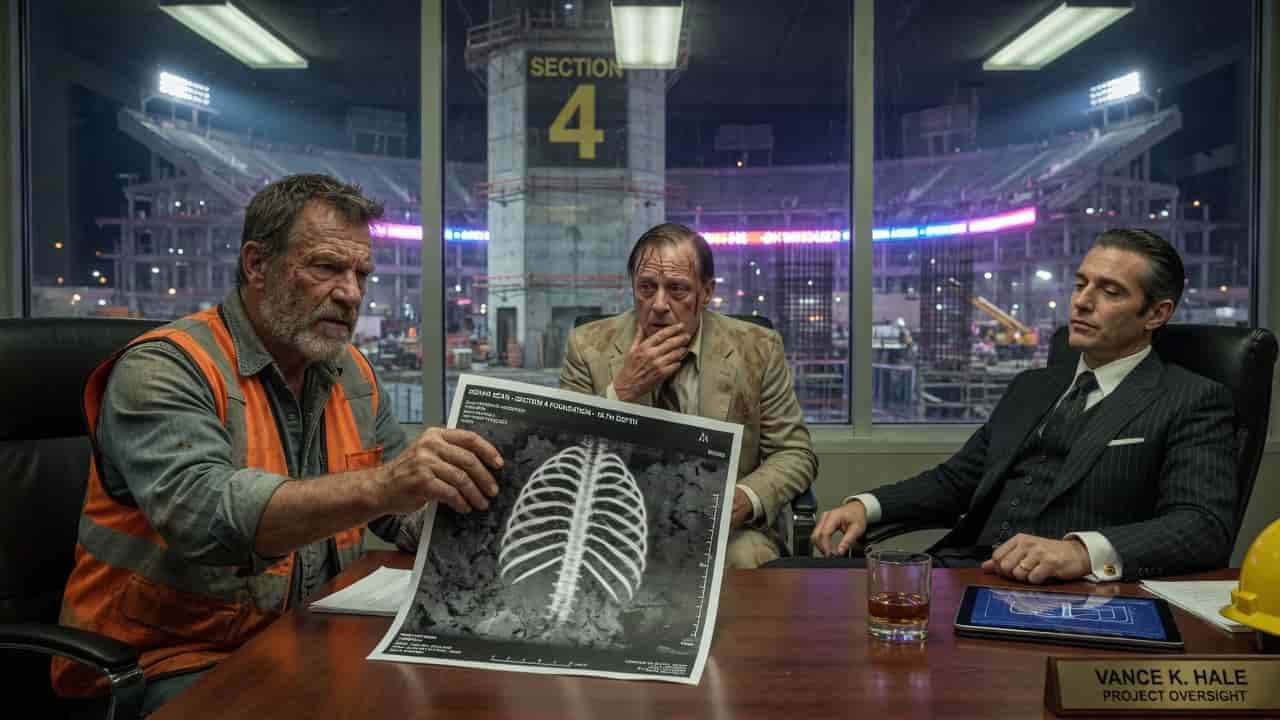
Leo didn’t raise his voice. He didn’t have to. The sonar image on the mahogany desk did all the talking for him. It was a grainy, jagged mess of whites and greys, but anyone with eyes could see the shape of a human ribcage trapped inside the solid concrete of the city’s new landmark.
Vance didn’t even look down. He just leaned back in his Italian suit, a thin, cruel smile playing on his lips as he looked Leo up and down—taking in the grime on his vest and the years of hard labor written in the lines of his face.
“You’ve always had a vivid imagination, Leo,” Vance said, his voice dripping with practiced contempt. “But this? This is pathetic. You’re a foundation man. You should know better than anyone that once the pour is done, the story is over. Go back to your shovel before you lose the only job you have left.”
In the corner, Miller, the site inspector, started to shake. He knew. He had seen the trucks that night three years ago. He had seen Leo’s brother, Danny, disappear into the dark.
Leo leaned in, his shadow falling over the powerful man behind the desk. “Look at the scan, Vance. That’s not a ghost story. That’s my brother. And if you don’t start the drills, I’m going to make this whole stadium sing until the world hears him.”
The room went ice cold. The secret that built a billion-dollar empire was finally coming up for air.
Chapter 1: The Singing Beams
The desert heat didn’t just sit on Las Vegas; it pushed. It was a physical weight, a shimmering, invisible hand that pressed the smell of diesel and hot asphalt deep into your lungs until you forgot what clean air felt like. Leo stood on the edge of the Section 4 mezzanine, his boots caked in a fine, alkaline dust that seemed to have permanent residence in the creases of his skin. Below him, the stadium floor was a chaotic hive of activity—welders throwing sparks like dying stars, heavy machinery groaning as it repositioned steel joists, and the constant, rhythmic thud-thud-thud of the pile drivers that vibrated in Leo’s marrow.
He was fifty-five, but in the midday sun, he felt eighty. His joints were full of glass, a legacy of thirty years spent pouring foundations, setting rebar, and trusting men who didn’t deserve it. He took a sip of lukewarm water from a plastic bottle, the liquid tasting faintly of the sun-baked plastic.
“Leo! The hell are you doing up here? The drainage specs for the south lot are a mess. Miller’s losing his mind.”
Leo didn’t turn. He knew the voice. It was Artie, a foreman who had survived three decades in the trade by knowing exactly when to look away.
“Miller loses his mind when the coffee’s cold, Artie,” Leo said, his voice a low, gravelly rasp. He kept his eyes fixed on Pillar B. It was a massive, cylindrical monolith of reinforced concrete, thirty feet thick at the base, rising like a sacrificial altar into the desert sky. To the tourists who would eventually fill these seats, it was a feat of engineering. To Leo, it was a tomb.
“Leave it be, Leo,” Artie said, stepping up beside him. The younger man’s voice softened, losing its sharp, professional edge. “It’s been three years. The inquiry is closed. Danny… he wandered off-site. The report said he hit the strip, got rolled, and vanished. It happens.”
Leo finally looked at him. His eyes were the color of wet cement, hard and unyielding. “Danny didn’t wander. He didn’t gamble, and he didn’t drink on work nights. He was twenty-four, Artie. He had a girl five months along and a house he was fixing up with his own two hands. You think he just walked into the Mojave because he felt like a hike?”
Artie looked away, his gaze drifting toward the luxury boxes where the brass usually gathered. “I’m just saying. This stadium opens in six weeks. The Infrastructure Board is breathing down everyone’s neck. If you keep poking at Section 4, Vance is gonna pull your card. You’re the best foundation man in the state, but nobody’s irreplaceable.”
“I’m not looking for a replacement,” Leo muttered. “I’m looking for a drill.”
He turned and walked away before Artie could respond, his gait heavy but deliberate. He made his way down the temporary steel stairs, the hollow clang of his footsteps echoing through the cavernous space. As he descended, the wind began to whip through the open steelwork of the upper tiers. It was a strange, haunting sound—a low-frequency hum that seemed to vibrate the very air.
Most of the workers ignored it, calling it the “stadium whistle.” But Leo had spent the last six months subtly adjusting the tension on the secondary support cables and the angle of the decorative louvers. He hadn’t broken any codes—he was too smart for that—but he had tuned the building. When the wind hit thirty knots from the west, the stadium didn’t just whistle. It groaned. It sounded like a collective intake of breath, a long, sustained note of mourning that centered right on Section 4.
He reached the ground floor and headed toward the site trailers, passing a group of younger laborers who were laughing and passing around a phone. They went quiet as he passed. To them, he was a relic, a grim ghost of the old guard who took the job too seriously. They didn’t know about the nights he spent sitting in his truck in the parking lot, watching the security lights reflect off the concrete, listening for a sound that wasn’t there.
Inside the site office, the air conditioning was a violent, humming relief. Miller was there, hunched over a set of blueprints, his face a roadmap of anxiety. Miller was the lead inspector, a man who had once been proud of his integrity until a gambling debt and a visit from a man in a very expensive suit had corrected his posture.
“Leo,” Miller said, not looking up. “The south lot. We need to sign off on the grade.”
“The grade is fine, Miller. The problem is the compaction near the Pillar B footer.”
Miller froze. The blueprint curled slightly under his sweating palms. “We’ve been over this. The seismic tests came back green. The Board approved the pour.”
“I’m not talking about seismic tests,” Leo said, leaning over the table. He could smell the fear on Miller—it was a sour, metallic scent that cut through the smell of ozone from the AC. “I’m talking about the density variance I saw on the last sonar sweep. There’s a pocket, Miller. About ten feet up from the base. Organic material. High moisture retention.”
Miller finally looked up. His eyes were darting toward the door, toward the closed office at the end of the trailer that belonged to Vance. “It’s a wood-block inclusion, Leo. A piece of formwork that got trapped. It happens on big pours. It’s not a structural issue.”
“A wood-block doesn’t have a calcium signature,” Leo said quietly.
Miller’s face went the color of ash. He stood up, his chair scraping harshly against the linoleum. “You need to stop this. Right now. You’re talking about a billion-dollar project. You’re talking about the reputation of the Board. You’re talking about people who don’t like being told they missed something.”
“I’m not saying they missed it,” Leo said, his voice dropping to a whisper that felt louder than a shout. “I’m saying they put it there.”
The door to the inner office swung open. Vance stepped out, looking as though he had been carved from a different reality than the dusty, sweating men in the trailer. His suit was a deep, charcoal grey, perfectly tailored to a body that spent its mornings in a private gym and its afternoons in climate-controlled boardrooms. He held a gold-trimmed pen in one hand, clicking it rhythmically.
“Is there a problem, gentlemen?” Vance asked. His voice was smooth, cultured, the kind of voice that sounded reasonable even when it was ruining your life.
“No problem, Mr. Vance,” Miller stammered, his hands shaking as he rolled up the blueprints. “Just a… a technical disagreement about the south lot.”
Vance’s eyes drifted to Leo. He didn’t look at him like a man looks at an equal. He looked at him like an architect looks at a cracked brick. “Leo. I thought we discussed your focus. You’re supposed to be finalizing the landscaping foundations. Why are you in here bothering Miller with… technical disagreements?”
“I was just telling him about the song the stadium’s been singing,” Leo said, standing his ground.
Vance’s expression didn’t change, but the clicking of the pen stopped. “The wind in the steel, you mean. It’s a known acoustic byproduct of the cantilever design. We’ve already commissioned a firm to look into dampeners.”
“It’s not the steel that’s singing, Vance. It’s the concrete.”
Vance walked closer, entering Leo’s personal space. He smelled of expensive sandalwood and success. “Listen to me very carefully, Leo. You’ve been a loyal employee for a long time. We made sure your brother’s… unfortunate departure… was handled with the utmost sensitivity. We even contributed to the memorial fund for his girlfriend.”
“You bought her a car so she’d stop asking questions,” Leo spat. “And you paid for a private investigator who spent three weeks looking for a gambling debt that didn’t exist.”
Vance’s eyes hardened. “I was being generous. But generosity has its limits. You’re tired, Leo. You’re grieving. It’s clouding your judgment. Why don’t you take a few days? Go home. Clear your head. If you come back and still want to talk about singing concrete, well… then we’ll have to discuss your future with this company.”
“My future is right there in Section 4,” Leo said, his voice steady. “And so is my past.”
Vance stared at him for a long beat, a predatory stillness settling over the room. Then he smiled—a quick, cold flash of teeth. “Take the time, Leo. That’s an order.”
Leo turned and walked out. He didn’t go to his truck. He walked back to the edge of the construction site, where the fence met the raw, red dirt of the desert. He looked up at the stadium, a skeletal giant rising against the setting sun. The wind was picking up.
Hoooooo-uhhhhhh.
The sound was faint at first, then grew, a low, vibrating moan that seemed to come from the very earth. It was a chord in a minor key, a sound of profound, structural loneliness.
Leo reached into his pocket and pulled out a small, encrypted thumb drive. He had spent his life building things that were meant to last forever. He knew exactly how to make them fall apart. He just needed the world to see what was inside the heart of the machine before it came down.
“I hear you, Danny,” he whispered into the wind. “I’m coming for you.”
Chapter 2: The Echo of the Unborn
The apartment smelled of lavender and stale grief. It was a small, two-bedroom unit in a complex that had seen better days, the kind of place where the walls were thin enough to hear your neighbor’s regrets. Leo stood in the doorway, his work boots left in the hall, feeling too large and too dirty for the space.
“Leo? Is that you?”
Sarah came around the corner, her hand instinctively resting on the high curve of her stomach. She was seven months along now, her face pale and drawn, the youthful brightness she’d had when she was with Danny replaced by a weary, haunting vigilance. She looked like she was constantly listening for a footstep that would never come.
“I brought some groceries,” Leo said, lifting the heavy paper bags. “And some prenatal vitamins. The good ones, from the pharmacy over on 4th.”
Sarah smiled, but it didn’t reach her eyes. “You do too much, Leo. You should be resting. You look like you haven’t slept since the foundation pour.”
“I’m fine,” Leo said, moving into the kitchen to put the milk away. He moved with a practiced, heavy efficiency, avoiding the framed photo of Danny on the mantel. In the photo, Danny was grinning, his arm around Sarah, his face smudged with the same Vegas dust that currently lined Leo’s lungs. He looked so much like their father it made Leo’s chest ache.
“They’re calling it the ‘Vegas Crown’ now,” Sarah said, leaning against the counter. “The stadium. I saw the commercial on the news. They’re doing the grand opening in a month. Big gala, the Governor, some country star.”
Leo’s jaw tightened. “They can call it whatever they want. It’s still a heap of stolen tax money and bad intentions.”
Sarah watched him for a moment, her eyes searching his face. “You went back there today. To Section 4.”
It wasn’t a question. Leo stopped with a carton of eggs in his hand. “I had to check the compaction specs.”
“Leo, stop,” Sarah said, her voice trembling. “Every time you go near that pillar, you come back looking like you’ve been buried alive yourself. The police said he’s gone. The Board said he’s gone. Even the union stopped taking my calls. Why can’t you just… why can’t we just focus on the baby? Danny would want you to be a grandfather, not a martyr.”
Leo turned, his eyes burning. “Grandfathers tell stories, Sarah. What am I supposed to tell this kid? That his father was a flake who walked out on him? That he’s buried in a shallow grave in the desert because he couldn’t handle the pressure? Because that’s the story Vance is telling. That’s the story that’s going to be written in the history of this city.”
“I don’t care about the history!” Sarah cried, her voice cracking. “I care about the man I lost! And I care about the only person I have left who remembers him! If you keep pushing Vance, something is going to happen to you. You think I don’t see the black SUVs parked down the street? You think I don’t hear the hang-up calls?”
Leo froze. “Black SUVs? When?”
“Yesterday. This morning. They just sit there. Watching.” Sarah’s eyes filled with tears. “Please, Leo. Just let it go. We can move. We can take the money Vance gave us and go to Arizona. Start over.”
“That money is blood, Sarah. I haven’t touched a cent of it, and neither should you.”
He walked over to her, his large, rough hand hovering near her shoulder before he finally let it land, a rare moment of physical tenderness. “I’m not doing this for revenge. Well, maybe a little. But I’m doing it because of the way the building sounds. It’s wrong. The math doesn’t add up. There’s a void in that pillar, Sarah. A void exactly the size of a man.”
He left her then, the weight of her fear adding to the leaden pressure in his chest. He drove his battered F-150 across the valley, away from the neon lights of the Strip, toward a small, nondescript industrial park on the edge of Henderson.
He stopped in front of a unit with a faded sign that read Deep Earth Imaging. Inside, the air was cool and smelled of solder and ozone. Marcus, a man in his late twenties with thick glasses and a nervous habit of tapping his pen against his teeth, was waiting for him.
“You’re late, Leo,” Marcus said, gesturing toward a computer monitor. “And you’re asking for something that could get me blacklisted from every municipal contract in the state.”
“I’m paying you enough to retire to a boat in Mexico, Marcus. Just tell me you got the resolution I asked for.”
Marcus sighed and hit a key. A series of images appeared on the screen—cross-sections of concrete, rendered in high-contrast greys and whites. “I used the drone-mounted ground-penetrating radar like you asked. Flew it in during the shift change when the sensors were down for calibration. The interference from the rebar is a nightmare, but I ran it through a new filtering algorithm.”
He zoomed in on a specific section. “This is Pillar B, ten feet above the footer. See this?”
He pointed to a shape. It was blurred, distorted by the density of the surrounding material, but the geometry was unmistakable. It wasn’t a wood block. It was a series of small, curved lines—a ribcage. And below it, the long, straight line of a femur.
Leo’s breath hitched. He felt a cold, sharp spike of triumph, followed immediately by a wave of nauseating grief. There he was. Danny. Trapped in the dark, held upright by the weight of a billion dollars.
“It’s a calcium-dense inclusion with a hollow core,” Marcus said, his voice dropping. “It’s… it’s a person, Leo. I’ve done enough forensic surveys to know. There’s no air pocket, which means the pour was fast. They didn’t even give him time to…”
“I know how they did it,” Leo whispered. “They used the high-speed pump. Three hundred cubic yards an hour. He wouldn’t have even been able to scream.”
“What are you going to do?” Marcus asked, looking at Leo with a mix of awe and terror. “If you take this to the cops, Vance will have it suppressed before you reach the precinct. He owns the DA. He owns the Board.”
“I’m not going to the cops,” Leo said, his hand closing into a fist. “I’m going to the opening night. I’m going to wait until the Governor is standing on that podium, until the cameras are rolling and the whole world is looking at Section 4. And then I’m going to make that stadium tell the truth.”
“The ‘singing’ beams,” Marcus realized, his eyes widening. “You didn’t just tune them for sound. You tuned them for resonance.”
“If I hit the right frequency with the wind-load dampeners locked open, that pillar will vibrate like a tuning fork,” Leo said. “The hairline fractures are already there. I’ve seen them in the infrared scans. The concrete is cured, but it’s stressed. It wants to break.”
“You’ll kill people, Leo,” Marcus whispered. “The whole section could come down.”
“No,” Leo said, his voice hard as the material he’d spent his life shaping. “I’ve calculated the load-bearing shift. The mezzanine will hold. But the facade? The beautiful, expensive skin Vance put over his crimes? That will peel right off. It’ll leave Danny standing there for everyone to see. A monument to what it costs to build a legacy in this town.”
He took the thumb drive from Marcus, the plastic feeling heavy in his palm. As he walked out into the desert night, the wind began to pick up again, blowing in from the flats. He could hear it in the distance—the low, mournful hum of the stadium, calling out from the dark. It was a hungry sound, the sound of a debt that was finally coming due.
Chapter 3: The Public Shaming
The weekly site meeting was held in the “War Room,” a double-wide trailer outfitted with high-end monitors and a conference table that cost more than Leo’s truck. Usually, Leo sat at the back, a silent observer of the logistical ballet that kept the project moving. But today, the room was packed with the elite—Board members, lead architects, and a handful of investors who looked like they’d never stepped foot on a job site in their lives.
At the head of the table sat Vance, looking every bit the visionary. Beside him was Miller, looking like he wanted to crawl into a hole and pull the dirt in after him.
“We are six weeks out,” Vance announced, his voice carrying an effortless authority. “The Crown is nearly complete. This is no longer a construction site. It is a stage. Every detail must be perfect. Which brings me to the foundation report.”
He paused, his eyes scanning the room until they landed on Leo. A small, cruel smile touched the corner of his mouth.
“Leo, stand up, would you? I want everyone to see the man who’s been so concerned about our structural integrity.”
The room went quiet. Heads turned. Leo felt the heat rise in his neck, but he stood, his back straight, his calloused hands resting on the back of his chair.
“Leo here has a theory,” Vance said, his tone conversational, as if he were discussing a quaint local legend. “He believes that Pillar B is… haunted. He’s been telling the men that the stadium is ‘singing’ because of some mysterious void in the concrete. He’s even suggested—quite publicly, I might add—that the Board has been negligent in its safety protocols.”
A murmur of laughter rippled through the room. One of the investors, a man in a silk polo shirt, smirked. “A haunted stadium? Is that the new union tactic, Leo? Ghost pay?”
Leo didn’t blink. “It’s not a theory, Vance. It’s physics. The density variance in Pillar B is ten times the allowable limit for a primary load-bearing member. You’ve seen the scans. You’ve seen the infrared.”
Vance sighed, a sound of weary disappointment. “I have seen the scans, Leo. And so has Miller. Miller, tell the group what you found when you re-inspected the pillar after Leo’s… outburst.”
Miller stood up, his voice cracking. He didn’t look at Leo. “We… we conducted a full ultrasonic sweep. The results were within normal parameters. The ‘void’ Leo is referring to was a minor air pocket caused by a temporary pump failure. It was remediated with high-pressure grout. There is no structural risk.”
“You’re lying, Miller,” Leo said, his voice low and dangerous. “You were there that night. You saw the pour. You saw the truck that wasn’t on the manifest.”
“That’s enough!” Vance snapped, the mask of civility slipping for a fraction of a second. “You’re out of line, Leo. You’re a laborer. You pour the concrete where we tell you to pour it. You don’t get to question the engineers, and you certainly don’t get to spread paranoid delusions to my crew.”
Vance walked around the table, stopping just inches from Leo. The power imbalance was palpable—the man who owned the city versus the man who built it.
“You’re a broken man, Leo,” Vance said, his voice dropping so only those nearby could hear. “You couldn’t protect your brother, so now you’re trying to blame the world for his failures. Danny was a drunk and a drifter. He walked off this site because he was scared of the work. He’s probably face-down in a ditch in Reno by now, and honestly? It’s the best thing that ever happened to that girl of his. She deserves better than a ghost.”
The room was silent. Leo’s hand twitched toward Vance’s throat, but he held back. He could feel the eyes of the other foremen on him—men he’d worked with for years, men who knew the truth but were too afraid to say it. They looked away, their silence a heavy, suffocating weight.
“You’re fired, Leo,” Vance said loudly, making sure the whole room heard. “Effective immediately. Security will escort you to your truck. If you ever set foot on this property again, I’ll have you arrested for trespassing and industrial sabotage.”
“I don’t need an escort,” Leo said, his voice trembling with a different kind of energy now. He looked at Miller, who was staring at his shoes. “You think you can bury it, Vance. You think you can just pour enough money over the truth to make it go away. But concrete has a memory. And so do I.”
As the security guards moved in, grabbing Leo by the arms, he didn’t struggle. He let them lead him out through the “War Room,” past the laughing investors and the silent, shamed foremen. He was led through the dust and the noise, out to the perimeter fence where his old truck sat like a stubborn animal.
One of the guards, a kid Leo had seen on the night shift, leaned in as he opened the gate. “Sorry, Leo. Orders are orders.”
“Just do me a favor, kid,” Leo said, looking up at the stadium. “When the grand opening starts? Stay away from Section 4. It’s going to be a loud night.”
Leo drove away, but he didn’t go home. He went to a small storage unit he’d rented under a fake name. Inside were the tools he’d been gathering for months—high-tensile wire, industrial-grade actuators, and a remote-frequency transmitter he’d salvaged from a demolition site.
He spent the next twelve hours working with a feverish precision. He wasn’t building a foundation anymore. He was building a detonator. Not one made of C4 or dynamite, but one made of vibration and truth.
He knew the security patrols. He knew the blind spots in the cameras where the shadows of the support beams fell. He knew exactly how to get into the maintenance tunnels that ran beneath the stadium floor.
As the sun began to rise over the desert, Leo sat on the floor of the storage unit, his hands covered in grease and his heart beating with a cold, steady rhythm. He thought about Danny. He thought about the way Danny used to whistle when he was working—a bright, cheerful sound that always seemed to cut through the noise of the job.
The stadium wouldn’t be whistling much longer. It would be screaming. And when it was over, everyone would finally know what Leo had known for three years.
He wasn’t just a foundation man. He was the man who was going to bring the whole rotten house down.
Chapter 4: The Final Scan
The night before the grand opening, the Vegas Crown was a spectacle of light. Thousands of LEDs traced the curve of the roof, and the giant video screens on the facade were testing loops of soaring eagles and waving flags. It looked like a temple to American ambition, a shimmering jewel in the middle of the dark desert floor.
Leo sat in his truck a mile away, watching through a pair of high-powered binoculars. He could see the caterers setting up the VIP tents, the security teams swept the perimeter, and the technicians making final adjustments to the sound system.
His phone buzzed. It was Sarah. He didn’t answer. He couldn’t. Not now. He had already left a letter for her in his lawyer’s safe, along with a copy of Marcus’s sonar scans. If he didn’t make it out tonight, the truth would still find its way into the light. But he wanted to be there when it happened. He wanted to see Vance’s face.
He checked his gear one last time. He was wearing a dark jumpsuit and a tool belt. In his pocket was the remote. In his heart was a void that only justice could fill.
He made his move at 2:00 AM. He entered through the drainage culvert on the north side, a route he’d mapped out during the early stages of the project. The water was cold and smelled of sulfur, but he pushed through, his boots splashing softly in the dark.
He reached the maintenance access for Section 4 and climbed the ladder, his muscles screaming with the effort. He was inside the “singing” beams now, the massive steel joists that supported the mezzanine. He had already installed the actuators weeks ago, hidden inside the acoustic dampener housings. All he had to do was unlock the safety pins and sync the frequency.
He worked in the dark, using only a small red light to guide his hands. He could feel the stadium around him—the massive, silent weight of it. It felt alive, a beast waiting to be awakened.
“Who’s there?”
The voice was sharp, echoing through the steelwork. Leo froze, his hand on the final actuator. He saw the beam of a flashlight cutting through the dark below him.
“Security! Come down with your hands up!”
Leo didn’t move. He recognized the voice. It was the young guard from the gate.
“It’s me, kid,” Leo called out, his voice echoing. “It’s Leo.”
The flashlight beam wavered, then settled on him. “Leo? The hell are you doing? I told you to stay away. If they catch you here, they won’t just arrest you. Vance has guys, Leo. Serious guys.”
“I know,” Leo said, descending the ladder slowly. He stepped into the light, looking at the young man. “But I can’t let them open this place. Not like this.”
“The Board says it’s safe,” the kid said, his voice trembling. “They signed off on everything.”
“The Board lied,” Leo said, walking toward him. “Look at this.”
He pulled out a portable tablet and swiped to the sonar image. “This is what’s inside Pillar B. Right behind that pretty marble facade. That’s my brother, Danny. He was murdered because he found out about the substandard steel they were using in the roof. They threw him in the pour to hide the evidence.”
The guard looked at the screen, his face turning pale. “Oh, god. Is that… is that real?”
“It’s as real as the concrete under your feet,” Leo said. “I’m not here to hurt anyone. I’m here to show the world. When the wind hits the resonance frequency tomorrow, the facade on this pillar is going to crack. It’s going to expose the crime. I just need you to look the other way for five minutes.”
The kid looked at the screen, then at Leo, then at the dark expanse of the stadium. He was young, barely older than Danny had been. He hadn’t been bought yet. He hadn’t learned how to look away.
“Go,” the kid whispered, turning off his flashlight. “I’m going to do a sweep of the south lot. It’ll take me twenty minutes.”
“Thanks, kid,” Leo said.
He finished the work in record time, his hands moving with a fluid, desperate grace. The actuators were synced. The frequency was locked. The stadium was ready to speak.
As he climbed back down into the culvert, he looked up one last time. The stadium was silent now, but he could feel the tension in the steel. It was a coiled spring, a secret waiting to explode.
He drove back to his storage unit and waited. He watched the sun rise over the mountains, a long, bloody streak of red. Today was the day. The Vegas Crown would be inaugurated. The Governor would speak. The cameras would flash.
And Leo would be there, sitting in the crowd he had helped build, waiting for the wind to blow.
He checked the weather report. A front was moving in from the west. Thirty-five knot gusts expected by mid-afternoon. Perfect.
He spent the morning cleaning himself up, putting on a clean shirt and a pair of slacks. He looked like any other retired worker coming to see the fruits of his labor. He tucked the remote into his inner pocket, the plastic warm against his chest.
As he walked toward the stadium entrance, he saw Vance. The man was standing on the red carpet, surrounded by reporters, looking like a king. He looked happy. He looked safe.
Leo smiled, a hard, cold expression that didn’t reach his eyes.
“Enjoy the view, Vance,” he whispered. “It’s about to change.”
He passed through the security checkpoint, his pulse steady. He was just another face in the crowd, another brick in the wall. But he was the one who knew where the crack was. And he was the one who was going to make it break.
He found his seat in Section 4, directly across from Pillar B. He sat down and waited. The stadium was filling up, the air humming with excitement and the smell of expensive perfume and popcorn.
Then, the wind began to pick up. A low, mournful whistle started to echo through the tiers.
Leo reached into his pocket and gripped the remote.
“It’s time, Danny,” he whispered. “Let’s tell them the truth.”
Chapter 5: The Resonance of Truth
The air inside the Vegas Crown was a pressurized mix of expensive cologne, ozone from the massive HVAC systems, and the frantic, electric hum of ten thousand people waiting to be told they were part of history. From his seat in Row 12, Section 4, Leo felt the vibration long before it became audible. It wasn’t a sound yet; it was a rhythmic pulse against the soles of his boots, a heartbeat traveling up through the reinforced concrete tiers.
On the floor of the stadium, a massive stage had been erected. It was a masterpiece of temporary architecture, draped in blue velvet and lit by spotlights that made the Governor’s hair look like spun silver. Vance stood just behind him, a shadow in a charcoal suit, his arms crossed, his posture radiating the smug satisfaction of a man who had successfully paved over his sins.
“Today,” the Governor’s voice boomed through the state-of-the-art line-array speakers, “we don’t just open a stadium. We open a gateway to the future of Nevada. A monument to what can be achieved when vision meets grit.”
Leo gripped the small plastic remote in his jacket pocket. His thumb traced the edge of the toggle switch. Grit. He knew all about grit. It was the stuff that lived under your fingernails for twenty years. It was the stuff they mixed into the concrete to make it hold. And it was the stuff Vance had used to choke the life out of a twenty-four-year-old kid who just wanted to do an honest day’s work.
Hoooooo-uhhhhhh.
The sound started low—a bass note so deep it felt like it was coming from the center of the earth. In the rows around Leo, people began to shift. A woman in a sequined dress frowned, touching her ear. A man in a suit leaned over to his wife, whispering something about the sound system.
Leo watched the stage. He saw Vance’s head tilt. The billionaire looked toward the ceiling, then toward the massive support pillars. He knew that sound. It was the “whistle” they had joked about in the trailers. But today, the whistle had a jagged edge.
Leo clicked the first toggle.
In the maintenance tunnels beneath the stadium, the first set of industrial actuators hummed to life. They were small machines, no bigger than a lunchbox, but they were positioned at the precise harmonic nodes of the Section 4 cantilever beams. They began to pulse in sync with the wind that was currently howling at thirty-eight knots against the stadium’s western skin.
The moan grew louder. It wasn’t a whistle anymore. It was a sustained, vibrating roar that seemed to bypass the ears and go straight to the chest cavity. It was the sound of a cello string being bowed by a giant.
“As we look around this magnificent structure—” the Governor continued, but his voice was wavering now. He glanced at the sound engineers in the pit, making a frantic ‘turn it down’ gesture.
The engineers were scrambling, sliding faders and checking connections, but they were fighting a ghost. The sound wasn’t coming from the speakers. It was coming from the bones of the building.
“Leo.”
A hand landed on Leo’s shoulder. He didn’t jump. He turned slowly and saw Miller. The inspector looked like he hadn’t slept in a week. His tie was crooked, and his eyes were bloodshot, darting around the vibrating arena with a look of pure, unadulterated terror.
“Leo, turn it off,” Miller hissed, sliding into the empty seat beside him. “I saw you on the monitors. I knew it was you. If you don’t stop this, the whole mezzanine will shake apart. There are kids in here, Leo.”
“The math holds, Miller,” Leo said, his voice calm, almost conversational, despite the deafening hum that was now making the glass railings in the VIP boxes rattle in their frames. “I did the load-bearing stress tests myself. The skin will peel, but the bones will stay. I’m just giving the building a chance to shed its lies.”
“Vance will kill you,” Miller whispered, his voice cracking. “He’s already sent security to the maintenance hatch. They’re going to find your rigs.”
“Let them,” Leo said, clicking the second toggle. “The actuators are welded to the primary joists. By the time they get a torch through the secondary casing, the resonance will be at peak. You can’t stop physics once it hits the tipping point.”
A sudden, sharp crack echoed through the stadium, louder than the Governor’s microphone. It sounded like a gunshot. A line of white dust puffed out from the top of Pillar B, right where the decorative marble facade met the structural concrete.
The crowd gasped. The Governor stopped speaking. The music that had been playing softly in the background cut out, replaced by a terrifying, organic groaning of steel.
Vance stepped forward to the edge of the stage, his eyes locked on Section 4. He searched the crowd, his gaze scanning the rows until it landed directly on Leo. For a long, frozen second, the two men locked eyes. Vance’s face wasn’t smug anymore. It was a mask of cold, predatory fury. He pulled a radio from his pocket and spoke into it, his lips moving fast.
“You’re not just exposing him, Leo,” Miller said, watching the facade of the pillar begin to spiderweb with cracks. “You’re ruining all of us. I have a family. I have a pension.”
“You had a soul once, too, Miller,” Leo said, looking back at the pillar. “But you traded it for a quiet life. Danny didn’t get that choice. He got three hundred cubic yards of wet mix and a forgotten grave.”
The vibration was so intense now that people were standing up, panicking. The ‘Vegas Crown’ was no longer a jewel; it was a trap. The sound had shifted into a high-pitched, metallic shriek—the sound of the wind being forced through the microscopic gaps in the shifting masonry.
“Ladies and gentlemen, please remain calm!” the Governor shouted, his voice cracking through the PA. “We are experiencing a minor harmonic imbalance due to the high winds. Our engineers are—”
CRA-A-ACK.
A slab of marble the size of a car door tore away from Pillar B, shattering on the empty concrete walkway below. The dust cloud rose like white smoke. Behind the marble, the raw, grey concrete was exposed—and right in the center of the pillar, ten feet up from the base, a dark, jagged void was beginning to appear.
Leo stood up. He felt a strange, lightheaded clarity. The weight he’d been carrying for three years—the shame of not being there, the guilt of being the one who lived—it was all pouring into the remote in his hand.
“Look at it, Miller!” Leo shouted over the roar of the building. “Look at the density variance! See the air pocket? See the inclusion?”
Vance was moving now, jumping off the stage and pushing through the crowd toward Section 4, followed by four men in heavy tactical gear. They weren’t stadium security; they were the “serious guys” the guard had warned him about.
The crowd was a sea of chaos, people trampling over seats to get to the exits, but Leo didn’t move. He stood in Row 12 like a lighthouse in a storm. He clicked the final toggle—the one that locked the actuators into a sustained, destructive loop.
The roar reached a crescendo that was almost unbearable. The very air seemed to shimmer. And then, with a sound like a giant tree snapping in half, the entire front face of Pillar B’s facade sloughed off.
It didn’t fall all at once. It peeled away in a slow-motion cascade of stone and mortar. As the dust cleared, the high-powered stadium floodlights hit the exposed concrete.
The room went silent. The resonance died down as the actuators reached their programmed limit and shut off, leaving only the sound of ten thousand people catching their breath at once.
There, embedded in the heart of the pillar, was the unmistakable silhouette. The concrete had been poured too fast to fill the cavity perfectly, leaving a skeletal impression behind. A ribcage. A skull tilted back as if in a final, silent scream. A hand, reaching upward, its finger bones entwined with the rusted rebar that was supposed to provide strength to the building.
It was Danny. He wasn’t a ghost story anymore. He was a fact.
Vance stopped ten feet away from Leo, his chest heaving, his expensive suit covered in white marble dust. He looked at the pillar, then at the giant video screens that were still broadcasting the live feed of the ceremony—now zoomed in on the grisly remains in Section 4.
The cameras had stayed on. The whole city was watching.
“You’ve killed it,” Vance whispered, his voice trembling with a rage so deep it sounded like grief. “The project. The Board. Everything. You destroyed a billion dollars for a pile of old bones.”
“They aren’t bones, Vance,” Leo said, stepping out into the aisle, his hands held out at his sides. “That’s my brother. And he’s finally finished with his shift.”
The tactical team closed in, but they hesitated. The crowd was watching. The cameras were rolling. And behind them, Miller had finally stood up, his face wet with tears.
“It’s true,” Miller shouted, his voice echoing in the sudden, heavy silence. “The manifests were faked! I signed the reports because Vance told me he’d bury me next if I didn’t! The whole foundation is a crime scene!”
Leo looked at Vance. The billionaire looked small now, dwarfed by the skeletal witness he had tried to hide. The residue of the moment settled over them like the falling dust—thick, suffocating, and impossible to wash off.
Leo felt the cold steel of handcuffs click around his wrists as the security team finally moved in, but he didn’t care. He looked up at Pillar B, at the quiet, grey shape of his brother.
“We’re going home, Danny,” he whispered. “The pour is over.”
Chapter 6: Concrete Justice
The interrogation room at the Clark County Detention Center smelled of floor wax and cold coffee. It was a stark, windowless box that felt more honest than any room Leo had been in for years. He sat with his hands cuffed to the table, watching the digital clock on the wall. It had been six hours since the “Vegas Crown” had been evacuated.
The door opened, and a woman in a sharp navy blazer walked in. She wasn’t a cop. She was an Assistant District Attorney named Elena Vance—no relation to the billionaire, a fact she had made very clear during her first three minutes in the room.
“You’ve caused quite a stir, Leo,” she said, sitting across from him and opening a thick folder. “The FAA had to ground flights at McCarran because of the crowd control issues. The Governor is under heavy sedation. And the structural engineers are saying the stadium might have to be condemned because of the harmonic damage you did to the secondary supports.”
“The supports are fine,” Leo said, his voice flat. “The resonance was localized. I spent four months on the math. The building is sound. It’s the people who built it that are the problem.”
Elena looked at him for a long time. She didn’t look like she wanted to throw the book at him. She looked like someone who had been waiting for a reason to tear the cover off the book entirely.
“Miller talked,” she said quietly. “He spent three hours in a room with two of my best investigators. He gave us the names of the drivers, the disposal site for the original steel, and the encrypted accounts Vance used to pay off the labor board. We’ve already frozen Vance’s assets. He was picked up trying to board a private jet to Cabo an hour ago.”
Leo felt a slow, cold wave of relief wash over him. It wasn’t the fiery explosion of vengeance he’d imagined; it was just the feeling of a heavy weight finally being set down.
“What about Danny?” he asked.
“The recovery team is at the stadium now,” Elena said. “They’re using precision hydro-demolition to extract the remains without further damaging the site. We’re treating it as a homicide investigation. You’ll be charged with industrial sabotage and reckless endangerment, but given the circumstances… and the evidence you’ve provided… my office is prepared to discuss a very favorable plea.”
“I don’t care about the plea,” Leo said. “I just want him out of there.”
He was released on bail two days later. The world outside the jail was different. The story had gone viral—not as a “terrorist” attack, but as a modern-day Greek tragedy. The image of the “Singing Tomb” was on every news cycle.
When Leo pulled his truck up to Sarah’s apartment, she was waiting on the curb. She didn’t say anything; she just walked over and hugged him, her head resting on his shoulder. She was shaking, but for the first time in three years, it wasn’t the shaking of fear.
“They found his ring,” she whispered into his shirt. “The one with the little chip in the band. It was still there, Leo. In the concrete.”
The legal battle that followed lasted eighteen months. It was a long, grinding process of depositions, hearings, and forensic audits. Vance’s lawyers tried every trick in the book—blaming Leo for the death, claiming Danny had been an accomplice in a theft gone wrong, trying to paint the entire exposure as a disgruntled worker’s fantasy.
But the concrete didn’t lie.
The forensic team found the substandard steel in the roof joists, just like Leo had suspected. They found the receipts for the high-speed pump rental that had no business being on-site that night. And they found the evidence of the blunt force trauma to Danny’s skull that occurred before the pour.
Vance was sentenced to forty years without the possibility of parole. Miller got ten, a sentence he accepted with a strange, hollow kind of gratitude.
The Vegas Crown never opened. The city couldn’t find an insurer willing to touch it, and the public sentiment was too toxic. It stood as a grey, skeletal monument on the edge of the Strip for two years before the city finally voted to demolish it.
Leo stood in the desert on the day of the demolition. He was sixty now, his hair completely white, his hands finally free of the Vegas dust. He stood with Sarah and a small, three-year-old boy named Daniel, who had his father’s eyes and a habit of whistling when he played with his toy trucks.
“Is the big house going to go boom, Grandpa?” the boy asked, clutching Leo’s hand.
“No, Danny,” Leo said, looking at the stadium. “It’s just going to go to sleep.”
The demolition wasn’t a spectacle. There were no fireworks, no cheering crowds. Just a series of muffled thuds as the shaped charges cut through the support columns. The building didn’t fall all at once; it seemed to sigh, the massive mezzanine tiers folding inward like a deck of cards.
As the dust cloud rose into the desert air, the wind picked up. For a brief, flickering second, Leo heard it—the low, mournful hum of the singing beams. But this time, it didn’t sound like a scream. It sounded like a release.
They had buried Danny properly six months earlier, in a quiet cemetery in Henderson, under a headstone of solid, polished granite. No concrete. Just stone and sun.
Leo turned away from the ruins of the stadium and walked back to his truck. He felt the residue of the last three years—the aches in his bones, the memories of the dark tunnels, the weight of the remote in his hand. It would never truly go away. You don’t build something like that and walk away clean.
But as he strapped his grandson into the car seat, he looked at his hands. They were scarred, rough, and permanently marked by the trade. But they were steady.
“Where are we going, Grandpa?” the boy asked.
“Home, Danny,” Leo said, starting the engine. “We’re going home.”
He drove away, leaving the dust of the Vegas Crown behind him. The desert was quiet now. The wind still blew, but the stadium was gone, and for the first time in a long time, the silence didn’t feel like a lie. It felt like justice. Grounded, heavy, and final.