“You’re a clever little ghost, Arthur. But you’re still just the help.”
Senator Sterling leaned in so close I could smell the expensive scotch and the rot of his own ego. He thought he’d won. He thought he’d finally forced me to authenticate the masterpiece that cost me everything ten years ago.
The room was full of the world’s wealthiest collectors, all of them watching us, waiting for me to give the nod that would make Sterling a legend. He looked down at me like I was a broken tool, something he could just discard once the gavel fell.
“Look closer, Senator,” I said, my voice as flat as the canvas. “Look at what you really bought.”
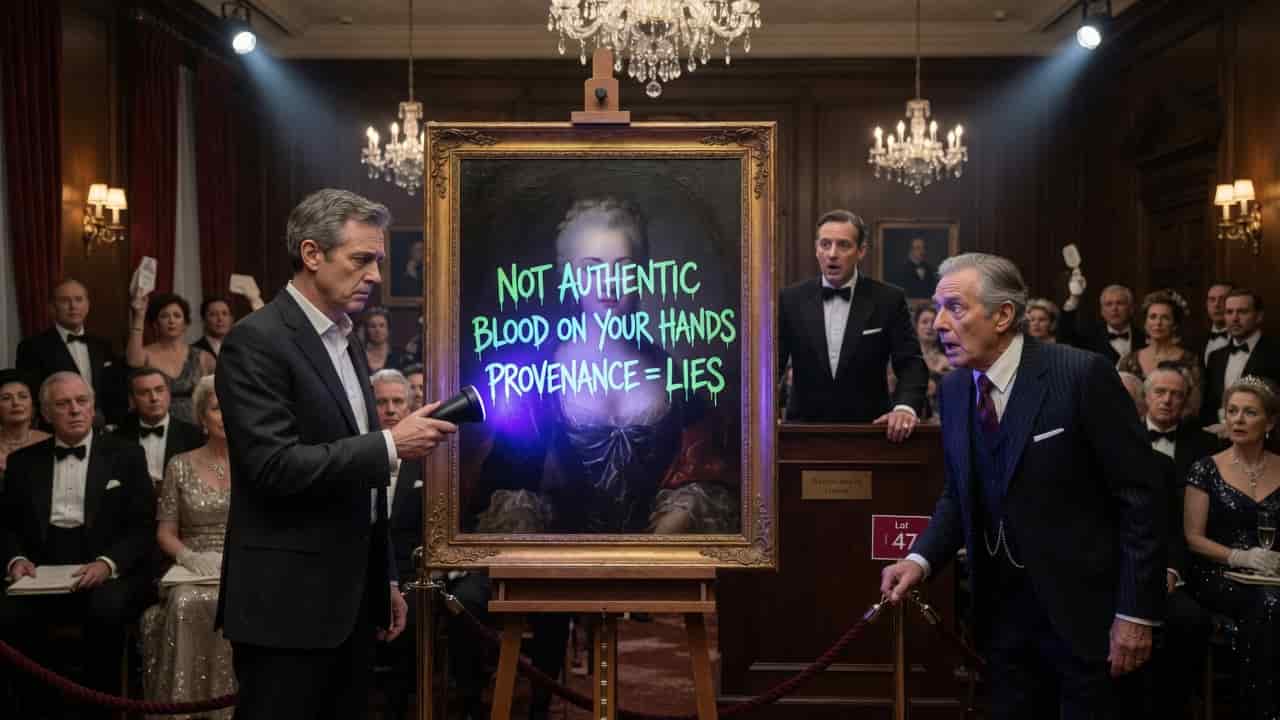
When I clicked the UV light on, the gasps from the front row hit like a physical wave. The hidden layer I’d spent months perfecting didn’t show a signature. It showed the truth he’d spent a decade trying to bury.
Sterling’s face went the color of ash. He tried to grab the lamp, tried to block the view of the cameras, but it was too late. The whole room saw it. The whole world saw the secret he thought went away the night my life ended.
He looked at me, his hands shaking, and realized for the first time that you can’t buy a man who has nothing left to lose.
Chapter 1: The Workshop of Ghosts
The air in the Brooklyn studio always smelled the same: a sharp, medicinal bite of turpentine, the heavy musk of linseed oil, and the dry, ancient scent of rabbit-skin glue. It was a smell that lived in Arthur’s pores. Even after a long shower, when he sat in the small, cramped living room of their apartment in Queens, he could still taste the chemicals on the back of his throat.
It was five in the morning. The blue-grey light of a New York winter was just starting to bleed through the high, grimy windows of the warehouse. Arthur stood before the easel, his back aching with a dull, familiar thrum. He was forty-eight, but in this light, with the fine lines of fatigue etched around his eyes, he looked sixty.
On the easel sat a landscape from the Hudson River School—or at least, it looked like one. It was a study in light and shadow, a winding river cutting through a valley of gold and russet trees. To anyone else, it was a beautiful piece of nineteenth-century Americana. To Arthur, it was a puzzle. He was currently removing a century of nicotine and fireplace soot with a cotton swab and a solvent he’d mixed himself.
“Dad?”
The voice was soft, barely more than a breath. Arthur didn’t turn immediately. He finished the stroke he was on, his hand rock-steady despite the lack of sleep. He capped the solvent jar and wiped his hands on a rag that was more stain than fabric.
He turned to see Sophie in the doorway. She was sixteen, though she looked younger, her frame thin and fragile in the oversized sweatshirt she wore. She sat in the motorized wheelchair, her hands resting pale and still in her lap. The chair hummed as she moved further into the room, the sound a constant reminder of the night the motor of their old life had stalled forever.
“You’re up early,” Arthur said. He walked over and squeezed her shoulder. Her skin felt like parchment—cool and thin.
“The heater was clicking again,” she said. She looked at the painting. “Is that the one for the museum?”
“No,” Arthur said. “This one is private. A collector in Connecticut. It’s a mess, Soph. Someone tried to ‘restore’ it in the fifties with house paint and good intentions. It’s going to take me a month just to find the original sky.”
Sophie smiled, a small, tired thing. “You’ll find it. You always find what’s buried.”
Arthur felt a sharp, familiar jab of guilt in his chest. He turned back to the painting so she wouldn’t see it. Finding what was buried was exactly the problem. Ten years ago, he’d been more than an appraiser and a restorer. He’d been the man the elite called when they wanted a masterpiece to appear out of thin air. He wasn’t just a forger; he was a ghost. He didn’t just copy brushstrokes; he inhabited the souls of the dead.
And then he’d said no.
Senator Sterling had wanted a provenance that didn’t exist for a painting that shouldn’t have been for sale. Arthur had refused to sign the papers. Two weeks later, a “robbery gone wrong” had left his wife, Elena, in a cemetery in New Jersey and Sophie paralyzed from the waist down. The police called it a tragedy. Arthur called it a message.
He’d spent the last decade hiding in the shadows of the art world, doing the grunt work—the cleaning, the appraisals for minor houses, the slow, painstaking repair of other people’s memories. He was a ghost now for real.
The buzzer at the street level rang.
Arthur froze. No one came to the studio at 5:15 AM.
“Stay here,” he told Sophie. He walked to the intercom, his heart kicking against his ribs. “Yeah?”
“Arthur Vance?” The voice was polished, mid-Atlantic, and utterly devoid of warmth. “I have a delivery for you. From the Sterling Foundation.”
Arthur felt the blood drain from his face. He looked at Sophie. She was watching him, her eyes wide. She didn’t know the name, but she knew the look on his face. She’d seen it ten years ago.
“Leave it at the door,” Arthur said.
“I’m afraid I need a signature, Mr. Vance. It’s a matter of some urgency.”
Arthur walked to the window and looked down. A black SUV sat idling on the curb, its exhaust pluming in the cold air. A man in a dark overcoat stood by the door, holding a thick, cream-colored envelope. He looked up, and for a second, Arthur felt the weight of a decade of fear crashing down on him.
“Go to the back room, Soph,” he said, his voice tight. “Close the door.”
“Dad, who is it?”
“Just go. Please.”
He watched her wheel away, the hum of the chair sounding louder than usual in the silence of the studio. Once she was gone, Arthur went down the stairs. The cold hit him like a physical blow as he opened the heavy metal door.
The man in the overcoat didn’t smile. He handed Arthur the envelope. It was heavy, the paper expensive enough to feed a family for a week.
“The Senator is hosting a gala on Friday,” the man said. “He’s acquired something special. A masterpiece everyone thought was lost. He wants the best eye in the business to verify the find before the auction.”
“I don’t work for Sterling,” Arthur said, his voice rasping.
“You do now,” the man said softly. He reached into his pocket and pulled out a small, grainy photograph. He handed it to Arthur.
It was a photo of Sophie, taken yesterday. She was sitting in the park, looking at a bird.
“She’s grown into a beautiful young woman, Arthur. It would be a shame if the clicking of that heater was the last thing she ever heard.”
The man turned and walked back to the SUV. He didn’t look back. Arthur stood on the sidewalk, the cold seeping into his bones, holding the invitation to his own execution.
He opened the envelope. Inside was a high-resolution print of a painting. The Veiled Muse. It was the very painting Arthur had refused to authenticate ten years ago. The painting that had killed Elena.
Underneath the photo was a handwritten note: Time to finish what we started, Arthur. See you on Friday.
Arthur looked up at the grey sky. The anger that had been a dull ember for ten years suddenly flared into a white-hot coal. He wasn’t the man he was a decade ago. He was tired, he was broken, and he was cornered. But a cornered man with a paintbrush is a dangerous thing.
He walked back inside, locking the door behind him. He didn’t go to Sophie. He went to the back of the studio, to a cabinet he hadn’t opened in years. He pulled out a small, lead-lined box. Inside were the tools of a trade he’d sworn never to touch again. Fine-tipped brushes made of sable, vials of rare pigments, and a stack of aged, seventeenth-century parchment.
He looked at the photo of the painting. Sterling wanted a masterpiece? Fine. Arthur would give him one. He would give him a masterpiece so perfect it would destroy him.
Chapter 2: The Sterling Invitation
The Metropolitan Club was a bastion of old money, a place where the air felt thicker as if it were weighted down by the sheer volume of hidden wealth. Arthur felt the eyes on him the moment he stepped through the door. He wasn’t wearing a tuxedo; he was wearing his charcoal suit, the one he used for funerals and court dates. He looked like a smudge of soot on a white tablecloth.
The gala was in full swing. Men in tailored black and women draped in silk and diamonds moved through the vaulted halls like schools of predatory fish. The sound of clinking crystal and forced laughter echoed off the marble walls.
“Mr. Vance. So glad you could join us.”
The voice was like velvet over gravel. Arthur turned to see Julian, the Senator’s lead curator. Julian was forty, with a face that looked like it had been carved out of soap—pale, slippery, and perfectly groomed. He looked at Arthur’s suit with a flicker of visible distaste.
“The Senator is in the East Gallery,” Julian said, gesturing with a champagne flute. “He’s been quite anxious to show you his new acquisition. Though, I must say, I’m surprised he insisted on you. Your reputation is… shall we say, a bit dusty.”
“Dust is what happens when you actually work for a living, Julian,” Arthur said.
Julian’s eyes thinned. “This way. And do try to keep your professional opinions to yourself until the Senator asks for them. We have some very important donors in the room.”
They walked through the crowd. Arthur felt the familiar pressure in his chest—the social humiliation of being the “service,” the man brought in to provide the veneer of legitimacy to people who didn’t know the difference between a Rembrandt and a grocery list.
Sterling was standing in the center of the East Gallery, surrounded by a semi-circle of admirers. He looked exactly as he had ten years ago, only the silver of his hair was more pronounced, his tan a little deeper. He held court with the easy arrogance of a man who owned the air everyone else breathed.
When he saw Arthur, he didn’t stop talking. He finished his anecdote about a vineyard in Tuscany, waited for the ripples of laughter to die down, and then turned with a slow, predatory smile.
“Ah, Arthur,” Sterling said, loud enough for the whole room to hear. “The prodigal son returns. I was telling everyone how hard it is to find a truly honest man in this city. And here you are.”
A few people chuckled. Arthur stood his ground, his hands buried in his pockets to hide the way his fingers were twitching.
“Senator,” Arthur said.
Sterling stepped forward and clapped a hand on Arthur’s shoulder. The grip was tight, a display of ownership. He leaned in, his voice dropping just enough to keep it private while the crowd watched.
“You look terrible, Arthur. Queens hasn’t been kind to you. But then again, neither has fate, has it?”
Arthur didn’t pull away. “The painting, Senator. Let’s get to it.”
“Straight to business. I love that. No sentimentality. Just the cold, hard truth.” Sterling turned back to the crowd. “Ladies and gentlemen, if you’ll excuse us. Mr. Vance and I have a bit of history to settle.”
He led Arthur to a private alcove at the back of the gallery. Two large men in dark suits stood guard at the entrance. Inside, on a velvet-draped easel, sat The Veiled Muse.
It was a haunting piece—a woman’s face obscured by a translucent lace veil, her eyes looking out with a mixture of sorrow and defiance. The light in the painting seemed to come from within the canvas itself. It was the masterpiece Arthur had spent his youth studying. It was also a fake.
Arthur knew it within three seconds. The brushwork in the lace was too heavy, the pigments too modern. It was a high-quality forgery, likely commissioned by Sterling when Arthur had refused to authenticate the original ten years ago.
“Well?” Sterling asked, standing with his arms crossed. “Is it everything I told them it was?”
Arthur walked a slow circle around the painting. He could feel the Senator’s eyes on him, a heavy, expectant weight.
“It’s a beautiful object, Senator,” Arthur said.
“Don’t play games, Arthur. I need the authentication papers signed by Monday. We’re taking it to auction in Geneva. The opening bid is sixty million.”
“You want me to put my name on a lie,” Arthur said, turning to face him.
Sterling’s smile vanished. He stepped closer, his face inches from Arthur’s. The smell of scotch was overpowering.
“I want you to do what you’re told. I’ve spent ten years being patient with you. I let you keep that little studio. I let you keep your daughter. But my patience is a finite resource, Arthur. And you’re currently burning through the last of it.”
“You killed Elena for this,” Arthur whispered, his voice shaking with a decade of repressed rage.
Sterling didn’t blink. “No one was supposed to die. It was a simple transaction that you made complicated. Don’t make the same mistake twice. You sign the papers, and I’ll see to it that Sophie gets the best specialists in Switzerland. She’ll walk again, Arthur. Think about that. One signature, and you’re a hero. You refuse, and… well, I think you know what happens to things that don’t serve a purpose.”
He patted Arthur’s cheek—a sharp, insulting gesture that made the room feel like it was tilting.
“Julian will have the documents ready,” Sterling said, turning away. “Enjoy the party, Arthur. Try not to spill anything on that suit. It looks like it’s the only one you have.”
Sterling walked back into the main gallery, his laughter joining the din of the crowd. Arthur stood alone in the alcove, looking at the fake painting. His vision was blurred by a sudden, hot film of tears.
He wasn’t going to sign the papers. But he wasn’t going to say no, either.
He reached out and touched the frame. It was a heavy, ornate thing, gilded in gold leaf. He felt the hidden groove he’d spent the last forty-eight hours thinking about.
He didn’t just need to stop the auction. He needed to destroy the man who thought he could buy the truth. And he knew exactly how to do it.
He walked out of the alcove, past the guards, and into the sea of silk and diamonds. He didn’t look at Sterling. He didn’t look at Julian. He walked straight to the exit, the weight of the microfilm in his pocket feeling like a lead weight.
He had four days. Four days to paint a ghost.
Chapter 3: The Forgery’s Heart
The restoration of a masterpiece is an act of surgery. The creation of a forgery is an act of possession.
For the next seventy-two hours, Arthur didn’t sleep. He lived on black coffee and the kind of adrenaline that comes from knowing you are walking a tightrope over a pit of fire. He had moved Sophie to stay with her aunt in New Jersey, telling her he had a massive commission that required the studio to be a “biohazard zone” of chemicals. She’d looked at him with those knowing, quiet eyes, but she hadn’t pushed. She knew the rhythm of his obsession.
Arthur had the high-resolution scans of The Veiled Muse. He had the memory of the original, burned into his brain from a decade of haunting. But most importantly, he had the secret Sterling didn’t know he possessed.
Ten years ago, before the “robbery,” Arthur had found something hidden in the lining of the original painting’s crate—a set of ledgers belonging to the Senator’s father, detailing forty years of money laundering, political assassinations, and the systematic looting of European estates. It was the microfilm of these ledgers that Arthur now held.
He stood at his workbench, his hands moving with a precision that felt like prayer. He was working on a new canvas, one he’d aged himself using a mixture of tea, soot, and a low-heat oven. He’d sourced a seventeenth-century frame from a contact in Ghent, a man who didn’t ask questions if the cash was green.
The first step was the “ground.” He mixed lead white with a touch of yellow ochre, laying it down in thin, translucent layers. Every stroke had to match the tension of a man who had been dead for three hundred years. He had to breathe when the artist breathed. He had to feel the same flickering candlelight in his eyes.
But the heart of the forgery wasn’t the paint. It was the “residue.”
Arthur opened a small, amber vial. Inside was a clear, odorless liquid—a concentrated neurotoxin derived from a rare species of nightshade, mixed with a slow-drying varnish. It was a specialty of the master restorer he’d met in his youth, a man who believed that some secrets were best kept by the dead.
Using a needle-thin brush, Arthur applied the toxin to the underside of the ornate gold frame. It wouldn’t kill instantly. It was designed to be absorbed through the skin over hours of contact. It caused a slow, cumulative paralysis of the central nervous system—a poetic mirror to what Sterling had done to Sophie.
“You’re playing a dangerous game, Arthur.”
Arthur didn’t jump. He knew the voice. He turned to see Elias standing in the shadows of the studio. Elias was eighty, his skin like crumpled parchment, his eyes a piercing, watery blue. He was the man who had taught Arthur everything about the “underside” of the art world.
“The game was already dangerous, Elias,” Arthur said, his voice raspy. “I’m just changing the rules.”
Elias walked over and looked at the canvas. He squinted, his nose inches from the wet paint. He let out a low, appreciative whistle.
“You’ve caught his hand. The way he turns the brush at the end of the stroke… it’s perfect. Even I would be fooled.” He looked at the microfilm sitting on the bench. “But the paint isn’t why you called me.”
“I need the UV-reactive layer,” Arthur said. “I need it to stay invisible under normal light, even under a standard restorer’s lamp. I need it to only trigger at a specific frequency.”
Elias reached into his coat and pulled out a small tin. “It’s a compound used in currency printing. It’s stable, but temperamental. If you mix it with the glaze too quickly, it will cloud.”
He handed the tin to Arthur. His hand lingered on Arthur’s for a second.
“You know what happens if they catch you, don’t you? Sterling won’t just kill you. He’ll make sure the world thinks you were the thief. He’ll take your name, and he’ll take your daughter’s future.”
“He already took them, Elias,” Arthur said. “I’m just getting them back.”
Elias nodded slowly. “Then paint well, my boy. Paint like your life depends on it. Because it does.”
Elias vanished back into the shadows. Arthur turned back to the easel. He began to mix the UV compound into the final glaze for the woman’s veil.
As he painted, he thought about Elena. He thought about the way she used to hum while she cooked, a low, rhythmic sound that made the world feel safe. He thought about the night the men had come, the sound of the breaking glass, the scream that had been cut short.
He wasn’t painting a masterpiece. He was painting a cage.
By the time the sun began to rise on the third day, the painting was finished. In the natural light, it was a breathtaking restoration of The Veiled Muse. It looked older, more authentic, and more valuable than the one Sterling had in his gallery.
Arthur took a professional UV lamp and set it to the specific frequency Elias had provided. He clicked it on.
The veil on the painting seemed to dissolve. Beneath it, written in a jagged, glowing green that looked like a scar across the canvas, were the names of the people Sterling had killed to build his empire. At the very center, across the woman’s forehead, was one word: MURDERER.
Arthur clicked the light off. The image vanished. The woman looked out at him again, her eyes sad and defiant.
“The provenance of this piece is blood, Senator,” Arthur whispered.
He packed the painting into a heavy, reinforced crate. He had twelve hours before the flight to Geneva. Twelve hours to become the man everyone thought he was—a broken appraiser, ready to sell his soul for a paycheck.
He looked at the photo of Sophie one last time. He tucked it into his pocket, right next to the UV lamp.
Chapter 4: The Gavel and the Light
Geneva in November was a city of grey stone and cold water. The auction house, Le Sommet, was a fortress of glass and steel overlooking the lake. It was the kind of place where billionaires came to play god, their fortunes protected by Swiss bank accounts and a wall of polite silence.
Arthur stood in the backstage area, the air-conditioning humming a low, sterile tune. He was surrounded by crates, security guards, and the nervous energy of the auction staff.
Julian was there, looking even more polished in a midnight-blue tuxedo. He was pacing back and forth, a clipboard clutched to his chest.
“Where is it?” Julian demanded when he saw Arthur. “The crate was supposed to be here an hour ago.”
“Customs had a question about the frame,” Arthur said smoothly. He looked tired—it wasn’t an act. “It’s here now. My team is setting it up.”
“The Senator is already in the VIP box,” Julian said, ignoring him. “He’s invited the press. This isn’t just an auction, Arthur. It’s a coronation. If those papers aren’t finalized by the time the lot is called, your daughter’s specialists will be the least of your worries.”
“The papers are ready,” Arthur said. He pulled a thick folder from his bag. “I just need to do one final check of the lighting. The varnish is sensitive to the halogen array they use on the main stage.”
Julian waved a hand dismissively. “Fine. Whatever. Just make it look like sixty million dollars.”
Arthur walked out onto the main stage. The room was massive, an amphitheater of wealth. Hundreds of people in black tie and evening gowns were taking their seats. In the front row, a bank of cameras from the international press was already live-streaming to millions.
He looked up at the VIP box. Sterling was there, leaning over the railing, a glass of champagne in his hand. He saw Arthur and raised the glass in a mocking toast.
Arthur turned back to the easel. His team—two men he’d hired from a local restoration firm who knew nothing of the plan—carefully lifted the painting onto the stand. They removed the protective cloth.
A collective gasp went through the room. Even under the house lights, the painting was magnificent. It looked like it had been salvaged from a dream.
Arthur stepped forward and began to adjust the frame. He made sure his bare hands stayed away from the underside of the gold leaf. He wore thin, invisible latex gloves, the kind restorers used to avoid fingerprint oils.
Sterling would be the one to touch the frame. It was a tradition—the owner would place the final seal on the back of the painting before the gavel fell. It was the moment of physical contact Arthur had banked everything on.
“Mr. Vance?”
It was the auctioneer, a tall, imposing woman with a voice like a bell. “We are ready to begin. If you could take your place.”
Arthur walked to the side of the stage. He could feel the UV lamp in his pocket, a heavy, secret weight. His heart was beating so hard he was sure the microphone on the podium would pick it up.
The auction began. Low-level lots—a Ming vase, a minor Impressionist sketch—flickered by in a blur of escalating numbers. Arthur didn’t hear them. He was watching Sterling.
The Senator had left the VIP box. He was walking down the side aisle, moving toward the stage. He wanted to be there for the main event. He wanted the world to see him standing next to his prize.
“And now,” the auctioneer said, her voice dropping into a reverent hush. “Lot 42. The Veiled Muse. A masterpiece recovered after a decade of mystery. Authenticated by the world’s leading expert, Mr. Arthur Vance.”
The lights in the room dimmed. A single, powerful spotlight hit the painting. It glowed like a jewel.
Sterling stepped onto the stage. He was beaming, the lights reflecting off his silver hair. He walked over to the painting and placed a hand firmly on the gold frame. Arthur watched as Sterling’s fingers curled around the underside—exactly where the toxin was hidden.
“Senator Sterling,” the auctioneer said. “Would you like to say a few words before we open the bidding?”
Sterling turned to the audience, his hand still gripped on the frame.
“This painting represents more than just art,” Sterling said, his voice booming through the hall. “It represents the resilience of the human spirit. It was lost to tragedy, to violence, but it has been returned to us by the sheer will of those who value the truth.”
Arthur felt a wave of nausea. He looked at the cameras. He looked at the hundreds of witnesses.
“Actually,” Arthur said.
The word was quiet, but it cut through Sterling’s speech like a knife. The room went silent. The auctioneer turned, her brow furrowed. Sterling’s smile faltered.
“Mr. Vance?” the auctioneer asked.
Arthur walked to the center of the stage. He stood three feet from Sterling. He could see the Senator’s hand tightening on the frame, the man’s knuckles turning white.
“The Senator is right,” Arthur said, his voice gaining strength. “This painting is about the truth. But the truth isn’t what he thinks it is.”
“Arthur,” Sterling hissed, his eyes narrowing. “What are you doing?”
Arthur pulled the UV lamp from his pocket. He didn’t look at Sterling. He looked directly into the lens of the lead camera.
“The provenance of this piece isn’t in the ledgers,” Arthur said. “It’s in the paint itself.”
He clicked the lamp on.
The violet light hit the canvas.
A sharp, collective intake of breath echoed through the amphitheater. The woman’s veil seemed to melt away. The jagged, glowing green letters erupted across the Senator’s face.
MURDERER.
Sterling froze. He looked at the canvas, then back at Arthur, his face a mask of pale, breathless shock. He tried to speak, but his voice failed him. He tried to pull his hand away from the frame, but his fingers seemed to catch.
“What is this?” Julian shouted, running onto the stage. “Turn that off!”
Arthur didn’t move. He kept the light fixed on the canvas.
“The names of the victims are all there, Senator,” Arthur said, his voice echoing through the silent hall. “My wife’s name. The names of the families you ruined. The truth you thought you buried.”
Sterling lunged forward, his face twisted in a mask of rage. He reached for Arthur’s throat, but his legs buckled. He stumbled, his hand sliding along the toxic underside of the frame before he crashed to his knees.
The room erupted into chaos. Security guards moved in, the press cameras surged forward, and the crowd began to shout.
But Arthur only saw Sterling. The Senator was on the floor, his eyes wide and panicked, his breath coming in ragged gasps. He looked down at his own hands, which were beginning to twitch uncontrollably.
Arthur leaned down, his voice a whisper that only Sterling could hear.
“The truth is a slow poison, Senator. And you’ve been soaking in it for a long time.”
Arthur stood up and walked away. He didn’t look back at the screaming crowd or the flashing lights. He walked off the stage, through the backstage area, and out into the cold Geneva night.
He had a flight to catch. He had a daughter to bring home. And for the first time in ten years, the smell of turpentine was gone.
Chapter 5: The Flight and the Residue
The cold air of Geneva didn’t just bite; it scoured. As Arthur stepped out of the glass-and-steel maw of Le Sommet, the transition from the pressurized, scent-heavy atmosphere of the auction house to the damp, stone-cold reality of the Quai du Mont-Blanc felt like a physical blow. His lungs burned with the sudden intake of oxygen that didn’t smell like Chanel No. 5 and old paper.
He didn’t run. Running was for the guilty, and Arthur didn’t feel guilty. He felt hollow, a bell that had been struck so hard it was still vibrating with a sound only he could hear. Behind him, the muffled roar of the crowd was punctuated by the shrill, rhythmic pulse of Swiss sirens. They were coming for the chaos, for the fallen Senator, for the “medical emergency” that would soon become a forensic mystery.
He walked toward the Jardin Anglais, his hands shoved deep into his overcoat pockets. Inside the right pocket, his fingers brushed the UV lamp. It was still warm. In the left, his gloved fingers traced the hard edges of the microfilm case. The latex of the gloves felt like a second, tighter skin, a membrane separating him from the world he had just set on fire.
He found a public trash bin near a row of sleeping excursion boats. With a practiced, casual movement, he stripped the gloves off, turning them inside out, and dropped them into the bin along with the UV lamp. They vanished beneath a discarded pastry wrapper and an empty soda can. The tools of his revenge were gone, but the residue stayed. He could still feel the weight of Sterling’s hand on the frame, the way the Senator’s arrogance had physically anchored him to the poison.
Arthur crossed the bridge, heading toward the Cornavin station. He needed to disappear before the Swiss authorities realized that the “accidental” exposure of a secret was actually the first movement of a premeditated execution.
The station was a hive of transit—commuters with their heads down, tourists looking at the departure boards with frantic eyes, and the ever-present, quiet efficiency of the Swiss police. Arthur bought a ticket for a regional train to Lyon, paying in cash. He sat in a corner café, a cup of bitter espresso in front of him, watching the news ticker on a wall-mounted television.
“Chaos at Le Sommet. Senator Sterling collapses during record-breaking auction. Claims of hidden messages on ‘The Veiled Muse’ rock the art world.”
The footage was grainy, shot from a cell phone in the crowd. It showed the violet light hitting the canvas. It showed the word MURDERER glowing like a neon sign in a dark alley. And then it showed Sterling, the most powerful man Arthur had ever known, crumpling like a discarded sketch.
Arthur’s hand trembled as he lifted the cup. He wasn’t a killer. Not by nature. He was a man who understood the chemistry of light and the patience of layers. But he had watched Sterling kill Elena with a phone call. He had watched Sterling paralyze Sophie with a “robbery.” The neurotoxin wasn’t a murder weapon; it was a mirror. It was the physical manifestation of the paralysis Sterling had inflicted on his family.
“Is this seat taken?”
Arthur didn’t look up. He knew the voice. It was lower than Julian’s, less polished, more dangerous. He looked up to see a man in a grey utility jacket. He was in his fifties, with the thick neck and flat eyes of a man who had spent his life in the periphery of state power. This was Miller, one of Elias’s “logistics” people.
“The train leaves in ten minutes,” Arthur said.
Miller sat down, unzipping his jacket just enough to show he wasn’t carrying a weapon—or at least, not one he intended to use yet. “You caused a hell of a mess, Vance. My phone hasn’t stopped buzzing since you clicked that light on. The Senator’s people are in a blind panic. Julian is currently being questioned by the Geneva police, trying to explain why his boss’s ‘masterpiece’ contains a list of his boss’s crimes.”
“It’s a good list,” Arthur said. “Very thorough.”
“It’s a death warrant,” Miller corrected. “For you. Sterling is in the ICU at Hôpitaux Universitaires de Genève. They’re calling it a stroke, but the doctors are confused by the localized nerve damage in his hand. They’ll find the toxin, Arthur. They always do.”
“By then, the microfilm will be in the hands of the New York Times and the Washington Post,” Arthur said. “The toxin isn’t the point. The truth is.”
Miller leaned in, his voice a low rasp. “The truth doesn’t protect you from a bullet in a dark station in France. You need to get out. Now. I have a car waiting outside the back entrance. We skip the train. We drive to a private strip in Annecy. From there, you’re a ghost again.”
Arthur looked at the television. The ticker was now showing a photo of Elena. They were digging up the past. They were connecting the dots. The “robbery” was being re-examined in the cold, bright light of the Geneva scandal.
“What about Sophie?” Arthur asked.
“She’s safe. Elias moved her an hour ago. She’s at a secure location in the Catskills. She doesn’t know what happened yet. She just knows she’s on ‘vacation.’”
Arthur stood up, leaving the espresso untouched. The bitterness was already in his mouth. He followed Miller out through the kitchen of the café, past the steam and the clatter of dishes. The reality of his life hit him: he was no longer an appraiser. He was no longer a restorer. He was a fugitive. He had traded his anonymity for a moment of justice, and the bill was already coming due.
They drove through the winding roads of the Haute-Savoie, the mountains looming like silent witnesses in the dark. Arthur stared out the window, his mind replaying the moment Sterling’s knees hit the stage. He had expected to feel a surge of triumph, a cleansing fire. Instead, he felt a heavy, cold residue. Revenge, he realized, didn’t fill the hole in his life. It just mapped the dimensions of it.
By the time they reached the small, unmarked hangar in Annecy, the sun was a pale smudge on the horizon. A small Gulfstream sat idling, its lights blinking in the mist.
“This is as far as I go,” Miller said, handing Arthur a Belgian passport. “You’re Marc De Smet now. You’re a consultant for a textile firm. Keep your head down, don’t look at the news, and for God’s sake, don’t try to call your daughter until you’re on American soil.”
Arthur took the passport. It felt light, flimsy. A fake life for a man who had spent his career creating fake art.
“Miller,” Arthur said as he stepped toward the plane. “Did he look scared? At the end?”
Miller looked at him for a long beat, his expression unreadable. “He looked like a man who realized the ground wasn’t there anymore. That’s enough for anyone, Arthur.”
Arthur climbed the stairs. The cabin was small, cramped, and smelled of jet fuel and leather. He strapped himself in as the engines began to whine. As the plane accelerated down the short runway, Arthur closed his eyes. He thought of the painting, The Veiled Muse, sitting in a Swiss evidence locker. He thought of the woman’s eyes, sad and defiant.
He had saved the painting from Sterling. He had saved the truth. But as the plane lifted off into the grey sky, he wondered if he had saved himself, or if he was just another ghost being transported across the Atlantic.
The flight was a blur of turbulence and fitful sleep. When he finally landed at a private airfield in Newburgh, New York, the air was sharp with the scent of autumn woodsmoke and damp earth. It was home, but it felt alien.
A black sedan was waiting. The driver didn’t speak. They drove for two hours into the deep woods of the Catskills, where the houses were hidden behind long, gravel driveways and stands of ancient hemlock. They pulled up to a modest stone cottage.
Elias was standing on the porch, a wool blanket draped over his shoulders. He looked older than he had three days ago, the weight of the conspiracy etching deeper lines into his face.
“She’s inside,” Elias said as Arthur climbed out of the car. “She’s seen the news, Arthur. There was no way to keep it from her. The world is screaming your name.”
Arthur felt a cold knot of dread in his stomach. “What did she say?”
“She didn’t say anything,” Elias said. “She just watched the clip of the light. Over and over.”
Arthur walked into the cottage. The room was warm, a fire crackling in the hearth. Sophie was sitting by the window, her wheelchair positioned so she could see the trees. The television was off. The room was silent.
Arthur stood in the doorway, his heart hammering. “Soph?”
She didn’t turn. Her hands were gripped on the armrests of the chair.
“You did it,” she said, her voice small and brittle. “You went back for the painting.”
“I went back for your mother,” Arthur said, walking toward her. “I went back for what he took from us.”
She turned the chair then. Her eyes were red-rimmed, her face pale. She looked at him with a mixture of love and a new, terrible kind of fear.
“He’s paralyzed, Dad. The news said he’s in a coma. They said it was a toxin.” She looked at his hands, the hands that had painted her nursery, the hands that had fixed her chair. “Did you do that? Did you use the paint to hurt him?”
Arthur stopped. The residue of the gallery, the smell of the chemicals, the cold weight of the UV lamp—it all converged in that moment. He looked at his daughter, the person he had done everything for, and he realized that the truth he had revealed to the world was now a wall between them.
“He killed her, Soph,” Arthur whispered. “He took your legs. He thought he could buy our silence with a signature.”
“I know what he did,” she said, a single tear tracking down her cheek. “But now every time I look at you, I’m going to see that light. I’m going to see you standing over a man, watching him die.”
Arthur reached out, but he didn’t touch her. He couldn’t. His hands felt heavy with the legacy of the last seventy-two hours. He was a hero to the art world, a vigilante to the press, and a monster to the person who mattered most.
“I had to finish it,” he said.
“No,” she said, turning back to the window. “You just started something else. And I don’t know if we can survive this one.”
Arthur stood in the center of the room, the firelight casting long, flickering shadows against the stone walls. He had the microfilm. He had his revenge. But as he looked at his daughter’s back, he realized that the final appraisal was yet to come. And he was terrified that he was the one who was about to be found fraudulent.
Chapter 6: The Final Appraisal
The stone cottage in the Catskills was a sanctuary that felt like a prison. For a week, Arthur lived in the silence of the woods, the only sound the rustle of dry leaves and the occasional, distant call of a hawk. The world outside was a storm. The “Sterling Scandal” had expanded into a global investigation. The microfilm Arthur had mailed to a trusted contact at the Times from a gas station in Pennsylvania had done its work.
The front pages were filled with the names of senators, CEOs, and middle-men. The Sterling Foundation was being dismantled by the DOJ. Julian had turned state’s evidence within forty-eight hours of being detained in Geneva. The empire was falling, piece by gilded piece.
But inside the cottage, the air was stagnant. Sophie spoke only when necessary. She ate the meals Arthur prepared, she let him help her into bed, but she never looked him in the eye. The residue of his actions had become a physical presence in the room, a thick, invisible glaze that distorted everything they said to each other.
Arthur spent his days in the small garage attached to the cottage. He had set up a makeshift bench. He wasn’t painting. He was cleaning. He was meticulously stripping the old varnish off a series of small, worthless portraits he’d found in the attic—exercises in focus. He needed to keep his hands moving so they wouldn’t shake.
On the eighth day, a car pulled up the long driveway. It wasn’t Elias’s sedan. It was a dusty SUV with government plates.
Arthur stepped out onto the porch. Two men in suits got out. They didn’t look like Sterling’s “Collectors.” They looked like the law.
“Arthur Vance?” the lead agent asked. He was a man in his fifties named Miller—not the fixer, but a federal investigator named Brennan. “We’ve been looking for you.”
“I haven’t been hiding,” Arthur said, though they both knew that was a lie.
“We have the microfilm,” Brennan said, leaning against the railing of the porch. “And we have the toxicology report from Geneva. The Swiss found the nightshade derivative on the frame of The Veiled Muse. They also found your prints on the UV lamp in the trash bin. You weren’t exactly subtle at the end, Arthur.”
“I didn’t want to be subtle,” Arthur said. “I wanted the world to see.”
Brennan nodded. “And they did. Sterling is still in a coma. The doctors say he’ll likely never speak again. The neural damage is permanent. You did a job on him.”
Arthur waited for the handcuffs. He expected the weight of the metal. He almost welcomed it.
“Here’s the thing, Arthur,” Brennan continued, looking out at the woods. “The information you provided has opened up cases we’ve been trying to build for twenty years. Sterling was the keystone. Without him, the whole arch is collapsing. The State Department isn’t exactly in a hurry to extradite a man who just handed them the biggest corruption bust in a generation.”
“So what happens?” Arthur asked.
“The Swiss want you for the assault. The FBI wants you for the forgery. But the higher-ups… they want this to go away quietly. They don’t want a public trial where you explain exactly how a sitting US Senator tried to murder a family for an oil painting.”
Brennan pulled a document from his pocket. “It’s a deferred prosecution agreement. You stay in the shadows. You never touch a paintbrush again—at least, not for anything with a signature. You live on a modest stipend from the government’s witness protection fund. You’re Marc De Smet for the rest of your life. In exchange, the Swiss drop the charges, and the FBI loses your file.”
Arthur looked at the paper. It was a different kind of signature. It was the one Sterling had wanted ten years ago—a signature that would make him a ghost.
“What about my daughter?”
“She gets the medical care she needs. Top-tier specialists. No more clicking heaters in Queens. But she has to live with a ghost, Arthur. That’s the deal.”
Arthur looked through the window. Sophie was watching them. She couldn’t hear the conversation, but she knew the stakes. She knew that her father was bargaining for their lives with the only thing he had left: his identity.
“I need to talk to her,” Arthur said.
Brennan nodded and stepped back to the car. Arthur walked into the house.
Sophie was sitting by the fire. The light flickered across her face, making her look older, harder.
“They’re going to let you go, aren’t they?” she asked.
“In a way,” Arthur said. He sat down on the hearth, the heat of the fire at his back. “We have to change our names, Soph. We have to move. We have to leave everything behind. The studio, the city… Elena.”
“We already left her behind, Dad,” Sophie said. “She’s been gone a long time. You just finally stopped pretending she was still in the paint.”
Arthur felt a sharp, cleansing pain in his chest. She was right. He had spent ten years trying to resurrect his wife through the restoration of masterpieces, trying to fix the world one brushstroke at a time. And when that failed, he had tried to avenge her with poison.
“I’m sorry,” Arthur whispered. “I thought if I could hurt him, the weight would go away. I thought it would make things right for you.”
Sophie reached out then. Her hand was small, but her grip was firm. She took his hand—the hand that had painted the lie, the hand that had revealed the truth.
“It didn’t make me walk again, Dad. It didn’t bring Mom back. But I saw your face on the TV in Geneva. For the first time since I was six years old, you didn’t look like you were waiting for someone to hit you.”
She leaned forward and kissed his forehead. “We’ll be ghosts. It’s okay. We’ve had a lot of practice.”
Arthur signed the papers on the porch. Brennan took them, gave a short, professional nod, and drove away.
That evening, Arthur went back into the garage. He gathered his brushes—the sables, the liners, the fans. He took his pigments, the rare lapis lazuli, the cadmium reds, the lead whites. He put them all into the lead-lined box.
He walked to the edge of the property, where a small creek ran through the rocks. He didn’t throw them in. He buried the box deep in the earth, beneath the roots of an old oak tree. He wasn’t a forger anymore. He wasn’t a restorer.
He walked back to the cottage. Sophie was waiting at the door.
“What now?” she asked.
Arthur looked at his hands. They were clean. The scent of turpentine was finally starting to fade, replaced by the smell of the coming winter—cold, honest, and clear.
“Now,” Arthur said, “we go for a walk.”
He got behind her chair and began to push. They moved down the gravel driveway, the sound of the wheels crunching on the stone the only noise in the twilight. They weren’t going anywhere in particular. They were just moving forward, two ghosts in the woods, leaving the masterpieces and the murders behind them.
The appraisal was finished. The value of his life wasn’t in the canvas or the frame. It was in the silence of the trees, the weight of his daughter’s hand on his, and the slow, steady rhythm of a heart that was no longer hiding.
As the sun dipped below the mountains, Arthur Vance disappeared for the last time. And in the quiet of the Catskills, Marc De Smet began to breathe.