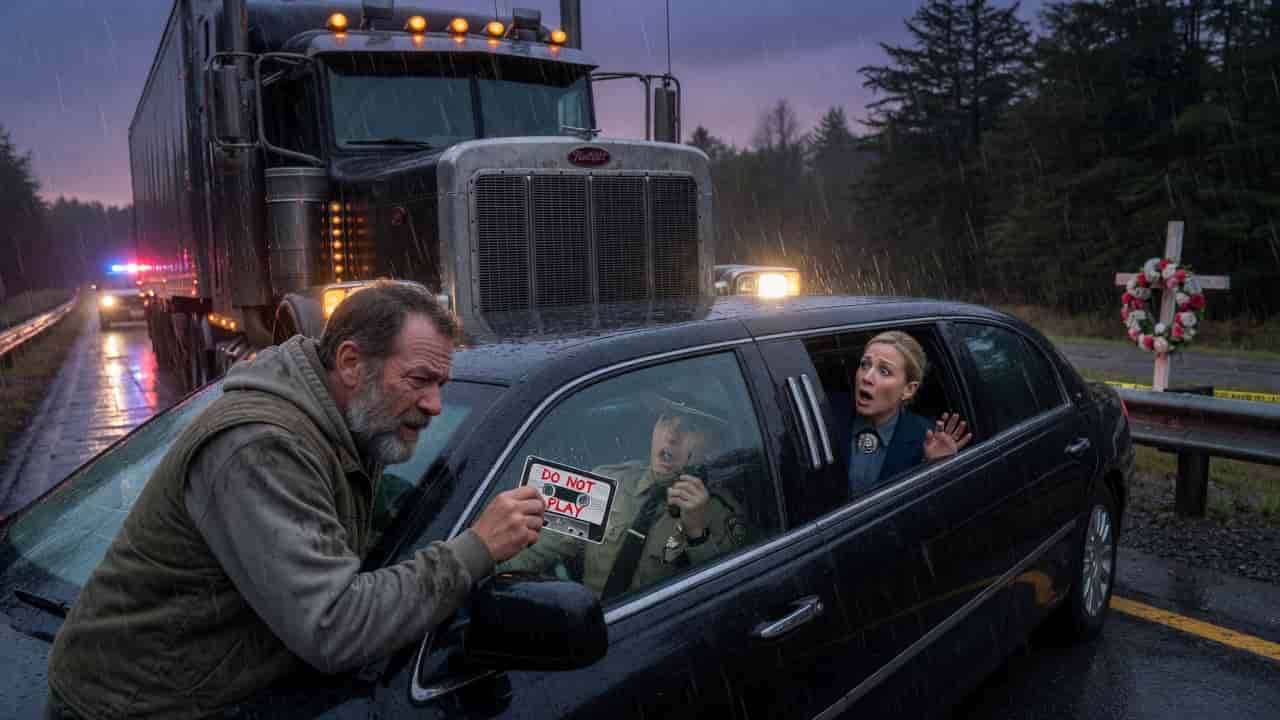
“You really think a fresh coat of asphalt can hide what you did to them?”
Miller didn’t care about the cameras or the State Troopers surrounding the Governor’s car. He didn’t care that he was just a man in a quilted vest and a used Peterbilt. He had spent three years listening to the silence of an empty house, and today, that silence was over.
When he pulled his eighteen-wheeler alongside the Governor’s armored limo at seventy miles per hour, he wasn’t looking for a payoff. He was holding the clear-shell cassette tape his sister had risked everything to pull from the dispatch archives—the recording that proved the Governor’s daughter wasn’t just a driver, but a person whose record was scrubbed clean while his wife and son were still being pulled from the wreckage.
Through the tinted glass, he saw the Governor’s face change. The mask of the grieving politician shattered, replaced by the raw, ugly panic of a woman who realized the man she thought she had buried was now riding right beside her.
“Look at the tape, Abigail. Tell me you don’t remember the radio traffic from that night.”
The road ahead was narrowing, the guardrail was closing in, and the State Troopers were screaming into their radios. But Miller wasn’t turning the wheel. He wanted her to hear the air go dead, just like it did on Route 9 three years ago.
Chapter 1
The Peterbilt 389 didn’t just vibrate; it hummed with a low-frequency growl that Miller felt in the marrow of his shins. It was a 2018 model, blacker than a coal mine, with a custom-fabricated steel grill that looked less like a truck part and more like a battering ram. He kept the chrome polished, not because he was a showman, but because dirt hid the stress fractures. In this business, you didn’t ignore stress fractures.
Miller sat high in the air-ride seat, his left hand draped over the wheel at ten o’clock, his right resting on the gear shifter like it was an extension of his own arm. He was forty-five, but the road had added a decade to the corners of his eyes. He wore an olive quilted vest that had seen better winters and a grey hoodie that smelled of diesel and stale coffee. He was a long-haul trucker now, a man of logistics and deadlines, but in his mind, he was still a combat medic in the 10th Mountain Division, looking for the bleed.
The bleed had been going on for three years. It started on Route 9, a stretch of Pennsylvania highway where the hemlocks grew so thick they choked out the sun even at noon. It was the night his wife, Elena, and their seven-year-old son, Leo, had disappeared from the world in a tangle of smoking metal and broken glass. The official report said “weather-related incident.” It said “unavoidable loss of traction.” It didn’t mention the black SUV that had been seen weaving through traffic miles before the crash. It didn’t mention the Governor’s daughter, Clara Sterling, who had been picked up by a State Trooper three miles away with a blood-alcohol level that would have floored a grown man.
Miller shifted into eighteenth gear, the engine roar dipping for a second before surging back. He was heading toward the Scranton terminal, but he wasn’t thinking about the freight. He was thinking about the weight in his vest pocket.
It was a clear-shell cassette tape. An anachronism in a digital world. His sister, Sarah, worked the night shift at the State Police dispatch center. She was the “Emotional Anchor” he couldn’t outrun, the only person who still looked at him like he was a human being instead of a walking ghost. Two nights ago, she’d met him at a diner in the middle of a thunderstorm, her hands shaking as she pushed the tape across the Formica table.
“They missed one, Miller,” she had whispered, her eyes darting toward the door. “The digital logs were wiped during the ‘server migration’ last year. But the old analog backup in the basement… it was still running. This is the raw audio from Route 9. The night it happened.”
Miller hadn’t played it yet. He didn’t need to. He knew what was on it. He knew it contained the voices of Troopers talking to the Governor’s office. He knew it contained the instructions to “clear the scene” before the local press arrived. He knew it was the sound of his family being traded for a political career.
He pulled into a rest stop twenty miles outside of Wilkes-Barre. The rain was starting again, a fine, grey mist that turned the asphalt into a mirror. He parked the rig at the far end of the lot, away from the other drivers. He didn’t want to talk about the weather or the price of fuel. He wanted the silence.
He reached into his pocket and pulled out the tape. He’d written “DO NOT PLAY” on it in red ink, a warning to himself. Or maybe a dare. He stared at the handwritten words. Sarah’s handwriting was neat, disciplined, but the “Y” at the end of “PLAY” trailed off, a sign of the fear she’d felt while stealing it.
If he released this, Governor Abigail Sterling would fall. Her “family values” platform would dissolve in the acid of the truth. But Miller knew how the system worked. A recording could be challenged. A tape could be “lost” in evidence. And the Sterling family had enough money to buy every lawyer from Philly to Pittsburgh.
He looked at the reinforced grill of his truck, visible through the windshield. He had spent six months and twenty thousand dollars modifying this machine. The chassis was reinforced. The engine was tuned for a torque curve that could pull a house. He wasn’t just a driver anymore. He was a kinetic force.
A shadow fell over his window. He didn’t jump; he just looked. It was a man in a tan uniform. State Trooper. Miller recognized the build before he saw the face. It was Vance.
Vance was younger, maybe early thirties, with the kind of earnest face that made you want to trust him. He had been at the scene three years ago. He was the one who had held Miller back while the paramedics—Miller’s former peers—worked on a car that was already a coffin. Vance had looked Miller in the eye that night and said, “I’m so sorry. It was the rain. Just the damn rain.”
Miller rolled down the window. The smell of wet pine and exhaust drifted in.
“Rough night for a haul, Miller,” Vance said. He leaned against the door, his hand resting near his belt, but not on his weapon. He looked tired. He looked like a man who hadn’t slept since 2023.
“The road doesn’t care about the weather,” Miller said. His voice was a low rasp, unused to conversation.
Vance looked at the truck. “You’ve done a lot of work on this rig. Heavy-duty stuff. Planning on hauling something special?”
“Just making sure I don’t get pushed off the road,” Miller said. He didn’t hide the tape, but he didn’t flaunt it either. He just let it sit in his hand, a clear plastic heart.
Vance’s eyes flicked down to the cassette. He went still. The earnestness on his face didn’t vanish, but it hardened into something else. Recognition. Fear. Miller saw the man’s throat move as he swallowed.
“Miller,” Vance said, his voice dropping an octave. “There are people looking for a specific piece of property. Something that belongs in the archives. They’re worried it might cause… unnecessary pain.”
“Pain is already here, Vance. It’s been here for three years. It’s sitting in the passenger seat. It’s sleeping in my bed. I’m just looking for the source.”
“Some sources are too deep to dig up,” Vance said. He looked around the empty lot. “If I were you, I’d take that tape and I’d throw it into the Susquehanna. I’d keep driving. I’d go to California and I’d forget I ever had a sister who worked for the state.”
The threat was there, wrapped in the skin of a warning. Miller felt a cold spark of anger in his chest, the first thing he’d felt in weeks that wasn’t just dull ache. He leaned out the window, his face inches from Vance’s.
“You were there, weren’t you?” Miller asked. “You saw the SUV. You saw the girl. You saw the bottle on the floorboard.”
Vance didn’t look away, but his eyes glazed over with the memory. “The rain was heavy, Miller. People see things in the dark that aren’t there.”
“I saw her, Vance. I was a medic. I’ve seen shock. She wasn’t in shock. She was wasted. And you put her in the back of your cruiser and drove her away while I was still trying to find my son’s pulse.”
Vance’s hand twitched. For a second, Miller thought the man might reach for him, might try to take the tape right there. But Vance just backed away, his boots crunching on the wet gravel.
“The Governor is holding the memorial service on Friday,” Vance said. “The three-year anniversary. She’s going to be at the site on Route 9. National press. She’s making it a platform for highway safety. Don’t go there, Miller. For your own sake. Don’t go.”
Vance turned and walked back to his cruiser, the blue and red lights reflecting in the puddles. Miller watched him go. He looked at the tape in his hand.
“Do not play,” he whispered.
He reached over and slotted the tape into the truck’s old-school deck. He pushed the button. The hiss of the magnetic tape filled the cab, and then, a voice came through the speakers. A voice he hadn’t heard in a long, long time.
“Dispatch, this is Unit 42. We have a high-profile involved. I repeat, high-profile. Contact the Commissioner. We need a sweep. Now.”
Miller closed his eyes. The bleed was wide open. And now, he knew exactly where to find the source.
Chapter 2
The “Blue Moon” truck stop sat on the edge of a jagged cliffside near the Delaware Water Gap, a place where the air always tasted of salt and woodsmoke. It was a haven for men who didn’t want to be found and for people who lived their lives in the margins of logs and ledgers. Miller pulled his Peterbilt into the lot, the air brakes hissing like a dying animal.
He didn’t go inside for the food. He went for the routine. He needed to be around people who didn’t know his name, who didn’t know about the tape, who didn’t know that in forty-eight hours, he was going to walk into a storm that might swallow him whole.
The diner was half-empty. A neon sign in the window flickered, casting a rhythmic blue light over the cracked vinyl booths. At the counter sat an old-timer in a “Vietnam Vet” cap, nursing a cup of coffee that looked like motor oil. Behind the counter was Dottie, a woman who had been pouring coffee at the Blue Moon since the Eisenhower administration. She was Miller’s unofficial “Supporting Character,” the only person on the road who didn’t ask questions because she already knew the answers were usually depressing.
“The usual, Miller?” Dottie asked, her voice a gravelly comfort. She didn’t wait for an answer. she just slid a heavy ceramic mug across the counter.
“Thanks, Dottie,” Miller said. He sat down, his back to the door. It was a habit from the service. You never let the entrance stay out of sight.
“You look like you’re carrying the whole load on your shoulders tonight,” she said, leaning on the counter. “And you’re empty-bedding it. I saw your rig. What’s in the vest, honey? It’s making you sit crooked.”
Miller touched the pocket where the tape sat. It felt warm, like it was generating its own heat. “Just some old music. Something I haven’t heard in a while.”
“Old music usually hurts the most,” Dottie said. She wiped a spot on the counter that was already clean. “My late husband had a box of 8-tracks. After he passed, I tried to listen to ’em. Had to stop after three bars of Waylon Jennings. Some things are better left in the box.”
“Sometimes the box breaks,” Miller said.
He felt a presence behind him. The air in the diner shifted, the way it does when someone with authority walks into a room. Miller didn’t turn around. He watched the reflection in the dark window. A man in a charcoal suit was walking toward him. He wasn’t a Trooper. He was “Opposing Force” personified. Clean-cut, mid-fifties, with the kind of smile that didn’t reach his eyes.
“Mr. Miller,” the man said. He sat down on the stool next to Miller, leaving exactly one stool of “social distance” between them. “I’m Silas Thorne. I work for Governor Sterling. Chief of Staff.”
Miller took a sip of his coffee. It was bitter and scorched. “The Governor has a lot of staff for a woman who spends all her time at ribbon-cuttings.”
Thorne chuckled, a dry, rehearsed sound. “She’s a busy woman. Especially this week. The Route 9 memorial is a very sensitive event for her. She feels a deep, personal connection to the tragedy that happened there.”
“Is that what they’re calling it now? A tragedy?” Miller turned his head slowly. “I call it a funeral that hasn’t ended.”
Thorne’s smile didn’t waver, but his posture stiffened. “We’re aware of your sister, Sarah. We’re aware of the… inaccuracies she might have shared with you. She’s a troubled woman, Miller. Grief does strange things to the mind. It makes people imagine conspiracies where there are only unfortunate accidents.”
“Sarah didn’t imagine anything,” Miller said. “She found the receipts. And I’m holding the bill.”
Thorne leaned closer. He smelled of expensive cologne and mints. “Let’s be realistic. You’re a man with a clean record, a veteran, a hard worker. It would be a shame if that record were tarnished by allegations of theft or harassment. The Governor is a very forgiving person, but she has a responsibility to the state. If you were to, say, deliver that ‘old music’ to me tonight, we could find a way to make sure your family’s memorial fund is… significantly enhanced.”
The “Bullying Force” wasn’t just physical. It was financial. It was the way Thorne spoke, as if Miller were a child who didn’t understand the rules of the playground. It was the assumption that everything had a price, even the lives of a wife and a son.
“I don’t want your money, Thorne,” Miller said. “I want her to say the name.”
“Whose name?”
“Clara’s. I want the Governor to stand in front of those cameras on Friday and tell the world that her daughter killed my family. I want her to admit that she used the State Police to bury the truth while I was still picking glass out of my son’s hair.”
Thorne sighed, a sound of genuine disappointment. “You’re making a mistake, Miller. You’re choosing a path that leads to a very hard wall. And that truck of yours… it’s a beautiful machine. It would be a tragedy if it ended up in an impound lot. Or worse.”
Thorne stood up. He reached into his pocket and pulled out a business card, placing it on the counter next to Miller’s coffee. “Think about it. You have forty-eight hours. After that, the window closes. And when it closes, it stays closed.”
Thorne walked out, the bell above the door chiming with a cheerful irony. Miller stared at the card. Silas Thorne. Chief of Staff. He picked it up and crumpled it into a ball, dropping it into the remains of his coffee.
Dottie came back over, her face pale. “Who was that, Miller? He looked like a man who buys and sells souls for a living.”
“Just a messenger,” Miller said. He stood up, his joints popping. He felt the weight of the reinforced grill on his truck, the steel he’d added to the frame. He had been preparing for a collision for three years. He just hadn’t realized the collision was going to be with the entire state of Pennsylvania.
“You be careful, honey,” Dottie said. “Men like that… they don’t play fair.”
“I know,” Miller said. “That’s why I brought my own rules.”
He walked out into the night. The rain was coming down harder now, a relentless drumbeat on the hood of his truck. He climbed into the cab and started the engine. The 389 roared to life, a primal sound that drowned out the wind.
He reached into the glove box and pulled out a small, framed photo. Elena and Leo. They were at a park, the sun catching the gold in Elena’s hair, Leo laughing at something off-camera. It was the last photo he had of them. The “Emotional Residue” of their lives was all he had left, and it was getting heavier by the hour.
He looked at the cassette deck. He hadn’t finished the tape. He pushed play.
“Unit 42, be advised. The Governor is on the line. She wants to know if the girl is secure. Negative on the other vehicle. No survivors. Just keep the perimeter tight. We’ll handle the paperwork from the capital.”
Miller gripped the steering wheel until his knuckles went white. No survivors. They hadn’t even checked. They had seen the wreckage, seen the profile of the driver who caused it, and decided that Miller’s family was a variable that needed to be deleted.
He put the truck in gear and pulled out of the lot. He wasn’t heading to the terminal. He was heading to a small garage in the hills where an old friend—a “CB radio enthusiast” and former motor-pool mechanic—was waiting.
He had forty-eight hours. He needed to make sure the Peterbilt was more than just a truck. He needed it to be a witness. And if necessary, he needed it to be an executioner.
Chapter 3
The roadside memorial was a sea of black umbrellas and camera lenses. It was Friday morning, the air cold and damp, clinging to the skin like a wet shroud. The site on Route 9 had been groomed for the occasion. The weeds had been pulled, the gravel raked, and a temporary podium had been erected just feet from where the impact had happened three years ago.
Governor Abigail Sterling stood at the center of it all. She was the “Bully” in a navy blue suit, her blonde hair perfectly coiffed, her expression a masterclass in performative grief. She was surrounded by “Witnesses”—local politicians, State Troopers in dress uniforms, and a few hand-picked families who had also lost loved ones to “highway accidents.”
Miller stood at the back of the crowd. He was a “Target” of her narrative, a ghost in a quilted vest. He felt the eyes of the State Troopers on him. He saw Vance standing near the perimeter, his campaign hat pulled low, his gaze fixed on the ground. Vance knew. Thorne, standing behind the Governor, also knew. They were waiting for Miller to make a move. They were waiting for him to justify their fear.
“We gather here today to remember,” the Governor’s voice boomed through the PA system. It was a rich, authoritative voice, the kind that won elections. “We remember the lives cut short by the elements, by the unpredictable nature of our roads. We remember the Miller family—Elena and young Leo—whose loss remains a stain on our hearts.”
Miller felt a surge of nausea. The way she said their names—as if they were props in her script—was a “Direct Public Humiliation” he hadn’t prepared for. She was using his grief to build her shield. She was standing on the ground where his son’s blood had soaked into the dirt and calling it “the unpredictability of the roads.”
“But out of tragedy comes a mandate,” she continued. “A mandate for safer highways, for better lighting, for the Sterling Safety Initiative. We will ensure that no other father has to stand where Mr. Miller stands today.”
She looked directly at him. It was a calculated move. The cameras followed her gaze, swiveling toward the man in the faded vest. The crowd parted slightly, leaving Miller isolated.
“Mr. Miller,” she said, her voice dripping with a fake, crystalline pity. “Would you like to come forward? Would you like to join me in laying this wreath?”
It was a trap. If he went forward, he was endorsing her lie. If he stayed back, he looked like a bitter, broken man refusing a hand of comfort. The “Social Shame” was thick enough to choke on. He saw the reporters’ pens poised over their notebooks. He saw the “Rescue Force”—or the lack of it—in the faces of the people around him. They wanted a story of reconciliation. They wanted the “beautiful” ending.
Miller didn’t move toward the podium. He took a step forward, but he didn’t stop at the wreath. He walked toward the line of State Troopers.
“I don’t want your wreath, Abigail,” Miller said. His voice wasn’t loud, but it had a frequency that cut through the electronic hum of the PA system. The Governor’s smile faltered, just for a fraction of a second.
“I understand you’re hurting, Miller,” she said, her voice still projecting for the microphones. “Grief is a heavy burden.”
“You want to talk about burdens?” Miller reached into his vest. Thorne took a step forward, his hand moving toward his jacket, but Vance stepped in his way, a subtle block that went unnoticed by the press.
Miller pulled out the cassette tape. He held it up, the clear plastic catching the grey light. “I have a recording here. It’s from the night of the ‘unpredictable accident.’ It’s the sound of your office telling the Troopers to leave my family in the car while they whisked your daughter away.”
The crowd went silent. The only sound was the wind whistling through the hemlocks. The Governor’s face didn’t break, but her eyes turned into chips of blue ice.
“Mr. Miller is clearly unwell,” she said to the cameras, her tone shifting to one of clinical concern. “The trauma of this anniversary has brought on a state of… confusion. Officers, please, help Mr. Miller to a place where he can rest.”
Two Troopers moved toward him. Miller didn’t resist. He didn’t fight. He just looked at the Governor, his gaze steady and terrifyingly calm.
“You can’t rest when the air is dead, Abigail,” Miller said.
As the Troopers took his arms, Miller dropped the tape. He didn’t drop it at her feet. He dropped it onto the white wooden cross that marked the spot.
“Vance,” Miller said, looking at the young Trooper. “Do your job.”
Vance looked at the tape. He looked at the Governor. He didn’t move. He was a “Mirror” of Miller’s own past—a man caught between a code and a lie.
Miller was led away, the cameras flashing, the Governor already pivoting back to her speech, her voice shaking slightly now. He was driven to the edge of the perimeter and released. They didn’t arrest him. They didn’t want the paperwork. They just wanted him gone.
But Miller wasn’t gone. He walked back to where he’d parked the Peterbilt, hidden behind a line of trees a quarter-mile up the road. He climbed into the cab. He felt the “Emotional Residue” of the humiliation he’d just endured, the sting of her pity, the weight of his family’s names in her mouth.
He started the engine. The Peterbilt roared, a sound of righteous fury. He didn’t need the tape anymore. He had seen her face when he held it up. He had seen the panic.
He looked at the road ahead. The memorial was breaking up. The Governor’s armored limo—a black beast of a vehicle—was pulling out onto Route 9, escorted by two cruisers. They were heading back to the capital. They were heading into the rain.
Miller shifted the truck into gear. He had modified the rig for a specific purpose. He hadn’t built a truck; he’d built a weapon of truth. He pulled out onto the highway, his lights off, his engine a low, predatory rumble.
The “Direct Hook” was set. He was going to pull alongside that limo. He was going to show her that some things can’t be raked away with gravel. Some things remain on the road forever.
Chapter 4
The rain was no longer a mist; it was a deluge, a solid wall of water that turned the world into a blur of grey and black. Miller sat in the cab of the Peterbilt, the wipers fighting a losing battle against the downpour. He was five miles behind the Governor’s motorcade, keeping a steady pace, his eyes fixed on the red glow of the limo’s taillights in the distance.
He felt a strange, cold clarity. The “Psychological Depth” of his grief had shifted from a heavy weight to a sharp edge. He wasn’t just a father and a husband anymore; he was a “Rescue Force” for the truth. He was the only person left who could force the Governor to look at what she had done.
He reached over and turned on the CB radio. The static hissed, a jagged sound that filled the cab.
“Break 1-9 for the Road Ghost,” Miller said, using his old handle.
A voice crackled back, thick with the accent of the coal regions. “You got the Ghost. This is Red Eye. Who’s asking?”
“Miller. I need a clear path on Route 9, northbound. You see the black SUVs?”
“I see ’em, Miller. They’re moving fast. Got a Trooper escort. What’s the play? You sound like you’re hauling a heavy heart.”
“I’m hauling the bill, Red Eye. Just keep the channel open. If I go dark, call my sister. Tell her I heard the voices.”
“Copy that, Road Ghost. Watch the curve at Devil’s Elbow. The water’s pooling deep there.”
Miller clicked the mic off. He shoved the shifter into tenth, then twelfth, then fifteenth. The Peterbilt surged forward, the twin chrome stacks belching black smoke into the rain. He was closing the gap.
He saw the first Trooper cruiser. It was trailing the limo by fifty yards, its lights flashing. Miller didn’t slow down. He steered the massive truck into the left lane, the reinforced grill cutting through the spray like the prow of a ship. He pulled alongside the cruiser.
The Trooper inside—a man Miller didn’t know—looked up, his eyes widening as he saw the sheer scale of the truck beside him. He reached for his radio, but Miller was already past him.
Now it was just him and the limo.
The Governor’s vehicle was a custom-built armored Cadillac, a tank disguised as a luxury car. It was heavy, stable, and designed to survive a bomb. But it wasn’t designed to survive a head-to-head confrontation with forty tons of steel and momentum.
Miller pulled the Peterbilt into the right lane, inches from the limo’s rear bumper. He could see the silhouettes inside through the tinted rear glass. He knew exactly where she was sitting. Rear right. The seat of power.
He moved the truck to the left lane again and accelerated. The engine screamed, the turbocharger whistling a high-pitched note of defiance. He pulled the cab level with the limo’s rear passenger window.
This was the “Direct Hook Scene.”
Miller leaned across the passenger seat of his cab. He rolled down the window, the freezing rain lashing his face. He didn’t look at the road; he looked down at the limo.
Through the tinted glass, he saw her. Governor Abigail Sterling. She was looking up, her face a pale oval in the darkness. He saw her mouth move—a scream, a command, he couldn’t tell. He saw Vance in the front seat, his hand on the dashboard, his face a mask of terror.
Miller reached into his vest. He didn’t have the tape—he’d left that at the cross—but he had something else. A small, white wooden cross, a replica of the one on the roadside. He held it against the passenger window of the truck, pressing it against the glass so she could see it.
“Look at it, Abigail!” he roared, though he knew she couldn’t hear him over the wind.
He pointed forward, toward the “Devil’s Elbow” curve. He knew this stretch of road better than his own name. He knew where the drainage was blocked. He knew where the hydroplaning happened.
The limo tried to speed up, but Miller swerved the truck, the massive tires kicking up a wall of water that blinded the limo’s driver. The Peterbilt’s steel grill was inches from the limo’s door. It was a dance of death at seventy miles per hour.
“Whose name is it?” Miller shouted. “Say his name!”
He saw Vance looking at him. The young Trooper’s eyes weren’t full of anger; they were full of a desperate, pleading realization. Vance knew what was coming. He knew that Miller wasn’t going to stop.
The limo swerved, hitting the standing water at the apex of the curve. The heavy car shuddered, the tires losing their grip for a heartbeat. Miller didn’t flinch. He kept the Peterbilt steady, his hand on the wheel like a surgeon.
The “Social Pressure” of the moment was gone. There were no cameras here. No press. No voters. There was just a mother who had lied and a father who had lost. There was just the road and the residue of a three-year-old crime.
The limo regained its footing, but the driver was panicked. He tried to ram the truck, to push Miller toward the guardrail. The armored car slammed into the Peterbilt’s side. Miller felt the impact in his teeth, but the reinforced chassis held. He didn’t move an inch.
He steered the truck back toward the limo, a gentle, lethal nudge. He wasn’t trying to flip them. He was trying to force them to stop. He was trying to bring the “Opposing Force” to a standstill at the very spot where his life had ended.
“Open it!” Miller screamed, pointing at the limo door. “Open the door and look at the road!”
He saw the Governor cowering in the back seat, her hands over her ears. She was the “Bully” who had run out of people to hide behind. She was small. She was terrified. She was human.
The road narrowed. The guardrail on the right was a blur of silver. The Peterbilt and the limo were locked together, a single mass of metal hurtling through the dark.
Miller saw the white cross in the distance—the real one, the one he’d left the tape on. He felt a surge of “Emotional Pressure” so intense it made his vision blur. This was the moment. The “Moral Choice” between the recording and the road.
He reached for the air horn. The blast was deafening, a sound that shook the very foundation of the highway.
He looked at the limo one last time. He saw Vance look away, his head bowing. He saw the Governor’s eyes meet his through the glass.
Miller jerked the steering wheel.
He didn’t hit them. He swerved the Peterbilt across the front of the limo, a massive, black shadow that cut off their path. The truck jackknifed slightly, the trailer swinging out like a giant’s arm.
The limo slammed on its brakes. The tires screamed against the wet asphalt, the smell of burning rubber cutting through the rain. The car spun, a slow, graceful rotation, before coming to a stop inches from the guardrail. Inches from the white cross.
Miller brought the truck to a halt fifty yards ahead. He sat in the cab, his chest heaving, his hands shaking so hard he had to grip the wheel to keep them still.
The air went dead. Just like the night of the crash.
He looked in the side mirror. The limo was sitting still. The lights of the following cruisers were approaching, a rhythmic pulse of red and blue.
Miller opened the door and stepped out into the rain. He didn’t have a weapon. He didn’t have a plan. He just had the truth. And for the first time in three years, he felt like he could breathe.
But the “Consequences” were just beginning. As the State Troopers spilled out of their cars, weapons drawn, Miller saw Thorne step out of the limo’s passenger side. He saw the Governor through the open door, her face a mask of ruined pride.
And then, he saw Vance. The young Trooper didn’t draw his gun. He walked toward the white cross. He picked up the cassette tape Miller had dropped earlier.
He looked at Miller. He looked at the Governor.
And then, he put the tape in his pocket.
The story wasn’t over. The “Residue” was still settling. And the next miles would be the hardest of all.
Chapter 5
The rain didn’t stop because the engines had. It pooled in the deep ruts of the shoulder, reflecting the frantic, strobing rhythm of the emergency lights. Miller stood with his hands raised, the palms open and wet, as four State Troopers moved in. Their boots splashed through the mire, a heavy, coordinated sound. Behind them, the Governor’s limo sat like a dead whale, its hazard lights blinking in a slow, pathetic amber pulse.
“On your knees! Now!” the lead Trooper shouted. It wasn’t Vance. It was a man named Miller didn’t know—built like a refrigerator with a voice that had been sanded down by years of shouting over sirens.
Miller didn’t fight. He went down, the gravel of Route 9 biting into his knees through the damp denim of his jeans. He kept his eyes on the limo. The door was still hanging open. Governor Sterling was sitting on the edge of the leather seat, her heels sinking into the mud. She looked less like a politician and more like a woman who had just seen a ghost, her navy suit jacket stained with spray from the Peterbilt’s tires.
Silas Thorne was already on his phone, his voice a sharp, low hiss as he paceed a three-foot circle near the guardrail. He was building the wall. He was calling the lawyers, the press secretaries, the damage control teams that lived in the shadows of the capital.
“He tried to kill us,” the Governor said. Her voice was thin, reedy, stripped of its PA-system resonance. She pointed a trembling finger at the black truck looming over the scene. “He’s a deranged veteran. Look at that machine. It’s a weapon. He modified it to murder me.”
Vance stood ten feet away, his hand still in his pocket, clutching the cassette tape. He wasn’t looking at the Governor. He was looking at Miller. There was a “Psychological Depth” to the silence between them—a shared history of the night the world broke. Vance saw the medic who had crawled into a crushed car; Miller saw the kid in the uniform who had been told to look the other way.
“Vance!” Thorne barked, snapping his phone shut. “Secure the perimeter. Get this man in a cage. And I want that truck impounded as evidence of attempted assassination. Move!”
Vance didn’t move. He looked at the tape in his hand, then back at Miller. The lead Trooper, the refrigerator-shaped man, grabbed Miller’s wrist, twisting it behind his back with a practiced, brutal efficiency. The “Bullying Force” was no longer just a narrative; it was the cold steel of handcuffs clicking shut.
“Wait,” Vance said. His voice was quiet, but it carried over the rain.
“Wait for what?” Thorne snapped, stepping toward him. “We have a sitting Governor who was almost forced into a ravine by a vigilante. There is no waiting.”
“I have property,” Vance said. He pulled the cassette tape from his pocket. The clear plastic shell was slick with rainwater. He held it up, not to Thorne, but so the Governor could see it.
Abigail Sterling went still. The trembling in her hand stopped, replaced by a rigid, electric tension. She looked at the tape like it was a live grenade. The “Direct Public Humiliation” of the roadside memorial was nothing compared to the raw exposure of this moment. Here, in the dark, with the rain washing away the polish, she was just a mother whose secret was sitting in the palm of a thirty-year-old Trooper.
“Give that to me, Officer,” Thorne said, his voice dropping into a dangerous, velvet tone. He held out his hand. “That’s state property. Evidence.”
“It’s not evidence of an accident,” Miller said from the ground. His face was pressed near the mud, but his voice was steady. “It’s evidence of a trade. Two lives for one career. How’s Clara doing, Abigail? Is she still having the nightmares? Or did you buy her a new conscience along with the SUV?”
The lead Trooper shoved Miller’s face down further. “Shut up.”
“Let him speak,” Vance said. He took a step toward the Governor, bypassing Thorne. The other Troopers hesitated. In the hierarchy of the road, Vance was one of them, but Thorne was the outsider. The power structure was beginning to fracture.
“Governor,” Vance said, stopping five feet from the limo. “I was the first on the scene three years ago. I remember the smell of the bourbon. I remember the way your daughter couldn’t stand up. And I remember the call I got ten minutes later telling me to put her in my car and drive.”
“You’re confused, Vance,” the Governor said. She stood up, trying to regain her height. She smoothed her skirt, a reflex of power that looked absurd in the mud. “You were in shock. It was a traumatic night for everyone.”
“I wasn’t in shock,” Vance said. “I was in debt. You promised my father that his pension wouldn’t be touched during the ‘restructuring.’ You bought my silence with a dead man’s money. But I’ve been listening to this silence for three years, and it’s getting too loud.”
Thorne moved fast—faster than a man in a charcoal suit should. He lunged for the tape in Vance’s hand. But Vance wasn’t a politician; he was a cop. He pivoted, catching Thorne’s wrist and twisting it until the Chief of Staff was doubled over against the limo’s fender.
“Don’t,” Vance whispered.
The other Troopers drew their weapons, but they weren’t pointing them at Miller anymore. They were pointing them at the space between Vance and Thorne. The “Residue” of the corruption was finally surfacing, and it tasted like copper and rain.
“This is a mistake, Vance,” Thorne gasped, his face pressed against the black paint of the car. “You’ll be in a cell next to him by morning. Your sister, Sarah? She’s already being processed for theft of state records. You want to lose everything for a tape that won’t even hold up in court?”
Miller felt a cold spike of fear. Sarah. He had tried to keep her out of the splash zone, but the Sterling machine didn’t miss. They didn’t just go after the target; they salted the earth.
“She’s not in a cell yet,” Miller said, straining against the handcuffs. “Because the people you sent to get her are the same people who listen to the CB. You think the State Police are the only ones on this road? Every trucker from here to Ohio knows what happened at the memorial. They know the Road Ghost is hauling a heavy load tonight.”
It was a lie—mostly. Miller had signaled Red Eye, but he didn’t know if the network would hold. But in the dark, on Route 9, the lie had weight.
The Governor looked around the dark highway. She saw the hemlocks. She saw the massive black truck. She saw the Troopers who were no longer looking at her with blind loyalty. The “Social Pressure” was shifting. She was no longer the victim of an accident; she was the architect of a crumbling fortress.
“Give me the tape, Vance,” she said, her voice dropping the performative pity. It was a command now, sharp and cold. “We can talk about your sister. We can talk about your father. But if that tape leaves this road, there is no coming back for anyone. Not even the Millers.”
Vance looked at the tape. He looked at Miller. Then, he did something that none of them expected. He walked over to Miller’s Peterbilt. He reached into the cab and pulled out the clear-shell cassette tape Miller had used earlier—the one with “DO NOT PLAY” written on it.
He held both tapes up.
“The recording is already on the air,” Vance said.
Thorne froze. The Governor’s face went white.
“What are you talking about?” Thorne demanded.
“Miller’s rig,” Vance said, pointing to the custom antenna on the truck’s roof. “He didn’t just reinforce the grill. He hooked his deck into a high-gain transmitter. He’s been looping the audio on the emergency bands for the last ten miles. Every cruiser within twenty leagues is hearing it right now. Every dispatcher. Every newsroom with a scanner.”
Miller looked up, surprised. He hadn’t done that. He’d thought about it, but he didn’t have the gear. He looked at Vance and saw the smallest wink in the man’s tired eyes. It was a “Rescue Force” move—a bluff designed to break the room.
Thorne lunged for his phone again, his fingers flying across the screen. “I’ll kill the signal. I’ll shut down the towers.”
“Too late,” Vance said.
A new set of headlights appeared in the distance. Not red and blue. White and yellow. A massive convoy of trucks was approaching, their air horns beginning to moan in the distance—a low, mournful chorus that shook the trees. Red Eye had come through. The “Mirror” of the working class was arriving.
The Governor backed into the limo, her heels finally giving out. She sat down in the mud, her navy suit ruined, her power evaporated. She looked at the white cross on the side of the road, the one Miller had pointed to.
“I only wanted to protect her,” she whispered.
“You didn’t protect her,” Miller said, standing up as the refrigerator-shaped Trooper slowly released his grip. “You just taught her that lives don’t matter if you have the right last name. And now, the bill is due.”
The trucks began to pull over, one by one, lining the highway like a wall of chrome and steel. The drivers didn’t get out. They just sat there, their lights illuminating the scene with a blinding, unforgiving glare.
Miller walked toward the Governor. The Troopers stepped aside. He stopped three feet away from her.
“Say the name, Abigail,” he said.
She looked up at him, her eyes vacant, the “Emotional Residue” of her choices finally settling in her throat.
“Leo,” she whispered.
“And Elena,” Miller added.
The rain continued to fall, but the silence was gone. The road was full of witnesses.
Chapter 6
The sun didn’t exactly rise on Saturday; it just bled a pale, sickly light through the thick Pennsylvania clouds. The “Aftermath” was a chaotic tangle of jurisdictional disputes and media scrums. By 8:00 AM, the entrance to the State Police barracks in Wilkes-Barre was clogged with satellite trucks and reporters in trench coats.
Miller sat in a small, windowless interview room. He wasn’t in handcuffs anymore, but the door was heavy and locked from the outside. He hadn’t slept. He smelled of diesel, rain, and the metallic tang of adrenaline. His olive vest was draped over the back of a plastic chair, and he was staring at the acoustic tiles on the ceiling, counting the tiny holes.
The door opened. It wasn’t a Trooper this time. It was a woman in a sharp grey blazer—Assistant District Attorney Sarah-Jane Miller. No relation, though the name felt like a cosmic joke. She carried a thick accordion folder and a look of profound exhaustion.
“Mr. Miller,” she said, sitting across from him. “The Governor resigned an hour ago. Citing ‘health reasons’ and a desire to ‘focus on her family.’ But we both know that’s the polite way of saying the ship is underwater.”
Miller didn’t move his eyes from the ceiling. “Did the tape hold up?”
“It didn’t need to,” she said, opening the folder. “The bluff on the road—the one Officer Vance pulled? It worked long enough to rattle Silas Thorne. He started talking the second he got into a separate cruiser. He thought he was being recorded, so he tried to cut a deal by burying the Governor before she could bury him. He gave us the location of the original digital logs. They weren’t wiped; they were just moved to a secure server in the Governor’s private residence.”
“And the girl? Clara?”
“She’s in custody. Not for the crash—the statute of limitations on the vehicular manslaughter might be tricky because of the botched initial investigation—but for the conspiracy to obstruct justice. And the secondary incident.”
Miller finally looked down. “Secondary incident?”
“She was found in a hotel room in Philly last night. She had three ounces of cocaine and a loaded firearm that wasn’t registered. It turns out when you teach a kid they’re invincible, they eventually try to prove it to the world.”
The “Psychological Depth” of the tragedy was complete. The Governor hadn’t saved her daughter; she had merely delayed the inevitable collision. The “Bullying Force” of the Sterling family hadn’t just crushed Miller; it had hollowed out its own core.
“What about my sister?” Miller asked, his voice cracking. “Sarah.”
The ADA smiled, the first genuine expression he’d seen since the diner. “She’s outside. We’re dropping the theft charges. Technically, the tape she took was an illegal duplicate of a record that didn’t officially exist. Hard to prosecute someone for stealing a ghost.”
Miller stood up. His knees felt stiff, the gravel from Route 9 still embedded in his skin like buckshot. He felt a strange “Emotional Flatness.” He had won. The lie was dead. But the house was still empty. The “Moral Choice” he had made on the road—the choice to swerve instead of strike—didn’t bring Elena and Leo back. It just meant he could still look at his own reflection in the Peterbilt’s chrome.
He walked out of the room and into the hallway. Sarah was there, sitting on a wooden bench. She looked smaller than he remembered, her face pale and her eyes red-rimmed. When she saw him, she stood up and threw her arms around him, sobbing into the grey fabric of his hoodie.
“I thought I lost you too,” she whispered.
“I was already lost, Sarah,” Miller said, holding her tight. “I’m just finding the way back.”
They walked out of the barracks together. The media swarm descended immediately, a wall of microphones and flashing lights. “Miller! Did you mean to kill her?” “Miller! What’s on the tape?” “Miller! Is it true about the daughter?”
Miller didn’t answer. He kept his head down, his hand on Sarah’s shoulder, guiding her through the pack. He saw Vance standing by the entrance, his uniform rumpled, his badge missing from his chest. He had resigned that morning.
Vance nodded at Miller as they passed. There were no words. The “Residue” of their shared night on Route 9 was a bond that didn’t need a vocabulary. Vance was a “Mirror” who had finally found his own light.
Miller’s truck was parked in the back lot, guarded by two Troopers who looked like they didn’t know whether to salute him or arrest him. The Peterbilt was covered in dried mud and scratches from the limo’s armored plating. It looked like a veteran returning from a war that nobody wanted to acknowledge.
He climbed into the cab. The smell of the interior—old coffee, diesel, and the faint, lingering scent of Elena’s perfume on the headrest—hit him like a physical blow. He sat there for a long time, his hands on the wheel.
He reached into the glove box and pulled out the photo again. He looked at Leo’s laugh. He looked at Elena’s eyes.
“It’s done,” he whispered.
He started the engine. The 389 roared, but it sounded different now. The predatory growl was gone, replaced by a steady, rhythmic thrum. He put the truck in gear and pulled out of the lot, leaving the media and the barracks behind.
He didn’t head for the highway. He headed for a small florist on the outskirts of town. He bought two bouquets—lilies for Elena, sunflowers for Leo.
He drove back to Route 9.
The road was quiet now. The memorial podium was gone. The white cross was still there, standing lonely against the backdrop of the hemlocks. Miller pulled the rig onto the shoulder, his air brakes hissing in the stillness.
He walked to the cross. He knelt in the mud, the same mud where the Governor had fallen the night before. He placed the flowers at the base of the wood.
He stayed there until the sun finally broke through the clouds, casting long, golden shadows across the asphalt. The road didn’t look like a crime scene anymore. It just looked like a road. A place where people went from one point to another, carrying their loads, their secrets, and their hopes.
Miller stood up and walked back to the Peterbilt. He had a long haul ahead of him. He was heading west. Not to California, like Vance had suggested, but just… west. He didn’t have a destination yet, and for the first time in three years, he didn’t need one.
He climbed into the seat and looked in the rearview mirror. He saw the white cross receding as he pulled away. He saw the flowers. And then, he saw the road ahead, stretching out into the horizon, grey and silver and infinite.
The “Ending” wasn’t a clean bow. There was still a hole in his heart that no court ruling or resignation could fill. But as he shifted into eighteenth gear and felt the truck settle into its stride, Miller realized that the weight was finally balanced. He wasn’t hauling the bill anymore. He was just hauling the memory.
And the memory, though heavy, was no longer a burden. It was a guide.
He reached over and turned off the CB radio. The static died, leaving only the sound of the wind and the tires on the pavement.
Miller drove into the light, a man no longer haunted by the dead air.