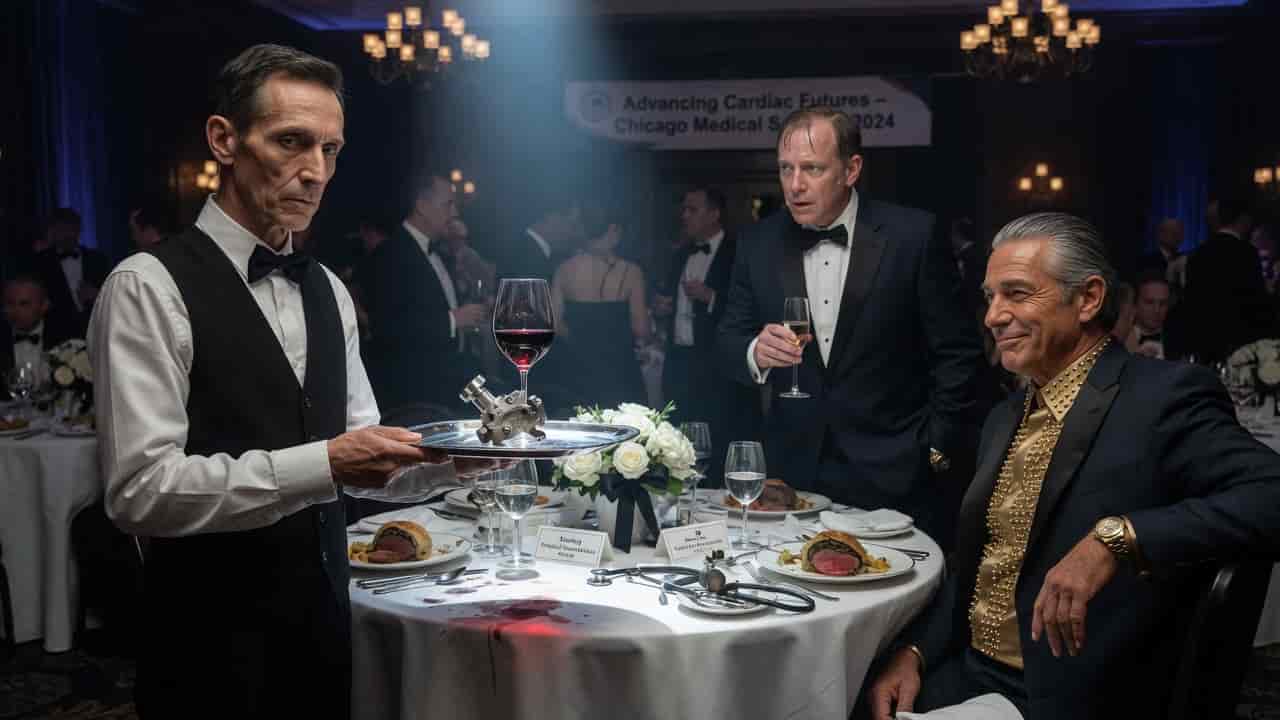
“Careful with the tray, Julian. We all know about your hands.”
Sterling didn’t even look up from his steak. He just sat there in his four-thousand-dollar tuxedo, mocking the man whose life he’d systematically dismantled three years ago. The entire table went silent, the elite of the medical world watching the disgraced Dr. Julian Reed stand there in a cheap waiter’s vest, holding a silver tray.
Elias, once Julian’s best friend, looked like he wanted to vanish into the floorboards. He knew the truth. They all did. But Sterling owned the hospitals, the boards, and the narratives.
Julian didn’t flinch. He didn’t let the tremor show—the one they’d lied about in court to prove he was unfit. He just lowered the tray until the wine glass was inches from Sterling’s arrogant face.
“Look at the glass, Sterling,” Julian said. His voice was clinical. Cold.
Sterling’s sneer faltered. He leaned in, his eyes tracking the jagged, metallic object resting at the bottom of the Cabernet. It was a surgical valve—the exact model that had failed on Julian’s operating table the night his wife’s life ended. The exact model that was supposed to have been recalled months before.
“What the hell is this?” Sterling whispered, the color draining from his face as he realized the ghost wasn’t just here to serve. He was here to perform one final, public autopsy on a reputation.
The room is about to find out exactly what happened in OR four, and the bill for the truth is finally due.
Chapter 1: The Anatomy of a Ghost
The basement of the warehouse smelled like rusted pipes, cheap cigarettes, and the metallic tang of unwashed copper. It was a scent that had become the wallpaper of Julian Reed’s life. Above him, the Chicago el-train rattled the foundations every twenty minutes, a rhythmic, bone-deep vibration that served as his only clock. Down here, time didn’t exist in hours; it existed in the steady drip of an IV bag and the labored breathing of men who couldn’t go to a real ER.
Julian adjusted the overhead shop light, a flickering fluorescent bar he’d rigged to a rolling stand. It wasn’t a Scialytic shadowless lamp, but it would have to do. His patient was a man named Vinnie “The Hook” Moretti, a mid-level enforcer whose shoulder had been opened by a jagged piece of rebar during a dispute over a shipping container.
“Don’t twitch, Vinnie,” Julian said. His voice was flat, devoid of the bedside manner he’d once perfected at Northwestern Memorial. “If I nick the artery, you’ll be dead before the next train passes.”
Vinnie grunted, his face slick with sweat. He was gripping the edges of the rusted metal table, his knuckles white. “Just fix it, Doc. I got places to be.”
Julian didn’t answer. He reached for a pair of forceps, his fingers hovering for a fraction of a second. There it was—the tremor. A subtle, rhythmic fluttering in his right thumb and forefinger. It wasn’t the result of age or alcohol, though the city’s medical board had been happy to record it as such. It was the physical residue of a trauma that had never properly set, like a bone broken and left to heal crooked. He took a slow, deliberate breath, grounding his heels into the concrete floor, and the tremor subsided. He moved in.
The work was methodical. Debridement. Irrigation. Suture. In the silence of the basement, Julian could hear the ghosts of his former life. The chime of high-end monitors, the soft rustle of sterile blue gowns, the respectful murmurs of residents waiting for him to explain the next move. Now, the only audience was a crate of bootleg whiskey and Cora, a nurse who had lost her license to a Percocet habit three years ago.
Cora stood by the supply cabinet, her eyes glassy but her hands steady enough to prep the bandages. She watched Julian with a mixture of pity and awe. She was the only one who knew who he had actually been—the “Golden Boy” of Chicago trauma surgery, the man with the hundred-percent survival rate until the night the world fell apart.
“He’s stable,” Julian said, stepping back and dropping the bloodied forceps into a plastic basin. “Keep him on the cephalexin. If he starts running a fever, call me.”
Vinnie sat up, hissing as the movement pulled at the fresh stitches. He reached into his leather jacket and tossed a thick envelope onto the table. It landed with a dull thud next to the surgical tools. “Thousand bucks, like we agreed. Boss says thanks.”
Julian didn’t look at the money. “Tell your boss I need more lidocaine. The local supply is drying up.”
Vinnie nodded, sliding off the table. “I’ll see what I can do. Stay safe, Doc. You’re too useful to get caught.”
As Vinnie shuffled out the heavy steel door, Cora approached the table. She picked up the envelope and fanned through the bills. “A thousand bucks for forty minutes of work. Not bad for a ghost.”
“It’s blood money, Cora,” Julian said, peeling off his latex gloves. “It goes toward the fund. Nothing else.”
“The fund,” Cora repeated, her voice tinged with bitterness. “You’re still chasing that ghost? Julian, it’s been three years. Bio-Med Corp has more lawyers than the city has rats. They buried the evidence under ten feet of corporate red tape and NDAs.”
Julian turned to the small, locked safe in the corner of the room. He keyed in the code and opened it. Inside wasn’t money, but a single, small plastic bag containing a jagged metallic surgical valve. It was stained with a brown residue that no amount of scrubbing would ever truly remove.
“They didn’t bury everything,” Julian said quietly. “I still have the failure.”
“You have a piece of scrap metal that a dozen experts testified was damaged by ‘surgical error,'” Cora countered, stepping closer. “They ruined you, Julian. They took your license, your reputation, and your wife. And you’re sitting in a basement in the West Loop acting like a mechanic for the mob. When is it enough?”
Julian looked at the valve. In its reflection, he didn’t see a piece of faulty tech. He saw Sarah’s face under the harsh lights of OR 4. He saw the way the monitors had suddenly flatlined, the way the blood had refused to stay inside her chest, the way his own hands—the hands that were supposed to be the best in the city—had felt suddenly, horrifyingly useless.
“It’s enough when Sterling admits he knew,” Julian said.
The tremor returned, more violent this time. He clenched his fist until his nails bit into his palm. He wasn’t just a doctor anymore. He was a man living in the aftermath of a demolition, sifting through the rubble for a single shard of truth.
He thought of Leo, the eight-year-old boy from the apartment complex three blocks over. Leo had a congenital heart defect, the kind that required a series of expensive surgeries Bio-Med Corp controlled the patents for. Julian had been treating him for free, using the mob’s money to buy black-market heart meds. It was his only penance, his only way of staying tethered to the man he used to be.
“I’m going to the apartment to check on Leo,” Julian said, grabbing his coat.
“Julian,” Cora called out as he reached the door. “There’s a gala on Friday. The Bio-Med Innovation Circle. Sterling is the keynote speaker.”
Julian froze, his hand on the cold iron handle. The Chicago el-train roared overhead, shaking the dust from the ceiling. He could feel the vibration in his teeth.
“I know,” Julian said. “I’m already on the catering list.”
He stepped out into the biting Chicago wind, the smell of the basement clinging to his skin like a second shadow. He walked through the industrial graveyard of the West Loop, his mind already moving through the anatomy of the coming confrontation. He wasn’t going there to beg for his life back. He was going there to show them what happened when you buried a man alive and forgot to check if he was still breathing.
The apartment complex was a crumbling brick monolith that smelled of boiled cabbage and damp carpet. Julian climbed the stairs to the third floor, his boots echoing in the narrow hallway. He knocked on 3B.
A woman named Maria opened the door, her face lined with a fatigue that no amount of sleep could fix. When she saw Julian, her eyes softened, but only slightly.
“How is he?” Julian asked.
“He’s tired, Doctor. He didn’t want to finish his dinner.”
Julian walked into the small, cramped living room. Leo was sitting on a sagging sofa, a thin blanket draped over his shoulders. His skin had a slight bluish tint around the lips—cyanosis. The valve in his heart was struggling. It was a Bio-Med valve.
“Hey, Champ,” Julian said, kneeling in front of the boy. “Heard you’re being difficult about the broccoli.”
Leo offered a weak smile. “It tastes like dirt, Dr. Julian.”
Julian pulled his stethoscope from his pocket, the metal cold against his palm. He listened to the boy’s chest. The sound was unmistakable—a turbulent, mechanical clicking followed by a faint, whistling murmur. It was the same sound he’d heard right before Sarah’s heart had given out.
The rage flared in his gut, cold and sharp. Bio-Med hadn’t just sabotaged his past; they were currently sabotaging this boy’s future. They were selling “innovation” that was designed to fail just enough to require more “innovation.”
“You’re doing great, Leo,” Julian lied, his voice steady. “I brought some new medicine. It’ll help with the breathing.”
He handed Maria a bottle of pills—Propranolol, sourced from a contact in the mob’s pharmaceutical wing. It was high-grade, the kind Maria could never afford on her cleaning-service wages.
As he left the apartment, the weight of the valve in his pocket felt like a lead weight. He wasn’t just a ghost anymore. He was a haunting. And on Friday night, he was going to make sure Sterling finally felt the cold.
Chapter 2: The Ghost at the Feast
The transition from the West Loop basement to the gold-leafed ballroom of the Drake Hotel was a violent shift in reality. Julian stood in the service corridor, tugging at the collar of his black waiter’s vest. It was too tight across the shoulders, the fabric cheap and smelling of industrial starch. In his pocket, the jagged surgical valve felt like a hot coal.
“Reed! Get your head in the game,” the banquet manager barked, a harried man with a clipboard and a sweating upper lip. “Table twelve is VIP. That means no mistakes. You drop a fork, you’re out on the street. Capisce?”
“I understand,” Julian said. He kept his head down, the posture of a man who had spent three years learning how to be invisible.
He stepped through the heavy oak doors and into the ballroom. The air was thick with the scent of expensive perfume, aged scotch, and the suffocating arrogance of the Chicago elite. It was a room he had once commanded. He’d been the keynote speaker here four years ago, standing at the mahogany podium while the city’s top surgeons toasted to his “unparalleled vision.”
Now, he was just a shadow carrying a tray of appetizers.
He moved through the crowd, his eyes scanning the faces. There was Dr. Aris, the head of cardiology who had been the first to sign the petition for Julian’s suspension. There was Linda Vance, the hospital board chair who had looked him in the eye and told him his “emotional instability” after Sarah’s death was a liability the insurance company couldn’t overlook.
Every face was a notch in the tally of his ruin. But the biggest notch was sitting at the center table, surrounded by a phalanx of corporate sycophants and high-level donors.
Sterling.
The CEO of Bio-Med Corp looked exactly as he had in the courtroom: tanned, silver-haired, and possessed of a smile that looked like it had been surgically perfected. He was laughing, a deep, resonant sound that cut through the chamber music like a dull blade.
Beside him sat Elias Thorne.
Seeing Elias hit Julian harder than the rest. They had been residents together. They had shared thirty-six-hour shifts, cheap coffee, and the terrifying responsibility of their first solo surgeries. When the lawsuit hit, Elias hadn’t just stayed silent; he had accepted a promotion to Head of Surgery at the very hospital that had fired Julian. He had traded his soul for a corner office and a Bio-Med consultancy fee.
Julian approached Table Twelve with a bottle of Cabernet in a silver bucket. His hand began to shake—the tremor, reaching up from his wrist like a live wire. He stopped, leaned his hip against a service station, and closed his eyes.
Sarah. OR 4. The sound of the valve snapping. The way the blood wouldn’t stop.
He opened his eyes. The tremor was gone. It was replaced by a deadly, focused stillness.
He walked to the table.
“More wine, Mr. Sterling?” Julian asked, his voice a perfect, neutral tenor.
Sterling didn’t even look up. He was mid-anecdote, gesturing with a gold-ringed hand. “And I told the FDA, if you want the new stent, you play by our clinical trial rules. We don’t negotiate with bureaucrats.”
The table erupted in appreciative laughter. Elias, however, froze. He looked up, his eyes meeting Julian’s. The color drained from Elias’s face so quickly it was almost comical. He fumbled with his champagne flute, nearly knocking it over.
“Julian?” Elias whispered, the word barely audible.
Sterling stopped laughing. He turned slowly, his eyes narrowing as he took in the man standing over him. It took a moment for the recognition to click through the layers of corporate filtered memory.
“Well, well,” Sterling said, his voice dripping with a predatory amusement. “If it isn’t the butcher of Northwestern. I heard you’d moved on to more… localized practice. Fixing up street thugs and junkies, wasn’t it?”
The conversation at the surrounding tables faltered. The social pressure in the room shifted, turning toward the spectacle. It was a public humiliation in the making, and Sterling was a master of the craft.
“I’m here to serve, Mr. Sterling,” Julian said, stepping closer.
Sterling leaned back, spreading his arms. “Look at this, everyone. A fall from grace so steep it’s practically a medical miracle. From the operating theater to the catering staff. Tell me, Julian, do you still have that nasty little shake in your hands? I’d hate for you to spill that expensive wine on my tuxedo.”
A few of the younger residents at the table snickered. Elias looked down at his plate, his jaw tight with a cowardice that made Julian’s stomach churn.
“My hands are steady enough for what I need to do,” Julian said.
“Is that so?” Sterling stood up, his physical presence designed to intimidate. He was a head taller than Julian and twice as broad. He stepped into Julian’s personal space, the smell of his expensive cologne cloying and thick. “Because the board records say otherwise. They say you were a broken man who took his wife’s life through sheer, unadulterated incompetence. And here you are, lurking in the shadows like a ghost. You don’t belong in this room, Julian. You don’t even belong in this city.”
Julian felt the heat rising in his neck, the old, familiar rage. But he didn’t explode. He didn’t shout. He watched Sterling’s face, noting the slight puffiness under the eyes, the subtle tremor in the man’s own lip. Sterling was on beta-blockers. High dosage. He was a man living on the edge of his own corporate stress.
“I’m not the one who doesn’t belong here, Sterling,” Julian said quietly.
“Security!” Sterling called out, his voice booming across the ballroom. “We have a trespasser. A disgraced former employee who seems to have forgotten his place.”
Two large men in dark suits appeared from the periphery, moving with the practiced efficiency of corporate muscle.
“Wait,” Julian said, his voice cutting through the rising murmur of the crowd. He reached into his vest pocket.
The security guards hesitated, their hands moving toward their waistbands. They thought he was reaching for a weapon. In a way, he was.
Julian pulled out the small bag containing the surgical valve. He didn’t hand it to Sterling. He held it up, the ballroom’s crystal chandeliers catching the jagged, irregular edges of the metal.
“Do you recognize the batch number on this, Sterling?” Julian asked.
Sterling’s bravado didn’t break, but his eyes flickered. A micro-expression of alarm that only a trained surgeon would catch. “I have no idea what piece of trash you’re holding, Reed.”
“It’s not trash,” Julian said, his voice growing louder, carrying to the neighboring tables. “It’s a souvenir from OR 4. The night the Bio-Med V-7 valve shattered inside my wife’s heart. The same V-7 valve you’re currently selling to three dozen hospitals in the Chicagoland area. The same one that’s currently ticking inside a boy named Leo in the West Loop.”
“He’s delusional,” Sterling said, turning to the crowd, his smile returning like a mask being slammed into place. “Grief-stricken and delusional. Take him out.”
The guards grabbed Julian’s arms, their grip bruising and sudden. They began to drag him toward the service doors.
“Look at the glass, Sterling!” Julian yelled, his voice echoing against the vaulted ceiling. “Look at the Cabernet!”
He kicked out, breaking free for a split second, and slammed the silver tray onto the table. The wine glass shattered, the deep red liquid spraying across Sterling’s white shirt front, looking for all the world like a fresh, jagged wound.
Among the shards of glass and the pooling wine, the metallic valve sat on the white linen, stark and undeniable.
Julian was slammed against the oak doors a moment later, the air rushing out of his lungs. But as the guards dragged him into the cold Chicago night, he saw Sterling standing by the table, staring down at the red stain on his chest and the piece of metal that wouldn’t go away.
Elias was staring, too. And for the first time in three years, Elias wasn’t looking away.
Chapter 3: The Residue of Truth
The alleyway behind the Drake Hotel was a canyon of damp brick and overflowing dumpsters. Julian lay on the wet asphalt, the metallic taste of blood in his mouth. The security guards hadn’t been gentle. They’d left him with a cracked rib and a clear message: Don’t come back.
He rolled onto his side, his breath hitching as his ribs protested. The Chicago wind whipped through the alley, carrying the faint sound of the gala’s orchestra. Up there, they were probably already cleaning the table. Sterling would have changed his shirt. The valve would be in a trash can or tucked into a pocket, headed for a shredder.
But the room had seen it. The elite had witnessed the crack in the facade.
Julian pushed himself up, leaning against the cold brick wall. His hand was shaking—not the subtle tremor this time, but a violent, post-adrenaline vibration. He looked at his fingers, red with his own blood and stained with the Cabernet.
“You’re an idiot, Julian.”
He looked up. Standing at the end of the alley, silhouetted by the streetlights of Michigan Avenue, was Elias Thorne. He looked out of place in his tuxedo, his hands shoved deep into his pockets.
“I wondered if you’d follow me,” Julian said, spitting a mouthful of red onto the pavement.
Elias stepped closer, his footsteps echoing. “You shouldn’t have come here. Sterling… he’s not just a CEO, Julian. He’s the board. He’s the donors. He has friends in the DA’s office. You just handed him a reason to put you in a cage.”
“He put me in a cage three years ago,” Julian snapped, the effort making him wince. “He took Sarah. He took my life. What’s left to take, Elias? My waiter’s vest?”
Elias stopped a few feet away. His face was a mask of conflicted misery. “You think I don’t know? You think I don’t see the numbers on the V-7 failures?”
Julian froze. He pushed himself off the wall, ignoring the pain in his chest. “You have the numbers?”
“Internal memos,” Elias whispered, glancing back toward the hotel doors. “Sterling has a ‘risk management’ team. They calculated the cost of a recall versus the cost of settling individual malpractice suits. It was cheaper to let a few ‘isolated incidents’ happen. They even have a profile on you, Julian. They knew your history with Sarah. They knew that if she died on your table, the narrative would be ‘distraught husband makes fatal error.’ It was the perfect cover.”
The world seemed to tilt. Julian had known it was sabotage, but hearing it confirmed—hearing that Sarah’s death had been a line item in a corporate ledger—was a different kind of agony. It was a cold, clinical cruelty that made the mob’s violence look honest.
“Give me the memos, Elias,” Julian said, his voice low and dangerous.
“I can’t. If I even log into that server, there’s a footprint. I have a family, Julian. I have a career.”
“You have a lie!” Julian stepped forward, grabbing Elias by the lapels of his expensive tuxedo. “You’re walking around with Sarah’s blood on your hands, and you’re worried about your career? There’s a boy named Leo. He’s eight. He has a V-7 in his chest right now, Elias. It’s whistling. It’s failing. He’s going to die just like Sarah did, and you’re going to sit at Table Twelve and eat your steak while it happens.”
Elias looked at him, his eyes filling with a sudden, sharp moisture. He didn’t pull away. He looked like a man who had been holding his breath for three years and was finally starting to drown.
“I can’t get you the server files,” Elias said, his voice shaking. “But Sterling keeps a physical backup of the original clinical trial data. The stuff they didn’t ‘scrub’ for the FDA. It’s in his private safe at the Bio-Med headquarters. He’s paranoid, Julian. He doesn’t trust the cloud. He keeps the truth in a leather-bound ledger.”
Julian let go of Elias’s coat. He stepped back, the gears of his mind already turning. The Bio-Med headquarters was a fortress of glass and steel on the edge of the lake. High-tech security. Biometric locks.
“Why are you telling me this?” Julian asked.
“Because I can’t look at the V-7 batch reports anymore,” Elias said. He reached into his pocket and pulled out a small, plastic keycard. “This is my executive override. It’ll get you into the building and the executive elevator. But the safe… the safe is Sterling’s own code. I don’t have it.”
Julian took the card. It felt cold and heavy in his palm. “I’ll find a way.”
“If you get caught, Julian, I was never here. I’ll testify against you. I’ll tell them you stole the card from the gala.”
“I know you will, Elias,” Julian said. “That’s why you’re Head of Surgery and I’m a ghost.”
Elias turned and walked away, disappearing into the bright lights of the city. Julian watched him go, then turned toward the darkness of the alley.
He didn’t go back to the warehouse. He went to the apartment complex.
He found Maria sitting in the hallway outside 3B. She was crying, her head in her hands.
“Maria? What happened?”
“He stopped breathing, Doctor,” she sobbed, clutching Julian’s sleeve. “I called the ambulance, but they said… they said his insurance doesn’t cover the transport to the specialty clinic. They took him to the County Hospital.”
County. The graveyard for the uninsured.
“I’m going there,” Julian said.
“You can’t,” Maria said, looking up at him with red-rimmed eyes. “You don’t have a license. They’ll arrest you if you try to touch him.”
“I’m not going there to touch him, Maria,” Julian said. “I’m going there to save him.”
He walked away, the keycard in his pocket and the rage in his heart. He didn’t have a scalpel. He didn’t have an OR. But for the first time in three years, he had a target.
He called Cora.
“I need the kit,” Julian said when she picked up. “The full surgical kit. And I need Vinnie.”
“Julian, what are you doing? You just got kicked out of the Drake.”
“Sterling’s ledger,” Julian said. “It has the original trial data. If I get that, the County doctors can’t ignore the failure. They’ll have to operate. They’ll have to replace the valve.”
“You’re going to break into Bio-Med?” Cora’s voice was high with panic. “That’s suicide.”
“No,” Julian said, looking at his reflection in a dark shop window. “It’s surgery. I’m just cutting out the tumor.”
Chapter 4: The Deepest Cut
The Bio-Med building was a needle of blue light piercing the Chicago fog. It looked like a temple to a future that Julian no longer believed in.
He sat in Vinnie’s black SUV, parked two blocks away. Vinnie was in the driver’s seat, a cigarette dangling from his lip. In the back sat the surgical kit—a sterilized stainless steel case that Julian had meticulously curated from his underground practice.
“You sure about this, Doc?” Vinnie asked. “My guys can just burn the place down. Much simpler.”
“I don’t want it burned,” Julian said. “I want the truth. If the building goes, the ledger goes with it.”
“Suit yourself. I got the perimeter cameras on a loop for the next fifteen minutes. After that, the night guard does his rounds. You got a short window.”
Julian nodded. He stepped out of the car, wearing a dark hoodie and tactical pants. He felt more like a thief than a doctor, but as he approached the side entrance, he felt a strange, familiar calmness. It was the same feeling he got right before a difficult procedure—the moment when the world narrowed down to the task at hand.
He swiped Elias’s keycard. The light flickered green. The door hummed and opened.
Inside, the building was a tomb of glass and silence. Julian moved through the lobby, his boots silent on the polished marble. He avoided the main elevators, taking the service stairs up to the 40th floor.
His lungs burned by the time he reached the executive suite. He pushed through the door and into Sterling’s world.
The office was massive, overlooking the dark expanse of Lake Michigan. It smelled of cedarwood and hubris. Julian ignored the art on the walls and the expensive furniture. He went straight for the mahogany desk.
The safe was behind a painting—a pastoral scene of a hunt. Very fitting.
He looked at the keypad. Six digits.
Julian closed his eyes, thinking of Sterling. Thinking of the man’s vanity. He tried Sarah’s birthday. Nothing. He tried the date Bio-Med went public. Nothing.
He thought of the V-7. The batch number on the valve he’d held in the ballroom.
041320.
He punched in the numbers.
The safe clicked.
Julian pulled the door open. Inside sat a thick, leather-bound book. He pulled it out and flipped it open.
It was all there. The original trial results. The red ink where the failure rates had been circled and then crossed out. The handwritten notes in Sterling’s own script: Cost of recall: $400M. Cost of settlement: $50M. Proceed with launch.
His hand began to shake. Not the tremor. Pure, unadulterated fury. He tucked the ledger into his hoodie.
“A bit late for a house call, isn’t it, Julian?”
Julian spun around.
Sterling was standing in the doorway. He wasn’t wearing his tuxedo anymore. He was in a silk robe, a glass of scotch in his hand. He looked tired, but his eyes were sharp and venomous.
“I saw you on the security feed at the hotel,” Sterling said, stepping into the room. “I knew you wouldn’t be able to stay away. You’re like a dog returning to its vomit.”
“I have the ledger, Sterling,” Julian said, holding up the book. “It’s over.”
Sterling laughed, a dry, rattling sound. “Over? You think a book of numbers is going to stop me? You’re a disgraced felon breaking into a private office. I have the police on the way. By the time that book reaches a courtroom, it’ll be ‘lost’ in evidence, and you’ll be in a cell for the next twenty years.”
“Maybe,” Julian said, stepping toward him. “But Leo won’t be.”
“Who?”
“The boy you’re killing,” Julian said. He was inches from Sterling now. He could see the pulse jumping in the man’s neck. It was erratic. Tachycardic.
Sterling’s face suddenly contorted. He gasped, his hand flying to his chest. The glass of scotch fell, shattering on the hardwood floor.
“What… what are you doing?” Sterling wheezed, stumbling back against his desk.
“I’m not doing anything,” Julian said, watching him with a clinical detachment. “But your heart is. Looks like that beta-blocker dosage wasn’t enough to handle the stress of the gala.”
Sterling collapsed onto the floor, his face turning a terrifying shade of gray. He was clutching his chest, his eyes rolling back in his head.
“Help… me,” Sterling gasped.
Julian stood over him. In his pocket, his phone vibrated. It was Cora.
“Julian! Leo’s in arrest! They’re taking him to the OR at County, but they don’t know what they’re looking for! They’re going to lose him!”
Julian looked at Sterling, who was struggling for air, his life leaking out of him on the expensive floor.
He had a choice.
He could stay here and watch the man who destroyed his life die. It would be justice. It would be easy.
Or he could go to County. He could take the ledger. He could save the boy.
But if he left Sterling here, he’d be a murderer. If he stayed, he’d be a witness to a death he could have prevented.
“Julian?” Cora’s voice was frantic on the phone. “What do I tell them?”
Julian looked at Sterling’s spasming body. He reached into his hoodie and pulled out his surgical kit. He knelt beside the man.
“I’m a doctor, Sterling,” Julian whispered, his voice cracking. “Even for you.”
He opened the kit. His hand was perfectly, terrifyingly steady.
“Cora,” Julian said into the phone. “Call the County OR. Tell them I’m coming. And tell them to get the bypass machine ready. I have the map.”
He jammed a syringe of epinephrine into Sterling’s chest, the needle sinking deep.
“Stay with me, you bastard,” Julian growled. “You don’t get to die until the world knows what you did.”
He worked with a feverish, desperate precision, his hands moving in the dance he had been born for. He was a ghost no longer. He was a surgeon. And the most difficult operation of his life was just beginning.
Chapter 5: The Geography of a Second Chance
The epinephrine didn’t just kickstart Sterling’s heart; it seemed to ignite the very air in the executive suite. The CEO’s body lurched, his back arching off the dark hardwood floor as his lungs fought for a ragged, whistling breath. Julian didn’t move. He stayed on his knees, his hands—the hands that had been called “shaky” and “incompetent” by every person in this man’s payroll—holding the syringe steady. He watched the monitor of Sterling’s life with a cold, predatory focus. He wasn’t looking at a man anymore. He was looking at a malfunction.
“Breathe, you son of a bitch,” Julian whispered. The sound of his own voice surprised him. It was the same tone he’d used in the West Loop basement, the one that stripped away the ego and left only the biology.
The blue lights of the Chicago PD began to paint the glass walls of the office in rhythmic strobes of sapphire and crimson. They were coming. Sterling had called them to erase a ghost, but they were arriving to find a tragedy. Julian looked down at the ledger tucked into his hoodie. The leather was cool against his ribs, a physical weight that felt more substantial than any degree or license he’d ever held. It was the map of a graveyard, and he was the only one who knew how to read the headstones.
Sterling’s eyes fluttered open. They were bloodshot, the pupils pinpricks of terror. He looked at Julian, and for a second, the corporate mask was gone. There was no CEO, no billionaire, no architect of healthcare empires. There was only a sixty-five-year-old man realizing that the “butcher” was the only thing standing between him and the ceiling.
“You…” Sterling wheezed, his hand feebly grasping at Julian’s sleeve. “You… saved me.”
“I stabilized you,” Julian corrected, his voice flat. “Don’t confuse ethics with forgiveness. I need you alive to witness the fallout. If you die now, you’re just a martyr for Bio-Med’s stock price. If you live, you’re the man who signed the checks for Sarah’s death.”
The sound of boots echoed in the hallway—heavy, rhythmic, and closing fast. Julian stood up, his ribs screaming as he moved. He didn’t have much time. He looked at the shattered scotch glass, the spilled amber liquid mixing with the epinephrine residue on the floor. It was a mess, just like the lives Sterling had touched.
“Vinnie,” Julian said into his burner phone. “The cavalry is here. I’m heading to the service elevator. Have the car running.”
“Already there, Doc. But the cops are swarming the front. You gotta move.”
Julian didn’t look back at Sterling. He didn’t check the pulse again. He knew the rhythm; he’d felt it under his fingers a thousand times. He slipped out of the office just as the first tactical team breached the main lobby four floors below. He moved through the service corridors, a maze of white-painted pipes and humming electrical panels. This was the digestive system of the Bio-Med machine—hidden, utilitarian, and ugly.
He reached the freight elevator and jammed the button. The wait felt like an eternity. Every second was a beat of Leo’s failing heart three miles away at County. In his mind, the two lives were inextricably linked. If he failed the boy, the ledger didn’t matter. If he failed the boy, Sterling had won anyway.
The elevator doors groaned open. Julian stepped inside, the metal cage rattling as it descended. He leaned his head against the cold steel wall, closing his eyes. He could see Sarah. Not the way she looked on the table, but the way she looked in their kitchen on a Tuesday morning, complaining about the way he over-extracted the espresso. She’d been the one who told him his hands were a gift. She’d been the one who reminded him that medicine wasn’t about the hospital boards; it was about the person who couldn’t breathe.
The elevator hit the basement with a bone-jarring thud. Julian pushed through the heavy doors and into the loading dock. Vinnie’s black SUV was idling near the trash compactors, the exhaust ghosting in the cold night air.
“Get in!” Vinnie shouted, leaning across the passenger seat.
Julian scrambled inside, the ledger clutched to his chest. Vinnie didn’t wait for the door to click. He slammed the car into gear, the tires screeching on the concrete as they lunged toward the exit. They cleared the ramp just as a squad car pulled into the alley, its sirens a deafening wail. Vinnie didn’t flinch. He swerved onto Wacker Drive, weaving through the late-night traffic with a reckless, practiced grace.
“Did you get it?” Vinnie asked, glancing at the hoodie.
“I got everything,” Julian said. He opened the ledger, the pages illuminated by the passing streetlights. “The trial data for batch V-7-04. The failure rates in the porcine models were nearly forty percent. They knew, Vinnie. They knew the polymer was unstable in high-stress cardiac environments. And they sold it anyway.”
Vinnie gripped the steering wheel, his knuckles white. “Bastards. My cousin’s got a Bio-Med stent. Should I tell him to start writing a will?”
“Tell him to call a lawyer,” Julian said. “But first, we have to get to County.”
The drive to the South Side was a blur of neon and shadow. Julian felt the pressure building in his temples. He wasn’t just a doctor anymore; he was a courier for the dead. He watched the city go by—the high-rises of the Loop giving way to the worn-out brick of the South Side, the transition from wealth to survival marked by the quality of the streetlights and the height of the weeds.
County Hospital was a concrete fortress, a sprawl of mid-century architecture that looked like it had been designed to withstand a siege. It was the end of the line for most of the people who walked through its doors. Julian saw the ambulances lined up at the bay, their lights flashing in a chaotic, urgent rhythm.
“Drop me at the ER entrance,” Julian said.
“Julian, wait,” Vinnie said, pulling the car to a halt. He reached into the glove box and pulled out a heavy silver handgun, sliding it under his seat. “The cops are gonna be looking for you. Bio-Med’s security team isn’t far behind. You walk in there, you might not walk out.”
“I’m already a ghost, Vinnie,” Julian said, his hand on the door handle. “You can’t kill what’s already dead.”
He stepped out of the car and into the chaos. The ER was a sea of noise—crying children, shouting nurses, the steady, rhythmic beeping of monitors. The smell was the same as the warehouse basement, but amplified: bleach, blood, and the stale air of human desperation.
Julian pushed through the sliding doors, his dark hoodie pulled low. He looked like just another grieving relative or a man looking for a fix. He scanned the boards. Patient: L. Moreno. Status: Critical. Location: Trauma 2.
He moved toward the trauma bays, his heart hammering against his cracked ribs. A nurse stepped into his path, her face a mask of professional exhaustion.
“Sir, you can’t be back here. This area is restricted.”
“I’m with the Moreno family,” Julian said, his voice steady. “I have his medical records. The specialized data for the V-7 valve.”
The nurse paused, her eyes flickering to the ledger. “The doctors are already in there. They’re prepping him for an emergency thoracotomy. You need to wait in the lounge.”
“He doesn’t have time for the lounge,” Julian said, stepping around her.
He reached Trauma 2 and pushed the curtain aside. The room was a hive of activity. Three residents and an attending surgeon were crowded around the small bed. Leo looked smaller than Julian remembered, his chest bared, his skin a terrifying, translucent shade of blue. The monitors were a jagged mess of failing rhythms.
“Who the hell are you?” the attending shouted, not looking up from the boy’s chest. He was holding a scalpel, his hands gloved in latex that was already stained.
“Dr. Julian Reed,” Julian said. He didn’t whisper it. He said it with the authority of the man who had once run the best trauma unit in the city.
The room went silent for a fraction of a second. The attending, a man in his fifties with deep-set eyes, looked up. “Reed? The butcher from Northwestern? Get him out of here!”
“Look at the ledger!” Julian yelled, slamming the book onto the instrument tray. “The V-7 valve isn’t just failing; it’s fragmenting. If you open him up the standard way, you’re going to send a shard of polymer into his carotid. You have to approach from the posterior. You have to bypass the aortic arch before you touch the valve seat.”
“He’s crazy,” one of the residents whispered. “Call security.”
“Check the batch number!” Julian roared, his voice shaking the glass jars on the shelves. “V-7-04. Look at the cross-sections on page eighty-two. The fatigue point is at the hinge. If you use the standard clamp, you’ll snap it. You’ll kill him right here, just like I killed my wife.”
The attending surgeon froze. He looked at Julian, then at the ledger. He saw the Bio-Med logo. He saw the red ink. He saw the truth that a billion-dollar company had tried to bury.
Outside, the sound of sirens was getting closer. The police were at the hospital. Julian could hear the heavy thud of boots in the hallway. He looked at Leo, the boy’s chest rising and falling in a shallow, mechanical imitation of life.
“You have five minutes before the police take me,” Julian said, his voice dropping to a whisper. “Save the boy, Doctor. Use the data. Don’t let Sterling win another one.”
The attending surgeon looked at the ledger, then back at Leo. He reached out and grabbed the book, flipping through the pages with a frantic, desperate speed. His eyes widened as he saw the porcine failure rates.
“Page eighty-two,” the attending whispered. “Posterior approach. Prep the bypass. Now!”
Julian stepped back, his hands finally beginning to shake. He felt the weight of the last three years finally starting to shift. He turned toward the door just as two Chicago police officers burst through the curtains, their weapons drawn.
“Julian Reed! Hands in the air! Do it now!”
Julian didn’t fight. He didn’t run. He raised his hands, the tremor in his thumb visible for the whole room to see. He looked at Leo one last time, the boy disappearing behind a swarm of blue-clad surgeons who were now moving with a new, informed purpose.
As the handcuffs clicked shut around his wrists, Julian felt the cold steel against his skin. It was the most honest thing he’d felt in years. He was being arrested for a crime he’d committed tonight, but in his mind, he was finally being exonerated for the one he’d lived with for three years.
He walked through the ER, the police flanking him, the stares of the staff burning into his back. He didn’t look down. He didn’t hide his face. He walked like a man who had finally performed the most important surgery of his life: he’d cut the lie out of the city’s heart, and he was ready for the residue.
Chapter 6: The Final Autopsy
The interrogation room at the 1st District was a concrete box that smelled of industrial floor cleaner and stale coffee. Julian sat at the metal table, his hands cuffed to the bar. He’d been there for six hours. His cracked rib was a dull, throbbing ache that pulsed with every heartbeat.
The door opened, and a man in a charcoal suit walked in. He wasn’t a cop. He had the polished, soulless look of a high-level corporate fixer. He sat across from Julian and placed a leather briefcase on the table.
“Dr. Reed,” the man said. His voice was smooth, like oil on water. “My name is Marcus Vane. I represent the board of Bio-Med Corp.”
“Where’s Sterling?” Julian asked.
“Mr. Sterling is in stable condition at Northwestern. He’s expected to make a full recovery, thanks in no small part to your… unconventional intervention.”
“He’s alive to stand trial,” Julian said. “That was the goal.”
Vane smiled, a thin, mirthless line. “Trial? Dr. Reed, you are currently facing charges of breaking and entering, theft of proprietary information, assault on a CEO, and practicing medicine without a license. You’re looking at twenty years in Joliet. Bio-Med, on the other hand, is a multi-billion dollar entity with a very robust legal defense.”
“I have the ledger,” Julian said.
“The ledger you stole? The one that was removed from a private safe during an illegal break-in? That’s inadmissible, Julian. Any lawyer worth their salt will have it tossed before the first hearing. It’s a fruit of the poisonous tree.”
Julian leaned forward, the handcuffs rattling. “It’s not just a book, Vane. It’s a confession. And I’m not the only one who saw it. The attending surgeon at County, Dr. Miller? He used that data to save a boy’s life tonight. He saw the failure rates. He saw the red ink. You can’t sue the truth out of his head.”
Vane’s smile faltered. He opened his briefcase and pulled out a single sheet of paper. “This is a non-disclosure agreement. And a settlement offer. Five million dollars. All charges dropped. We’ll even fund a private clinic for you in whatever city you choose. All you have to do is sign, return the ledger, and admit that your ‘theories’ about the V-7 were the result of a mental breakdown following your wife’s death.”
Julian looked at the paper. It was the same choice Elias had made. The same choice the entire board had made. It was the price of a soul in the city of Chicago.
“Five million,” Julian whispered. “That’s a lot of lidocaine for the West Loop.”
“It’s a life, Julian. A real one. Not this ghost act you’ve been playing.”
Julian looked at the man, really looked at him. He saw the expensive watch, the perfectly knotted tie, the utter lack of empathy in the eyes. He saw the machine that had crushed Sarah.
“There’s a detail in that ledger you haven’t realized yet,” Julian said. “The V-7-04 batch? It wasn’t just a failure of materials. It was a failure of ethics. Sterling didn’t just ignore the data; he accelerated the production to meet a quarterly projection. He traded lives for a three-point bump in the stock price.”
“That’s a compelling narrative, Doctor. But narratives don’t win in court. Power does.”
The door opened again. This time, it was a police detective, a woman with tired eyes and a badge clipped to her belt. She looked at Vane with a look of pure, unadulterated disgust.
“Mr. Vane, you’re done here,” she said.
“Excuse me? We are in the middle of a private negotiation.”
“No,” the detective said, stepping into the room. “You’re in the middle of a federal investigation. A Dr. Elias Thorne just walked into the DA’s office with a thumb drive containing the digital backups of the clinical trials. It seems he kept a ‘residue’ of his own.”
Julian felt a sudden, sharp intake of breath. Elias. The man who had stayed silent for three years had finally found his voice.
Vane’s face went pale. He stood up, grabbing his briefcase. “This is a misunderstanding. Bio-Med will issue a statement—”
“Save it for the SEC,” the detective said, stepping aside to let him out.
The door clicked shut. The detective looked at Julian. She reached into her pocket and pulled out a key, unlocking his handcuffs.
“Is the boy okay?” Julian asked, his voice trembling.
“Leo? He’s in the ICU. Dr. Miller says the surgery was a success. He said… he said he’d never seen anything like the data you provided. He said you saved that kid.”
Julian rubbed his wrists, the skin raw from the metal. The tremor was gone. He looked at his hands, and they were as steady as a surgeon’s ought to be.
“What happens now?” Julian asked.
“Well, the theft charges are still on the books, but given the circumstances, the DA is looking at a suspended sentence. You’re a hero in the press tonight, Reed. The ‘Ghost Surgeon’ who took down a corporate giant. But you’re still not a doctor. Not legally.”
“I never was,” Julian said, standing up. “I was just a man with a scalpel.”
He walked out of the police station and into the gray light of a Chicago morning. The fog was lifting, revealing the grit and the beauty of the city he’d both loved and hated. He walked toward the West Loop, his boots clicking on the damp pavement.
He didn’t go to the Drake. He didn’t go to Northwestern. He went to the warehouse.
Cora was there, sitting on the metal table, smoking a cigarette. She looked at him, and for the first time in years, she didn’t look pitying. She looked proud.
“I heard,” she said, blowing a plume of smoke into the rafters. “The news is calling it the ‘Bio-Med Massacre.’ Stock’s down forty percent. Sterling’s being moved to a secure wing under guard.”
“And Leo?”
“Maria called. He’s awake. He asked for his medicine that tastes like dirt.”
Julian sat on the crate of whiskey, his head in his hands. The adrenaline was gone, replaced by a deep, hollow exhaustion. He thought of Sarah. He thought of the three years he’d spent in the dark, sifting through the rubble of his life.
“It’s over, Cora,” Julian said.
“No,” Cora said, hopping off the table. She walked over to the supply cabinet and pulled out a new, sterile pack of sutures. “It’s just beginning. We have three guys coming in tonight from the docks. One with a broken leg, two with shrapnel. They don’t have insurance, Julian. And they don’t trust the hospitals.”
Julian looked at his hands. They were steady. He looked at the flickering fluorescent light, the rusted pipes, the dirty basement that had become his cathedral.
He reached out and took the sutures.
“Tell them to be here at eight,” Julian said. “And tell Vinnie we need more lidocaine. The real stuff.”
He walked over to the locked safe and opened it. He took out the plastic bag with the jagged surgical valve—the piece of metal that had been his anchor and his curse for three years. He didn’t throw it away. He placed it on the table, right under the lamp, where the light could hit it.
It was a reminder. A souvenir of the cost of silence.
The el-train roared overhead, shaking the building, the dust dancing in the air like tiny, fragmented ghosts. Julian didn’t flinch. He just reached for his stethoscope and waited for the next patient.
He wasn’t the Golden Boy of Northwestern anymore. He wasn’t the butcher of OR 4. He was Julian Reed, and in the shadows of the city, he had finally found a way to heal himself.
The anatomy of a ghost was simple, after all: you just had to find the part of you that was still alive and give it room to breathe.
As the sun began to rise over the Chicago skyline, painting the glass towers in shades of gold and amber, Julian Reed stood in his basement and prepared for the next cut. The tremor was gone, but the residue remained—a sharp, clinical focus that reminded him that every life was a second chance, if you were brave enough to take it.
The final autopsy of his old life was complete. The cause of death: silence. The cure: the truth.
He picked up a scalpel, the steel cool and familiar.
“Next,” he said.
The door opened, and the first patient stepped out of the shadows.