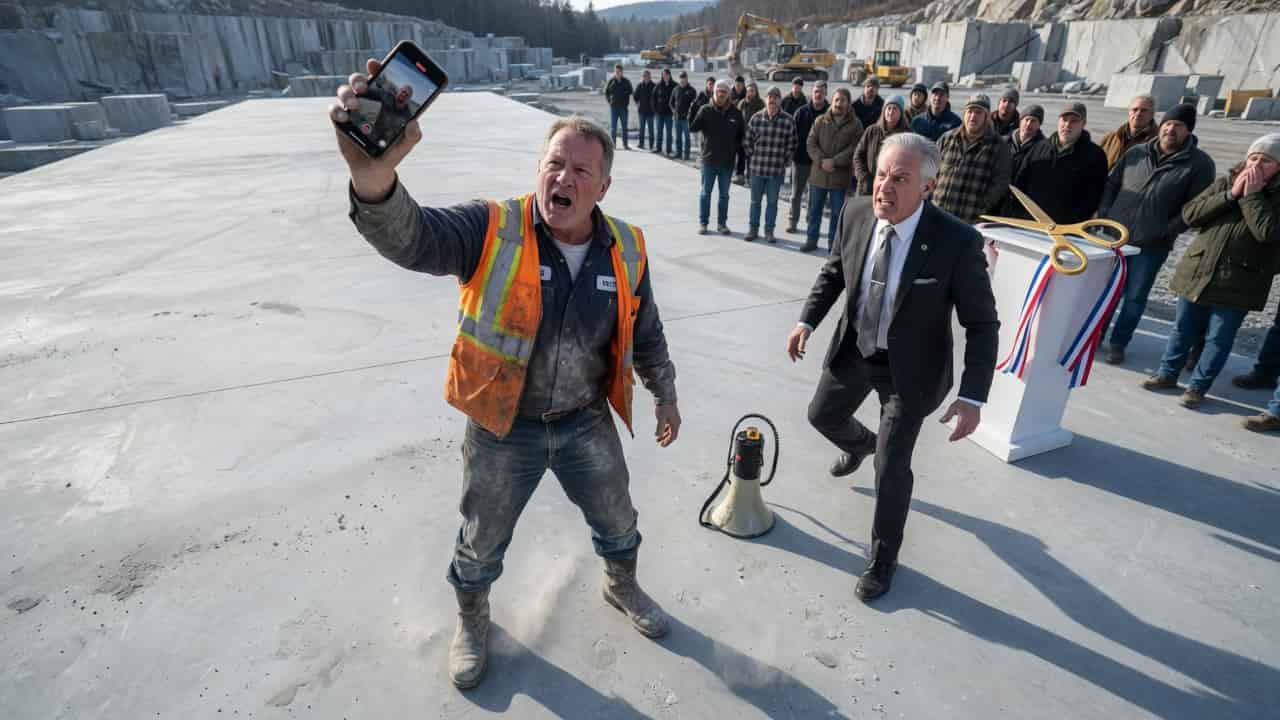
“She’s under your feet, Vance. Every single inch of this building is sitting on the daughter you told us ran away.”
Miller didn’t care about the cameras or the local police standing by the catering tent. He didn’t care that he was just a man who moved rocks for a living while Vance Sterling owned the very air they breathed in this valley. He only cared about the cracked smartphone in his hand—the one he’d found buried in the wet pour three days ago.
The crowd went silent as Miller kicked the megaphone across the concrete. He wasn’t looking at the townspeople; he was watching the way the color drained from Sterling’s face, turning the powerful man into a ghost before he even stopped breathing.
“You told the sheriff she hopped a bus to Burlington,” Miller said, his voice vibrating with a decade of unspent grief. “You let my wife wither away to nothing believing our girl just didn’t love us enough to stay. But the concrete doesn’t lie, Vance. And neither does her phone.”
When the recording started to play over the speakers, the sound of a terrified girl’s voice filled the quarry, and the most respected man in Vermont realized that the building he built to be his legacy was about to become his tomb.
Chapter 1
The Silver Lining quarry didn’t just take your time; it took the moisture from your joints and the light from your eyes. It was a three-hundred-foot hole in the Vermont earth, a jagged amphitheater of gray granite that smelled of diesel exhaust and ancient, wet stone. Miller had spent twenty-four years at the bottom of that hole, operating the 994K loader, moving blocks of stone the size of suburban garages. His hands were mapped with scars that had long since turned into slick, white ridges, and his hearing was a fading radio signal, permanently damaged by the rhythmic thump-thump-thump of the hydraulic breakers.
It was a Tuesday, the kind of morning where the fog sat heavy in the basin, clinging to the machinery like a cold sweat. The company was in a rush. Vance Sterling, the man whose name was etched into the gate and whose shadow fell over every dinner table in North Bradley, was building his “Legacy Center.” It was a glass-and-steel monstrosity designed to sit right on the lip of the quarry, overlooking the pit that had made him the richest man in the state.
Miller was working the late pour. Usually, he stayed in the pit, but they were short-handed on the foundation crew. The concrete trucks were lined up like a funeral procession, their drums rotating with a wet, heavy slosh.
“Keep it moving, Miller! We’re behind!”
That was Silas, the site foreman. Silas was a man who had traded his soul for a pension ten years ago and spent his days licking Sterling’s boots. He stood on the edge of the wooden forms, checking his watch every thirty seconds.
Miller didn’t answer. He never did. He just adjusted the chute, watching the gray slurry pour into the deep trench. This was the main load-bearing pillar for the south wing. It was deep—twelve feet of rebar and darkness.
As the concrete swirled, something caught the light.
At first, Miller thought it was a piece of discarded slag or a bit of broken glass from a beer bottle some idiot had tossed into the forms. But the sun hit it just right as the wet mix shifted. It was a rectangular glint. Metallic.
He didn’t think. He reached.
“Hey! What the hell are you doing?” Silas yelled, stepping toward him. “Don’t you touch that pour!”
Miller ignored him, his fingers plunging into the cold, caustic muck. His skin burned immediately—wet concrete was like lye—but he closed his hand around the object. He pulled it out, his arm coated in gray slime up to the elbow.
It was a phone. An old model, the screen spiderwebbed with cracks, the casing a faded, muddy purple.
Miller’s heart didn’t shatter. It stopped. He knew that purple. He had bought that phone at a mall in Burlington for a girl’s fourteenth birthday. He had paid for the insurance plan she’d never used because she was careful. She was so damn careful.
“Give me that,” Silas said, reaching out, his voice suddenly losing its edge and turning into something sharp and panicked. “It’s trash, Miller. Just junk in the mix. Let it go.”
Miller stepped back, the concrete dripping from his arm onto his boots. He looked at the phone, then up at the lip of the quarry. Three years ago, Chloe had gone missing. The police—Sterling’s police—had found her car at the bus station. They’d found a note in her bedroom that didn’t sound like her, saying she was tired of the cold, tired of the dust, tired of him.
But Chloe never went anywhere without this phone.
“Where did this come from, Silas?” Miller asked. His voice was a low growl, the sound of a machine starting up after a long winter.
“I don’t know! It’s a construction site, for Christ’s sake! People lose things!” Silas was sweating now, despite the fifty-degree morning. He looked over his shoulder toward the main office trailer where Sterling’s black SUV was parked. “Just throw it back in. We have a schedule.”
Miller didn’t throw it back. He wiped the screen with his vest, smeared the gray lime across the glass. Underneath the muck, tucked into the edge of the protective case, was a small, laminated sticker of a sunflower.
Chloe’s favorite.
The world around Miller began to tilt. The roar of the engines, the hiss of the air brakes, the distant scream of the saws—it all faded into a white noise. He looked down into the wet, gray throat of the foundation.
If the phone was here, she wasn’t in Burlington. She wasn’t in a warm city enjoying the life she’d supposedly run away to.
“Miller, I’m telling you as a friend,” Silas said, stepping closer, his hand dropping to Miller’s shoulder. It was a heavy, controlling grip. “Put it back. You don’t want to dig this up. You don’t want to know what’s under there. Think about your pension. Think about Sarah.”
Miller looked at Silas’s hand. Then he looked at Silas’s eyes. He saw the flicker of a secret there, a dark, oily thing that had been hidden for three years.
“My daughter is in there,” Miller whispered. It wasn’t a question.
“You’re crazy,” Silas spat, but he backed away. “You’re off the clock. Go home, Miller. Go home and wash that shit off your arm before it eats through your skin.”
Miller didn’t go home. He walked to his truck, the purple phone clutched in his hand like a holy relic, while behind him, the trucks kept pouring, burying the truth under another six inches of stone and cement.
Chapter 2
The house was too quiet. It had been too quiet for one thousand and ninety-six days.
Miller sat at the kitchen table, a bottle of isopropyl alcohol and a box of Q-tips in front of him. He worked with the precision of a watchmaker, cleaning the concrete from the charging port of the purple phone. His arm burned where the lime had irritated the skin, a red, angry rash forming, but he didn’t feel it.
Sarah was in the living room. He could hear the low hum of the television—some shopping channel she watched not to buy things, but to fill the air with human voices. She hadn’t been the same since the police brought that note to the door. She’d shrunk. Her skin had turned the color of parchment, and her eyes always seemed to be looking at something three feet behind him.
“Miller?” she called out. Her voice was thin, like a wire about to snap. “Is that you?”
“Yeah,” he said, his voice cracking. “Just… working on something from the shop.”
He couldn’t tell her. Not yet. If he gave her hope and it turned out to be a fluke—some other girl with the same phone, the same sticker—it would kill the little bit of her that was left.
He plugged the phone into a charger. Nothing happened. He waited, his breath hitching in his chest. A minute passed. Two. The black screen mocked him, reflecting his own haggard, desperate face.
Come on, he pleaded silently. Come on, Chloe. Talk to me.
Then, a flicker. A battery icon appeared, red and depleted.
Miller let out a breath he felt he’d been holding for three years. He stayed there for an hour, watching the percentage climb. 10%. 20%. At 30%, he couldn’t wait anymore. He pressed the power button.
The screen glowed. The wallpaper was a photo of the three of them at the county fair. Chloe was in the middle, holding a massive wad of blue cotton candy, her eyes crinkled with a laugh that Miller could almost hear. He touched the screen, his thumb covering her face.
The phone wasn’t locked. Chloe had always complained about the passcode, saying she had nothing to hide.
He went straight to the messages. His hands were shaking so hard he almost dropped the device. He scrolled past his own hundreds of unanswered texts—Where are you? Please call me. Your mother is sick with worry. Please, Chloe.
He looked for the last sent message.
It wasn’t to him. It wasn’t to Sarah. It was to a number he didn’t recognize.
I’m at the quarry. I saw what you did with the ledger. I’m calling my dad.
The timestamp was 10:42 PM, October 14th. The night she vanished.
Miller felt a cold, sharp blade of reality slide between his ribs. The ledger. Everyone knew Sterling kept two sets of books—one for the IRS and one for the “extra-curriculars” that kept the town council in his pocket. Chloe had been interning at the main office that autumn. She was smart. She was too smart.
He opened the unsent drafts. There was only one.
Dad, help. He’s following me near the old crusher. Please come—
The message ended there.
Miller stood up so fast his chair clattered to the floor. The sound brought Sarah to the doorway. She looked at him, then at the glowing purple phone in his hand. Her eyes widened, the pupils pinpricks of sudden, terrifying clarity.
“Is that…” she started, her voice a ghost of a scream.
“I found it, Sarah. In the pour. In the foundation of the new building.”
Sarah didn’t cry. She didn’t collapse. She walked over to the table and sat down in his chair, her hands folded neatly as if she were waiting for a meal. “They killed her,” she said. It wasn’t a question. It was a statement of fact she had been carrying in her marrow for three years. “Vance Sterling killed our daughter and put her in a hole.”
“I’m going to the police,” Miller said, reaching for his jacket.
“The police?” Sarah laughed, and it was the most horrible sound Miller had ever heard. “Sheriff Miller’s brother-in-law is the head of Sterling’s security. The deputies drive trucks Sterling paid for. You go there, and that phone will disappear before you hit the sidewalk.”
Miller stopped, his hand on the doorknob. She was right. North Bradley wasn’t a town; it was a fiefdom.
“I have to do something,” Miller said. “I can’t just let her stay there. Not under that building.”
“You found the phone,” Sarah said, looking up at him. For the first time in years, there was something other than grief in her eyes. There was a hard, cold light. “That means he missed it. He was in a hurry, or he was arrogant. He thinks he’s won.”
“He hasn’t,” Miller said.
He walked out the back door and headed for his tool shed. He didn’t know exactly what he was looking for until he saw the heavy wooden crate tucked under a pile of burlap sacks. It was a leftover from a private blasting job he’d done five years ago—industrial-grade dynamite and a handful of blasting caps.
He’d kept it “just in case.” He’d never known the “case” would be his own daughter’s grave.
He sat on the dirt floor of the shed, the purple phone in his pocket, and began to check the fuses. He was a heavy-machinery operator. He knew how to move earth. And he knew that if you wanted to see what was buried in the foundation, you had to break the house first.
Chapter 3
The next morning, Miller went back to the quarry. He had to. If he stayed away, they’d know.
He walked into the break room, his boots echoing on the linoleum. The air was thick with the smell of burnt coffee and the quiet, desperate murmurs of men who knew they were being squeezed but couldn’t afford to scream.
At the far table sat Leo.
Leo was twenty-two, a kid from the tech school who’d been hired as a surveyor’s assistant. He was the one who’d been on the lip of the quarry the night Chloe disappeared. Miller remembered seeing him in the background of the police interviews, his face pale, his eyes darting toward Sterling every time the Sheriff asked a question.
Miller grabbed a cup of coffee and sat down directly across from the boy. Leo froze, a piece of toast halfway to his mouth.
“Morning, Leo,” Miller said.
“Miller. Hey. Sorry about… you know. Yesterday. Silas said you had a bit of a breakdown.”
“Did he?” Miller leaned forward, the steam from his coffee rising between them. “Is that what we’re calling it now? Seeing things that shouldn’t be there?”
Leo looked around the room. The other workers were engrossed in their own business, but the tension was a physical thing, a wire stretched tight across the table. “I don’t want any trouble, Miller. I’m just trying to get my hours.”
“You were there, Leo. That night. You were checking the grade on the south lip.”
Leo’s hand started to shake. He put the toast down. “It was dark. I didn’t see anything.”
“I found her phone, Leo. In the south wing foundation. Right where you were working.”
Leo’s face went from pale to gray. He looked like he was going to vomit. “I can’t talk to you. He’ll kill me. He told me if I ever said a word, my mom’s house would be leveled for a ‘drainage easement.'”
“He’s one man, Leo. He’s not a god.”
“In this town, he is,” Leo whispered. He leaned in, his voice barely audible over the hum of the vending machine. “She wasn’t dead when he put her in the truck, Miller. She was screaming. He told me she’d just tripped, that he was taking her to the hospital. But he didn’t go toward the highway. He went toward the concrete plant.”
Miller felt a wave of nausea so powerful he had to grip the edge of the table to keep from falling. She wasn’t dead. The words echoed in his head, a rhythmic torture. She’d been alive. She’d been scared. And she’d looked for him, and he hadn’t been there.
“Why didn’t you say anything?” Miller asked. His voice was no longer a growl; it was a hollow, broken thing.
“I was nineteen! He had the Sheriff right there with him! What was I supposed to do?” Leo was crying now, silent tears tracking through the dust on his cheeks. “I’ve been sick every day for three years. I watch that building go up and I know… I know she’s the heart of it.”
“I’m going to take it down,” Miller said.
Leo looked at him, his eyes wide. “You can’t. There’s security. There’s cameras.”
“I know the blind spots, Leo. I’ve been in this pit longer than those cameras have been alive.”
Miller stood up. He didn’t feel the fatigue anymore. He didn’t feel the ache in his knees. He felt like a piece of the granite he’d spent his life moving—hard, cold, and impossible to break.
He spent the rest of the shift moving stone, but his mind was elsewhere. He was calculating the load-bearing points of the new building. He was thinking about the dynamite in his shed. He was thinking about the ribbon-cutting ceremony.
It was scheduled for Thursday. Two days away. The Governor was coming. The press. The whole town would be there to celebrate the “New Era of North Bradley.”
Sterling wanted a stage. Miller was going to give him a pedestal.
As he drove home, he saw Silas’s truck following him. It stayed two cars back, a silent threat in the rearview mirror. When Miller pulled into his driveway, Silas didn’t stop. He just slowed down, his eyes visible through the windshield, watching.
Miller went inside and locked the door. He went to the shed and moved the dynamite into a heavy tool chest. He began to wire the timers. He wasn’t a terrorist. He was a father. And in the twisted logic of North Bradley, this was the only way to get a witness to speak.
He sat in the dark of the shed, the purple phone on the workbench in front of him. He played the unsent message over and over.
Dad, help.
“I’m coming, baby,” he whispered into the dark. “I’m coming to get you out.”
Chapter 4
The morning of the ceremony broke cold and clear. The kind of day that looked beautiful in a brochure but felt like a slap in the face if you had to work in it.
North Bradley was out in force. There were balloons tied to the quarry gates, and a high school band was playing something upbeat and out of tune near the catering tent. Vance Sterling stood on the temporary stage, looking every bit the savior of the valley. He was wearing a suit that cost more than Miller’s truck, shaking hands with the Governor and laughing with the local priest.
Miller stood at the edge of the crowd, his work vest on, his hands deep in his pockets. He felt the weight of the phone in one pocket and the remote detonator in the other.
He’d spent the night under the foundation. He’d crawled through the crawlspaces and the drainage pipes he’d helped install twenty years ago. He knew where the vulnerabilities were. The dynamite was nestled against the main pylon—the one where he’d found the phone.
“You look like hell, Miller.”
It was Silas. He was wearing a “Staff” lanyard, his face tight with a mix of authority and fear.
“Just a long night,” Miller said.
“Sterling wants to see you. After the speech. He says he has a ‘bonus’ for your years of service. He’s feeling generous.”
“Is he?” Miller looked at the stage. Sterling was stepping up to the microphone. The crowd began to cheer.
“Just stay quiet, Miller,” Silas hissed. “One more hour and you’re set for life. Just let the girl go. She’s gone. This doesn’t bring her back.”
“You’re right, Silas. It doesn’t bring her back. But it stops her from being a floorboard.”
Miller walked away before Silas could respond. He pushed through the crowd, ignored the “Authorized Personnel Only” signs, and stepped onto the concrete foundation. It was a massive, flat expanse of gray stone, polished to a mirror finish.
The Governor was finishing his remarks. “…and so, I give you the man who made this possible, the heartbeat of our county, Vance Sterling!”
The applause was thunderous. Sterling stepped to the podium, his smile wide and fake.
“Thank you,” Sterling said, his voice booming over the speakers. “This building isn’t just steel and stone. It’s a promise. A promise that North Bradley will never be forgotten. We build on the past to reach the future.”
Miller stepped forward, his boots loud on the concrete. He wasn’t supposed to be there. The security guards at the edge of the stage started to move, their hands going to their radios.
“Vance!” Miller shouted.
The crowd went silent. The high school band stopped mid-note. Sterling froze, his hand on the ceremonial scissors.
“Miller?” Sterling said, his voice smooth but his eyes turning into chips of ice. “This is a private moment. Why don’t you wait in my office?”
“I think the people should hear the promise, Vance,” Miller said. He pulled the orange megaphone from behind a stack of crates and set it on the ground. He held up the purple phone.
“Is that a phone, Miller?” Sterling laughed, a dry, nervous sound. “We’re all very impressed.”
“It’s Chloe’s phone, Vance. I found it in the concrete. Right under where you’re standing.”
A murmur rippled through the crowd. People looked at each other, the name Chloe hanging in the air like a bad omen.
“The man is grief-stricken,” Sterling said, turning to the Governor. “He’s had a hard time. Someone help him down.”
Two security guards lunged for Miller.
Miller didn’t flinch. He kicked the megaphone toward the front of the stage and hit the play button on the phone.
“She’s under your feet, Vance!” Miller screamed over the sudden scuffle. “She’s right there! Listen to her voice and tell them I’m lying!”
The grainy, terrified voice of a fourteen-year-old girl blasted through the speakers, magnified by the megaphone.
“Dad, help… he’s following me… Mr. Sterling, please, I won’t tell… I promise… please don’t—”
The sound was cut off as a guard tackled Miller, sending the phone skidding across the concrete.
But it was too late. The silence that followed was heavier than any stone in the quarry. The townspeople weren’t cheering anymore. They were looking at the pristine gray foundation. They were looking at Vance Sterling, who was standing perfectly still, the ceremonial scissors shaking in his hand.
Miller looked up from the ground, his face pressed against the cold concrete. He saw Leo in the front row, his hard hat on the ground, his face covered in tears.
“Tell them, Leo!” Miller roared. “Tell them what you saw!”
Sterling looked at Leo, his eyes a silent death threat. The power imbalance in the room was a physical weight, a mountain pressing down on a single, scared kid.
“I…” Leo started, his voice failing.
The Sheriff stepped forward, his hand on his holster. “That’s enough, Miller. You’re under arrest for disturbing the peace and… and whatever else I can think of.”
“Look at his face!” Miller shouted, pointing at Sterling. “Look at him!”
Sterling wasn’t looking at the crowd. He was looking at the phone, which had stopped near his polished black shoes. For a second, the mask slipped. The “savior of the valley” disappeared, and all that was left was the man who had followed a girl into the dark.
“It’s a hoax,” Sterling said, his voice thin. “A digital fabrication. Miller is a sick man.”
He looked at the Sheriff. “Get him out of here. Now.”
As the guards dragged Miller toward the edge of the foundation, he felt the remote detonator in his pocket. He hadn’t used it. Not yet. He’d wanted the truth first. But as he saw the Sheriff picking up the purple phone, saw the way Sterling was regaining his composure, Miller realized the truth wasn’t enough.
In North Bradley, you didn’t just need the truth. You needed the hole.
“One more chance, Vance!” Miller yelled as they shoved him toward the police cruiser. “Tell them where she is, or I’ll show them myself!”
Sterling didn’t answer. He just turned back to the Governor and forced a smile, while under the foundation, the red light on the timer began to blink.
Chapter 5
The interior of the Sheriff’s cruiser smelled of stale coffee, cheap upholstery cleaner, and the metallic tang of a man who had long ago sold his dignity for a steady paycheck. Miller sat in the back, his wrists cuffed in front of him—a mistake born of the Sheriff’s haste and a lingering, misplaced sense of familiarity. They had played Little League together forty years ago. They had shared beers at the VFW. But as the cruiser pulled away from the gleaming gray expanse of the foundation, the distance between them was wider than the quarry itself.
Through the reinforced glass, Miller watched the Legacy Center shrink in the side mirror. The crowd was a chaotic swarm of color against the monochromatic granite. He could see Sterling on the stage, a tiny, dark figure gesturing wildly, trying to stitch the veil of his reputation back together.
“You’re a fool, Miller,” Sheriff Ben Reed said, his eyes fixed on the dirt road ahead. He didn’t look in the rearview mirror. He couldn’t. “You had twenty years of a clean record. You had a pension waiting. Now? Now you’re just the crazy old man who ruined the biggest day in the county’s history.”
Miller didn’t answer. He was feeling the hard, rectangular shape of the remote detonator pressed against his thigh, hidden in the deep pocket of his work trousers. His fingers, calloused and thick, twitched. He wasn’t thinking about his pension. He was thinking about the way Chloe used to hum when she was doing her homework, a soft, mindless sound that filled the house with a sense of safety he hadn’t realized was a luxury.
“Sterling’s going to bury you,” Reed continued, his voice rising, seeking a justification Miller wouldn’t give him. “He’s already calling the state AG. They’ll say that recording was a deepfake. They’ll say you’re a grieving father who lost his mind. And honestly, looking at you right now, who’s going to disagree?”
“Is that what you’re going to tell Sarah?” Miller asked. His voice was sandpaper on stone. “When you go to the house to tell her I’m in a cell, are you going to look her in the eye and tell her our daughter is just a ‘fabrication’?”
Reed’s grip tightened on the steering wheel until his knuckles turned the color of the granite dust. “I’m doing my job, Miller. I’m keeping the peace.”
“The peace,” Miller spat. “You call it peace because the screaming stopped three years ago. But the ground remembers, Ben. The stone doesn’t forget.”
Miller shifted his weight, his cuffed hands reaching into his pocket. His fingers found the toggle switch. It was a simple industrial trigger, designed for clearing blockages in the primary crusher. One flick for the secondary charges. One button for the main event.
He didn’t want to kill anyone. He wasn’t a murderer. But he knew the structural integrity of the south pylon. He had reinforced it himself. He knew that if he blew the secondary charges—the ones he’d placed in the drainage vents—it wouldn’t bring the building down, but it would crack the foundation. It would open the earth. It would force them to look.
“Stop the car, Ben,” Miller said.
“Shut up, Miller.”
“Stop the car, or the whole valley is going to hear what a three-year-long lie sounds like when it breaks.”
Reed finally looked in the mirror. He saw Miller’s hand in his pocket. He saw the grim, absolute certainty in Miller’s eyes—the look of a man who had already decided he was never coming home.
“What do you have in your pocket?” Reed’s voice went thin, the bravado evaporating.
“The truth,” Miller said.
He flicked the toggle.
The explosion wasn’t a roar; it was a deep, subterranean thump that vibrated through the floor of the cruiser. A second later, the sound caught up—a sharp, cracking report that echoed off the quarry walls like a gunshot in a cathedral. In the distance, a plume of gray dust erupted from the base of the Legacy Center, rising into the clear blue sky like a signal fire.
Reed slammed on the brakes, the cruiser skidding sideways on the gravel. He stared out the window, his mouth hanging open. “What did you do? Miller, what did you do?”
“I opened the door,” Miller said.
Behind them, the ceremony had dissolved into a panicked stampede. The high school band had scattered, instruments abandoned on the grass. The Governor’s security detail was hustling him toward a waiting Suburban. And there, in the center of the cracking concrete, stood Vance Sterling. He wasn’t moving. He was staring at the jagged fissure that had just appeared at his feet, a black lightning bolt splitting the pristine gray surface.
“Drive back,” Miller commanded.
“I can’t—I have to call for backup—I have to—”
“Drive back, Ben! Or I hit the main charge. The one under the stage. The one that will take every single lie you’ve told and turn it into dust.”
Reed was shaking now, his professional veneer completely shattered. He put the car in reverse, the tires spitting gravel as he spun the cruiser around.
As they neared the site, the scale of the damage became clear. The secondary blast had blown out the retaining wall of the south wing. The concrete hadn’t just cracked; it had slumped, revealing the twisted rebar and the dark, hollow spaces beneath the pour.
Miller kicked the door open before the car had even fully stopped. He stumbled out, his cuffs clinking, and started walking toward the fissure.
Sterling saw him coming. The man looked diminished, his expensive suit covered in a fine layer of gray dust. He was holding the purple phone, his thumb hovering over the screen as if he could delete the reality of the last ten minutes.
“You’re a dead man, Miller!” Sterling screamed, his voice cracking with a high-pitched, desperate frequency. “I’ll have you under the prison! I’ll destroy everything you’ve ever touched!”
“You already did,” Miller said, stopping at the edge of the crack.
The dust was settling. The smell of cordite and pulverized stone was thick in the air. Miller looked down into the dark gap. He could see the layering of the concrete—the different pours, the shortcuts they’d taken to meet the deadline. And there, wedged between a support beam and a mass of hardened slurry, was something that didn’t belong in a building.
It was a scrap of fabric. Faded denim.
Miller felt a coldness spread from his chest to his fingertips, a numbness that was the only thing keeping him standing. He didn’t look at Sterling. He didn’t look at the Sheriff, who was standing ten feet back with his gun drawn but pointed at the ground.
He looked at the crowd, which had stopped running. They were gathered at the edge of the police line, a silent wall of witnesses. He saw Leo standing at the front, his face ashen, his body trembling.
“Leo!” Miller called out, his voice echoing in the sudden, terrible silence of the quarry. “The grade is wrong, isn’t it? Tell them why the south pylon shifted.”
Leo looked at Sterling. He looked at the Sheriff. Then he looked at the denim in the crack.
“He told me to ignore the anomaly,” Leo whispered, his voice gaining strength as it traveled across the concrete. “He said it was just a shifting of the backfill. But it wasn’t. I saw the shape before the trucks came. I saw what he was trying to hide.”
“You’re lying!” Sterling shrieked, stepping toward the boy. “I’ll sue you into the dirt! I’ll—”
“Shut up, Vance,” Sheriff Reed said.
The gun in the Sheriff’s hand didn’t move, but his voice had changed. The weight of the badge, the weight of the forty years of friendship, the weight of the denim in the crack—it had finally tipped the scales.
“Miller,” Reed said, looking at the cuffed man. “Give me the remote.”
“Not until she’s out,” Miller said. “Not until everyone sees.”
He turned back to the crowd, to the town that had lived off Sterling’s money and looked away from his shadows. “I spent twenty years moving this mountain for him,” Miller said, gesturing to the quarry. “I broke my back making him a king. And he repaid me by using my daughter as gravel.”
He looked directly at the local news camera that was still rolling, the red light a tiny, unblinking eye.
“My name is Miller. And I’m going to finish the pour.”
He didn’t wait for a response. He walked toward the line of heavy machinery parked near the edge of the pit. He knew the keys to the 994K loader were in the sun visor. He knew the controls better than he knew the lines on his own palms.
As he climbed into the cab, the Sheriff didn’t stop him. The security guards didn’t move. Even Sterling just stood there, his mouth working silently, a man watching his empire crumble one inch at a time.
Miller started the engine. The 994K roared to life, a deep, rhythmic thrumming that shook the very foundation of the Legacy Center. He engaged the bucket. He wasn’t going to build anymore. He was going to dig.
Chapter 6
The 994K loader was a beast of a machine, a five-hundred-ton titan of steel and hydraulics that could move the world if you gave it enough diesel. Inside the cab, the vibration was a comfort to Miller, a familiar, honest frequency that drowned out the sirens and the shouting. He settled into the seat, his cuffed hands gripping the joysticks with a practiced, agonizing grace.
He swung the massive bucket around, the teeth of the steel scraping against the polished concrete. The sound was like a scream—the protest of the “Legacy” as it was torn apart.
The first strike didn’t do much more than scar the surface. Miller reversed, the engine growling, and then lunged forward, the full weight of the loader behind the blow. The concrete buckled. A section of the south wing’s flooring collapsed into the hollow space he’d created with the dynamite.
Through the glass of the cab, Miller saw the Sheriff trying to hold back the crowd. They weren’t running away anymore. They were pressing forward, drawn by the macabre spectacle of a man destroying his life’s work to find his life’s meaning.
Sterling was screaming at the edge of the pit, his face purple, his veins standing out like cords. He was trying to get to the loader, but Silas was holding him back. Even Silas, the loyal dog, seemed to have realized that the hunt was over.
Miller didn’t care about the noise. He was focused on the stone. He moved the bucket with the delicacy of a surgeon, peeling back the layers of the foundation. He cleared the rubble, the twisted rebar snapping like dry twigs. Each pass of the loader brought him closer to the pylon, to the place where the denim had been glimpsed.
He worked for an hour. The sun climbed higher, casting long, harsh shadows across the granite basin. The state police arrived, their blue and red lights flashing against the gray walls of the quarry, but they didn’t intervene. They stood with the Sheriff, watching the 994K methodically dismantle the million-dollar building. Perhaps they saw the dynamite strapped to the main supports. Perhaps they finally realized that some truths were too heavy to be suppressed by a badge.
Miller stopped the loader when he reached the core of the south pylon. He lowered the bucket and stepped out of the cab. His legs were heavy, his heart a leaden weight in his chest. He walked toward the hole he’d dug, the dust settling on his hair like ash.
The crowd went silent as he knelt at the edge of the excavation.
He didn’t need the loader for this part. He used his hands. He cleared away the smaller chunks of concrete, the sharp edges cutting his palms, his blood mixing with the gray dust. He felt the Sheriff kneel beside him, the metallic click of the handcuffs being unlocked.
“I’ve got it, Miller,” Reed whispered. “Let me help.”
Miller didn’t look at him. He just kept digging.
And then, he found her.
It wasn’t like the movies. There was no peaceful repose, no cinematic dignity. There was only the reality of the stone and the passage of time. But as Miller cleared the last of the debris, he saw the small, silver locket she’d worn every day—the one that held a photo of her as a toddler, and a tiny, pressed sunflower.
Miller didn’t scream. He didn’t cry. He simply laid his forehead against the cold, unyielding concrete and let out a long, shuddering breath. The weight that had been pressing down on him for three years—the weight of the mountain, the weight of the silence—didn’t lift. It simply shifted, becoming a part of him, a permanent topography of his soul.
“She’s home,” he whispered.
He felt hands on his shoulders, pulling him back. The forensics team moved in, their white suits stark against the gray granite. They worked with a quiet, clinical efficiency, treating the site with a respect that had been missing for three long years.
Miller stood up and turned around.
Vance Sterling was being led toward a police cruiser. He wasn’t screaming anymore. He looked small. He looked like what he was—a man who had traded his humanity for a pile of rocks and a name on a gate. As he passed Miller, their eyes met for a single, fleeting second. Miller didn’t see a monster. He saw a coward. He saw a man who had been so afraid of losing his empire that he had buried his soul in the foundation.
“You’ll never leave this valley, Vance,” Miller said. It wasn’t a threat. It was a prophecy. “Every time you close your eyes, you’ll hear the concrete pouring. Every time you breathe, you’ll taste the dust.”
Sterling looked away, his head bowing as he was shoved into the back of the car.
Miller walked toward the edge of the quarry, away from the cameras, away from the crowd, away from the wreckage of the Legacy Center. He looked down into the three-hundred-foot hole, the jagged theater of his life.
Sarah was there, at the very edge of the police line. She was leaning against their old truck, her face a mask of exhaustion and something that might have been peace. Miller walked to her and took her hand. Her skin was cold, but her grip was firm.
“We found her,” he said.
“I know,” Sarah replied.
They stood there for a long time, watching the activity at the site. The news vans were packing up, their satellites folding down like the wings of predatory birds. The townspeople were drifting away, returning to their lives in the valley, lives that would never be quite the same. The silence of the quarry had been broken, replaced by a new, more difficult truth.
“What now?” Sarah asked.
Miller looked at his hands—the scars, the concrete dust, the blood. He looked at the 994K loader, sitting idle in the center of the ruins.
“Now we bury her properly,” Miller said. “Somewhere with sun. Somewhere where the ground doesn’t have a price tag.”
He turned his back on the quarry, on the Silver Lining, on the twenty-four years of moving mountains. He walked toward the truck, his boots crunching on the gravel, a man who had finally finished the job he never wanted to do.
The building would be torn down. The company would be liquidated. The town would struggle, and then it would find a new way to survive. But as Miller drove out of the gates for the last time, he didn’t look back. He kept his eyes on the road ahead, the purple phone sitting on the dashboard, its screen dark, its message finally delivered.
The stones would always be there. The granite would always be cold. But as the sun set over the Vermont hills, casting a long, golden light over the valley, Miller realized that the weight was finally shared. He wasn’t the only one who knew what was under the feet of North Bradley. And in the end, that was the only legacy that mattered.