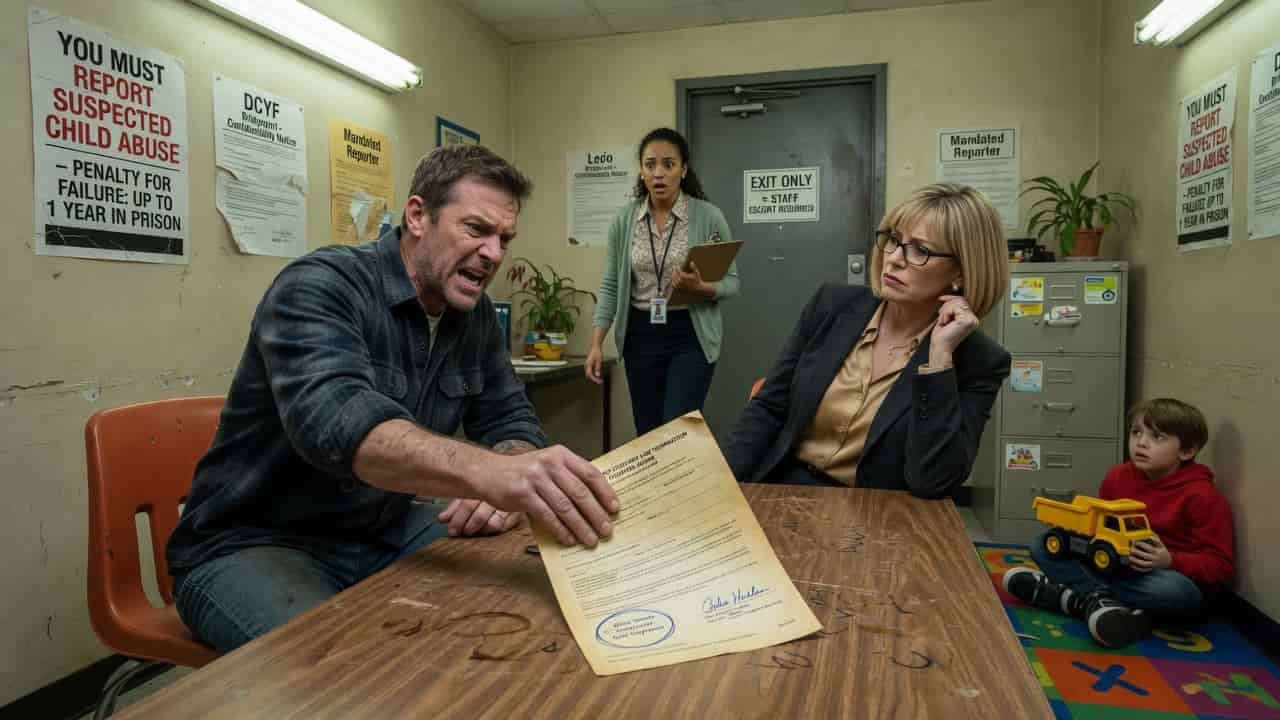
“You’re just a foster-kid who never grew up, Gabe. Look at you. You can’t even afford the gas to get to this hearing.”
Gabe didn’t move. He didn’t shout. He just sat there in that cold, fluorescent-lit room while Sheila Thorne, the woman holding his son’s life in her hands, picked lint off her charcoal blazer. She looked at him like he was something she’d found on the bottom of her shoe. In the corner of the room, six-year-old Leo was clutching a toy truck, his eyes darting between the father he loved and the woman who had spent the last six months convincing the state that Gabe was a ghost.
“He’s with a family now that can give him a legacy,” Sheila continued, her voice like ice. “People with a name. Not a man who spends his days pouring concrete and his nights in a trailer.”
Gabe reached into his pocket. His hands were shaking, not from fear, but from the kind of rage that burns a man’s soul clean. He pulled out a single, crumpled sheet of paper—the document they claimed he’d signed six months ago, surrendering his parental rights.
“I was in foster care, Sheila. I know what the system does to kids,” Gabe said, his voice a low, dangerous rumble. He slammed the paper onto the table, right under her nose. “But I also know my own handwriting. I never signed this. And I know exactly how much that ‘legacy’ family paid you to make sure I didn’t.”
The room went deathly silent. Even the junior social worker by the door stopped breathing.
He had the proof. He had the names. And now, he was going to burn their gated world to the ground to get his boy back.
Chapter 1
The morning they took Leo, the air in Bridgeport tasted like wet pavement and impending rain. It was 7:14 AM. Gabe was standing at the kitchen counter, packing a ham sandwich into a plastic container for Leo’s lunch, when the first heavy rap hit the door. It wasn’t a neighbor’s knock. It was the rhythmic, authoritative pound of someone who owned the sidewalk they stood on.
“Gabe? It’s the police. Open up.”
Gabe froze, the butter knife still slick with mayo. He looked at Leo, who was sitting at the small, scarred wooden table, methodically picking the marshmallows out of a bowl of Lucky Charms. Leo was six, with Gabe’s messy brown hair and a pair of eyes that seemed too large for his face.
“Finish your cereal, buddy,” Gabe said, his voice sounding thin even to his own ears.
He wiped his hands on his jeans and walked to the door. When he opened it, the humidity of the Connecticut morning pushed inside, followed by two uniformed officers and a woman Gabe had never seen before. She was wearing a beige trench coat that looked like it cost more than Gabe made in a month of framing houses. Her eyes were shielded by tortoise-shell glasses, and she held a clipboard like a shield.
“Gabriel Vance?” the woman asked. She didn’t wait for an answer. She stepped past him, her heels clicking sharply on the linoleum. “I’m Sheila Thorne with the Department of Children’s Services. We’ve received a report of immediate endangerment regarding Leo Vance.”
“Endangerment?” Gabe’s heart did a slow, painful roll in his chest. “What are you talking about? He’s eating breakfast. We’re going to school in twenty minutes.”
“We have a signed affidavit,” Sheila said, her voice a flat, practiced monotone. She didn’t look at Gabe; she was scanning the room, her eyes lingering on the overflowing laundry basket in the corner and the sink full of dishes from the night before. “Allegations of neglect, unstable housing, and a history of… behavioral issues on your part. There’s a court order for emergency removal.”
Gabe felt the world tilt. “Behavioral issues? I haven’t had a drink in three years. I work sixty hours a week. Who said this? Who signed an affidavit?”
One of the officers, a man Gabe recognized from the local precinct named Miller, looked down at his boots. “Sorry, Gabe. We just have the order. We have to take him.”
“You aren’t taking him anywhere!” Gabe’s voice rose, a jagged edge of the old Bridgeport street kid cutting through.
Leo dropped his spoon. It hit the floor with a plastic clatter. The boy scrambled out of his chair and ran to Gabe, burying his face in Gabe’s thigh, his small fingers hooking into the loops of his father’s work pants.
“Daddy?”
“It’s okay, Leo. Just a misunderstanding,” Gabe whispered, placing a heavy, calloused hand on the back of the boy’s head. He looked at Sheila Thorne. “You’re making a mistake. Look at him. He’s healthy. He’s fine.”
Sheila finally looked at him. It wasn’t a look of concern; it was a look of clinical assessment. To her, Gabe wasn’t a father. He was a case file. He was a demographic: single male, blue-collar, former ward of the state. He saw the way she looked at his tattooed forearms—the ink he’d gotten in his late teens when he was trying to look harder than he felt. He saw her register the dent in the drywall where he’d tripped over a boot last week.
“Mr. Vance, if you resist, the officers will be forced to restrain you in front of the child,” Sheila said. She stepped toward Leo and reached out a hand. “Come on, Leo. We’re going to go for a little ride. We have some toys for you.”
“No!” Leo shrieked, his grip tightening on Gabe’s leg.
“Don’t touch him,” Gabe growled.
Officer Miller stepped forward, placing a hand on Gabe’s shoulder. “Gabe, don’t make this worse. You know how this goes. If you fight us, you lose him for good. Let him go, we’ll get it sorted at the hearing tomorrow.”
Gabe’s vision blurred. He looked down at Leo. He saw the pure, unadulterated terror in his son’s eyes. He remembered being that age. He remembered the smell of the social worker’s car—stale air freshener and old paper. He remembered the feeling of being peeled away from the only person he knew, the way his mother had screamed as they led her away in handcuffs.
He couldn’t let that happen to Leo. He couldn’t let Leo see him in cuffs.
“Leo,” Gabe said, his voice breaking. He knelt down so he was eye-level with the boy. “Listen to me. I need you to go with Officer Miller for a little bit. I’m going to go talk to some people, and I’m going to come get you. Okay? I’m going to come get you today.”
“No, Daddy! Stay!” Leo was sobbing now, the kind of deep, chest-heaving sobs that break a parent’s ribs from the inside.
“I’ll be right behind you, buddy. I promise.” Gabe gently unpried Leo’s fingers. It felt like tearing his own skin off.
Sheila Thorne didn’t wait. She grabbed Leo’s hand—not roughly, but with a firm, possessive authority—and led him toward the door. The other officer followed, carrying Leo’s backpack. Miller stayed behind for a second, his hand still on Gabe’s shoulder.
“Get a lawyer, Gabe,” Miller said quietly. “A real one. Not the public defender.”
“How am I supposed to afford a lawyer, Miller? They just took my life out the door.”
The door clicked shut. The apartment, which had been loud with the sounds of morning and cereal spoons and a six-year-old’s chatter, was suddenly, violently silent. Gabe stood in the center of the kitchen. He looked at the Lucky Charms bowl. The marshmallows were starting to melt, turning the milk a sickly, neon pink.
He didn’t cry. He couldn’t. He felt a coldness settling into his bones, a familiar, bitter weight he hadn’t felt since he was eighteen and walking out of his last foster home with everything he owned in a garbage bag. He knew the system. He knew that once the machine started grinding, it didn’t stop until it had pulverized everything in its path.
He walked over to the counter and picked up the ham sandwich. He threw it against the wall. It didn’t make a sound, just slumped to the floor, a useless pile of bread and meat.
The hearing the next day was a blur of fluorescent lights and legal jargon that felt designed to exclude him. He sat at a long table in a courtroom that smelled of floor wax and old sweat. He had a court-appointed lawyer, a woman named Claire who looked like she hadn’t slept since the nineties and spent the entire time checking her watch.
Sheila Thorne stood at the podium. She didn’t look like the woman in the trench coat anymore. She looked like a judge’s dream—professional, empathetic, and devastatingly thorough.
“Your Honor,” Sheila said, her voice echoing in the nearly empty room. “Mr. Vance has a documented history of instability. He grew up in the system himself, with multiple placements due to behavioral outbursts. His current employment is sporadic, and the home environment is… less than ideal. But more importantly, we have concerns about his temper. The neighbors have reported shouting. And given the lack of a maternal figure in the home, we believe Leo is at significant risk.”
“Shouting?” Gabe stood up, his chair screeching against the tile. “I was cheering at a football game on TV! My son is fine! He’s happy!”
“Mr. Vance, sit down,” the judge barked.
“You’re lying,” Gabe said, pointing at Sheila. “You’re just making things up to keep him. Where is he? Tell me where he is.”
Sheila didn’t even turn around. She just adjusted her glasses. “As you can see, Your Honor, the volatility is a primary concern. We are requesting that the child remain in state custody pending a full psychological evaluation of the father.”
The judge didn’t even hesitate. The gavel hit the wood with a sound like a bone snapping. “Motion granted. Supervised visitation only, once every two weeks. We’ll reconvene in thirty days.”
Thirty days.
Gabe walked out of the courthouse and stood on the steps, the Connecticut sun mocking him. He had thirty days to prove he wasn’t the monster they’d painted him to be. But as he looked down at his hands, still stained with the grey dust of the construction site, he realized he didn’t even know where to start.
He didn’t know then that the evaluations were a sham. He didn’t know that Sheila Thorne was already looking at a file on her desk—a file for a family in Greenwich with a five-story house, a private chef, and a desperate need for a child that looked just like Leo. He didn’t know that his son wasn’t in a foster home.
He was being prepared for sale.
Chapter 2
For the next two weeks, Gabe worked. He worked until his muscles screamed and his fingernails were permanently rimmed with dirt. He took every double shift the foreman offered, framing houses in the hills of Fairfield County where the air was thinner and the houses were separated by miles of manicured lawn.
He was building a nursery for a man who made more in a day than Gabe would see in five years. As he hammered nails into the raw pine, he thought about Leo. He wondered if Leo was sleeping. He wondered if they were giving him the crustless sandwiches he liked, or if they were making him eat the vegetables he always pushed to the side of his plate.
Every time he closed his eyes, he saw the way Leo had looked back at him from the window of the DCS car. The boy hadn’t been crying then. He’d just been staring, his face small and white, as if he were trying to memorize Gabe before the world swallowed him whole.
On a Tuesday, during his lunch break, Gabe sat on the tailgate of his rusted F-150, eating a cold taco. A silver SUV pulled up to the construction site, and a woman hopped out. She looked younger than Sheila Thorne, maybe in her late twenties, with dark, curly hair and a green cardigan that looked a little frayed at the sleeves. She looked around, squinting in the sun, until her eyes landed on Gabe.
“Gabriel Vance?” she asked, walking over.
Gabe tensed. “If you’re here to take my truck, you’re going to have to wait until Friday.”
She laughed, a small, tired sound. “No. I’m Sarah. I’m an assistant at DCS. I work in the records department.”
Gabe wiped his mouth. “Records? You here to tell me you found more ‘behavioral issues’ from when I was twelve?”
Sarah looked around to make sure the foreman wasn’t listening. She leaned against the truck, her voice dropping to a whisper. “I’m not supposed to be here. If Sheila finds out, I’m fired. Probably blacklisted.”
Gabe’s interest sharpened. “Sheila Thorne? What about her?”
“I was filing the paperwork for Leo’s placement,” Sarah said, her fingers twisting the hem of her cardigan. “Usually, kids like Leo—kids with active parents who are fighting for them—they go to local foster homes. But Leo’s file was flagged. It didn’t go to the general pool.”
“What does that mean?”
“It means he was fast-tracked,” Sarah said. “There’s a private agency called ‘Bright Horizons.’ They handle high-end adoptions. They aren’t supposed to touch state cases until parental rights are terminated. But Leo is already there. They have him in a ‘transition suite’ in Greenwich.”
Gabe’s heart hammered against his ribs. “Greenwich? That’s where the billionaires live. He’s not even in a foster home?”
“No. And Gabe… I saw the surrender form. The one from the hearing.” She reached into her bag and pulled out a grainy photocopy. “This is the one they used to tell the judge you were considering giving him up.”
Gabe snatched the paper. He stared at the signature at the bottom. It was his name. The ‘G’ was looped exactly the way he did it, the ‘V’ sharp and jagged. But he’d never seen this paper in his life.
“I didn’t sign this,” Gabe breathed. “I’ve never even seen this document.”
“I know,” Sarah said. “Look at the date. It was filed two days before they even picked him up. They had the paperwork ready before they even knocked on your door.”
Gabe looked at the young woman. Her eyes were full of a frantic, suppressed fear. “Why are you telling me this?”
“Because my brother was a ‘Ward of the State’ too,” she said, her voice trembling. “And he didn’t make it out. I see what Sheila does. She picks the kids who look a certain way—the ones who can pass for the children of the people in the mansions—and she finds a way to erase their parents. She gets a ‘consultation fee’ from Bright Horizons for every successful placement. It’s not a system, Gabe. It’s a market.”
Gabe looked at the photocopy, then at the half-finished mansion behind him. The injustice of it felt like a physical weight, a pressure in his lungs that made it hard to breathe. He was a nobody. He was a guy in a flannel shirt with a record of a few scuffles in his twenties. They thought they could just wipe him out like a smudge on a window.
“Where is he?” Gabe asked. “Give me an address.”
“I can’t do that,” Sarah said, backing away. “If you show up there, they’ll call the cops and you’ll never see him again. You have a visitation tomorrow. At the central office. Use it. See him. But don’t do anything stupid, Gabe. If you blow up, you’re giving them exactly what they want.”
She turned and ran back to her SUV, leaving Gabe standing in the dust.
He didn’t go back to work. He sat on his tailgate for three hours, staring at the forged signature. He thought about the people in the mansions. He thought about the ‘Adoption CEO’ Sarah had mentioned. They wanted a child? They wanted a legacy?
He looked at his hands. They were covered in scars—small nicks from saws, burns from hot coffee, the rough callouses of a man who built things with his own strength. He wasn’t a legacy. He was a father.
That night, he didn’t sleep. He sat in his darkened living room, the silence of the apartment pressing in on him. He walked into Leo’s room. The bed was still unmade, the Lucky Charms bowl still on the kitchen counter because he couldn’t bring himself to wash it. He picked up Leo’s favorite toy—a battered blue truck with a missing wheel.
“I’m coming, Leo,” he whispered into the dark.
But he knew Sarah was right. He couldn’t just kick in the doors of a Greenwich estate. He had to play the game long enough to get close. He had to let them think they were winning.
He spent the rest of the night at his computer, a machine he barely knew how to use, searching for ‘Bright Horizons’ and ‘Sheila Thorne.’ He found things. Small things. A news article about a whistleblower who disappeared. A lawsuit that was settled out of court for an undisclosed sum. And a name: Sterling Vance. No relation, but the man was a billionaire hedge fund manager who had been ‘blessed with a miracle’ three days after Leo was taken.
The photo in the society pages showed a man with silver hair and a woman in a Chanel suit, standing on a lawn that looked like a golf course. They were holding a small boy. The boy was wearing a tiny blazer and his hair was slicked back, but the eyes were unmistakable.
It was Leo. And he looked like he was screaming on the inside.
Chapter 3
The visitation room at the DCS central office smelled of bleach and desperation. Gabe sat at the small table, his heart thumping a frantic rhythm against his ribs. He’d scrubbed his hands until they were raw, trying to get the construction grease out of his skin. He wore a clean shirt, tucked in, and he’d even combed his hair.
He wanted to look like the kind of man who had a ‘future.’
The door opened, and Sheila Thorne walked in. She looked as immaculate as ever, her charcoal blazer crisp, her expression one of polite boredom. Behind her was Sarah, holding a clipboard, her eyes fixed firmly on the floor.
And then, there was Leo.
The boy looked different. He was wearing a stiff, expensive-looking polo shirt and khakis. His hair had been cut short, a professional barber’s trim that replaced the messy bangs Gabe used to clip himself. When Leo saw Gabe, he didn’t run. He froze. He looked at Gabe with a haunting mix of longing and profound confusion.
“You have twenty minutes,” Sheila said, checking her watch. “Please remain on opposite sides of the table. No physical contact is permitted until the evaluation is complete.”
“No contact?” Gabe’s voice cracked. “He’s my son.”
“It’s for the child’s stability, Mr. Vance,” Sheila said, sitting in a chair by the door. “He’s adjusting to a new environment. We don’t want to trigger any… regressions.”
Gabe looked at Leo. “Hey, buddy. Come sit down. I brought your blue truck. Remember? The one with the missing wheel?”
He reached into his bag and pulled out the toy. He set it on the table. Leo looked at the truck, then at Sheila, then back at Gabe. He walked over slowly and climbed into the chair opposite his father.
“Hi, Daddy,” Leo whispered.
“How are you, Leo? Are they being nice to you? Are you eating okay?”
“The house is big,” Leo said, his voice small and flat. “There’s a lady. She says I have to call her ‘Auntie.’ She says you’re… you’re going away on a long trip.”
Gabe felt a surge of heat behind his eyes. He looked at Sheila, who was calmly writing something in a notebook.
“I’m not going anywhere, Leo. I’m right here. I’m fighting to bring you home. You remember what I told you? I’d be right behind you.”
“Mr. Vance, keep the conversation focused on the present,” Sheila interrupted. “Do not make promises you cannot keep. It’s distressing to the child.”
Gabe ignored her. He leaned across the table, his voice dropping to a low, urgent whisper. “Leo, I need you to listen to me. I know it’s scary. I know they’re telling you things. But they’re lying. Everything they’re saying is a lie.”
Leo looked down at the blue truck. He ran a finger over the place where the wheel used to be. “I want to go home, Daddy. I don’t like the big house. It’s quiet. And the man… he gets mad when I make noise.”
Gabe’s jaw tightened. “The man? The one with the silver hair?”
“He says I’m his now,” Leo said. A single tear tracked down his cheek, leaving a pale line through the dust of the room. “He says you didn’t want me anymore. He showed me a paper with your name on it.”
Gabe felt the rage boil over. It was a cold, sharp thing now. He reached into his pocket and pulled out the photocopy Sarah had given him. He slammed it onto the table, right in front of Sheila Thorne.
“Is this the paper?” Gabe shouted. “Is this the one you showed my six-year-old son to tell him his father didn’t love him?”
Sheila didn’t flinch. She looked down at the paper, then back at Gabe. “I don’t know what you’re talking about, Mr. Vance. That looks like a standard surrender form.”
“I didn’t sign it, Sheila!” Gabe was standing now, his chair clattering to the floor. “I was in the system, remember? I know how you people work. You forged my name. You sold my son to a billionaire because you wanted a kickback.”
“Mr. Vance, lower your voice immediately or I will terminate this visit,” Sheila said, her voice rising in authority.
Sarah, standing by the door, looked like she wanted to disappear into the wall.
“You’re a monster,” Gabe said, leaning over the table until he was inches from Sheila’s face. “You think because I’m a construction worker from Bridgeport, I don’t matter? You think I’m just a foster-kid who never grew up?”
Sheila’s eyes thinned. She leaned in, her voice a sharp, whispered blade. “Actually, Gabe, that’s exactly what I think. You’re a statistic. You’re a cycle that needs to be broken. That boy has a chance at a life you can’t even imagine. He’ll go to Harvard. He’ll run companies. With you, he’ll end up exactly where you are—pouring concrete for people like me. I’m not selling him. I’m saving him from you.”
Gabe stared at her. He saw the absolute, unshakable conviction in her eyes. She really believed she was the hero. She’d rationalized her greed into a crusade.
“You sold him,” Gabe repeated, his voice low and jagged. “And I’m here to collect the debt.”
“Security!” Sheila shouted.
The door burst open, and two guards in blue uniforms grabbed Gabe’s arms.
“Daddy!” Leo shrieked, reaching out across the table.
“I’m coming for you, Leo! Don’t forget! I’m coming for you!”
Gabe was dragged out of the room, his boots scuffing against the linoleum. He saw Leo’s face one last time before the door slammed shut—the boy was standing on his chair, sobbing, reaching for the blue truck that was still sitting on the table.
They threw him out of the building and onto the sidewalk. Gabe stood there, his chest heaving, his hands shaking. He looked up at the windows of the DCS office. He knew what would happen now. They would use this ‘outburst’ to terminate his rights permanently. They would say he was a danger to the child.
He had no more legal moves. The system had closed its doors.
He walked to his truck and sat inside. He reached into the glove box and pulled out a small, leather-bound notebook. It didn’t contain phone numbers or grocery lists. It contained addresses. It contained the names of the offshore accounts he’d spent the last three nights tracking, using the information Sarah had slipped him.
He wasn’t going to fight them in a courtroom anymore. He was going to fight them where they lived.
He started the engine. The rusted Ford roared to life, a low, guttural growl in the quiet afternoon. He put the truck in gear and headed toward Greenwich.
Chapter 4
The meeting took place in the back of a dive bar in South Norwalk, a place where the air was thick with the smell of stale beer and old cigarettes. It was the kind of place where men with calloused hands went to forget the world, not to change it.
Gabe sat at a corner booth, a glass of ginger ale in front of him. He hadn’t touched a drop of alcohol in three years, and he wasn’t about to start now. He needed his mind sharp.
Opposite him sat three men. They were older than Gabe, their faces lined with the kind of weariness that comes from decades of losing.
“We call ourselves the Ghost Files,” said the man in the center. His name was Miller—not the cop, but a former teacher whose daughter had been taken ten years ago. “Because that’s what we are to the state. We’re the parts of the record they’ve deleted.”
“I saw what you did at the DCS office,” said the second man, a guy named Rick who had a prosthetic arm and a permanent scowl. “Word gets around. You’re the first one in a long time who didn’t just crawl away and die.”
Gabe looked at them. “I’m not here for a support group. I’m here for my son. Sarah told me you guys have been tracking Bright Horizons.”
Miller nodded. He pulled a thick, tattered folder from under the table and slid it across to Gabe. “Sheila Thorne is just the face of it. The real engine is a man named Marcus Vane. He’s the CEO of Bright Horizons. He’s got a network of judges, social workers, and lawyers. They target kids with parents who have ‘histories.’ Addiction, foster care, minor criminal records. Anything they can use to build a case of instability.”
Gabe flipped through the folder. He saw names, dates, amounts. $50,000 for a ‘referral.’ $100,000 for a ‘finalized placement.’
“They sold Leo to Sterling Vance,” Gabe said.
“The hedge fund guy?” Rick whistled. “That’s a big fish. Vance has enough money to buy the whole city of Bridgeport and turn it into a parking lot. You can’t touch him, Gabe. His estate has more security than a military base.”
“I don’t need to touch him,” Gabe said, his voice flat. “I just need the files. Sarah said there’s a master ledger. The one that links the payments from the families to the DCS staff. If I get that, the whole thing collapses.”
“The ledger is in Vane’s private office,” Miller said. “In the Bright Horizons building in Stamford. It’s a glass tower. You can’t just walk in there with a hammer and expect to get out.”
“I’m not using a hammer,” Gabe said.
He spent the next four hours with the Ghost Fathers, mapping out the building. They knew the shift changes. They knew the weak points in the security system. They had been watching for years, waiting for someone with enough rage and nothing left to lose to actually do something.
As Gabe walked out of the bar, the night air was cool. He felt a strange sense of peace. For the first time since they took Leo, he felt like he was in control. He wasn’t a victim anymore. He was a hunter.
He drove to a quiet street in Greenwich, a mile away from the Vance estate. He parked the truck and walked through the woods, his boots crunching on the dry leaves. He reached the edge of the property—a massive, wrought-iron fence topped with security cameras.
He pulled a pair of binoculars from his jacket and looked toward the house. It was a palace of stone and glass, glowing with warm light. And there, in a second-story window, he saw a small figure.
Leo was sitting at a desk, a tutor standing over him. The boy looked exhausted. He wasn’t playing. He was performing.
Gabe watched for a long time. He saw Sterling Vance walk into the room and pat Leo on the shoulder. It wasn’t the pat of a father; it was the pat of a man checking his investment.
Gabe lowered the binoculars. He knew what he had to do. He couldn’t wait for a trial. He couldn’t wait for the ledger to work its way through the slow, clogged arteries of the legal system.
He was going to take his son. And then he was going to burn the system down from the outside.
He walked back to his truck and pulled out a burner phone. He dialed a number Sarah had given him.
“Sarah? It’s Gabe. I need the location of the offshore file. The one you mentioned. The one Vane uses for the kickbacks.”
“Gabe, what are you doing?” Sarah’s voice was frantic. “I heard what happened at the office. Sheila is filing for a permanent termination of your rights. If you do anything now, it’s over.”
“It’s already over, Sarah,” Gabe said. “They already ended it. Now I’m starting something else. Give me the location.”
There was a long silence on the other end of the line.
“It’s in a safe deposit box,” Sarah whispered. “In a bank in the Caymans. But he keeps the digital key on a drive in his office. In the desk. The bottom drawer.”
“Thank you, Sarah.”
“Gabe… be careful. These people… they don’t just take your kids. They make people disappear.”
“I’ve been a ghost my whole life, Sarah,” Gabe said. “I’m used to it.”
He hung up the phone and looked at the moon hanging over the wealthy estates of Connecticut. He had twenty-four hours. Tomorrow, he would go to the Bright Horizons building. He would get the key. And then, he would go to Greenwich.
He wasn’t a construction worker anymore. He wasn’t a ward of the state.
He was a father who was going home.
And God help anyone who stood in his way.
He put the truck in gear and drove toward the Stamford skyline, the lights of the glass towers reflecting in his eyes like cold, distant stars.
The residu of the day—the look in Leo’s eyes, the cold sneer on Sheila’s face, the smell of the dive bar—it all settled into a hard, sharp point in his mind. He didn’t feel tired. He felt electric.
He knew the cost. He knew that after tomorrow, he might never be able to live a normal life again. He would be a fugitive. He would be a man on the run with a six-year-old boy.
But as he thought about Leo sitting in that quiet, lonely room in the mansion, he knew it was the only choice he had.
He would rather be a fugitive with his son than a free man without him.
He reached into the passenger seat and picked up the blue truck with the missing wheel. He gripped it so hard the plastic groaned.
“Hold on, Leo,” he whispered. “I’m almost there.”
Chapter 5
The Bright Horizons building in Stamford was a monolith of glass and brushed steel that looked like it had been designed to reflect the sky and ignore the sidewalk. It sat in a district of high-end offices where the air felt scrubbed and the people moved with the quiet, unearned confidence of those who never had to check their bank balances before buying a cup of coffee. Gabe sat in his rusted F-150 three blocks away, watching the light change from the bruised purple of dusk to the sharp, artificial blue of the city at night.
He wasn’t wearing his work flannel tonight. He’d found an old black windbreaker and a pair of dark work trousers. He looked like a janitor, or a delivery guy, or a shadow. He felt like a ghost—one of the Ghost Fathers Miller had talked about. A man whose existence had been scrubbed from the official record to make room for a more convenient narrative.
Beside him on the bench seat was a heavy canvas tool bag. It didn’t contain hammers or levels. It held a pair of bolt cutters, a high-end signal jammer provided by Rick, and a laptop he barely knew how to operate but which Sarah had promised was already pre-loaded with the decryption software he’d need.
“You’re going to get caught, Gabe,” his internal voice whispered. It sounded like the foster father he’d had at fourteen, a man who had spent three years telling Gabe he was destined for a cell. “You’re proving them right. You’re the criminal they said you were.”
Gabe gripped the steering wheel, his knuckles white. “If I’m going to be a criminal,” he muttered to the empty cab, “I’m going to be the one that brings the whole house down.”
He checked his watch. 8:15 PM. The cleaning crew shift change was at 8:30. He’d spent the last four hours memorizing the layout Sarah had sent him. The executive offices were on the 12th floor. Marcus Vane’s private suite was tucked into the northwest corner, overlooking the harbor.
Gabe stepped out of the truck. The humidity had broken, replaced by a sharp, biting wind off the Long Island Sound. He walked toward the glass tower, keeping his head down. He didn’t take the front entrance. He followed the service road to the loading dock, where a heavy-set man in a grey uniform was leaning against a concrete pillar, smoking a cigarette.
“Late delivery for the 12th floor,” Gabe said, holding up a clipboard he’d stolen from a job site. He kept his voice flat, bored. “Maintenance request for the HVAC controller.”
The guard barely looked up. He took a long drag, the cherry of his cigarette glowing in the dark. “Sign in. Freight elevator’s on the left. Don’t touch the brass in the lobby.”
Gabe signed a fake name—John Miller—and stepped into the elevator. The doors closed with a soft, expensive hiss. As the lift rose, Gabe felt the familiar vibration of machinery, a sensation that usually calmed him on a job site. But here, in the gut of the machine that had stolen his son, it felt like being swallowed.
The 12th floor was silent. The carpet was thick, muffling his boots, and the walls were lined with framed photographs of smiling children in sunlight. “The Harvest,” Rick had called it. Dozens of kids, scrubbed clean of their pasts, presented as products for the highest bidder. Gabe looked at a photo of a little girl with pigtails and felt a surge of nausea. She looked like she was trying to remember someone she wasn’t allowed to talk about.
He found Marcus Vane’s office at the end of a long, dark hallway. The door was heavy mahogany, a stark contrast to the glass and steel of the rest of the building. It had a keypad lock. Gabe pulled out the signal jammer, a small black box with a flickering red light. He held it against the sensor.
The Ghost Fathers had told him that these high-end locks had a fail-secure mode. If the signal was disrupted for more than thirty seconds, they reverted to a physical override. Gabe waited, his heart thumping like a trapped bird against his ribs. Ten seconds. Twenty.
Click.
The lock disengaged. Gabe pushed the door open and stepped inside.
The office smelled of expensive leather and old money. A massive desk sat in the center of the room, carved from a single piece of dark wood. Gabe didn’t waste time. He went straight for the bottom drawer Sarah had mentioned. It was locked, but the bolt cutters made short work of the thin metal casing of the lock mechanism. He felt like a brute in a sanctuary, a bull in a china shop, but the urgency in his gut wouldn’t let him slow down.
He pulled the drawer open. Inside was a small, velvet-lined box. He opened it and found a silver USB drive and a thick, leather-bound ledger.
He opened the ledger. It wasn’t full of legal jargon. It was a list of names. Vance. Sterling. $250,000. Beside it, in a different pen: Thorne. Sheila. $25,000.
The proof. It was right there. The social worker’s “consultation fee” for every child she “saved.”
Gabe felt a cold, sharp clarity. He tucked the ledger into his windbreaker and plugged the USB drive into the laptop. The screen flickered to life, a progress bar appearing: Decrypting ‘Private_Trust_Accts_2025’.
“Looking for something, Gabe?”
The voice came from the doorway, sharp and cold as a winter morning. Gabe froze. He didn’t turn around immediately. He stared at the progress bar. 42%.
“I knew you couldn’t help yourself,” Sheila Thorne said. She was standing in the shadows of the doorway, her charcoal blazer draped over her shoulders like a cape. She held a small, silver pistol, her grip steady, her eyes devoid of anything resembling empathy. “The foster-kid logic always wins out. When things get hard, you stop thinking and start taking.”
Gabe turned slowly, keeping his hands visible. “I’m not taking anything that doesn’t belong to me, Sheila. I’m just reclaiming the property you stole.”
“You think this changes anything?” Sheila stepped into the room, the light from the laptop casting long, jagged shadows across her face. “You think a judge is going to look at a stolen ledger in the hands of a man who just broke into a corporate office and say, ‘Oh, well, let’s give the child back to the criminal’?”
“I think the people who paid you might have a problem with their names being on the front page of the Hartford Courant,” Gabe said.
Sheila laughed, a short, brittle sound. “You’re so small, Gabe. You really don’t understand the world you’re trying to fight. Sterling Vance doesn’t care about the news. He owns the news. He doesn’t care about the law. He is the law. You’re just a nuisance. An ‘outburst’ that we have to finally, permanently, silence.”
She raised the pistol. “I’ll tell them I found you here. A disgruntled parent, intoxicated, trying to destroy records. I had to defend myself. It’s a clean story. It’s the story the world expects from a man like you.”
Gabe looked at the laptop. 88%.
“You know what the problem with your story is, Sheila?” Gabe said, his voice dropping to a low, dangerous rumble. He stepped toward her, ignoring the gun. “You think I’m doing this because I want to win a court case. You think I’m doing this because I want to prove I’m a good man.”
“Stop right there,” Sheila snapped, her finger tightening on the trigger.
“I don’t care if I’m a good man,” Gabe said. He was six feet away now. He could see the slight tremor in her hand. For all her talk of power, she was just a bureaucrat with a piece of metal she didn’t know how to use. “I’m a father. And a father doesn’t wait for a judge to give him permission to save his son.”
Ding.
The laptop finished the download. Gabe didn’t look back. He lunged.
Sheila fired. The sound was deafening in the small office, a sharp crack that shattered a glass award on the desk behind Gabe. He didn’t stop. He slammed into her with the full weight of a man who had spent fifteen years lifting timber and concrete. They hit the floor hard. The gun skittered across the polished wood, sliding under the mahogany desk.
Gabe pinned her wrists to the floor. Sheila struggled, her face contorting with a rage that looked like a physical deformity. She spat at him, her words a hissed venom. “You’re nothing! You’re dirt! You’ll rot in a hole and that boy will forget your name before the year is out!”
Gabe didn’t hit her. He wanted to. Every muscle in his arm screamed to crush the sneer off her face. But he looked at the ledger sticking out of his jacket. He looked at the laptop.
“He won’t forget,” Gabe said, his voice trembling with the effort of restraint. “Because I’m going to tell him the truth. Every single word of it.”
He grabbed his bag and the laptop. He didn’t look back at Sheila as she scrambled toward the desk, searching for the gun. He ran.
He didn’t take the elevator. He hit the stairs, his boots thundering against the metal risers. Three floors. Six. Nine. By the time he reached the loading dock, his lungs were burning and his vision was swimming with adrenaline.
The guard was still there, but he was standing now, his hand on his radio. “Hey! What’s the rush?”
Gabe didn’t answer. He vaulted over the concrete barrier and ran toward his truck. He heard the sirens in the distance—the high-pitched wail of the Stamford PD. Sheila had called it in.
He jumped into the F-150 and jammed the key into the ignition. The engine coughed, sputtered, and then roared to life. He slammed it into gear and tore out of the parking lot just as the first blue and red lights appeared at the end of the block.
He didn’t go back to Bridgeport. He didn’t go to the bar. He drove north, toward the gated estates of Greenwich.
The residue of the confrontation was a vibration in his hands that wouldn’t stop. He could still feel the weight of Sheila under him, the coldness of her eyes. He realized then that she wasn’t just a villain in his story. She was the architect of a thousand stories just like his. She was the one who decided which lives were worth keeping and which were disposable.
He looked at the ledger on the seat beside him. It was heavy, like a tombstone.
“I’ve got it, Leo,” he whispered.
But as he approached the high stone walls of the Vance estate, he knew the hardest part was still ahead. He wasn’t just fighting Sheila anymore. He was going to face the man who had bought his son. A man who had everything Gabe didn’t.
Gabe pulled over a mile from the estate and checked the laptop one last time. He hit ‘Send’ on an email he’d drafted to every major news outlet in the state, with the ledger and the offshore accounts attached.
The Ghost Files are open, he thought.
He put the truck back in gear and drove toward the iron gates. He wasn’t going to sneak in this time. He was going to walk through the front door.
Chapter 6
The Sterling Vance estate was a monument to the kind of wealth that didn’t just buy things, but bought silence. The gates were wrought iron, twenty feet high, and the drive was lined with ancient oaks that looked like they’d been imported from a better century. Gabe didn’t wait for the intercom. He drove his rusted truck right up to the gate and leaned on the horn, a long, blaring sound that cut through the manicured quiet of the Greenwich night.
A security guard in a dark suit appeared at the gatehouse, looking more like a secret service agent than a rent-a-cop. He looked at Gabe’s truck with a mix of confusion and disgust.
“This is private property,” the guard said through the speaker. “Turn around and leave, or I’m calling the police.”
“The police are already on their way,” Gabe shouted, leaning out the window. “And I’ve got a ledger in here that says Sterling Vance paid a state official a quarter-million dollars to kidnap my son. Tell him Gabriel Vance is at the gate. Tell him I’m not leaving until I have Leo.”
The guard paused. He spoke into his radio, his eyes never leaving Gabe. A minute passed—a long, agonizing minute where the only sound was the ticking of Gabe’s engine. Then, with a low, mechanical hum, the gates swung open.
Gabe drove up the winding path. The house was a sprawling Tudor-style mansion of stone and timber, glowing with a soft, amber light. In the circular driveway, Sterling Vance was waiting.
He didn’t look like a kidnapper. He looked like a man who had spent his life being right. He was tall, with silver hair and a charcoal cashmere sweater that looked soft enough to melt. He stood with his hands in his pockets, his expression one of mild curiosity, as if Gabe were a strange bird that had landed on his lawn.
Gabe stepped out of the truck. He was dirty, his windbreaker was torn from the struggle with Sheila, and his face was smeared with a smudge of grease. He looked like the nightmare the people of Greenwich built walls to keep out.
“Mr. Vance,” Sterling said, his voice smooth and cultured. “I assume you’re the biological father. I’ve heard quite a bit about your… instability.”
“I’m not the biological father,” Gabe said, stepping toward him. The security guard followed closely, his hand near his belt. “I’m his father. Period. And you’re the man who bought him like a used car.”
Sterling sighed, a sound of genuine disappointment. “You don’t understand the situation, Gabriel. My wife and I… we couldn’t have children. We’ve spent years trying. We were told Leo was a ward of the state with no viable future. We were told his father had abandoned him, that he was a man of violence and vice. We didn’t buy a child. We provided a sanctuary.”
“A sanctuary?” Gabe laughed, a harsh, jagged sound. He pulled the ledger from his jacket and held it up. “You paid Sheila Thorne twenty-five thousand dollars as a ‘finder’s fee.’ You paid Bright Horizons two hundred and fifty thousand. You knew the paperwork was forged. You knew I was fighting for him. You just didn’t care because you wanted what you wanted.”
Sterling looked at the ledger. For the first time, a flicker of something—fear, or perhaps just the realization that his sanctuary was built on sand—passed through his eyes.
“I have the records, Sterling,” Gabe said. “I’ve already sent them to the press. By tomorrow morning, every person you know is going to know that you’re a child trafficker. The police are ten minutes behind me. You can fight me, or you can let me take my son and try to save whatever’s left of your reputation.”
“You think you can just take him?” Sterling’s voice lost its smoothness, turning sharp and cold. “Into what? That truck? To a trailer? You’re a man with no resources, no education, and now, a criminal record for breaking into a Stamford office. What life are you offering him?”
“A life where he’s loved for who he is, not what he represents,” Gabe said. “A life where he doesn’t have to be a ‘legacy.’ A life where his father doesn’t buy people.”
From the shadows of the massive front door, a small figure appeared.
“Daddy?”
Leo was standing in the doorway, wearing silk pajamas that looked too big for him. He looked small, lost in the grandeur of the stone entryway. Behind him, a woman in a silk robe—Sterling’s wife—reached out a hand to pull him back, but Leo stepped away.
He saw Gabe. He saw the truck. He saw the man who had promised he’d be right behind him.
“Leo,” Gabe said, his voice breaking. He knelt down on the gravel driveway, ignoring the guard, ignoring Sterling. “I’m here, buddy. I told you I’d come.”
Leo didn’t hesitate. He ran. He ran past Sterling, past the security guard, and threw himself into Gabe’s arms with a force that nearly knocked them both over. Gabe pulled him tight, burying his face in the boy’s neck. He smelled like expensive soap and laundry detergent, a smell that felt wrong, a smell that felt like an intrusion.
“Don’t let go,” Leo sobbed, his small hands clutching Gabe’s torn windbreaker. “Don’t go away again.”
“Never,” Gabe whispered. “Never again.”
Gabe stood up, holding Leo against his chest. He looked at Sterling Vance. The billionaire looked older now, his shoulders slumped. His wife was crying in the doorway, her hand over her mouth.
“The truth is out, Sterling,” Gabe said. “You can’t buy your way out of this one.”
“You’re making a mistake, Gabriel,” Sterling said, but there was no conviction in his voice. “The state will never let you keep him now. You’re a fugitive.”
“Then we’ll be fugitives,” Gabe said.
He walked back to the truck and strapped Leo into the passenger seat. He didn’t look back at the mansion. He didn’t look at the gates. He drove.
As he reached the end of the driveway, the first police cruisers appeared, their sirens screaming. Gabe didn’t stop. He turned onto a side road, heading toward the woods, toward the maze of backroads that only a man who had grown up in the gutters of Connecticut knew.
He drove for hours, watching the rearview mirror until the lights faded into the distance. He knew he wasn’t free. He knew the Ghost Fathers would help him for a while, but the machine would eventually come for him. They would call him a kidnapper. They would put his face on the news.
But as the sun began to rise over the hills of Litchfield County, Gabe looked over at Leo. The boy had fallen asleep, his head resting against the door, his small hand still clutching the blue truck with the missing wheel that Gabe had managed to snatch from the table in the visitation room.
The residue of the last forty-eight hours sat heavy in Gabe’s gut—the violence, the rage, the crushing weight of the system. He knew he was a different man now. He’d broken the laws he’d tried so hard to follow. He’d become the monster they wanted him to be, just to save the one thing that made him human.
He pulled over at a small, rusted diner on the edge of the state line. The air smelled of woodsmoke and old grease. He sat for a moment, watching his son breathe.
He had the ledger. He had the truth. And for the first time in his life, he had his son without anyone else’s permission.
He knew the road ahead was uncertain. He knew they’d be sleeping in the truck for a while, eating cold sandwiches and moving under the cover of dark. He knew the “Adoption CEO” and Sheila Thorne would fight to the end to protect their empire.
But as Leo stirred, opening his eyes and looking at Gabe with a sleepy, trusting smile, Gabe felt a sense of peace that no mansion or trust fund could ever buy.
“Where are we, Daddy?” Leo asked.
Gabe looked out at the open road, the sun breaking over the horizon, painting the world in shades of gold and grit.
“We’re home, Leo,” Gabe said, his voice steady and true. “Anywhere we are… that’s home.”
He put the truck in gear and drove toward the border, a man with nothing left to lose and everything to protect. The Ghost Files were open, the truth was screaming, and for the first time in thirty-two years, Gabriel Vance was finally free.
He reached over and squeezed Leo’s hand. The boy squeezed back.
The system had tried to erase them, but they were still here. Two ghosts on a highway, heading into a future they would write themselves.
The final sentence of the ledger wasn’t written in a book. It was written in the way Leo held his hand.
Paid in full.