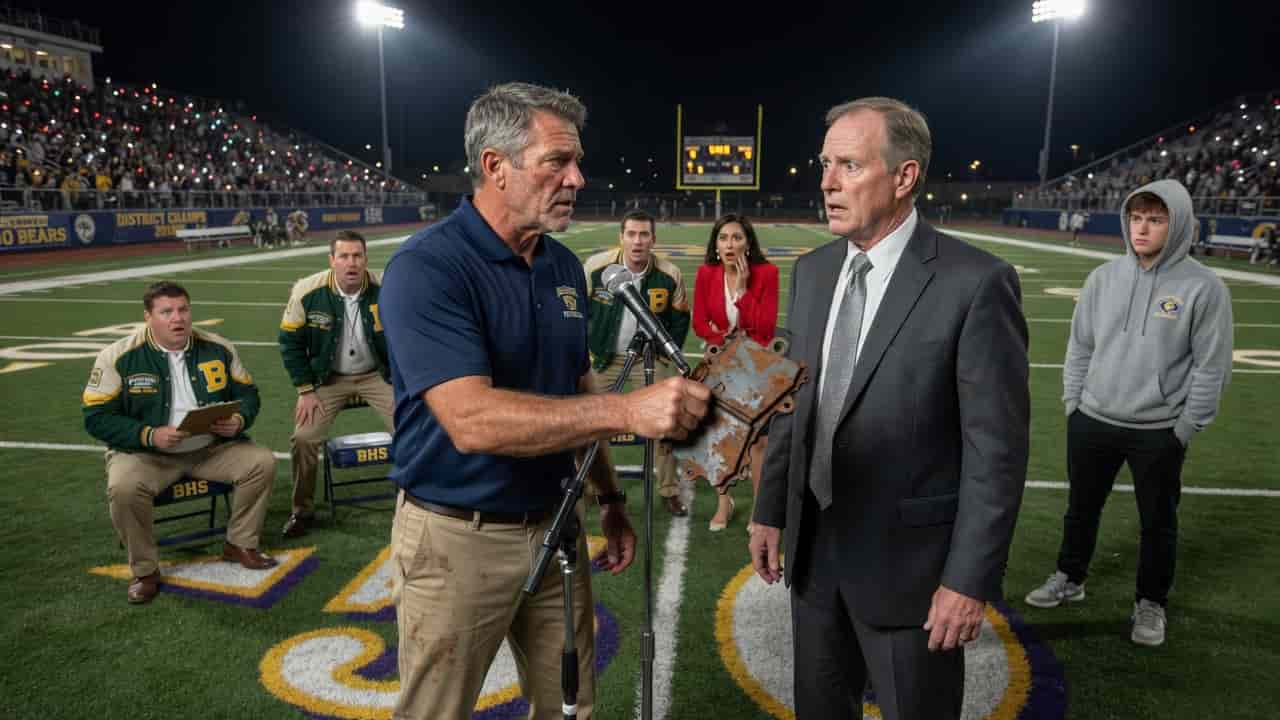
“Look at it, Whitaker. Tell this whole stadium what this is.”
The crowd went silent. Ben wasn’t supposed to be out there. It was Homecoming, the biggest night of the year in Oakhaven, and the School Board President was halfway through giving Ben an award for ‘courage’ after the loss of his wife.
But Ben didn’t want the trophy. He wanted the truth.
He held up a jagged, rusted piece of metal—a brake pad pulled from the wreckage of the school bus. The same bus the board claimed was in perfect condition. The same bus they used to pin the blame on Leo, a kid who has spent the last six months looking for a way to end his own life because he couldn’t live with the guilt.
“Your signature is on the safety pass report from last May,” Ben’s voice boomed over the speakers, shaking with a rage he’d been burying for months. “You knew the rotors were gone. You knew the lines were thin. You signed it anyway because the new fleet wasn’t in the budget.”
Whitaker reached for the microphone, his face pale, his hands shaking as he tried to shut the Coach down. But the town was already listening. They saw the rusted metal. They saw the way the President couldn’t look Ben in the eye.
The rest of what happened on that field is something this town will never forget.
Chapter 1: The Hollow Hum
The air in West Texas doesn’t just sit; it weighs. It’s a dry, dusty pressure that smells of sun-baked asphalt and the faint, metallic tang of irrigation water. For Ben Miller, that weight had become a permanent part of his skeleton. He felt it in his knees when he climbed the bleachers and in his chest every time he looked at the empty passenger seat of his Ford F-150.
He sat in the darkened film room of Oakhaven High, the rhythmic thrum-click of the projector the only sound in the office. On the screen, the Oakhaven Coyotes were running a sweep right. The grainy footage showed his lead blocker missing a chip on the linebacker. Ben should have been taking notes. He should have been circling the defensive end’s late jump. Instead, he was staring at the clock on the wall. 7:14 PM.
Seven months ago, at 7:14 PM, Sarah would have been texting him to ask if he wanted the brisket leftovers or if he was stopping at the diner on his way home. Now, the phone stayed dark.
Sarah hadn’t just been his wife; she’d been the town’s moral compass. She taught eleventh-grade English with a patience that Ben, a man who spoke in grunts and whistles, never understood. When the school bus went over the embankment on County Road 12, the town didn’t just lose a teacher. They lost the woman who remembered everyone’s birthday and made sure the food pantry stayed stocked.
Ben clicked the projector off. The sudden silence was worse than the hum.
He walked out of the athletic wing, his boots echoing on the waxed linoleum. The hallways were lined with trophies, silver-plated reminders of a history he was supposed to be upholding. “State Champions ’98,” “District Winners ’04,” “Oakhaven Pride.” It was all a lie, or at least, it felt like one now. Pride required a foundation, and Ben felt like he was standing on quicksand.
Outside, the stadium lights were on for practice. They were a brilliant, artificial white against the bruised purple of the Texas twilight. Ben stopped by the fence, watching his boys run drills. They were fast this year. They were mean. The town expected a ring. They expected Ben to lead them to a title as a tribute to Sarah. “Win it for her,” the boosters told him at the grocery store. “Make her proud,” the pastor said.
It made him want to vomit.
He saw Leo sitting on the far end of the bench, a skinny kid with a hood pulled over his head despite the heat. Leo hadn’t been on the team in years, but he showed up to every practice, sitting like a ghost on the periphery. He was the one who had been behind the wheel of Bus 42. He was the kid the school board had labeled “distracted and negligent.”
The town hated him. They didn’t just ignore him; they treated him like a leper. Ben watched as a group of seniors finished their lap, purposely kicking up dust as they ran past the boy. One of them, a linebacker named Trace, bumped Leo’s shoulder hard enough to send him sliding off the bench.
Leo didn’t fight back. He didn’t even look up. He just climbed back onto the wood and stared at the grass.
“Trace!” Ben barked, his voice cutting through the air like a whip.
The boy stopped, panting. “Coach?”
“Apologize. Now.”
Trace looked at his teammates, a smirk playing on his lips. “For what? He’s in the way. He’s always in the way.”
“He’s a person, Trace. Apologize or you’re running ’till you puke.”
The smirk vanished, replaced by a sullen, simmering resentment. Trace mumbled something that might have been a sorry and jogged off. Ben walked over to the bench. Leo finally looked up. His eyes were sunken, surrounded by dark circles that looked like bruises. He looked thirty years old instead of seventeen.
“You okay, Leo?” Ben asked, his voice softening.
“You shouldn’t do that, Coach,” Leo whispered. His voice was thin, unused. “It only makes it worse when you’re not looking.”
“They’re kids, Leo. They don’t know.”
“They know what everyone says,” Leo said, his fingers twisting the drawstring of his hoodie. “They know I’m the reason she’s gone. They’re right. I should have… I should have seen the turn coming. I should have felt the pedal go soft.”
“The board said it was driver error, Leo. They didn’t say it was on purpose.”
Leo looked at him then, a flash of something sharp and painful in his eyes. “Does it matter? She’s still in the ground, and I’m the one who put her there.”
Ben reached out to touch the boy’s shoulder, but Leo flinched away, stood up, and vanished into the shadows beyond the bleachers. Ben stood there, the stadium lights burning the back of his neck. He felt the rusted weight of the truth in his pocket—the small, jagged piece of metal he’d found at the impound lot two months ago.
He wasn’t supposed to have been at the impound lot. He was supposed to be grieving. But Ben Miller was a man who understood mechanics. He understood how things worked. And he knew that a seventeen-year-old kid who lived for his driving hours wouldn’t just forget how to use a brake pedal on a turn he’d taken a hundred times.
He walked to his truck, the engine turning over with a familiar, comforting roar. As he pulled out of the parking lot, he saw a black Mercedes parked near the administration building. President Whitaker’s car.
Whitaker was Oakhaven’s king. He owned the local bank, the largest ranch in the county, and he’d run the school board for twenty years. He was the one who had sat in Ben’s living room three days after the funeral, holding a glass of iced tea and talking about “tragic accidents” and “moving forward for the sake of the town.”
“We have to protect the district, Ben,” Whitaker had said, his voice smooth and practiced. “If people think the equipment was at fault, the lawsuits would bankrupt the athletic program. No more stadium. No more Coyotes. We have to be united.”
Ben had nodded then. He’d been in a fog of grief so thick he couldn’t see his own hands. But the fog was clearing now, and underneath it was a cold, hard anger.
He drove past the diner, seeing the neon “OPEN” sign flickering. He thought about stopping, but he knew what would happen. People would pat him on the back. They would offer him free pie. They would tell him he was a hero for staying strong. And they would look away when Leo walked by.
Ben pulled into his driveway, the house dark and silent. He walked into the kitchen, not bother to turn on the light. He opened the junk drawer and pulled out a manila envelope. Inside were the maintenance logs for Bus 42. He’d spent ten thousand dollars of his own savings on a private investigator to get them.
The official logs the board released showed a clean bill of health. But these—the originals, the ones the mechanic had kept a copy of—told a different story.
May 14th: Rear brake pads at 15%. Recommend immediate replacement.
May 15th: Work order denied. Budget constraints.
Signed: Arthur Whitaker.
Ben sat at the kitchen table, the silence of the house pressing in on him. He could hear Sarah’s voice in his head, telling him to do the right thing. But the right thing meant destroying the only thing the town had left. It meant forfeiting the season. It meant turning Oakhaven into a place of scandal instead of pride.
He looked at the rusted brake pad he’d pulled from the wreckage. It was thin as a wafer, the metal scored and blackened by heat.
“I’m sorry, Sarah,” he whispered to the empty room. “I’m so damn sorry.”
He didn’t know yet how he was going to do it. He only knew that the hum in the walls was getting louder, and the weight on his chest was becoming unbearable.
Chapter 2: The Price of Silence
The following Monday was the start of Homecoming week. In Oakhaven, that meant the town was draped in blue and white streamers, and the tension in the air was high enough to snap a wire. The Coyotes were 8-0. One more win and they were headed to the state play-offs with a home-field advantage.
Ben was in his office when there was a knock on the door. It wasn’t the tentative knock of a student. It was the sharp, rhythmic rap of someone who owned the air they breathed.
“Come in,” Ben said, not looking up from his clipboard.
Arthur Whitaker stepped inside. He looked like he’d stepped off the cover of a magazine for wealthy retirees—crisp white shirt, expensive jeans, and a belt buckle the size of a dinner plate. He smelled of expensive cologne and old money.
“Ben,” Whitaker said, pulling up a chair without being asked. “You look tired, son.”
“It’s a long season, Arthur.”
“It’s a great season. The town hasn’t been this electric since the ’90s. My phone hasn’t stopped ringing. People are saying this is the year. Your year.”
Ben finally looked up. “It’s the boys’ year. I just blow the whistle.”
Whitaker smiled, but it didn’t reach his eyes. “Modesty is a fine trait, but let’s be real. You’ve kept this team together through the unthinkable. The way you’ve handled Sarah’s… the way you’ve stayed the course. It’s an inspiration.”
Ben felt a muscle twitch in his jaw. “Is there a reason you’re here, Arthur? I’ve got a practice to run.”
“Actually, yes. The board met last night. We want to do something special at halftime during the Homecoming game. A ceremony. We’re calling it the ‘Sarah Miller Legacy Award.’ We want to present it to you, Ben. A five-thousand-dollar scholarship in her name, given every year to a student who embodies her spirit.”
It was a perfect move. Public, emotional, and designed to bind Ben to the board forever. If he accepted the award, how could he ever turn around and accuse the man who gave it to him of negligence? It was a golden shackle.
“I don’t know if I’m ready for that, Arthur,” Ben said, his voice flat.
“The town needs it, Ben. They need to see us honoring her. They need to see that we’re moving forward together. It’s about closure.”
Closure. The word tasted like copper in Ben’s mouth.
“I’ll think about it,” Ben said.
“Don’t think too long. We’ve already invited the press. It’s going to be a beautiful moment.” Whitaker stood up and clapped Ben on the shoulder. As he moved toward the door, he stopped. “Oh, and Ben? I heard you’ve been spending some time with that boy. Leo.”
Ben’s heart skipped a beat. “He’s a kid who needs a hand, Arthur.”
“He’s a kid who killed your wife,” Whitaker said, his voice dropping an octave, becoming cold and precise. “The town has a long memory. People don’t like seeing the Coach fraternizing with the person who caused all that pain. It looks… confused. For your own sake, and the sake of the team’s focus, I’d keep my distance.”
The door closed behind him. Ben sat in the silence, his hands shaking. He felt like he was being hunted in his own office.
He spent the rest of the day in a haze. Practice was a disaster. The boys were distracted by the homecoming festivities, and Ben found himself snapping at Trace for the smallest mistakes. Every time he looked at the bleachers, he looked for Leo, but the boy wasn’t there.
After practice, Ben drove out to the edge of town, to a dilapidated garage run by a man named Grady. Grady was seventy, his lungs ruined by forty years of diesel fumes, but he was the best mechanic in three counties. He was also the man who had worked for the school district for thirty years before being “retired” two weeks after the crash.
Ben found him sitting on a lawn chair inside the bay, drinking a lukewarm beer.
“You look like hell, Coach,” Grady rasped.
“I feel like it, Grady. I need to know something. About the logs.”
Grady sighed, a wet, rattling sound. “I already told you everything I can. They took my files, Ben. They cleared out my locker before I could even get my jacket.”
“But you kept a copy. You told me you kept a copy of the maintenance requests.”
Grady looked around the empty garage, as if the walls were listening. He stood up, limped over to an old tool chest, and pulled out a greasy, leather-bound notebook. He flipped through the pages until he found what he was looking for.
“I didn’t just request the brakes, Ben,” Grady said, pointing to an entry dated three months before the crash. “I told them the steering rack on 42 was sticking. I told them that bus shouldn’t be on the road for anything longer than a trip to the grocery store, let alone a mountain pass.”
“And Whitaker denied it?”
“Whitaker told me if I couldn’t make the parts last, he’d find a mechanic who could. Said the district was ‘trimming the fat.’ He wasn’t trimming fat, Ben. He was trimming lives.”
Ben leaned against the cold metal of a lift. “Why didn’t you say anything at the hearing?”
Grady looked down at his oil-stained hands. “I’ve got a wife in the nursing home, Ben. The district pays for her care. If I talked, they’d cut her off. Whitaker made that real clear. I’m a coward, Coach. I know that. But you… you’ve got nothing left to lose but a game.”
Ben took the notebook. “I’m not sure that’s true, Grady. I think I’m about to lose the only home I’ve ever known.”
He drove back to his house, the notebook sitting on the seat beside him. He thought about Leo, about the way the boy looked at the grass because he couldn’t bear to look at the world. He thought about Sarah, and the way she used to say that the truth was the only thing that could survive a fire.
He spent the night at his kitchen table, cross-referencing Grady’s notebook with the redacted logs the board had provided. It was all there. The systematic dismantling of safety for the sake of a budget surplus. A surplus that Whitaker had used to build a new executive wing at the bank.
Around 3:00 AM, Ben’s phone buzzed. It was a text from an unknown number.
He’s at the bridge. Please.
Ben didn’t ask who “he” was. He already knew.
He raced out to the County Road 12 bridge, the place where the road curved sharply over the dry creek bed. He saw a lone figure standing on the concrete railing, the wind whipping a grey hoodie around a thin frame.
Ben slammed on the brakes and jumped out of the truck. “Leo! Get down from there!”
Leo didn’t turn around. “It’s peaceful out here, Coach. No one’s yelling. No one’s looking at me like I’m a ghost.”
“Leo, listen to me. I know the truth. I know it wasn’t you.”
“It doesn’t matter,” Leo shouted over the wind. “Even if you know, they won’t believe you. They want it to be me. It’s easier if it’s me.”
“I have proof, Leo! I have the logs! I have the brake pad!” Ben stepped closer, his heart hammering against his ribs. “I’m going to tell them. On Friday. At the game.”
Leo finally turned his head. His face was streaked with tears, his expression one of pure, unadulterated exhaustion. “If you do that, they’ll hate you too, Coach. You’ll be just like me.”
“Then we’ll be ghosts together,” Ben said, reaching out a hand. “Just get down. Please. For Sarah.”
At the mention of her name, Leo’s shoulders slumped. He hesitated for a long, agonizing second, then reached out and took Ben’s hand. He stepped down from the railing, his body shaking with sobs.
Ben held the boy there on the side of the road, the headlights of the truck cutting through the darkness. He knew then that there was no turning back. The scholarship, the trophy, the championship—it was all ash.
He was going to burn it all down.
Chapter 3: The Diner Stand-Off
The Tuesday before Homecoming, the atmosphere in Oakhaven shifted from celebratory to predatory. Small towns have a way of sensing a fracture before it even opens. Word had gotten out that Coach Ben had been seen out on the bridge with Leo in the middle of the night. Gossip in Oakhaven didn’t travel; it infected.
Ben walked into “The Iron Skillet” for breakfast. Usually, the morning rush was a chorus of “Morning, Coach” and “Get ’em Friday.” Today, the room went quiet the moment the bell above the door chimed.
He sat at the counter. The waitress, a woman named Martha who had been Sarah’s friend for twenty years, didn’t bring him his coffee immediately. She lingered by the pie case, her back to him.
“Coffee, Martha? Please,” Ben said.
She turned, her face tight. She poured the coffee, but she didn’t meet his eyes. “Folks are talking, Ben.”
“Folks always talk, Martha.”
“Not about this. They’re saying you’re taking sides. They’re saying you’re coddling the boy who… who did it. After everything this town has done for you.”
Ben looked at the steam rising from his cup. “This town hasn’t done anything for me that they didn’t expect to get back in wins, Martha. And Leo is a kid. A kid who’s being used as a scapegoat.”
Martha leaned in, her voice a sharp whisper. “Watch yourself. Whitaker’s been in here twice this morning. He’s not happy. And when he’s not happy, things change.”
Ben took a sip of the bitter coffee. “Let them change.”
He was halfway through his eggs when the door opened. A group of boosters, led by Trace’s father, Miller Senior, walked in. They didn’t sit in a booth. They walked straight to the counter and flanked Ben.
“Coach,” Miller Senior said. He was a big man, a former Coyote himself, with a voice that always sounded like he was shouting over a crowd. “We missed you at the booster meeting last night.”
“I was busy, Miller.”
“Busy with what? Tucking in the kid who ran Sarah’s bus off the road?”
The room went deathly silent. Every fork in the diner stopped moving. Ben slowly put his coffee cup down. He felt the cold, familiar pressure in his chest.
“Leo didn’t run that bus off the road, Miller. The brakes failed.”
Miller Senior laughed, a harsh, ugly sound. “The board had an expert look at that bus. They said the brakes were fine. They said the kid panicked and over-corrected. You calling Arthur Whitaker a liar?”
“I’m calling the truth the truth,” Ben said, turning his stool to face him. “And if you’re so concerned about the team, maybe you should worry about your son’s grades instead of who I spend my time with.”
Miller Senior stepped into Ben’s space, his face inches from Ben’s. “You listen to me, Miller. We pay your salary. We built that stadium. We gave you a place to live when you were a nobody. If you pull some stunt on Friday, if you distract these boys from that championship, you’re done in this town. You’ll be lucky if you can get a job sweeping floors at the car wash.”
“Is that a threat?”
“It’s a fact. Oakhaven doesn’t forgive traitors. And choosing that boy over your own wife’s memory? That’s about as low as it gets.”
The boosters walked out, leaving a thick, suffocating tension behind. Ben looked at Martha. She looked away.
He left five dollars on the counter and walked out into the bright morning sun. He felt like he was walking through a graveyard.
He spent the afternoon at the school, trying to focus on the game plan, but his mind kept wandering to the rusted brake pad in his truck. He felt like he was carrying a bomb.
Around 4:00 PM, he saw Leo walking toward the diner. Ben tried to shout for him to stop, to go home, but it was too late. Leo had already walked through the doors.
Ben followed him, his stomach churning.
Inside, the scene was exactly what he feared. Trace and three other football players were sitting in the corner booth. They had Leo cornered at the counter.
“Hey, ghost boy,” Trace sneered, loud enough for the whole diner to hear. “You hungry? Or did you already eat enough of our tuition money with that bus?”
Leo sat on the stool, his shoulders hunched, his head down. “I just want a sandwich.”
“I don’t think we serve murderers here,” Trace said, standing up and walking over. He grabbed the hood of Leo’s sweatshirt and yanked it back. “Look at us when we’re talking to you.”
“Leave me alone,” Leo whispered.
“What was that? I can’t hear you over the sound of the bus crashing.” Trace’s friends laughed. One of them, a linebacker named Silas, picked up a glass of ice water and poured it slowly over Leo’s head.
The water soaked through the hoodie, dripping onto the counter. Leo didn’t move. He didn’t fight back. He just sat there, shivering, the shame radiating off him in waves.
“That’s enough!” Ben roared, stepping into the middle of the room.
Trace turned, a smirk on his face. “Just having some fun, Coach. Giving the kid a little bath. He smells like failure.”
“Get out,” Ben said, his voice low and vibrating with a fury that made the boys hesitate. “All of you. Now. If I see any of you in here again before Friday, you’re off the team. I don’t care if you’re the star quarterback or the water boy.”
“You can’t do that,” Trace spat. “My dad—”
“I don’t give a damn about your dad! Get out of my sight before I lose my temper!”
The boys scrambled out, muttering under their breaths. Ben turned to Leo. The boy was shaking, the cold water dripping from his chin.
“Come on, Leo,” Ben said, his voice cracking. “Let’s get you home.”
“Why do you keep doing this?” Leo asked, his eyes red and raw. “Why don’t you just let them do it? It’s what I deserve.”
“No one deserves this, Leo. No one.”
He drove Leo home, a small, sagging house on the edge of the trailer park. Leo’s mother was a waitress who worked double shifts; the house was empty and smelled of stale cigarettes and grief.
“I’m going to finish this on Friday, Leo,” Ben said as the boy got out of the truck. “I’m going to tell them everything. You won’t have to look at the ground anymore.”
Leo looked at him, and for the first time, there was a tiny flicker of something like hope in his eyes. But it was quickly replaced by fear. “They’ll kill you, Coach. Not with a gun. They’ll just… they’ll make it so you don’t exist.”
“I already don’t exist, Leo,” Ben said. “I died on that road with Sarah. I’m just waiting for the rest of me to catch up.”
He drove back to the stadium, the lights already humming. He walked out to the 50-yard line and stood there in the dark. He looked up at the press box, where Whitaker would be sitting on Friday. He looked at the bleachers, where the town would be screaming for blood and victory.
He felt the weight of the brake pad in his pocket. It felt like a heart. A cold, rusted, honest heart.
He knew exactly what he was going to do.
Chapter 4: The 50-Yard Line
Homecoming Friday arrived with a heat that felt personal. The town was a fever dream of blue and white. The parade had ended, the pep rally was over, and the stadium was packed two hours before kickoff. Every seat was filled, and people were standing ten deep along the fence.
In the locker room, the air was thick with the smell of wintergreen rub and sweat. The boys were vibrating, a collective engine of aggression. Ben stood in the center of the room, looking at them. Trace, Silas, Miller Junior—they were all there, their faces painted with war streaks, their eyes focused on the trophy they thought was their birthright.
Ben didn’t give a speech about winning. He didn’t talk about Sarah. He looked at them and felt a profound, hollow pity.
“Play hard,” he said. “Play clean. Remember who you are when the lights go out.”
They roared and filtered out onto the field. Ben stayed behind for a moment, the silence of the locker room ringing in his ears. He pulled the rusted brake pad from his bag and tucked it into the waistband of his khakis, hidden by his navy polo. He felt the jagged edge bite into his skin. Good. He wanted to feel it.
The first half was a blur of violence and adrenaline. The Coyotes played like possessed men. They were up 21-0 by the end of the second quarter. The crowd was ecstatic, a roaring beast that shook the very foundations of the bleachers.
As the halftime whistle blew, Ben didn’t go to the locker room. He stayed on the sideline. He saw the maintenance crew wheeling out a podium to the center of the field. He saw Whitaker stepping out of the tunnel, flanked by the school board. Sarah Miller’s scholarship ceremony was beginning.
Ben felt a hand on his arm. It was the athletic director, a man named Henderson who had spent the last twenty years avoiding conflict.
“It’s time, Ben,” Henderson said, his voice nervous. “They’re ready for you.”
Ben walked out onto the turf. Every step felt like he was walking through water. The lights were blinding, the roar of the crowd a physical wall of sound. He reached the 50-yard line. Whitaker was standing behind the microphone, a large, ornate trophy in his hands.
“Oakhaven!” Whitaker’s voice boomed over the PA system. The crowd went silent instantly. “We are here tonight to celebrate more than just a game. We are here to celebrate the spirit of this town. A spirit that was tested seven months ago when we lost one of our finest. Sarah Miller.”
A wave of applause, soft and respectful, rippled through the stands. Ben looked at the sideline. He saw Leo standing near the tunnel, his hood down for once. The boy looked terrified.
“But in the wake of that tragedy,” Whitaker continued, “we saw a hero emerge. A man who put his own grief aside to lead our boys. Coach Ben Miller.”
Whitaker held out the trophy. “Ben, on behalf of the Oakhaven School Board, we present you with the first Sarah Miller Legacy Scholarship. Five thousand dollars to the student who shows the most courage. And we want you to choose that student, Ben. Right here. Right now.”
It was a trap of absolute genius. If Ben accepted, he was complicit. If he refused, he was a madman.
Ben stepped up to the microphone. He didn’t look at the trophy. He didn’t look at the crowd. He looked straight at Whitaker.
“I have a student in mind,” Ben said. His voice was steady, carried by the massive speakers to every corner of the stadium.
Whitaker smiled, leaning in. “Tell us, Coach. Who deserves this honor?”
Ben reached into his waistband and pulled out the rusted brake pad. He held it up high, the jagged metal catching the glare of the stadium lights.
“This is the student,” Ben said.
The silence that followed was unlike anything Ben had ever heard. It wasn’t just quiet; it was a vacuum.
“Ben,” Whitaker whispered, his face turning pale. “What are you doing? Put that away.”
“This is a rear brake pad from Bus 42,” Ben said, his voice growing louder, more certain. “I pulled it from the wreckage myself. It’s worn down to the bone. It never should have been on the road. Grady, our mechanic for thirty years, requested a replacement three months before the crash. He was told it wasn’t in the budget.”
“He’s confused,” Whitaker shouted to the crowd, his voice cracking. “The Coach has been under a lot of stress—”
“I’m not confused, Arthur!” Ben stepped closer, shoving the metal pad toward Whitaker’s chest. “I have the original logs. I have Grady’s notebook. And I have your signature on the safety pass report from May 14th. You signed off on a death trap to save twenty thousand dollars.”
The crowd began to murmur, a low, ominous sound like a rising tide.
“You blamed a seventeen-year-old kid!” Ben yelled, turning toward the bleachers. “You let this town treat Leo like a murderer because you were too proud and too greedy to admit you let our equipment rot! This isn’t courage, Arthur. This is a crime!”
Whitaker lunged for the microphone, but Ben blocked him with his shoulder, a solid, coaching hit that sent the older man stumbling back.
“Leo!” Ben shouted, pointing toward the sideline. “Leo, come out here!”
Leo hesitated, then began to walk. He walked slowly at first, then faster, crossing the white lines of the field. The crowd watched him, thousands of eyes tracking the boy they had spent months hating.
“This scholarship doesn’t belong to me,” Ben said, his voice shaking with emotion. “And it doesn’t belong to some ‘courageous’ athlete. It belongs to the truth. And the truth is that Leo saved as many kids as he could that day. He fought a steering rack that was sticking and brakes that didn’t exist.”
Ben turned back to Whitaker, who was being held up by two alarmed board members.
“Why did you lie, Arthur? Was the executive wing at the bank worth my wife’s life? Was it worth this boy’s future?”
Whitaker didn’t answer. He couldn’t. He looked at the crowd, then at Ben, his eyes full of a desperate, cornered venom.
“You’re finished, Miller,” Whitaker hissed, so low the mic barely caught it. “You’ll never work again. You’re dead in this town.”
“I told you,” Ben said, a sad, sharp smile breaking across his face. “I’m already dead. But the kid is still alive. And he’s going to stay that way.”
Ben handed the rusted brake pad to Leo. The boy took it, his hands trembling, his eyes fixed on the man who had finally seen him.
The stadium was silent for another long, heavy moment. Then, from the far end of the bleachers, a single person began to clap. Then another. And then, a roar began to build. It wasn’t the roar for a touchdown. It was the roar of a town realizing they’d been lied to. It was the sound of the foundation cracking.
Ben walked off the field, Leo by his side. He didn’t look back at the lights. He didn’t look at the scoreboard. He just kept walking, out through the tunnel and into the cool, dark Texas night.
Behind him, the game was over. But the story was just beginning.
Chapter 5: The Glass House
The walk from the 50-yard line to the locker room was the longest three hundred feet of Ben Miller’s life. The roar of the stadium was no longer a unified cheer; it had fractured into a thousand different sounds—boos, screams of confusion, the rhythmic pounding of feet on aluminum bleachers, and the shrill, panicked whistles of the referees trying to regain control of a game that had effectively died the moment Ben spoke into the mic.
Leo walked beside him, his head tucked into his chest, clutching the rusted brake pad like it was a holy relic. The boy was shaking so hard Ben could feel the vibrations radiating off him. Ben kept a heavy hand on Leo’s shoulder, guiding him through the tunnel.
As they reached the concrete mouth of the locker room, the sound of the crowd was cut off, replaced by the low, electrical hum of the stadium’s underbelly. They weren’t alone. Three sheriff’s deputies were standing by the door, their expressions unreadable under the brims of their hats.
“Coach,” one of them said. It was Miller Junior’s cousin, a man named Deputy Vance. “We’re going to need you to stay right here.”
“I’m not going anywhere, Vance,” Ben said, his voice sounding hollow and metallic to his own ears. “The boy goes home. Now.”
“Whitaker’s calling it a disturbance. He wants a statement.”
“Whitaker can want whatever he likes,” Ben said, stepping into Vance’s space. The adrenaline was still humming in his blood, making his skin feel tight and hot. “But unless you’re arresting me for telling the truth, get out of my way. This kid is going home to his mother.”
Vance hesitated, looking at the other deputies. The power structure of Oakhaven was shifting in real-time. For twenty years, Whitaker’s word was law. But the town had just seen the law exposed as a lie. Vance stepped aside, his hand resting tentatively on his belt.
“Don’t leave town, Ben,” Vance muttered.
Ben didn’t answer. He led Leo to his truck, the parking lot already a chaotic swarm of parents and students who had fled the stands. He saw the black Mercedes—Whitaker’s car—peeling out of the VIP lot, nearly clipping a group of cheerleaders in its haste.
The drive to Leo’s house was silent. The Texas night was huge and indifferent, the stars cold pinpricks of light above the dusty plains. When they pulled into the trailer park, Ben saw a single light on in the window of Leo’s home.
“You okay?” Ben asked, killing the engine.
Leo looked at the rusted metal in his hands. He ran a thumb over the jagged edge. “I didn’t think anyone would ever believe me. I thought I was going to die with everyone thinking I was a monster.”
“You’re not a monster, Leo. You’re just a kid who got caught in the gears of a machine that didn’t care about you.”
“What happens tomorrow?”
Ben leaned back against the headrest, closing his eyes. “Tomorrow, the machine tries to fix itself. It’ll try to crush me. It’ll try to call me crazy. But the truth is out now. You can’t put smoke back in the bottle.”
Leo got out of the truck. He stopped at the door, looking back at Ben. “Thanks, Coach. For… everything.”
Ben watched him go inside, then sat in the dark for a long time. His phone was vibrating in the cup holder. It had been vibrating since he left the field. 114 missed calls. 86 texts. He didn’t check any of them. He knew what they said. Half were from people who hated him for “ruining” the season; the other half were from people who were terrified that they were next on the list of secrets to be exposed.
He drove home to his empty house. The silence there was different tonight. It wasn’t just the absence of Sarah; it was the presence of the aftermath. He walked into the kitchen and saw the manila envelope still sitting on the table. He felt a strange sense of peace, the kind that only comes when you’ve finally stopped running from a fire and decided to stand in it.
At 2:00 AM, the first stone came through the front window.
The sound of shattering glass was explosive in the quiet house. Ben didn’t jump. He stood up slowly and walked into the living room. A heavy river rock sat in the middle of his rug, surrounded by shimmering shards of glass.
He walked to the jagged hole in the window. Outside, a truck was speeding away, its taillights two red blurs in the dust. He didn’t call the police. He knew Vance wouldn’t come. He knew the town’s protection had been revoked.
He spent the rest of the night boarded up in his kitchen, a kitchen knife on the table and his wife’s old English textbooks stacked in the corner. He realized then that he had underestimated the town’s loyalty to the lie. Oakhaven didn’t want the truth; they wanted the championship. They wanted the comfort of believing that their leaders were good men and that their children were safe. Ben had taken that comfort away, and they were going to make him pay for it.
The next morning, the sun rose over a different Oakhaven. Ben was at the school by 7:00 AM, not because he thought he still had a job, but because he had to face it.
The athletic wing was locked. Not just the doors, but the entire building. A “Closed for Maintenance” sign hung on the glass. Ben stood there, his breath hitching in his chest, when he saw the athletic director, Henderson, walking toward him from the parking lot. Henderson looked like he hadn’t slept in a week.
“You shouldn’t be here, Ben,” Henderson said, his voice barely a whisper.
“I have a practice to run, Henderson.”
“There is no practice. The board met at midnight. They’ve suspended the season. We’re forfeiting the game against Lubbock.”
Ben felt a sharp pang of guilt for the boys, for the ones like Trace who had worked their lives for this. “And the coaching staff?”
“You’re fired, Ben. Effective immediately. For ‘conduct unbecoming of a district employee’ and ‘endangering the psychological well-being of the student body.’ They’re already talking about a lawsuit. They’re saying you fabricated the evidence.”
Ben pulled Grady’s notebook from his bag. “I didn’t fabricate anything. I have the logs.”
“It doesn’t matter what you have!” Henderson snapped, his eyes wide and panicked. “They’re going to bury you. Whitaker has the state inspectors in his pocket. He’s already issued a statement saying the brake pad you held up wasn’t even from the bus. They’re calling it a ‘grief-induced delusion.'”
Ben looked at the locked doors. He felt a cold, hard resolve settling in his gut. “Let them call it whatever they want. I’m going to the press.”
“The local paper won’t touch it. Their biggest advertiser is Whitaker’s bank.”
“Then I’ll go to the city. I’ll go to the state capital. I’ll go to anyone who will listen.”
Henderson looked at him with a mix of pity and fear. “You’re going to lose everything, Ben. Your house, your pension, your reputation. Was it worth it? For one kid?”
Ben thought about Sarah. He thought about the way she used to grade papers late into the night, her glasses sliding down her nose, her belief in the inherent goodness of people never wavering. He thought about Leo, who was finally sleeping without the weight of a thousand deaths on his chest.
“Yeah, Henderson,” Ben said, turning away. “It was worth it.”
He spent the afternoon at Grady’s garage. The old mechanic was sitting in his usual spot, but his hands were shaking as he held his beer.
“They came for me this morning, Ben,” Grady rasped. “Two guys in suits. Said if I talked to a lawyer, they’d find ‘irregularities’ in my pension. Said they’d move my wife out of the home by Monday.”
Ben sat down beside him. “I’m sorry, Grady. I didn’t mean to bring this on you.”
“Don’t be sorry. I’ve been waiting for someone to do what you did for twenty years. I just didn’t have the spine for it.” Grady looked at the notebook in Ben’s lap. “You got a plan?”
“I’m going to see a lawyer in Austin. A friend of Sarah’s. Someone who doesn’t care about West Texas football.”
“Good. But watch your back, Coach. People in this town… they don’t like it when the lights go out. And you just blew the fuse for the whole county.”
As Ben drove away from the garage, he saw a group of boys standing on the corner near the high school. They were wearing their Coyote jerseys. As he passed, they didn’t wave. They didn’t cheer. They stood in a silent line, their faces hard and unforgiving. Trace was at the center, his eyes burning with a hatred that felt like a physical weight.
Ben realized then that he wasn’t just fighting Whitaker. He was fighting the very soul of the town he had loved. He was a traitor in a land that valued loyalty over truth.
He reached his house and found a letter taped to the door. It wasn’t a threat. It was a notice from the bank. His mortgage, which had been handled through Whitaker’s institution for fifteen years, was being “reviewed for immediate acceleration due to a technical default.”
They were going to take his house. They were going to take his past.
Ben walked inside, the shattered glass still crunching under his boots. He sat at the kitchen table and began to pack. He didn’t take much. A few clothes, Sarah’s journals, the manila envelope, and the rusted brake pad.
He felt a strange lightness as he loaded the truck. The residue of his old life was falling away, leaving only the essential, painful truth of who he was. He wasn’t the Coach anymore. He wasn’t the hero. He was just a man with a jagged piece of metal and a story to tell.
Before he left, he drove by the cemetery. The sun was setting, casting long, orange shadows over the rows of headstones. He stood by Sarah’s grave for a long time. The wind whistled through the dry grass, the only sound in the empty field.
“I did it, Sarah,” he whispered. “I told them. I don’t know if it’ll change anything, but I told them.”
He felt a faint warmth on his shoulder, a memory of her hand. He turned and walked back to his truck. As he pulled out of the cemetery, he saw a figure standing by the gate.
It was Leo. He was wearing a clean shirt, and his hood was down. He didn’t say anything. He just nodded.
Ben nodded back and drove toward the highway. The road ahead was dark, and the town of Oakhaven was a flickering glow in the rearview mirror. He didn’t know where he was going, but for the first time in seven months, he knew exactly who he was.
The weight was still there, but it wasn’t crushing him anymore. It was just a part of the journey.
Chapter 6: The Residue of Truth
Six months later, the dust in Oakhaven had settled, but the air never quite regained its clarity. The town felt like an old house that had survived a hurricane; the walls were still standing, but everything inside was damp and smelled of rot.
Ben Miller lived in a small apartment in Austin, a place that smelled of pine cleaner and traffic. He worked as a driver for a medical transport company, a quiet, invisible job that required no whistles and no halftime speeches. The lawsuit against the Oakhaven School District was still winding its way through the courts, a slow, grinding process of depositions and discovery.
He was sitting in a sterile law office on a Tuesday morning, the air conditioning humming with a relentless, expensive efficiency. Across from him sat a team of lawyers in charcoal suits, their faces as smooth and unyielding as polished stone.
“Mr. Miller,” one of the lawyers said, flipping through a folder. “We have the testimony from the third-party inspector. He claims that the brake pad you produced cannot be definitively linked to Bus 42. He says the oxidation levels suggest a different environmental exposure.”
Ben looked at the man. He felt a familiar, weary anger, but he kept it contained. “The oxidation levels match the creek bed where the bus sat for three weeks before your ‘experts’ bothered to move it. And I have Grady’s signature on the chain of custody.”
“Grady is a retired mechanic with a history of documented alcohol use,” the lawyer countered, his voice smooth and dismissive. “His credibility is… questionable.”
“His credibility was fine when he was keeping your fleet on the road for thirty years on a shoestring budget,” Ben said. “His credibility only became an issue when he stopped lying for you.”
The deposition went on for four hours. They questioned his mental state. They questioned his relationship with Leo. They even questioned his marriage, subtly suggesting that his “obsession” with the bus was a way of displacing his guilt over Sarah’s death.
By the time he walked out into the bright Austin sun, Ben felt like he’d been scrubbed raw. But he didn’t feel broken. He felt like a witness.
He walked to a nearby coffee shop and saw a familiar figure sitting at a corner table. It was Leo. The boy looked different. He’d filled out a bit, and the haunted circles under his eyes had faded. He was a freshman at the community college now, studying mechanical engineering.
“How’d it go, Coach?” Leo asked, pushing a cup of coffee toward him.
“The same,” Ben said, sitting down. “They’re trying to say the sky isn’t blue. They’re trying to say I’m crazy.”
“People back home are starting to talk,” Leo said, his voice quiet. “Whitaker’s bank is under federal investigation. Something about the construction funds for the new athletic wing. People are saying you were right about the money.”
“It doesn’t matter if I was right about the money, Leo. It only matters if they admit the truth about the bus.”
Leo looked at his hands. “They won’t. Not officially. They can’t afford to. But everyone knows. Even the kids at the high school. I saw Trace last week when I went back to get my transcripts. He didn’t say anything. He just… he looked at the ground. Like I used to.”
Ben took a sip of the coffee. It was bitter and hot. “Shame is a powerful thing, Leo. It can either burn you up or it can change you. I hope it changes him.”
They sat in silence for a while, watching the city move past the window. Austin was a world away from Oakhaven. Here, no one cared about the Coyotes. No one cared about the 50-yard line. It was a place where you could be a ghost and no one would notice.
“Do you miss it?” Leo asked. “The coaching?”
Ben thought about the feeling of the whistle in his hand, the smell of the grass on a Friday night, the way the lights made the world feel small and manageable. He thought about the boys, the ones who had turned their backs on him.
“I miss who I thought I was,” Ben said. “But I don’t miss the lie. I don’t miss the weight of keeping the lights on for a town that wanted to stay in the dark.”
Before he left, Leo handed him an envelope. “My mom wanted you to have this. It’s a copy of the news report from last night.”
Ben opened the envelope as he walked back to his apartment. Inside was a clipping from the West Texas Herald.
WHITAKER RESIGNS FROM SCHOOL BOARD AMID FINANCIAL PROBE.
The article was short and dry, a clinical accounting of “misallocated funds” and “administrative restructuring.” It didn’t mention the bus. It didn’t mention Sarah. It didn’t mention Ben.
But it was a crack in the wall. A small, jagged opening that the light could finally get through.
Ben reached his apartment and sat on his small balcony, looking out over the city. The sun was setting, the sky a bruised purple that reminded him of Oakhaven. He pulled the rusted brake pad from his pocket. He’d kept it all this time, a physical reminder of the cost of the truth.
He looked at the metal, at the scores and the blackened heat damage. He realized then that he didn’t need it anymore. The evidence was no longer in his hand; it was in the world. It was in the way Leo walked with his head up. It was in the way Whitaker’s name was being scrubbed from the signs in town. It was in the way the silence in his own heart had finally become a quiet, steady thing instead of a hollow roar.
He walked to the edge of the balcony and held the piece of metal over the railing. He hesitated for a second, then let it go.
It fell silently, disappearing into the shadows of the alley below.
Ben went inside and closed the door. He sat at his small table and opened one of Sarah’s journals. He turned to a page near the back, a passage she’d written a few months before the accident.
The truth doesn’t always win, she’d written in her neat, precise hand. But it survives. It stays in the cracks of things, waiting for someone to find it. And when someone does, they have to decide if they’re brave enough to hold it.
Ben traced the words with his finger. He felt a tear prick at his eye, the first real tear he’d shed since the night on the field. He let it fall, a small, honest thing on the page.
He wasn’t a hero. He wasn’t a coach. He was just a man who had been brave enough to hold a piece of rusted metal in front of a stadium full of people who wanted him to stay silent.
He closed the book and turned out the light. The apartment was dark, but for the first time in a long time, it didn’t feel empty. It felt like a place where a person could finally sleep.
The story of Oakhaven would continue. There would be new games, new coaches, new championships. But the residue of that Friday night would remain. It would be in the way the school board members looked at each other in the halls. It would be in the way the mechanics checked the brakes on the new fleet of buses. It would be in the way the town remembered the man who chose a boy over a trophy.
And for Ben Miller, that was enough. The lights were out, but the truth was still there, glowing in the dark, waiting for the next person who was brave enough to see it.