
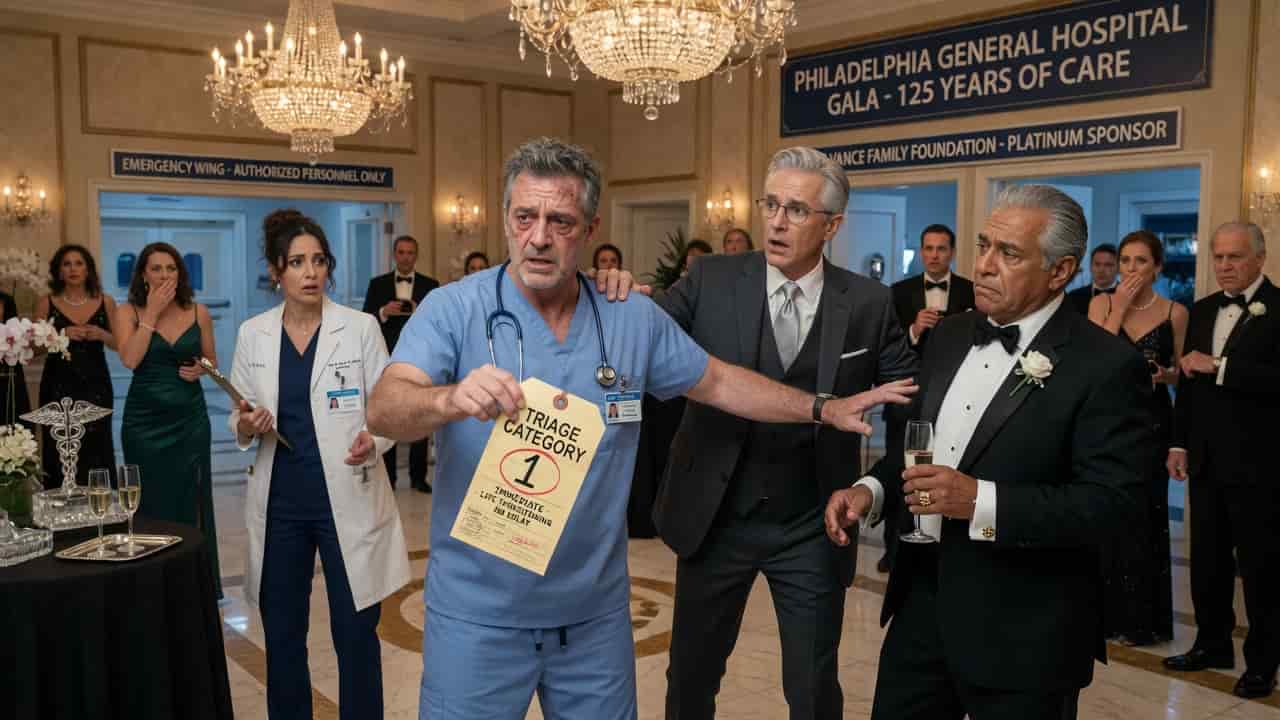
“You got a stitch, Arthur. My son was told to wait in the hall until he stopped breathing.”
I stood there in my stained scrubs, right in the middle of their thousand-dollar-a-plate gala, holding the yellow paper they thought they’d buried. The Administrator tried to grab my arm, tried to whisper about my ‘exhaustion’ and my ‘grief,’ but the whole room had already gone quiet.
They all knew. They looked at the billionaire in his tuxedo and then they looked at the crumpled Number 1 tag in my hand.
The hospital had a secret list. A list that decided who lived based on the size of their donation. My son was the first one on the charts that night, the highest priority the medical code allows, and they pushed him into a corner because a donor’s son had a scratch on his finger.
Arthur Vance didn’t even blink. He just looked at me like I was the dirt on his shoe and told security to clear the trash out of the lobby. He didn’t realize I wasn’t just holding a triage tag. I was holding the recording of the Administrator’s orders.
The room is about to find out exactly what “Priority” means at Mercy General.
Chapter 1: The Weight of the Triage
The air in the Mercy General ER tasted like ozone, floor wax, and the metallic tang of blood that never quite left the pores of the walls. It was 2:00 AM on a Tuesday, the hour when the city of Philadelphia usually decided to break itself into pieces. David sat at the triage desk, the plastic chair creaking under a weight that had nothing to do with his physical frame. He was forty-five, but in this light, under the flickering fluorescent tubes that hummed like a swarm of angry bees, he looked sixty.
“David, we’ve got a walk-in. GSW to the shoulder, heavy bleeding,” Elena said, leaning over the counter. Her eyes were rimmed with the kind of red that sleep hadn’t touched in twenty-four hours.
David didn’t look up from the monitor. “Bed four is open. Move the kid with the fever to the hallway chairs. He’s stable enough.”
“The kid’s mother is going to scream,” Elena warned.
“Let her scream,” David said, his voice a flat, tired rasp. “Screaming means they’re breathing. It’s the quiet ones that keep me up.”
He finally looked at her. Elena had been there three years ago. She had been the one who held the door open when David had sprinted through it, carrying his seven-year-old son, Leo, in his arms. She had been the one who watched the triage clock tick past forty minutes while the “VIP” wing took a priority call for a donor’s wife who had “migraine symptoms.”
Leo hadn’t been screaming. He had been very, very quiet.
The memory didn’t hit him like a wave anymore; it was more like a slow-acting poison, always present in the bloodstream. David adjusted his stethoscope. It was a habit, a physical anchor to the present. He’d served two tours as a medic in the sandbox before coming back to Philly to work the ER. He knew how to categorize trauma. He knew how to look at a room full of suffering and decide who got the chance to see Wednesday and who didn’t.
But the rules at Mercy General weren’t the rules of the field.
The phone on the “Internal Line” rang. It was a specific, high-pitched chirp that only rang for one reason. David stared at it for three seconds before picking up.
“Triage, Miller speaking.”
“David, it’s Sterling,” the voice on the other end said. It was smooth, polished, and carried the practiced empathy of a man who sold insurance for a living. Mr. Sterling was the Hospital Administrator, a man who viewed patients as “units of service.”
“Go ahead, Mr. Sterling. We’re at Code Black down here. Every bed is full.”
“I need Bed One cleared immediately,” Sterling said. “We have a private transport arriving in five minutes. It’s Arthur Vance’s son. Apparently, there was an accident at a private party. Laceration to the hand.”
David felt a cold, familiar tightening in his chest. Bed One was the trauma bay. It was the only bed equipped with the high-end monitoring suite and the immediate surgical prep kit. Currently, it was occupied by a sixty-year-old construction worker who had been crushed by a fallen beam.
“Bed One is occupied, sir. The patient is unstable. He’s got internal bleeding and a possible pelvic fracture.”
“Move him to the hallway, David. Or the overflow unit in the basement.”
“The overflow unit doesn’t have a ventilator tech on duty,” David said, his voice dropping an octave. “If I move him, he’s at risk.”
“And if you don’t move him, the Vance family pulls their ten-million-dollar endowment for the new oncology wing,” Sterling snapped. The mask of empathy had slipped. “This isn’t a debate, Miller. It’s a directive. Vance’s son has a laceration. He needs the best plastics guy we have, and he needs to be in a private, secure bay. Now.”
David looked through the glass of the triage booth. In the waiting room, thirty people sat in plastic chairs. A woman was holding a rag to her husband’s head. A teenager was shivering with a dry, hacking cough that sounded like pneumonia. And in Bed One, a man was fighting for his life while his wife sat on a stool in the corner, clutching her rosary.
“He’s a Priority Three, Sterling. At best,” David said. “My son was a Priority One. Do you remember that night? Or do the numbers all just look like dollar signs to you?”
The silence on the other end of the line was heavy. David could almost hear Sterling’s teeth grinding.
“That was a tragic oversight, David. We’ve discussed this. But if you want to keep your license, if you want to keep working in this city, you will clear that bed. This is how the world works. Some people are just worth more to the survival of this institution than others.”
“I’ll clear the bed,” David said.
He hung up the phone. His hand was shaking, just a little. He stood up and walked out of the booth.
“Elena,” he called out.
She looked up from a chart. “Yeah?”
“Move the guy in Bed One to the hallway near the elevators. Tell the wife we need the room for a ‘specialized procedure.’”
Elena stared at him. She knew what that phone call meant. “David, he’s crashing. If we move him—”
“I know,” David said, his eyes hard and glassy. “Just do it. And Elena? Find me the triage log from the night of the fourteenth, three years ago. The physical copy. The one that was supposed to be shredded.”
“David, what are you doing?”
“I’m tired of being the one who decides who dies,” David said, turning toward the trauma bay. “I think it’s time the people in the tuxedos had a turn to look at the numbers.”
He spent the next hour watching a nineteen-year-old boy with a smell of expensive gin on his breath scream about a half-inch cut on his palm while the construction worker’s heart rate began to climb in the hallway, the monitors beeping a lonely, frantic rhythm that nobody but David seemed to hear.
This was the “VIP” reality. This was the cost of the endowment. As he stitched the boy’s hand, David felt the residue of the day Leo died—the shame of his own silence, the rage at his own helplessness—begin to solidify into something sharp. Something dangerous.
Chapter 2: The Paper Trail of Shame
The basement of Mercy General was a labyrinth of steam pipes, humming servers, and the forgotten history of the city’s sick. It was where the “dead files” went—records that were legally required to be kept but socially required to be forgotten. David walked through the dim corridors, his footsteps echoing against the concrete.
He shouldn’t have been there. His shift had ended four hours ago, but the adrenaline and the bitter taste of Sterling’s “directive” had kept him from his car. He had a key to the records room, a leftover from his time on the safety committee.
He found the box marked June—July 2023.
His fingers felt numb as he flipped through the manila folders. Most were empty, the contents digitized and then deleted according to “hospital policy.” But David knew how Mercy worked. The administrative assistants were overworked and underpaid. They didn’t shred everything. They just moved it.
He found it in a folder labeled Audit Discrepancies.
It was a single sheet of yellow paper. A triage tag. The kind they looped around a patient’s wrist when they arrived.
Name: Leo Miller. Age: 7. Triage Category: 1 (Immediate). Time of Arrival: 11:14 PM.
Scrawled across the bottom in red pen were the words: Delayed per Admin. Priority shift for donor intake.
David sat on a stack of cardboard boxes and put his head in his hands. He didn’t cry. He hadn’t been able to cry since the funeral. Instead, he felt a cold, vibrating clarity. It wasn’t just an “oversight.” It was a written order.
“I wondered if I’d find you down here,” a voice said.
David didn’t jump. He recognized the steady, rhythmic gait. It was Elena. She was holding two cups of lukewarm cafeteria coffee. She set one down on a box next to him and looked at the yellow tag in his hand.
“You shouldn’t be looking at that, Dave. It won’t bring him back.”
“I’m not trying to bring him back, Elena,” David said, his voice sounding like it was coming from a long way off. “I’m trying to figure out how many others there are.”
“Others?”
“The VIP list. Sterling mentioned it on the phone. A ‘Priority Policy.’ It’s not just about one night. It’s the system.”
Elena sighed, leaning against the shelving unit. “We all know how it is. The Vance family, the Steinbergs, the city council. They have a different phone number to call. They get the private elevators. We just work the floor, Dave. We do what we can with what’s left.”
“What’s left isn’t enough,” David said. He stood up, the yellow tag gripped in his fist. “The guy from Bed One? The construction worker? He died an hour ago. Pulmonary embolism. Probably triggered by the stress of the move.”
Elena went still. The coffee in her hand wavered. “Oh, God. I didn’t hear.”
“Because it wasn’t a ‘Code Blue’ in a VIP suite. It was a ‘quiet event’ in a hallway. Sterling already has the legal team drafting the ‘pre-existing condition’ defense.” David looked at her, his eyes piercing. “I need the login for the Administrator’s scheduling portal. I know you still have it from when you were the head nurse.”
“David, no. That’s a felony. They’ll ruin you.”
“They already ruined me, Elena. They took the only thing that mattered and they put a price tag on it.” He stepped closer to her. “Tomorrow night is the Mercy Gala. The ten-million-dollar fundraiser. Arthur Vance is the guest of honor. Sterling is going to be up there talking about ‘care for the community.’ While his ‘Priority List’ is sitting on a server upstairs.”
Elena looked at the floor. She thought about her own mortgage, her own kids, the pension she was five years away from. Then she thought about the way David had looked holding his son in that waiting room, screaming for a doctor while the VIP wing was serving sparkling water to a man with a stubbed toe.
“It’s not just a list,” she whispered. “It’s a database. It’s called ‘The Platinum Tier.’ It tracks donations against wait-time reductions.”
“Give me the code, Elena.”
She reached into her pocket, pulled out a scrap of paper, and scribbled six digits on it. She handed it to him, her hand trembling.
“If you do this, there’s no coming back. They’ll strip your credentials. They’ll sue you for every dime you have.”
“Let them,” David said. He looked down at the yellow triage tag—Number 1. “I’ve spent three years being a ghost. I think it’s time I started haunting them.”
He walked out of the basement, leaving the coffee untouched. He had a shift starting in eight hours, but he wasn’t going to spend it at the triage desk. He had work to do in the administrative office, and for the first time in three years, he didn’t feel tired at all. He felt like a soldier again, and the mission was finally clear.
Chapter 3: The Gala of Ghosts
The lobby of Mercy General had been transformed. Gone were the rows of plastic chairs, the smell of antiseptic, and the desperate faces of the city’s uninsured. In their place were silk banners, towering floral arrangements of white lilies, and a stage backed by a shimmering silver curtain. Men in Italian tuxedos and women in silk gowns moved through the space, sipping champagne and laughing at jokes that cost more than a nurse’s monthly salary.
David stood at the edge of the room, still in his scrubs. He hadn’t changed. He hadn’t showered. He looked like exactly what he was: a man who had just come from the trenches of a failing system.
“Mr. Miller? You aren’t supposed to be on this floor tonight,” a security guard said, stepping into his path. The guard was young, maybe twenty-two, his uniform shirt still stiff with starch.
“I’m just here to see the show,” David said.
“Sterling said no staff in the lobby during the event. You need to head back to the ER.”
“I have something for Mr. Vance,” David said, raising a hand. In his fingers, he held an envelope. “A personal thank you for the ‘Priority Care’ his son received last night.”
The guard hesitated. The name Vance carried more weight in this building than the Chief of Surgery. He stepped aside, though his hand stayed near his radio.
David walked toward the center of the room. He felt like a foreign object, a smear of blue ink on a white canvas. He saw Sterling on the stage, adjusting the microphone. The Administrator looked radiant, his silver hair catching the light.
“And now,” Sterling’s voice boomed through the speakers, “it is my distinct honor to introduce the man whose generosity has made our new trauma center possible. A man who understands that the heart of Philadelphia beats through the halls of Mercy General… Mr. Arthur Vance!”
The room erupted in polite, expensive applause. Arthur Vance stepped onto the stage, a glass of champagne in one hand, the other raised in a modest wave. He looked healthy, tanned, and utterly untroubled by the world.
David didn’t wait. He walked straight toward the front of the stage. The crowd near the front began to murmur, the sea of black and white parting as the disheveled nurse in blue scrubs approached.
“Mr. Vance!” David shouted. His voice wasn’t loud, but it had the sharp, serrated edge of a drill instructor’s command.
The room went silent. The music died down. Sterling’s face went from a smile to a mask of pure, frozen horror in less than a second.
Vance stopped mid-stride. He looked down from the stage, his eyes squinting against the spotlights. “Can I help you, young man?”
“I wanted to return something,” David said. He reached into his pocket and pulled out the yellow triage tag. He didn’t use the envelope. He wanted the color to show. “This belongs to the hospital records. But I think you should keep it.”
He stepped up onto the stairs of the stage. Security moved, but Sterling hissed a command to wait, terrified of a physical scene in front of the cameras.
David walked right up to Vance. The billionaire smelled of sandalwood and expensive tobacco.
“What is this?” Vance asked, his voice dropping to a cold, dangerous whisper.
“It’s a Triage Tag,” David said, loud enough for the first three rows to hear. “It’s what we use to decide who gets a bed and who waits in the hall. My son was wearing this three years ago. It has a ‘1’ on it, Arthur. Do you know what that means? It means he was dying. It means he was the most important person in this building.”
“David, that’s enough,” Sterling said, stepping forward, his hand gripping David’s bicep. “You’re exhausted. You’re grieving. Let’s go to my office.”
David shook him off. He held the tag up to Vance’s face. “You got a stitch last night, Arthur. Your son had a scratch. And Sterling moved a dying man into a hallway so your boy could have a private suite. My son died in a chair because you hadn’t signed the endowment check yet.”
A woman in the front row gasped. The silence in the room was no longer polite; it was heavy, suffocating.
“I don’t know who you are,” Vance said, his face reddening. “But you are making a grave mistake.”
“The mistake was thinking we were all the same once we walked through those doors,” David said. He pulled a second piece of paper from his pocket—the printout of the ‘Platinum Tier’ list. “I have the list, Arthur. I have the names, the donation amounts, and the minutes ‘shaved’ off the wait times. I have the recorded orders from Mr. Sterling telling us to let ‘uninsured units’ wait until the donors are settled.”
He turned to the crowd. “How much is a life worth to you people? Is it ten thousand? A million? Because I can tell you exactly what it cost my son. It cost him forty minutes. That’s all.”
“Security!” Sterling screamed. “Get him out of here! Now!”
Two large men grabbed David by the arms. They didn’t be gentle. They hauled him toward the exit, his feet dragging across the polished marble. David didn’t fight them. He kept his eyes locked on Vance, who was standing on the stage, his champagne flute trembling so hard the liquid was slopping over the rim.
“The list is already in the hands of the Inquirer, Sterling!” David shouted as they reached the doors. “You can throw me out, but you can’t shred the truth!”
The heavy oak doors slammed shut, cutting off the sound of the gala. David was shoved into the cold night air of the ambulance bay. He hit the pavement hard, the sting of the asphalt a welcome distraction from the hollow ache in his chest.
He stayed there for a long time, breathing in the smell of exhaust and rain. He had lost his job. He had likely lost his career. But as he looked up at the glowing red ‘EMERGENCY’ sign, he felt something he hadn’t felt in three years.
He felt like he had finally brought Leo home.
Chapter 4: The Residue of Truth
The aftermath of a bomb doesn’t look like fire; it looks like dust.
David sat in a small, dimly lit diner three blocks from the hospital. The Formica tabletop was sticky, and the coffee was bitter enough to strip paint. Across from him, Elena sat with her hands wrapped around a mug, her face pale.
“They fired me, Dave,” she said. Her voice was flat, devoid of emotion. “Ten minutes after they dragged you out. Sterling walked into the breakroom and told me to clear my locker.”
David looked up. The guilt hit him then, a sharp, cold spike in the gut. “Elena, I’m sorry. I didn’t think they’d go after you that fast.”
“They don’t have to be slow when they’re scared,” she said. She looked at him, and for the first time, he saw a flicker of something other than exhaustion in her eyes. It was a grim, dark satisfaction. “But you should have seen the lobby after you left. It wasn’t a party anymore. Half the board members were on their phones, calling their lawyers. Vance walked out the back entrance before the main course was even served.”
“And the list?”
“The Inquirer called the hospital’s main line twenty minutes ago for a comment,” she said. “The story goes live at 6:00 AM. ‘The Price of Mercy.’ They have the triage tag photo. They have the Platinum Tier logs.”
David nodded. He should have felt triumphant. He should have felt a sense of justice. But all he felt was the residue of the scene—the look of pure, unadulterated contempt on Arthur Vance’s face. It wasn’t the look of a man who felt guilty. It was the look of a man who felt inconvenienced by a bug he had stepped on.
“It’s not over, is it?” David asked.
“No,” Elena said. “Sterling is already spinning it. He’s telling the press you’re a ‘disgruntled employee with a history of PTSD’ who fabricated the documents. They’re going to come for your service record, David. They’re going to try to make you look like a madman.”
David leaned back in the booth. He thought about his tours in Iraq. He thought about the men he’d tried to save in the dirt, where there were no VIPs and no endowments.
“Let them,” he said. “The numbers don’t lie. They can call me crazy, but they can’t explain why a seven-year-old with a Triage One status waited forty minutes while a billionaire’s son got a plastic surgeon for a scratch.”
The door of the diner opened, a bell chiming overhead. A man in a dark windbreaker stepped in, his eyes scanning the room until they landed on David. He walked over, his movements deliberate and controlled.
“David Miller?”
David didn’t move. “Who’s asking?”
The man pulled a leather wallet from his pocket and flipped it open. A badge glinted in the low light. “Detective Miller, Internal Affairs. But I’m not here about the hospital.”
David frowned. “Then what are you here for?”
“We’ve been looking into the construction accident from Bed One,” the detective said, sliding into the booth next to Elena. “The family filed a report. They said their husband was moved out of a trauma bay while he was in critical condition. They said a nurse told them it was on orders from the Administrator.”
Elena looked at David. This was the consequence. The legal reality of what they had done.
“I moved him,” David said, his voice steady. “I was following a direct order from Mr. Sterling.”
“I know,” the detective said. “But we also found something else. In the hospital’s discard bin. A recording device. It was still active when the janitors found it in the Administrator’s office.”
David felt a jolt of electricity run through him. He hadn’t planted a recorder. He’d only used the login codes.
“I didn’t put a recorder there,” David said.
The detective leaned in close, his voice a low murmur. “I know you didn’t. The orderly did. A kid named Marcus. Turns out his mother died in that same hallway two years ago. He’s been collecting audio for months.”
The detective slid a small digital recorder across the table.
“Sterling is on here, David. He’s on here talking about the ‘Priority Policy.’ He’s on here laughing about how much the Vance family is worth compared to the ‘trash’ in the waiting room.”
David picked up the recorder. It was small, light, and held enough power to burn Mercy General to the ground.
“Why are you giving this to me?” David asked.
“Because the DA is on the Vance payroll,” the detective said, his eyes hard. “If I take this to the station, it disappears. But if you take it to that reporter you’ve been talking to… then the police have to investigate. Public pressure is the only thing these people fear.”
David looked at the device, then at Elena, then at the yellow triage tag sitting on the table between them. The shame, the grief, and the years of silence seemed to condense into this one moment.
“The hospital is going to try to bury us, Elena,” David said. “They’re going to use everything they have.”
“Then we give them everything we have,” she replied, her hand reaching out to cover his.
David stood up, the recorder gripped in his hand. He looked toward the window. The sun was just beginning to grey the edges of the Philadelphia skyline. The night was over, but the war was just beginning.
He had been a medic. He had been a father. And now, he was going to be the witness that Mercy General couldn’t silence.
“Let’s go,” David said. “We have a deadline to meet.”
As they walked out of the diner, David didn’t look back at the hospital. He looked forward, into the cold, honest light of the morning. He still had the triage tag in his pocket—Number 1. And for the first time, he felt like the number finally meant what it was supposed to.
Chapter 5: The Weight of the Signal
The dawn over Philadelphia was the color of a fresh bruise—deep purples and sickly greys that bled into the skyline. David drove his battered 2012 Ford F-150 with a grip so tight his knuckles were white against the cracked leather of the steering wheel. Elena sat in the passenger seat, the digital recorder clutched in her lap like a live grenade. Neither of them had spoken since they left the diner. The city was waking up, oblivious to the fact that the two people idling at the red light on Broad Street were carrying the detonator for the city’s most prestigious institution.
“You okay?” David asked, his voice cracking. He realized he hadn’t had water in ten hours.
Elena didn’t look at him. She was watching a homeless man wrap himself in a discarded tarp near a subway entrance. “I’m thinking about my mortgage, Dave. I’m thinking about how my daughter is supposed to start her sophomore year at Temple in August. And I’m thinking about how Sterling looked when he realized you weren’t going to stop.”
“He looked like a man who just saw his own reflection for the first time,” David said.
“No,” Elena corrected softly. “He looked like a man who was already calculating how much it would cost to make you disappear.”
They pulled up to the Philadelphia Inquirer building just as the first shift of reporters was trickling in. David felt a strange, detached sense of unreality. For twenty years, his life had been defined by the clinical: heart rates, oxygen levels, the precise measurement of morphine. Now, his life was defined by narrative. By who told the story first.
Sarah Vance—no relation to Arthur, a fact she had joked about in their previous phone calls—was waiting in the lobby. She was a woman in her late thirties with hair that looked like it had been cut with kitchen scissors and eyes that moved too fast to be anything but exhausted. She didn’t offer a handshake. She just gestured for them to follow her to a glass-walled conference room that felt too small for the secrets they were about to spill.
“The board is already calling our editor,” Sarah said, slamming a laptop onto the table. “They’re threatening a defamation suit before we’ve even published a word. They’re claiming David has a history of ‘documented psychological instability’ related to his service. They’ve already leaked a memo to the Daily News about a ‘disciplinary incident’ from two years ago.”
David felt a familiar heat rise in his chest. “The ‘incident’ was me shouting at a doctor who tried to discharge a homeless man with an active GI bleed. I was right, Sarah. The guy would have bled out on the sidewalk.”
“It doesn’t matter if you were right in the medical sense,” Sarah said, her voice sharp but not unkind. “In the PR sense, you’re an aggressive, unstable veteran with a grudge. That’s the frame they’re building. Now, tell me you have something that breaks that frame.”
David looked at Elena. She slowly placed the digital recorder on the table and pushed it toward the reporter.
“This is from Marcus,” Elena said. “An orderly. He’s been working the executive wing for five years. He’s been invisible to them. People like Sterling don’t think the help has ears.”
Sarah pressed play.
The audio was grainy, layered with the hum of a high-end HVAC system and the clink of ice in a glass. But the voice was unmistakable. Sterling’s mid-Atlantic accent, usually so refined, sounded wet and heavy.
“…the Vance endowment is contingent on the ‘White Glove’ experience, Arthur. I don’t care if the lobby looks like a MASH unit. You keep those doors locked. If we have to triage, we triage by the balance sheet. I’m not losing ten million dollars because some transient from Kensington has a heart attack in the wrong chair. They’re units of service, that’s all. Some units are just more profitable than others.”
Then came Arthur Vance’s voice, cold and dry. “The boy in the waiting room. The nurse was making a scene. Miller’s kid.”
Sterling laughed. It was a short, sharp sound. “Miller is a technician. He doesn’t understand the macro. His son was a loss-leader, Arthur. Tragic, yes, but statistically insignificant compared to the oncology wing we’re building. We’ll settle with the insurance, give him a few months of paid leave, and he’ll go back to his station. They always do. They need the paycheck more than they need the truth.”
The recording clicked off. The silence in the conference room was different than the silence in the ER. In the ER, silence meant death. Here, it felt like a vacuum, sucking the air out of David’s lungs.
Sarah was staring at the recorder. She didn’t look triumphant. She looked sick. “He called a seven-year-old child a ‘loss-leader.'”
“He called my son a statistic,” David said, his voice a jagged edge. “He sat in an office three floors above me and watched the clock run out on Leo’s life because he was worried about a check.”
“This changes everything,” Sarah said, her fingers flying over her keyboard. “This isn’t just a ‘Priority List.’ This is criminal negligence. This is a conspiracy to withhold life-saving care based on financial incentive. If I can verify this file—if Marcus will go on the record—we aren’t just looking at a headline. We’re looking at a grand jury.”
“Marcus is terrified,” Elena said. “He’s got three kids. He needs the job.”
“He won’t have a job if the hospital closes,” David said. “But he’ll have a soul. Tell him I’ll pay his rent for a year if I have to. Tell him he’s not alone.”
The next six hours were a blur of legal vetting and rapid-fire questioning. David and Elena were moved to a “secure” room while the Inquirer’s legal team dissected the recording. David spent most of it staring out the window at the city. He saw an ambulance racing down Callowhill Street, its lights flashing. He wondered who was in the back. He wondered if they were “profitable units.”
Around 2:00 PM, his phone rang. It was a number he didn’t recognize.
“David Miller,” he answered.
“You should have taken the paid leave, David.” It was Sterling. The voice was no longer wet and heavy; it was razor-thin.
“I’m at the paper, Sterling. They’ve heard the tape. They’ve heard you call my son a loss-leader.”
“A tape that was recorded illegally in a private office?” Sterling said, his tone conversational. “Good luck getting that admitted in a court of law. And as for your friend Marcus? He’s already been escorted from the building. We found ‘illegal substances’ in his locker. He’s not exactly a credible witness anymore.”
David’s hand tightened on the phone. “You planted it. You piece of—”
“I did nothing but protect the integrity of this institution,” Sterling interrupted. “But here is what is going to happen now. You are going to walk out of that building. You are going to sign a non-disclosure agreement and a public retraction, claiming you were under extreme emotional duress. In exchange, Mercy General will establish a ‘Leo Miller Memorial Fund’ for pediatric care. One million dollars. You can even be the chairman. You get to be a hero, David. You get to save other kids. Or you can keep going, and I will spend the next ten years making sure you never even get a job as a school crossing guard. I will dismantle you, piece by piece.”
“My son wasn’t a loss-leader,” David said, his voice trembling with a rage so pure it felt like ice. “And I’m not a technician. I’m a medic. And I’ve seen better men than you die in the dirt for a lot less than the truth.”
He hung up.
Elena was watching him from across the room. “What did he say?”
“He tried to buy me,” David said. “He offered me a fund in Leo’s name.”
Elena went still. “And?”
“And I realized that if I took it, I’d be just like him. I’d be putting a price on a life.” David walked over to the table where Sarah Vance was finishing her lead. “Publish it. All of it. The list, the tape, the names. Don’t leave a single stone unturned.”
“The hospital’s lawyers are filing an injunction as we speak,” Sarah said. “We have about thirty minutes before a judge might shut us down.”
“Then hit ‘send’ now,” David said.
The residue of the conversation with Sterling hung in the air like smoke. David felt the social pressure mounting—the knowledge that the entire city was about to turn into a courtroom where he was both the plaintiff and the evidence. He looked at Elena, who looked like she was mourning the life she had yesterday.
“I’m sorry I dragged you into this,” David whispered.
Elena looked at him, and for the first time, she smiled. It wasn’t a happy smile; it was the smile of someone who had finally stopped pretending. “Don’t be. I haven’t been able to look at myself in the mirror for three years, Dave. Today, I did. It’s worth the mortgage.”
At 4:12 PM, the Philadelphia Inquirer website updated. The headline was simple, black, and devastating: THE PRICE OF MERCY: HOW A BILLIONAIRE’S STITCH COST A CHILD HIS LIFE.
David watched the view counter climb. A hundred. A thousand. Ten thousand. The comments section exploded—a mixture of outrage, disbelief, and stories from others who had been “triaged” into the hallway.
But as the sun began to set, David’s phone began to buzz with a different kind of notification. A process server was at his apartment. His bank account had been frozen pending a civil investigation. The hospital’s PR firm had just released a video of a “former colleague” talking about David’s “erratic behavior” and “unresolved trauma.”
The machine was fighting back. And it was a much bigger machine than David had ever realized. He felt a moment of sheer, blinding panic. He was just a man in scrubs. He didn’t have a legal team. He didn’t have an endowment.
“David,” Elena said, pointing to the television in the corner.
It was a local news broadcast. They were live outside the Mercy General ER. But they weren’t interviewing Sterling.
There was a crowd. A big one. Nurses in scrubs. Orderlies in gray. Residents in white coats. They were standing in a line across the ambulance bay. They weren’t shouting. They were just… standing there.
“What are they doing?” David asked.
“They’re striking,” Sarah said, her voice full of awe. “The entire night shift just walked out. They’re saying they won’t go back in until the board resigns.”
David watched the screen. He saw Marcus, the orderly, standing at the front of the line. He looked terrified, but he wasn’t moving. He saw Dr. Aris, the head of trauma, standing next to him.
The “units of service” were refusing to be processed.
David felt a lump in his throat that he couldn’t swallow. The pressure hadn’t broken him; it had transferred. It was moving through the city, through the halls he had walked for a decade. The residue of his son’s death was no longer just his to carry. It belonged to everyone now.
“We need to go back there,” David said.
“They’ll arrest you the moment you step on the property,” Sarah warned.
“Then let them,” David said. “I’ve spent three years waiting in the hallway. I’m done waiting.”
He walked out of the newspaper building, Elena right behind him. The air felt colder now, but clearer. The battle lines were no longer hidden behind oak doors and “Platinum Tier” software. They were drawn in the streets, in the blue and white of the medical profession, and in the memory of a boy who had been told to wait until his time ran out.
As he drove back toward Mercy General, David looked at the yellow triage tag he had taped to his dashboard. Number 1.
He wasn’t just a technician anymore. He was the witness. And the testimony was just beginning.
Chapter 6: The Last Shift
The air around Mercy General was thick with the scent of woodsmoke from portable heaters and the low, constant hum of a city in upheaval. The strike had lasted forty-eight hours. The hospital was running on a skeleton crew of administrators and temp nurses who didn’t know where the crash carts were kept. It was a disaster, a clinical breakdown that mirrored the moral one David had exposed.
The Board of Trustees had called an emergency meeting for 8:00 PM. Not in the hospital, but in the Union League—a sanctuary of dark wood and hushed voices where the city’s power had been brokered for a century.
David stood on the sidewalk outside the League. He was wearing the same blue scrubs. They were wrinkled and stained with coffee, but they felt like armor. Beside him stood Elena and Sarah Vance. Across the street, a line of police officers watched them, their faces unreadable.
“They won’t let you in,” Sarah said. “You’re a persona non grata.”
“I have an invitation,” David said. He pulled a folded piece of paper from his pocket. It wasn’t an invitation to a meeting; it was a subpoena from the District Attorney’s office, issued an hour ago.
He walked up the marble steps. Two security guards moved to block him, but David didn’t flinch. He held up the subpoena like a shield.
“I’m here to deliver a statement of fact,” David said. “Move, or you’re obstructing a criminal investigation.”
The guards looked at each other, then at the cameras from three different news stations positioned behind David. They stepped aside.
The boardroom was a tomb of silence. A massive mahogany table was surrounded by twelve men and women, all of them in suits that cost more than an ER ventilator. At the head of the table sat Arthur Vance. To his left, Mr. Sterling looked like he had aged a decade in two days. His eyes were bloodshot, his tie slightly crooked.
“This is a private meeting, Mr. Miller,” a woman at the far end said. “You are trespassing.”
“I’m a witness,” David said, walking to the foot of the table. He didn’t sit down. He stood with his hands resting on the wood, leaning forward. “And I’m here to tell you that your endowment just evaporated.”
Arthur Vance leaned back, his fingers interlaced. “You’ve caused a lot of trouble, David. You’ve hurt a lot of people who depend on this hospital. I hope you’re proud of yourself.”
“I’m not proud,” David said, his voice quiet and steady. “I’m relieved. For the first time in three years, I don’t feel like I’m choking on a lie.”
He looked at Sterling. “The DA has the recording, Sterling. And they have Marcus. It turns out when you plant drugs on an honest man, his coworkers tend to get angry. Three other orderlies came forward today. They saw you in the records room. They saw you shredding the original triage logs.”
Sterling’s mouth opened, but no sound came out. He looked at Vance for help, but the billionaire was looking at David with a new expression. Not contempt. Curiosity. The way a scientist might look at a new strain of bacteria that had proven resistant to every antibiotic.
“What do you want, Miller?” Vance asked. “You’ve ruined Sterling. You’ve dragged my family through the mud. You’ve shut down the ER. Is it money? Is it an apology? Just say the word so we can end this circus.”
David felt the “residue” of the gala—the feeling of being treated like a servant. He looked around the room, at the portraits of dead men on the walls, at the crystal water carafes, at the sheer, suffocating wealth of the place.
“I want you to look at this,” David said.
He pulled out a stack of photos. They weren’t photos of his son. They were photos of the construction worker who died in the hallway. They were photos of the woman with the rag on her head. They were photos of the faces in the waiting room from the night of the strike.
“This is Bed One,” David said, throwing a photo onto the mahogany. “This man had a name. It was Robert. He was a father of four. He died because you wanted a ‘White Glove’ experience for a kid with a scratch. I want you to look at him and tell me he was a ‘loss-leader.'”
Vance didn’t look. “We have a business to run, David. A business that saves thousands of lives.”
“You don’t run a business,” David snapped. “You run a sanctuary. At least, that’s what it’s supposed to be. A place where the rules of the world—the money, the names, the power—stop at the door. You broke the sanctuary, Arthur. You brought the market into the trauma bay.”
David reached into his pocket and pulled out the yellow triage tag. He walked around the table, ignoring the gasps of the board members, and stopped behind Sterling. He leaned over and taped the tag to the back of Sterling’s expensive charcoal chair.
“Number 1,” David whispered into Sterling’s ear. “That’s your status now. You’re the first one to go.”
He turned back to the board. “The staff isn’t coming back until every one of you resigns. And the DA is currently filing charges for tampering with evidence and corporate conspiracy. You can stay in this room as long as you want, but the hospital doesn’t belong to you anymore. It belongs to the people who actually do the work.”
David turned and walked out. He didn’t wait for a response. He didn’t need one. He could feel the power in the room shifting, crumbling like wet sand.
He walked down the marble steps of the Union League and into the cool Philadelphia night. Elena was waiting for him at the bottom.
“How was it?” she asked.
“Quiet,” David said. “The quietest room I’ve ever been in.”
They walked back toward Mercy General. As they approached the ambulance bay, the crowd of nurses and doctors saw them. A low cheer started, growing into a roar that echoed off the brick walls. David felt the weight of it—the responsibility, the exhaustion, the grief. It didn’t go away. It wasn’t a “clean” ending.
The hospital wouldn’t be the same. He might never work as a nurse again. The lawsuits would drag on for years. Sterling would likely take a plea deal and disappear into a consulting firm. The system would try to heal itself, to scar over the truth he had exposed.
But as David stood in front of the ER doors, he saw Marcus walking toward him. The orderly looked tired, but his head was held high.
“They’re opening the doors, Dave,” Marcus said. “The interim board just signed the new protocol. No more Platinum Tier. Triage is clinical only. No exceptions.”
David looked at the sliding glass doors. He saw a woman rushing toward them, carrying a small child who was crying. A nurse he recognized—a young woman named Sarah who had only been there a month—stepped out to meet her. She didn’t look at the woman’s clothes. She didn’t ask for insurance. She just took the child’s pulse and gestured for them to come inside.
David stayed outside. He sat on the low concrete wall where he had sat three years ago, watching the sun come up after Leo died.
The residue was still there. He could still feel the phantom weight of his son in his arms. He could still feel the coldness of the waiting room. But for the first time, it didn’t feel like a haunting. It felt like a memory.
Elena sat down next to him. She didn’t say anything. She just leaned her head on his shoulder.
“We did it, Dave,” she whispered.
“No,” David said, looking at the ambulance bay where a new crew was taking over. “We just started.”
He reached into his pocket and felt the empty space where the triage tag had been. He didn’t need the paper anymore. The number was written on the building now. It was written in the way the doors opened for everyone, equally, without hesitation.
In the distance, a siren wailed—a long, rising note that cut through the city’s noise. David listened to it, his ears tuned to the frequency of the work. It was a sound of urgency, of pain, but also of hope.
He stood up, his joints popping, his body feeling every one of his forty-five years. He looked at the hospital one last time. He wasn’t going inside. Not today. Today, he was going to go home, sleep for twelve hours, and then he was going to take a drive out to a quiet cemetery in Jersey. He was going to sit by a small headstone and tell a story about a night when the whole world finally stopped waiting in the hall.
The city of Philadelphia moved around him, loud and messy and painfully human. And for the first time in a long time, David Miller felt like he was a part of it again.
He turned his back on the hospital and started to walk. He didn’t look back. He didn’t have to. The light was green, the path was clear, and for once, the most important patient in the world was finally at peace.
[END OF STORY]



