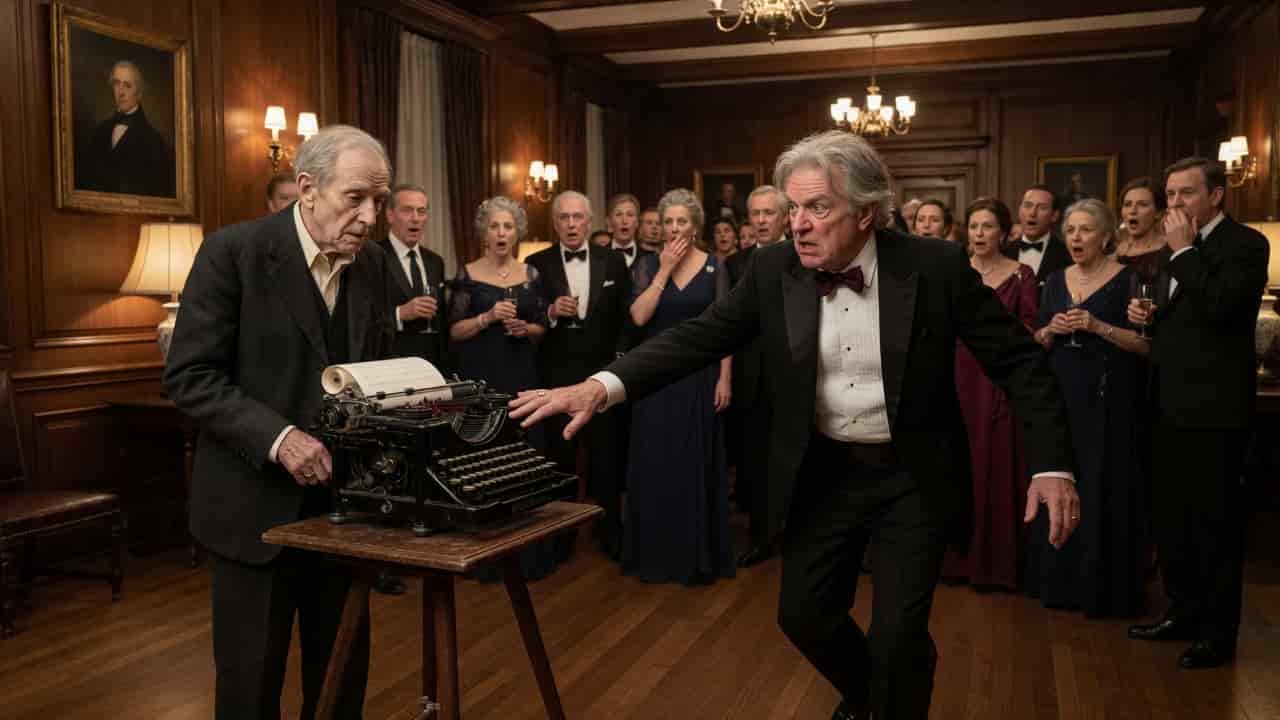
“Shut that damn thing off, Arthur!”
Senator Thorne’s voice didn’t sound like a hero’s anymore. It sounded like a man who had spent fifteen years waiting for a ghost to come back and haunt him. He lunged across the stage, his expensive tuxedo straining at the shoulders, but he was too late. The speakers had already caught the sound.
The room—filled with Boston’s elite, the judges, the donors, and the press—went so quiet you could hear the ice melting in the crystal glasses. Then, the recording played. It wasn’t a digital file. It was the raw, grainy audio from a hidden recorder inside a steno-machine from a trial everyone wanted to forget.
“I don’t care if he’s innocent,” Thorne’s younger, hungrier voice crackled through the hall. “Just get a conviction. I want his name erased.”
Arthur didn’t move. He stood there, a frail man in a cheap suit, finally letting the truth breathe. He looked past the panicked Senator and found Sara in the back of the room. She was the widow of the man they’d sent away—the man Arthur had helped bury with his own silence.
Thorne grabbed the tripod, his knuckles white, but the damage was done. For forty years, Arthur had been the invisible man in the corner of the courtroom. Now, he was the only one in the room who could see the floor falling out from under the man who thought he was a king.
Chapter 1: The Rhythm of the Keys
The doctor didn’t use metaphors. He didn’t talk about the sunset of my life or a long journey ahead. He used words like metastasized and unresponsive. He pointed to a grey shadow on a black-and-white scan that looked like a thumbprint on a windowpane. It was a cold, clinical conversation held in a room that smelled of industrial lemon and unwashed lab coats. I sat there in my charcoal wool suit—the one I’d worn to every sentencing for a decade—and I listened to the logistics of my own departure.
“How long?” I asked. My voice was thin, the sound of dry paper rubbing together. It was a voice built for whispers in the back of courtrooms, not for demands.
“Three months. Maybe four with aggressive intervention,” the doctor said. He looked at his watch. He had three more shadows to explain to three more people before lunch.
“No intervention,” I said.
I walked out of the clinic and into the biting Boston autumn. The air felt sharper than it had an hour ago. I walked three blocks to the T, my hand instinctively patting the side of my leather satchel. Inside was my old Stenograph—the mechanical heart of my career. It was an antique by modern standards, a heavy, black-enameled machine with keys that felt like piano ivory. I had retired two years ago, but I still carried it sometimes. It was a phantom limb.
My apartment in Dorchester was a museum of silence. Every surface was dusted, every book aligned. I made a pot of tea and sat at my kitchen table. I didn’t cry. I didn’t feel the “shattered heart” the novels talk about. I felt a strange, vibrating clarity. It was the same feeling I had during a high-stakes cross-examination when the witness started to sweat and the rhythm of my fingers on the keys became a perfect, unbroken loop.
I pulled the steno-machine from the bag and set it on the table. It was a 1994 professional model. I had modified it myself thirty years ago. Back then, I was terrified of a mechanical failure during a capital case, so I’d rigged a secondary digital recording unit into the base—a micro-cassette rig at first, then a digital chip. It was illegal, of course. Stenographers aren’t supposed to keep their own audio. We are supposed to be vessels, translating spoken lies into official truths, then emptying ourselves for the next case.
I opened the hidden compartment in the base. I hadn’t touched the storage drive in years. My brother, Leo, had died in a prison cell in Concord four years ago. He’d been convicted of a RICO predicate that Thorne—then the District Attorney—had built out of thin air and planted ledgers. I had sat five feet away from the witness stand, my fingers flying, typing the words that buried my own blood. I had heard the off-the-record whispers in the judge’s chambers when the microphones were supposed to be off. I had heard Thorne tell the judge, “The evidence is thin, but the optics are perfect. We need this win.”
I had stayed silent. I wanted to keep my pension. I wanted to keep my respectable life. I told myself that the system would correct itself. It never did.
I plugged the drive into my laptop. The files were dated by case number. I scrolled down to Commonwealth v. Penhaligon.
My hand shook as I clicked the audio file. The sound was grainy, filtered through the casing of the machine, but the voices were unmistakable.
“The brother is the weak link,” Thorne’s voice said. He sounded younger, more arrogant. “If he won’t flip, we just pin the whole procurement on him. The ledger is already in the evidence locker. It’s got his prints on it now.”
A second voice—Judge Miller, long since deceased—chuckled. “You’re playing a dangerous game, Elias. If the court reporter catches a whiff of this…”
“Arthur?” Thorne laughed. “Arthur is a ghost. He doesn’t hear anything that isn’t for the record. He’s the most obedient man I’ve ever met.”
The words hit me harder than the doctor’s diagnosis. The most obedient man. It was the epitaph of a coward.
I looked at the steno-machine. For forty years, I had been a tool. I had shaped the official history of this city. I had helped Thorne climb the ladder to the Senate, stepping on the necks of men like Leo.
I didn’t have much time left. My body was already starting to fail me; a dull ache in my lower back was beginning to radiate toward my hips. But my mind was a sharp, narrow beam.
I looked at the calendar on the wall. In three weeks, the city was holding the “Justice and Honor” gala at the Boston Marriott Copley Place. It was a fundraiser for Thorne’s re-election, a “Hero’s Welcome” to celebrate his decade of public service. Every judge, every lawyer, and every high-ranking cop in the district would be there.
I stood up and walked to the window. The sun was dipping behind the triple-deckers, casting long, bruised shadows across the street. I wasn’t going to spend my last three months in a hospital bed. I was going to go back to work. I was going to give the Senator one final transcript.
I reached out and touched the keys of the machine. S-T-K-P-W-R. The initial stroke for a new session.
“I’m not a ghost yet, Elias,” I whispered to the empty room.
The weight of the silence in the apartment changed. It was no longer the silence of a man waiting to disappear. It was the silence of a predator waiting for the right moment to strike. I spent the rest of the night transcribing the secret audio, my fingers moving with a speed I thought I’d lost. I wasn’t just typing words; I was building a cage.
Chapter 2: The Widow’s Ghost
Sara lived in a small, cramped bungalow in Quincy that smelled of Murphy Oil Soap and damp wool. She was my brother’s widow, but for the last fifteen years, she had been a stranger. When I pulled my old Buick into her driveway, I stayed in the car for ten minutes, watching the flickering blue light of a television through her front window.
My back was throbbing. The doctor had given me a prescription for something “to take the edge off,” but I wanted my head clear. I needed to see the damage one more time before I started the fire.
I climbed out and walked to the door. The salt air from the bay was cold, biting through my coat. I knocked.
The curtain moved. Then, the sound of three separate locks turning. Sara opened the door only a few inches. Her hair was entirely white now, pulled back so tight it made her eyes look startled.
“Arthur,” she said. It wasn’t a greeting. It was a statement of fact, delivered with the same warmth one might give a bill collector.
“Hello, Sara. Can I come in?”
“Why? You need more testimony for a transcript? You need to make sure you didn’t miss a word of how they ruined us?”
The bitterness was a physical thing, a thick layer of residue that had never been washed away. I deserved it. I had been the man in the room. I was the one who survived while Leo died of a pulmonary embolism in a six-by-nine cell, still protesting his innocence to a wall.
“I have something to show you,” I said. “And I don’t have a lot of time. In any sense.”
She looked at me then, really looked at me. She saw the way I leaned slightly to the left to take the weight off my hip. She saw the greyish tint to my skin that the makeup of a healthy life couldn’t hide. She stepped back and opened the door.
The living room was filled with photos of Leo. Leo at the shipyard. Leo at their wedding. There were no photos of me. I sat on the edge of a floral-patterned sofa that felt like it hadn’t been sat on in years.
“I’m sick, Sara,” I said. “Cancer. It’s moved into the bones.”
She didn’t gasp. She didn’t offer sympathy. She sat in a wooden rocking chair across from me and folded her hands in her lap. “Is that why you’re here? You want me to tell you it’s okay? You want a priest?”
“I want to clear his name,” I said.
She laughed, a dry, hacking sound. “With what? Your memories? The city doesn’t care about the memories of a retired clerk. Thorne is a god in this town. He’s going to be Governor next, or maybe more. He’s a ‘man of the people,’ Arthur. That’s what the papers say.”
I reached into my satchel and pulled out a stack of papers. It wasn’t a legal brief. It was a transcript, formatted in the strict, courier-font style of the Massachusetts Superior Court.
“This is what was said in Judge Miller’s chambers on October 14, 2011,” I said. “While you were sitting in the hallway crying, and Leo was being led out in cuffs.”
I handed her the pages. I watched her eyes move. At first, they moved with a kind of weary suspicion, but then they slowed. Her breathing hitched. She hit the part where Thorne talked about the “optics” and the “planted ledger.”
She looked up at me, her face pale. “How?”
“I kept my own recordings. I was a coward, Sara. I kept them for insurance, in case they ever turned on me. I should have come forward fifteen years ago. I know that. Every day of those fifteen years, I’ve known that.”
“You let him die,” she whispered. The words weren’t loud, but they carried the weight of a sledgehammer. “You sat there with your little machine and your little keys, and you let them take him. You watched him rot for a pension.”
“Yes,” I said. I didn’t look away. “I did.”
“And now you’re dying, so you want to be a hero? You want to go to heaven with a clean slate?” She stood up, the pages fluttering to the floor. “Get out of my house, Arthur. You’re a ghost. You’ve been a ghost since the day you stopped being his brother.”
I stood up, the pain in my back flaring into a sharp, white heat. I didn’t pick up the papers. “I’m going to the gala in three weeks. The one for Thorne. I’m going to play the audio. Not just the transcript, but the actual voices. I’ve rigged my old Stenograph to broadcast to the house speakers.”
She froze. “They’ll kill you. Or they’ll put you in a cell worse than the one Leo had.”
“Let them,” I said. “I’m already under a death sentence. The only difference is whether I die in a bed or on my feet.”
I walked to the door. I didn’t expect her to follow me. I didn’t expect her to forgive me.
“Arthur,” she called out as I reached the porch.
I turned back.
“He never hated you,” she said, her voice cracking for the first time. “In all those letters, he kept saying, ‘Arthur is doing his job. Arthur is a good man.’ He died believing you were the only honest thing in that room.”
I couldn’t breathe for a second. The air in my lungs felt like broken glass. I didn’t say anything. I couldn’t. I just nodded and walked to my car.
As I drove away, I saw her in the rearview mirror, standing in the doorway, the light from the house spilling out around her. She looked small and fragile, a remnant of a life that had been systematically dismantled by a man in a tuxedo.
I had twenty-one days. I needed to find someone who knew the layout of the Marriott’s sound system. I needed to be more than a ghost. I needed to be a glitch in the machine.
Chapter 3: The Young Shadow
The Boston courthouse is a labyrinth of marble and institutional cruelty. I walked through the metal detectors, the old guards nodding to me out of habit. They didn’t see the man with the terminal shadow; they saw “Artie,” the guy who used to bring donuts on Fridays.
I made my way to the court reporters’ pool in the basement. It was a windowless room filled with the frantic clicking of keys and the smell of burnt coffee.
“Arthur! What are you doing in the pits?”
It was Elena. She was twenty-four, sharp-eyed, and wore her idealism like a target on her back. She was the best stenographer they’d hired in a decade—fast, accurate, and still burdened by the belief that the words mattered.
“Just picking up some old files, Elena,” I said, leaning against her desk. “How’s the grind?”
She sighed, pushing a strand of dark hair behind her ear. “Thorne’s people are in and out of here every day. They’re trying to ‘archive’ everything from his time as DA. Translation: they’re shredding the stuff that doesn’t look good for the campaign. It’s disgusting, Arthur. I saw a file yesterday—an old procurement case—where the signatures didn’t even match the witness statements. I pointed it out to the clerk, and he told me to ‘focus on my wpm’ and shut up.”
I felt a surge of adrenaline. The bullying wasn’t a relic of the past; it was the current operating system. Thorne’s reach was still long, and his people were still silencing anyone who looked too closely at the seams.
“Which clerk?” I asked.
“Loomis. He’s Thorne’s boy. He treats us like we’re part of the furniture. Yesterday, he actually told me that if I kept ‘finding’ things, I’d find myself transcribing traffic court in Worcester.”
I looked over at Loomis’s office. He was a small, ambitious man with a permanent sneer, currently berating a young intern for bringing him the wrong coffee. He was a bully by proxy, a man who derived his power from his proximity to a Senator.
“Come with me for a minute, Elena,” I said.
We walked into the hallway, near the old elevators where the cameras didn’t reach.
“I need a favor,” I said. “And it’s the kind of favor that could get you fired. Or worse.”
She didn’t blink. “Try me. I’m already halfway to Worcester anyway.”
“I need the schematics for the Marriott Copley Place ballroom. Specifically the AV patch-ins. And I need someone to vouch for me as a ‘retired consultant’ to the sound crew setting up for the gala.”
Elena’s eyes widened. She knew about my brother. Everyone in the pool knew, even if they never said it to my face.
“You’re going after him,” she whispered.
“I’m giving a final statement,” I said.
Before she could answer, the door to the office swung open. Loomis stepped out, his face flushed. He marched over to us, his heels clicking loudly on the marble.
“Penhaligon? What the hell are you doing here? You’re retired. This area is for active staff only.” He stepped into my personal space, his chest puffed out. He was six inches shorter than me, but he talked like he owned the air I was breathing.
“Just saying hello to old friends, Michael,” I said calmly.
“You’re loitering. And you’re distracting my best reporter.” He turned to Elena, his voice dropping into a low, menacing hiss. “Elena, didn’t I give you the Miller transcripts to finish by five? Why are you out here gossiping with a washed-up clerk who doesn’t know when to stay home?”
“He’s not a washed-up clerk,” Elena said, her voice trembling slightly. “He’s Arthur Penhaligon. He has more seniority in his little finger than—”
“He has nothing,” Loomis snapped. He turned back to me, his finger jabbed toward my chest. “Get out, Arthur. Before I have security escort you out. You’re an embarrassment. Everyone knows you only kept your job because Thorne felt sorry for you after your brother turned out to be a crook. Don’t push your luck.”
The room went silent. The other reporters were watching from the doorway. It was a public degradation, a calculated strike meant to remind everyone in the room who held the leash.
I looked at Loomis. I saw a man who thought he was big because he served a giant. I felt a strange sense of pity for him. He was so focused on the hierarchy that he couldn’t see the man who had nothing left to lose.
“You’re right, Michael,” I said. My voice was steady, projecting to the back of the room. “I have nothing. And that makes me the most dangerous person you’ve ever met.”
I turned and walked away. I didn’t look back until I reached the elevators.
Five minutes later, my phone buzzed. It was a text from an unknown number.
Schematics in your inbox. I’m the ‘consultant’ on the floor Thursday night. Be at the loading dock at 6 PM. Wear a headset.
I smiled. The bullying had backfired. Loomis had tried to crush a girl, and instead, he’d given her a reason to fight.
I walked out of the courthouse and looked up at the grey Boston sky. The pain in my hip was a dull roar now, but I felt light. I was no longer a ghost. I was a man with a schedule.
Chapter 4: The Preparation
The week before the gala was a blur of technical trial and error. I spent my days in my apartment, the steno-machine disassembled on my kitchen table. I was bypassing the internal speakers and wiring a high-gain transmitter into the motherboard. It was delicate work for hands that were increasingly prone to tremors.
I had to be able to hit a specific chord on the keys—a sequence that didn’t exist in standard shorthand—to trigger the audio playback. I chose T-R-U-T-H.
Every time I practiced the stroke, the sound of Thorne’s voice filled the room.
“The brother is the weak link…”
I practiced until the movement was muscle memory. I practiced until I could do it while my vision blurred from the pain. I was losing weight; my suits were starting to hang off my frame like they belonged to a larger man. I looked in the mirror and saw a stranger—a man with hollowed-out eyes and a jawline like a hatchet.
On Thursday night, I drove to the Marriott. The loading dock was a chaotic mess of catering trucks and floral delivery vans. I wore a black windbreaker and carried a battered equipment case.
Elena was there, wearing a “Staff” lanyard and a headset. She looked nervous, her eyes darting toward the security guards.
“You’re late,” she whispered, pulling me into the service elevator.
“Old men move slow, Elena. It’s our only privilege.”
“The sound booth is on the mezzanine. I’ve already patched the wireless receiver into the main board. All you have to do is be within fifty feet of the stage. The signal will pick up your machine and override the podium mic.”
“And the Senator’s security?”
“They’re focused on the doors and the VIP tables. Nobody looks at the ‘old man’ in the back. I’ve got you listed as a secondary stenographer for the deaf and hard-of-hearing feed. It’s a standard addition for these kinds of events now. You’ll have a little table right at the edge of the stage.”
She looked at me, her expression softening. “Arthur, once you play it… there’s no going back. They’ll have you in custody in thirty seconds.”
“Thirty seconds is more than enough time for a transcript to enter the record,” I said.
The elevator opened to the grand ballroom. It was a sea of gold-clothed tables, crystal chandeliers, and mahogany pillars. In the center was a massive stage with a podium bearing the seal of the United States Senate.
I saw Loomis near the stage, barking orders at the catering staff. He looked like a king in a small kingdom.
“Go,” Elena whispered. “I’ll be in the booth. If they try to cut the power, I’ve got a backup loop that will keep it running for another minute.”
I walked across the floor. My heart was thumping against my ribs, a frantic, uneven rhythm. I set up my steno-machine on the small table Elena had arranged. It was perfectly positioned—twenty feet from the podium, ten feet from the press line.
I sat down and adjusted the tripod. I looked out at the empty chairs. In two hours, this room would be filled with the people who had built their lives on the silence of men like me.
I reached into my pocket and pulled out a small, framed photo of Leo. I tucked it into the side of the steno-case, where only I could see it.
“Almost there, Leo,” I whispered.
The pain in my back was a white-hot spike now, radiating down both legs. I took a deep breath, closed my eyes, and let my fingers rest on the keys. I wasn’t thinking about the cancer. I wasn’t thinking about the law. I was thinking about the rhythm.
The doors opened. The first of the guests began to trickle in—the minor players, the aides, the social climbers. They walked past me without a glance. I was just the furniture. I was the invisible man.
I watched as the room filled. I saw the flashbulbs of the cameras. I heard the clinking of glasses and the roar of a hundred polite conversations.
Then, the music changed. A triumphant brass fanfare.
“Ladies and gentlemen,” a voice boomed over the speakers. “Please welcome… Senator Elias Thorne.”
The room erupted into applause. Thorne walked onto the stage, beaming, his silver hair catching the light. He looked invincible. He looked like a man who had forgotten that ghosts exist.
He reached the podium and raised his hands, basking in the adulation. I saw Sara in the back of the room. She was standing near a pillar, her face a pale mask. She saw me. She nodded, once.
Thorne began to speak. “My friends, tonight is not about me. It’s about justice. It’s about the honor of the great city of Boston…”
I looked down at my keys. My hands were steady. The tremors were gone.
I waited. I waited for him to reach the part of his speech where he talked about “the rule of law” and “the integrity of the courts.”
“We must remember,” Thorne said, leaning into the microphone, “that the truth is the foundation of everything we build.”
I looked up. Thorne was smiling. He looked directly toward the press line, passing over me as if I were a shadow on the wall.
My fingers shifted. I felt the weight of the keys—the ivory feel of the plastic, the mechanical resistance of the springs.
T-R-U-T-H.
I struck the chord.
The podium mic didn’t cut out. It stayed live, but a second layer of sound began to bleed through the house speakers. It was grainy. It was low. But it was loud enough to stop the breath of everyone in the room.
“…just get a conviction. I don’t care if he’s innocent.”
Thorne froze. His mouth stayed open, but no words came out. He looked around, his eyes darting toward the sound booth, then toward the speakers in the ceiling.
“I want his name erased.”
The room went so quiet I could hear the hum of the air conditioning. Thorne’s gaze finally landed on me. He saw the old machine. He saw my hands on the keys.
His face turned from a tan, healthy glow to a mottled, panicked purple. He stepped away from the podium, pointing a trembling finger at me.
“Shut that damn thing off!” he shouted. His voice cracked, the sound of a hero breaking apart in real-time.
I didn’t move. I looked him in the eye and hit the chord again, louder this time.
“Everyone needs to hear it, Elias,” I said.
The sound of the recording swelled, filling every corner of the ballroom, drowning out the Senator, drowning out the silence, drowning out the fifteen years of lies.
I sat there, the invisible man in the charcoal suit, finally making a record that would never be shredded.
Chapter 5: The Weight of the Record
The ballroom didn’t just go quiet; it became a vacuum. The air seemed to leave the lungs of five hundred people simultaneously. For a heartbeat, the only sound in the Marriott was the grainy hiss of the recording—the ghost of a younger Elias Thorne, arrogant and untouchable, admitting to a felony that had cost a man his life.
Then, the collision happened.
Thorne didn’t act like a Senator. He acted like a cornered animal. He lunged across the three feet of stage separating the podium from my small steno-table. His tuxedo jacket bunched at his thick neck, and his face was a shade of plum I’d only seen on men having heart attacks in the witness box. He didn’t reach for me; he reached for the steno-machine.
“Shut it off!” he roared again, his voice cracking. He grabbed the metal tripod, his knuckles white and trembling.
I didn’t pull back. I couldn’t have even if I wanted to; my hips felt like they were fused with iron. I stayed seated, my fingers hovering an inch above the keys. I looked at him, not with hatred, but with the clinical observation of a man who had spent forty years watching people’s masks slip.
“The record is open, Elias,” I said. My voice was low, but with the house speakers still live, it carried to the very back of the hall, where the waitstaff stood frozen with silver trays. “You can’t strike this from the minutes.”
Two men in dark suits—Thorne’s personal security, the kind of men who never look you in the eye—moved in from the wings. One of them, a blocky man with a buzz cut I recognized as Agent Vance, grabbed my shoulder. His grip was a vice, crushing the thin bone. He didn’t care about the cancer; he didn’t even see me. I was just an obstacle to be moved.
“Move him!” Thorne hissed, his eyes darting toward the press line. The cameras were already up. The red lights of the news crews were tiny, judging eyes. The flashbulbs were a staccato of white lightning, capturing the Senator’s hands on my equipment, capturing the raw, unpolished panic on his face.
Vance yanked me backward. My chair scraped across the stage with a sound like a scream. I felt a jagged, hot flash of pain shoot through my spine, a white light that threatened to swallow my vision. I didn’t cry out. I bit my tongue until I tasted copper. I watched as the other security guard tried to rip the steno-machine from the tripod.
He didn’t know how it worked. He pulled at the carriage, and the internal recording unit—the one Elena had helped me patch into the board—was hard-wired. He was yanking on the nervous system of the room.
“Get him out of here,” Thorne commanded, trying to regain some semblance of his public persona. He straightened his tie, though his hands were shaking so badly he nearly undid it. He turned back to the microphone, his voice a desperate, booming baritone. “Ladies and gentlemen, please. This is a… a deeply disturbed former employee. A man suffering from a terminal illness who has clearly been manipulated by my political opponents. This recording is a fabrication. A deep-fake.”
It was a good lie. It was a Senator’s lie. It might have even worked if the recording hadn’t shifted.
Elena, God bless her, had played the next file.
“The ledger is in the evidence locker, Elias. It’s got his prints on it now. We used the glass from his kitchen. He’ll never know.”
That was the sound of the DA’s investigator, a man named Miller who had been dead five years. The room didn’t just stay quiet this time; it began to growl. It was the sound of five hundred people realizing they’d been sold a fake hero for a decade. I saw a judge I’d worked with for twenty years—Judge Halloway—stand up from the front table. He wasn’t looking at the stage; he was looking at the floor, his face pale with the realization of every conviction Thorne had handed him.
Vance dragged me toward the service exit. My feet trailed on the carpet. The pain was a living thing now, a heavy weight dragging me toward the ground. He shoved me through the heavy velvet curtains and into the stark, fluorescent light of the backstage hallway.
Thorne followed a second later, the doors swinging shut behind him, cutting off the roar of the ballroom. He was sweating through his shirt. He walked right up to me as Vance pinned me against a concrete wall.
“You’re a dead man, Arthur,” Thorne whispered. He wasn’t shouting now. This was the voice he used in backrooms, the one that broke lives. “You think this matters? I’ll have those files suppressed by morning. I’ll have you committed. I’ll make sure everyone knows you’re a senile, bitter old man trying to avenge a criminal brother.”
I leaned my head back against the cold concrete. It felt good. I looked at the Senator. He looked small in the fluorescent light. He looked like a man who had spent his whole life building a house of cards and had finally realized the windows were open.
“The files aren’t just on that machine, Elias,” I said, my voice barely a wheeze.
He froze. “What?”
“I’m a court reporter. I know about backups. I know about the chain of custody.” I felt a strange, cold joy. “Elena didn’t just patch the audio into the speakers. She patched it into a cloud server. Every major news outlet in the city received a link ten minutes ago. The Boston Globe, the Herald, the Attorney General’s office. By the time you get home tonight, the transcript will be on every front page in the country.”
Thorne’s face didn’t turn purple this time. It turned a grey, ashen color. He looked at Vance, then back at me. He looked like he wanted to hit me, but he knew the cameras were just on the other side of that curtain. He was a man of optics, and the optics were gone.
“Why?” he asked. It was a genuine question. He truly couldn’t understand why a man would throw away a peaceful death for a dead brother’s ghost. “You had a pension. You had a quiet life. I looked out for you.”
“You didn’t look out for me,” I said. “You used me as a witness to your own righteousness. You made me a part of your lie. And Leo… Leo was the only thing I had that was real. You took that. You made me type the words that killed him.”
I felt my legs give out. Vance held me up for a second, then, seeing Thorne’s expression, he let go. I slumped to the floor, my back against the wall. The pain was no longer a spike; it was a tide, rising up to my chest.
Thorne looked down at me. For a moment, I saw the fear in him—not the fear of prison, but the fear of being seen. He was a man who existed only in the reflection of other people’s admiration. Without that, he was nothing.
“Get him out of the building,” Thorne said to Vance, his voice hollow. “Call an ambulance. Just get him away from here.”
He turned and walked back toward the ballroom. He had to go back on that stage. He had to try to spin the unspinnable. I watched him go, his shoulders slumped, the hero’s cape trailing in the dust.
Vance didn’t be rough with me this time. He looked at me with a kind of confused respect, or maybe just the realization that he was working for a sinking ship. He knelt down beside me.
“You okay, old man?” he asked.
“I’ve been better,” I said. “But I’ve never been clearer.”
Ten minutes later, I was on a gurney, being wheeled out the loading dock. The cool night air hit my face, and for the first time in fifteen years, I didn’t feel like I was holding my breath. I saw Elena standing by the police tape. She was crying, but she was smiling, too. She held up her phone.
BREAKING: SENATOR THORNE ACCUSED OF EVIDENCE TAMPERING IN 2011 CASE.
I closed my eyes as they slid me into the back of the ambulance. The rhythm of the siren started—a long, wailing note that sounded like a final, sustained chord on a steno-machine.
S-T-K-P-W-R.
The session was almost over.
Chapter 6: The Final Transcript
The hospice ward smelled of lavender and industrial-grade floor wax, a scent that tried to mask the heavy, sweet rot of ending. It was a quiet place on the edge of the city, where the windows looked out over a small courtyard of dying oaks. I liked it here. There were no courtrooms. No one was lying for the record.
It had been six weeks since the gala. The world outside was in a state of high-velocity collapse, but inside this room, time moved like molasses.
I was mostly bed-bound now. The grey shadow on the scan had become a map of my entire body. Every movement felt like a negotiation with a landslide. But the television in the corner was always on, and the news was the only medicine I needed.
“Senator Elias Thorne resigned his seat this morning,” the news anchor said, her voice a calm, professional drone. “Following the release of the so-called ‘Penhaligon Tapes,’ the Department of Justice has opened a federal investigation into over forty cases handled during Thorne’s tenure as District Attorney. A special prosecutor has been appointed to oversee the exoneration process for wrongfully convicted inmates.”
I watched as the screen showed a clip of Thorne walking down the steps of the federal building, his head low, his face shielded by a folder. He looked old. He looked like the man I’d seen in that hallway—a man who had finally run out of words.
A knock came at the door. It wasn’t the nurse.
Sara walked in. She looked different. She wasn’t wearing the navy dress from the gala, but a soft green sweater that made her look younger, less brittle. She was carrying a small bouquet of yellow roses—Leo’s favorite.
She didn’t say anything at first. She sat in the vinyl chair by the bed and reached out, taking my hand. Her skin was cool, her grip surprisingly strong.
“They took the sign down,” she said.
“What sign?”
“The one at the prison. The one that listed the ‘Inmate Number.’ They replaced it with his name. They’re doing a memorial service at the shipyard next week. The union is organizing it. They’re calling it the ‘Justice for Leo’ day.”
I felt a lump in my throat that had nothing to do with the cancer. “That’s good, Sara. That’s… that’s right.”
“The Attorney General called me yesterday,” she continued, her voice steady. “She told me that the state is issuing a formal apology. And a settlement. Not that the money brings him back, but… she said it wouldn’t have happened without you. She called you the ‘conscience of the court.'”
I laughed, a weak, wet sound. “I was just a man with a machine, Sara. A man who waited too long.”
“No,” she said, squeezing my hand. “You were the man who stayed in the room. You were the only one who kept the truth when everyone else was busy burning it.”
She looked at the roses, then back at me. “I talked to the lawyer. The one you found—the disgraced one. He’s not disgraced anymore. He’s leading the class-action suit for the others. He said you sent him a file. A file on the Loomis clerk?”
“Loomis was a bully,” I said, thinking of the way he’d treated Elena. “I had a few transcripts from his private meetings with the evidence technicians. I thought the prosecutor might find them interesting.”
“He did,” Sara said with a small, grim smile. “Loomis was indicted yesterday. Obstruction of justice.”
The residue of the confrontation at the gala was still settling, but it was settling into something like a foundation. The power structure hadn’t just cracked; it had been dismantled, piece by piece, by the very words it had tried to use as a weapon.
We sat in silence for a long time. The sun began to dip behind the oaks, casting long, golden bars across the linoleum floor.
“Arthur,” Sara said, her voice dropping to a whisper. “I forgive you.”
The words hit me with a force that made my breath catch. It was the one thing I hadn’t allowed myself to hope for. I had earned the justice, maybe, but I didn’t think I’d earned the peace.
“You don’t have to say that,” I said.
“I do. Because Leo would have said it. And because I can’t carry the anger anymore. It’s too heavy, Arthur. You took the weight off me at that gala. You took the shame and you put it where it belonged.”
She leaned over and kissed my forehead. She smelled like Murphy Oil Soap and roses. “Sleep now, Arthur. The record is closed.”
She stayed until I drifted off. When I woke up, the room was dark, except for the blue glow of the steno-machine on the nightstand. Elena had brought it to me a few days ago. She’d cleaned it, polished the black enamel until it shone like a mirror.
I reached out and touched the keys. My fingers were cold, and I couldn’t feel the tips anymore, but I knew the positions. I knew the language.
I didn’t need to type anything. I just felt the rhythm of my own breathing.
H-E-R-E.
H-E-A-R-D.
F-I-N-I-S-H-E-D.
The next morning, the nurse found me. I was still holding the steno-machine’s carriage. The television was off. The room was silent.
But it wasn’t the silence of a ghost. It was the silence of a courtroom after the final verdict has been read and the truth has finally been entered into the record.
In the final transcript of Commonwealth v. Thorne, the last entry wasn’t a word. It was a notation, typed in the margin by a young reporter named Elena who had taken over the pool.
The witness has been excused. The record is complete.
The city of Boston went on. The wood-paneled courtrooms were still filled with lies, and the politicians were still building their houses of cards. But in a small cemetery in Quincy, there were two headstones side by side now. One said Leo Penhaligon—Innocent. The other said Arthur Penhaligon—Reporter.
And for the first time in forty years, the words meant exactly what they said.
THE END