“You’re a ghost, Leo. Too broken to even stand straight on my roof.”
Vince Gallo spit the words out like they were worth something. He looked around at the younger guys, the ones in their twenties with good knees and no memories, waiting for them to laugh. He kicked my tool belt—the one I’ve carried for thirty years—and watched it slide across the concrete.
I didn’t pick it up. My knees screamed, the bone-on-bone grind of three decades on the hot tar of St. Louis, but I didn’t move. I looked at Toby, the kid I’m supposed to be mentoring, and I saw the look in his eyes. Pity. The kind of pity you give a dog before it’s put down.
Vince thought he’d won. He thought the bribe he paid twenty years ago had buried the truth along with my brother. He thought because I had a limp and a mortgage I couldn’t afford, I’d just take the humiliation and keep my mouth shut.
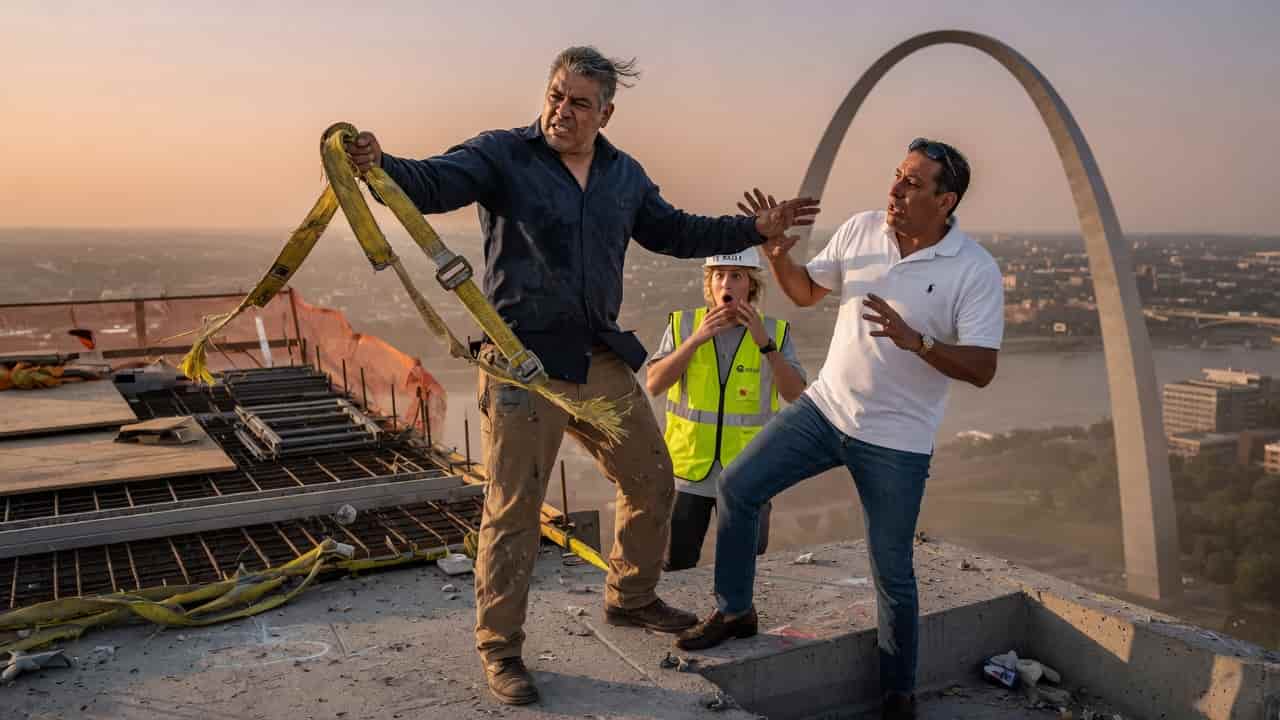
But I wasn’t just standing there. I was holding the yellow harness. The one with the jagged edges. The one Vince himself had cut to save five minutes on a safety check.
“Then why are you shaking, Vince?” I asked. My voice was quiet, but the wind on the fortieth floor carried it just fine.
I held the frayed strap up to his expensive white shirt. I wanted him to see the fibers. I wanted him to remember the sound of the snap. The whole roof went silent. The laughter Vince was waiting for never came.
He didn’t realize that when you take everything from a man, you leave him with nothing to lose. And I’m not just a ghost. I’m the one who knows where the bodies are buried.
Chapter 1: The Grind
The humidity in St. Louis doesn’t just sit on you; it possesses you. It’s a thick, wet wool blanket that smells of river silt and hot asphalt, and by seven in the morning, it was already heavy enough to make breathing feel like a chore. I stood on the edge of the Lofts at North Grand, forty stories above the sidewalk, feeling the familiar, rhythmic throb in my left knee. It wasn’t a sharp pain anymore. It was a dull, persistent roar, like a radio left on in another room. Bone on bone. The legacy of thirty years spent crawling on my hands and knees across the blistering skin of the city.
I was forty-eight, but in roofer years, I was ancient. My hands were mapped with scars—burns from hot tar, slices from flashing, the deep, jagged white line where a nail gun had misfired in ’04. I looked down at them, the fingers thick and slow, and then I looked at Toby.
Toby was twenty. He was lean and fast, his skin still that pale, suburban shade that hadn’t yet been cured into leather by the sun. He was humping a bundle of shingles toward the far edge of the southern parapet, moving with a grace that made my teeth ache. He didn’t know how to pace himself yet. He thought the energy would last forever. He reminded me so much of Liam it made my chest tight.
“Watch your step on that transition, kid,” I called out. My voice sounded like gravel shifting in a bucket. “The plywood’s soft near the scupper.”
Toby didn’t look back, just gave a quick thumbs-up. He was eager. He wanted to impress the man in the white polo shirt standing near the hoist.
Vince Gallo was the reason we were up here. He was the contractor, the man who owned the trucks and the contracts and, if you believed the rumors at the union hall, half the city council. He was fifty-two and looked like he spent more time in a tanning bed than on a job site. His white polo was crisp, tucked into jeans that cost more than my first car. He was checking his gold watch, his eyes scanning the roof with the restless, predatory energy of a man who saw every second as a lost dollar.
“Leo!” Gallo barked. He didn’t look at me, just pointed toward the hoist. “Move it. We’re behind on the southern face. I’m not paying for the view.”
I started toward him, my left leg dragging just a fraction of an inch. I tried to hide it, to keep my gait level, but you can’t lie to concrete. The scuff of my boot was a confession.
“I’m on it, Vince,” I said, reaching him. “But the wind’s picking up. If we don’t secure the staging, those bundles are going to catch sail.”
Gallo finally looked at me, his eyes hidden behind aviator sunglasses. He smiled, but it was the kind of smile a shark gives a buoy. “The wind’s fine, Leo. You’re just getting slow. Maybe the height’s starting to get to you. Is that it? You getting dizzy in your old age?”
I felt the heat crawl up the back of my neck, and it wasn’t from the sun. “I’m not dizzy. I’m being careful. There’s a difference.”
“Careful doesn’t finish the Lofts by September,” Gallo said, stepping closer. He smelled of expensive cologne and air conditioning. “Careful is for guys who want to collect a pension. You want a pension, Leo? Or do you want to keep that mortgage?”
He knew about the mortgage. He knew about the medical bills for my mother’s physical therapy. He made it his business to know exactly how short the leash was for every man on his crew. He leaned in, his voice dropping so the others couldn’t hear, though Toby was watching us from twenty feet away, his bundle of shingles forgotten.
“You’re a ghost, Leo,” Gallo whispered. “A walking relic. You’re too broken to even stand straight on my roof. Don’t push me. I’ve got ten kids like that one over there who can do your job in half the time for half the pay.”
He didn’t wait for an answer. He turned his back on me—a deliberate insult—and started shouting at the hoist operator. I stood there, my hands trembling slightly. I wanted to reach out, to grab the collar of that white polo and pull him toward the edge, just to see if his expensive shoes could find purchase on the gravel. But I didn’t. I couldn’t.
I turned away and saw Toby looking at me. The kid’s face was a mixture of embarrassment and fear. He’d heard enough to know I was being gutted, even if he didn’t know the history. He looked away quickly, focusing on his shingles, but the damage was done. The air on the roof felt thinner, colder.
I walked to the edge and looked out over St. Louis. From here, you could see the red brick of the old warehouses, the gleaming curve of the Arch, and the shimmering haze of the Mississippi. Somewhere down there, in a small, cramped house in South City, my mother was sitting in her recliner, staring at a framed photograph of my brother, Liam.
Liam had been twenty-two. He’d been the one with the talent, the one who was going to go to college, the one who wasn’t supposed to end up like me. But he’d wanted to help with the bills, so he’d taken a summer job on one of Gallo’s sites.
Twenty years ago, on a roof not unlike this one, Liam had stepped onto a faulty scaffold. The harness he was wearing—the one Gallo had provided—had snapped like a piece of cheap twine. The union had investigated, but the report had been buried. The harness had “disappeared” from the evidence locker. A bribe was paid, a boss looked the other way, and my brother became a statistic.
My mother never forgave me for not being there. “You were supposed to watch him,” she’d say, her voice flat and dead. “You were the big brother.”
I reached into my pocket and felt the small, jagged piece of nylon I’d kept all these years. It was a secret I carried, a piece of the original harness I’d cut away before the foreman could hide it. It was my penance. My proof.
My knees screamed as I knelt to help Toby with the next bundle. The kid didn’t say a word, but he moved a little slower, matching my pace. It was a small mercy, but on a roof owned by Vince Gallo, it was the only kind we were likely to get.
Chapter 2: The Topping Out
The “Topping Out” ceremony was a week away. In the construction world, it’s supposed to be a celebration—the highest beam is lifted into place, an evergreen tree is perched on top for good luck, and the owner buys a round of beers for the crew. For Gallo, it was a marketing opportunity. He’d invited the press, the investors, and the mayor. He wanted the Lofts at North Grand to be the jewel in his crown, the project that proved he was the king of the St. Louis skyline.
The pressure on the roof was becoming unbearable. The heatwave had settled in, the temperature hitting triple digits by noon. The tar was soft under our boots, sticking to the soles like black molasses. We were working twelve-hour shifts, and the tempers were as frayed as the safety lines.
Gallo was on the roof every day now, a constant, buzzing presence. He didn’t just manage; he tormented. He had a way of finding the one man who was struggling and picking at him until he bled. Today, it was Toby.
Toby had made a mistake. He’d misaligned a row of flashing on the northern parapet, leaving a gap that would let water seep into the luxury units below. It was a minor fix, but Gallo had caught it before I could.
“Is this what I’m paying for?” Gallo screamed, pointing at the gap. He was standing in the center of the roof, his voice echoing off the neighboring buildings. “I’m paying for a kid who can’t even line up a piece of tin? Leo! Get over here!”
I limped across the roof, the heat radiating through the soles of my boots. Toby was standing by the parapet, his face beet-red, his eyes fixed on his boots.
“Look at this,” Gallo said, grabbing me by the shoulder and shoving me toward the flashing. His grip was surprisingly strong. “You’re supposed to be mentoring him. You’re supposed to be the veteran. Instead, you’re letting him ruin my building. What’s the matter, Leo? Your eyes going bad along with your knees?”
“It’s a five-minute fix, Vince,” I said, my voice tight. “He’s learning. It’s hot as hell out here, and he’s been humping bundles for six hours.”
“I don’t care if it’s the surface of the sun,” Gallo spat. He turned to Toby, leaning into the kid’s space. “You see this man? You see Leo? Look at him. This is your future if you keep screwing up. A broken-down hack who can’t even climb a ladder without whimpering. You want to be him? You want to be forty-eight and begging for scraps from men like me?”
Toby didn’t look up. He looked small, diminished. The pride I’d seen in him during the first few weeks was being systematically dismantled.
“Answer me, kid!” Gallo barked. “You want to be a ghost like Leo?”
“No, sir,” Toby whispered.
Gallo laughed, a sharp, ugly sound. “Then fix it. And Leo, you stay on him. If I see one more crooked line, both of you can go find work at a car wash. I hear they’re looking for guys who are good with sponges.”
He sauntered off toward the hoist, leaving a silence behind him that felt heavier than the humidity. I looked at Toby. I wanted to say something, to offer some kind of comfort, but what do you say to a kid who’s just been shown his own funeral?
“He’s just trying to rattle you,” I said, my voice sounding hollow.
“He’s right though, isn’t he?” Toby asked, finally looking at me. His eyes were hard. “He treats you like garbage, and you just take it. Why? You’ve been in the union forever. You know more about this roof than he does.”
“Because I need the job, Toby. It’s that simple.”
“My dad said you were the best,” Toby said, his voice dropping. “He said you and your brother were the fastest crew in the city. He said you didn’t take crap from anyone.”
The mention of Liam was like a punch to the gut. I looked away, out toward the river. “Your dad remembers a different time. Things change. People break.”
“I’m not staying here,” Toby said, more to himself than to me. “I’m not going to end up like this.”
He went back to work, his movements jerky and aggressive. I watched him for a moment, feeling a terrible sense of déjà vu. Liam had said the same thing two days before he fell. He’d been tired of the shortcuts, tired of the way Gallo—who was just a foreman back then—had pushed the men to work in the rain.
After the shift, I went to see my mother. The house smelled of lavender and old age. She was sitting in her chair, the television blaring a game show she wasn’t watching. The photo of Liam was on the side table, the silver frame polished until it shone.
“How was work?” she asked, her voice thin.
“Hot,” I said, sitting on the edge of the sofa. “Gallo’s pushing us hard for the Topping Out.”
She stiffened at the name. “Gallo. He’s a rich man now, isn’t he? Built his empire on the backs of boys like Liam.”
“He’s the same as he always was, Ma.”
“You should have watched him, Leo,” she said, the familiar refrain. “If you’d been there that day, instead of down in the truck…”
“I was getting the water, Ma. It was a hundred degrees. We were out.”
“You were the big brother,” she said, and then she went silent, her eyes drifting back to the television.
I left her there and went to the small bar down the street. It was a roofer’s bar—dark, smelling of stale beer and cigarettes. I sat in the corner and ordered a whiskey. My knees were screaming, but the real pain was in my chest.
I took the piece of nylon out of my pocket and set it on the scarred wood of the table. It was yellow, faded by twenty years of guilt. I’d spent two decades waiting for the right moment, for the leverage that would actually matter. Gallo was a big man now. He had more to lose.
The sabotage had started small. A loosened bolt on a hoist. A section of membrane that looked sealed but would fail at the first sign of a real storm. I knew this roof better than Gallo ever would. I knew its weaknesses because I was the one creating them.
I wasn’t just building his jewel; I was building his trap. And the Topping Out ceremony was going to be the perfect place to spring it.
Chapter 3: The Proof in the Plywood
The heat didn’t break, but the tension did. It happened on a Wednesday, three days before the ceremony. We were installing the final decorative caps on the southern parapet, the most exposed part of the roof. The wind was whipping off the Mississippi, gusting up to thirty miles an hour, making the long sheets of copper flashing difficult to handle.
Gallo was up there with the Union Boss, a man named Miller who’d been in Gallo’s pocket since the nineties. Miller was a big man with a red face and a permanent scowl, a man who’d traded the interests of the rank-and-file for a suite in one of Gallo’s buildings and a kickback on every major contract.
They were walking the perimeter, laughing, their voices carrying over the whine of the wind. I was working with Toby, trying to keep the copper steady as he drilled the anchor holes.
“Keep it tight, kid!” I shouted. “If the wind catches the underside, it’ll rip your arm out of the socket.”
Toby was sweating, his face pale. He was leaning into the wind, his boots slipping slightly on the gravel-covered membrane.
Gallo and Miller stopped ten feet away. Gallo was pointing at us, saying something to Miller that made the big man chuckle.
“Look at them,” Gallo called out, his voice booming. “The old man and the boy. It’s like a nature documentary. The silverback showing the fledgling how to fail.”
He walked over, his expensive shoes crunching on the roof. “Leo, Miller here was just saying he hasn’t seen you at the hall in a while. You still paying your dues, or are you too broke for that, too?”
Miller grinned, showing yellowed teeth. “Leo’s a legacy, Vince. We keep him around for the nostalgia. Though I hear the knees are finally giving out. That right, Leo? You still fit for a forty-story climb?”
I didn’t answer. I kept my weight on the copper, my eyes on the drill bit.
“He’s gone deaf, too,” Gallo laughed. He turned to Toby. “How’s he treating you, kid? He teaching you how to hide in the truck when the real work starts? That was his specialty back in the day.”
Toby looked at me, then at Gallo. I could see the conflict in his eyes. He wanted to defend me, but he saw Miller standing there—the man who held his future in his hands.
“He’s teaching me plenty,” Toby said, his voice shaky.
“I bet,” Gallo said. He reached out and kicked the copper sheet I was holding. It wasn’t a hard kick, just enough to jar my grip. The wind caught the edge, and for a second, the sheet bucked like a living thing.
“Careful there, Leo,” Gallo mocked. “Don’t want to lose your grip. We know what happens when things start falling on your watch.”
The air left my lungs. The reference to Liam was so direct, so cruel, that the entire roof seemed to go silent. Even the wind seemed to hold its breath. I felt the piece of nylon in my pocket, the jagged edges pressing against my thigh.
“Vince,” Miller said, a note of warning in his voice. Even he knew that was a bridge too far.
“What? It’s a safety concern,” Gallo said, his grin widening. “I’m a man of safety, Miller. You know that. I always provide the best equipment. Isn’t that right, Leo? You still got that old harness I gave your brother? The one that ‘malfunctioned’?”
I stood up. My knees screamed, but I ignored them. I let the copper sheet go. It clattered against the parapet. I walked toward Gallo until I was inches from his chest. I could smell the gin on his breath.
“I have it, Vince,” I said, my voice a low, dangerous rumble. “I have exactly what’s left of it.”
Gallo’s smile didn’t disappear, but it wavered. “Is that so? You keeping souvenirs now? That’s a bit morbid, don’t you think?”
“It’s not a souvenir,” I said. “It’s a receipt.”
I saw the flicker of genuine fear in his eyes. It was gone in a second, replaced by his usual mask of arrogance, but I’d seen it. He knew. He knew that the harness hadn’t disappeared. He knew that I knew exactly where the bribe had gone.
“Get back to work, Leo,” Gallo said, his voice cold. “And Miller, make sure this one’s on the list for the next layoff. I’m tired of looking at his face.”
They walked away, but the dynamic had shifted. I looked at Toby, who was staring at me with wide eyes.
“What was he talking about?” Toby asked. “Your brother… he fell?”
“He fell,” I said. “Twenty years ago. On a site just like this.”
“And the harness…”
“The harness was cut, Toby. To save time on a safety check. Gallo didn’t want to wait for the proper rigging, so he told Liam to use a temporary line. A line that wasn’t rated for his weight.”
“And you have it? The proof?”
“I have enough,” I said.
That night, I didn’t go to the bar. I went back to the roof. The site was quiet, the giant cranes standing like skeletal sentinels against the city lights. I climbed the internal stairs, my breath coming in ragged gasps, my knee on fire.
I went to the southern parapet, to the section of flashing I’d been working on. I pulled back a corner of the membrane. Beneath it, the plywood was damp. I’d spent the last month ensuring that the drainage system for the entire southern face was compromised. A few strategically placed blocks of foam, a diverted channel, a loosened seal.
It wasn’t just a leak. It was a structural nightmare. By the time the investors moved in, the entire southern face would be rotting from the inside out. It was a slow-motion disaster, a mirror of the way Gallo had rotted my family.
But as I sat there in the dark, looking out over the city, I realized that sabotage wasn’t enough. It was too quiet. Too hidden. Gallo would just sue the subcontractors, file an insurance claim, and walk away with his pockets full.
He needed to fall. Not literally—I wasn’t a murderer—but he needed to experience the same vertigo, the same sudden, terrifying realization that the world beneath his feet was gone.
I reached into my pocket and pulled out the yellow nylon. I looked at it in the moonlight. Tomorrow was the Topping Out. Tomorrow, the mayor would be here. The press would be here.
And I would be standing on the edge, holding the line.
Chapter 4: The Edge of the World
The day of the Topping Out ceremony arrived with a heat that felt apocalyptic. The sky was a bruised, metallic gray, the humidity so thick it felt like you could grab a handful of it and wring it out. A storm was brewing over the Ozarks, pushing a wall of pressure toward the city, but Gallo refused to postpone. The caterers were set, the champagne was on ice, and the dignitaries were already beginning to arrive at the base of the tower.
On the roof, the atmosphere was electric. The crew was nervous, moving with a forced efficiency. Toby was quiet, his eyes constantly darting toward me. He knew something was coming. He’d seen the look in my eyes the day before, the cold, steady light of a man who has finally stopped running.
Gallo was in his element. He was wearing a new white polo, his hair perfectly gelled, his aviators reflecting the dull, grey sky. He was shaking hands with Miller and a group of suit-clad investors, gesturing toward the skyline as if he’d built the Mississippi himself.
“It’s about vision!” Gallo’s voice carried over the wind, which was beginning to gust in earnest now. “Most people look at a site and see dirt and steel. I see a legacy. I see a new St. Louis!”
I was standing near the southern edge, my tool belt heavy on my hips. I had the yellow harness tucked into the large pouch at the back, the frayed strap coiled like a snake. My knee was throbbing in time with the distant thunder, a low, ominous beat that seemed to vibrate through the concrete.
“Leo!” Gallo called out, seeing me. He detached himself from the investors and walked over, his smile tight and performative for the benefit of the witnesses. “Looking good. We’re about thirty minutes out from the hoist. You and the kid ready to guide the beam?”
“We’re ready, Vince,” I said.
Gallo leaned in, his voice dropping. “Keep your mouth shut today, you hear me? You do your job, you smile for the cameras, and maybe I’ll reconsider that layoff. Maybe there’s a place for an old dog like you in the maintenance crew.”
“I’m not looking for a reconsider, Vince,” I said. “I’m looking for a closing.”
Gallo’s eyes narrowed. “What’s that supposed to mean?”
“It means the wind’s getting dangerous,” I said, pointing toward the dark wall of clouds on the horizon. “We should clear the roof. The crane operator’s already worried about the sway.”
“The crane’s fine,” Gallo snapped. “We’re doing the hoist. I’ve got the mayor coming up in twenty minutes. You think I’m going to cancel because of a little breeze?”
“It’s not a breeze,” I said. “It’s a shear. If that beam catches a gust, it’ll take out the entire southern staging. And the scuppers are already backing up. The drainage is failing, Vince.”
Gallo froze. He looked at the southern parapet, then back at me. “The drainage? What are you talking about? The drainage was certified last week.”
“Was it?” I asked. “Or did Miller just sign the paper because you told him to?”
Gallo grabbed me by the arm, his fingers digging into my muscle. He pulled me away from the investors, toward the very edge of the roof where the wind was strongest. Toby followed at a distance, his face a mask of terror.
“You listen to me, you broken-down piece of trash,” Gallo hissed. “You try to sabotage this project, and I’ll make sure you never work again. I’ll tell everyone you’re the one who cut that line twenty years ago. I’ll tell your mother you were the one who wanted the shortcut.”
I felt a coldness wash over me that had nothing to do with the wind. The lie was so monstrous, so perfectly Gallo, that it transcended anger. It became a kind of clarity.
“You’d do that, wouldn’t you?” I said. “You’d kill a man and then blame his brother just to keep your white shirt clean.”
“In a heartbeat,” Gallo said. He let go of my arm and gave me a shove—not enough to send me over, but enough to make me stumble. My bad knee buckled, and I went down on one joint. The gravel tore into my skin.
Gallo laughed, looking back at the investors who were watching with mild curiosity. “See? Can’t even stand up! You’re a ghost, Leo! A ghost!”
I stayed on one knee for a moment, the pain radiating through my body. I looked at Toby. The kid was standing there, his hands trembling, his yellow vest flapping in the wind. He saw it all. The humiliation. The cruelty. The absolute absence of any soul in the man who owned the building.
I reached into my tool belt. I didn’t pull out a hammer or a knife. I pulled out the yellow harness.
I stood up, slowly, ignoring the grind in my knee. I walked toward Gallo. He saw the harness and his laughter died. He backed away, his eyes darting toward the edge of the roof behind him.
“What is that?” Gallo asked, his voice cracking.
“You know what it is, Vince,” I said. I held it out, the frayed, jagged end of the strap dancing in the wind. “This is the line you told Liam to use. This is the one you said was ‘safe enough.’ Look at the fibers, Vince. Look at how they’re cut. Not snapped. Cut.”
“You’re crazy,” Gallo whispered. He looked at Miller, who had stopped talking and was watching us with a pale, sweaty face. The investors had gone quiet. Even the wind seemed to drop for a second, leaving my voice to ring out across the roof.
“I kept it,” I said. “I’ve had it for twenty years. I waited because I wanted you to have something to lose. I wanted you to be standing on the highest point you could reach before the line snapped on you.”
“Leo, put that away,” Miller called out, his voice shaking. “We can talk about this.”
“We’re done talking, Miller,” I said. I stepped closer to Gallo. He was backed up against the temporary safety railing, forty stories of nothingness behind him. The sky was turning a deep, bruised purple. A flash of lightning illuminated the city, followed instantly by a crack of thunder that shook the building.
“Then why are you shaking, Vince?” I asked. I thrust the harness toward his chest, the yellow nylon brushing against his white polo. “It’s a long way down when nobody’s holding the line, isn’t it?”
“Leo, please,” Gallo said. The arrogance was gone. The king of the skyline was just a man in an expensive shirt, trembling against a piece of plastic railing.
I looked at Toby. “Toby, get the others off the roof. Now. The storm’s here.”
Toby didn’t hesitate. He turned and started shouting at the crew, leading them toward the stairs. Miller followed them, his face white, his career flash-frying in front of his eyes.
I was left alone with Gallo on the edge of the world. The rain started then—not a drizzle, but a sudden, violent deluge that turned the roof into a slick, grey sea.
“Look at the cut, Vince,” I said, my voice barely audible over the roar of the rain. “Tell me why it’s jagged. Tell me before the wind takes us both.”
Gallo looked at the harness, then at me. His mouth opened, but no sound came out. He was staring into the abyss he’d built, and for the first time in twenty years, he was the one without a safety line.
Chapter 5: The Weight of the Rain
The rain didn’t just fall; it hammered. It was a St. Louis deluge, the kind that turns the sky into a sheet of lead and makes the city’s red bricks look like they’re bleeding. On the fortieth floor of the Lofts, there was no cover, no reprieve. The wind screamed through the skeletal steel of the upper levels, a high-pitched, mourning wail that vibrated in my teeth. The world was a blur of grey and white, the Gateway Arch a ghost in the distance, disappearing and reappearing as the squalls rolled in off the river.
Vince Gallo was pressed against the temporary railing, his expensive white polo now a translucent second skin, plastered to his chest. His hair, usually so meticulously gelled, was a chaotic mess of dark strands across his forehead. He looked smaller, older. The power he wielded in the boardrooms and the union halls didn’t mean a damn thing to the wind. Up here, gravity was the only law that mattered, and it was a law he’d spent his life trying to bribe his way out of.
I stood five feet from him, my boots planted wide on the slick, gravel-covered membrane. My left knee was a mess of fire and grinding bone, but for the first time in years, the pain didn’t dictate my movements. I felt steady. I felt heavy. I held the yellow harness out, the frayed strap whipping in the wind like a lash.
“You’re going to kill us both!” Gallo screamed over the roar of the storm. “Leo, put it away! We can go downstairs, we can talk! I’ll give you whatever you want! You want a payout? A settlement? Just tell me the number!”
“The number is twenty, Vince,” I said, my voice low but carrying through the pressure of the air. “Twenty years. Seven thousand, three hundred days of my mother looking at me like I was the one who cut that line. Seven thousand days of you building this empire on the back of a dead boy.”
“I didn’t cut it!” Gallo shrieked, his eyes darting toward the stairwell door, which was thirty feet away across a sea of pooling water and loose debris. “It was a faulty batch! The manufacturer—”
“Stop lying,” I said, stepping closer. The limp was there, but it was rhythmic, a deliberate thud of leather on wet concrete. “I was there that morning. I saw you looking at the schedule. I saw the face you made when the inspector said the rigging wasn’t rated for the south face. You told Liam to ‘make it work.’ You told him he didn’t need the heavy gear because the wind was light. You gave him this.”
I thrust the harness into his chest. Gallo recoiled, his back hitting the railing. The plastic mesh groaned under his weight. He looked down at the frayed nylon, the jagged, ugly end of it that proved the fibers hadn’t snapped under tension—they’d been compromised before he ever stepped onto the scaffold.
“It was an accident,” Gallo whispered, his voice suddenly losing its edge. He looked at me, and I saw a flicker of the man he’d been twenty years ago—a desperate foreman trying to make a name for himself, a man who thought shortcuts were just a different kind of ambition. “I didn’t think… I didn’t know the wind would gust like that.”
“You didn’t care,” I said. “And you didn’t care when you paid off the union rep. You didn’t care when you had the evidence removed from the locker. You just kept climbing, didn’t you, Vince? Every floor of this building is another lie you told.”
A massive crack of thunder shook the roof, a sound so violent it felt like the building itself was flinching. Gallo slumped against the railing, his legs beginning to give out. The arrogance had been washed away, leaving only a shivering, middle-aged man who was terrified of the dark.
“What do you want, Leo?” he asked, his voice breaking. “You want me to jump? Is that it? You want blood for blood?”
“I want the truth,” I said. “And I already have it. But you need to know something else. You think you’re topping out today? You think this is your legacy?”
I pointed toward the southern parapet, where the water was swirling into a deep, dark pool. “The drainage is gone, Vince. I spent the last month making sure of it. Every scupper, every channel—it’s blocked. The foam is deep, and the seals are broken. By tomorrow morning, the luxury units on the thirty-ninth floor are going to be flooded. By next month, the mold will be in the drywall. You’ll be in litigation for the next ten years. Your insurance won’t cover it because it’s a structural failure. A failure of oversight.”
Gallo’s eyes went wide. He looked at the water, then back at me, his face pale with a new kind of horror. “You… you destroyed it? You ruined the building?”
“I didn’t ruin it,” I said. “I just revealed what it was. A shell. Just like you.”
Gallo lunged then. It wasn’t a calculated move; it was the desperate act of a man who realized his entire world was dissolving. He threw himself at me, his hands reaching for my throat. But his expensive shoes had no grip on the wet membrane. He slipped, his feet sliding out from under him, and his shoulder slammed into my chest.
We went down together. The pain in my knee was an explosion of white light as we hit the concrete. Gallo scrambled over me, trying to reach the stairwell, but his panic was his undoing. He tripped over a coil of loose wire, his body pitching forward toward a stack of unsecured copper flashing.
“Vince!” I yelled, reaching out.
The wind caught the top sheet of copper, lifting it like a razor-sharp sail. It whipped across the roof, narrowly missing Gallo’s head, and slammed into the railing he’d just been leaning against. The plastic mesh snapped. The railing gave way.
Gallo was sliding. The water on the roof had created a slick, frictionless surface, and he was heading straight for the gap where the railing had been. He clawed at the concrete, his fingernails tearing, his mouth open in a silent scream.
I didn’t think. I didn’t weigh the twenty years of grief or the sabotage or the cold fury I’d been nursing. I just moved. I threw myself across the roof, my bad leg dragging, and grabbed him by the wrist just as his torso cleared the edge.
The jerk of his weight nearly pulled my arm out of its socket. My chest slammed into the edge of the concrete, the wind knocked out of me. I looked down, and for a second, I was back in the truck twenty years ago, looking up at the sky.
Gallo was dangling forty stories above the street. His legs kicked uselessly in the empty air, his face turned upward, his eyes wide and dilated with a primal, soul-deep terror. The rain lashed at his face, and the wind tried to pry my fingers from his wrist.
“Don’t let go!” he screamed. “Leo! Please! Don’t let go!”
I looked at him. I could see the Gateway Arch behind him, the lights of the city flickering in the storm. I could feel the yellow harness trapped between my chest and the concrete. I could have let go. It would have been so easy. A slip of the hand, a tired muscle, a moment of weakness. Everyone would have called it an accident. Another roofer’s tragedy. The contractor who fell during his own Topping Out ceremony.
But I looked at his eyes, and I realized that if I let him fall, I’d be finishing the job he started twenty years ago. I’d be the one who cut the line.
“Hold on,” I grunted, the words a physical struggle.
I dug my boots into the gravel, my knee screaming in a way I didn’t think was possible. I felt the bone-on-bone grind, the wet, sickening slide of a joint that had reached its limit. I pulled. I pulled with everything I had—with the weight of the mortgage, the weight of my mother’s silence, the weight of the brother I couldn’t save.
Slowly, inch by inch, I hauled him back. His chest hit the edge, then his waist. He scrambled over the concrete like a landed fish, gasping and sobbing, until he was ten feet from the edge. He curled into a ball, his body shaking with violent, uncontrollable tremors.
I rolled onto my back, the rain hitting my face. I couldn’t feel my leg anymore. I just felt the cold.
The door to the stairwell flew open. Toby was there, his neon vest a bright flash in the gloom, followed by two paramedics and a pair of police officers. They’d been waiting at the base, and Toby must have forced them up when the storm hit its peak.
“Leo!” Toby screamed, running toward me.
The paramedics swarmed Gallo first, but he pushed them away, pointing a shaking finger at me. “He… he tried to kill me!” Gallo sobbed, the lie coming back to him as naturally as breath. “He sabotaged the roof! He held me over the edge!”
The officers looked at me, then at the shattered railing and the copper sheet. One of them stepped toward me, his hand on his holster.
Toby stepped between us. “That’s a lie,” he said, his voice loud and clear, ringing out over the wind. “I saw him. I saw Gallo push Leo first. I saw the harness.”
Toby reached down and picked up the yellow nylon strap that had fallen near my hand. He held it up for the officers to see. “Leo saved him. I saw that, too. He could have let him go, and he didn’t.”
I looked at Toby. The kid was standing tall, his jaw set, his eyes fixed on Gallo with a contempt that was far older than twenty years. He wasn’t the fledgling anymore. He was the witness.
“Leo?” one of the paramedics asked, kneeling beside me. “Can you hear me?”
“I hear you,” I said. I looked past them, toward the door. The storm was beginning to move off, the thunder rolling away toward the east. The sky was still grey, but the pressure was lifting.
They put me on a stretcher. As they carried me past Gallo, who was being draped in a shock blanket, I saw his eyes. He wasn’t the king of the skyline anymore. He was a man who had been exposed, a man whose empire was built on rot, and who now had to live with the fact that the man he’d tried to break was the only reason he was still breathing.
I closed my eyes as they entered the stairwell. The throb in my knee was still there, but for the first time in twenty years, the radio in the other room had finally gone silent.
Chapter 6: The Residue of Truth
The aftermath of a fall is never clean. It doesn’t matter if it’s a body hitting the pavement or a reputation hitting the dirt; the debris spreads further than anyone expects.
The Lofts at North Grand never had their grand opening. The “structural failures” I’d initiated were discovered within forty-eight hours of the storm. The flooding was catastrophic, but it was the investigation that followed that truly leveled the site. Once the inspectors started looking at the drainage, they started looking at the scaffolding. Then they started looking at the contracts.
Toby’s testimony, combined with the piece of the harness I’d kept, was enough to reopen the file on Liam’s death. It turned out that the union rep Miller had been keeping his own set of books—a “just in case” file to use as leverage against Gallo. When the police raided Gallo’s office, they found more than enough to turn “accidental death” into “negligent homicide.”
I wasn’t there to see the handcuffs go on. I was in a hospital bed at Barnes-Jewish, recovering from a total knee replacement that had been twenty years overdue.
The room was quiet, the only sound the rhythmic hiss of the cooling unit and the distant hum of the city. I was propped up on pillows, watching the sun set over Forest Park, when the door opened.
It was Toby. He was wearing a clean t-shirt and jeans, looking older, somehow. More settled.
“Hey, Leo,” he said, pulling up a chair.
“Hey, kid. You’re not on a roof?”
“Not today,” Toby said. “The union’s in a bit of a mess. Miller’s gone, and Gallo’s company is in receivership. Most of the crews are on hiatus until the new board gets sorted.”
“You’ll find work,” I said. “You’re good, Toby. Just don’t let them push you.”
“I won’t,” he said. He looked out the window for a moment, then back at me. “They dropped the charges against you, by the way. The sabotage stuff. Gallo tried to press it, but his lawyers told him to shut up before he added ‘malicious prosecution’ to his rap sheet. The DA called it ‘unintentional damage due to extreme weather conditions.'”
I nodded. It was a gift I didn’t deserve, but I took it.
“How’s your mom?” Toby asked.
“She’s… she’s okay,” I said. “I went to see her yesterday. First time since I got out of surgery.”
I didn’t tell him the details of that visit. I didn’t tell him about the way I’d sat by her chair and told her everything—about the harness, about the sabotage, about the moment I’d held Gallo over the edge.
She hadn’t cried. She’d just listened, her eyes fixed on the photo of Liam. When I was finished, she’d reached out and touched my hand. Her skin felt like parchment, dry and fragile.
“You brought him home, Leo,” she’d whispered. “You finally brought him home.”
It wasn’t a full forgiveness. The twenty years of silence couldn’t be erased by a single conversation. But the air in the house had changed. It didn’t smell like lavender and death anymore. It just smelled like an old house in South City.
“I’m moving out to the county,” Toby said, breaking the silence. “Got a job with a small residential firm. Shingles mostly. Ground level stuff for a while.”
“Smart move,” I said. “The air’s better down there.”
“I brought you something,” Toby said. He reached into his pocket and pulled out a small, heavy object wrapped in a rag. He set it on my bedside table.
I unwrapped it. It was a copper decorative cap from the Lofts. One of the ones we’d been working on that last day. It was scarred and dented, but the metal caught the light of the setting sun, glowing a deep, rich orange.
“I found it in the debris near the southern parapet,” Toby said. “I thought you should have it. A piece of the roof that didn’t fall.”
I ran my thumb over the smooth surface of the copper. It was cold, solid, and real. “Thanks, Toby.”
“I’ll see you around, Leo,” the kid said, standing up. He paused at the door. “You were right, you know. About the wind.”
“I usually am,” I said, a ghost of a smile touching my face.
After he left, I sat in the dimming light, looking at the copper cap. My leg ached, a different kind of pain now—the clean, sharp ache of healing rather than the dull roar of decay. I knew I’d never be back on a roof. My time on the skyline was over. I’d be a ground-dweller now, a man who walked with a cane and watched the weather from a porch instead of a parapet.
But as I looked out at the St. Louis skyline, I didn’t feel like a relic. I didn’t feel like a ghost.
The Lofts at North Grand were still there, a dark silhouette against the purple sky. They would eventually be repaired, the rot cut out, the drainage fixed. Someone else would finish the job. But every time I looked at that building, I’d know what was underneath the skin. I’d know that the truth had finally been anchored.
I reached out and turned off the bedside lamp. The room fell into shadow, but the copper cap stayed bright, holding onto the last of the sun. I closed my eyes and breathed in the sterile, quiet air of the hospital. For the first time in twenty years, I wasn’t waiting for the snap. I wasn’t waiting for the fall.
I was just a man, finally standing on solid ground.