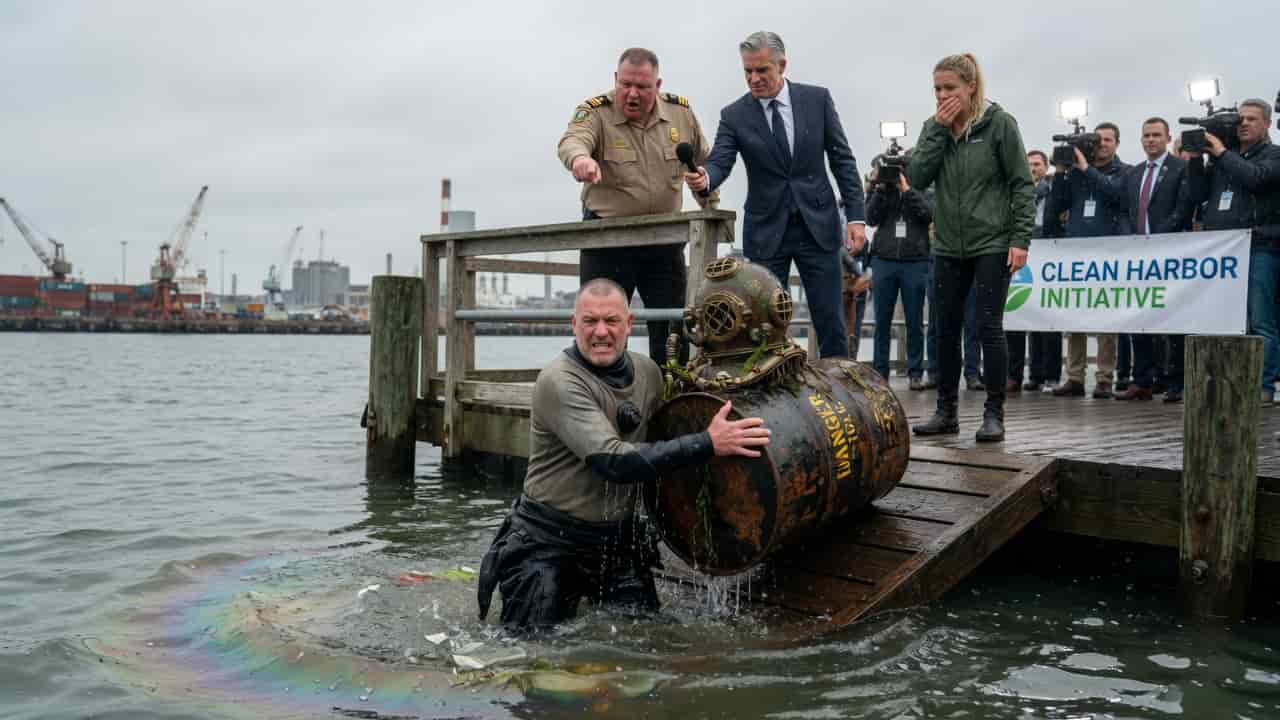
“Get this junkie out of my water before I have him arrested!”
Elias Thorne’s voice boomed across the pier, amplified by the salt-heavy air and the smug silence of the city officials standing behind him. He looked down at Cole—dripping, shivering, and clinging to the side of the rusted dock—with the kind of contempt you usually reserve for something you’ve stepped in.
Beside him, Julian Vane, the man who owned half the industrial coastline, didn’t even look away from the TV cameras. “He’s pathetic,” Vane added, his voice a smooth, polished blade. “Just like his father. Some people are born to sink.”
The reporters started to snicker. The “Clean Harbor Initiative” was supposed to be a victory lap, a PR stunt to bury the rumors of toxic dumping once and for all. And here was Cole, the town’s resident cautionary tale, ruining the shot.
But Cole didn’t move. His joints felt like they were filled with crushed glass—the first signs of the nitrogen bubbles screaming in his blood—but he didn’t let go. He looked past the insults, past the public shame, and stared directly into Thorne’s eyes.
“You’ve been telling this town my father died because he was careless,” Cole rasped, his voice cracking from the salt. “You told my sister he was a drunk who couldn’t handle the pressure.”
He reached down into the murky green water, his hand closing around a heavy, rusted chain. With a roar of agony that silenced the entire pier, he hauled a black 55-gallon barrel onto the slipway.
The sound of the metal hitting the wood was like a gunshot. But it wasn’t the barrel that made the Harbor Master’s face turn the color of ash.
It was the vintage brass diving helmet bolted to the top of it—the same one Cole’s father had been wearing the night he disappeared twenty years ago.
The room went dead silent. The truth was finally at the surface, and it was uglier than anyone imagined.
Chapter 1: The Pressure Gradient
The pain didn’t start in Cole’s joints. It started in the marrow, a low, tectonic hum that whispered of nitrogen bubbles and the slow, inevitable betrayal of his own blood. It was the price of the “bends,” the tax collected by the Atlantic for every minute he spent deeper and longer than a man was meant to stay.
Cole sat on the edge of his bunk in the cramped cabin of the Iron Maiden, a thirty-foot salvage boat that smelled perpetually of diesel, rotting kelp, and his own unwashed skin. He gripped his knees, his knuckles white and scarred from years of wrenching steel from the seabed. Outside, the Jersey harbor was a soup of gray mist and industrial runoff, the kind of morning where the sun felt like an after-thought.
“You’re shaking again, Cole.”
The voice belonged to Sully, a man whose face looked like a map of every bad decision he’d made since the eighties. He was standing by the galley’s tiny stove, stirring a pot of coffee that looked like motor oil.
“I’m fine,” Cole said, his voice a gravelly rasp. He forced his hands to be still. “It’s just the cold. The heater’s shot again.”
“The heater’s fine,” Sully countered, pouring a mug and sliding it across the scarred laminate table. “Your blood’s what’s shot. You’ve been down three times this week, hitting the trench. Nobody hits the trench three times in a week. Not without a chamber. And you haven’t seen a chamber in five years.”
Cole didn’t answer. He couldn’t. If he told Sully what he’d found down there, in the lightless pressure of the Newark Basin, the old man would either call the Coast Guard or have Cole committed. Or worse, he’d get scared. Fear was the only thing more dangerous than the pressure.
Twenty years ago, Cole’s father, Thomas, had gone down into these same waters. He’d been the best commercial diver on the coast, a man who moved through the dark like he’d been born to it. Then one Tuesday, the air lines went slack. The official report said it was a mechanical failure—a freak accident caused by Thomas’s own negligence. They said he’d been drinking on the job. They’d used that lie to strip the family of the pension, the insurance, and the dignity that was supposed to be Cole’s inheritance.
Cole took a sip of the coffee. It burned his throat, but it didn’t touch the cold in his hips.
“I’m going back down today,” Cole said.
Sully slammed the pot onto the stove. “The hell you are! Look at your eyes, kid. You’ve got the nystagmus. You can’t even focus on me. You go down again, and you’re coming up in a bag.”
“I found it, Sully.”
The silence that followed was heavy, filled with the rhythmic thud of the harbor chop against the hull. Sully stopped moving. He didn’t ask what it was. He knew. Every salvage diver in the state knew about the “Ghost Barrels”—the rumored illegal dumping site that had turned the Newark Basin into a dead zone in the late nineties.
“It’s not just the barrels,” Cole whispered, his eyes fixed on a rust stain on the bulkhead. “He’s there. My dad. They didn’t just dump the waste, Sully. They used him to anchor it.”
Sully’s face went pale. He sank into the opposite bench, the coffee forgotten. “Cole… if that’s true… if Vane Chemicals and the Harbor Master find out you’re poking around that site…”
“They already know,” Cole said. “Thorne’s been watching the boat from the pier every morning. He knows I’m bringing something up. He just doesn’t know I’ve already got the proof.”
Cole stood up, a groan escaping his lips as his hip joint flared with a sharp, stabbing heat. He moved to the small locker near the stern and pulled out his father’s old logbook. It was water-damaged, the ink bled into blue ghosts, but the last entry was clear: Thorne says it’s a standard salvage. But the barrels don’t have manifests. If I don’t come up, tell Cole to look under the shelf.
“I looked under the shelf, Sully,” Cole said, his voice trembling with a mix of agony and resolve. “There are hundreds of them. Rows and rows of black 55-gallon drums. And right in the middle, tied to a header pipe with a stainless steel cable… is a Mark V diving helmet. It’s still attached to the suit. Or what’s left of it.”
Sully wiped a hand across his mouth. “You can’t bring him up, Cole. The pressure… the gasses in the tissue… he’ll come apart. And so will you.”
“I’m not just bringing him up,” Cole said, his eyes hardening into something cold and dangerous. “I’m bringing him to the party.”
He checked the tide clock. In four hours, the city was holding the “Clean Harbor Initiative” press conference on Pier 17. Julian Vane, the billionaire CEO whose company had poisoned the water, would be standing there in a three-thousand-dollar suit, talking about environmental stewardship. Elias Thorne, the man who had signed the death warrant on Cole’s father, would be standing right beside him, holding the scissors for the ribbon-cutting.
Cole reached for his drysuit. Every movement was a struggle, a battle against the invisible bubbles trying to tear his nervous system apart. He felt the familiar weight of the shame he’d carried for two decades—the looks from the townspeople, the way the teachers had spoken to his sister Maya like she was the daughter of a criminal, the way Cole had been forced to take the dirtiest, most dangerous jobs just to keep their heads above water.
He wasn’t a hero. He was a man who was dying of a slow-motion explosion in his veins. But as he zipped the heavy waterproof seal across his chest, he felt a strange, terrifying clarity.
“Start the compressor, Sully,” Cole commanded.
“Cole, don’t do this. Think about Maya. She finally got that job at the university. If you start a war with Vane, they’ll crush her too.”
“They already crushed us,” Cole said, pulling the neoprene hood over his ears. “They just didn’t finish the job. Today, we’re all going to see what’s been hiding at the bottom of the harbor.”
He stepped out onto the deck. The air was bitingly cold, the salt spray stinging his face. He looked toward the shoreline, where the lights of the city were beginning to flicker to life. Somewhere over there, Maya was getting ready for work, oblivious to the fact that her brother was about to tear their world open.
Cole checked his gauges. His tank was full, his regulator was humming, and his heart was a frantic, uneven beat in his chest. He sat on the gunwale, the weight of the lead belts pulling at his aching back.
“See you on the flip side,” he muttered.
He rolled backward into the gray water. The silence swallowed him instantly, the cold a shocking, familiar embrace. As he descended into the gloom, the light from the surface faded into a sickly green, then into a bruised purple, until there was nothing but the sound of his own breathing and the crushing weight of the dark.
Chapter 2: The Social Surface
Maya stood in the kitchen of the small apartment she shared with Cole, her hands trembling as she adjusted her professional blazer. She was thirty, but in the harsh morning light of the kitchen, she felt fifty. Her job as a junior marine biologist at the state university was the only thing that kept their lives from sliding into the abyss of debt and local infamy.
On the counter sat a pile of unpaid bills and a notice from the Harbor Authority. Cole hadn’t told her, but she knew. They were threatening to impound the Iron Maiden for unpaid docking fees.
“Cole?” she called out, though she knew he was already gone.
She hated that boat. She hated the way it took him away into the dark and brought back a man who looked more and more like a ghost every day. She’d seen the way he walked lately—the hitch in his hip, the way he fumbled with his fork at dinner. She knew the signs of the bends. She’d studied the physiology of diving until she could recite the decompression tables in her sleep, hoping that knowledge could somehow protect him.
She grabbed her bag and headed out the door, the damp Jersey air clinging to her hair. The walk to the pier was short, but it felt like a gauntlet. The town of Port Amity was a place where memories were long and forgiveness was a rare commodity.
As she passed the Rusty Anchor, a dive bar that served breakfast to the early shift, a group of men in work shirts looked up.
“Hey, Maya!” one of them called out. It was Miller, a guy who’d worked for her father once. “Your brother still digging for treasure in the muck? Or is he just looking for another bottle of what killed his old man?”
The laughter that followed was sharp and practiced. Maya didn’t look back. She kept her head down, her face burning with a familiar, searing shame. This was the social tax of being a Thorne. You were either a victim or a joke, and in this town, the jokes were meaner.
She arrived at Pier 17 just as the stage was being set. The “Clean Harbor” banner was being hoisted, its bright blue and white fabric flapping in the wind. It was a masterpiece of corporate theater.
“Maya! Over here!”
She looked up to see Elias Thorne walking toward her. He looked every bit the authority figure—sturdy, tanned, and wearing a smile that didn’t reach his eyes. He’d been like an uncle to them after their father died, until the insurance money ran out. Then he’d become the man who made sure Cole never got a city contract again.
“Mr. Thorne,” Maya said, her voice tight.
“I saw your brother’s boat out by the basin this morning, Maya,” Thorne said, dropping his voice to a conspiratorial whisper. “He’s trespassing. Again. I’ve tried to be patient, for your sake, but Julian Vane is losing his cool. This initiative is worth millions to the city. If Cole ruins the optics today with some kind of salvage stunt…”
“He’s just working, Elias,” Maya said, her heart hammering against her ribs. “He’s trying to pay the docking fees you keep raising.”
Thorne leaned in closer, the smell of peppermint and stale coffee on his breath. “Listen to me, girl. Your father was a good man who made a bad choice. Don’t let Cole make an even worse one. Tell him to stay in the mud where he belongs. If he shows up here today, I can’t protect him. The police are already on standby.”
Maya felt a cold shiver of dread. “What are you talking about? Why would the police be here for a diver?”
“Because your brother is unstable, Maya. Everyone sees it. The way he talks, the way he looks… he’s a liability.” Thorne patted her shoulder, a gesture that felt more like a threat than a comfort. “You’ve got a career now. Don’t let his obsession with the past drag you under with him.”
He turned away to greet a group of reporters, his face instantly shifting back into a mask of professional warmth. Maya stood frozen on the pier, watching the cameras being positioned. She looked out at the harbor, her eyes searching for the silhouette of the Iron Maiden.
She knew what Cole was doing. He’d been obsessed with the basin for months, coming home with scrapings of sediment that he’d begged her to test in the lab. When she’d found the mercury levels were ten times the legal limit, she’d been terrified. Not for the environment, but for Cole. Because if he was right, if the dumping was real, it meant the people standing on this stage were monsters.
A black town car pulled up to the edge of the pier, and Julian Vane stepped out. He was the picture of elite success—unruffled, expensive, and utterly detached from the grime of the docks. He nodded to Thorne, a brief, silent communication of power.
Maya felt a sudden, desperate need to find Cole. She ran toward the end of the pier, looking down into the churning water.
“Cole!” she whispered. “Please, just stay down. Just this once, stay down.”
But she knew her brother. Cole didn’t know how to stay down. He’d been raised on the myth of the salvage—that everything lost could be recovered, that every debt had to be paid in full.
As the first TV crews began their sound checks, the atmosphere on the pier grew electric. It was a coronation of lies, and Maya was a guest of honor she never asked to be. She saw the way Vane looked at the water—not with admiration, but with the cold calculation of a man looking at a grave he’d finally managed to pave over.
“Maya, dear, you’re in the shot,” a producer said, gently pushing her toward the back of the crowd.
She moved to the edges, feeling smaller than she ever had. She was a scientist, a woman of facts and data, but standing here, she felt like the same ten-year-old girl who had waited on these docks for a man who never came home. The shame was a physical weight, a thick, oily film that she couldn’t wash off.
She looked at the “Clean Harbor” banner and felt a surge of pure, unadulterated loathing. It wasn’t just about the water. It was about the way they treated them—the way they’d turned their grief into a punchline and their poverty into a weapon.
Then, she saw it.
A ripple in the water, a hundred yards out. A trail of bubbles, steady and rhythmic.
Cole was coming. And he wasn’t alone.
Chapter 3: The Weight of the Deep
Underwater, the world was reduced to the sound of Cole’s own heartbeat and the metallic hiss of the regulator. Every breath felt like sucking air through a straw dipped in ice water. At sixty feet, the pressure was nearly three atmospheres, pressing against his drysuit, squeezing the air out of the folds of the fabric until it felt like a second, tighter skin.
The visibility was less than three feet. His dive light cut a weak, amber path through the suspended silt—disturbed sediment from decades of industrial runoff that never truly settled. It was a graveyard of ghosts and heavy metals.
Cole checked his wrist computer. He’d been down for twenty-two minutes. At this depth, with his history of decompression illness, he was already pushing into the red. His left leg felt numb, a dull ache radiating from his hip that told him the bubbles were already starting to congregate in the joint, like tiny, expanding needles.
Focus, Cole. Find the cable.
He moved with agonizing slowness. In the dark, distance was an illusion. He felt the massive, barnacle-encrusted shape of a header pipe before he saw it. This was the spine of the dumping site, an old cooling intake that Vane Chemicals had abandoned—and then repurposed as a secret mooring.
He followed the pipe, his gloved hand sliding over the razor-sharp shells. His light hit something flat and black. A barrel. Then another. They were stacked like cordwood, bound together by heavy gauge steel cables that had begun to fuse with the silt.
This was the “treasure” the town said didn’t exist.
Cole reached the center of the stack. His light flickered, the batteries struggling against the cold. He swept the beam upward, and there it was.
The helmet.
It was a Mark V, the iconic copper dome of the old-school commercial divers. It sat atop the central barrel, bolted through the lid. It was covered in a thick, furry layer of sea growth, but the faceplate remained clear, a dark, empty eye staring back at him.
Cole reached out and touched the copper. A jolt of electricity seemed to snap through his fingers. He wasn’t just touching a piece of equipment; he was touching his father’s tombstone.
“I’m here, Dad,” he choked out, the words lost in the bubbles of his exhaust.
He pulled a heavy-duty hydraulic cutter from his belt. The tool felt like it weighed fifty pounds in the thick water. He positioned the jaws over the cable that anchored the barrel to the pipe. He squeezed the trigger. The tool hummed, a vibration that rattled his teeth, and then—snap.
The barrel lurched, suddenly buoyant. Cole grabbed the rim, his boots digging into the silt as he struggled to maintain his trim. The barrel wanted to rise, but it was weighted with the toxic sludge inside, creating a dangerous, lumbering momentum.
He clipped his lift bag to the barrel’s harness and hit it with a burst of air from his secondary tank. The bag blossomed like a yellow lung, and the barrel began its slow, terminal ascent.
Cole followed it, keeping his hand on the rusted metal. He had to time this perfectly. If he rose too fast, the nitrogen in his blood would expand like shaken soda, tearing his tissues apart before he even hit the surface. But his air was running low—the needle on his SPG was dipping into the five-hundred-PSI reserve.
He hit his ten-foot decompression stop. The water here was brighter, a murky emerald, and he could hear the distant, rhythmic throb of a boat engine. Sully was nearby, waiting.
But Cole didn’t signal Sully. He looked up at the silhouette of Pier 17. He could see the dark lines of the pilings and the shimmering, distorted shapes of the people standing above. He could hear the muffled, electronic drone of the PA system.
“…a new era for Port Amity… a harbor we can be proud of…”
The irony tasted like copper in his mouth.
His leg spasmed, a sharp, white-hot bolt of pain that made him gasp. He lost his grip on the barrel for a second, and it began to drift toward the pilings. He kicked hard, ignoring the screaming protest of his joints, and hauled it back.
He was out of time. He was out of air.
He looked at his father’s helmet one last time. The brass eye seemed to be watching the surface, waiting for the light.
“One more push,” Cole whispered.
He vented the last of his buoyancy compensator and kicked for the surface. The change in pressure was a physical blow. His ears popped painfully, and a sudden, blinding headache bloomed behind his eyes—the classic “squeeze.”
He broke the surface twenty yards from the pier slipway. The air was a shock of cold and noise. He saw the “Clean Harbor” banner, the bright TV lights, and the rows of faces turned toward the stage.
He saw Elias Thorne. He saw Julian Vane.
And he saw Maya.
She was standing at the edge of the crowd, looking like a small, fragile bird caught in a storm. When her eyes met his, he saw the moment of recognition, the sudden, terrible blooming of fear.
Cole didn’t wave. He didn’t call for help. He grabbed the slipway railing and began to haul the barrel toward the dock. Every inch was a battle against the outgoing tide and the failing strength of his own heart.
He heard Thorne’s voice, amplified and ugly, cutting through the salt air.
“Get this junkie out of my water!”
Cole didn’t stop. He heaved the barrel onto the first step of the slipway. The weight was immense, a dead, toxic gravity that wanted to pull him back into the dark.
He looked up at the pier, at the men in their clean clothes and their clean lies. He felt the residue of twenty years of shame, twenty years of being the “drunk diver’s son,” twenty years of watching his sister cry over bills they couldn’t pay.
It all ended here.
He took a breath, his lungs burning with the effort, and prepared for the final heave.
Chapter 4: The Trophy
The pier felt like a theater, and Cole was the uninvited lead.
The cameras had pivoted away from Julian Vane’s polished face, drawn by the spectacle of the soaking wet man struggling in the slipway. The reporters, sensing a crack in the carefully curated event, surged toward the railing, their lenses zooming in on Cole’s shivering form.
Elias Thorne stepped to the very edge of the dock, his tan uniform straining against his gut. He didn’t look like an uncle now. He looked like a warden.
“I said get out of here, Cole!” Thorne roared, his voice cracking with a frantic, underlying panic. “You’re trespassing on a restricted city site. Officers! Remove him!”
Two local deputies started down the wooden stairs, their boots thudding rhythmically. Julian Vane followed them, but he stayed a few steps back, his hands in his pockets, his expression one of bored, aristocratic annoyance.
“He’s pathetic,” Vane said, loud enough for the nearest microphone to catch it. “Just like his father. Some people are born to sink, and they spend the rest of their lives trying to pull everyone else down with them.”
The crowd chuckled—a small, mean sound that cut deeper than the cold water.
Cole reached the top of the slipway, his drysuit dripping black, oily water onto the pristine wood. He was shivering violently now, his breath coming in ragged, shallow gasps. His left leg gave out, and he collapsed to one knee, his hand still clamped onto the rusted rim of the barrel.
Maya broke through the crowd, her face a mask of horror. “Cole! Stop! You’re hurt, you need to get to a hospital!”
“Stay back, Maya,” Cole rasped. He looked at Thorne, who was standing barely three feet away now, looking down at him with pure, unadulterated loathing.
“You really want to do this here, Cole?” Thorne hissed, leaning down so only Cole could hear him. “You want to ruin your sister’s life for a dead man? Because that’s what happens next. You pull this stunt, and she’s fired by noon. I’ll make sure of it.”
Cole looked at his sister. He saw the plea in her eyes, the desperation for a normal life, a life without the shadow of the harbor hanging over her. He felt the weight of her sacrifice—the years she’d spent studying, the shifts she’d worked to keep him in gear.
Then he looked at the barrel. He looked at the brass helmet.
“Tell them what you did with the barrels, Elias,” Cole said, his voice gaining a sudden, terrifying strength.
“I don’t know what you’re talking about,” Thorne snapped, looking at the reporters. “He’s got the bends. He’s hallucinating. He’s dangerous.”
“Look at the helmet!” Cole screamed.
With a final, agonizing surge of strength, he heaved the 55-gallon drum upward, slamming it onto the flat deck of the pier. The sound was deafening, a hollow metallic boom that echoed off the warehouse walls.
The barrel stood upright, leaking a thick, iridescent black sludge that began to stain the “Clean Harbor” banner. But it was the object bolted to the lid that froze every person on that pier.
The copper-and-brass diving helmet gleamed under the TV lights, its dark faceplate staring directly at Julian Vane. A hush fell over the crowd—a silence so absolute you could hear the distant cry of a seagull.
“This is my father’s helmet,” Cole said, his voice trembling but clear. “I found it at the bottom of the Newark Basin. It wasn’t an accident. It wasn’t a mechanical failure.”
He pointed a shaking finger at the barrel. “This barrel is filled with Vane Chemical waste. And there are five hundred more just like it down there. My father found them twenty years ago. And when he wouldn’t take your money to stay quiet, you bolted him to one and dropped him into the trench.”
The reporters erupted. Cameras flashed like a strobe light, capturing Thorne’s face as it drained of color. He looked like a man who had just seen a ghost—because he had.
Julian Vane took a step back, his composure finally shattering. “This is a fabrication! A desperate act by a mentally ill man!”
“Then open it,” Cole said, his eyes burning with a cold, righteous fire. “Open the barrel, Julian. Let’s see what’s inside. Let the ‘Clean Harbor’ people see what you’ve been hiding.”
Maya moved to Cole’s side, her hand resting on his shoulder. She wasn’t looking at the cameras anymore. She was looking at the helmet. She reached out, her fingers trembling, and touched the corroded brass.
“Dad,” she whispered, a single tear tracking through the salt on her cheek.
The deputies hesitated, looking from Thorne to the barrel. They were locals; they’d grown up hearing the rumors. They’d seen the way the fish died and the way the water turned black after a storm.
Thorne looked around, his eyes darting like a trapped animal’s. He saw the reporters, the city officials, the people of Port Amity who had gathered to celebrate a lie. He saw the power shifting, the carefully built structure of his authority beginning to crumble under the weight of a single, rusted object.
“Get him out of here,” Thorne whispered, but his voice had no conviction.
“No,” Maya said, standing tall beside her brother. “Nobody is going anywhere.”
Cole felt a sudden, sharp pain in his chest, a sensation of cold air rushing into his lungs. The world began to tilt, the lights of the pier blurring into a smear of white and gold. He felt Maya’s grip tighten on his arm, her voice calling his name from a great distance.
He’d done it. He’d brought the dark water to the surface.
But as he felt the consciousness slipping away, he knew the battle had only just begun. The residue of the past was thick and toxic, and it wouldn’t be washed away with a single reveal.
He looked at Thorne one last time—a man who was now just as trapped as his father had been.
“Your turn to sink, Elias,” Cole whispered.
Then, the world went black.
Chapter 5: The Bends of Justice
The world inside the hyperbaric chamber was a pressurized, clinical tomb. Cole lay on the narrow cot, the hiss of pure oxygen through the mask the only sound in a universe that had shrunk to the size of a metal tube. Through the thick, porthole-style window, the hospital room beyond looked distorted, like a scene viewed through the very harbor water that was currently killing him.
Every time the technician adjusted the pressure, Cole felt the nitrogen bubbles in his blood shrink, but the relief was temporary. The “bends” weren’t just a physical ailment; they were a systemic collapse. His joints felt like they had been injected with liquid lead, and a persistent, dull throb behind his eyes reminded him that his brain was still a battlefield of expanding gasses.
Maya sat on a plastic chair just outside the glass, a phone pressed to her ear. Her face was pale, her professional blazer replaced by a rumpled sweatshirt. He watched her lips move, catching fragments of the conversation through the intercom.
“…no, Dean Halloway, you don’t understand. The samples were verified. My brother didn’t plant that barrel… Yes, I realize the university’s funding comes from Vane-affiliated grants, but this is a matter of public health.”
She closed her eyes, her shoulders sagging. She looked defeated. She looked exactly like she had ten years ago when the bank told them they were foreclosing on their mother’s house. Cole hammered his fist against the glass—a dull, muffled thud.
Maya jumped, dropping the phone. She looked at him, forcing a smile that looked like a scar. She picked up the intercom handset.
“Hey,” she said. “The doctors say your saturation levels are stabilizing. You’re going to be okay, Cole.”
“The school,” Cole rasped into the mask. “They’re cutting you loose, aren’t they?”
Maya looked away, her eyes tracing the floor tiles. “It’s just… administrative leave. Until the ‘situation’ is clarified. Vane’s lawyers are already filing injunctions. They’re claiming the barrel was a prop, something you fabricated to extort the city.”
“Extort?” Cole let out a dry, hacking laugh that tasted of medical-grade air. “I’m lying in a tank because I’m rotting from the inside out. What am I supposed to be extorting? A new set of lungs?”
“They’re good at what they do, Cole,” she whispered. “Thorne is already on the local news. He’s telling everyone you’ve been ‘suffering from substance abuse’ and that the helmet was stolen from a maritime museum in Philly. He’s making it look like a tragic, desperate cry for attention.”
The anger flared in Cole’s chest, a hot, sharp pressure that rivaled the nitrogen. This was the strategy. It wasn’t about the truth; it was about the narrative. They didn’t need to prove him wrong; they just needed to make him sound crazy. They were using the same social weapons they’d used after his father died. The “shame” was their armor.
The door to the hospital room opened, and Elias Thorne walked in. He wasn’t wearing his Harbor Master uniform. He was in a dark, somber suit, looking every bit the grieving family friend. He carried a small bouquet of grocery-store carnations.
Maya stood up, her body tensing like a cornered animal. “Get out, Elias.”
“Now, Maya, let’s be civil,” Thorne said, his voice smooth and paternal. He set the flowers on the bedside table and looked at Cole through the glass. His eyes were cold, devoid of the panic Cole had seen on the pier. He’d had time to regroup. He’d had time to call in favors.
“You look terrible, Cole,” Thorne said into the external microphone. “Truly. This obsession… it’s eaten you alive. I told your sister I was worried about you.”
“You’re a murderer, Elias,” Cole said, his voice flat.
Thorne sighed, a sound of weary disappointment. “That’s the sickness talking. The doctors say the neurological symptoms of the bends can include paranoia, memory loss, even psychosis. It’s a tragedy. To see a man so desperate to blame someone for his father’s mistakes that he’d risk his own life to stage a hoax.”
He leaned closer to the glass, his breath fogging the surface. “The barrel is gone, Cole. Chain of custody issues. The police department decided it was a biohazard and had it ‘contained’ by a private contractor. One of Vane’s subsidiaries, actually. I doubt it will ever be seen again.”
Cole felt the room spin. “The helmet… people saw it. The cameras…”
“Cameras see what they’re told to see,” Thorne countered. “A rusted piece of junk and a man having a mental breakdown. By tomorrow, the news cycles will be talking about the ‘Tragic Hoax at Pier 17.’ Your father died because he was a drunk, Cole. And you’re dying because you couldn’t accept it. Don’t drag Maya down with you. Sign the statement. Admit you found the barrel in a scrap yard and that you were confused. Vane will pay for your treatment. He’ll even set up a trust for Maya.”
Cole looked at Maya. She was standing behind Thorne, her face a mask of pure, concentrated fury. She didn’t look like a junior biologist anymore. She looked like a woman who had spent her whole life watching men like Thorne take things from her.
“He won’t sign anything,” Maya said. Her voice was quiet, but it had a serrated edge.
Thorne turned to her, his smile widening. “Maya, think about your career. You’re so close to Tenure. Don’t let your brother’s delusions end it.”
“My career was built on the idea that the truth matters,” Maya said. She stepped toward Thorne, forcing him to take a step back. “You think you can just ‘contain’ the truth? You think you can lose a 55-gallon drum of toxic waste and people will just forget? I’ve already sent the sediment samples from Cole’s suit to three independent labs in New York. They aren’t funded by Vane. And the helmet? Cole took photos of it while it was still underwater. Geotagged, time-stamped, and uploaded to a cloud server you can’t touch.”
Cole blinked. He hadn’t told her about the photos. He hadn’t even known he’d taken them—then he remembered the GoPro mounted to his wrist. He’d forgotten it was even running.
Thorne’s smile faltered. For the first time, a flicker of the old panic returned to his eyes. “Photos can be faked, Maya. In the age of AI, nobody believes a screen.”
“They’ll believe the EPA,” she said. “I called them an hour ago. They’re already on their way to the harbor. And they’re not interested in your city contracts, Elias. They’re interested in the mercury levels in the soil behind Vane’s old warehouse.”
Thorne looked from Maya to Cole, his face hardening. The “kind uncle” facade was gone now, replaced by the predatory stillness of a man who had spent twenty years guarding a secret.
“You think you’re so smart,” Thorne hissed. “You think the truth is a shield? In this town, the truth is just something we bury. Like your father. Like your brother.”
He turned on his heel and walked out, the carnations left behind like a taunt.
The silence that followed was thick with the residue of the confrontation. Cole watched Maya, waiting for her to break, for the weight of the social pressure to finally crush her. But she didn’t move. She stood there, staring at the door, her hands clenched into fists.
“Maya,” Cole whispered through the intercom.
She looked at him, and for a second, the scientific detachment was gone. She looked raw, terrified, and utterly alive.
“I lost the job, Cole,” she said, her voice cracking. “The Dean called while you were talking to him. I’m out. Blacklisted.”
“I’m sorry,” Cole said. It felt like the most inadequate thing he’d ever spoken.
“Don’t be,” she said, wiping a stray tear from her cheek. “I’ve spent ten years trying to be ‘respectable’ in a town that hated us. I’ve spent ten years pretending I didn’t know Thorne was a liar. It feels good to finally say it out loud.”
She walked back to the glass, pressing her hand against the surface. “We aren’t done, Cole. Thorne was right about one thing. The barrel is gone. And without it, the EPA won’t have enough to shut Vane down. We need the rest of it. We need the ‘shelf.'”
“I can’t go back down, Maya,” Cole said, looking at his shaking hands. “The doctors say if I dive again, the bubbles will hit my brain. I won’t come back up.”
“You aren’t going back down,” Maya said. She looked toward the door, then back at him. “Sully’s waiting in the parking lot. He’s got the Iron Maiden fueled up. And I’ve got my old certification from the university’s research team.”
“No,” Cole said, the word a sharp bark of alarm. “Absolutely not. You don’t know the currents, Maya. You don’t know the dark.”
“I know the science, Cole,” she said. “And I know where you found him. You saw the helmet. But you didn’t see what was under it. You said there was a pipe. A header pipe.”
“Yeah. So?”
“Header pipes have serial numbers, Cole. If I can get a rubbing of that number, and match it to the manifests Vane filed with the city in 2006, we don’t need the barrels. We have the connection. We have the intent.”
She leaned in, her eyes burning with a fierce, desperate intelligence. “Thorne thinks he’s won because he took the physical evidence. But he’s a man of the old world. He doesn’t understand that data is harder to bury than steel.”
“Maya, please,” Cole pleaded. “It’s too dangerous. Vane’s people will be watching the basin.”
“Let them watch,” Maya said. “Sully’s got a plan. We’re going to use the fog. And we’re going to do it tonight.”
She stood up, grabbing her bag. “I’ll be back for you. The doctors said you can leave the chamber in six hours. We’ll meet you at the old salvage yard at midnight.”
“Maya!”
But she was already gone, the door swinging shut behind her.
Cole lay back on the cot, the hiss of the oxygen now sounding like a countdown. He felt the crushing weight of the responsibility, the terror of his sister entering the dark world that had already claimed their father and was currently claiming him.
He looked at the carnations Thorne had left. He reached out, his hand shaking, and knocked them off the table. The glass vase shattered on the floor, the water spilling like a dark stain across the linoleum.
He wasn’t just a diver anymore. He was a witness. And if he had to crawl to the harbor to protect the only person he had left, he would. The bends weren’t just in his blood; they were in the foundation of the town. And it was time to let the whole thing crack.
Chapter 6: The Residue of Truth
Midnight at the Port Amity salvage yard was a landscape of jagged shadows and the smell of oxidized iron. The harbor was a sheet of obsidian, the fog rolling in from the Atlantic in thick, spectral banks that swallowed the lights of the industrial cranes.
Cole sat in the passenger seat of Sully’s rusted Chevy, his breath coming in shallow, ragged bursts. He was out of the chamber, but he wasn’t “well.” Every movement felt like his bones were being ground together with sand. His vision was tunneled, the edges of the world blurring into a gray haze.
“They’re out there, Cole,” Sully whispered, nodding toward the dark expanse of the water. “I can see the running lights of the Harbor Patrol. Thorne’s got every boat he owns circling the basin.”
Cole looked at the silhouette of the Iron Maiden, tied to the end of a rotting pier. Maya was on the deck, her green jacket replaced by a sleek black wetsuit. She was checking the valves on her tank, her movements precise and practiced. She looked terrifyingly small against the backdrop of the industrial ruins.
“I should be the one going down,” Cole rasped.
“You can’t even stand up without me holding your belt, kid,” Sully said, his voice heavy with a grim realism. “Maya’s the only one who can do this. She’s got the lungs, and she’s got the head for it.”
Cole watched as Maya slipped into the water. There was no splash, just a quiet ripple that was instantly lost in the fog. He felt a visceral pull in his gut, a phantom pressure that made his own ears pop. He knew that dark. He knew the way the silt felt like a shroud, the way the cold seeped into your soul until you forgot what the sun looked like.
“Stay with her, Sully,” Cole said. “If the patrol moves in, you get her out. Forget the boat. Just get her out.”
“I got her, Cole. You just keep your eyes on that pier.”
The wait was an agony of minutes that felt like hours. Cole watched the surface of the water, searching for the tell-tale bubbles that would signify her position. But the fog was too thick, the harbor too restless.
On the far side of the basin, a searchlight cut through the mist. It was Thorne’s boat, the Argus. It was moving slowly, methodically, the beam of light sweeping the water like a predatory eye.
“They’re closing in,” Cole whispered.
He reached for the door handle, his fingers fumbling with the latch. He forced himself out of the truck, his legs buckling as he hit the gravel. He gripped the side of the cab, his knuckles white. The pain was an explosion in his hip, a white-hot scream that threatened to black him out.
Focus. Move.
He dragged himself toward the end of the pier, his boots scraping against the uneven wood. He could see the Argus now, its hull a dark, looming shape in the fog. He could see Elias Thorne standing on the bow, a megaphone in his hand.
“Iron Maiden!” Thorne’s voice boomed across the water. “You are in a restricted area! Cease all diving operations immediately and prepare to be boarded!”
Sully fired up the Iron Maiden’s engine, the diesel roar a defiant counterpoint to the megaphone. He began to pull away from the dock, leading the Argus into the deeper, more treacherous waters of the channel.
It was a diversion. But it was a dangerous one.
Cole reached the edge of the pier and looked down. He saw a flash of yellow—the lift bag.
Maya was surfacing.
She broke the water twenty feet away, her head bobbing in the chop. She was gasping for air, her mask pushed up onto her forehead. She gripped the side of a rusted piling, her body shaking with exhaustion.
“Maya!” Cole hissed.
She looked up, her eyes wide. She held up a small, waterproof digital camera. “I got it, Cole. The serial number. And I found the anchor point. It’s stamped with the Vane logo.”
“Get up here! Now!”
He reached down, his fingers straining to touch hers. The pain in his back was a jagged knife, but he didn’t feel it. He only felt the cold spray of the water and the desperate need to pull her to safety.
A sudden, blinding light hit them.
The Argus had turned back. Thorne hadn’t fallen for the diversion. The searchlight pinned Cole and Maya against the rotting wood of the pier, making the fog look like a wall of solid white.
“Stay where you are!” Thorne shouted.
The patrol boat pulled alongside the pier, the wake tossing Maya against the piling. Thorne looked down at them, his face twisted in a mask of triumph and rage. He was holding a heavy, industrial-grade grappling hook.
“Give me the camera, Maya,” Thorne commanded. “Give it to me, and I’ll let the deputies take you in quietly. Otherwise, things are going to get very messy.”
Maya looked at Cole, then at the camera. She looked at the Argus, and at the men standing on the deck—men who had spent their lives protecting the people who had poisoned their town.
“The truth doesn’t belong to you anymore, Elias,” Maya said.
She didn’t give him the camera. She threw it.
The small black device arched through the air, but it wasn’t aimed at the boat. It was aimed at Cole.
He caught it in his shaking hands, the impact nearly knocking him off his feet. He shoved it deep into the pocket of his jacket just as Thorne swung the grappling hook.
The heavy iron claw slammed into the pier beside Cole’s foot, splintering the wood. Thorne began to climb over the railing, his face red with a desperate, frantic energy. He wasn’t the Harbor Master anymore. He was a man drowning in his own lies.
“Cole, run!” Maya screamed, struggling to climb the slipway.
But Cole couldn’t run. His legs were heavy, his vision failing. He saw Thorne land on the pier, his boots thudding against the wood. He saw the man’s hand reach for the pocket of his jacket.
“You think you’re a hero, Cole?” Thorne hissed, his face inches from Cole’s. “You’re nothing. You’re a ghost of a man who never mattered.”
Cole looked at Thorne, and for the first time, he felt pity. Not for the man, but for the world he’d built—a world made of rusted barrels and buried bodies.
“My father mattered,” Cole said, his voice a low, steady growl. “He mattered to me. And he matters to the water.”
He didn’t fight Thorne. He didn’t have the strength. Instead, he stepped backward.
He stepped off the edge of the pier.
The fall was short, the impact of the cold water a sudden, jarring shock that cleared his head for a single, brilliant second. He sank into the dark, the weight of the camera in his pocket pulling him down.
He saw Thorne’s face peering over the edge, the man’s expression shifting from rage to a sudden, soul-deep terror. Thorne knew. He knew that the water didn’t forget.
Cole felt a hand grab his collar. It was Sully. The Iron Maiden had circled back under the cover of the fog. Sully and Maya hauled him over the gunwale, his body a dead, shivering weight on the deck.
“We got it,” Maya whispered, her arms around him. “We got it, Cole.”
The Iron Maiden roared to life, disappearing into the fog before the Argus could regroup. They didn’t go to the hospital. They didn’t go home. They went to the local news station in Atlantic City—the only place Thorne’s influence couldn’t reach.
The aftermath was not a clean victory. It was a slow, agonizing unraveling.
The serial number on the header pipe matched a shipment of “industrial lubricants” that Vane Chemicals had supposedly incinerated in 2006. The EPA moved in, and the “Clean Harbor Initiative” was revealed as a massive, multi-million dollar fraud. Julian Vane fled to a non-extradition country, leaving behind a crumbling empire and a string of indictments.
Elias Thorne was found three days later. He hadn’t fled. He was sitting in his office at the Harbor Authority, the “Clean Harbor” banner draped over his desk like a shroud. He didn’t resist arrest. He just looked at the handcuffs and asked if the water was still gray.
Maya never got her job back at the university. The academic world was as risk-averse as the corporate one, and she was too “complicated” for their funding models. But she started an independent testing lab in a rented warehouse on the outskirts of Port Amity. She called it The Salvage Project.
And Cole.
Cole lived, but the bends had left a permanent residue. He walked with a cane, his left leg a constant, aching reminder of the pressure. He couldn’t dive anymore. The doctors said the nitrogen had done too much damage to his heart.
He sat on the porch of their new house, a small cottage overlooking the harbor. The water was still murky, the industrial cranes still looming on the horizon. The harbor wasn’t “clean.” It would take decades, maybe centuries, to wash away the poison Vane had dumped into the silt.
But the silence was different now. It wasn’t the silence of a secret. It was the silence of a town that had finally stopped lying to itself.
Maya walked out onto the porch, carrying two mugs of coffee. She sat beside him, her eyes on the distant line where the water met the sky.
“The EPA says they’re starting the dredging next month,” she said. “They’re going to bring up the rest of the barrels. All of them.”
Cole took a sip of the coffee. It was hot, strong, and tasted of the world above the surface.
“They won’t find everything,” he said.
“No,” she agreed. “But they’ll find enough.”
She reached out and took his hand. Her grip was strong, her skin warm. It was the only anchor he needed.
Cole looked down at the harbor. Somewhere down there, in the dark and the cold, his father was finally at rest. The helmet was gone, replaced by the crushing, honest weight of the deep.
He’d spent his life trying to bring the past to the surface. And now that it was here, he realized the most important thing wasn’t the truth he’d found. It was the fact that he was still here to tell it.
The pressure was gone. The world was just the world—muddy, visceral, and painfully human.
“Let’s go inside, Maya,” Cole said, his voice a gravelly, familiar rasp. “It’s getting cold.”
They walked into the house together, leaving the dark water behind. The residue of the past would always be there, in his bones and in the silt of the harbor, but for the first time in twenty years, Cole wasn’t afraid of the dark.
He’d found the light. And it was enough.