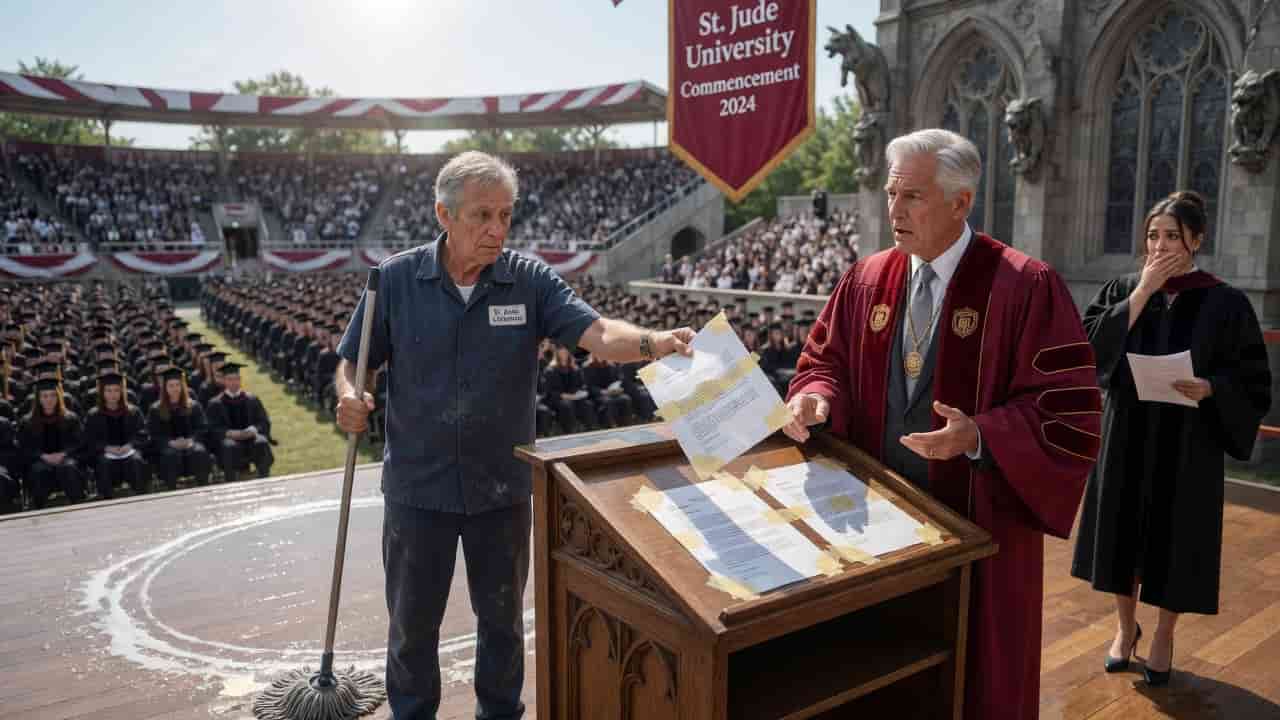
“You missed a spot, Dean.”
Arthur had been the invisible man at St. Jude University for twenty years. He emptied the trash, buffed the floors, and disappeared into the shadows whenever a donor walked by. He was the man they trusted to handle the shredder bins because they didn’t think he could read.
But for three years, Arthur hadn’t been emptying those bins. He’d been taking the bags home to a cramped basement apartment, sorting through thousands of tiny paper teeth, and taping a nightmare back together.
It was the letter that shouldn’t exist. The one that explained exactly why his daughter—a straight-A scholarship student—had been expelled and silenced after a donor’s son decided she wasn’t a person.
The Dean thought the truth was dust. He thought he could stand on that graduation stage and talk about “legacy” and “honor.” He didn’t see the man in the navy uniform walking toward the podium. He didn’t see the mop. And he definitely didn’t see the reconstructed letter until it was sitting right on top of his speech, held together by three years of a father’s rage.
The room went silent. Thousands of parents watched. And then Arthur leaned into the microphone.
Chapter 1
The Dust of Great Men
The shredder in Dr. Sterling’s office was a top-of-the-line industrial beast. It didn’t just cut paper into strips; it chewed them into tiny, confetti-like diamonds. To anyone else, it was the sound of administrative efficiency. To Arthur, it was the sound of a man trying to eat his own history.
Arthur pushed his gray Rubbermaid cart through the heavy oak doors of the Dean’s suite at 2:15 AM. The university was a different animal at this hour. The grand, Gothic hallways of St. Jude didn’t feel like a place of learning; they felt like a tomb where the light was left on for the ghosts. The air smelled of old wood, floor wax, and the faint, metallic tang of the heating system.
He emptied the blue recycling bin first. It was mostly junk—syllabi for classes that didn’t matter, memos about faculty parking, drafts of speeches that sounded like they’d been written by a machine. But the shredder bin was different. The bag was always heavy, dense with the weight of things that weren’t supposed to be remembered.
Arthur reached into the bin, his fingers grazing the plastic liner. He could feel the heat still radiating from the machine’s motor. Sterling had been working late again. The Dean was a man obsessed with his “perfect” legacy, a man who spent his days polishing the university’s $50 billion endowment and his nights erasing the friction that came with it.
Arthur’s back ached, a low, grinding throb that had become his constant companion over the last two decades. He was fifty-eight, but in the blue fluorescent light of the suite, his reflection in the glass cabinets looked seventy. His navy uniform was clean but thin at the elbows, the “St. Jude University” patch over his heart slightly frayed. He was the help. He was the scenery.
He pulled the bag from the shredder. It was a five-gallon bag, nearly full. He didn’t throw it into the large gray bin on his cart. Instead, he tucked it into a secret compartment he’d fashioned under the cart’s base, hidden by a heavy flap of rubber matting.
“Long night, Artie?”
Arthur didn’t jump. He’d heard the squeak of the security guard’s thick-soled shoes twenty yards down the hall.
“Always is, Mike,” Arthur said, his voice a low, gravelly rasp. He didn’t look up as he replaced the liner. “The dust never stops falling.”
Mike leaned against the doorframe, his belt jingling with the weight of his flashlight and radio. He was a younger man, maybe thirty, with a soft face that hadn’t yet been hardened by the university’s particular brand of indifference.
“Sterling’s been on a tear lately,” Mike said, nodding toward the Dean’s desk. “Board meeting’s coming up. He’s looking for that new science wing money. One of the big donors—that guy Thorne—is being a pain about something.”
Arthur’s hands stilled for a fraction of a second at the name Thorne. He kept his head down. “Money usually makes people a pain.”
“No kidding. Anyway, don’t stay too late. You’re looking a little gray around the gills.”
“I’m fine,” Arthur said.
He waited until the sound of Mike’s footsteps faded into the distance. Then he finished the suite, his movements methodical and practiced. He mopped the floor in wide, rhythmic arcs, the scent of pine cleaner rising to meet the dust. He cleaned the windows until the dark reflection of the campus outside was clear enough to see the predatory silhouettes of the gargoyles on the library roof.
When his shift ended at 6:00 AM, the sun was just beginning to bleed over the horizon, turning the university’s stone walls the color of dried blood. Arthur didn’t go to the staff breakroom. He didn’t linger for the morning gossip. He walked to his beat-up 2012 Ford F-150, the secret bag tucked under his arm like a loaf of bread.
His apartment was four miles away, in a part of the city the university’s brochures never showed. It was a basement unit in a brick building that always felt damp. The windows were at street level, offering a view of nothing but the tires of passing cars and the occasional discarded cigarette butt.
Arthur locked the door behind him. The air in the apartment was stale, smelling of coffee and the faint, chemical scent of Scotch tape.
He walked into the second bedroom—a room that had once been bright and full of textbooks and posters of the Hubble Deep Field. Now, the posters were gone. The bed had been pushed against the wall to make room for four long folding tables.
On those tables were hundreds of thousands of paper diamonds.
They were organized by color, by paper weight, and by the specific grain of the shredder’s teeth. Arthur sat down in a hard wooden chair, the kind of chair a man sits in when he doesn’t want to get comfortable. He switched on a high-intensity jeweler’s lamp, pulled a pair of tweezers from a drawer, and emptied the new bag onto a tray.
It was a puzzle that would have driven a sane man to madness. But Arthur wasn’t interested in sanity. He was interested in the residue.
He found a piece with a sliver of blue ink. A curve. Part of a letter. He moved it to a section of the table he’d labeled S-1. Correspondence.
Three years ago, this room had been different. Three years ago, Ellie had lived here. She’d been a sophomore at St. Jude, a scholarship kid who’d beaten the odds of her zip code to sit in those hallowed halls. She’d wanted to be an astrophysicist. She used to talk about the stars as if they were neighbors she was just waiting to visit.
Then came the night of the Winter Gala. Then came Julian Thorne.
Arthur closed his eyes for a moment, his fingers trembling as they held the tweezers. He could still see the way Ellie had looked when she came home that night. She hadn’t been crying. That was the most terrifying part. She was just… gone. Her eyes were empty, her dress torn, her spirit crushed into the same kind of dust Arthur swept up every night.
And then had come the second assault: the administrative one.
Dr. Sterling had called them into his office forty-eight hours later. He hadn’t offered a chair. He’d stood behind that massive oak desk, his crimson tie perfectly knotted, and explained that “he said, she said” situations were “regrettable but complicated.” He’d mentioned Julian Thorne’s father—the man whose name was about to be etched into the new science wing. He’d talked about “institutional integrity.”
And then he’d handed Ellie a withdrawal form. For your own mental health, he’d said. To avoid a public spectacle.
Arthur hadn’t fought then. He’d been too small. He’d been a man who believed in the greatness of the institution, a man who thought that if he worked hard and kept his head down, the world would be fair.
He’d been wrong.
He looked back down at the tray of shreds. He’d spent three years learning the language of the Dean’s secrets. He knew which papers were shredded in the morning and which were shredded in the dead of night. He knew the signature of the ink. He knew the way Sterling’s hand shook slightly when he signed something he knew was a lie.
Arthur picked up a shred with a jagged edge. It was white, heavy stock. On it was a single word, partially cut: …erasure…
He felt a cold, sharp spark in his chest. He didn’t move. He didn’t breathe. He searched the tray for five minutes until he found a matching diamond that fit the curve of the e.
It was happening. The documents from that winter three years ago—the files they’d claimed were “lost in a server migration”—were finally being fed to the beast. Sterling was cleaning house before the new wing opened. He was trying to turn the past into confetti.
Arthur reached for his roll of Scotch tape. His hands were no longer trembling.
Chapter 2
A Ghost in the Grocery Aisle
The grocery store where Ellie worked was a cavernous, soul-sucking place under humming fluorescent lights that made everyone look like they were recovering from a long illness. It was a three-mile walk from their apartment, and Arthur usually met her there at the end of her shift, just so she didn’t have to walk home alone in the dark.
He stood by the magazine rack, pretending to look at a cover of National Geographic, but his eyes were on Aisle 4.
Ellie was stocking cans of soup. She moved with a rhythmic, mechanical dullness that broke Arthur’s heart more than her screaming ever could have. She was twenty-two, but she moved like she was eighty. Her hair, once a vibrant, messy brown that she’d constantly have to tuck behind her ears while studying, was now pulled into a limp ponytail. Her grocery vest was too big for her, making her look small and disposable.
A customer, a college-aged kid wearing a St. Jude hoodie, brushed past her. He didn’t say excuse me. He didn’t even see her. To him, she was just an obstacle between him and the tomato bisque.
Ellie flinched. It was subtle—just a slight tightening of her shoulders, a momentary freeze—but Arthur saw it. He saw the way she looked down at the floor, waiting for the space to be hers again.
When she finished the pallet, she saw him. A tiny, flicker of a smile touched her lips, but it didn’t reach her eyes.
“Hey, Dad,” she said. Her voice was flat, the cadence of a person who had stopped expecting anything from the world.
“Hey, El. You about done?”
“Ten minutes. I just have to sign out.”
He waited for her by the automatic doors. When she came out, she smelled like cardboard and floor wax—the same smell that clung to him. It was the family scent now. The scent of the invisible.
They walked in silence for a while. The city air was cold and damp, the streetlights reflecting off the oily puddles in the gutters.
“I saw Dr. Aris today,” Ellie said suddenly.
Arthur felt a tightening in his throat. Dr. Aris had been Ellie’s favorite professor. The one who had told her she had a “cosmic mind.” The one who had gone silent when the Dean started making the phone calls.
“Did she see you?” Arthur asked.
“She was buying organic kale and expensive wine,” Ellie said, a trace of bitterness finally surfacing in her tone. “She saw me. She looked at my name tag, and then she looked at the grapes. She didn’t say a word.”
Arthur gripped the handle of his jacket pocket. “She’s a coward, El. Most of them are. They like the idea of the stars, but they don’t like the cold of space.”
Ellie stopped walking. She looked up at the sky, but between the city smog and the glare of the streetlights, there was nothing to see but a hazy, orange void.
“I don’t think I’ll ever go back, Dad,” she whispered. “Even if they asked. I don’t think I can stand the sound of my own footsteps in those halls anymore.”
“You shouldn’t have to go back to a place that tried to bury you,” Arthur said. “But they don’t get to keep the dirt. They don’t get to pretend it didn’t happen.”
Ellie looked at him, her eyes narrowing slightly. “You’ve been staying up late again. I can hear the tape dispenser through the wall.”
“It’s just a hobby, El. Keeps the hands busy.”
“It’s not a hobby. It’s a haunting. You’re trying to build a bridge out of trash, and it’s not going to work. They’re too big. They have too much money. They own the air we breathe in this town.”
She started walking again, faster this time. Arthur followed, his joints screaming.
“They don’t own the truth,” he said to her back.
“The truth is for people who can afford it, Dad. We’re the people who sweep up after the truth has been told.”
They reached the apartment. Ellie went straight to her room and closed the door. Arthur stood in the small, dark kitchen, listening to the hum of the refrigerator. He felt the weight of the bag in his truck, the one currently tucked under the rubber mat.
He went into his workroom and sat down. He didn’t turn on the jeweler’s lamp yet. He sat in the dark, thinking about Dr. Aris looking at the grapes. He thought about Julian Thorne, who had graduated last year with honors and was now likely working at a hedge fund or a law firm, his “legacy” untarnished.
He thought about the word he’d found: erasure.
He turned on the lamp.
For four hours, he worked. He found the rest of the sentence.
…the Thorne incident requires total erasure from the student conduct records before the capital campaign launch…
The ink was a specific shade of navy blue. The paper was the heavy, cream-colored bond that Sterling used for his most private correspondence.
Arthur’s hands were steady as he searched for the next fragment. He wasn’t just a janitor anymore. He was an archaeologist of the corrupt. He was digging through the strata of St. Jude’s lies, and he was finally hitting bone.
He found a piece with a date. December 14th, three years ago. The week of the gala.
Then he found it. A fragment with a jagged, looping line. A signature.
It wasn’t a full signature yet. It was just the St… and the tail of a g.
Arthur felt a surge of something hot and terrifying. It wasn’t joy. It was the feeling of a hunter who had finally smelled blood in the snow.
He didn’t sleep that morning. He worked until his eyes burned and his fingers felt like they were made of wood. He taped piece after piece, his vision blurring until the table was nothing but a sea of white and blue.
And then, just as the first morning traffic started to hiss on the street above his head, he found the final piece.
The letter was 80% complete. It was a mosaic of betrayal, held together by miles of tape.
It was a memo from Dean Sterling to the Head of Campus Security. It explicitly ordered the destruction of the medical examiner’s report from the university infirmary regarding Ellie’s “exam.” It mentioned a “private settlement” with the Thorne family to ensure the “continued cooperation” regarding the Science Center.
And at the bottom, reconstructed from twenty-two tiny diamonds of paper, was the signature of Dr. Alistair Sterling.
Arthur leaned back in his chair. The light from the jeweler’s lamp felt like a spotlight.
He looked at the letter. It was beautiful in its ugliness. It was the physical proof that his daughter wasn’t crazy, that she wasn’t a “voluntary withdrawal,” that she was a victim of a $50 million transaction.
He heard Ellie’s door open. She was going to her morning shift at the grocery store.
Arthur quickly covered the table with a dark sheet. He stood up, his bones cracking like dry wood, and went into the hallway.
Ellie was standing by the door, her grocery vest already on. She looked at him, her eyes lingering on his red-rimmed, bloodshot gaze.
“You look terrible, Dad,” she said.
“I’m close, El,” he said, his voice a whisper. “I’m so close.”
“Close to what? Breaking?”
“Close to making them see.”
Ellie shook her head, a look of profound pity crossing her face. “They already see us, Dad. They just don’t care. That’s what you don’t understand. They see us perfectly, and they chose this.”
She walked out, the door clicking shut behind her.
Arthur went back into the room. He pulled the sheet back. He looked at the signature. He looked at the tape.
He didn’t care if they cared. He was going to make it impossible for them to look away.
Chapter 3
The Shadow Map
The university library was a five-story cathedral of silence and leather-bound prestige. Arthur spent three hours there every night, moving between the stacks with his vacuum and his dust cloths. To the students pulling all-nighters, he was a ghost, a background hum of labor that only became annoying if he got too close to their carrels.
But Arthur was doing more than cleaning.
Over the years, he’d developed a “shadow map.” He knew where every security camera was pointed. He knew the four-second blind spot of the rotating lens in the Great Hall. He knew which doors in the basement boiler room were left propped open by tired maintenance workers. He knew how to move through the heart of the university without ever appearing on a monitor.
Tonight, he wasn’t looking for trash. He was looking for Dr. Aris.
He found her in the faculty lounge on the third floor of the Humanities building. It was a room of velvet armchairs and the smell of expensive tobacco that had soaked into the walls over a century. Aris was alone, staring at a stack of ungraded papers, a glass of dark red wine on the table beside her.
Arthur didn’t knock. He just pushed his cart into the room, the wheels squeaking on the hardwood.
Aris looked up, startled. She adjusted her glasses, her eyes flickering with a moment of recognition followed by a deep, visible discomfort.
“Arthur,” she said. Her voice was thin, academic. “I… I didn’t expect anyone to be cleaning this late.”
“The dirt doesn’t keep a schedule, Professor,” Arthur said. He stopped his cart near her table. He didn’t start cleaning. He just stood there.
Aris shifted in her chair. “I saw Ellie the other day. At the store.”
“She told me.”
“She looks… she looks well.”
Arthur felt a surge of cold fury. “She looks like a woman who was hollowed out by people she trusted. She looks like a woman who spends ten hours a day stocking soup because her dreams were traded for a science wing.”
Aris turned her head away, her gaze landing on the wine glass. “Arthur, you don’t understand the pressures. The Board… Sterling… it wasn’t just one person’s decision.”
“I have a map, Professor,” Arthur said quietly.
Aris looked back at him, confused. “A map?”
“Of the cameras. Of the blind spots. I’ve spent twenty years learning how this place hides things. And I’ve spent the last three years learning how it destroys them.”
He reached into the pocket of his navy uniform and pulled out a small, high-resolution photocopy of the reconstructed letter. He laid it on the table over her papers.
Aris stared at it. At first, she seemed puzzled by the jagged lines and the tape. Then, as she read the words, the color drained from her face. Her hand reached out, trembling, but she didn’t touch the paper.
“This… this is…”
“Evidence,” Arthur said. “The kind you all said didn’t exist.”
“Where did you get this?” she whispered, her voice cracking. “The files were deleted. The records were purged.”
“You forgot about the trash,” Arthur said. “You all think that once something goes through the shredder, it stops being real. But I’ve been putting it back together. Piece by piece. Diamond by diamond.”
Aris looked at him as if she were seeing him for the first time. Not as the janitor, but as something ancient and vengeful. “Sterling will destroy you, Arthur. If he finds out you have this, he won’t just fire you. He’ll bury you.”
“He already tried that with my daughter,” Arthur said. “He’s run out of things to take from me.”
He leaned over the table, his shadow falling across her. “I’m not here to ask for your help, Professor. I know you’re a coward. I just wanted you to know that when the light comes, you’re going to be standing right next to him. You’re in the letter, too. ‘Consulted with Aris; she agrees the student’s history makes her unreliable.'”
Aris let out a small, strangled sob. “He forced me to say that. He said my tenure depended on it.”
“Tenure,” Arthur spat the word. “I hope it keeps you warm in the dark.”
He snatched the photocopy back and shoved it into his pocket. He turned his cart and began to push it toward the door.
“Arthur, wait!”
He didn’t stop. He pushed the cart out into the hall, the sound of the wheels echoing like a drumbeat.
He moved through the building, his mind racing. He’d shown his hand. He knew Aris would tell Sterling. He’d counted on it. He needed Sterling to be afraid. He needed the man to start making mistakes, to start moving faster, to try and cover his tracks one last time.
Arthur didn’t go back to his truck. He went to the basement of the Science Center—the building that was scheduled to be dedicated in three days.
The air here was different—new paint, expensive air filtration, the smell of sterile progress. It was a monument to Julian Thorne’s father.
Arthur found the janitor’s closet in the sub-basement. It was a cramped, windowless room filled with industrial chemicals and spare mop heads. He sat down on a crate of floor wax and pulled out his “map.”
He’d already disabled the cameras in the loading dock. He’d loosened the screws on the ventilation grate in the main auditorium.
He heard a sound from the hallway. A heavy, rhythmic thud.
Arthur stayed perfectly still. He reached for a heavy metal spray bottle filled with degreaser.
A shadow fell across the crack in the door. Then, the door creaked open.
It was Mike, the security guard. He wasn’t smiling. He held his flashlight low, the beam bouncing off the floor.
“Artie,” Mike said, his voice unusually soft. “What are you doing down here? This isn’t your zone.”
“Checking the supplies for the dedication,” Arthur said, his heart hammering against his ribs. “Sterling wants everything perfect.”
Mike stepped into the room. He didn’t look at the supplies. He looked at Arthur.
“I just got a call from dispatch,” Mike said. “Dr. Aris called the Dean. She sounded hysterical. Said a janitor was threatening her with ‘stolen documents.'”
Arthur didn’t move. He kept his hand on the spray bottle.
“You’re a good man, Artie,” Mike said. “I like you. I like Ellie. I remember what happened. Everyone on the night shift remembers.”
He paused, the flashlight beam flickering.
“Sterling’s calling the police. He’s claiming you’ve been stealing confidential university property for years. They’re on their way to your apartment right now.”
Arthur felt a cold wave of panic. The tables. All the work. All the diamonds.
“He thinks he’s won,” Arthur said, his voice trembling with rage.
“He probably has,” Mike said. “Unless you have something he wants more than your arrest.”
Mike reached into his belt and pulled out a master key card—the one that opened every door in the university, including the Dean’s private vault in the graduation staging area.
He tossed it onto the crate next to Arthur.
“I didn’t see you tonight, Artie,” Mike said. “And I’m going to ‘forget’ to log the camera malfunctions in the Science Center for the next hour.”
Mike turned and walked out, his footsteps receding into the dark.
Arthur looked at the key card. It was a small, white piece of plastic that felt as heavy as a mountain.
He didn’t have much time. If the police were at his apartment, they’d find the shreds, but they wouldn’t find the master letter. He’d hidden that in the one place Sterling would never look: inside the hollowed-out handle of his mop.
Arthur stood up. He didn’t go to his truck. He went toward the heart of the university.
Chapter 4
The Rehearsal
The morning of the 200th Commencement of St. Jude University broke with a cruel, mocking brilliance. The sky was a hard, cloudless blue, and the air was thick with the scent of blooming lilacs and the sweat of ten thousand people.
The Great Quad was a sea of folding chairs and crimson banners. A massive stage had been erected in front of the library, draped in velvet and flanked by the university’s two-century-old seal.
Arthur was there. He’d spent the night in the shadows of the Science Center, watching the campus wake up. He hadn’t slept in forty-eight hours. His eyes were bloodshot, his skin the color of ash, but his hands were steady.
He wore his navy uniform. He carried his mop. He moved through the crowd of wealthy parents and excited graduates like a ghost through a garden. No one looked at him. To them, he was just part of the maintenance crew, a piece of the institutional furniture that ensured the grass was green and the stage was clean.
He saw the police cars parked near his apartment building from a distance. He’d watched them through his binoculars earlier. They’d hauled away the tables, the lamps, the thousands of shards of paper. They thought they’d seized the evidence.
They were wrong. The evidence was in his hand, tucked inside the aluminum tube of the mop handle.
Arthur watched as the dignitaries began to take their places on the stage. He saw Dr. Aris, looking pale and fragile in her black robes. He saw the Board of Trustees, a phalanx of old men in expensive suits who looked like they’d been carved from the same stone as the buildings.
And then, he saw Sterling.
The Dean was in his element. He moved through the VIP section with the grace of a king, shaking hands, patting backs, his crimson robes billowing in the light breeze. He looked untouchable. He looked like a man who had successfully erased every stain on his reputation.
Arthur moved toward the side of the stage. He saw Mike standing near the stairs, looking straight ahead, his face a mask of professional indifference.
Arthur began to mop.
He didn’t mop the grass. He mopped the stone walkway leading to the stage. He mopped with a slow, deliberate rhythm, his eyes fixed on the podium.
The ceremony began. The brass quintet played “Pomp and Circumstance,” the sound swelling and echoing off the Gothic walls. The crowd rose. The air was filled with the collective breath of ten thousand people waiting to be told that they were part of something great.
Sterling stepped to the podium. The applause was deafening. He raised his hands, a benevolent smile on his face.
“Members of the Board, faculty, parents, and most importantly, the Class of 2026,” Sterling began, his voice amplified by the massive speaker system until it filled the entire quad. “Today, we stand at the intersection of history and the future. We stand in a place where integrity is the foundation of every brick and every dream.”
Arthur was at the base of the stage stairs. He looked up.
He saw Julian Thorne’s father sitting in the front row, his chest puffed out with pride. He saw the new Science Center gleaming in the distance.
“We are a community built on trust,” Sterling continued. “A community that protects its own. A community that understands that the truth is not merely a fact, but a legacy.”
Arthur stepped onto the first stair.
A security guard he didn’t know moved to block him. “Hey, pal, not now. We’re in the middle of the keynote.”
“The Dean called for a cleanup,” Arthur said, his voice calm and terrifyingly flat. “He said there was a spill on the stage. Something messy.”
The guard looked at Arthur’s navy uniform, the frayed patch, the weathered face. He looked at the mop. He saw a man who looked like he’d been part of the university since the foundations were laid.
“Make it quick,” the guard muttered, stepping aside.
Arthur walked up the stairs.
He didn’t rush. He moved with the slow, methodical gait of a man who had spent twenty years cleaning up after other people. He walked across the stage, the sound of his heavy shoes clicking on the wood.
The audience began to murmur. A few graduates laughed. A janitor on stage during the keynote? It looked like a glitch in the perfect ceremony.
Sterling didn’t see him at first. He was mid-sentence, talking about “the shining light of academic honor.”
Arthur reached the center of the stage. He stopped five feet from the podium.
He dipped his mop into the bucket he’d left at the top of the stairs and began to mop a wide, glistening circle on the wood. He mopped around the podium, his movements precise.
Sterling stopped. He turned, his face flushing a deep, angry red. He covered the microphone with his hand.
“Arthur? What the hell are you doing? Get off this stage right now.”
Arthur didn’t look up. He finished the circle. He’d mopped the Dean into a corner.
“You missed a spot, Dean,” Arthur said.
The audience was silent now. The murmur had turned into a thick, expectant tension.
Sterling leaned in close, his voice a hissed venom. “I called the police, you old fool. They’ve taken everything. You have nothing. If you don’t leave this stage this instant, I’ll have you hauled off in zip ties in front of everyone.”
“You took the diamonds, Dean,” Arthur said, finally looking up. His eyes were cold, bright, and utterly without fear. “But you forgot about the ring.”
Arthur reached into the handle of his mop. He pulled out the reconstructed letter.
It was a jagged, fragile thing, held together by miles of tape. In the bright midday sun, the tape shimmered, making the document look like it was made of light and glass.
Arthur stepped forward and dropped the letter onto the podium, right on top of Sterling’s speech about integrity.
Sterling’s eyes dropped to the paper. He saw the words …Thorne incident… He saw the word …erasure… And then he saw his own signature, reconstructed from twenty-two tiny shards of his own deceit.
The Dean’s hand reached out to shove the paper away, but his fingers froze. He looked at the audience. He looked at the Board of Trustees. He looked at Dr. Aris, who had stood up in the back, her face a mask of pure terror.
Arthur stepped toward the microphone. He didn’t wait for Sterling to move. He leaned in, his voice rasping through the speakers, echoing off the stone walls, reaching every ear in the quad.
“Read the bottom, Dean,” Arthur said. “Tell them whose name is on that.”
The silence that followed was the heaviest thing Arthur had ever felt. It was the sound of an institution holding its breath, the sound of a legacy beginning to crack.
Sterling’s mouth opened, but no sound came out. He looked down at the jagged, taped-together proof of his own soul’s price.
“Read it,” Arthur said again, his voice echoing like a tolling bell. “Tell them what you did to my daughter.”
Ten thousand people waited. The sun beat down. And for the first time in twenty years, the janitor was the only person in the room who was clean.
Chapter 5
The Glisten of the Tape
The feedback from the microphone was a high-pitched, agonizing whine that seemed to tear through the humid air of the quad. It was the sound of a system failing. Dean Sterling stood behind the oak podium, his hand still hovering near the taped-together letter as if it were a live coal. The crimson of his academic robes was no longer a symbol of authority; it looked like a shroud.
Arthur didn’t move. He stood on the damp circle he had mopped around the podium, his feet planted firmly on the polished wood. He felt the vibration of the thousands of people in the audience—a collective, jagged intake of breath that held more power than any endowment.
“Arthur,” Sterling hissed, his voice barely a whisper, yet caught by the sensitive lapel mic. “You’re delusional. This is a fabrication. A janitor’s fantasy.”
“It’s your handwriting, Alistair,” Arthur said. He used the Dean’s first name for the first time in twenty years. It felt like breaking a glass seal. “Those are your loops. That’s your signature. You can tell them it’s a fake, but the ink doesn’t lie. Neither does the tape.”
The first row of the audience—the Board of Trustees—was a row of statues. Their faces were pale, their eyes darting between the two men on stage. Julian Thorne’s father, a man who built empires out of steel and silence, had gone perfectly still. He wasn’t looking at Arthur. He was looking at the letter, his jaw working as if he were trying to grind a stone into powder.
From the back of the stage, Dr. Aris stepped forward. Her black robes fluttered in the light breeze, making her look like a dark bird caught in a storm. She didn’t go to Sterling. She walked toward the edge of the stage, looking out at the thousands of faces—the students she had taught to value truth, and the institution she had helped betray.
“Dean,” she said, her voice trembling but clear. She wasn’t using a microphone, but the silence in the quad was so absolute that her words carried. “He’s telling the truth. I saw the original. I was in the room.”
The sound that came from the crowd wasn’t a cheer. It was a low, visceral growl—the sound of ten thousand people realizing they had been lied to. In an instant, the sea of graduation caps became a sea of glowing rectangles. Thousands of cell phones were raised, their lenses focused on the small, weathered man in the navy uniform and the shaking titan in the crimson robes.
Sterling finally broke. He lunged for the letter, his fingers clawing at the taped shards, trying to crumple the evidence into a ball. But the paper was thick with Scotch tape, reinforced by Arthur’s three years of meticulous obsession. It didn’t crumple; it merely bent and snapped back, the jagged edges catching on Sterling’s gold signet ring.
“Get him off!” Sterling screamed, finally turning toward the wings of the stage. “Security! Now!”
Two guards Arthur didn’t recognize—heavy-set men in black blazers with earpieces—rushed from the sides. They didn’t move with Mike’s hesitant grace. They moved like machines. One grabbed Arthur by the shoulder, spinning him around, while the other reached for the mop.
Arthur didn’t fight. He let the mop clatter to the stage. He let them twist his arms behind his back. He didn’t need to hold the letter anymore. He’d dropped it on the podium, and now it was part of the public record, broadcast to a thousand social media feeds in real-time.
As they dragged him toward the stairs, Arthur looked back. He saw Sterling standing at the podium, his face a mask of sweating, desperate rage. The Dean was still trying to speak into the microphone, but someone in the sound booth—maybe a student worker who had seen the letter on the monitors—had cut the power.
Sterling was shouting into a dead piece of metal.
They hauled Arthur down the stairs and through the side entrance of the library. The cool, dim air of the building felt like a slap. They shoved him into a small, windowless office used by the events staff and slammed the door. One guard stayed inside, his arms crossed, his eyes fixed on a point just above Arthur’s head.
“You’re in a lot of trouble, old man,” the guard said. He sounded bored, as if ruining a man’s life was just another item on his shift log.
Arthur sat in a plastic chair, his breath coming in shallow, ragged bursts. His ribs ached where the guard had gripped him, and his heart felt like it was trying to kick its way out of his chest. But for the first time in three years, the weight was gone. The bag of diamonds was empty.
“I’ve been in trouble for twenty years,” Arthur said. “This is just the first time everyone else is in it with me.”
An hour passed. The muffled sound of the commencement ceremony continued outside, but it was disjointed—no music, no speeches, just the low, chaotic roar of a crowd that refused to leave. Then, the door opened.
It wasn’t the police. It was a woman in a charcoal gray suit, her hair pulled back into a sharp, professional bob. She carried a leather portfolio like a weapon. Arthur recognized her: Sarah Vance, the University’s General Counsel. She was the one who handled the “liabilities.”
She looked at the guard and nodded. He stepped out, closing the door behind him. Vance didn’t sit down. She stood over Arthur, her expression one of clinical, detached assessment.
“Arthur,” she said. Her voice was like dry silk. “You’ve caused a significant amount of damage today. To the university. To the students. To your own future.”
“My future is behind me, Ms. Vance,” Arthur said. “I’m interested in the past. The part you tried to shred.”
Vance opened her portfolio and pulled out a single sheet of paper. It wasn’t the taped letter. It was a legal document. “We’ve been to your apartment. The police found the… workshop. We have the files. We have the evidence of your ongoing theft of confidential university property.”
“It’s not theft if it’s in the trash,” Arthur said.
“The courts may disagree. Especially when it involves private personnel records and protected administrative correspondence. You’re looking at multiple felony counts of grand larceny, trespassing, and harassment.”
She leaned in closer, the scent of her expensive perfume clashing with the smell of the floor wax on Arthur’s boots. “But the university is prepared to be lenient. We understand you’re a grieving father. We understand you’re… not well.”
“I’m fine,” Arthur said.
“If you sign a full retraction,” Vance continued, ignoring him. “If you admit the letter was a composite you created to extort the university for your daughter’s reinstatement, we will drop the charges. We will provide a generous severance package. And we will ensure Ellie’s student loans are forgiven.”
Arthur looked at the document. It was a beautiful piece of prose. It turned his three years of labor into a mental breakdown and his daughter’s assault into a bargaining chip.
“You’re still trying to buy the dirt,” Arthur said.
“I’m trying to save what’s left of your life,” Vance said. “Sterling is gone. The Board is already meeting to discuss his resignation. But the institution remains. St. Jude is bigger than one man’s mistake. We cannot allow a single janitor to burn down two hundred years of excellence because of a personal grievance.”
Arthur stood up. His joints screamed, and he had to steady himself against the desk. He looked Vance in the eye.
“It wasn’t a personal grievance,” he said. “It was a transaction. You traded my daughter’s soul for a science wing. And you think I want my severance in the same currency?”
He walked toward the door.
“Where are you going?” Vance called out, her voice losing its cool edge. “You can’t just walk out. The police are on their way.”
“Then let them come,” Arthur said. “I’ve spent twenty years cleaning up your mess. I’m done.”
He pushed past the guard in the hallway. No one stopped him. The library was in chaos—staff running back and forth, phones ringing, the sound of glass breaking somewhere in the distance. He walked out the front doors and back into the sun.
The quad was a battlefield of abandoned chairs and discarded programs. The ceremony had collapsed. Groups of students stood in clusters, their faces red with excitement or anger, staring at their phones. Arthur saw the Science Center in the distance, its glass facade catching the light. It looked cold. It looked empty.
He walked toward the parking lot, his navy uniform a dark blotch against the sea of crimson and black. He reached his truck and climbed inside. The cab smelled of old coffee and the faint, lingering scent of Ellie’s perfume from a time when she used to ride in the passenger seat on the way to school.
He drove toward the grocery store.
He didn’t need to look at the news. He didn’t need to see the headlines that were already appearing on the tickers: ST. JUDE DEAN ACCUSED OF COVER-UP AT COMMENCEMENT. He didn’t need to see the video of himself dropping the letter, a video that would be viewed ten million times before sunset.
He pulled into the parking lot of the Big-O Grocery. He walked through the automatic doors, his boots squeaking on the linoleum.
He found Ellie in Aisle 4. She was standing still, a can of chicken noodle soup in her hand, staring at a group of teenagers who were huddled around a phone. They were whispering, their eyes wide, looking from the screen to the girl in the grocery vest.
Ellie turned and saw him.
She didn’t move for a long time. The fluorescent lights hummed above them, a steady, indifferent sound. Then, she dropped the can. It hit the floor with a heavy, metallic thud, rolling toward Arthur’s feet.
“Dad?” she whispered.
Arthur didn’t say anything. He walked to her and took her hand. It was cold, trembling, but for the first time in years, her eyes weren’t empty. They were full of a terrifying, bright realization.
“I saw it,” she said. “The video. Everyone’s seeing it.”
“I told you, El,” Arthur said, his voice thick. “They don’t get to keep the dirt.”
She looked at the teenagers, who were now staring at her with a mix of pity and awe. She looked at her grocery vest, at the name tag that felt like a brand.
“What happens now?” she asked.
“Now,” Arthur said, “we go home. And we wait for the light.”
They walked out of the store together. Arthur didn’t look back at the soup aisle. He didn’t look back at the university. He looked at his daughter, whose shoulders were finally beginning to un-bunch, whose head was finally beginning to lift.
The residue was still there—the pain, the shame, the three years of silence. But the tape had held. The truth had been reconstructed, and though it was jagged and fragile, it was whole.
As they reached the truck, a black SUV pulled up behind them. A man in a dark suit stepped out. He wasn’t a guard. He wasn’t a lawyer. He was a reporter from the city’s largest daily.
“Arthur? Arthur Miller?” the man called out, holding a recorder. “Do you have a comment on the letter? Are you prepared for the university’s lawsuit?”
Arthur opened the door for Ellie. He looked at the reporter, a man who lived on the surface of things, a man who saw the story but not the dust.
“My name is Arthur,” he said. “And I’ve already finished my shift.”
Chapter 6
The Weight of the Win
The basement apartment had never felt so small. For three years, it had been a cathedral of focus, a place where the air was thick with the purpose of the diamonds. Now, with the tables gone and the jeweler’s lamp seized by the police, it was just a damp, dark hole in the ground.
Arthur sat at the small kitchen table, a cup of lukewarm tea in front of him. It had been two weeks since the commencement. The world had moved on to newer scandals, but the fallout at St. Jude was still settling like radioactive ash.
Alistair Sterling had resigned forty-eight hours after the ceremony. The Thorne family had withdrawn their funding, leaving the Science Center a $50 million hollow shell. The Board of Trustees had issued a four-hundred-page “Internal Review” that used the word regrettable sixty-four times but never once used the word sorry.
The police hadn’t arrested Arthur. Not yet. The university’s lawyers had realized that putting a grieving, sixty-year-old janitor on the stand would be a public relations suicide. Instead, they were trying to drown him in paperwork—cease and desist orders, non-disclosure agreements, threats of civil litigation that would take a hundred lifetimes to pay off.
Arthur didn’t care. He spent his days sitting in the quiet, listening to the cars pass on the street above.
Ellie came out of her room. She wasn’t wearing her grocery vest. She hadn’t been back to the store since the video went viral. The manager had called and offered her a “paid leave of absence,” which was a polite way of saying she was too famous to stock soup.
She sat down across from him. She looked different. The hollowness was gone, replaced by a sharp, restless energy. She spent hours on her laptop, reading the thousands of messages that had poured in from other women, from other students, from people who had been swept under the same Gothic rugs.
“There’s a law firm in the city,” she said. “They want to take the case. Pro bono. They say they can get the student records subpoenaed. They think they can prove the fraud.”
Arthur looked at his hands. They were stained with years of industrial chemicals, the skin cracked and dry. “Is that what you want, El? More lawyers? More rooms with oak desks?”
Ellie stayed quiet for a moment. She looked at the wall where her star posters used to hang. “I don’t know. Part of me wants to burn the whole place down. Part of me just wants to never hear the name St. Jude again.”
“The win has a weight to it,” Arthur said. “Sometimes it’s heavier than the loss.”
The doorbell rang. It was a sharp, intrusive sound that made them both flinch. Arthur stood up, his knees popping, and went to the street-level door.
It was Dr. Aris.
She wasn’t wearing her academic robes. She wore a simple trench coat and carried a small cardboard box. She looked exhausted, her eyes rimmed with red, her skin sallow in the gray afternoon light.
“Arthur,” she said. She didn’t wait for an invitation. She stepped into the small entryway, her eyes darting around the cramped, humble space. “I… I brought these. They were in my office. I thought Ellie might want them.”
She handed him the box. Arthur looked inside. It was Ellie’s old textbooks—the ones on astrophysics, the ones she’d left behind in the frantic, blurred week after the assault. They were covered in dust, the edges of the pages yellowed.
“Thank you,” Arthur said. He didn’t move to let her in further.
Aris looked past him at Ellie, who was standing in the kitchen doorway. “Ellie. I’m so sorry. I’m so incredibly sorry.”
“Which part?” Ellie asked. Her voice was cold, precise. “The part where you lied? Or the part where you watched me disappear?”
Aris flinched as if she’d been struck. “Both. All of it. I’ve resigned. The Board… they’re trying to make me the scapegoat for Sterling’s decisions. They’re launching a full investigation into the department.”
“Good,” Ellie said. “Maybe they’ll find where you kept your spine.”
Aris looked down at her feet. “I know I don’t deserve your forgiveness. I just wanted you to know that the letter… the one your father found… it’s not the only one. There are others. In the permanent archives. I’ve told the reporters where to look.”
She turned and walked back up the stairs to the street, her footsteps hurried and uneven.
Arthur closed the door and took the box into the kitchen. He set it on the table. Ellie reached out and touched the cover of a book titled The Fabric of the Cosmos. Her fingers lingered on the title, her expression softening into something that looked like grief.
“She’s right,” Ellie said. “It’s not enough to just find one letter. The whole system is built on shredders.”
“Systems don’t change because they’re wrong,” Arthur said. “They change because they’re exposed. You did that, El. Not me. I just found the paper. You were the one who had to live through it.”
That evening, they drove out of the city. Arthur steered the old truck toward the mountains, away from the hum of the university and the glare of the streetlights. They parked on a high ridge overlooking a valley that was dark and silent.
The sky was clear. The stars were brilliant, indifferent pinpricks of light that didn’t care about endowments or legacies or the secrets of men.
Ellie climbed into the bed of the truck and lay down, staring up at the void. Arthur sat on the tailgate, his legs dangling, the cold night air stinging his face.
“I used to think they were neighbors,” Ellie said, her voice small in the vastness. “I used to think if I studied hard enough, I could understand the logic of the universe.”
“And now?”
“Now I think the universe doesn’t have a logic. It just has a residue. Everything that happens leaves a mark. A light echo. A shard of something.”
She sat up and looked at him. “What are you going to do, Dad? You can’t go back to the university. They’ve already sent the formal termination notice.”
“I’m going to sit in the sun for a while,” Arthur said. “I’ve spent twenty years in the dark, cleaning up after ghosts. I think I’ve earned a little light.”
“They’re going to sue you, you know. Vance wasn’t kidding.”
“Let them. They can’t take anything I haven’t already given up. And every day they keep the lawsuit going is another day the headlines stay on the front page. They’re stuck with me now, El. I’m the stain they can’t mop away.”
Ellie laughed—a real, genuine sound that cut through the mountain air. It was a sound Arthur hadn’t heard in a thousand days. It was better than any apology, more powerful than any subpoena.
They stayed there for hours, watching the stars crawl across the sky. The silence wasn’t deafening; it was peaceful. It was the silence of a job finished, of a floor finally buffed to its true grain.
When they drove back into the city, the sun was just beginning to rise. As they passed the university gates, Arthur saw a crew of workers removing the gold letters of the “Thorne Science Center” from the side of the building. The facade was scarred where the letters had been, the stone a lighter shade of gray than the rest of the wall.
It was a permanent mark. A reminder of what had been there and what had been lost.
Arthur pulled the truck into the alley behind their apartment. He helped Ellie down from the cab. They walked toward the basement door, their shadows long and thin on the brick.
Arthur stopped at the door. He looked at the “St. Jude University” patch on his navy jacket. He reached up, his fingers catching the frayed threads, and ripped the patch away. The fabric underneath was dark and clean.
He dropped the patch into the gutter.
“You missed a spot, Dad,” Ellie said, smiling.
“No,” Arthur said, looking at his daughter, whose eyes were finally reflecting the morning light. “I think I got it all.”
They went inside. The apartment was still damp, and the air still smelled of coffee and Scotch tape. But the door was unlocked, and the lights were on, and for the first time in twenty years, Arthur Miller didn’t have anything left to hide.
The story was told. The diamonds were back together. And though the seams would always show, the truth was finally holding.