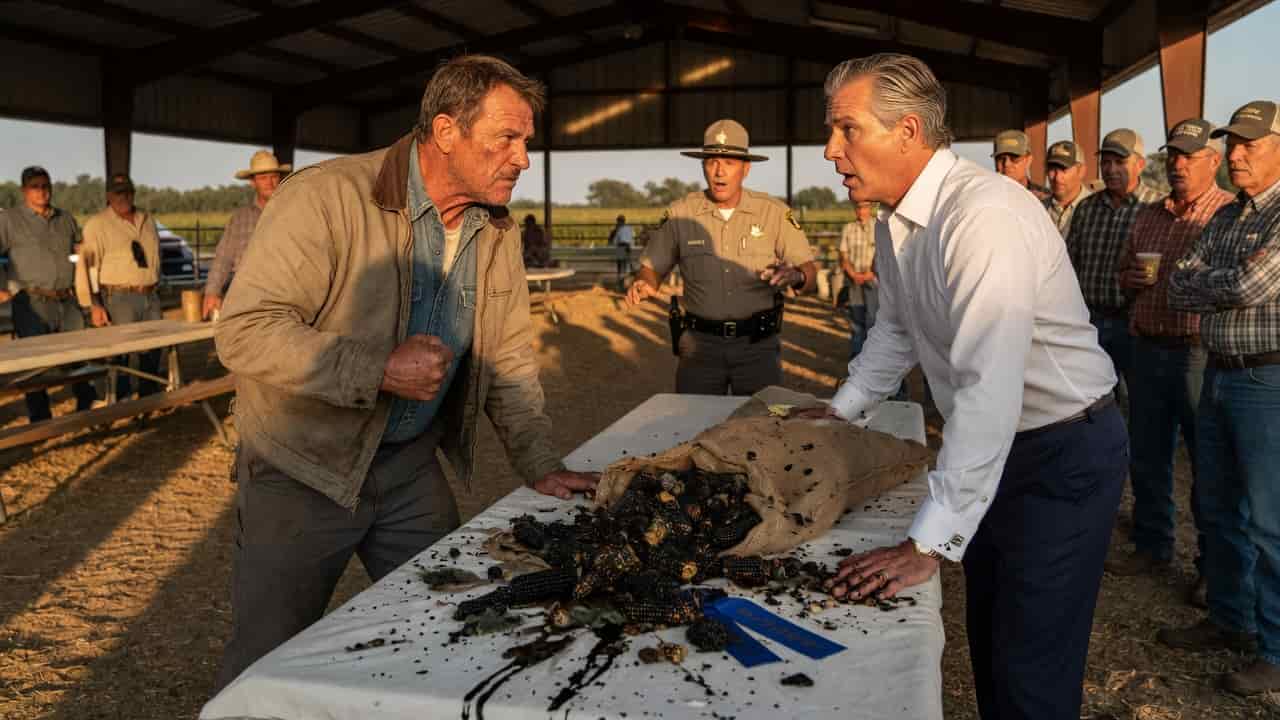
“You’re just a bad farmer, Miller. Your soil is sour because you’re lazy.”
Sterling said it loud enough for every neighbor I’ve known for forty years to hear. He stood there in his three-hundred-dollar shirt, looking down at me like I was something he’d stepped on in the barn. He thought because he owned the chemical plant, he owned the truth. He thought because his brother-in-law wore the judge’s robes, I’d just keep quiet while my fields turned to ash.
But I wasn’t there for a blue ribbon. I was there to show them what Agri-Chem’s ‘miracle runoff’ actually does to the land.
When I slammed that sack onto the white linen and the black, shriveled ears spilled out across his expensive watch, the whole pavilion went silent. The Sheriff started to move, then he saw the rot. He smelled the chemicals.
“Look at it, Sterling,” I told him. My voice didn’t shake. Not this time. “That’s the future you sold us. That’s your legacy. Now, tell these people again why my wife can’t walk in her own garden.”
Sterling’s face went white. He looked at the crowd, looking for a way out, but for the first time in a decade, nobody was looking away. They were looking at the poison.
I’ve been breeding something in my barn. Something that doesn’t care about his chemicals. Something that’s going to return the favor his company gave my family.
Chapter 1: The Burden of Dust
The dust in O’Brien County didn’t just settle; it colonized. It found the weave of your shirt, the creases around your eyes, and the back of your throat until everything you tasted reminded you of the dirt you were losing. Miller sat on the back porch of the farmhouse, a heavy ceramic mug of coffee gone cold in his hand. The sun was a bruised orange, hanging low over the horizon, bleeding light across the flat, unrelenting expanse of the soybean fields.
Behind him, through the screen door, he could hear the rhythmic, mechanical sigh of the oxygen concentrator. It was a dry, plastic sound that had replaced the sound of Sarah’s humming months ago. It was the metronome of their lives now—the sound of a body trying to remember how to be a body.
He stood up, his knees popping like dry kindling. He was fifty-eight, but the last three years had added a decade to the way his bones sat in his skin. He walked to the edge of the porch and looked out toward the North Forty. To an outsider, it looked like any other field in late August, a sea of green leaves trembling in the hot wind. But Miller knew the geometry of failure. He saw the yellowing at the margins, the way the stalks leaned as if they were tired of holding themselves up.
He looked toward the horizon, where the Agri-Chem plant sat like a squat, silver god on the edge of the county line. Its chimneys were silent today, but the shimmer of heat rising off the corrugated steel felt like a threat. For three generations, the Millers had farmed this dirt. His grandfather had survived the Depression on these acres; his father had built the barn with lumber he’d milled himself. Now, the soil was changing. It felt greasy between the fingers. When it rained, the puddles in the low spots didn’t reflect the sky; they held a shimmering, iridescent film that smelled like a garage floor.
“Miller?”
The voice was faint, thin as a single thread of silk. He turned and pulled open the screen door, the spring giving a familiar, mournful wail.
Inside, the house smelled of antiseptic and old wood. Sarah was propped up on three pillows, her hair a fine mist of white against the floral pillowcases. Her skin was the color of unbaked dough, translucent enough to see the blue spider-webbing of her veins.
“I’m here,” he said, sitting on the edge of the mattress. The bed creaked under his weight. He took her hand. It felt like holding a bird made of dry paper.
“The wind,” she whispered, her eyes drifting toward the window. “It’s coming from the east.”
“I know,” Miller said.
The east wind brought the smell of the plant. It brought the invisible particulates that the doctors said hadn’t caused her respiratory failure, but Miller knew doctors in this town were paid by the same hand that signed the Agri-Chem payroll. The local clinic was a gleaming white monument to corporate charity, a gift from Sterling himself.
“Did you check the garden?” she asked.
“I did. The tomatoes are coming in.” He lied. The tomatoes had withered on the vine two weeks ago, their leaves curling into black soot. The soil in the kitchen garden was dead, saturated with whatever was leaching out of the creek that fed the irrigation lines.
“I want to see them,” she said, her eyes fluttering. “Tomorrow. If it’s not too hot.”
“Tomorrow,” Miller promised.
He stayed with her until her breathing leveled out, the machine doing the heavy lifting. He felt a cold, hard knot of iron forming in his gut, a weight he’d been carrying since the day the first heifer dropped dead in the south pasture.
He left the house and walked toward the barn. It was an old structure, the red paint long ago scoured away by the Iowa winters. But inside, behind a false wall he’d built beneath the hayloft, was a different world.
He unlocked the heavy padlock and stepped into the hidden greenhouse. The air here was humid, thick with the scent of damp earth and something sharper, something primal. Rows of grow lights hummed overhead, casting a surreal purple glow over the plants.
These weren’t soybeans. They were something else—a mutated strain of Amaranthus palmeri, commonly known as pigweed. But this wasn’t the weed that farmers had been fighting for decades. This was Miller’s masterpiece. For two years, he’d been cross-breeding the most resistant stalks he could find, dousing them with every chemical Agri-Chem produced, and selecting only the ones that thrived on the poison.
He walked to the center table, where a single plant stood nearly four feet tall. Its leaves were a deep, bruised burgundy, tipped with thorns as fine as needles. He reached out and touched a leaf. It didn’t feel like plant tissue; it felt like leather.
He’d named it the “Widow-Maker.”
He’d spent thirty years being a good neighbor. He’d gone to church with the men who now sat on the board of directors. He’d bought seed from the company store when his own stocks failed. He’d played by the rules until the rules killed his cattle and started on his wife.
He picked up a spray bottle filled with a concentrated solution of Sterling’s prized herbicide—the one the company claimed could kill anything with a root. He spritzed the leaves of the Widow-Maker.
The plant didn’t wither. It didn’t even flinch. Instead, the leaves seemed to unfurl, drinking in the toxin as if it were a spring rain.
“Almost ready,” Miller muttered to the empty barn.
He thought about the County Fair. It was four days away. The whole town would be there. Sterling would be at the head table, handing out checks and ribbons, smiling for the local paper while his plant continued to pump poison into the water table.
Miller took a pair of shears and clipped a heavy seed head from the plant. He held it in his palm. It was dense, packed with thousands of microscopic seeds. If he released this—if he let the wind carry these seeds across the county—it would be the end of Agri-Chem’s dominance. Their chemicals would become useless. The “miracle” crops they sold would be choked out by a weed that fed on the very things designed to kill it.
But it wouldn’t just be Sterling’s fields. It would be Ben’s fields. It would be the Henderson’s. It would be everyone’s. The county’s economy would collapse. The land would become a battlefield where nothing but the Widow-Maker grew.
He looked at the seed head, his hand trembling. He thought about the oxygen machine back in the house. He thought about the way the Judge had looked at him in the courtroom six months ago, with pity and a trace of boredom, before dismissing his lawsuit against the plant.
“You have no proof of causation, Mr. Miller. This is an agricultural community. Things die. It’s the cycle of life.”
The cycle of life was over. Miller was starting the cycle of ash.
He walked back to the house under a sky that had turned a sickly, bruised purple. He sat back down on the porch, watching the lights of the plant flicker on in the distance. He felt like a man holding a match in a room full of gasoline. He wasn’t sure if he wanted to burn it all down or if he just wanted to feel the heat.
He closed his eyes and tried to remember the smell of the fields before the chemicals. He tried to remember the way Sarah looked when she was laughing, her hair catching the sun as she walked through the high corn. But the memories were like the dust—they slipped through his fingers, leaving nothing but a bitter taste behind.
He was a farmer. He knew how to plant, and he knew how to harvest. This year, the harvest was going to be different. He was going to bring the truth to the table, and he was going to make them eat every rotted bit of it.
He went back inside, the screen door wailing its familiar warning. He checked the oxygen levels one more time, then sat in the armchair by the bed, the shears still in his pocket, waiting for the morning that felt more like an ending than a beginning.
Chapter 2: The Judas Crop
The heat in the barn was a physical weight, a humid blanket that smelled of damp mulch and desperation. Miller stood over the long wooden bench, his fingers stained dark by the soil of the hidden greenhouse. He was transplanting the third-generation Widow-Maker starts into individual peat pots. They were small now, innocent-looking with their rounded, purple-veined leaves, but he knew the hunger built into their DNA.
A heavy knock echoed through the barn, the sound flat and hollow against the aged timber. Miller froze. He stood perfectly still, his heart hammering against his ribs like a trapped bird.
“Miller? You in there?”
It was Ben. Ben owned the four hundred acres to the west. He was a younger man, thirty-five, with a wife and two small kids who still believed that hard work and a bank loan were enough to guarantee a future. Ben was the mirror Miller looked into and saw the man he used to be—before the bitterness took root.
Miller stepped out of the hidden room, sliding the false wall shut and locking it with a click that felt loud as a gunshot in the silence. He wiped his hands on a greasy rag and walked to the main barn door.
He slid the heavy door open just enough to see Ben standing there. Ben looked tired. His cap was pulled low, and his shirt was soaked with sweat. He was holding a small plastic container.
“Hey, Ben,” Miller said, his voice raspy. He stepped outside, pulling the door shut behind him. He didn’t want Ben smelling the sharp, ozone-and-earth scent of the greenhouse.
“Sorry to drop by, Miller. I just… I wanted you to see this.” Ben held out the container. Inside was a handful of soil and a shriveled, stunted soybean plant. The roots were black and brittle. “It’s starting in the North section. Same as yours last year.”
Miller looked at the plant. He didn’t need to touch it to know what it was. It was the same systemic rot, the slow-motion murder of the land.
“You call the plant?” Miller asked, his voice devoid of hope.
Ben spat into the dust. “Yeah. They sent a guy out this morning. A kid in a polo shirt with a clipboard. He told me it was a drainage issue. Said I was over-irrigating.” Ben’s voice rose, a sharp edge of panic cutting through the exhaustion. “I told him I haven’t seen a drop of rain in three weeks, and my pumps are barely pulling mud. He just wrote something down and told me to buy their ‘Soil Revitalizer’ package.”
“Don’t do it,” Miller said. “It’s just more of the same. They sell you the poison, then they sell you the bandage, and then they charge you for the funeral.”
Ben looked at Miller, his eyes wide and pleading. He was looking for a veteran’s wisdom, for some trick of the trade that could save his legacy. “What am I supposed to do, Miller? I’ve got a mortgage on the equipment. If I don’t hit my numbers this year, the bank…”
“The bank is on the same board as Sterling,” Miller interrupted. He felt a flash of pity, but it was quickly swallowed by a cold, hard clarity. “You’re fighting a ghost, Ben. You can’t shoot it, and you can’t out-work it.”
Ben looked away, his jaw working. “I heard you went to the courthouse again.”
“I did.”
“And?”
“And the Judge told me I was a bad neighbor for trying to drive away the county’s biggest employer.” Miller leaned against the barn door, the wood hot against his back. “They’re untouchable, Ben. As long as they control the seed and the chemicals, they control us.”
Ben stayed silent for a long time, watching a hawk circle high above the fields. Finally, he looked back at Miller. “I saw a light in your barn late last night. You working on something?”
Miller’s grip tightened on the rag in his hand. “Just fixing the tractor. Old girl doesn’t like the heat.”
“Right,” Ben said, though his eyes lingered on the barn doors a second too long. “Well. If you need anything… help with Sarah, or… whatever. You let us know. Amy made a casserole.”
“Thanks, Ben. Give the kids my best.”
Miller watched Ben walk back to his truck, a beat-up Ford that had seen better days. He felt like a traitor. He was holding the weapon that would finish what Sterling started. If he released the Widow-Maker, Ben’s fields would be the first to go. The weed would move like a wildfire, choking out everything in its path.
He went back inside the barn, back into the purple light of the greenhouse. He looked at the rows of plants. They were beautiful in a terrifying way. They were the physical manifestation of his rage.
He sat down on a stool, his head in his hands. He thought about Sarah. He thought about the way she used to talk about the land as if it were a member of the family. “We don’t own it, Miller. We just look after it for a little while.”
If she knew what he was doing, she’d be horrified. She’d tell him that revenge was just another kind of poison. But she wasn’t the one who had to watch her life’s work turn into a graveyard. She wasn’t the one who had to stand in the grocery store and feel the pitying stares of the people who knew the Millers were finished.
He stood up and walked to the back of the greenhouse, where he kept a special tray. These were the “Judas” seeds. He’d treated them with a fluorescent dye that only showed up under UV light. He wanted to be able to track the spread. He wanted to see exactly how fast justice could move.
He began the process of drying the seed heads. He used a small, low-heat dehydrator, the kind people used for making beef jerky. As the seeds dried, they made a soft, clicking sound, like thousands of tiny teeth.
The process was meticulous. He had to ensure the seeds were viable but dormant until they hit the soil. He worked through the night, the purple light casting long, distorted shadows against the barn walls.
He felt a strange, detached sense of peace. For months, he’d felt like a victim, a man being slowly erased. Now, he was an architect. He was building a new world, even if it was a world made of thorns.
Around 3:00 AM, he returned to the house. The oxygen concentrator was still humming, a steady, mechanical heart. He sat by Sarah’s bed, watching the shallow rise and fall of her chest.
He reached out and stroked her forehead. She felt so small. It was as if she were already being reclaimed by the earth.
“I’m going to make them look at us,” he whispered. “I’m going to make them see what they did.”
He thought about the County Fair. He thought about the look on Sterling’s face when the first reports of the “unidentifiable weed” started coming in. He thought about the chaos that would follow—the emergency meetings, the panicked spraying of chemicals that would only make the Widow-Maker stronger.
He felt a sudden, sharp pang of guilt. Was he any better than Sterling? He was playing god with the land, too. He was choosing who lived and who died.
He stood up and walked to the kitchen, pouring himself a glass of water that tasted of iron and sulfur. He looked at the black-and-white photo on the mantel—his father and grandfather standing in front of a harvest that reached their shoulders. They looked proud. They looked like men who belonged to the earth.
He looked at his own hands in the moonlight. They were the hands of a man who was about to kill the very thing he was born to protect.
He didn’t go back to sleep. He sat in the dark, listening to the machine breathe for his wife, waiting for the sun to rise over the fields of ash. He knew there was no turning back now. The seeds were dried. The plan was set. All that was left was the harvest.
Chapter 3: The King of Chemicals
The Agri-Chem regional headquarters was a building of glass and steel that looked as though it had been dropped into the middle of the cornfields by an alien civilization. It was surrounded by a manicured lawn that was so green it looked fake, a sharp contrast to the parched, dusty brown of the surrounding county.
Miller pulled his rusted Chevy into the visitor parking lot, feeling like an intruder. He didn’t belong here. He belonged in the dirt, not in a place that smelled of air-conditioning and expensive floor wax.
He climbed the stairs, his work boots thudding heavily against the polished stone. He was wearing his best shirt, a clean flannel, but he still felt like a beggar.
The receptionist was a young woman with a headset and a smile that didn’t reach her eyes. “Can I help you, sir?”
“I’m here to see Sterling,” Miller said.
“Do you have an appointment?”
“No. But tell him it’s Miller. From the south section.”
She hesitated, then tapped something into her computer. A few minutes later, a man stepped out of the glass elevators. It wasn’t Sterling. It was a younger man in a navy suit, carrying a leather-bound folder.
“Mr. Miller? I’m David, Mr. Sterling’s assistant. How can I help you?”
“I didn’t come to talk to the help, David. I came to talk to the man who signed the letter telling me my water is fine.”
David’s smile tightened. “Mr. Sterling is very busy today, Mr. Miller. We’re preparing for the County Fair. If you have concerns about the water report, I can schedule a meeting with our environmental team for next month.”
“Next month?” Miller’s voice rose. “My wife is on a machine that breathes for her now. My cattle are buried in a pit now. I don’t have next month.”
He pushed past David, headed for the elevators.
“Sir! You can’t go up there!”
Miller didn’t stop. He’d spent his whole life being polite, being the man who waited his turn. That man was dead. He hit the button for the top floor.
The doors opened into a wide, plush office suite. The walls were lined with awards and framed photographs of Sterling shaking hands with governors and senators. Through the floor-to-ceiling windows, you could see for miles—a panoramic view of the kingdom Sterling had built on top of the ruins of men like Miller.
Sterling was standing by a wet bar, pouring himself a glass of sparkling water. He looked up, his expression one of mild annoyance rather than surprise.
“Miller. You always did have a problem with boundaries.”
“And you always did have a problem with the truth,” Miller said, walking into the center of the room. He felt small in this space, but the rage in his chest made him feel ten feet tall.
Sterling sighed and walked to his mahogany desk. He sat down, leaning back in his leather chair. “I know why you’re here. You’re upset about the lawsuit. You feel the system failed you.”
“The system didn’t fail me, Sterling. The system is on your payroll. Your brother-in-law is the Judge. Your cousin is the Sheriff. It’s not a system; it’s a family business.”
Sterling smiled, a cold, thin-lipped expression. “It’s called infrastructure, Miller. I provide jobs. I provide tax revenue. I provide the chemicals that allow this county to feed the world. What do you provide? A few bushels of beans and a lot of complaints?”
“I provide the land!” Miller shouted. “The land you’re poisoning!”
Sterling leaned forward, his eyes narrowing. “The land is a resource, Miller. It’s a tool. And like any tool, it wears out. If you can’t keep up with the technology, if you can’t adapt to the requirements of modern agriculture, then you’re just dead weight. You’re a bad farmer, Miller. That’s the simple truth of it. You’re lazy, you’re stuck in the past, and you’re looking for someone to blame for your own failures.”
The words hit Miller like a physical blow. A bad farmer. The ultimate insult. It was the one thing he’d always prided himself on—the heritage of the dirt.
“You think you can just erase us?” Miller asked, his voice shaking.
“I don’t have to erase you,” Sterling said, picking up a gold pen. “You’re erasing yourselves. You’re obsolete. Within ten years, there won’t be any family farms left in this county. It’ll all be corporate-managed, high-efficiency acreage. And it will be a hell of a lot more productive than anything you’ve ever done.”
Miller looked at the man across the desk. He didn’t see a human being. He saw a machine, a cold, calculating force that didn’t care about the cost of its progress.
“The Fair is Saturday,” Miller said, his voice dropping to a low, dangerous growl.
“It is. And I expect to see you there. We’re announcing the new scholarship fund. It’s a big day for the community.”
“I’ll be there,” Miller said. “And I’m bringing something for you, Sterling. A gift. From my land to yours.”
Sterling chuckled. “I look forward to it. Now, if you’ll excuse me, I have a company to run.”
Miller turned and walked out. He didn’t look at David, who was standing by the elevators with a look of panicked concern. He didn’t look at the awards or the photographs.
He drove back to the farm in a daze. A bad farmer. The words rang in his ears, keeping time with the thrum of the engine.
When he got home, he didn’t go into the house. He went straight to the barn. He went into the hidden greenhouse and looked at the Widow-Maker.
The plants were thriving. They were lush and aggressive, their thorns glistening in the purple light.
He took a burlap sack from a pile in the corner. He went to the storage bin where he’d kept the shriveled, oily-black ears of corn from the south pasture—the crop that Agri-Chem said was a ‘drainage issue.’
He filled the sack with the rotted corn. It smelled of decay and chemicals, a cloying, metallic scent that made his eyes water.
He sat on the stool and began to strip the seeds from the Widow-Maker plants, mixing them in with the rotted corn. Thousands upon thousands of them, tiny black specks of destruction hidden inside the rot.
He was going to give Sterling exactly what he asked for. He was going to give him the future.
He worked until his fingers were raw, his mind focused on the image of Sterling standing at that judging table. He thought about the crowd, the neighbors, the witnesses. He thought about the moment the truth would spill out across the white linen.
He wasn’t just a farmer anymore. He was a harbinger.
He went into the house and sat by Sarah’s bed. She was asleep, the machine sighing beside her.
“He called me a bad farmer, Sarah,” Miller whispered. “He thinks he knows what the land can do.”
He reached out and touched the glass of the window. Outside, the lights of the plant were a cold, unblinking eye.
“He’s about to find out,” Miller said. “He’s about to find out that the dirt doesn’t forget. And it sure as hell doesn’t forgive.”
He leaned his head against the wall and closed his eyes. He didn’t feel like a hero. He didn’t even feel like a man anymore. He felt like a part of the storm, a force of nature that had finally found its direction.
Saturday was coming. The harvest was ready. And the ash was already starting to fall.
Chapter 4: The Harvest of Ash
The O’Brien County Fair was a sensory assault—the smell of fried dough and diesel exhaust, the shrill mechanical music of the tilt-a-whirl, and the low, constant hum of a thousand conversations. It was the one time of year when the county tried to pretend it wasn’t dying, masking the scent of the chemicals with the smell of livestock and popcorn.
Miller moved through the crowd like a ghost. He was wearing his clean tan jacket, the burlap sack slung over his shoulder. People nodded to him, some with pity, some with a quick, uncomfortable turn of the head. He was the man with the dying wife and the dead fields, a walking reminder of what was coming for all of them.
He made his way toward the Main Pavilion. It was a massive, open-air structure where the produce was judged. Long tables were lined with the best the county had to offer—monstrous pumpkins, perfect ears of golden corn, jars of preserved peaches that glowed like amber in the afternoon light.
At the far end, under a banner that read AGRI-CHEM: GROWING THE FUTURE TOGETHER, was the judging table.
Sterling was there, looking every bit the corporate king. He was laughing at something the Mayor said, his silver hair gleaming under the high-intensity lights of the pavilion. Beside him sat the Sheriff and the Judge, a triumvirate of power that had held the county in a stranglehold for a generation.
Miller stopped ten feet away. He felt the weight of the sack on his shoulder, a heavy, silent accusation.
Ben was there, too, standing near the edge of the crowd with his wife and kids. He saw Miller and his eyes widened. He looked at the sack, then at Miller’s face, and he seemed to shrink back into the shadows of the crowd.
Sterling looked up and saw Miller. His smile didn’t falter, but his eyes turned cold.
“Mr. Miller,” Sterling said, his voice amplified by the microphone on the table. “I see you’ve brought an entry. I was worried you wouldn’t make it.”
The crowd went quiet. The sound of the carnival in the distance seemed to fade, leaving only the sound of the wind pulling at the canvas roof of the pavilion.
“I brought something, Sterling,” Miller said. His voice was flat, devoid of emotion. He walked forward, the sawdust crunching under his boots.
He stopped at the table, directly across from Sterling. The white linen cloth was pristine, a stark contrast to the grime on Miller’s jacket.
“We’re judging the corn category now, Miller,” Sterling said, gesturing to the perfect, yellow ears lined up in front of him. “I hope you’ve brought something that can compete.”
The Judge chuckled. The Sheriff leaned forward, his hand resting casually near his belt.
“You told me I was a bad farmer, Sterling,” Miller said. “You told me my soil was sour because I was lazy.”
“I think this is neither the time nor the place for this conversation, Miller,” Sterling said, his voice dropping an octave, a warning clear in his tone.
“No,” Miller said. “This is exactly the place. You wanted to see what my land produced? You wanted to see the result of your ‘miracle’ chemicals?”
Miller grabbed the bottom of the burlap sack.
“Miller, don’t,” the Sheriff warned, taking a step forward.
With a violent, snapping motion, Miller upended the sack.
The rotted, oily-black corn spilled across the table. It tumbled over the blue-ribbon entries, staining the white linen with a dark, chemical-smelling sludge. Two shriveled ears bounced off the table and landed directly on Sterling’s hand.
Sterling recoiled as if he’d been struck, his face contorting in a mask of disgust and shock. He jerks his hand back, his silver hair falling into his eyes as his composure shattered.
The smell hit the crowd—a sharp, metallic stench of decay and industrial waste. People in the front row took a step back, their hands over their noses.
“Look at it, Sterling!” Miller shouted, his voice finally breaking, the rage pouring out of him like a flood. “That’s your legacy! That’s the future you’re selling to these people!”
“Get him out of here!” Sterling hissed, his voice trembling with fury. He was wiping his hand frantically on a napkin, but the black stain remained.
The Sheriff moved in, grabbing Miller by the arm. Miller didn’t resist. He stood his ground, his eyes locked on Sterling.
“You told me I was obsolete!” Miller yelled as the Sheriff pulled him back. “You told me the land was just a tool! Well, the tool is broken, Sterling! And you’re the one who broke it!”
The pavilion was in a state of stunned silence. The farmers looked at the black rot on the table, then at each other. For the first time, the fear in their eyes was replaced by something else—a dawning realization.
“That’s enough, Miller,” the Sheriff said, his voice low. He didn’t sound angry; he sounded tired. He knew what was in that sack. He’d seen the pits where the cattle were buried.
Miller looked at Ben. Ben was staring at the table, his face pale. Miller felt a pang of regret, but it was too late. The seeds were out. They were already in the sawdust. They were on the boots of the people in the front row. They were in the air.
“You think you’ve won?” Sterling shouted, standing up and pointing a trembling finger at Miller. “You’re a crazy old man! You’ve ruined the Fair! You’ve embarrassed this community!”
“I didn’t ruin it, Sterling,” Miller said, a cold, terrible smile spreading across his face. “I just harvested it.”
The Sheriff led Miller away, toward the exit of the pavilion. Miller didn’t look back. He didn’t need to. He knew what he’d left behind.
He’d left a bag of rotted corn, yes. But he’d also left thousands of seeds of the Widow-Maker. By the time the Fair was over, those seeds would be carried to every corner of the county. They would find the soil, and they would wait.
As he was led out into the fading golden light of the afternoon, Miller looked toward the horizon. The Agri-Chem plant was still there, silver and imposing.
But for the first time in years, the air felt different. It felt like a storm was coming.
He thought about Sarah, lying in her bed with the machine breathing for her. He thought about the garden she wanted to see tomorrow.
“I’m coming home, Sarah,” he whispered.
The Sheriff walked him to his truck and let go of his arm. “Go home, Miller. Don’t come back here tonight. Sterling’s going to want blood for this.”
“He’s already got enough of mine,” Miller said.
He climbed into the Chevy and started the engine. As he drove out of the fairgrounds, he saw the dust rising from the parking lot, a great, swirling cloud that obscured the lights of the carnival.
He drove toward the farm, the empty burlap sack on the seat beside him. He felt a strange, hollow sense of completion. He’d done it. He’d forced the truth into the open.
But as he looked in the rearview mirror, he saw the wind picking up, blowing the dust across the fields. He knew that what he’d started was bigger than Sterling. It was bigger than his revenge.
It was a harvest of ash, and it was only just beginning.
He pulled into his driveway and saw the house, small and fragile against the dark expanse of the plains. The lights were on in the bedroom.
He sat in the truck for a long time, listening to the ticking of the cooling engine. He thought about the Widow-Maker seeds, already settling into the dirt of a hundred different farms.
He had returned the favor.
He got out of the truck and walked toward the house, his boots heavy with the dust of a dying world. He opened the screen door, and the sound of the oxygen machine met him—a steady, mechanical heart in the silence of the night.
He went into the bedroom and sat by Sarah. She was awake, her eyes searching his face.
“Did you go?” she whispered.
“I did,” Miller said, taking her hand.
“Was it… was it a good harvest?”
Miller looked out the window at the dark fields, where the thorns were already waiting to rise.
“It was the only harvest we had left, Sarah,” he said. “It was the only one left.”
Chapter 5: The Rising Thorns
The dawn didn’t break over O’Brien County so much as it bruised its way through a low, leaden ceiling of clouds. The humidity had reached a breaking point, the air so thick it felt like breathing through a wet wool blanket. Miller stood on the back porch, the silence of the morning punctuated only by the distant, rhythmic thud of a neighbor’s pump and the low, constant wheeze of the oxygen concentrator inside.
He looked toward the North Forty. In the gray, pre-dawn light, the fields looked different. There was a shimmering quality to the weeds along the fence line, a vibrant, aggressive purple that hadn’t been there forty-eight hours ago. The Widow-Maker was waking up.
He’d spent the night sitting in the armchair by Sarah’s bed, watching the numbers on the pulse oximeter flicker like a dying candle. She was drifting deeper into the fog, her moments of clarity becoming shorter, more fragmented. She talked about the creek. She talked about the year the blizzard took the barn roof. She didn’t talk about the future because there was no room left for it.
The sound of a truck engine groaning up the gravel drive broke his reverie. It was Ben’s Ford. The vehicle looked even more battered than it had a few days ago, covered in a fine layer of gray dust. Ben didn’t wait for the engine to stop before he jumped out, slamming the door with a force that made the house windows rattle.
Miller stepped off the porch to meet him. He saw the look on Ben’s face—a mixture of panic and a hard, jagged suspicion.
“You see it, Miller?” Ben shouted, not bothering with a greeting. He pointed a trembling hand toward his own fields to the west. “It’s in the drainage ditch. It’s in the low spots. It’s growing three inches an hour. I tried to spray it with the Round-Up I had left in the tank, and the damn stuff seemed to like it. It grew thorns right in front of my eyes.”
Miller looked at the ground. “I saw it.”
Ben walked right up to him, his chest heaving. He smelled of diesel and cheap tobacco. “What is it? That’s not pigweed. I’ve been fighting pigweed since I was ten years old. That stuff… it looks like something from a nightmare. And it’s only showing up where the wind blew after you dumped that sack at the fair.”
The silence between them stretched, heavy and dangerous. Miller looked up, meeting Ben’s eyes. He saw the desperation there, the fear of a man watching his children’s inheritance being choked out by a ghost.
“It’s a response, Ben,” Miller said, his voice low. “It’s what happens when you try to kill something for thirty years and it finally decides to fight back.”
“Don’t give me that philosophical horseshit!” Ben roared. “I’ve got three hundred acres of prime beans that are being strangled by a purple vine that eats poison for breakfast. Is this what was in the barn, Miller? Is this the ‘fixing the tractor’ you were doing at three in the morning?”
Miller didn’t blink. “I did what I had to do to make them look. Sterling wasn’t going to stop until we were all in the ground, Ben. You saw the corn on that table. You smelled the chemicals. You think he was going to let your kids grow up healthy on this dirt?”
“So you killed the dirt instead?” Ben’s voice broke. He looked at the farmhouse, then back at Miller. “You’re no better than him. You’re just the other side of the same coin. He poisons us for profit, and you poison us for pride.”
“It’s not pride,” Miller said, the iron in his gut hardening. “It’s a debt. And I’m collecting it.”
Ben shook his head, backing away toward his truck. “The Sheriff is coming, Miller. Sterling’s lawyers are already at the courthouse. They’re calling it ‘biological terrorism.’ They’re saying you deliberately infested the county to devalue the land so you could sue for more. They’re going to take this farm. They’re going to take everything.”
“They already took everything,” Miller said.
He watched Ben drive away, the dust from his tires settling on the parched grass of the lawn. He felt a sudden, sharp pang of regret for Ben, but it was a distant thing, like the sound of a storm in the next county. The residue of his choice was everywhere—in the air, in the soil, in the way the light hit the purple leaves of the Widow-Maker.
He went back inside the house. Sarah was awake, her eyes wide and glassy.
“The garden,” she whispered. “It’s… it’s so loud out there, Miller.”
He sat beside her, taking her hand. “It’s just the wind, honey.”
“No,” she said, a strange strength in her voice. “It’s the growing. I can hear it. Like teeth on a whetstone.”
He didn’t tell her she was hallucinating. He could hear it too. A dry, rustling sound that seemed to come from every direction. The sound of a thousand thousand seeds finding their purchase.
An hour later, the Sheriff’s cruiser pulled into the yard, followed by a black SUV with tinted windows. Miller didn’t move from his spot on the porch. He watched the Sheriff get out, his shoulders slumped, his hat pulled low. From the SUV emerged two men in dark suits, their shoes immediately becoming coated in the fine O’Brien County dust.
The Sheriff walked up the steps, stopping on the third one. He didn’t look at Miller; he looked at the floorboards.
“Miller,” he said.
“Sheriff.”
“These gentlemen are from the State Agricultural Board. And there’s a couple of fellas from the FBI coming down from Des Moines. Sterling filed a formal complaint. He’s claiming you’ve released a prohibited invasive species with the intent to damage the regional economy.”
The taller suit stepped forward, holding a leather-bound folder. “Mr. Miller, we have a warrant to search your property, specifically the barn and any outbuildings. We’ve had reports of illegal botanical experimentation.”
“Is that what we’re calling it?” Miller asked. “Experimentation? I thought I was just a bad farmer.”
The suit didn’t smile. “We’ve seen the infestation on the neighboring properties. It’s localized around your delivery path from the fairgrounds. We need to see your nursery, Mr. Miller. Now.”
Miller stood up. He felt a strange sense of lightness. The secret was over. The weapon had been fired. All that was left was the fallout.
“It’s in the barn,” Miller said. “Under the hayloft. You won’t need to look hard. It’s the only thing left alive in there.”
He led them to the barn, the Sheriff walking behind him like a man at a funeral. Miller unlocked the heavy door and slid it back. The interior was dark, smelling of old dust and dry rot, but the purple glow from the hidden room’s vents bled through the cracks in the false wall.
The suits moved with clinical efficiency. They tore down the plywood panels, revealing the greenhouse.
The light hit the Widow-Maker plants, and even the men from the state took a step back. The plants had grown since Miller had last seen them, their thick, thorny stalks straining against the grow lights, their leaves a deep, pulsating burgundy.
“My god,” one of the suits whispered. “What did you cross this with?”
“Nothing but Sterling’s own chemicals,” Miller said. “I just gave them exactly what they were trained to survive. I taught them that the only way to live was to become a monster.”
The Sheriff stepped into the room, looking at the rows of plants. He reached out a hand, then pulled it back as if the air itself was dangerous. “You done it, Miller. You really done it.”
“I gave him a mirror, Sheriff. That’s all.”
The suits began taking samples, their movements hurried and nervous. They were talking about containment, about chemical fire, about stripping the topsoil for ten miles in every direction. They didn’t understand. The Widow-Maker didn’t care about containment. Its seeds were already in the birds, in the tires of every truck that had left the fair, in the very clothes of the men standing in the room.
Miller walked back to the house alone. The suits were too busy with their “biological threat” to worry about an old man in a tan jacket.
He sat in the kitchen and listened to the radio. The local station was frantic. Reports were coming in from three different townships. A new, aggressive weed was choking out the soy crops. It was resistant to every known herbicide. It was breaking the equipment. It was growing through the asphalt of the county roads.
He felt a cold, hollow satisfaction. Sterling’s stock would be plummeting. The “Agri-Chem Miracle” was being exposed as the catalyst for a disaster. The company wouldn’t survive this. They’d be tied up in litigation for decades. The kingdom was falling.
But then he looked out the kitchen window at Ben’s farm. He saw Ben’s wife, Amy, standing in their yard, holding a child on her hip, looking out at the purple haze creeping across their fields. She looked small and helpless.
The residue of his vengeance tasted like copper in his mouth. He’d torn down the giant, but he’d crushed the neighbors in the process. He’d saved the land from Sterling’s poison by giving it a sickness it could never recover from.
He went into the bedroom. Sarah’s breathing was ragged now, a wet, rattling sound that made his own lungs ache. He sat by her and took her hand.
“It’s over, Sarah,” he whispered. “The plant is going to close. Sterling is finished.”
She opened her eyes, but they didn’t see him. They saw something far away. “The flowers, Miller. They’re so dark. I didn’t know the garden would turn dark.”
“It’s just the evening coming on,” he said, his voice cracking.
He stayed with her as the sun went down, casting a bloody light over the fields of thorns. He could hear the sirens in the distance—the state police, the environmental teams, the news crews. The world was coming for O’Brien County, but they were too late. The harvest was already in.
He thought about the greenhouse, about the look of awe on the suits’ faces. He thought about the rotted corn on the white linen table. He’d made them look. He’d made them see the rot.
But as the darkness swallowed the room, and the oxygen machine gave a final, stuttering cough before falling silent, Miller realized the terrible truth of his choice. He had won the war, but he had lost the world he was fighting for.
He sat in the dark, holding the hand of a woman who was no longer there, listening to the sound of the Widow-Maker growing in the silence. It was a dry, clicking sound, like thousands of tiny teeth, eating the past to make room for a future that had no place for men like him.
The thorns were rising. And Miller, the king of the ash, sat on his throne of dirt and waited for the end of the day.
Chapter 6: The Final Reaping
The silence in the farmhouse was different now. It wasn’t the heavy, expectant silence of a sickroom; it was the hollow, echoing silence of a tomb. Sarah had passed just as the moon reached its zenith, her last breath a quiet sigh that seemed to blend into the rustle of the wind through the dying corn.
Miller didn’t call the funeral home. He didn’t call the Sheriff. He simply sat in the armchair, watching the light change from the silver of the moon to the bruised purple of another Iowa dawn. He felt a strange, detached clarity. The world outside was in chaos, but inside this room, the debt had been paid in full.
Around 8:00 AM, the sound of a heavy engine approached—not a truck, but something larger. A bulldozer.
Miller stood up and walked to the front door. He didn’t look back at the bed. He’d already said his goodbyes in the long hours of the night.
He stepped onto the porch. A massive yellow D9 bulldozer was idling at the edge of his property, its blade raised like a guillotine. Behind it stood a line of black SUVs and a dozen men in white hazmat suits. And in the center of it all, leaning against the hood of a pristine Cadillac, was Sterling.
He looked different. The polished corporate veneer had cracked. His silver hair was disheveled, and his expensive white shirt was stained with sweat and dirt. He looked like a man who had seen the bottom of his own grave and was trying to negotiate with the shovels.
Sterling walked toward the porch, stopping at the edge of the lawn. He didn’t have his assistants now. He didn’t have his lawyers. He just had the desperation of a ruined man.
“You’ve had your fun, Miller,” Sterling shouted over the roar of the bulldozer. “You’ve made your point. The county is a disaster zone. The EPA is declaring the whole region a Superfund site. My company’s stock is worth less than the paper it’s printed on.”
“I told you I was bringing a gift,” Miller said, his voice carrying clearly in the morning air.
“A gift?” Sterling laughed, a harsh, jagged sound. “You’ve destroyed the economy of three states! You’ve unleashed a plague! But it ends here. This farm is the epicenter. I’ve got an emergency court order for the destruction of all structures and the incineration of the topsoil on this property. We’re going to bury your ‘Widow-Maker’ under six feet of lime and concrete.”
“You think you can bury it?” Miller asked. He stepped off the porch, walking slowly toward the man who had been his shadow for thirty years. “You still don’t get it, Sterling. You spent your whole life trying to control the dirt. You thought if you bought the right seeds and the right judges, the earth would do what it was told. But the earth doesn’t take orders.”
Sterling’s face twisted in rage. “I’m going to level this house, Miller! I’m going to push every stick of your pathetic heritage into a hole and burn it! You’ll have nothing left! Not even a memory!”
Miller stopped five feet from him. He could smell the expensive cologne and the sour scent of failure on the man. “Sarah died last night, Sterling.”
The rage in Sterling’s eyes faltered for a fraction of a second, replaced by a flicker of something that might have been pity, or perhaps just the realization that he no longer had any leverage.
“I’m sorry for your loss,” Sterling said, his voice tightening. “But it doesn’t change anything. The dozers start in five minutes.”
“Go ahead,” Miller said. “Push it down. Burn the soil. You think that’s going to stop what’s coming? Those seeds are already in the wind, Sterling. They’re in the tires of your Cadillac. They’re in the cuffs of your pants. You can’t kill a ghost with a bulldozer.”
The lead man in the hazmat suit walked over, his voice muffled by the respirator. “Mr. Sterling, the readings from the barn are off the charts. The plant isn’t just resistant to the herbicide; it’s metabolizing the heavy metals in the soil. It’s drawing the toxins up from the water table and concentrating them in the thorns. If we disturb the roots now without the proper containment…”
“I don’t care!” Sterling screamed, turning on the technician. “Level it! Now!”
The technician hesitated, looking at the massive, pulsating purple vines that were already beginning to curl around the legs of the barn.
Miller looked past them, toward the North Forty. He saw Ben standing at the fence line, his hands in his pockets, watching the scene with a look of profound, weary sadness. Ben wasn’t shouting anymore. He wasn’t angry. He was just a man watching the end of a world.
Miller walked back toward the house. He didn’t look at Sterling again. He went inside and sat at the kitchen table. He picked up the black-and-white photo of his father and grandfather. He wiped the dust from the glass with his thumb.
He thought about the cycle of life the Judge had talked about. The Judge was right, in a way. Things died. But sometimes, they died so something else could live. Something harder. Something that didn’t need blue ribbons or corporate scholarships to prove its worth.
The roar of the bulldozer grew louder. The house began to tremble, the plates in the cupboard rattling like dry bones. Miller closed his eyes.
He didn’t feel fear. He felt a strange, quiet pride. He was a bad farmer, according to the world. He’d produced a crop that couldn’t be sold, couldn’t be eaten, and couldn’t be controlled. He’d grown a harvest of justice that was as bitter as it was absolute.
The first impact of the blade against the porch was a sound of rending wood and shattering glass. The house groaned, the old timbers screaming as they were forced from their foundations.
Miller stayed in his chair. He held the photo against his chest.
Outside, Sterling was screaming orders, but his voice was being swallowed by the sound of the destruction. He was a small man, yelling at a storm he had helped create.
The house tilted. The ceiling began to sag. A cloud of ancient dust, the residue of three generations of Millers, filled the air.
As the walls collapsed around him, Miller had one final thought. He thought about the garden Sarah wanted to see. He thought about the way the Widow-Maker’s flowers would look in the spring—a vast, unbroken sea of purple, covering the ruins of the chemical plant, choking the highways, and reclaiming the land for a truth that was older than any company.
The weight of the roof came down, a heavy, final blanket of wood and shingles.
In the silence that followed, there was no sound of sirens. There was no sound of angry men. There was only the wind, blowing across the Iowa plains, carrying a billion microscopic seeds toward a horizon that was no longer silver.
Six months later, the O’Brien County Fairgrounds were empty. The Main Pavilion was a skeleton of rusted steel, its canvas roof long ago shredded by the winter gales.
But the sawdust on the floor was gone. In its place was a carpet of deep burgundy and emerald green. The Widow-Maker had taken the pavilion. It had grown through the judging tables, its thorns wrapping around the abandoned microphones and the faded banners of Agri-Chem.
A single truck pulled up to the gate. Ben got out, his face older, his eyes harder. He looked at the ruin of the fairgrounds. He looked at the purple vines that were already reaching for the fences of the neighboring farms.
He reached into his pocket and pulled out a small, shriveled ear of black corn—the one he’d picked up from the floor the day Miller was arrested.
He looked at the rotted grain, then at the thriving, aggressive weeds.
“You done it, Miller,” Ben whispered to the wind. “You really done it.”
He dropped the corn into the dirt and turned away. Behind him, the Widow-Maker stirred in the breeze, its thorns glistening like needles in the cold autumn sun, waiting for the next season to begin.
The harvest was over. The land was free. And the ash had finally settled into something that looked like peace.