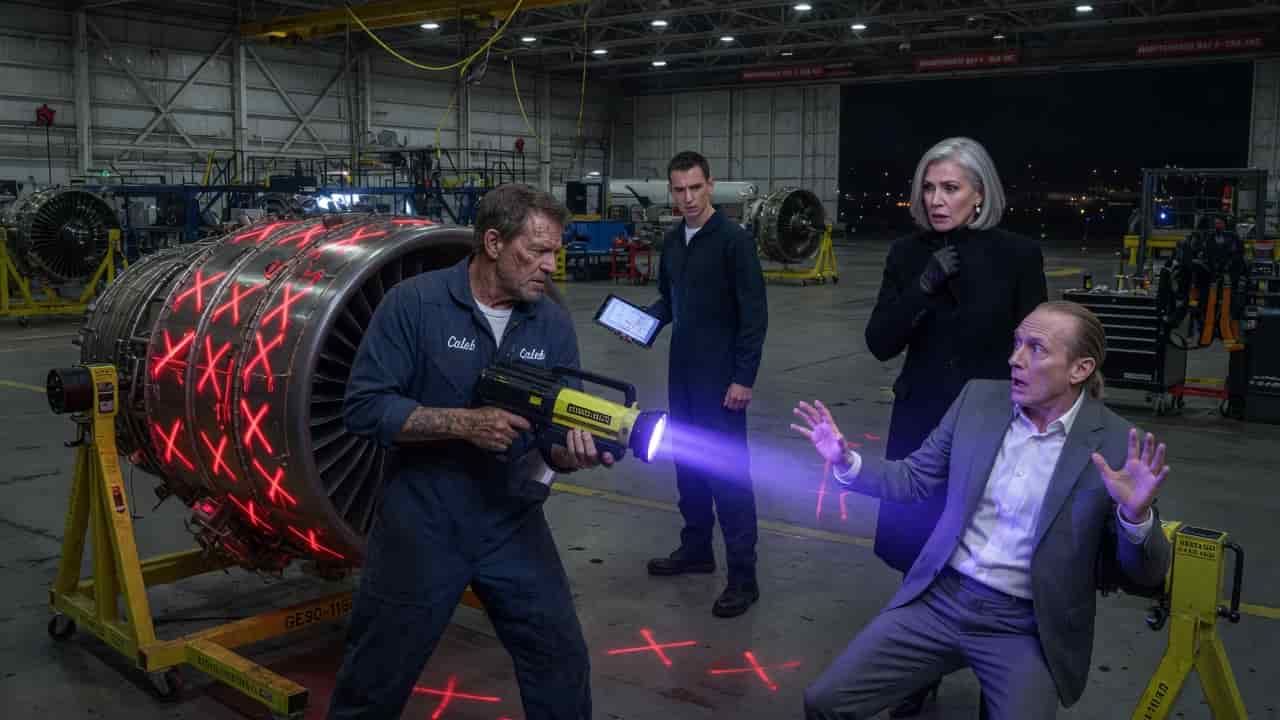
“You’re finished, Caleb. Pack your tools and get out before I have security drag you across the tarmac.”
Miller didn’t just say it; he spat it. He wanted the board members to see him “cleaning house.” He wanted the CEO to see that the delays were the fault of an old man who had lost his edge, not the result of the corner-cutting Miller had been ordering for months.
Caleb didn’t move. He didn’t blink. He just reached for the heavy industrial lamp sitting on the workbench—the one Miller had mocked him for “obsessing over” for weeks.
“You told them this engine was perfect, Miller,” Caleb said, his voice cutting through the silent hangar. “You told them the cracks were just ‘cosmetic surface tension.’ You even signed the sign-off sheet in front of them.”
The CEO stepped forward, her heels clicking like gunshots on the concrete. “Is there a problem here?”
“Just a disgruntled employee, Diane,” Miller laughed, though his eyes were darting toward the door. “Caleb can’t accept that the world moved on from his slow, manual inspections. He’s reaching for ghosts.”
“I’m not reaching for ghosts,” Caleb whispered. He lifted the lamp and flipped the switch.
The purple light flooded the engine. Suddenly, the pristine chrome was gone. In its place was a roadmap of failure—bright, neon-red “X” marks scrawled over every weld, every bolt, and every hairline fracture Miller had ordered him to ignore.
The room went deathly silent. Miller’s face turned the color of ash as he realized what those marks were. And Caleb was only getting started.
Chapter 1
The smell of argon gas and burnt ozone always reminded Caleb of things that were gone. It was a clean, sharp scent, the kind that got into your pores and stayed there until you scrubbed yourself raw in a lukewarm shower. He adjusted the auto-darkening hood on his head, feeling the familiar weight of the world narrow down to the size of a two-inch tungsten electrode.
He was working on a titanium bleed air duct for a 787. It was delicate work, the kind that required a steady hand and a mind that didn’t wander. But Caleb’s mind was a traitor. Every time the blue arc flared to life, he saw the flickering lights of the terminal at Sea-Tac, the last place he’d seen Sarah. She’d been wearing that ridiculous yellow scarf, the one he told her looked like a caution sign.
“Safety first,” she’d joked, kissing him on the cheek before heading to the gate.
A year later, the NTSB report had called it a “fatigue-induced structural failure.” Caleb called it a lie. He knew the shop that had serviced that engine. He knew the man who ran it. And he knew that a report about a cracked mount had been filed three weeks before the crash—and then vanished from the digital logs as if it had never been written.
The hangar door hummed, a massive groan of steel on track, and the Seattle rain began to mist into the workspace. Caleb didn’t look up. He didn’t need to. He knew the rhythm of the boots approaching. They were expensive boots, the kind that never saw a drop of oil or a stray spark.
“Still on that duct, Caleb?”
Miller’s voice was like a rasp on a soft piece of aluminum. It didn’t belong in a place where things were being built. It belonged in a boardroom where things were being sold.
Caleb finished the bead, let the gas post-flow for three seconds, and then pushed his hood up. He didn’t look at Miller. He looked at the weld. It was perfect. A stack of silver dimes, even and strong.
“It’s done when the puddle says it’s done, Miller,” Caleb said.
Miller stepped into Caleb’s personal space, his grey suit trousers dangerously close to a pile of sharp metal shavings. He was smiling, but it wasn’t the kind of smile that reached his eyes. Miller was forty-eight, ten years younger than Caleb, and he carried himself with the frantic, brittle energy of a man who was terrified someone would notice he didn’t actually know how to do anything.
“The ‘Safety Excellence’ tour is in forty-eight hours,” Miller said, leaning over the workbench. “The CEO is bringing the NTSB board and the press. We’re showcasing the new engine mounting protocols. Your station is supposed to be the centerpiece.”
“If you want a centerpiece, hire an interior decorator,” Caleb said, wiping his hands on a rag. “If you want an engine mount that doesn’t snap at thirty thousand feet, let me finish the X-ray on the mounting bolts for the flagship.”
Miller’s smile faltered. He glanced toward the back of the hangar, where a young kid named Leo was struggling with a heavy grinding tool. Leo was twenty-two, with a permanent look of anxiety etched into his forehead. He’d been at SkyLink for six months, and Miller had spent five of them riding him like a rented mule.
“Leo already signed off on those bolts,” Miller said, his voice dropping an octave.
Caleb stopped wiping his hands. He looked at Leo, who was currently avoiding eye contact, his shoulders hunched.
“Leo’s a good kid, but he doesn’t know what a stress fracture looks like until it’s screaming at him,” Caleb said. “He’s been working double shifts for three weeks because you’re pushing the line. He’s tired. People make mistakes when they’re tired.”
“He didn’t make a mistake,” Miller snapped. “He followed the protocol. The digital log is green. We’re on schedule for the award. Do you have any idea what that award means for our stock price? For the pension fund you’re so fond of complaining about?”
Miller walked over to Leo’s station. He didn’t ask Leo how he was doing. He grabbed the grinding tool out of the kid’s hand, the cord yanking taut.
“Hey, Leo,” Miller shouted over the hum of the ventilation fans. “Tell Caleb what you told me about the flagship mounts. Tell him they’re perfect.”
Leo looked like he wanted to crawl into the scrap bin. He looked at Caleb, then at Miller, then at the floor. “I… I ran the NDT, Caleb. The sensors didn’t pick up anything.”
“Did you look with your eyes, Leo?” Caleb asked softly. “Did you wipe the grease off the seat and look at the grain of the metal?”
“He used the equipment we provided!” Miller interrupted, stepping between them. He poked a finger into Caleb’s chest, right over the embroidered name on his jumpsuit. “The problem isn’t the equipment, Caleb. The problem is you. You’re looking for problems that don’t exist because you can’t handle the fact that you weren’t there to save your wife. You think every bolt in the world is out to get you.”
The hangar went silent. The other welders, the three men at the far end of the bay, stopped what they were doing. Even the ventilation seemed to die down.
Caleb felt a heat in his chest that had nothing to do with the welding arc. It was a cold, sharp burn. He looked at Miller’s finger, then up at Miller’s face.
“My wife died because a man like you thought a digital green light was more important than a human life,” Caleb said. His voice was steady, which seemed to annoy Miller more than if he had yelled.
Miller laughed, a short, sharp sound. “See? This is what I’m talking about. You’re a liability, Caleb. You’re slow, you’re obsessed with the past, and you’re poison to the morale of this shop. If it weren’t for your seniority, I’d have had you out of here months ago.”
Miller turned back to the CEO’s path, marking the floor with a piece of blue tape. “Make sure this station is spotless by tomorrow morning. And if I hear one more word about those bolts, I’ll have you reassigned to the midnight shift in the paint booth. You want to talk about toxic? Try breathing those fumes for eight hours.”
Miller walked away, his boots clicking rhythmically.
Caleb stood there for a long time. Leo eventually shuffled over, looking like he was about to cry.
“I’m sorry, Caleb,” the kid whispered. “He… he told me if I didn’t sign the log, he’d find a way to fail my apprenticeship. I have a baby coming in August. I can’t lose this.”
Caleb looked at the kid. He saw himself thirty years ago. He saw the same fear, the same pressure to just be a gear in the machine. He reached into his pocket and felt the small, plastic card he always carried. Sarah’s pilot’s license. The edges were worn smooth.
“It’s okay, Leo,” Caleb said. “It’s not on you.”
“But the bolts,” Leo said, his voice shaking. “What if you’re right? What if they’re bad?”
Caleb looked at the massive jet engine sitting on the stand ten yards away. The flagship. The plane that would carry the CEO and the press on a demonstration flight after the ceremony.
“Go home, Leo,” Caleb said. “Get some sleep.”
“What are you going to do?”
Caleb reached into his toolbox and pulled out a small, unmarked bottle of clear fluid. He also pulled out a specialized welding pen, one he’d modified himself.
“I’m going to do a little extra work,” Caleb said. “Miller wants a show. I think I’ll give him one he won’t forget.”
After Leo left, Caleb waited until the hangar was empty. The night shift was small, mostly focused on the far end of the facility. He walked over to the flagship engine. He didn’t use the standard NDT sensors. He didn’t trust the software Miller had installed—software that was designed to “filter out noise,” which was just corporate-speak for ignoring hairline fractures.
Caleb pulled a small UV flashlight from his belt. He took the clear fluid—a high-visibility penetrant dye he’d mixed with a custom fluorescent compound—and began to paint.
He didn’t paint the whole engine. He only painted the spots where his gut told him the metal was screaming. The places where the grain was off. The places where the heat-treat had been rushed.
As he worked, he felt a strange sense of peace. He wasn’t just welding anymore. He was marking the truth. He scrawled a jagged “X” over a hairline crack in the main fuel line bracket. He scrawled another over the mounting bolt that Leo had signed off on—the one that felt just a fraction too light when Caleb had tapped it with a hammer.
He spent four hours in the dark, a ghost in the hangar, marking the lies Miller had told. To the naked eye, the engine looked perfect. It was polished, chrome-bright, and ready for the cameras. But under the right frequency of light, it was a map of a disaster waiting to happen.
He packed his tools at 3:00 AM. His back ached, and his eyes were gritty with exhaustion. As he walked toward the exit, he stopped by Miller’s office. Through the glass, he saw the “Safety Excellence” trophy sitting on the desk, waiting for its moment in the sun.
Caleb pulled out his UV light and shined it on the glass door. He’d left a small “X” right on the handle.
“Safety first, Miller,” he whispered to the empty hangar.
He walked out into the Seattle rain, the weight of the UV lamp in his bag feeling like a promise. He had forty-eight hours to decide if he was going to let that plane take off, or if he was going to burn Miller’s world to the ground. The residue of the conversation with Leo stayed with him, a bitter taste in his mouth. He’d seen the kid’s soul crack just a little bit today. That was the thing about Miller—he didn’t just break machines. He broke people.
Caleb got into his old Ford truck, the engine turning over with a familiar, mechanical cough. He looked at the hangar one last time. It looked like a tomb in the moonlight. He knew that by the time the sun came up, the gears of the corporate machine would be turning, oblivious to the glowing red truth he’d hidden in its heart.
Chapter 2
The breakroom at SkyLink Hangar 4 smelled of burnt coffee and stale popcorn. It was a windowless box designed to keep the workers from looking at the sky for too long. Caleb sat at the end of the long laminate table, his hands wrapped around a lukewarm mug. Across from him, Leo was picking at a muffin, his eyes darting toward the door every time it swung open.
“You didn’t go home last night,” Leo said. It wasn’t a question.
Caleb took a sip of the coffee. It was bitter, just the way he liked it. “Had some things to finish.”
“Miller was in early,” Leo whispered, leaning in. “He was looking for you. He was in a mood, Caleb. Even worse than yesterday. He’s been on the phone with the CEO’s office every twenty minutes. They’re landing at noon.”
Caleb didn’t answer. He was watching a fly buzz against the fluorescent light fixture.
“Caleb, listen,” Leo said, his voice trembling. “I went back and looked at the logs this morning. My signature… it’s been time-stamped for three hours before I actually finished the inspection. He’s faking the timestamps to make it look like we have more downtime than we do.”
Caleb looked at the kid. The anxiety was radiating off him like heat off a radiator. “He’s been doing that for years, Leo. It’s how he keeps his efficiency bonuses.”
“But that’s illegal,” Leo said, his voice rising slightly. “If something happens, my name is on those digital records. I’ll be the one they come for. Not him. He’ll just say I was incompetent.”
“That’s the plan,” Caleb said. He set the mug down. “Miller doesn’t build planes. He builds shields. He uses people like you and me to block the fallout when things go wrong.”
The door swung open, and two other welders, Mike and Sully, walked in. They were older guys, men who had been at the hangar almost as long as Caleb. They looked at Caleb with a mixture of pity and respect. They knew what had happened yesterday. They’d heard the shouting.
“Rough day at the office, Caleb?” Mike asked, heading for the coffee pot.
“Just another Tuesday,” Caleb said.
“Miller’s calling a mandatory safety briefing in ten minutes,” Sully said, shaking his head. “He’s got the whole crew lined up in Bay 3. He wants us to look ‘professional’ for the cameras. Told us to wear the new branded jumpsuits. The ones with the SkyLink logo the size of a dinner plate.”
Caleb looked down at his own jumpsuit. It was old, the navy blue faded to a dull grey in spots, stained with the history of a thousand repairs. It was comfortable. It was real.
“I’m keeping this one,” Caleb said.
“He’s gonna ride you for it,” Mike warned. “He’s looking for an excuse to pull your badge, man. Don’t give it to him. Not today.”
Caleb stood up. “He doesn’t need an excuse, Mike. He needs a victim. There’s a difference.”
Bay 3 was the showcase hangar. It was cleaner than the others, the floors polished to a mirror finish that made the massive jet engines look like sculptures in a gallery. The flagship—a Boeing 777X with the SkyLink livery—sat in the center of the bay. It was a beautiful machine, but to Caleb, it looked like a ticking clock.
Miller was standing on a portable riser, flanked by two PR assistants in sharp blazers. He looked at his watch, his face tightening as Caleb walked in last, still wearing his old jumpsuit.
“Thank you for joining us, Caleb,” Miller said, his voice amplified by the hangar’s acoustics. “I see you missed the memo about the uniform.”
Caleb stood at the back, his arms crossed. “The old one works fine, Miller. The welds don’t care what I’m wearing.”
A few of the younger guys chuckled. Miller’s jaw tightened. He turned his attention back to the crowd.
“Today is a historic day for SkyLink,” Miller began, his voice taking on that practiced, inspirational tone that made Caleb’s skin crawl. “In two hours, Diane Sterling and the NTSB oversight committee will be here to present us with the Diamond Award for Maintenance Excellence. This isn’t just a trophy. It’s a message to the world that SkyLink is the safest, most efficient hangar in the Pacific Northwest.”
Miller paced the riser, his eyes scanning the faces of the men. “I know we’ve been pushing hard. I know the shifts have been long. But look at the result.” He gestured toward the flagship. “A perfect turnaround. Zero safety incidents. A fleet that is ready for another ten thousand hours of service.”
He stopped and looked directly at Leo. “And it’s thanks to the diligence of our team. Our young technicians, like Leo here, who are proving that SkyLink’s future is in good hands.”
Leo looked like he wanted to vomit. He stared at his boots, his hands shaking at his sides.
“After the ceremony,” Miller continued, “there will be a demonstration flight. Diane and the committee will be on board. We’re going to show them exactly what SkyLink quality looks like in the air.”
Caleb felt a cold shiver run down his spine. He knew Miller was arrogant, but he hadn’t realized he was suicidal. Or maybe Miller actually believed his own lies. That was the most dangerous kind of bully—the one who had convinced himself he was a hero.
“Miller,” Caleb said, his voice cutting through the silence of the hangar.
Miller stopped. He closed his eyes for a second, a look of profound patience crossing his face. “Yes, Caleb? Do you have a question about the catering?”
“I have a question about the flight,” Caleb said. He walked forward, the crew parting for him like water. He stopped ten feet from the riser. “Have you personally inspected the engine mounts on the flagship in the last twelve hours?”
Miller laughed. “Caleb, we’ve been over this. The NDT scans were completed yesterday. The logs are signed. The aircraft is cleared.”
“I’m not asking about the logs,” Caleb said. “I’m asking if you, the Director of Maintenance, have put your own eyes on the primary fuel line brackets and the mounting bolts. Because I have.”
The hangar went silent. Even the PR assistants stopped typing on their tablets.
Miller stepped down from the riser, moving into Caleb’s space. He was shorter than Caleb, but he used his posture to try and dominate the room. He leaned in, his voice dropping to a low, venomous hiss that only Caleb and the men in the front row could hear.
“You’re pathetic,” Miller whispered. “You’re so broken by what happened to your wife that you want to break this company too. You want to see us fail because it’s easier than admitting that accidents happen.”
He straightened up and spoke louder, for the benefit of the room. “Caleb here is having a hard time adjusting to our modern protocols. He thinks that if he doesn’t personally touch every bolt, the plane will fall out of the sky. It’s a sad state of affairs, but we have to move forward. Caleb, you are relieved of duty for the remainder of the day. You can wait in the security office to surrender your credentials.”
“I’m not going to security,” Caleb said.
“Then I’ll have you removed,” Miller said. He turned to the PR assistant. “Call campus security. Tell them we have a terminated employee refusing to leave the premises.”
Leo stepped forward, his face pale. “Wait, Mr. Miller… Caleb is just—”
“Back in line, Leo!” Miller barked. “Unless you want to follow him out the door. Think about that baby you’ve got coming. Think about your career.”
Leo froze. The fear in his eyes was heartbreaking. He looked at Caleb, a silent apology written in his features, and then he stepped back.
Caleb felt the residue of the moment settle over him like ash. He wasn’t surprised. He knew how this worked. Miller didn’t win by being right; he won by making the cost of being right too high for anyone else to pay.
“I’ll leave,” Caleb said softly. He looked at the crew, at Mike and Sully, who were looking away, unable to meet his eyes. They had families too. They had mortgages. They couldn’t afford to be heroes.
“Good choice,” Miller said, smoothing his tie. “Security will meet you at the gate.”
Caleb turned and walked toward the back of the hangar. He didn’t go to his locker. He went to his workbench. He grabbed his heavy industrial bag and the UV lamp he’d hidden under a tarp.
As he walked toward the side exit, he passed the flagship engine. He looked at the spot where he’d painted the first “X.” In the bright light of the hangar, it was invisible.
He walked out into the rain and sat in his truck. He didn’t leave. He watched the black SUVs pull up to the hangar entrance. He watched the CEO, Diane Sterling, get out of the car, followed by a group of men in suits.
He reached into his pocket and pulled out Sarah’s pilot’s license.
“Safety first,” he whispered.
He looked at the UV lamp sitting on the passenger seat. He knew exactly what he was going to do. He wasn’t going to let that plane take off. He was going to wait until the cameras were rolling, until the CEO was standing right in front of that engine, and then he was going to turn on the light.
He sat in the cab of his truck, the rain drumming on the roof, feeling the cumulative pressure of a year of silence. He wasn’t just doing this for Sarah anymore. He was doing it for Leo. He was doing it for the men in that hangar who were too afraid to speak.
But mostly, he was doing it to see the look on Miller’s face when the truth finally became too bright to ignore.
Chapter 3
The “Safety Excellence” ceremony was a choreographed lie. Caleb watched from the shadows of a mezzanine walkway two levels above the hangar floor. He’d slipped back in through a side door used by the HVAC contractors, a route he’d discovered years ago when he wanted to avoid Miller’s morning rants. The UV lamp was heavy in his hand, wrapped in a dark cloth.
Below, the hangar was a sea of false smiles and polished metal. A small stage had been set up directly in front of the flagship’s left engine. Diane Sterling, the CEO, was speaking into a microphone, her voice echoing with the smooth, practiced authority of someone who had never had grease under her fingernails.
“At SkyLink, we don’t just meet standards,” Diane said, her silver bob catching the light. “We set them. This Diamond Award is a testament to the culture of accountability we’ve built here.”
Miller was standing just behind her, his chest puffed out, looking like a man who had personally forged every titanium spar in the building. He was nodding along, his eyes occasionally scanning the crowd, likely looking for any sign of the “disgruntled employee” he’d had escorted out.
Caleb looked at the engine. From this height, it looked like a massive, hungry mouth. He could see the mounting bolts, the ones he knew were compromised, hidden behind the sleek cowling. He could see the fuel line brackets.
He also saw Leo. The kid was standing in the front row of the workers, wearing the new SkyLink jumpsuit. He looked small. He looked like he was vibrating with tension.
“I want to invite our Director of Maintenance, Robert Miller, to say a few words,” Diane said, stepping back and clapping.
Miller stepped to the podium. He took a moment, looking out at the press cameras with a humble, self-effacing smile.
“Thank you, Diane,” Miller said. “When I took over this facility, people told me that you couldn’t have both speed and safety. They told me that the old ways of manual, slow-motion inspections were the only way. But we’ve proven them wrong. By embracing digital oversight and high-efficiency protocols, we’ve made SkyLink the gold standard.”
Caleb felt a surge of cold fury. Digital oversight. It was a fancy way of saying nobody actually looks at the hardware.
“And I want to address something,” Miller continued, his voice taking on a somber tone. “Earlier today, we had to let go of a long-term employee. It’s always hard to say goodbye to a veteran. But when a worker’s personal grief begins to cloud their professional judgment, when they start to invent problems to justify their own trauma… we have to make the hard choice. For the safety of the fleet. For the integrity of this team.”
The crew shifted uncomfortably. Mike and Sully looked at the floor. Miller was publicly dancing on Caleb’s career, using his dead wife as a prop to explain away the dissent. It was a masterclass in bullying—not just humiliating Caleb, but using Caleb’s humiliation as a warning to everyone else in the room.
Stay in line, or I’ll tell the world you’re crazy.
Caleb started down the stairs. He moved slowly, keeping to the shadows of the massive steel pillars. He needed to get to the hangar floor. He needed to be within twenty feet of that engine.
“Now,” Miller said, “before we board the flagship for our celebratory flight, I’d like to show our guests the level of detail we put into our pre-flight checks.”
He gestured to a group of NTSB officials and reporters. “If you’ll follow me to the engine, I’ll show you the digital signature logs on our tablets. Every bolt you see has a unique ID, a record of its last inspection, and a green-light status that is updated in real-time.”
The crowd began to move toward the engine. This was it.
Caleb stepped out from behind a stack of shipping crates. He was fifty feet away. He dropped the cloth from the UV lamp. It was a large, rectangular industrial unit, the kind used for detecting leaks in massive hydraulic systems.
He saw Leo notice him first. The kid’s eyes went wide. He started to shake his head, a silent plea for Caleb to stop, to run, to go away.
Caleb ignored him. He kept walking.
Miller was mid-sentence, pointing at the engine casing with a laser pointer. “As you can see, the finish is flawless. Our NDT sensors—”
“The sensors are blind, Miller.”
Caleb’s voice wasn’t loud, but it had a weight that stopped the room. The crowd turned. The cameras swiveled.
Miller froze. His face went through a rapid-fire succession of emotions: confusion, realization, and then a cold, murderous rage.
“Caleb,” Miller said, his voice trembling with the effort to stay calm. “I believe I told security to ensure you were off the property. You’re trespassing.”
Diane Sterling stepped forward, her brow furrowed. “Is this the man you were talking about, Robert?”
“Yes, Diane. I’m so sorry for this disruption. Security is on their way.” Miller walked toward Caleb, his hands out, trying to shepherd him away from the cameras. “Come on, Caleb. Don’t do this to yourself. You’re making a scene. You’re proving everything I said about you.”
“I’m not here for me,” Caleb said. He stopped twenty feet from the engine. He held the lamp up, his thumb on the heavy toggle switch. “I’m here for the people who are about to get on that plane.”
“There’s nothing wrong with the plane!” Miller shouted, his composure finally breaking. He lunged for Caleb, reaching for the lamp. “Give me that!”
Caleb stepped back, his movements practiced and calm. He was a man who had spent thirty years moving around heavy machinery; he knew how to hold his ground.
“You told them the mounting bolts were perfect, Miller,” Caleb said. “You told them the fuel lines were sound. You told them you looked at it.”
“I have the logs!” Miller screamed, his face turning a deep, ugly red. He looked at the CEO, desperate. “Diane, he’s unstable. He’s obsessed with his wife’s accident. He’s trying to sabotage us!”
The security guards appeared at the edge of the hangar, two men in tan uniforms running toward them.
“Every ‘X’ is a lie you told, Miller,” Caleb said.
“What are you talking about?” Diane Sterling asked, her voice sharp. She looked from Caleb to the engine, then back to Miller.
Caleb didn’t answer with words. He flipped the switch.
The industrial lamp hummed, a deep, resonant vibration that Caleb could feel in his teeth. A brilliant, violet-blue beam shot out, hitting the polished chrome of the engine.
For a second, nothing happened. And then, the red scrawls began to bleed into existence.
A jagged, glowing neon-red “X” appeared on the main fuel line bracket. Then another on the primary mounting bolt. Then another, and another, and another. Under the UV light, the engine looked like it had been attacked by a ghost with a can of spray paint.
The room went silent. The only sound was the clicking of the press cameras.
Caleb panned the light across the engine. The marks were everywhere—jagged, angry scars of light that pointed directly at the fractures and stress points Caleb had found in the dark.
“What is that?” Diane Sterling whispered. She walked toward the engine, her hand reaching out as if to touch a mark, then pulling back. “Robert? What am I looking at?”
Miller was frozen. He looked at the engine, his mouth hanging open. He looked like a man who had just seen his own execution warrant written in light.
“It’s… it’s a prank,” Miller stammered, his voice thin and reedy. “He… he painted those on. It doesn’t mean anything. It’s just paint!”
“It’s fluorescent penetrant dye, Diane,” Caleb said, his voice steady. “It only sticks to the surface tension of a crack. If the metal is solid, the dye wipes off. If there’s a fracture, it stays. I didn’t create those marks. The metal did. I just made them visible.”
Caleb pointed the light at the mounting bolt Miller had just praised. The red “X” there was particularly bright, a jagged star of warning.
“That bolt is failing,” Caleb said. “If this plane takes off, the vibration will shear it within twenty minutes. The engine will drop. The fuel line will snap. And we’ll have another NTSB report about a ‘fatigue-induced failure.’”
Diane Sterling turned to Miller. Her face was no longer smooth and practiced. It was cold. It was terrifying.
“Robert,” she said, her voice like ice. “Did you personally sign off on this mount?”
Miller looked at the cameras. He looked at the NTSB officials. He looked at the red marks that were reflecting in his own eyes.
“I… I trusted the digital logs,” Miller whispered. “The sensors said—”
“I don’t care about the sensors!” Diane yelled, her voice echoing through the entire hangar. “I asked if you signed the sign-off!”
Miller didn’t answer. He couldn’t.
The residue of the moment was thick, a heavy, suffocating silence. Caleb lowered the lamp. He felt a strange lack of triumph. He just felt tired. He looked at the engine, at the red marks that looked like blood under the violet light.
He’d done it. He’d broken the machine. But as he looked at Miller’s crumbling face, he realized that the machine was much bigger than one man.
The security guards stopped five feet from Caleb, looking at the CEO for instruction.
“Don’t touch him,” Diane said, her eyes never leaving Miller. “Call the NTSB lead. Tell him the flight is grounded. Tell him we need a full forensic audit of every log filed in this hangar for the last five years.”
She looked at Caleb. For the first time, she really saw him.
“And someone get this man a chair,” she said. “He’s clearly the only one in this room who knows how to do his job.”
Caleb sat on a workbench. He watched the chaos unfold. He watched the NTSB officials swarm the engine. He watched Miller being led away to a side office, his head down, his expensive suit looking like a shroud.
Leo walked over to him. The kid was crying, silent tears tracking through the dust on his face.
“You did it,” Leo whispered.
“No, Leo,” Caleb said, reaching into his pocket and touching Sarah’s license one last time. “We did it. Now, go get your tools. We’ve got a lot of work to do if we’re going to fix this fleet for real.”
Chapter 4
The aftermath of the reveal was not a clean victory. It was a slow-motion car crash that lasted through the night. By 9:00 PM, the hangar was flooded with NTSB investigators, federal agents, and a team of corporate lawyers who looked like they were preparing for a war.
Caleb sat in a small, glass-walled observation room overlooking Bay 3. He’d been there for hours, answering questions, identifying the marks, and explaining the chemistry of the dye he’d used. His voice was gone, a dry rasp in his throat, and his hands wouldn’t stop shaking. It wasn’t fear; it was the adrenaline finally leaving his system, leaving nothing but a hollow ache behind.
The door opened, and Diane Sterling walked in. She’d traded her black coat for a SkyLink windbreaker. She looked exhausted, her silver bob messy for the first time. She sat down across from Caleb and placed a thick manila folder on the table.
“The preliminary X-rays are back,” she said.
Caleb didn’t look at the folder. “And?”
“You were right,” she said. “The mounting bolt on the flagship had a forty-percent structural compromise. It would have sheared on the climb-out. We would have lost the engine over the Sound.”
She leaned back, rubbing her eyes. “Miller is in custody. The FBI is looking into the digital log tampering. They found a script on his personal laptop designed to auto-populate inspection fields with ‘Pass’ status based on the production schedule.”
Caleb felt a cold weight in his stomach. “He was playing God with the fleet.”
“He was playing with the stock price,” Diane corrected him. “He wanted his quarterly bonuses. He wanted to be the man who ‘saved’ SkyLink by cutting maintenance costs by thirty percent.”
She looked through the glass at the hangar below. “I spent ten years building this company’s reputation. He destroyed it in eighteen months.”
“He didn’t do it alone,” Caleb said.
Diane looked at him, her eyes sharpening. “What does that mean?”
“The system let him,” Caleb said. “The pressure for turnaround, the constant push for more flights, the way the managers were rewarded for speed but never for caution. Miller was the symptom, Diane. Not the cause.”
She didn’t answer. She knew he was right.
“I’m grounding the entire fleet,” she said after a long silence. “Two hundred aircraft. We’re going to check every weld, every bolt, every bracket. Using your dye method.”
Caleb stood up. “I need to get home. I haven’t slept in thirty-six hours.”
“Caleb, wait,” Diane said. She stood up too. “I want you to head the audit. I’m appointing you Director of Quality Assurance for the entire region. You’ll have a team of fifty inspectors. You answer only to me.”
Caleb looked at her. He saw the offer for what it was—a chance to finally have the power he’d been denied for years. A chance to make sure no one else ended up like Sarah.
But he also saw the cost. The meetings, the politics, the suits.
“I’m a welder, Diane,” Caleb said. “I’m not a Director.”
“You’re the only person I trust to tell me the truth,” she said. “If you don’t take it, someone like Miller will eventually find their way back into that chair. Do you want that on your conscience?”
Caleb walked to the door. He stopped and looked back at her. “I’ll do the audit. But I keep my jumpsuit. And I work on the floor with the men. I don’t want an office.”
Diane smiled, a tired, genuine expression. “Deal.”
Caleb walked out of the observation room and down to the hangar floor. He needed to get his tools. He needed to see Leo.
The hangar was buzzing with activity, but the vibe had changed. The frantic, brittle energy of Miller’s reign was gone, replaced by a grim, focused intensity. The men were working, but they were talking to each other, pointing things out, taking their time.
He found Leo at his station. The kid was staring at the engine mount he’d signed off on. He looked like he’d aged five years in a single day.
“Caleb,” Leo said, looking up.
“He’s gone, Leo,” Caleb said. “Miller’s not coming back.”
“I know,” Leo whispered. “But I still signed it. I still let him push me.”
Caleb put a heavy hand on the kid’s shoulder. “We all let him push us, Leo. For a long time. The difference is what we do tomorrow.”
“What do we do tomorrow?”
“We start over,” Caleb said. “We check every bolt. And we don’t sign anything until we’d put our own mothers on that plane.”
Caleb walked to his workbench and began to pack his bag. He felt the weight of Sarah’s pilot’s license in his pocket. For the first time in a year, it didn’t feel like a burden. It felt like a foundation.
He was about to leave when he saw a figure standing in the doorway of the hangar. It was Miller. He was being escorted by two federal agents, his hands cuffed behind his back. He looked small, his suit wrinkled, his hair matted with sweat.
As they walked past Caleb’s station, Miller stopped. He looked at Caleb, and for a second, the old arrogance flared in his eyes.
“You think you won, don’t you?” Miller hissed. “You think you saved the day? You just cost this company billions. You just put five thousand people’s jobs at risk. All because you couldn’t get over a dead woman.”
The agents tugged at Miller’s arms, but Caleb stepped forward. He stood right in front of the man who had tried to erase his life.
“I didn’t cost them anything, Miller,” Caleb said, his voice low and dangerous. “You did. You’re the one who thought people were disposable. I just turned on the light so everyone could see what you’d done.”
Caleb reached into his bag and pulled out the UV lamp. He shined it on Miller’s chest.
There, on the lapel of his expensive grey suit, was a faint, jagged red “X.” Caleb had swiped the handle of Miller’s office door with the dye the night before. Miller had been wearing the mark all day, a neon brand of failure he hadn’t even known he was carrying.
“Safety first, Miller,” Caleb said.
Miller’s face crumpled. He looked down at the glowing mark on his chest, then back at Caleb. The last of his pride vanished, replaced by a raw, naked fear.
The agents pulled him away, dragging him out into the rain.
Caleb watched him go. He felt the residue of the anger finally start to dissolve. It wasn’t gone—it would never be entirely gone—but it was no longer the thing that defined him.
He walked out to his truck, the Seattle rain cooling his face. He sat in the cab and looked at the license one last time.
“We got him, Sarah,” he whispered.
He started the engine. He had three hours of sleep ahead of him, and then he had a fleet to save.
As he drove away from the hangar, he saw the lights of Bay 3 reflecting in his rearview mirror. They were no longer the lights of a tomb. They were the lights of a workshop.
And for the first time in a very long time, Caleb felt like he was exactly where he was supposed to be.
Chapter 5
The silence of a grounded fleet was heavier than the roar of a thousand engines.
In the weeks following the ceremony, Hangar 4 had been transformed from a high-speed assembly line into a sprawling, industrial morgue. Two hundred Boeing 777s sat across the country, their engines swaddled in white plastic, their flight decks dark. The financial markets had reacted with the violence of a mid-air stall; SkyLink’s stock had plummeted forty percent in forty-eight hours, and the air was thick with the scent of impending litigation and bankruptcy.
Caleb stood on the floor of Bay 3, his boots making a dull, lonely sound on the polished concrete. He was no longer just a welder. He was the man responsible for the “Red List”—the catalog of every failed component discovered during the audit. It was a list that grew by the hour.
He held a clipboard, but his hands felt clumsy without a torch. He looked up at the flagship engine, which was now partially disassembled, its guts spilled across steel tables for the NTSB teams to poke and prod.
“You haven’t been to the office today,” a voice said behind him.
Caleb didn’t turn. He knew it was Diane. She was the only one who still walked with that particular, purposeful stride.
“The office doesn’t have the smell of failing titanium,” Caleb said. “I can’t think up there.”
Diane walked up beside him. She looked older. The silver bob was still sharp, but the skin around her eyes was tight, shadowed by the kind of exhaustion that sleep couldn’t fix. “The board is meeting in an hour, Caleb. They’re pushing for a ‘phased re-entry.’ They want forty planes back in the air by Monday. The airlines are screaming about the lease payments.”
Caleb finally looked at her. “Forty planes? Based on what?”
“Based on the fact that we’ve checked ten and they were ‘mostly’ fine,” Diane said, her voice flat. “They want to use a statistical model. They think if we check a certain percentage and the failure rate is low, we can clear the rest through probability.”
“Probability doesn’t hold a mount together at Mach 0.8,” Caleb said. “Miller used probability. That’s how we got here.”
“I know that,” Diane snapped, then immediately softened. “I know that, Caleb. But I’m fighting a room full of men who see numbers, not bolts. They see a billion dollars in losses. They don’t see the red ‘X’ you painted on that engine.”
Caleb looked back at the flagship. “Then bring them down here. Let them stand under the wing and tell me which forty planes they want to bet their lives on. I’ll give them a coin to flip.”
The residue of the conversation stayed with him as Diane left for her meeting. It was the same old ghost, just in a different suit. The pressure to move, to produce, to ignore the inconvenient truth of physics in favor of the convenient lie of a balance sheet.
He walked toward the back of the hangar, where the “Night Crew”—his hand-picked team of veteran welders—was working. These were the men who had spent decades in the heat, the ones Miller had sidelined because they were too slow, too thorough.
Mike was bent over a bracket, his goggles pushed up, squinting at a weld through a magnifying glass.
“What do you see, Mike?” Caleb asked.
“Porosity,” Mike said, spitting into a trash can. “Small, like pinpricks. You wouldn’t see it on a standard scan. But I run the UV over it, and it looks like a starry night. The filler material they used… it’s substandard, Caleb. It’s not the grade we ordered.”
Caleb leaned in. “Which batch?”
“The last six months. Everything coming out of the Ohio forge.”
Caleb felt a cold chill. The Ohio forge supplied the entire fleet’s secondary supports. If the material itself was compromised, a simple weld repair wouldn’t fix it. The parts were structurally hollow.
“Mark it,” Caleb said. “And pull the shipping manifests for every part from that forge. I want them quarantined.”
“Miller’s gonna have a heart attack in his cell when he hears that,” Mike grunted. “That’s another eighty planes on the list.”
“Let him have it,” Caleb said.
He moved on to the next station, where Leo was working. The kid was different now. He didn’t jump when Caleb approached. He was focused, his hands steady as he applied the penetrant dye to a fuel line.
“Found another one, Caleb,” Leo said, not looking up. “Right at the elbow. It’s a hairline, but it’s deep.”
“Good catch, Leo,” Caleb said.
“I’m not signing the log yet,” Leo said. “I want to run a second check after the metal cools. It might be shifting.”
Caleb felt a flicker of pride. He’d saved the kid’s career, but more than that, he’d saved his conscience. Leo would never be a man who signed a lie again.
But the pride was short-lived. A group of three men in charcoal suits entered the bay, led by a man Caleb recognized as the Executive VP of Operations, a shark named Harrison who had been Miller’s primary benefactor.
Harrison didn’t look at the engines. He looked at Caleb like he was a stain on the floor.
“Caleb,” Harrison said, his voice loud enough to make the workers look up. “A word.”
Caleb wiped his hands on a rag and walked over. He didn’t step away from his team. He stood right there, in the middle of the grease and the noise.
“I hear you’re adding the Ohio forge parts to the quarantine,” Harrison said, his eyes narrowed. “Do you have any idea what that does to our timeline? That’s a total fleet grounding for at least six months.”
“It’s a total fleet grounding because the parts are bad, Harrison,” Caleb said. “The timeline is secondary to the fact that the metal is garbage.”
“The metal met the specifications provided by the vendor,” Harrison countered. “We have the certifications.”
“The certifications are paper,” Caleb said, holding up a small piece of the porous bracket Mike had found. “This is reality. You want to argue with the physics, go ahead. But I’m not signing off on a single airframe that has this junk in it.”
Harrison stepped closer, his voice dropping to a low, intimidating growl. “You think you’re a hero, don’t you? You think you’re the conscience of this company. But you’re just an old man with a grudge. Diane might be listening to you now because she’s scared, but the board? The board wants results. If you can’t provide a path to flight, they’ll find someone who can. And your ‘audit’ will be buried so deep it’ll never see the light of day.”
Caleb looked at the piece of metal in his hand. He thought about Sarah. He thought about the yellow scarf.
“You can bury the audit,” Caleb said softly. “But you can’t bury the news reports when the next wing snaps over a populated area. You think the stock price is bad now? Wait until the liability suits start claiming ‘willful negligence’ because you ignored a direct warning from your own QA head.”
Harrison’s face twitched. He wasn’t used to people who didn’t care about their titles.
“You’re done here, Caleb,” Harrison said. “I’m calling an emergency session. We’re going to discuss your ‘methods.’ I suspect they aren’t as scientific as you claim.”
Harrison turned on his heel and marched out, his suits trailing behind him like a wake.
Caleb stood there, the piece of metal biting into his palm. The pressure was mounting. It wasn’t just Miller anymore; it was the whole weight of the corporate structure, a machine designed to protect itself at any cost.
He walked back to his workbench and pulled out his phone. He had one card left to play. He called a number he’d kept in his wallet for a year.
“This is Caleb from SkyLink,” he said when the voice answered. “Is this Agent Vance from the NTSB? I think I found something your team missed in the original report on Flight 812. And I think you’re going to want to see it before the board meeting today.”
He spent the next hour in the “dark room”—a small, windowless office where they kept the records that Miller had tried to delete. He’d recovered a series of encrypted emails between Miller and the Ohio forge, dating back two years.
The emails were damning. Miller had known about the substandard material. He’d negotiated a discount for SkyLink in exchange for “relaxed inspection standards.” He’d literally sold the lives of the passengers for a line-item savings that helped him hit his bonus.
But there was more. The emails had been copied to an internal “compliance” address. An address that Harrison controlled.
Caleb felt a wave of nausea. It wasn’t just Miller’s greed. It was a conspiracy of silence that went all the way to the top. Harrison hadn’t just been Miller’s boss; he’d been his partner.
He heard the heavy thud of boots outside the office. He looked up to see Agent Vance and two other men in windbreakers.
“Show me,” Vance said.
Caleb turned the monitor toward him. As the agent read through the emails, his face went from professional curiosity to a deep, dark anger.
“This isn’t just maintenance failure,” Vance whispered. “This is criminal racketeering.”
“The board meeting is in thirty minutes,” Caleb said. “Harrison is going to try and shut down the audit. He’s going to try and clear the planes.”
Vance looked at Caleb. “Not today, he isn’t.”
The walk to the boardroom felt like a funeral procession. Caleb, Vance, and the federal team moved through the sterile hallways of the executive wing. They passed portraits of former CEOs and models of aircraft that had built the company’s legacy—a legacy that was currently being disassembled in a hangar a mile away.
They reached the double oak doors of the boardroom. Caleb could hear Harrison’s voice through the wood, loud and confident.
“…and therefore, we believe the ‘Caleb Method’ is an outlier. A result of personal bias rather than structural reality. We propose an immediate return to service for the first forty airframes…”
Vance didn’t knock. He pushed the doors open.
The room went silent. Diane was at the head of the table, looking like she was about to be outvoted. Harrison was standing at the far end, a laser pointer in his hand, a chart of “Projected Recovery” on the screen behind him.
“Agent Vance,” Diane said, her voice a mixture of surprise and hope. “We weren’t expecting the NTSB until tomorrow.”
“Plans changed,” Vance said. He walked to the center of the table and laid his federal ID on the polished wood. “Mr. Harrison, I suggest you sit down and stop talking. In fact, I suggest you stop talking until your lawyer arrives.”
Harrison’s face went white. “I don’t understand. We were just discussing the audit—”
“We’re not discussing the audit,” Vance said. “We’re discussing the emails you received from the Ohio forge on June 14th of last year. The ones where you authorized the use of the ‘B-Grade’ titanium supports to meet the holiday flight schedule.”
The room exploded. The board members began shouting at each other. Diane stood up, her eyes fixed on Harrison with a look of pure, unadulterated betrayal.
“Harrison?” she whispered.
Harrison didn’t answer. He looked at Caleb, and for a fleeting second, the shark was gone. There was only a man who had realized he’d run out of water.
Caleb didn’t stay for the arrest. He didn’t need to see the handcuffs again. He walked out of the boardroom and back toward the hangar.
The residue of the confrontation was a strange, hollow feeling. He’d exposed the corruption, he’d saved the fleet, and he’d likely ended the careers of the men who had killed his wife. But as he walked back onto the floor of Hangar 4, he realized that the victory didn’t feel like he thought it would.
The hangar was still full of broken planes. The industry was still in a tailspin. And Sarah was still gone.
He found Leo at his station, still working on the fuel line.
“Is it over?” Leo asked.
“For them, yeah,” Caleb said. He picked up a welding torch and checked the gas levels. “But for us, the work is just starting.”
He lowered his hood. The blue arc flared to life, bright and hot. He wasn’t a Director, and he wasn’t a hero. He was a welder. And as long as there were cracks in the world, he was going to be the one to fill them.
Chapter 6
The final report was twelve thousand pages long. It sat on Caleb’s workbench like a tombstone, bound in heavy black plastic. It was the official record of the SkyLink collapse—the story of how a billion-dollar company had been brought to its knees by a few ounces of fluorescent dye and the memory of a woman in a yellow scarf.
Six months had passed since the boardroom arrest. Harrison was awaiting trial for corporate manslaughter and fraud. Miller had already taken a plea deal, trading his testimony against the board for a fifteen-year sentence. The Ohio forge had been shuttered, its assets seized by the federal government.
SkyLink itself was a ghost. The company had been broken up and sold for parts. The hangars at Sea-Tac were now operated by a new consortium, one that had been forced to adopt the “Caleb Protocols” as a condition of their operating license.
It was Caleb’s last day.
He moved through the hangar, which was finally starting to sound like a workshop again. The “Night Crew” had stayed on, now the leaders of a new generation of inspectors. They moved with a different kind of pace—not the frantic rush of Miller’s era, but a steady, rhythmic competence.
He found Diane in what used to be the executive offices. She was packing a small box. She was no longer a CEO; she was a witness in a dozen different civil suits, her reputation tattered but her integrity intact.
“I heard you’re heading to Alaska,” she said, looking up as Caleb entered.
“A small bush-pilot outfit near Fairbanks,” Caleb said. “They need someone who can weld a manifold in a blizzard. Suits me.”
Diane smiled. It was a sad, weary smile. “You could have stayed, Caleb. The new board wanted you to run the national oversight committee. You’d be the most powerful safety official in the country.”
Caleb shook his head. “I’ve had enough of power, Diane. Power is what started this. I just want to work on things I can see with my own eyes.”
He looked out the window at the tarmac. A single 777 was taxiing toward the runway. It was the first of the audited fleet to return to full service. It didn’t carry the SkyLink logo anymore; it was painted in the clean white and blue of the new owners.
“You saved them, you know,” Diane said softly. “Not just the people on that plane. You saved the soul of this industry. You made them realize that the cost of a lie is always higher than the cost of the truth.”
“The truth is expensive,” Caleb said. “A lot of people lost their jobs because of what I did.”
“They lost their jobs because of what Miller and Harrison did,” Diane corrected him. “You just stopped them from losing their lives.”
Caleb nodded. He didn’t feel like arguing. The residue of the last six months was a deep, bone-weary exhaustion. He’d spent every day in courtrooms or hangars, reliving the worst year of his life over and over again. He was ready for the cold. He was ready for the silence of the north.
He walked back down to the floor to say his goodbyes.
Leo was at the flagship station. The engine was finally back together, polished and gleaming, ready for its final certification. Leo held a UV light, scanning the mounts one last time.
“I’ve checked it four times, Caleb,” Leo said, his voice firm. “It’s clean. Not a single red mark.”
Caleb looked at the engine. He didn’t need the light to know it was solid. He could feel it in the way the air moved around the machine. It felt whole.
“I know, Leo,” Caleb said. He reached into his pocket and pulled out a small wooden box. He handed it to the kid.
Leo opened it. Inside was Caleb’s old specialized welding pen—the one he’d used to mark the truth.
“I’m not going to need this in Alaska,” Caleb said. “I think you should keep it. Just as a reminder.”
Leo’s eyes welled up. He looked at the pen, then at Caleb. “I’ll use it, Caleb. I promise. Every time someone tells me to ‘just sign the log,’ I’ll pull this out.”
“Good,” Caleb said.
He turned and walked toward the hangar door. He didn’t look back. He’d spent too much of his life looking back, searching for Sarah in the shadows of the wings.
As he reached the exit, he stopped. He looked at the spot where Miller had stood that day, humiliating him in front of the crew. He remembered the heat of the anger, the cold weight of the shame. It was gone now. Not forgotten, but settled, like dust after a storm.
He walked out into the Seattle rain. It was a grey, drizzly afternoon, typical for the Northwest. He got into his truck and threw his bag onto the passenger seat.
He reached into his pocket and pulled out Sarah’s pilot’s license.
He looked at her photo. She was smiling, her eyes bright with the excitement of her first solo flight. He remembered the way she’d laughed when he told her he’d checked the fuel lines on her Cessna three times.
“I’m going north, Sarah,” he whispered.
He took a deep breath, the scent of the rain and the distant ozone of the hangar filling his lungs. He realized, with a sudden, sharp clarity, that he wasn’t carrying her grief anymore. He was carrying her memory. And there was a difference.
One was a wound. The other was a light.
He put the license back in his pocket, but he didn’t put it in the front. He tucked it into his wallet, next to his own ID. He didn’t need to touch it every five minutes to know it was there.
He started the engine. The Ford turned over with a strong, mechanical roar. No cough, no hesitation. He’d spent the weekend tuning it, making sure every bolt was torqued, every line was clear.
He drove out of the SkyLink gate for the last time. As he pulled onto the highway, he saw a plane taking off from Sea-Tac. It was the white and blue 777, climbing steeply into the grey clouds.
He watched it until the landing gear retracted and the tail disappeared into the mist. He didn’t worry about the mounts. He didn’t worry about the fuel lines. He knew the men who had built that plane. He knew the man who had inspected it.
He turned his truck north, toward the mountains and the snow.
The road ahead was long, and the air would be thin, and the work would be hard. But as Caleb drove, he felt a strange, quiet sense of peace. He’d done the work. He’d told the truth. And for the first time in a year, he wasn’t looking for a crack in the world.
He was just looking at the road.
The final residue of the hangar was the smell of argon on his jacket. He knew it would eventually wash out, replaced by the scent of pine and woodsmoke. But for now, he didn’t mind it. It was the smell of a job well done.
Safety first, he thought, a small smile finally touching his lips.
The truck disappeared into the rain, leaving the hangars and the ghosts behind. Caleb was moving forward, and for once, he wasn’t afraid of what he might find at the end of the line. He was just a man with a steady hand and a clear heart, heading into the cold to find a new way to build something that would last.