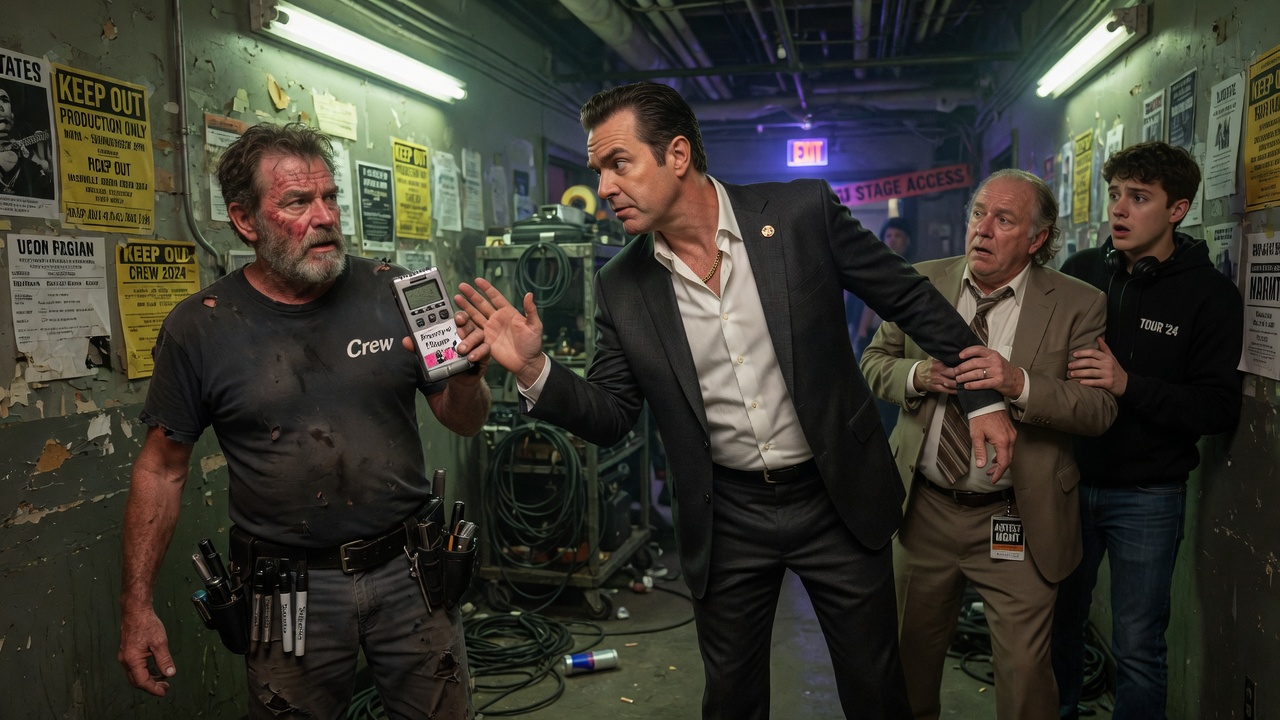
“You really think I’m just going to let you walk onto that stage after what you did?”
Jack’s voice was a low rasp, the kind of sound a man makes when he’s been screaming underwater for a year. He was standing in the VIP hallway of the Bridgestone Arena, his grease-stained work shirt a sharp contrast to the thousand-dollar blazers around him. For thirty years, Jack had been the man behind the curtain, the one who made the lights flash and the guitars howl. He was invisible. He was “just the help.”
But tonight, the help was holding a silver digital recorder, and the man in the charcoal suit—the most powerful producer in the city—was starting to sweat.
“You’re a ghost, Jack,” the producer sneered, his voice loud enough for the younger roadies to hear. “Nobody hears the help. Give me that toy before I have security throw you into the street where you belong.”
He reached out to snatch it, but Jack didn’t move. He didn’t blink. He just held the recorder tighter. He remembered Maya’s voice on that tape. He remembered her pleading for help while the music stayed loud enough to drown her out.
The producer thought he could humiliate Jack into silence one last time. He thought a roadie’s daughter didn’t matter as much as a multi-platinum record. He was wrong.
The show is about to start, and the audio is already rigged.
Chapter 1: The Weight of the Case
The Bridgestone Arena smelled like ozone, stale popcorn, and the expensive, antiseptic sweat of a hundred people who were paid to be important. Jack stood at the edge of the stage, his boots planted on the scarred plywood, watching the loaders haul in the subwoofers. At fifty-five, the vibrations of the arena floor didn’t feel like excitement anymore. They felt like a dull ache in his knees and a reminder that his expiration date was screaming at him from the mirror every morning.
He adjusted his utility belt, the leather supple and blackened by decades of Nashville grime. He was a “Master Lead,” which was just a fancy way of saying he was the first one in and the last one out, the man who knew exactly where the ghost in the wiring was hiding when the monitors started to hum. He was a shadow in a black t-shirt, part of the architecture of the tour. To the fans, he didn’t exist. To the band, he was a sentient tool.
“Jack, we got a phase issue on Stage Left,” Toby called out.
Toby was twenty-two, with the kind of eager, unblemished face that Jack used to have before the road chewed him up. The kid was talented, but he still thought being a roadie was about the music. It wasn’t. It was about the logistics of ego.
“Check the snake, Toby. It’s always the third return,” Jack said without looking. He was focused on a specific flight case—one that didn’t belong to the lighting rig or the backline. It was a battered hardshell guitar case, covered in stickers from festivals that didn’t exist anymore.
Maya’s guitar.
He shouldn’t have brought it. It was a breach of protocol, a sentimental anchor dragging behind a ship that was supposed to move at light speed. But every night, in the quiet hour before the doors opened and the VIPs started their peacocking, Jack opened that case. He tuned the strings. He wiped the neck. He made sure it was ready to play, even though the girl who played it had been gone for fourteen months.
“He’s here,” a voice muttered behind him.
Jack didn’t need to ask who. The air in the room shifted. It became thinner, more expensive.
Vance walked onto the stage like he owned the atoms it was built from. He was the producer of the year, the man who had turned a mediocre country-rock band into a global infection. He wore a charcoal blazer that cost more than Jack’s truck, and he moved with the practiced ease of someone who had never been told no.
Beside him was Gary, the band’s manager, a man who looked like he’d been carved out of a block of anxiety and cheap cigars. Gary was already pointing at his watch, whispering into Vance’s ear, but Vance wasn’t listening. He was looking at the stage. He was looking at Jack.
“Still here, Jack?” Vance called out, his voice echoing in the empty rafters. He climbed the steps with a smirk that didn’t reach his eyes. “I thought we talked about your retirement package after the London leg.”
Jack didn’t turn around. He kept his back to the man who had destroyed his world. He could feel the weight of the digital recorder in his pocket—the little silver rectangular proof that Maya hadn’t just “slipped away” in a hotel room.
“The tour isn’t over, Vance,” Jack said, his voice a low, gravelly rasp.
“For you, it should be,” Vance stepped closer, the scent of his cologne—something metallic and sharp—clashing with the smell of the road. He looked at the guitar case near Jack’s feet. “Is that the same junk? You’re still hauling that around? It’s a liability, Jack. It’s clutter.”
“It’s my daughter’s,” Jack said, finally turning.
Vance didn’t flinch. He didn’t offer a look of pity. Instead, he let out a short, dry chuckle. “We all lost something that night, Jack. We lost a backup singer. We lost momentum. But the rest of us moved on. You’re starting to look like a man who wants to be fired.”
Gary stepped forward, his eyes darting toward the crew members who were starting to slow down, watching the exchange. “Vance, let’s go. Soundcheck in ten.”
Vance ignored him. He leaned in, his face inches from Jack’s. “You’re a ghost, Jack. You’re the help. Don’t start thinking your grief makes you interesting. It just makes you slow.”
Vance patted Jack’s shoulder—a condescending, heavy gesture—and walked toward the soundboard. Jack stood perfectly still. His hand went into his pocket, fingering the “Record” button on the device. He hadn’t pressed it yet. He was waiting.
He looked over at Toby, who was staring at him with a mixture of fear and confusion. The kid had seen the producer of the world belittle the man he looked up to, and he didn’t know where to put that information.
Jack felt the residue of the interaction—the heat in his neck, the way his pulse thudded against his utility belt. It wasn’t just anger. It was the crushing realization that to people like Vance, Maya hadn’t been a person. She’d been a technical difficulty that had been successfully resolved.
He knelt down and closed the guitar case, the latches snapping shut like a final judgment.
Chapter 2: The Young Blood and the Old Secret
The tour bus was a rolling metal tube of recycled air and unspoken resentments. Jack sat in the front lounge, the glow of the microwave the only light in the cabin. The rest of the crew was at a bar three blocks from the arena, but Jack stayed. He always stayed.
Toby walked in, smelling like cheap beer and Nashville rain. He sat across from Jack, hesitating before he spoke.
“He shouldn’t have talked to you like that, Jack. Not after how long you’ve been with this band,” Toby said, his voice earnest and clumsy.
Jack looked at him. Toby reminded him so much of Maya—that same belief that if you worked hard enough and stayed close to the light, the shadows wouldn’t touch you. Maya had been a backup singer, a girl with a voice like honey and a heart that was too soft for the vultures in the VIP suites.
“In this business, Toby, there are people who make the noise and people who provide the electricity. If you aren’t the noise, you don’t exist,” Jack said. He pulled the silver recorder out and set it on the laminate table.
Toby frowned, leaning in. “What’s that?”
“Insurance,” Jack whispered.
He pressed play.
The sound was grainy at first—the muffled thrum of a tour bus engine, the clink of glass. Then, a girl’s voice. Maya. She sounded scared. She was talking to someone.
“Vance, please. I just want to go to my bunk. I’m not feeling right. Whatever you put in that drink…”
Then Vance’s voice, unmistakable and cold. “Don’t be dramatic, Maya. You’re a star. Stars don’t go to sleep early. They do what they’re told.”
The recording cut into static. Jack hit stop. His hands were shaking, a fine tremor that he couldn’t suppress no matter how hard he gripped the table.
Toby’s face had gone pale. “Jack… is that… from that night?”
“The soundboard records everything, Toby. Every mic, every ambient feed in the green room, every wireless pack that isn’t turned off. I was the one who set the levels. I was the one who forgot to wipe the drive that night because I was too busy identifying my daughter’s body.”
“Why haven’t you gone to the police?” Toby’s voice was a frantic whisper.
“The police saw a girl with a history of ‘party habits’ and a producer with a clean record and a team of lawyers. They saw an accidental overdose. They didn’t see the man who forced it down her throat because she said no to him.”
Jack looked out the window at the neon lights of Broadway. He thought about the year he’d spent in a fog of whiskey and silence, waiting for the right moment. He’d stayed on the tour. He’d worked for the man who killed his daughter. He’d fetched Vance’s water and fixed Vance’s monitors, all while the silver recorder sat in his toolbox like a live grenade.
“If you use that, the tour ends,” Toby said. “The band, the crew… everyone loses their jobs. Gary will bury you before you can even get to a news station.”
“I don’t care about the tour, Toby. I don’t care about the band,” Jack said, his voice flat. “I’m not looking for a settlement. I’m looking for a funeral.”
The door to the bus swung open, and Micky stepped in. Micky was the band’s lead guitarist, a man whose talent was currently being held together by hair dye and a very specific cocktail of prescriptions. He looked at the recorder, then at Jack.
“You guys look like you’re planning a heist,” Micky said, his voice raspy. He grabbed a water from the fridge and leaned against the counter. “Or a murder.”
“Just fixing a phase issue, Micky,” Jack said, sliding the recorder back into his pocket.
Micky stared at him for a long beat. He’d known Maya. He’d been the one who taught her how to play the G-chord on that old acoustic. He knew the truth, or at least the shape of it. But Micky liked his lifestyle. He liked the stadiums.
“Be careful, Jack,” Micky said softly. “The stage is a long way down if you fall off the edge.”
Micky disappeared into the back of the bus. The silence that followed was heavy, filled with the residue of a warning that felt more like a threat.
“You can’t do this alone,” Toby said.
“I’m the only one who has to,” Jack replied.
Chapter 3: The Humiliation
The following afternoon, the pressure in the arena reached a breaking point. It was the final dress rehearsal before the live global stream. The stage was a forest of light towers and LED screens. Vance was in a foul mood, pacing the “pit”—the area directly in front of the stage—while Gary trailed behind him with a tablet.
“The mix is muddy! Why is the low end swallowing the vocals?” Vance screamed, his voice amplified by the talkback mic.
Jack was on the catwalk, sixty feet above the floor, checking the rigging for the overhead arrays. He heard the scream and knew it was coming for him. Vance didn’t care about the frequency; he cared about the control.
“Jack! Get down here!”
Jack descended the ladder, his joints protesting every rung. By the time he reached the floor, the entire local crew had stopped working. They were standing in the shadows, watching. This was the ritual. Vance needed a sacrificial lamb to keep the hierarchy intact.
“The sub-bass is peaking, Jack. Did you even calibrate the arrays this morning?” Vance stood in the center of the pit, his arms crossed.
“I calibrated them at 08:00, Vance. The room is empty. It’ll flatten out when the bodies are in the seats,” Jack said, his voice steady.
“Don’t give me physics, you old hack. Give me results.” Vance stepped closer, his face reddening. He looked at the crew, then back at Jack. “Maybe you’re too old for this. Maybe your ears are as shot as your work ethic.”
Vance reached out and grabbed Jack’s utility belt, yanking it hard. Tools spilled onto the concrete—wrenches, testers, tape. And the silver recorder.
It skittered across the floor, stopping inches from Vance’s polished leather shoes.
The room went silent. Jack felt the air leave his lungs. He lunged for it, but Vance was faster. He kicked the recorder away, sending it sliding toward the edge of the stage.
“What’s this? You recording the rehearsals now? Planning on selling some bootlegs to pay for your retirement?” Vance laughed, a sharp, ugly sound.
“Give it back,” Jack said, his voice trembling with a different kind of energy now.
“I don’t think so.” Vance walked over and picked it up. He held it between two fingers like it was a piece of trash. “This is company property if it’s on this stage. Gary, take this and see what’s on it. If Jack’s been stealing intellectual property, I want him in cuffs before the first set.”
“Vance, let’s just get back to the mix,” Gary said, his voice tight. He saw the look in Jack’s eyes—the look of a man who had nothing left to lose.
“No. I’m tired of the attitude. I’m tired of the ‘grieving father’ routine.” Vance looked directly at Jack, his voice dropping to a cruel, public whisper. “You think because your daughter couldn’t handle the pressure, you get a free pass to be mediocre? You’re a failure, Jack. You failed her, and now you’re failing me. Pick up your tools. All of them. And then you’re going to apologize to this crew for wasting their time.”
Jack looked at his tools scattered on the floor. He looked at Toby, who was standing by the soundboard, his face twisted in shame. He looked at the silver recorder in Vance’s hand.
The humiliation was a physical weight, a heat that burned in his chest and blurred his vision. He was being stripped of his dignity in front of the only people who still respected him.
“I said apologize,” Vance barked.
Jack knelt down. He began picking up his tools, one by one. His hands were slow, deliberate. He didn’t look up. He didn’t speak. He felt the eyes of the loaders, the lighting techs, the security guards. He felt their pity, and it was worse than Vance’s contempt.
“I’m waiting,” Vance sneered.
Jack stood up, his utility belt heavy again. He looked Vance in the eye.
“I’m sorry,” Jack said, his voice echoing in the vast, empty space. “I’m sorry I waited this long.”
Vance frowned, confused by the tone. “Whatever. Gary, keep the recorder. Jack, get back to work. If I hear one more hum from those speakers, you’re done.”
Vance turned his back, a move of pure arrogance. He didn’t see Jack glance at Toby. He didn’t see the silent nod the younger roadie gave him.
Vance thought he had the recorder. He didn’t know that Jack had swapped the SD card three hours ago. He didn’t know that the real recording was already sitting in the digital buffer of the stadium’s main audio processor, waiting for a single command.
Chapter 4: The Rigging
The hours leading up to the show were a blur of frantic activity and calculated deception. The arena was a hive, thousands of people moving in a synchronized dance to prepare for the fifty thousand fans who would soon flood the gates.
Jack moved through the bowels of the stadium like a shadow. He had a job to do, and for the first time in fourteen months, he felt a strange, cold clarity. The residue of the humiliation in the pit hadn’t faded; it had hardened into a diamond-sharp purpose.
He met Hank, the head of security, in the tunnel behind the loading docks. Hank was a man built like a brick wall, with a soft spot for the roadies who had been on the circuit as long as he had.
“You look like hell, Jack,” Hank said, leaning against a stack of barricades.
“It’s a long tour, Hank,” Jack replied. He handed the big man a coffee. “I need a favor. I need the bypass code for the VIP elevator during the opening act.”
Hank narrowed his eyes. “That’s a high-security zone. Vance’s people are all over it. Why do you need to be up there? Your station is at the board.”
“I left a piece of Maya’s gear in the upper suite. I don’t want it getting tossed when the after-party starts,” Jack lied. The lie felt oily in his throat, but he didn’t stumble.
Hank sighed, looking around before scribbling a four-digit code on a scrap of paper. “Ten minutes, Jack. That’s all I can give you. If you get caught, I didn’t give you squat.”
“Thanks, Hank.”
Jack headed back to the soundboard. Toby was already there, his hands hovering over the faders. The kid looked like he was about to vibrate out of his skin.
“Is it ready?” Jack whispered.
“I’ve routed the ‘Maya’ file into the emergency override channel,” Toby said, his voice trembling. “If you hit the master kill-switch on the intercom, it triggers the file. It’ll play through every speaker in the house. The broadcast feed, too. They won’t be able to stop it from the booth because I’ve locked the admin permissions.”
“And the Jumbotron?”
“I’ve synced the audio to the house cameras. When the audio hits the three-minute mark—where he starts talking about the… the pills—the screen will lock onto whoever is in the VIP box. Face recognition is already set for Vance.”
Jack looked at the massive screens hanging from the rafters. They were currently displaying a loop of the band’s logos, bright and flickering. In two hours, they would show something else.
“You should leave, Toby,” Jack said. “Go to the loading dock. Tell them I sent you to check a cable. Get out of the building.”
“I’m staying,” Toby said, his jaw set. “You were right. If we aren’t the noise, we don’t exist. I want to exist tonight.”
Jack felt a pang of guilt. He was dragging this kid into the fire with him. But there was no time for second thoughts. The house lights dimmed, and the roar of fifty thousand people erupted like a physical blow. The floor began to shake—the real vibration this time, the one that meant the monster was awake.
The band took the stage in a blizzard of light and distorted chords. From his position at the board, Jack could see Vance in the VIP box, perched above the crowd like a king overlooking his domain. Vance had a drink in his hand, laughing with a group of investors. He looked untouchable.
Jack waited. He watched the setlist. Song three. Song four. Song five.
The band finished a high-energy anthem, and the lead singer stepped to the mic to address the crowd. “Nashville! How we feeling tonight?”
The roar was deafening.
“This next one… we want to dedicate this to someone we lost. A member of our family. Maya.”
The crowd cheered, a mindless, collective sound. In the VIP box, Vance raised his glass in a mock toast.
Jack felt the silver recorder’s absence in his pocket, but the weight of the truth was heavier. He reached out his hand. His finger hovered over the master intercom switch.
“Turn it up, sir,” Jack whispered to the empty air, looking up at Vance. “I don’t think they heard you the first time.”
He pressed the button.
The music didn’t just stop. It died. A screech of feedback tore through the arena, followed by a silence so sudden it felt like a vacuum. Fifty thousand people held their breath.
Then, a girl’s voice filled the stadium.
“Vance, please. I just want to go to my bunk…”
Jack looked up. On the Jumbotron, the image of the band vanished. In its place was a high-definition close-up of Vance’s face. The producer’s smile was gone. His glass was frozen halfway to his lips. He looked at the screen, then at the crowd, his eyes filling with a sudden, panicked realization.
The show had finally started.
Chapter 5: The Static and the Storm
The sound of Maya’s voice didn’t just fill the arena; it seemed to physically push against the walls, a spectral presence that turned the high-tech sanctuary of pop-rock into a cold, hollow chamber of secrets. It was the sound of a girl trying to stay polite while her world was dissolving into a chemical blur. It was the sound of a predator’s patience wearing thin.
On the massive LED screens, Vance’s face was a study in sudden, catastrophic deconstruction. He looked like a man who had forgotten how to breathe. The glass in his hand tilted, a expensive amber liquid splashing onto his charcoal blazer—the blazer he’d been so proud of, the one that cost more than Jack’s truck. For a split second, the fifty thousand people in the seats were silent, a collective intake of breath that sounded like a giant lung collapsing. Then, the realization hit.
It wasn’t a glitch. It wasn’t a tribute. It was an execution.
Jack stood at the soundboard, his hands resting on the cold steel of the console. He didn’t feel the triumph he’d expected. He felt a strange, heavy vacuum in his chest. He looked at Toby. The kid was frozen, his eyes wide, his hands hovering over the faders like he was afraid the board might catch fire.
“Toby,” Jack said, his voice barely audible over the recording of his daughter’s pleading. “Go. Now.”
“Jack, the security… they’re heading for the booth,” Toby stammered. He pointed toward the stairs. Three men in black polos—Vance’s personal security, not the arena staff—were pushing through the crowd with a violence that ignored the confusion around them.
“I know. Get to the dock. Don’t look back,” Jack said. He reached over and shoved Toby toward the side exit.
The recording reached the three-minute mark. The ambient mics on the tape had caught the sound of a struggle—the rhythmic thud of a body hitting a bunk, the clatter of a pill bottle on a laminate floor. And then Vance’s voice, clear as a bell, stripped of its professional sheen: “Nobody’s going to believe a backup singer with a history, Maya. Just take it and be quiet. You’re making this harder than it needs to be.”
The roar that erupted from the crowd wasn’t a cheer. It was a jagged, ugly snarl. It was the sound of fifty thousand people realizing they had been complicit in a lie. In the VIP box, Vance finally moved. He didn’t run; he lunged toward the railing, his face contorted in a scream that no one could hear over the sound of his own recorded crimes. He was pointing at the soundboard, pointing at Jack.
Jack didn’t wait for the security team to reach him. He knew the arena’s layout better than the architects. He slipped under the soundboard rail, dropping into the “cable trench”—a narrow, dark concrete channel that ran beneath the floor. It was hot, smelling of burning dust and high-voltage electricity. Above him, the floor was vibrating with the rhythm of a riot. He could hear the thud of feet, the shouting, the sound of chairs being overturned.
He crawled through the trench, his utility belt snagging on zip-ties and metal brackets. He didn’t care about the scrapes on his knees or the way the air was thinning. He had one more stop to make.
He emerged in the backstage corridor near the dressing rooms. The hallway was a scene of controlled panic. Publicists were screaming into phones, and the band’s opening act was huddled together in a corner, looking like they wanted to vanish. Jack ignored them. He headed for the VIP elevator.
He punched in the code Hank had given him. 4-9-1-2.
The doors slid open. The interior was mirrored, polished to a high shine. Jack caught a glimpse of himself—a grey-haired man in a stained shirt, his face smeared with grease and sweat. He looked like a ghost that had finally decided to haunt the living.
The elevator rose. When the doors opened on the luxury level, the sound of the arena was muffled, replaced by the soft, ambient hum of high-end air conditioning. But the peace was an illusion. At the end of the hall, near the entrance to the private suites, Gary was leaning against the wall, his head in his hands.
He looked up when he heard Jack’s boots on the carpet. His face was gray, the skin sagging around his jaw.
“You did it, Jack,” Gary whispered. “You burned the whole thing down.”
“I just turned the lights on, Gary. The fire was already there,” Jack said. He walked past the manager toward the suite door.
“He’s in there. He’s losing his mind,” Gary said, not moving to stop him. “The label called. The streaming service pulled the feed thirty seconds ago. It’s over. For everyone.”
“Good,” Jack said.
He pushed the door open. The suite was an expanse of white leather and glass, overlooking the chaos of the arena floor. From here, the crowd looked like a churning sea of angry fireflies, their phone lights flashing as they recorded the collapse of a kingdom.
Vance was standing by the window, his back to the door. He held a phone to his ear, his voice a frantic, high-pitched hiss.
“I don’t care what it costs! Get the servers down! Sue the arena! Sue the tech crew!” Vance spun around, seeing Jack. He dropped the phone. “You.”
The producer’s face was unrecognizable. The arrogance had been replaced by a raw, jagged desperation. He looked small in his charcoal blazer, a child caught in a lie that was too big to hide.
“Where is it, Jack? The original? Give it to me,” Vance stepped forward, his hands twitching.
“It’s everywhere, Vance,” Jack said, his voice steady, almost gentle. “It’s on the cloud. It’s in the hands of three different journalists. It’s being downloaded by ten thousand people right now. You can’t sue the internet.”
“You destroyed me! For what? A girl who couldn’t stay clean? A girl who was a footnote in this industry?” Vance’s voice cracked. He was trying to find his power again, trying to reach for the contempt that had worked for so long. “You think you’re a hero? You’re a roadie. You’re the help. You’ll be in a cell by midnight.”
“Maybe,” Jack said. He walked to the center of the room, looking at the silver recorder Vance had kicked across the floor earlier. It was sitting on a glass coffee table, right next to a bottle of two-hundred-dollar bourbon. Jack picked it up. “But I’ll be a roadie who knows exactly where the bodies are buried. You’re just a man whose name is about to become a punchline.”
Vance lunged. It wasn’t a professional move; it was a clumsy, frantic grab. He slammed into Jack, his fingers digging into Jack’s shoulders, trying to reach for the recorder. They crashed into the white leather sofa, then to the floor.
Jack felt the impact in his ribs, a sharp, white-hot flash of pain. But he didn’t let go. He’d spent thirty years hauling flight cases and rigging steel; he was stronger than a man who spent his life in swivel chairs. He shoved Vance back, his forearm pressing into the producer’s throat.
Vance gasped, his eyes bulging. He clawed at Jack’s arm, his expensive watch scratching Jack’s skin.
“Say her name,” Jack hissed, his face inches from Vance’s.
“Get… off…”
“Say it! Say her name!” Jack pressed harder.
The residue of a year’s worth of grief and silence was pouring out of him. He could feel Maya’s absence like a physical weight, a cold space where his heart used to be. He wanted to break this man. He wanted to feel the life leave him, the way Maya’s had left her in that sterile hotel room.
But then, he saw it. In the reflection of the glass window, he saw himself. He saw the man he was becoming—the same kind of monster he was trying to punish.
He let go.
Vance collapsed against the sofa, clutching his throat, sobbing in great, ragged gulps. He looked pathetic. He looked like the coward he had always been.
Jack stood up, his breath coming in short, painful bursts. He looked down at the producer, then at the arena below. The security teams were finally moving in to clear the floor, but the damage was irreversible. The music had stopped, and the truth had taken its place.
“She was my daughter, Vance,” Jack said, his voice thick. “And she was better than anything you ever produced.”
He turned and walked out of the suite. Gary was still in the hallway, staring at the floor. He didn’t look up as Jack passed. He didn’t say a word.
Jack headed for the stairs. He didn’t use the elevator this time. He wanted to feel every step. He wanted to feel the weight of the building, the weight of the city, the weight of the life he was leaving behind.
When he reached the loading dock, the cool night air of Nashville hit him like a benediction. The street was a chaos of sirens and flashing lights. Police cruisers were screaming toward the arena, and a crowd of fans was gathering at the barricades, shouting questions that no one could answer.
Jack walked toward his old truck, parked in the gravel lot across the street. He didn’t look back at the lights. He didn’t look back at the stage.
He climbed into the cab and sat in the silence for a long time. He pulled the digital recorder from his pocket and set it on the dashboard. It looked so small. So insignificant.
He reached into the back seat and pulled out Maya’s guitar case. He opened it, the velvet interior smelling of cedar and old strings. He ran his hand over the wood of the acoustic, feeling the grain, the small scratches near the bridge where she used to play too hard.
He wasn’t a hero. He wasn’t a ghost. He was just a father. And for the first time in fourteen months, he felt like he could finally go home.
Chapter 6: Residue
The aftermath of the “Dead Air” show didn’t happen all at once. It was a slow, grinding collapse that played out across the news cycles for months. The band broke up before they even reached the next city. The lead singer went into “rehab” to escape the fallout, and the management firm dissolved under a mountain of lawsuits.
Vance was arrested forty-eight hours after the show. The recording Jack had played wasn’t enough for a murder charge, but it was enough to open the floodgates. Other women came forward. Other roadies started talking about what they’d seen in the VIP suites and the back of the buses. The “accidental overdose” was reclassified, and by the time the winter hit Nashville, the most powerful producer in the city was sitting in a county jail cell, awaiting a trial that he would never win.
Jack didn’t go to the trial. He didn’t give interviews to the tabloids that offered him six figures to tell the “Inside Story.” He didn’t even stay in Nashville.
He bought a small, drafty house three hours east, in the foothills of the Smokies. It was a place where the air smelled like pine and wet stone, and the only noise was the sound of the creek running through the backyard. He spent his days fixing things—broken fences, leaky roofs, old engines. He was still the help, but now he was helping himself.
Six months after the arena went dark, Jack was sitting on his back porch, watching the mist roll off the mountains. A car pulled into the gravel drive—a beat-up sedan that looked like it had seen too many highway miles.
Toby climbed out. He looked older. The eagerness in his face had been replaced by a quiet, steady resolve. He was wearing a black hoodie and work boots, the uniform of the road.
“Jack,” Toby said, walking up the porch steps.
“Toby,” Jack nodded. He poured a second glass of iced tea and set it on the wooden table. “What are you doing this far out?”
“I’m on the road again. Working a folk tour out of Asheville. Small venues, mostly. Van and a trailer stuff.” Toby sat down, looking out at the trees. “It’s different. No blazers. No VIP boxes.”
“Is it better?” Jack asked.
Toby looked at his hands. “It’s honest. Nobody’s hiding anything behind the arrays. We just play the music and go to the next town.”
They sat in silence for a while, the kind of comfortable silence that only exists between people who have survived the same wreck.
“I heard about Vance,” Toby said eventually. “The sentencing is next week. They’re saying fifteen years, minimum.”
“It’s a start,” Jack said. He didn’t feel the surge of satisfaction he thought he would. The anger was still there, but it was cold now, like an old ember. It didn’t burn anymore; it just sat there, a permanent part of his geography.
“People still talk about that night, you know,” Toby said. “In the crews. They call it ‘The Jack Feed.’ Every time a producer starts acting like a god, someone mentions your name. It makes them nervous.”
“I didn’t do it to start a movement, Toby. I did it because I couldn’t breathe.”
“I know,” Toby said. He reached into his pocket and pulled out a small, padded envelope. “I found this in the locker room at the Bridgestone. It was behind one of the lockers. I think it fell out of your belt when you were… when you were in the pit.”
He handed the envelope to Jack. Jack opened it.
Inside was a silver pick. Maya’s favorite. It had a small hole drilled in the top so she could wear it as a necklace, but she’d lost the chain years ago. It was scratched and worn, the logo of some long-defunct music shop fading from the surface.
Jack held the pick in his palm. It was light, almost weightless, but it felt like it weighed a thousand pounds. He remembered the night she’d bought it. She’d been fifteen, convinced she was going to be the next Joni Mitchell. He’d told her to keep practicing her scales. He’d told her the industry was hard.
He hadn’t told her it was lethal.
“Thanks, Toby,” Jack said, his voice thick.
“I should get going,” Toby stood up. “We’ve got a load-in in Knoxville at four. I just wanted to… I wanted to make sure you were okay.”
“I’m getting there,” Jack said.
He watched Toby drive away, the sound of the sedan’s engine fading into the hum of the forest.
Jack went inside the house. He walked into the small room he’d set up as a workshop. In the corner, Maya’s guitar stood on a wooden stand. He’d finally stopped keeping it in the case. It deserved the light.
He picked up the guitar and sat in the old rocking chair by the window. He took the silver pick and held it between his thumb and forefinger.
He didn’t play a song. He didn’t know if he ever would again. He just tuned the strings. One by one. E. A. D. G. B. E. The notes were clear and bright, echoing in the quiet room. They didn’t have any distortion. They didn’t have any phase issues. They didn’t have any secrets.
He thought about the residue of his life. The thirty years of black t-shirts and flight cases. The night the music died. The man in the charcoal blazer who was rotting in a cell.
It wasn’t a clean ending. There was no applause, no encore. There was just the sound of the strings and the weight of the pick in his hand.
Jack closed his eyes. He could almost hear her. Not the voice on the recording—the one that was scared and small—but the real Maya. The girl who used to hum while she practiced. The girl who thought the world was a song worth singing.
“I heard you, Maya,” he whispered to the empty room. “Everyone heard you.”
He set the guitar down and walked to the door. He turned off the lights, leaving the room in the soft, blue glow of the evening. He stepped out onto the porch and looked up at the stars, the same stars that hung over the arenas and the tour buses and the hotel rooms.
The air was cold, and his knees still ached, and his daughter was still gone. But for the first time in a very long time, Jack didn’t feel like a ghost. He felt like a man who had finally finished his shift.
He sat down in his chair and watched the dark mountains, listening to the silence. It wasn’t deafening. It was just quiet. And for Jack, that was enough.