“Is this the part where we all clap for the man who erased the truth?”
Silas stood at the edge of the ballroom, his old overcoat smelling of Detroit rain and cheap coffee. He wasn’t supposed to be here. He was the man they had spent six years trying to forget—the detective who wouldn’t stop asking why his wife never came home from that warehouse raid.
Chief Higgins was on the podium, golden watch gleaming under the chandeliers, a hero’s smile plastered on a face that had ordered a dozen men into the ground. The room was full of the city’s elite, all of them eager to toast to a legacy built on a foundation of hidden files and silenced witnesses.
When Silas walked toward the stage, the music didn’t stop, but the air in the room vanished.
“Silas, you’re drunk,” the Chief sneered into the microphone, his voice echoing with practiced contempt. “Someone get this man out of here before he embarrasses himself further.”
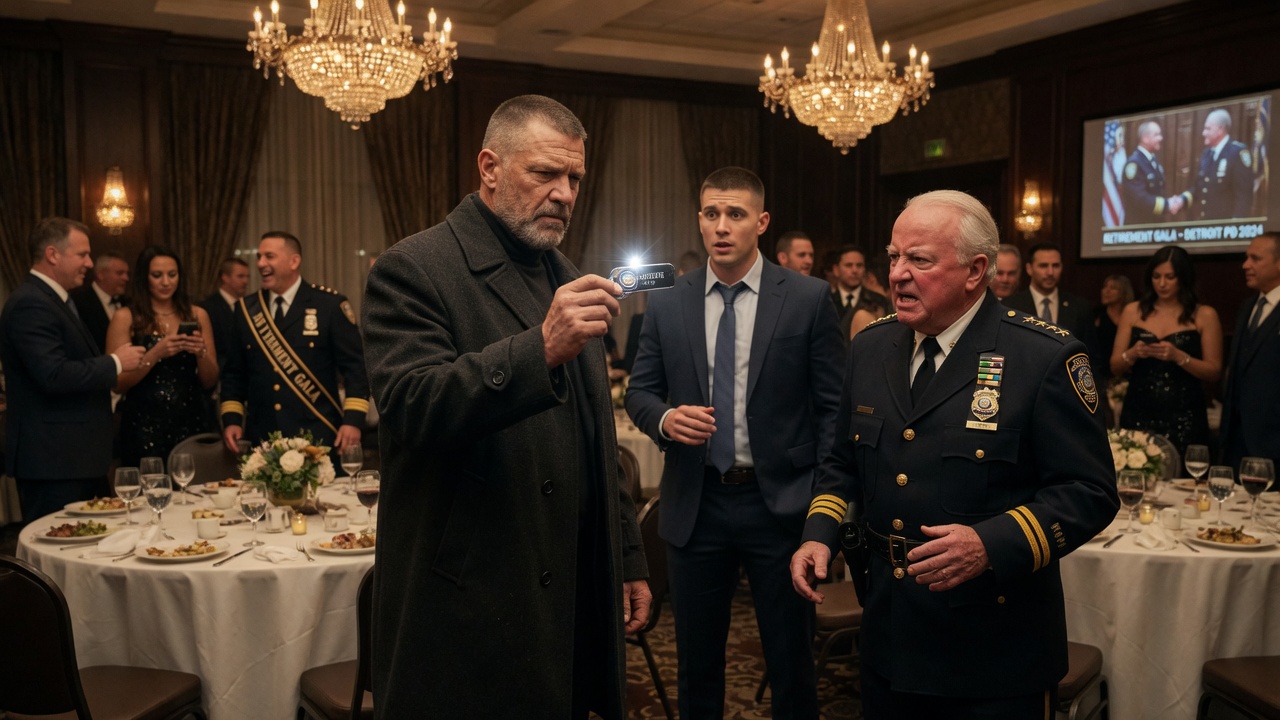
But Silas didn’t stumble. He reached into his pocket and pulled out the one thing the Chief thought had been destroyed years ago. A silver badge, modified into a drive. The Ghost File.
“I brought the guest list for your next party, Chief,” Silas said, his voice cutting through the murmurs of the crowd. “And it’s not happening at the country club. It’s happening in a cell.”
The look on the Chief’s face told the whole room everything they needed to know. The hero was gone. The monster was exposed. And Silas was just getting started.
Chapter 1
The rain in Detroit doesn’t wash things away; it just moves the grit into the cracks. Silas sat in his office on Cass Avenue, watching the neon sign of the liquor store across the street flicker in a rhythmic, dying buzz. The office smelled of old paper, cold radiators, and the faint, persistent scent of his own sweat. He was fifty, but in this light, with the grey stubble catching the blue neon, he looked like a man who had already been buried once and had just forgotten to stay down.
He reached into the top drawer of his desk and pulled out a Smith & Wesson M&P 9mm. It was heavy, a solid piece of American steel that felt colder than the room. It wasn’t his service weapon. It was Sarah’s. He ran his thumb over the grip, feeling the slight wear where her palm used to rest. Six years ago, she had carried this into a warehouse in Southwest, and six years ago, she had been carried out in a bag.
Friendly fire, they called it. A tragic mistake in a high-pressure environment. A chaotic scene where lines of sight were blurred by smoke and panic. That was the official story, the one signed by Chief Higgins and notarized by the city. It was a lie that had tasted like copper in Silas’s mouth every day since.
A sharp rap on the frosted glass door made him flinch. He didn’t put the gun away. He just draped a manila folder over it.
“Come in,” Silas said.
The door opened, admitting a gust of damp air and Detective Miller. Miller was young, the kind of young that made Silas feel like a relic. He had a clean-cut fade, a suit that cost more than Silas’s car, and eyes that hadn’t seen enough of the city yet to be tired.
“You shouldn’t be here, Miller,” Silas said, not looking up. “Your Sergeant sees you talking to a ghost, you’ll be walking a beat in the Fourth Precinct by Monday.”
“Sergeant’s at the gala prep,” Miller said, closing the door softly. He stayed by the entrance, his hands buried in his pockets. “The whole department is. Higgins is retiring tomorrow night. It’s the biggest event of the year.”
“I’m aware. I’ve been invited. In a manner of speaking.”
Miller stepped further into the room, his eyes scanning the stacks of boxes and the dusty shelves. “I found something, Silas. In the cold case archives. I was looking through the old digital logs from the warehouse raid. There’s a gap. Six minutes of radio silence that wasn’t in the final report.”
Silas felt a familiar, sharp pang in his chest. He stopped rubbing the gun grip. “I know about the gap, kid. I’ve known about it since the funeral.”
“But I found where it went,” Miller whispered. He looked toward the door as if the walls had ears. “Higgins didn’t delete it. He moved it to a private server. A ‘Ghost File’ for internal affairs that never went to IA. It’s got everything. Every order, every cover-up. It’s not just your wife, Silas. It’s a dozen others.”
Silas finally looked up. His eyes were bloodshot, the weight of a thousand sleepless nights behind them. “Why are you telling me this? You want to be a hero? You want to be the guy who takes down the king?”
Miller shook his head. “I want to be a cop. The kind you were supposed to be. But I can’t touch this. If I try to pull that file, the system flags it. Higgins gets a notification. He’ll bury me before I can even hit print.”
“He already buried me,” Silas said, his voice flat. “What makes you think I can do any better?”
“Because you don’t have anything left to lose,” Miller said. It was a cruel thing to say, but it was true. “I put the access codes in this.” He set a small, folded piece of paper on the edge of the desk. “The server is hosted off-site, at the old substation on Livernois. If you can get in there, you can pull it.”
Silas looked at the paper. It felt like a trap. Or a miracle. In this city, they usually looked the same.
“If I do this,” Silas said, “there’s no going back for either of us. Higgins has a unit—the Shadow Unit. They aren’t cops. They’re hitters with badges. They’ll come for you, Miller.”
“They’re already coming for the city,” Miller said. He turned to leave, then paused. “I’m sorry about Sarah. Everyone says she was the best of us.”
“She was,” Silas said.
Miller left, and the office was silent again, save for the hum of the neon light. Silas picked up the paper and stared at the numbers. He felt the weight of the gun under the folder. For six years, he had been a man waiting for a reason to pull the trigger. Now, he had a reason to do something much more dangerous. He had a reason to tell the truth.
He stood up, his knees popping, and reached for his overcoat. He didn’t put his own gun in his holster. He took Sarah’s. He checked the magazine, the brass of the rounds gleaming in the dim light. He had been a ghost for a long time. It was time to see if he could still haunt the man who had made him one.
He walked out into the rain, the Cass Avenue sidewalk slick and black. He didn’t look back at his office. There was nothing there but memories and dust. He had a substation to visit, a file to steal, and a retirement party to crash.
Chapter 2
The Wayne County Medical Examiner’s office always smelled like a mix of industrial bleach and something sweet that you didn’t want to think about for too long. Silas walked through the double doors, his damp coat heavy on his shoulders. The security guard, an old man named Pops who had seen Silas in a suit and Silas in a stupor, just nodded him through.
Down in the basement, Arthur was hunched over a stainless steel table, his spectacles perched on the tip of his nose. Arthur was sixty-five, cynical, and had spent forty years looking at what was left of people after the city was done with them.
“You’re late, Silas,” Arthur said, not looking up from the torso he was examining. “And you smell like a bar that hasn’t been mopped since the 80s.”
“It’s the rain, Artie. Don’t get your hopes up.” Silas leaned against a tiled wall, avoiding the sight of the table. “I need the ballistics report from the warehouse. Not the one for the public. The one you wrote before the Chief’s office ‘assisted’ with the editing.”
Arthur stopped what he was doing and looked at Silas. He sighed, a long, weary sound that echoed in the sterile room. He pulled off his gloves and walked over to a battered filing cabinet in the corner.
“That’s ancient history. Why are you digging this up now? The man is getting a parade tomorrow.”
“Because I think I found the map to where he buried the bodies,” Silas said. “A kid named Miller gave me a lead. A Ghost File.”
Arthur froze, his hand on the drawer handle. “Miller? That kid has a death wish. And so do you if you’re following him.” He pulled out a thin, yellowing folder and tossed it onto a desk. “The bullet that killed Sarah wasn’t a standard issue 9mm. It was a specialized subsonic round. The kind only issued to the tactical units that answer directly to the commissioner’s office. Higgins’s boys.”
Silas felt the air leave his lungs. He had suspected it, but hearing it out loud, in this room of cold truths, was different. It was a physical blow.
“Why didn’t you say anything then, Artie?” Silas’s voice was low, dangerous.
“Because I have a daughter in college and a pension I worked forty years for,” Arthur snapped. “And because the man who brought me the ‘corrected’ report was wearing a Shadow Unit patch and holding a photo of my house. I’m a doctor, Silas, not a martyr.”
Arthur walked closer, his voice dropping to a whisper. “Higgins didn’t just order the hit because she was getting close to the narcotics ring. He did it because she found out he was selling the evidence back to the cartel. He wasn’t just a corrupt cop. He was the biggest dealer in Detroit.”
Silas gripped the edge of the desk so hard his knuckles turned white. The betrayal was a thick, oily thing. It wasn’t just that his wife was gone; it was that her life had been traded for a line on a ledger.
“I need a copy of that original report,” Silas said.
“I can’t give it to you,” Arthur said. “But I can leave the room for five minutes to get a cup of coffee. And if someone happened to use the copier while I was gone, well, I’m getting old. My eyes aren’t what they used to be.”
Arthur walked out without another word. Silas moved to the copier, his hands shaking as he laid out the pages. The report was detailed, clinical, and devastating. It showed the trajectory of the shot, the grain of the bullet, the unmistakable proof that it wasn’t a mistake. It was an execution.
As the machine whirred, Silas felt the pressure building behind his eyes. He thought of all the nights he had spent drinking himself into a stupor, blaming himself for not being there, for not being faster, for not being better. All that time, the man responsible had been sitting in an office with a view of the river, collecting medals.
He tucked the copies into his coat and walked out of the morgue just as Arthur returned. They didn’t exchange a glance.
Back in his car, a beat-up Ford Crown Vic that felt like a rolling coffin, Silas sat in the dark. He watched the wipers struggle against the downpour. He had the ballistics. He had the lead on the Ghost File. He was building a cage, and the Chief was about to walk right into it.
But he knew the Shadow Unit was out there. They weren’t just a rumor. They were the men who did the things that shouldn’t be done, the ones who made sure people like Silas disappeared. He checked his mirrors. Every pair of headlights behind him felt like a threat. Every shadow in an alleyway felt like a man with a gun.
He drove toward Livernois, toward the old substation. The building was a relic of a different era, a brick fortress that looked abandoned but hummed with the hidden life of the city’s digital secrets.
He didn’t know if he would make it out of the night. He didn’t particularly care. He just wanted to make sure that when Higgins stood on that podium tomorrow, he wasn’t looking at a crowd of admirers. He wanted him to be looking at the end of his world.
Chapter 3
The informant’s name was Twitch, a man who existed in the narrow spaces between the law and the street. Silas met him in the back of a shuttered bowling alley on the West Side, a place where the air smelled of stale beer and rotting wood. Twitch was pacing, his eyes darting toward every shadow.
“You’re gonna get us both killed, Silas,” Twitch hissed. “The Shadow Unit? You don’t talk about them. You don’t even think about them. They’re the boogeymen with badges.”
“I just need to know how they’re moving, Twitch. Who’s running point for Higgins now that he’s taking his bow?”
Twitch stopped pacing and leaned in close. “A guy named Vance. Former Ranger. He doesn’t arrest people. He deletes them. He’s been cleaning house all week, making sure there are no loose ends before the party. He’s already looking for Miller.”
Silas’s heart hammered against his ribs. “Miller? Is he safe?”
“For now. But Vance is smart. He’s tracing the access logs. If Miller touched that file, he’s a dead man walking. And you? You’re the one they’re gonna use to send a message.”
Twitch handed Silas a small burner phone. “I’m done, Silas. This is the last time. There’s a frequency on there. It’s their tactical channel. They’re using it to coordinate the security for the gala. If you listen close, you’ll hear where they are.”
“Thanks, Twitch.”
“Don’t thank me. Just don’t let them find me when they catch you.”
Silas walked out of the bowling alley and into the cold night. He sat in his car and turned on the burner phone. The static was thick, but then, a voice broke through. Cold, professional, and terrifyingly calm.
“Ghost One to Base. Target is on the move. He’s heading toward Livernois. We have eyes on the Ford.”
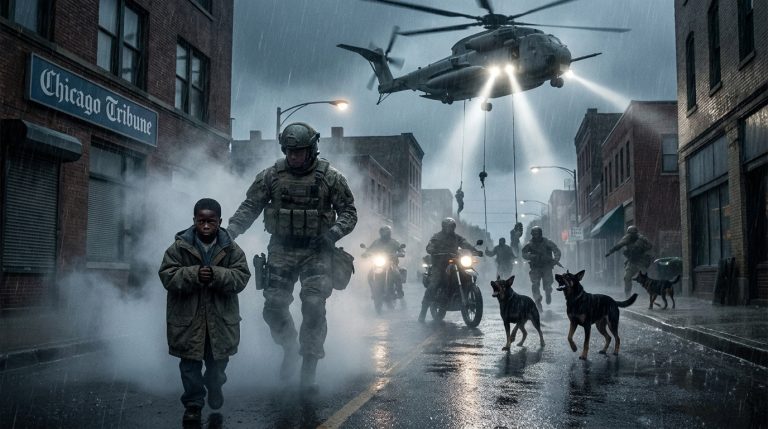
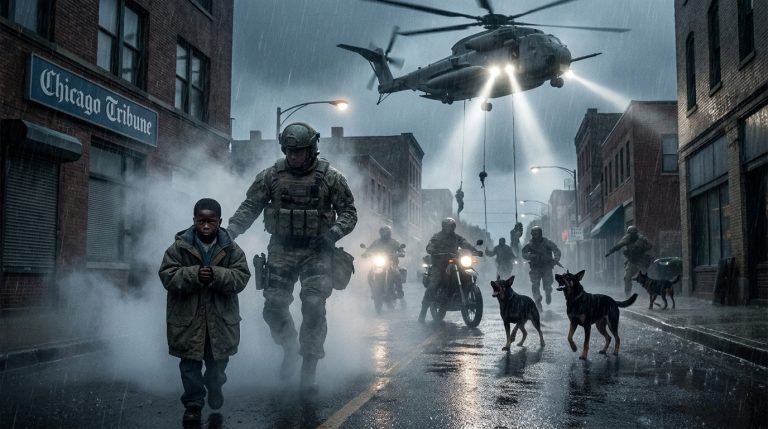
Silas froze. They were already on him. He looked in his rearview mirror. A black SUV was two blocks back, its lights off. It was a predator, closing the distance.
He didn’t panic. He had been a cop too long for that. He shifted the Ford into gear and accelerated, not fast enough to show he knew they were there, but enough to create space. He turned into a maze of side streets, the narrow alleys of the old industrial district.
The SUV followed, weaving through the tight corners with a practiced ease. Silas knew he couldn’t outrun them in this car. He had to outthink them. He knew these streets better than any tactical team. He had chased a hundred suspects through these same shadows.
He cut through a vacant lot, the Ford’s suspension groaning over the rubble. He turned sharply behind an old warehouse and doused his lights. He waited, his hand on Sarah’s gun, his breath shallow in the dark cabin.
The SUV roared past the warehouse, its tires kicking up gravel. Silas waited ten seconds, then backed out and headed in the opposite direction. He had a small window, but it wouldn’t last. Vance would realize he’d been played.
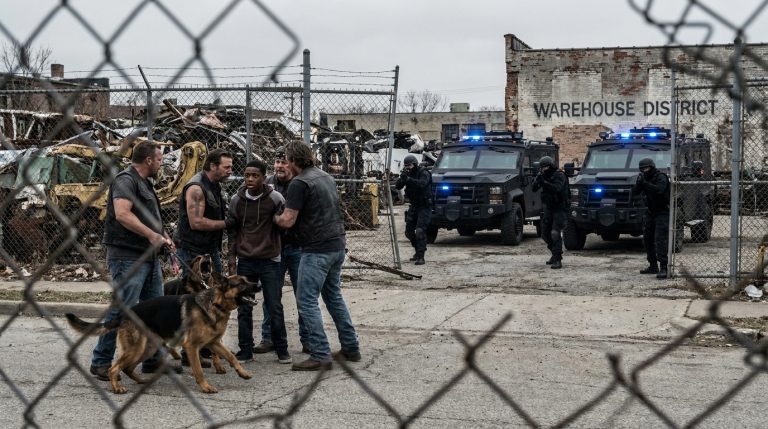
He reached the Livernois substation twenty minutes later. The building was dark, surrounded by a chain-link fence topped with razor wire. He used a pair of bolt cutters to make a hole in the back fence and slipped through.
The air inside the substation was cold and smelled of ozone. Row after row of server racks hummed in the darkness, their blue and green lights flickering like mechanical eyes. Silas moved to the terminal Miller had described. His fingers felt heavy as he typed in the access codes.
The screen flickered to life. Access Granted.
He felt a surge of adrenaline. He navigated the menus, his eyes scanning the directories until he saw it. GHOST_FILE_09.
He plugged in the silver badge USB drive. The progress bar began to crawl. 5%… 12%… 20%…
Every second felt like an hour. He looked toward the door, expecting Vance to burst through at any moment. He thought of Sarah. He thought of the night she left for the raid, how she had kissed him on the cheek and told him they’d go to that Italian place on Friday. She never made it to Friday.
50%… 65%… 80%…
The file was massive. It wasn’t just text. There were audio recordings, photos, video clips from body cams that had supposedly been malfunctioning. It was a digital graveyard.
99%… Download Complete.
Silas snatched the drive and tucked it into his pocket. He was about to leave when a shadow moved in the corner of the room.
“It’s a long walk to the podium from here, Silas.”
Silas spun around, his gun leveled. A man stood in the doorway, framed by the moonlight. He was tall, dressed in tactical black, his face a mask of professional indifference. Vance.
“You’re not going to make it to that party,” Vance said, his voice as cold as the server room. “The Chief wants his retirement to be peaceful.”
“He’s had six years of peace,” Silas said, his finger tightening on the trigger. “It’s someone else’s turn now.”
Vance didn’t move. He didn’t even draw his weapon. He just smiled. “You think you’re the only one who knows how to use a ghost? Look behind you.”
Silas didn’t fall for it. He fired. The shot echoed in the small space, the muzzle flash blinding. Vance dove to the side, and the room erupted in chaos. Silas scrambled through a back exit, the sound of boots on concrete behind him.
He hit the rain-slicked street and didn’t stop running until he reached the Ford. He roared away, the black SUV already turning the corner. He had the file. He had the proof. But he was running out of city to hide in.
Chapter 4
The Detroit Athletic Club was a fortress of limestone and tradition, its windows glowing with the warm, expensive light of the gala. Outside, the sidewalk was lined with black town cars and police cruisers with their lights off. The air was thick with the scent of perfume and power.
Silas sat in his car a block away, watching the entrance. He had changed in a gas station bathroom. He wore a clean black turtleneck and his charcoal overcoat, his hair combed back, his face scrubbed of the last few days of grime. He looked like a man who belonged, or at least, a man who wouldn’t be stopped at the door.
He looked at the silver badge USB drive in his hand. It was the only thing that mattered now.
He checked the burner phone. Miller had sent a text: They’re looking for you. Vance is inside. Don’t do this, Silas. Just give me the drive and go.
Silas deleted the message. He wasn’t going anywhere.
He walked toward the entrance, his heart a steady, heavy drum in his chest. He passed the security detail, flashing his old detective’s shield. They didn’t even look at the expiration date. To them, he was just another veteran coming to pay his respects to the king.
The ballroom was a sea of navy blue and silk. Silas moved through the crowd, a shark in a school of goldfish. He saw familiar faces—men he had worked with, men he had trusted, men who had looked the other way when he was being forced out. They avoided his eyes, their conversations faltering as he passed.
He saw the podium at the far end of the room. Chief Higgins was standing there, surrounded by city council members and the mayor. He looked triumphant. He was laughing, a glass of champagne in his hand, the hero of a story he had written in blood.
Silas saw Vance standing near the stage, his eyes scanning the room. Their eyes met for a split second, and Silas saw the man reach for his earpiece. The clock was ticking.
Silas didn’t wait. He pushed through the crowd, his overcoat flapping. He reached the edge of the stage just as the Mayor was finishing his introduction.
“And now, a man who has given thirty years to this city, a man of integrity, a man of courage… Chief Thomas Higgins!”
The room erupted in applause. Higgins stepped to the microphone, his chest puffed out, his smile wide.
“Thank you,” Higgins said, his voice booming through the speakers. “Thank you all. It’s been the honor of my life to lead this department…”
Silas stepped onto the stage.
The applause died down, replaced by a confused murmur. Higgins froze, his smile faltering. He looked at Silas, and for the first time in six years, Silas saw a flicker of genuine fear in the man’s eyes.
“Silas,” Higgins said, his voice tight. “This is a private event. You’re not welcome here.”
He signaled to the security detail at the edge of the stage. Two officers started to move forward, but Miller stepped out from the crowd and blocked them. He didn’t say a word, he just stood his ground.
“Get this drunk out of my sight,” Higgins sneered into the microphone, his voice echoing with practiced contempt. “Someone get this man out of here before he embarrasses himself further.”
Silas reached the podium. He didn’t look at the crowd. He looked only at Higgins.
“I’m not the one who’s leaving, Chief,” Silas said. His voice was low, but the microphone caught it, carrying it to every corner of the silent room.
He reached into his pocket and pulled out the silver USB badge. He thrust it into the light, right under Higgins’s nose.
“I brought the guest list for your next party, Chief,” Silas said. “And it’s not happening at the country club. It’s called a cell block.”
The room was so quiet you could hear the hum of the air conditioning. Higgins looked at the drive, his face draining of color. He reached out to grab it, but Silas pulled it back.
“Look at the badge, Thomas,” Silas said, using the man’s first name like a weapon. “Look at it in front of your officers. In front of the Mayor. Tell them what happened in that warehouse six years ago. Tell them why Sarah never came home.”
Higgins stumbled back half a step, his hand trembling as it brushed against the podium. He looked at Vance, but Vance was being held back by a group of younger detectives who had gathered around Miller. The room was turning. The air of authority that had protected Higgins for decades was evaporating.
“You have nothing,” Higgins hissed, but his voice lacked conviction. “It’s a prop. A desperate stunt from a broken man.”
“Then let’s see what’s on it,” Silas said. He turned to the tech booth at the back of the room. “Plug it in. Let the city see the Ghost File.”
The tech hesitated, looking at the Mayor, then at the silent, watching officers. He reached for the drive as Silas tossed it to him.
Higgins lunged for the tech, but Silas stepped in his way, his hand on the man’s chest. It wasn’t a shove; it was a wall.
“It’s over, Chief,” Silas said.
The first image appeared on the giant screens behind the podium. A digital document, stamped CONFIDENTIAL. Then, a voice filled the room. Higgins’s voice, clear and unmistakable, giving the order to the Shadow Unit.
“Take her out. Make it look like a crossfire. We can’t have her talking to the feds.”
The room exploded into a cacophony of shouts and gasps. Higgins looked at the screen, then at the crowd, his face a mask of ruined pride. He looked at Silas, and for a moment, the two men were alone in the center of the storm.
“You’re dead,” Higgins whispered.
“I’ve been dead for six years,” Silas said. “I’m just here to make sure you join me.”
The doors to the ballroom burst open, and a team of federal agents in tactical vests swarmed the room. They didn’t go for Silas. They went for the podium.
Silas stepped back, his job done. He watched as they tackled Higgins to the floor, the golden watch skittering across the stage. He watched as they cuffed Vance and the rest of the Shadow Unit.
He felt a hand on his shoulder. It was Miller. The young man looked shaken but resolute.
“We got him, Silas,” Miller said.
“No,” Silas said, looking at the screen where Sarah’s face was now displayed, her service photo from the file. “She got him. I just delivered the message.”
He walked off the stage, through the chaos of the arrests and the flashbulbs of the press. He walked out of the ballroom, down the limestone steps, and into the Detroit rain. It was still cold, still gritty, but for the first time in six years, Silas felt like he could breathe.
He reached into his pocket and felt the weight of Sarah’s gun. He wouldn’t need it tonight. He walked toward the river, the neon lights of the city reflecting in the puddles, a ghost finally finding his way home.
Chapter 5
The adrenaline didn’t leave Silas’s system all at once; it drained away slowly, leaving behind a cold, hollow ache that felt like lead in his joints. He sat in his Crown Vic three blocks away from the Detroit Athletic Club, the engine idling with a rough, rhythmic thrum. The blue and red lights of the police response reflected off the wet pavement in his side mirror, a frantic neon pulse that seemed to mock the stillness inside the car. He had done it. He had walked into the lion’s den and torn the throat out of the king. But as he stared through the windshield at the rain-streaked city, he didn’t feel like a victor. He felt like a man who had finally set a fire he couldn’t put out.
His hands were shaking. Not from fear, but from the sudden absence of the singular purpose that had driven him for six years. He looked down at the passenger seat. Sarah’s gun lay there, its black polymer frame catching the dim light of the streetlamps. He had carried her ghost for so long that he wasn’t sure who he was without the weight of her unfinished business.
The burner phone buzzed against his thigh. He pulled it out, expecting a message from Miller or perhaps a final threat from a Shadow Unit remnant. It was an unsaved number. A series of coordinates and a single word: Lafayette.
Silas knew the spot. An old Coney Island diner that had survived the city’s worst decades by being a neutral ground for cops, criminals, and the ghosts who lived between them. He shifted the car into gear. The city was in a state of tectonic shift; the arrest of a Chief of Police was an earthquake that would trigger a dozen tsunamis. He needed to know which way the water was moving.
He pulled into the narrow lot behind Lafayette. The diner was nearly empty, the smell of grilled onions and heavy grease hanging thick in the air. In the back booth, tucked behind a pillar that shielded him from the window, sat Detective Miller. The kid looked like he’d aged a decade in the two hours since the gala. His tie was loosened, his white shirt stained with coffee, and his eyes were darting toward the door every time the bell chimed.
Silas slid into the booth across from him. He didn’t say hello. He just waited.
“They’re not taking him to the county jail, Silas,” Miller whispered, leaning over his cooling coffee. “The feds moved him to a holding facility in Dearborn. High security. No visitors, no phone calls.”
“That’s standard for a high-profile arrest, Miller. They don’t want him getting reached by his own people.”
“No, you don’t understand,” Miller said, his voice trembling with a frantic energy. “I was at the precinct when the order came down. It didn’t come from the DOJ. It came from a private security firm contracted by the city’s legal counsel. They’re calling it ‘protective custody,’ but it looks a lot more like a disappearance. Half the evidence we pulled from that server? It’s being sequestered. They’re claiming national security interests because of the cartel connections.”
Silas felt the familiar, oily sensation of a cover-up beginning to slide into place. The system was an organism; when it detected a wound, it didn’t just bleed. It grew scar tissue. Hard, impenetrable layers of bureaucracy designed to protect the body at all costs.
“Higgins knows too much,” Silas said, his voice like gravel. “He wasn’t just a dirty cop. He was the bridge. If he talks, he doesn’t just take down the Shadow Unit. He takes down the people who signed the checks for the city’s redevelopment. He takes down the lobbyists and the precinct captains who turned a blind eye for a piece of the narcotics pie.”
“They’re going to bury it, aren’t they?” Miller’s voice was small, the sound of a young man watching his heroes—even the ones he’d just arrested—turn into shadows. “Everything we did. Sarah. The warehouse. It’s all going to vanish into a sealed file that nobody will ever see.”
“Not if we have the original,” Silas said.
Miller looked up, his brow furrowing. “What do you mean? You gave the drive to the tech. The feds took it.”
Silas reached into his overcoat and pulled out a second silver badge. It was identical to the first. He laid it on the Formica table between them. “I spent twenty years as a detective, kid. You never bring the only copy of a death warrant to the execution. The drive I threw to the tech was a decoy. It had enough to trigger the arrest—the audio of Sarah’s hit, the basic ledgers—but the deep stuff? The bank account numbers for the ‘Redevelopment Fund,’ the names of the judges on the payroll, the real Ghost File? It’s right here.”
Miller stared at the badge as if it were a live grenade. “If they find out you have that…”
“They already know,” Silas said. He looked toward the front of the diner. A black sedan had pulled into the lot, idling near the entrance. Two men in suits sat inside, their faces obscured by the rain on the glass. “The feds aren’t the only ones looking for a plea deal. The cartel lost their best inside man tonight. They don’t want justice. They want their money back, and they want the names of anyone who might flip to save their own skin.”
Silas leaned in, his voice dropping to a low, dangerous register. “This is the part where you decide who you are, Miller. You can walk out the back door, go back to the precinct, and play the part of the brave young detective who helped take down a corrupt boss. You’ll get a commendation. You’ll get a promotion. And in five years, you’ll be sitting in an office wondering why the city still smells the same.”
“And the other option?”
“You help me finish this. We don’t give this to the FBI. They’ll trade it for a win in a different department. We don’t give it to the press; they’ll turn it into a three-day cycle and move on to the next scandal. We give it to the only people who will actually do something with it.”
“Who?” Miller asked, his voice barely a breath.
“The ones who were hurt the most,” Silas said. “The families of the officers Higgins erased. The people in the neighborhoods where his Shadow Unit ran the narcotics. And,” Silas paused, his jaw tightening, “the cartel’s rivals. We let the wolves eat the wolves.”
Miller looked at the badge, then at the men in the sedan outside. He looked at Silas, seeing the man who had lost everything and was still standing in the wreckage.
“My apartment was tossed an hour ago,” Miller said, his voice gaining a sudden, hard edge. “They didn’t even try to make it look like a burglary. They left a photo of my sister on the kitchen table. They’re not waiting for a trial, Silas. They’re already cleaning the room.”
“Then we stop running,” Silas said.
He stood up, the weight of the moment pressing down on him. The diner felt smaller now, the grilled onion smell more cloying. He looked at the counter where an old man was nursing a cup of tea, oblivious to the fact that the future of the city’s soul was being debated ten feet away.
“Meet me at the old boat club on Belle Isle in one hour,” Silas said. “It’s been abandoned since the bankruptcy. No cameras, no patrols. If you’re coming, bring your service weapon and every ounce of nerve you have left. If you’re not, leave the city tonight. Don’t go home. Just drive.”
Silas didn’t wait for an answer. He walked out the front door, passing the black sedan without a glance. He got into his Crown Vic and pulled out of the lot. In his rearview mirror, he saw the sedan pull out behind him.
He didn’t head for Belle Isle. Not yet. He drove back toward the Fourth Precinct, toward the heart of the machine. He needed to see the residue of the night for himself. He needed to see if there was anyone left in that building who still remembered what the badge was supposed to mean.
The precinct was a hive of controlled panic. Detectives were hauling boxes of files into secure storage; the phones were ringing off the hooks, and the air was thick with the scent of cheap coffee and nervous sweat. Silas stood in the lobby, a ghost in a charcoal coat. He watched as men he had once called brothers scurried past him, their eyes downcast.
He saw Sergeant Kovac, a man who had been at the warehouse raid, a man who had testified that it was an accident. Kovac saw Silas and froze. He looked older, his face etched with a guilt that no amount of pension could soothe.
“Silas,” Kovac said, his voice hushed. “You shouldn’t be here. The Commissioner issued an order. You’re to be detained if you set foot on city property.”
“The Commissioner is on the payroll, Kovac. We both know that.” Silas stepped closer, forcing the man to look him in the eye. “Tell me one thing. When you stood in that warehouse and watched them bag Sarah, did you know? Did you know it was Vance?”
Kovac’s lip trembled. He looked around the lobby, then leaned in. “We were told it was a mistake, Silas. We were told that if we made it a problem, the whole unit would go down. We had families. We had kids.”
“So did she,” Silas said. The words were a quiet, devastating blow.
“Higgins is gone, Silas. Let the feds handle it. It’s over.”
“It’s not over until the names are public, Kovac. All of them. Even yours.”
Silas turned and walked out before the Sergeant could respond. The residue of the night wasn’t just in the arrests; it was in the rot that remained. The arrest of the Chief was a pruning of a dead branch, but the roots were still deep in the Detroit soil.
As he drove toward Belle Isle, Silas felt a strange sense of clarity. He had spent six years in a fog of grief and booze, but the cold rain of the night had washed it all away. He wasn’t just a husband looking for revenge anymore. He was a detective again. And he had one final case to close.
He crossed the MacArthur Bridge, the dark waters of the Detroit River churning below. The island was a shadow in the mist, the skeletal remains of the old boat club rising like a ghost ship from the trees. He pulled his car into the weeds behind the structure and turned off the engine.
The silence was absolute, broken only by the steady drip of rain from the roof. He reached for Sarah’s gun and checked the magazine one last time. He knew Vance was coming. He knew the Shadow Unit wouldn’t let the Ghost File remain in the hands of a man who had nothing to lose.
He stepped out of the car, his boots crunching on the gravel. He didn’t feel like a hero. He felt like a man who was finally doing the work he was meant to do. He walked into the dark maw of the boat club, his heart a steady, relentless beat. The gala was over. The party was finished. Now, the real work began.
Chapter 6
The Belle Isle Boat Club was a skeleton of a building, a Victorian ruin that had once been the crown jewel of the island. Now, the grand ballroom was a cavern of peeling plaster and rotted floorboards, the windows long since smashed by vandals or the wind. Rain hissed through the gaps in the roof, pattering against the piles of debris. Silas stood in the center of the room, his overcoat damp, his breath blooming in the cold air.
He wasn’t alone.
Miller was there, standing by a rusted radiator, his hand hovering near his holster. He looked terrified, but he was there. That was more than Silas had expected.
“They followed me,” Miller whispered, his voice echoing in the hollow space. “Two cars. I lost them in the woods near the lagoon, but they’re on the island.”
“I know,” Silas said. He wasn’t looking at Miller. He was looking at the shadows near the grand staircase. “They’ve been here for ten minutes. They’re just waiting for the right moment to see if we’re alone.”
A floorboard creaked above them. Then, a voice drifted down from the balcony—calm, professional, and entirely devoid of heat.
“You’re a hard man to kill, Silas. I’ll give you that. Most people would have taken the win at the gala and disappeared into a bottle. But you? You just have to see it through to the end.”
Vance stepped into the dim light of the upper landing. He wasn’t in uniform anymore. He wore a dark tactical jacket and carried a suppressed submachine gun with the easy familiarity of a man who used it as an extension of his own arm. Behind him, two more men in black moved into position, their silhouettes sharp against the grey sky visible through the roof.
“The Chief is in a cell, Vance,” Silas said, his voice steady. “The feds have the server. It’s over.”
“The feds have what we allowed them to have,” Vance said, beginning to descend the stairs, his movements fluid and precise. “Higgins was a dinosaur. He thought he was the architect, but he was just the foreman. The people I work for—the people who actually own this city—they don’t care about a disgraced Chief. They care about the ledger you’re holding. The one with the bank routing numbers and the project names.”
Vance reached the bottom of the stairs and stopped twenty feet away. The two men on the balcony leveled their weapons at Silas and Miller.
“Give me the badge, Silas,” Vance said. “And the kid lives. You? You get a quick exit. A hero’s death in an abandoned building, killed by ‘cartel remnants’ in the line of duty. It’s a clean story. People like clean stories.”
Silas looked at Miller. The young man’s face was pale, his eyes wide, but his hand was firm on his weapon. Silas felt a pang of something he hadn’t felt in a long time. Responsibility. Not for a case, but for a life.
“The file is already gone, Vance,” Silas lied, his voice dropping an octave. “I set it to upload to three different news outlets and the FBI’s public tip line at midnight. If I don’t enter a kill-code in the next twenty minutes, the whole city sees what’s under the floorboards.”
Vance smiled, a thin, mirthless expression. “You’re a good liar, Silas. But you’re old school. You don’t trust the cloud. You want the physical proof. You want to see the look on the man’s face when you hand it over. You have it in your pocket right now.”
Vance raised his weapon. “Last chance. The badge for the kid’s life.”
Silas felt the weight of Sarah’s gun in his hand. He thought of the warehouse. He thought of the six years of silence. He thought of the residue of the gala—the way the room had turned, the way the truth had finally broken through the crust of lies. He knew he couldn’t let it be buried again.
“Miller,” Silas said, not looking away from Vance. “Run.”
“What?” Miller stammered.
“Run! Now!”
Silas lunged behind a thick oak pillar just as the room erupted in a storm of suppressed gunfire. The sound was like a thousand hammers hitting velvet. Splinters of wood sprayed into the air, and the smell of ancient dust filled Silas’s lungs.
He heard Miller scramble toward the back exit, his boots thumping on the rotted floor. One of the men on the balcony turned to fire at the kid, and Silas took his shot.
He leaned out from the pillar and fired three times. The M&P barked, the recoil familiar and solid. The man on the balcony spun back, his weapon clattering to the floor as he tumbled over the railing and hit the ground with a sickening thud.
“Miller! Go!” Silas roared.
Vance was moving now, suppressing Silas’s position with short, controlled bursts. Silas stayed low, moving from pillar to pillar, the shadows his only ally. He wasn’t trying to escape. He was drawing them in.
He reached the edge of the ballroom, near the old kitchens. He could hear Vance’s breathing, the calm, rhythmic inhalation of a predator. The man was good. He was better than Silas. But he didn’t have the ghost.
“You’re out of room, Silas!” Vance called out. “Your wife didn’t have to die. She just couldn’t leave it alone. Just like you.”
Silas felt a cold rage settle in his gut. It wasn’t the hot, blinding anger of his youth. It was a cold, precise thing. He checked his magazine. Two rounds left.
He stepped out from behind a steel prep table, not aiming for Vance, but for the overhead chandelier—a massive, rusted iron beast held up by a single, corroded chain. He fired both rounds.
The chain snapped with a sound like a gunshot. The chandelier groaned, then plummeted, a thousand pounds of iron and glass crashing down exactly where Vance had been standing a second before.
The explosion of sound was deafening. Dust billowed up in a thick, choking cloud. Silas didn’t wait to see if it had hit. He ran forward, drawing his backup piece—his old detective’s snub-nose .38.
Vance was on the ground, pinned by one of the iron arms of the chandelier. His leg was crushed, his weapon just out of reach. He was coughing, blood bubbling at the corner of his mouth, but his eyes were still full of defiance.
Silas stood over him, the .38 aimed directly at the man’s forehead.
“Finish it,” Vance wheezed. “You think this changes anything? They’ll just send someone else. The city belongs to them, Silas. It always has.”
“Maybe,” Silas said. “But tonight, it belongs to the truth.”
He reached into his pocket and pulled out the silver badge. He didn’t give it to Vance. He didn’t even look at it. He set it on the ground next to the man’s head.
“I didn’t upload it, Vance. You were right about that. But I did call someone. Not the feds. Not the cops.”
The sound of engines approached from the woods. Not the high-pitched whine of police sirens, but the low, guttural roar of heavy motorcycles and old trucks.
“The cartel doesn’t like being lied to,” Silas said. “Higgins told them the file was destroyed. He told them he had everything under control. When they see this badge—when they see the names of the people he was going to flip on to save his own skin—they’re not going to wait for a trial.”
Vance’s eyes widened. For the first time, the professional mask slipped. “You’re giving it to them? You’re a cop, Silas! You’re supposed to be better than that!”
“I’m not a cop,” Silas said, his voice a whisper. “I’m a husband. And I’m a ghost.”
He turned and walked away, leaving Vance in the wreckage of the boat club. He walked out into the rain, meeting Miller at the edge of the parking lot. The kid was shaking, his suit ruined, but he was alive.
“Is it done?” Miller asked.
“It’s done,” Silas said.
He watched as a fleet of dark vehicles pulled into the lot. Men with hard faces and heavy coats stepped out, moving toward the boat club with a grim, silent purpose. Silas didn’t stay to watch the aftermath. He got into his Crown Vic and drove.
He drove to the cemetery in the North End. It was nearly dawn, the sky a bruised purple over the industrial horizon. He walked through the rows of headstones until he reached a simple granite marker.
Sarah Miller-Vane. 1980–2020. She served with honor.
Silas knelt in the damp grass. He reached into his coat and pulled out her gun. He didn’t feel the need to carry it anymore. He dug a small hole in the earth at the base of the stone and laid the weapon inside. He covered it with dirt, his hands moving with a slow, ritualistic grace.
“It’s over, Sarah,” he whispered. “The room is clean.”
He stood up, his knees popping, his back aching. He looked out over the city. Detroit was waking up. The lights were flickering on in the houses, the factory whistles were blowing in the distance, and the rain was finally starting to let up.
He walked back to his car. He didn’t have a job anymore. He didn’t have a badge. He didn’t even have a clear idea of where he was going. But as he started the engine and pulled out onto the road, Silas felt something he hadn’t felt in six years.
He felt the weight of the city, and for once, he wasn’t the only one carrying it. He drove toward the sunrise, a man who had finally stopped being a ghost, leaving the shadows behind in the rain.