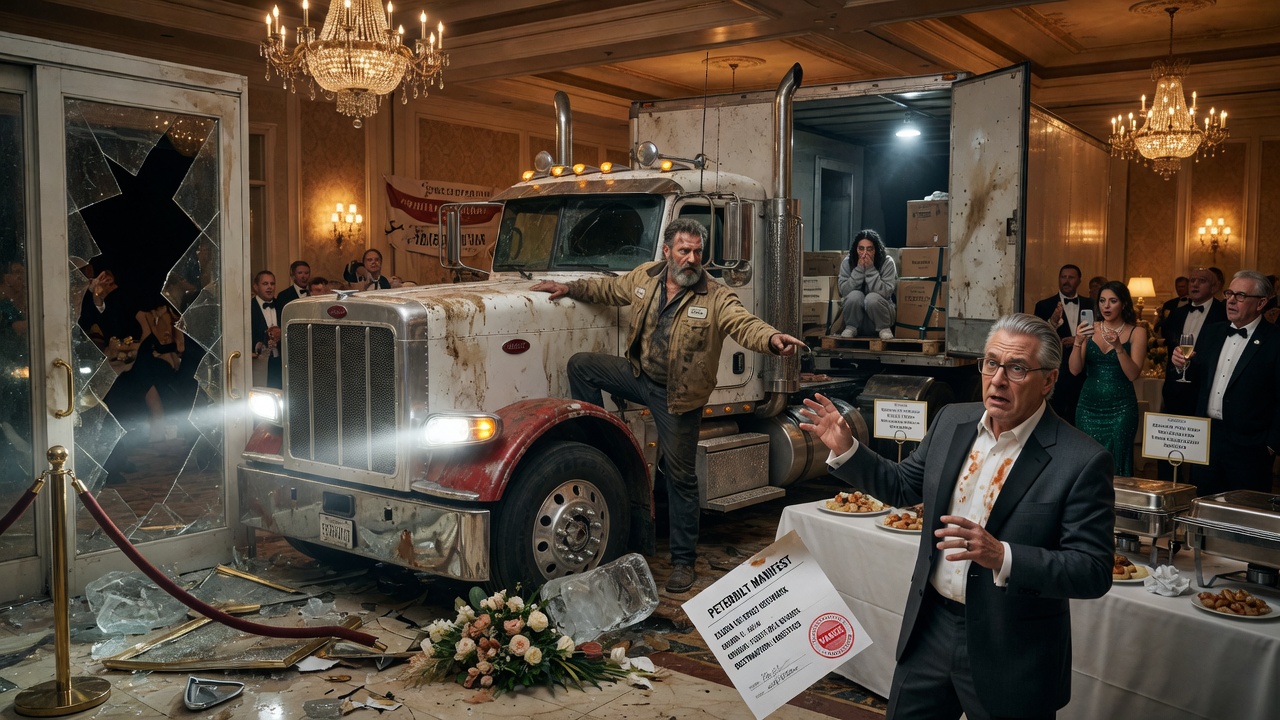
“Open it, Vance. Right here in front of everyone.”
I stood on the step of my rig, the engine still ticking like a time bomb in the middle of the Hilton ballroom. The crystal chandeliers were shaking, and the air smelled like diesel and expensive perfume.
Vance looked at the manifest I’d shoved into his chest. He looked at the wine-sipping donors and the cameras. He tried to laugh it off, that slick, corporate laugh that had fooled me for five years.
“Miller, you’re drunk,” he sneered, his voice loud enough for the front row to hear. “Get this piece of junk out of my sight before I have you arrested.”
He thought I was the one who should be ashamed. He thought he could still bully me into silence.
I didn’t move. I just stepped down, my work boots heavy on the plush carpet, and pointed to the back of the trailer. The doors were wide open.
“I brought the cargo you asked for,” I said, and the room went deathly quiet. “Why don’t you tell your guests what’s really inside those crates? Or should I let the girl tell them?”
The look on his face when he realized I wasn’t bluffing… that was worth the five years of lies. The truth was out, and there wasn’t a lawyer in New Jersey who could put it back in the box.
Chapter 1: The Cold Iron
The rain in northern New Jersey didn’t fall; it vibrated. It was a grey, industrial mist that clung to the windshield of the Peterbilt like grease. Miller sat in the cab, the engine idling in a low, rhythmic thrum that he felt in the base of his skull. He was fifty-four, and his joints ached with the kind of deep-seated dampness that no amount of heater-cranked air could touch. He took a sip of black coffee from a styrofoam cup, the liquid bitter and lukewarm, and stared out at the sprawling, light-starved expanse of the Secaucus truck stop.
Behind him, sixty feet of sealed trailer sat in the dark. It was a “special” load, the kind Vance—CEO of Logistics and Miller’s employer for the last five years—personally assigned. High-value electronics, the manifest said. Do not break seal. No stops except fuel.
Miller wiped a hand over his face, feeling the grit of thirty-six hours without sleep. He shouldn’t have stopped. But his bladder was screaming, and the coffee was gone.
He climbed down from the cab, his boots hitting the oily asphalt with a wet slap. The air smelled of diesel exhaust and soggy cardboard. He made his way toward the neon-lit sanctuary of the diner, his head down, but as he passed the rear of his trailer, he stopped.
It wasn’t a sound. It was a lack of sound. A subtle shift in the vibration of the rig.
Miller frowned. He walked to the back doors. The heavy steel bar was locked, the plastic security seal intact. He leaned his ear against the cold metal.
Nothing. Just the wind whistling through the underside of the chassis.
He started to turn away, but then he heard it. A soft, rhythmic thud. It was faint, like a heartbeat transmitted through iron. Then, a sharp, metallic scrape.
Miller’s stomach did a slow, nauseating roll. He knew that sound. He’d heard it ten years ago in the back of a van in a different state, the night his wife, Sarah, hadn’t come home. She’d been a dispatcher, sharp as a tack, and she’d found something she wasn’t supposed to. They’d found her car, but they’d never found her. Not until the “accidental” warehouse fire three months later.
He reached into his pocket and pulled out a heavy set of bolt cutters he kept in the side box. He wasn’t supposed to break the seal. Breaking the seal was a firing offense. In Vance’s world, breaking the seal was a “disappearance” offense.
Snip.
The plastic seal hit the wet ground. Miller hauled the lever up and pulled the door open just six inches.
The smell hit him first. Not electronics. Not ozone and plastic. It was the smell of unwashed bodies, stale bread, and fear. It was an old, thick scent that turned his throat dry.
He clicked on his heavy Maglite and swept the beam into the dark.
The crates were there, stacked high, branded with the Logistics logo. But they weren’t full of circuit boards. They were honeycombed with air holes. And in the narrow aisle between the rows, a pair of eyes caught the light.
They were wide, dark, and rimmed with a terrifying, hollowed-out exhaustion.
It was a girl. She couldn’t have been more than ten. She was wearing an oversized grey hoodie, her small hands clutching the edge of a wooden crate. She didn’t scream. She didn’t move. She just stared at him like he was the reaper himself come to collect.
“Hey,” Miller whispered, his voice cracking. “Hey, kid. It’s okay.”
It wasn’t okay. Nothing about this was okay.
He swept the light further back. There were others. Shadows huddled in the corners, faces blurring into a collective mask of misery. He counted six, maybe seven. All children.
Miller felt a coldness spread through his chest that had nothing to do with the New Jersey rain. He looked at the girl again. She reminded him of Sarah’s niece—the same stubborn set to her jaw, the same way she held her breath when she was scared.
“What’s your name?” he asked, stepping into the trailer.
The girl pulled back, her sneakers squeaking on the metal floor. She shook her head.
“I’m Miller,” he said, keeping his voice low and steady. “I’m the driver. I didn’t know you were back here. I swear to God, I didn’t know.”
From the front of the truck stop, a pair of headlights swung across the lot. A black SUV, tinted windows, moving slow. It was the kind of vehicle Vance’s “compliance” teams drove.
Miller didn’t think. He stepped back out, slammed the trailer doors, and shoved the steel bar into place. He couldn’t re-seal it, but he could make it look closed from a distance.
He scrambled back into the cab, his heart hammering against his ribs like a trapped bird. He threw the Peterbilt into gear, the gears grinding in protest, and hauled the rig out of the lot just as the SUV began to circle toward his row.
He was trembling. Not from the cold, but from the sudden, violent realization that his entire life for the last five years—the steady paychecks, the “safety” of the job, the loyalty he’d given Vance—was a lie built on the same industry that had killed his wife.
He looked at the manifest sitting on the passenger seat. High-value electronics. He reached out and grabbed it, crinkling the paper in his fist. He felt a hot, bubbling rage rising in his throat, a residue of ten years of grief that had never quite settled. He wasn’t just a driver anymore. He was a courier for the devil.
And the devil was expecting a delivery in Newark.
Chapter 2: The Mirror and the Mud
By the time Miller hit the Turnpike, the rain had turned into a steady, punishing deluge. The wipers fought a losing battle against the sheets of water, and the spray from the passing tankers created a blinding white-out every few seconds.
He checked his mirrors. The black SUV was gone for now, but he knew they were out there. Vance didn’t leave forty million dollars’ worth of “cargo” to chance.
His CB radio crackled to life, the static harsh and jagged.
“Hey, Big Dog. You copy? Over.”
It was Cody. A kid in his early twenties, driving a company rig a few miles back. Cody was everything Miller used to be—eager, oblivious, and convinced that a Logistics patch on his jacket meant he was part of something important.
Miller hesitated, then keyed the mic. “I copy, Cody. Keep it on the low. I’m making time.”
“Man, you seen the news?” Cody’s voice was high, excited. “The old man is getting that ‘Driver of the Year’ award tonight at the Hilton. They’re calling it the ‘Gala of the Decade.’ My dispatcher says if we hit our windows, we might get a bonus. Can you imagine? Five grand just for staying on schedule.”
Miller looked at the girl’s face in his mind. Five grand. That’s what a life cost in Vance’s ledger.
“Don’t get ahead of yourself, kid,” Miller said, his voice grim. “Bonuses come with strings. You ever wonder why we only run these loads at night?”
There was a pause. The static hissed.
“It’s just logistics, Miller. Less traffic. Why you gotta be so dark all the time? You’re acting like we’re hauling bodies or something.”
Miller’s hand tightened on the steering wheel until his knuckles went white. “Just drive your truck, Cody. And keep your eyes on the road. The mud is deep out here.”
He clicked off the radio. He couldn’t save Cody. Not yet. The kid was still in love with the myth of the open road, the same myth that had blinded Miller until he’d broken that seal.
He pulled into a rest area near Edison, a desolate stretch of concrete tucked behind a wall of dead pines. He needed to check on the girl. He needed to know what he was dealing with before he made his move.
He went to the back, his heart in his throat. He opened the door again, just enough to slip inside.
The girl was standing this time. She was holding a small, tattered teddy bear, its fur matted and grey. The other children were huddled together, whispering in a language Miller didn’t recognize—maybe Romanian, maybe Polish.
“You okay?” Miller asked, kneeling in the cramped space.
The girl stepped forward. Her voice was small, but steady. “Are we there?”
“Where?”
“The place where the mothers are.”
Miller felt a physical ache in his chest. The mothers. Vance’s “inventory” wasn’t just cargo. It was a promise of a life that didn’t exist. These kids were being moved to a holding facility, a transition point before they were sold into the grey market of domestic service or worse.
“Not yet,” Miller said, his voice thick. “But we’re not going where they planned.”
He reached into his jacket and pulled out a granola bar and a bottle of water. He handed them to her. She took them with a trembling hand, her eyes never leaving his.
“My name is Elena,” she whispered.
“Elena,” Miller repeated. “I’m going to get you out of here. But I need you to stay quiet. No matter what happens, no matter how loud it gets, you stay in the back behind the crates. Do you understand?”
She nodded slowly.
Miller stood up, his mind racing. He couldn’t just go to the cops. Not in this county. Half the state troopers were on the Logistics payroll, and the other half wouldn’t ask questions until it was too late. He needed something bigger. He needed a stage.
He walked back to the cab, but a flash of light in his side mirror caught his eye.
A motorcycle. A dark, low-slung cruiser with no chrome, just matte black paint. It was idling at the edge of the pines, the rider’s face hidden behind a dark visor.
A “cleanup” crew.
Miller didn’t wait. He scrambled into the cab and slammed the door. He didn’t even warm the engine. He threw the rig into gear and floored it, the heavy diesel engine roaring like a wounded beast.
He checked the mirror as he merged onto the highway. The motorcycle was following him, keeping a steady distance, a silent shadow in the rain.
He reached under the seat and pulled out a small, heavy box wrapped in electrical tape. It was something he’d put together years ago, a “negotiation tool” he’d built after Sarah disappeared, hoping he’d never have to use it. It was two pounds of industrial blasting caps and a remote trigger.
He set it on the dashboard.
“Okay, Vance,” Miller whispered, his eyes fixed on the taillights ahead. “You want your delivery? You’re going to get it. Right in front of the whole world.”
Chapter 3: The Ghost in the Rain
The “cleanup” crew wasn’t just one bike. By the time Miller crossed into Union County, there were three of them. They moved with a predatory precision, flanking the trailer, their headlights invisible in his blind spots. They weren’t trying to stop him—not yet. They were herding him. Ensuring he didn’t deviate from the route to the Newark docks.
Miller’s phone buzzed in the cup holder. A restricted number.
He picked it up. He didn’t say anything.
“Miller,” a voice said. It was smooth, cultured, and entirely devoid of empathy. Vance. “I see you’ve had a bit of a rough night. My team tells me you broke the seal in Secaucus.”
Miller stared at the road, his jaw set. “The seal was loose, Vance. I was checking the cargo.”
“Don’t lie to me, Miller. It’s beneath you. You’ve been a good soldier for five years. Why ruin it now? You have a delivery to make. Ten p.m. at the terminal. If you’re there, we can forget this little lapse in judgment. I’ll even double your bonus.”
“And if I’m not?”
“Then we have a problem. A very messy, very permanent problem. You remember what happened to Sarah, don’t you? She was curious, too. Curiosity is a fatal trait in this business.”
The mention of Sarah’s name hit Miller like a physical blow. The air in the cab suddenly felt thin, the smell of her perfume—vanilla and old books—ghosting through his memory.
“I remember,” Miller said, his voice a low, dangerous rumble. “I remember everything.”
“Good. Then be at the terminal. Don’t make me disappointed in you, Miller. You’re the best driver I have.”
The line went dead.
Miller looked at the explosives on the dashboard. He looked at the girl in the back. He was trapped between a past he couldn’t change and a future he couldn’t escape.
The highway was a blur of neon and grey. He passed a state trooper cruiser idling on the shoulder, but he didn’t slow down. He knew Trooper Rhodes—a woman who’d been on Sarah’s case ten years ago. She was tough, but she’d been silenced by the same system that owned Vance. If he pulled over now, she’d be forced to arrest him, and the kids would be “processed” back into the dark.
He keyed the CB radio again. “Red? You out there? This is Miller.”
A long silence, then a gravelly voice responded. “I hear you, Miller. Where you at?”
Red was a legend on the Jersey roads, an old-timer who’d seen the transition from independent trucking to corporate greed. He knew every backroad and every dirty secret from Cape May to High Point.
“I’m on the Turnpike, mile marker 112. I’ve got a tail. Three bikes, blacked out. And I’ve got cargo that doesn’t belong in a trailer.”
“Logistics load?” Red asked, the static thickening.
“Yeah. The big one.”
“Listen to me, Miller. If you’re carrying what I think you’re carrying, you don’t go to Newark. You go to the Hilton. The gala starts in an hour. Vance is going to be on a stage with the Governor and the press. He thinks he’s untouchable tonight.”
“I know,” Miller said. “I’m already headed there.”
“You’re going to need a distraction. Those bikes won’t let you get within a mile of the hotel.”
“I’ve got that covered,” Miller said, looking at the explosives. “But I need someone to call the news. Not the local rags. The networks. Tell them the ‘Driver of the Year’ is bringing a special guest.”
“Consider it done, Miller. Godspeed. And hey… don’t let them take you alive. It’s worse that way.”
Miller clicked off the radio. He checked his mirrors. The motorcycles were closing in now, one of them pulling alongside the cab. The rider reached out and tapped a heavy metal rod against the door.
Clang.
It was a warning. A reminder of who owned the road.
Miller gripped the wheel. He wasn’t afraid of the bikes. He wasn’t afraid of Vance. He was afraid of the look in Elena’s eyes if he failed her.
He swung the rig into the fast lane, forcing a sedan to swerve, and began to pick up speed. The Peterbilt groaned as it hit seventy, then eighty. The trailer swayed behind him, sixty feet of steel and human suffering hurtling through the night.
He was done being a ghost. Tonight, he was the storm.
Chapter 4: The Gala of the Damned
The Hilton at Meadowlands was a fortress of light and glass. Valet parkers in red vests scurried around German luxury cars, and a red carpet stretched from the curb to the grand double doors. Inside, the “Driver of the Year” gala was in full swing, a sea of black ties and silk dresses shimmering under the glow of a dozen crystal chandeliers.
Vance stood at the center of the room, a glass of vintage scotch in his hand. He was the picture of success—silver hair perfectly coiffed, a charcoal-grey tuxedo that cost more than Miller made in a year. He was laughing, charming a group of investors, his hand resting familiarly on the shoulder of a young woman who looked entirely too uncomfortable.
“To Logistics!” a man toasted. “To the man who keeps America moving!”
Vance smiled, but his eyes kept drifting toward the entrance. He was waiting for a phone call. He was waiting for the news that Miller had been neutralized.
Outside, the rain had turned into a torrential downpour. The valet parkers huddled under the portico, watching as a pair of headlights appeared at the end of the long driveway.
It wasn’t a limousine.
It was a semi-truck. A massive, mud-streaked Peterbilt, moving at a speed that was entirely too fast for a hotel entrance.
“Hey! You can’t park that here!” a valet yelled, waving his arms.
The truck didn’t slow down. It hit the curb with a bone-jarring thud, the tires screaming as they tore through the manicured lawn. The motorcycles were still there, buzzing around the rig like angry hornets, but they couldn’t stop the momentum of fifteen tons of moving steel.
Miller sat in the cab, his face illuminated by the dashboard lights. He was bleeding from a cut on his forehead where one of the bikers had smashed a window, but his eyes were clear.
He reached out and flipped the switch on the “negotiation tool.”
“Stay down, Elena,” he whispered.
He aimed the grill of the truck directly at the grand glass doors of the ballroom.
CRASH.
The sound was like a bomb going off. Shattered glass rained down on the red carpet as the Peterbilt smashed through the entrance, its massive chrome grill coming to a halt just feet from the main stage.
The ballroom went silent. The music stopped. The guests froze, their faces masks of sheer, unadulterated shock.
Miller climbed out of the cab. He was a stark contrast to the tuxedoed crowd—covered in grease, blood, and the grime of the road. He stood on the step of the rig, holding the manifest in one hand and the remote trigger in the other.
Vance stepped forward, his face turning a sickly shade of white. “Miller? What is the meaning of this? You’ve lost your mind!”
“I brought your delivery, Vance,” Miller said, his voice echoing through the vaulted ceiling. He stepped down, his work boots sinking into the plush carpet.
The crowd began to murmur, cell phones coming out to record the scene.
“Get him out of here!” Vance screamed, gesturing to his security team. “He’s a madman! He’s dangerous!”
“I am dangerous,” Miller said, holding up the remote. “Because I’ve got two pounds of high-grade explosives rigged to the fuel tank of this truck. And I’ve got a manifest that says you’re a human trafficker.”
He shoved the manifest into Vance’s chest, the paper crinkling against the expensive silk of the tuxedo.
“Open it, Vance,” Miller growled. “Read the inventory to your guests. Tell them what you’ve been hauling under their noses for five years.”
Vance looked at the paper, then at the crowd. He tried to maintain his composure, his lip curling in a sneer. “This is a fabrication. A disgruntled employee looking for a handout.”
“Is she a fabrication?” Miller asked, pointing to the back of the truck.
He walked to the rear doors and hauled them open.
The light from the chandeliers flooded into the dark trailer. Elena stood there, her small hand clutching the teddy bear, her eyes wide with terror as she looked out at the sea of wealthy, staring strangers.
The room went deathly quiet. A woman in the front row gasped, her hand flying to her mouth.
Vance’s face collapsed. The mask of the “CEO of the Year” shattered, leaving behind nothing but a scared, cornered bully.
“I didn’t know,” Vance stammered, his voice thin and reedy. “I… it was a sub-contractor. I had no idea.”
“You signed the manifest, Vance,” Miller said, stepping closer until he was inches from the man’s face. “Your name is on every crate. You killed my wife because she found out, and you thought you could buy my silence with a paycheck.”
Miller looked around the room, at the cameras and the witnesses. The residue of ten years of shame was finally washing away, replaced by a cold, hard sense of justice.
“My name is Miller,” he said, his voice steady. “And I’m the one who’s making the final delivery tonight.”
Outside, the sirens began to wail, the red and blue lights reflecting off the broken glass. But the room didn’t move. All eyes were on the girl in the back of the truck, and the man who had finally brought the truth home.
Chapter 5: The Glass House
The silence in the ballroom wasn’t peaceful; it was a vacuum, a sudden drop in pressure that made Miller’s ears pop. The Peterbilt’s engine continued to tick, a metallic, cooling sound that felt like a countdown. The smell of diesel was thick enough to taste, a sharp, oily contrast to the scent of wagyu beef and overpriced champagne that had filled the room moments before.
Miller kept his thumb on the remote. His hand was steady, but he could feel the fine, electric tremor in his forearms. He didn’t look at the crowd. He didn’t look at the cameras. He kept his eyes locked on Vance, watching the way the man’s silver hair caught the light from the truck’s high beams. Vance looked smaller now, his expensive tuxedo suddenly fitting like a borrowed suit, his posture sagging as the weight of the moment began to press down.
“Put the phone down, Vance,” Miller said. His voice was gravelly, worn out from years of cigarettes and highway miles.
Vance’s hand was frozen halfway to the inner pocket of his jacket. He looked at the security guards—four men in dark suits who had emerged from the shadows like sharks—then back at Miller. The guards were hesitant. They were trained for unruly guests and pickpockets, not fifteen tons of iron and a man with a detonator.
“Miller, let’s be rational,” Vance said, his voice regaining a sliver of its corporate sheen. He took a step forward, his palms out. “You’ve made your point. You’re hurt. You’re confused. We can talk about Sarah. We can talk about everything. Just… put that thing down.”
“Don’t say her name,” Miller growled. The name felt like a jagged piece of glass in his throat. “You don’t get to say it. Not here. Not ever again.”
Behind Miller, the trailer was a dark cavern of truth. Elena was still there, a small shadow against the crates. She hadn’t moved. She was watching the room with a gaze that was far too old for a ten-year-old girl. She saw the tuxedos, the jewels, the fear on the faces of people who had spent their lives pretending people like her didn’t exist.
A woman in a sequined gown let out a ragged sob. It broke the spell. The room exploded into a chaotic, frantic shuffle. Guests began to back away toward the side exits, their shoes clicking frantically on the marble floors. Some were still holding their phones up, the little red recording lights like a thousand accusing eyes.
“Nobody leaves!” a voice boomed from the shattered entrance.
State Trooper Rhodes stepped through the broken glass. She had her sidearm drawn, but it was pointed at the floor. Behind her, two more troopers moved in, their tactical gear a jarring intrusion into the elegance of the Hilton. Rhodes looked at the truck, then at Miller, her eyes narrowing as she processed the scene. She’d known Miller for a decade. She’d seen him at his worst—drunk and grieving in the back of a precinct after Sarah disappeared. She’d seen him at his most invisible—a name on a logbook she checked once a month.
“Miller,” Rhodes said, her voice calm and authoritative. “I need you to step away from the rig.”
“I can’t do that, Rhodes,” Miller said, not moving an inch. “I’ve got a delivery to finish.”
“I see the delivery,” she said, flicking her gaze toward the back of the trailer. She saw Elena. She saw the crates with the air holes. “I see exactly what’s happening here. But you have a bomb in your hand, Miller. That changes the math. You let those people leave, and we can figure this out.”
“Vance stays,” Miller said.
Vance’s eyes darted toward Rhodes. “Officer, this man is a terrorist! He’s kidnapped these children and he’s trying to extort me! He’s unstable!”
The sheer audacity of the lie made Miller’s stomach churn. It was the same tone Vance used to announce quarterly earnings—smooth, confident, and utterly detached from reality. For five years, Miller had listened to that voice. He’d believed it because it was easier than facing the silence of an empty house.
“I have the manifest, Rhodes,” Miller said, his voice rising. “His signature. The GPS logs from the truck. The secondary warehouse in Elizabeth. It’s all here. He’s been moving kids through the ports for years. Logistics was just a front.”
Rhodes looked at Vance. She’d always suspected Logistics of something, but they were too big, too connected. They funded the police athletic league. They donated to the Governor’s re-election. They were the “good guys.”
“Vance,” Rhodes said, her voice hardening. “Keep your hands where I can see them.”
“This is ridiculous,” Vance spat, but he didn’t move. “I have friends in the Attorney General’s office. I suggest you remember who pays for your pensions.”
The room was nearly empty now, save for the police, the security guards, and a few brave or foolish members of the press who had stayed behind the pillars. The air was thick with the smell of the storm outside—ozone and wet pavement—leaking through the shattered doors.
“Is that how it works, Vance?” Miller asked, stepping off the truck. He felt the weight of the remote in his hand, the power of it. He could end it all right now. He could take Vance with him, turn the ballroom into a crater and let the fire wash away the filth. “You just pay the bill and the bodies disappear?”
He looked at Elena. She had climbed down from the trailer now, standing on the edge of the plush carpet. She looked tiny against the massive truck. She looked like a ghost that had wandered into a nightmare.
“Miller, look at the girl,” Rhodes said, stepping closer. “If you do this, she’s the first one to go. Is that what Sarah would want? Another child lost because you couldn’t let go of the trigger?”
The mention of Sarah’s name usually felt like a punch. This time, it felt like a hand on his shoulder. He remembered Sarah’s laugh—how it sounded like bells in a cold wind. She hadn’t been a person who looked for revenge. She’d been a person who looked for justice.
Miller’s thumb eased off the pressure plate, but he didn’t let go. He looked at Vance, who was sweating now, a dark stain spreading under the arms of his charcoal tuxedo. The man was terrified. Not of the bomb, but of the exposure. He was watching the cameras, his mind already spinning the narrative, trying to find the loophole that would let him walk away.
“The manifest is on the floor,” Miller said to Rhodes. “Take it. And get the kids out of the truck. They’re cold.”
Rhodes nodded to her partners. They moved cautiously toward the trailer, keeping their eyes on Miller. One of them, a young trooper named Henderson, reached out a hand to Elena. She flinched, pulling back into the shadows of the Peterbilt.
“It’s okay, kiddo,” Henderson said, his voice soft. “We’re the good guys. We’re going to get you some food.”
Elena looked at Miller. He gave her a small, tight nod. It was the only promise he had left to give. She took the trooper’s hand and stepped out onto the ballroom floor, her oversized hoodie dragging on the carpet.
As the children were led out, a news van from a local affiliate pulled up to the curb, its satellite dish unfolding like a metallic flower. The lights from the cameras cut through the rain, illuminating the ballroom like a stage.
Vance saw the cameras and his demeanor shifted instantly. He straightened his tie, wiped his brow, and put on his “crisis” face.
“I want it on the record,” Vance shouted toward the press, “that I am cooperating fully with this investigation! This driver is a troubled individual, and we will do everything in our power to support these poor children!”
Miller felt a cold, jagged laugh rise in his chest. “You never stop, do you, Vance? Even when you’re standing in the wreckage, you’re still selling.”
“Miller, give me the remote,” Rhodes said. She was only five feet away now. “It’s over. You won. The truth is out.”
“It’s never over,” Miller whispered.
He looked at the Peterbilt. His home for five years. His prison. He thought about the thousands of miles he’d driven, the nights spent in lonely rest stops, the way the road always promised something better just over the horizon and never delivered.
He handed the remote to Rhodes.
The moment the plastic hit her palm, the security guards lunged. They weren’t waiting for the police. They were working for Vance, and their orders were clear. One of them tackled Miller, slamming him into the side of the truck. His head hit the chrome with a sickening crack, and the world went grey.
He heard Rhodes screaming for them to stop. He heard the sound of a struggle, the heavy thud of boots on carpet. He felt a boot in his ribs, a sharp, searing pain that made his breath catch.
But through the haze of pain, he saw something that made him smile.
Trooper Henderson was holding the manifest. He was looking at the signature, then at Vance. And he wasn’t looking at a CEO anymore. He was looking at a predator.
The cameras were rolling. The lights were bright. And for the first time in ten years, Miller didn’t feel like he was driving in the dark.
As they hauled him to his feet and shoved his wrists into cold, heavy steel, Miller looked at the shattered glass on the floor. It looked like diamonds in the mud. He felt a strange sense of residue—not the grease of the truck, but a lightness in his chest.
He’d made the delivery.
Chapter 6: The Long Road Home
The interrogation room at the Newark precinct smelled of industrial floor cleaner and stale tobacco. It was a small, windowless box that seemed to hum with the collective anxiety of everyone who had ever sat in the metal chair. Miller sat with his hands cuffed to a bar on the table, a paper cup of water in front of him. His ribs were taped, and there was a bandage over the cut on his forehead, but the pain felt distant, like a radio station fading out as you drove away from the city.
Trooper Rhodes sat across from him. She’d traded her tactical vest for a windbreaker, but she still looked like she hadn’t slept since the Reagan administration. She had a folder open in front of her—the “special” manifest.
“The Feds are taking over the case,” Rhodes said, her voice quiet. “Vance’s legal team is already trying to claim he was set up, that the signature is a forgery. They’re saying you’re a radicalized trucker with a grudge.”
Miller leaned back, the chair groaning under his weight. “They can say whatever they want. I gave you the GPS logs. I gave you the secondary warehouse. Did you find it?”
Rhodes nodded. “We found it. It wasn’t just children, Miller. It was a logistics hub for the whole Northeast corridor. Drugs, weapons, people. Vance wasn’t just a CEO. He was a broker.”
“And the girl? Elena?”
“She’s in protective custody. She’s talking. Not a lot, but enough. She told them you were the one who broke the seal. She said you gave her a granola bar.” Rhodes smiled, a small, tired thing. “That granola bar might be the most important piece of evidence in the whole trial. It proves you weren’t part of the conspiracy.”
Miller looked down at his hands. They were stained with grease that would never truly come out. “I was part of it for five years, Rhodes. Every mile I drove, every load I delivered… I was helping him build that house. I just didn’t want to see it.”
“You saw it when it mattered,” she said. “Most people would have just closed the door and kept driving. They would have taken the five grand and bought a new boat.”
“I don’t have a boat,” Miller said. “I have a truck that’s currently evidence in a terrorism investigation.”
“About that,” Rhodes said, leaning forward. “The D.A. is going to have to charge you with something. Reckless endangerment, maybe the explosives. But they’re looking at a plea. You testify against Vance, you walk with a suspended sentence. You’re the hero of the hour, Miller. The news is calling you the ‘Jersey Vigilante.'”
The term made Miller’s skin crawl. “I’m not a vigilante. I’m just a guy who got tired of being a ghost.”
He thought about the “cleanup” crew. The motorcycles. “What about the bikes? The guys on the road?”
“Gone,” Rhodes said. “Vance’s private security disappeared the second the truck hit the ballroom. We’re tracking them, but guys like that… they’re like cockroaches. They just find a different kitchen.”
The door to the interrogation room opened, and a man in a dark suit stepped in. He had a federal badge clipped to his belt and a face that looked like it was carved out of granite.
“Miller,” the man said. “I’m Agent Vance—no relation.” He didn’t smile. “We’ve got a problem. The cartel that was using Logistics as a front… they’re not happy about the loss of inventory. They’ve already made a move on one of the witnesses.”
Miller felt a cold spike of fear. “Who?”
“Cody. The kid who was driving the other rig. They found his truck in a ditch near the border. He’s alive, but he’s scared. He’s saying he didn’t know anything.”
“He didn’t,” Miller said, his voice sharp. “He’s just a kid. He wanted a bonus.”
“We need you to talk to him,” Agent Vance said. “He won’t talk to us. He thinks we’re in on it. He says he only trusts the ‘Big Dog.'”
Miller looked at Rhodes. She nodded.
“I’ll talk to him,” Miller said.
They took him to a safe house in the Pine Barrens, a nondescript cabin tucked away at the end of a long, dirt road. Cody was sitting on a porch swing, wrapped in a wool blanket, staring out at the trees. He looked older, the excitement and obliviousness stripped away to reveal a raw, jagged fear.
Miller walked up the steps, his boots heavy on the wood. He sat down next to the kid. They didn’t speak for a long time. The only sound was the wind in the pines and the distant hum of the highway.
“I thought we were the good guys, Miller,” Cody said, his voice cracking. “I thought we were part of something.”
“We were part of something,” Miller said. “We were part of the machine. It’s a big machine, Cody. It’s designed to make you feel important while it grinds you up.”
“What do I do now? My rig is gone. My job is gone. They know my name.”
“You tell the truth,” Miller said. “You tell them everything you saw. Every weird load, every midnight drop, every time the dispatcher told you to look the other way. You give them the names. And then you start over.”
“How?” Cody asked, looking at Miller’s scarred face. “How do you start over after this?”
“One mile at a time,” Miller said. “You find something worth driving for. Not a paycheck. Not a bonus. Something real.”
Miller stayed with Cody until the Feds took him back to the city. As he watched the black SUVs pull away, he felt a sense of completion. He’d saved the kid. He’d saved Elena. He’d finally finished the delivery Sarah had started ten years ago.
The trial lasted six months. It was a media circus—the disgraced CEO, the heroic trucker, the hidden world of human trafficking. Vance tried every trick in the book. He hired the best lawyers, he leaked stories to the press, he even tried to claim he was a victim of a corporate coup. But the evidence was too heavy. The manifest, the GPS logs, and the testimony of a ten-year-old girl who looked the jury in the eyes and told them about the “man with the granola bar.”
Vance was sentenced to forty years. As they led him out of the courtroom, he looked at Miller, who was sitting in the back row. There was no anger left in Vance’s eyes, only a hollow, pathetic desperation. He was a man who had built a kingdom on lies, and he’d finally run out of bricks.
Miller walked out of the courthouse into the bright afternoon sun of Newark. He had a small bag of his belongings and a set of keys in his pocket. He didn’t have a truck anymore. He didn’t have a job. But he had a name.
He took a bus to the Jersey Shore. He found a small, quiet town where the air smelled of salt and fried dough. He rented a room in a boarding house and spent his days walking on the beach, watching the waves come in and out.
One afternoon, a car pulled up to the curb as he was walking back from the pier. It was Trooper Rhodes. She looked different—more relaxed, her hair tied back in a ponytail.
“Hey, Miller,” she said, leaning out the window. “I thought I might find you here.”
“How’s Elena?” Miller asked.
“She’s with a good family. In Pennsylvania. They’ve got a farm. She’s going to school. She sent you this.”
Rhodes handed him a small, tattered envelope. Inside was a drawing—a big, red truck with a man and a girl standing next to it. Underneath, in shaky, childish handwriting, it said: Thank you, Mr. Miller.
Miller felt a lump in his throat. He tucked the drawing into his pocket.
“I’ve got some news,” Rhodes said. “The Peterbilt. The Feds finished with it. It was going to be auctioned off, but… well, a few of us in the department, and some of the guys from the CB radio, we put some money together. It’s sitting in a lot in Toms River.”
Miller looked at her, stunned. “You bought my truck?”
“It’s not just a truck, Miller,” she said. “It’s a legacy. There’s a non-profit starting up. They need a driver to move supplies to shelters and relief centers. No corporate bosses. No secret loads. Just honest work.”
Miller looked out at the ocean. He thought about the thousands of miles he’d driven, the nights spent in the dark, the way the road always felt like a promise.
He looked at Rhodes. “Is it fueled up?”
She smiled. “Full tank.”
Miller climbed into the passenger seat of her car. As they drove toward Toms River, he looked out at the horizon. The rain had stopped, and the sky was a deep, bruised purple, the sun setting over the industrial sprawl of New Jersey.
He thought about Sarah. He thought about the ten years he’d spent looking for her in the rearview mirror. He realized now that she hadn’t been behind him. She’d been ahead of him, waiting at the end of the road.
He wasn’t a ghost anymore. He was a man with a delivery to make.
And for the first time in a long time, the road looked clear.