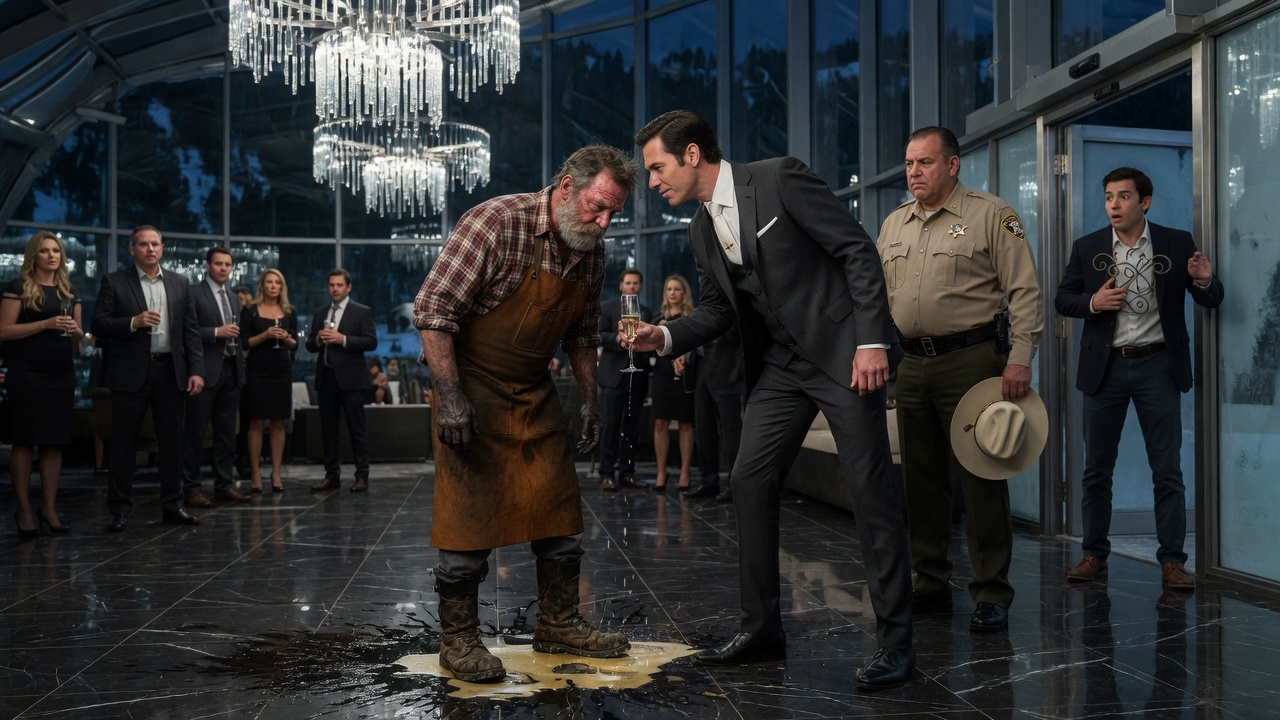
“You smell like coal and failure, Silas. Is that the ‘heritage’ we’re paying for?”
The room went silent, the kind of silence that happens right before a storm breaks. Julian Vane stood there in his three-piece suit, tipping his champagne glass until the expensive bubbles soaked into the old man’s work boots.
Silas didn’t move. He stood there in his leather apron, the same one he’d worn for forty years, and took the insult in front of the very people who had helped tear his life apart. He was the town’s last blacksmith, a man whose family had worked this mountain since before the roads were paved. Now, he was just a “hired hand” being mocked for the entertainment of a developer who didn’t know the difference between steel and spite.
But Silas wasn’t looking at the wine on his boots. He was looking at the massive, decorative iron supports he’d just installed on the resort’s Grand Balcony—the ones Vane had forced him to “rush” for the opening.
The Sheriff turned his head, unable to watch the humiliation of a man he’d known since they were boys. Nobody stepped in. Nobody said a word while Vane treated Silas like a servant in his own valley.
They thought they were watching a broken man surrender. They didn’t know that the iron Silas forged for them had a secret hidden in the grain—a flaw that was designed to wait for the exact moment the room was full.
Luxury is fragile when it’s built on a grave, and Silas was finally ready to let it all come down.
Chapter 1: The Ring of the Anvil
The air in the forge didn’t just smell like heat; it smelled like history being burned alive. It was a thick, choking mixture of anthracite coal smoke, hot oil, and the sharp, metallic tang of iron that had been pushed past its breaking point. Silas handled the long-handled tongs with a familiarity that was more biological than learned. His hands were mapped with scars—white lines of old burns, thick calluses that had turned his skin into something resembling the very leather of his apron.
He pulled the glowing orange bar from the heart of the fire. The light reflected in his eyes, two dark coals set deep in a face that looked like it had been carved out of the mountain itself. He moved to the anvil, a three-hundred-pound slab of steel that sat on a massive stump of cured oak.
Clang.
The sound was pure. It echoed off the corrugated tin walls of his “new” shop—a drafty, cramped garage on the edge of town that felt like a tomb compared to the sprawling, stone-walled forge his grandfather had built two centuries ago. That shop was gone now. It was under ten feet of concrete and the foundations of a “Wellness Spa” currently being marketed to people who wouldn’t know a day’s labor if it bit them in the wallet.
Clang. Clang.
Each strike was precise. He wasn’t just shaping the iron; he was interrogating it. He was drawing out a long, tapering decorative scroll for the resort’s ceremonial gates. To the world, it was art. To Silas, it was a ledger of everything he owed and everything that had been taken.
The roar of a high-end engine cut through the rhythm of the hammer. Silas didn’t stop. He knew the sound. It was the purr of a vehicle that cost more than the house he lived in. A moment later, a sleek, black SUV pulled into the gravel lot, kicking up a cloud of dust that drifted into the forge.
Silas kept hammering until the iron lost its glow, turning a dull, bruised purple. Only then did he drop the piece back into the coals and turn around.
Julian Vane stepped out of the SUV, shielding his eyes from the glare of the afternoon sun. He looked like an intruder from a different century. His suit was a sharp, clinical gray, and his shoes were polished to a mirror finish—shoes that were never intended to touch mountain dirt. Behind him, Sheriff Colton climbed out of the driver’s side, looking like he wanted to be anywhere else on God’s green earth.
“It’s like stepping back into the Stone Age,” Vane said, his voice carrying that effortless, coastal condescension that made Silas’s teeth ache. He stepped into the shop, wrinkling his nose at the smoke. “Do you actually work in this… atmosphere, Silas?”
Silas wiped his hands on a greasy rag. “The iron doesn’t care about the atmosphere, Mr. Vane. It just cares about the heat.”
Vane walked over to the workbench, poking at a finished railing section with a manicured finger. “It looks heavy. Brutal. We’re going for ‘rustic elegance’ for the Grand Opening. I hope you remembered the specifications for the Grand Balcony supports. They need to look like they’ve been there for a hundred years, but they need to be light enough for the aesthetic.”
“I remembered the specifications,” Silas said quietly. He glanced at Colton. The Sheriff was leaning against the doorframe, adjusting his belt, avoiding Silas’s gaze. “Sheriff. You lose your way? The resort is three miles up the road.”
Colton cleared his throat. “Just making sure things are on schedule, Silas. Mr. Vane is under a lot of pressure. The opening is in three days. The Governor is coming. Half of Denver’s money is going to be standing on that balcony.”
“Is that right?” Silas asked. He turned back to the forge, pumping the bellows. The fire roared, casting long, flickering shadows against the back wall. “A lot of weight for one piece of iron.”
Vane stepped closer, his shadow falling over the anvil. “Let’s be clear, Silas. I know you’re still bitter about the land. I know the town council’s decision wasn’t your favorite. But you’re being paid—generously—to finish this job. My investors want to see ‘local craftsmanship.’ They want the story. They don’t want the attitude.”
Silas stopped pumping the bellows. The silence that followed was heavy, filled only with the ticking of the cooling iron. He looked at Vane, really looked at him—the smooth skin, the eyes that saw the mountain only as a line item on a spreadsheet.
“The land wasn’t just a favor, Mr. Vane,” Silas said, his voice low and raspy. “It was a promise. Two hundred years of it. My wife is buried in the churchyard three hundred yards from where you put the pool. She died trying to pack up that shop because your bulldozers wouldn’t wait another twenty-four hours.”
Vane sighed, a sound of genuine boredom. “We’ve been over this, Silas. It was an unfortunate accident. Stress is a part of life. But that forge was a fire hazard, and the town needed the revenue. You should be thanking me for keeping you in business.”
He reached into his pocket and pulled out a heavy, gold-plated pen, tapping it against the anvil. “The ironwork for the balcony. Is it done?”
Silas nodded toward the back of the shop, where several long, intricate beams were wrapped in heavy burlap. “Finished this morning. They’re being delivered to the site tonight.”
“Good,” Vane said. “I’ll have my engineers inspect them. If they aren’t perfect, you don’t get the final installment. And Silas? Try to wash the soot off before the Gala. I want you there for the ribbon cutting. It’s good for the brand. The ‘Grizzled Mountain Smith’ blesses the new era.”
Vane turned on his heel and walked back to the SUV. Colton stayed behind for a second, his shadow lingering in the doorway.
“Silas,” the Sheriff muttered. “Don’t do anything stupid. Just take the money and move on. Martha wouldn’t have wanted you living like this.”
“You don’t get to say her name, Colton,” Silas said, not looking up. “Not after you served the papers.”
The SUV roared to life and sped away, leaving Silas alone in the heat. He walked over to the burlap-wrapped beams. He reached down and pulled the cloth back from one of the main support brackets. It was a beautiful piece of work—scrolled, tapered, and finished in a deep, matte black.
He picked up a small, four-ounce ball-peen hammer. He tapped the center of the beam, a spot where the iron looked solid but held a microscopic, intentional flaw. He’d spent weeks perfecting it—a “stress-fracture” created by cooling the iron too quickly with a specific chemical brine, then forging a thin skin of healthy metal over the top. To any engineer, it would look perfect. It would pass a load test.
But iron has a memory. And Silas had programmed this iron to remember exactly how much weight it could take before the molecular structure simply gave up.
“Luxury is fragile, Martha,” he whispered to the empty shop. “You just have to know where to hit it.”
Chapter 2: The Price of Belonging
Leo was nineteen, and he walked with the permanent hunch of a kid who had spent too much time being told he was in the way. He had arrived at Silas’s door three months ago, smelling of cheap cigarettes and desperation, asking for work. Silas had hired him mostly because the boy’s father had been a good man before the drink took him, and partly because Silas needed someone to haul the heavy charcoal bags that his own sixty-year-old back was starting to protest.
“You’re late,” Silas said, his voice echoing in the morning chill of the shop.
Leo scrambled inside, tripping over a pile of scrap iron. “Sorry, Silas. The Sheriff had the main road blocked off. They’re moving the statues into the resort plaza. Big bronze things. Looked like they took ten cranes to lift ’em.”
Silas didn’t look up from the bench where he was filing a hinge. “Statues of what?”
“Founders, I guess,” Leo said, wiping his nose with his sleeve. “Men in suits. Didn’t look like anyone I know from around here.”
Leo went to the corner and started the grueling process of breaking down the coke for the day’s fire. He worked in silence for a while, but Silas could feel the questions vibrating off the boy.
“Just say it, Leo,” Silas muttered.
Leo stopped, the sledgehammer resting against his thigh. “People in town are talking, Silas. They’re saying you’re a sell-out. They saw you talking to Vane yesterday. My cousin works the front desk at the resort, and she said Vane told everyone you’re going to be his ‘mascot’ at the opening.”
Silas’s file screeched against the metal. “Is that what they’re saying?”
“They’re saying you took a six-figure check to forget about what happened to the old shop,” Leo said, his voice small. “They’re saying you’re making the iron for the very place that killed Martha.”
Silas stopped filing. He stood up, his height dwarfing the boy in the small shop. He walked over to Leo and took the sledgehammer from his hand. It was heavy, but in Silas’s grip, it looked like a toy.
“You see this hammer, Leo?” Silas asked.
Leo nodded, swallowing hard.
“If I hit that anvil with everything I’ve got, what happens?”
“It… it makes a noise?”
“No,” Silas said. “The energy goes somewhere. It goes into the steel. It vibrates through the stump, into the floor, into the ground. Nothing in this world just disappears. Not heat, not force, and certainly not an insult.”
He handed the hammer back. “I’m making the iron, Leo. I’m making it exactly how they asked. But don’t you ever think for one second that I’ve forgotten. A man who forgets where he came from is just a pile of meat and bone. You want to survive in this world? You learn to wait. The fire takes time to build. If you throw the coal on all at once, you just choke the flame.”
Leo looked confused, but he went back to work.
An hour later, the Sheriff’s cruiser pulled up again. This time, Colton was alone. He didn’t get out. He just rolled down the window and gestured for Silas to come over. Silas wiped his brow and walked into the sunlight.
“What now, Colton?”
“Vane wants the ceremonial shears,” Colton said, his face shadowed by the brim of his hat. “The ones for the ribbon cutting. He wants them forged from ‘reclaimed iron’ from your old shop. He thinks it’s a nice touch. A symbol of the old town becoming the new.”
Silas felt a surge of cold rage, the kind that didn’t make you scream, but made your vision narrow to a sharp point. “He wants me to use the scrap from the building he tore down? To cut the ribbon for his palace?”
“He’s offering another five thousand for the ‘story’ of it,” Colton said, his voice sounding tired. “Look, Silas. I know how it looks. But Leo’s mom is behind on her taxes. The town is looking to seize her place next. If you take this job, you could help them out. You could be the hero here, instead of the hermit.”
Silas looked back at the shop, where Leo was struggling with a heavy bag of coal. The boy’s ribs were visible through his shirt. The “economic engine” Vane promised hadn’t reached the people who actually lived in the valley. It had only raised the property taxes and brought in boutiques that sold five-hundred-dollar candles.
“Tell him I’ll do it,” Silas said. “Tell him I’ll find the right piece of iron.”
“Good man,” Colton said, looking relieved. “I knew you’d see sense.”
As the cruiser pulled away, Silas walked to the back of the shop. Under a heavy tarp sat a pile of twisted, blackened iron—the remains of his grandfather’s forge. He spent an hour digging through the rubble until he found what he was looking for: a heavy, rusted mounting bracket that had once held the main door to the old shop.
It was high-carbon steel, brittle from years of heat and the final, crushing weight of the demolition. It was perfect.
He brought it to the anvil and started to heat it.
“What are you making?” Leo asked, stepping closer to the heat.
“A gift,” Silas said. “A pair of shears. To cut a ribbon.”
He began to hammer. But he wasn’t refining the steel. He was folding it. He was creating “cold shuts”—layers of metal that looked solid on the outside but held pockets of air and slag on the inside. It was a masterclass in failure. If you tried to cut paper with them, they would work fine. If you tried to cut a thick, silk ceremonial ribbon with the eyes of the world watching, the blades would snap at the pivot point, leaving the user holding two useless pieces of jagged metal.
“You’re working fast, Silas,” Leo noted. “Usually you take your time.”
“Sometimes the moment requires a certain… urgency,” Silas said.
He worked through the night. The rhythm of his hammer was the only sound in the valley, a steady, pulsing heartbeat that seemed to irritate the silence of the mountain. He thought about Martha. He thought about the night the Sheriff had come with the “Final Notice.” He remembered how she’d tried to lift a heavy crate of ledgers, how her heart—already weakened by years of hard work and the stress of the looming loss—had simply stopped. She’d died on the floor of the shop, surrounded by the smell of iron and the sound of the bulldozers idling at the edge of the property.
Vane hadn’t even stopped the demolition for the funeral.
Silas quenched the shears in a bucket of oil. The hiss was like a scream. He pulled them out, the black liquid dripping from the blades. They were beautiful. They were elegant. They were a lie.
“Tomorrow,” Silas whispered, “we go to the resort.”
Chapter 3: The Ghost in the Foundation
The resort sat on the shoulder of the mountain like a parasite made of glass and cedar. It was called The Peak at Blacksmith’s Anvil, a name that made Silas’s stomach turn every time he saw it on a billboard. They had used the history of his family to sell “authentic mountain experiences” to people who would never have to worry about a frozen pipe or a failed harvest.
Silas arrived in his old, dented flatbed truck, the ceremonial shears and the final decorative scrolls rattling in the back. The security guards at the gate—men in tactical vests who looked like they were guarding a Green Zone in a war—checked his ID with exaggerated suspicion.
“He’s the smith,” one of them said into a radio. “Let him through.”
As Silas drove up the winding driveway, he saw the transformation. The creek where he used to fish with his father had been dammed into a series of “ornamental water features.” The old growth pines had been thinned to make room for “scenic vistas.”
He parked near the service entrance and began to unload. He was met by a young woman in a sharp blazer with a headset clipped to her ear.
“Mr. Silas! We’ve been waiting for you. Mr. Vane is on the Grand Balcony with the investors. He wants the shears delivered personally. It’s for the ‘Behind the Scenes’ video we’re filming.”
She led him through the maze of the resort. The interior was all polished stone and “reclaimed” wood that Silas recognized as the siding from the old barns down the valley. It was a museum of a life they had killed.
They stepped out onto the Grand Balcony.
It was a massive structure, cantilevered out over the valley. It felt like standing on the edge of the world. The view was breathtaking, but Silas only had eyes for the iron. His iron. The support beams he had forged were bolted into the stone, their dark, scrolled arms holding up the weight of the massive cedar deck.
Vane was there, surrounded by three men in expensive suits and a woman holding a professional camera. He was gesturing toward the valley with a glass of scotch in his hand.
“And here is the man himself,” Vane announced, turning toward Silas with a practiced, predatory smile. “The last of the mountain smiths. Silas, come here. Don’t be shy.”
Silas walked forward, the heavy shears wrapped in a simple cloth in his hands. He could feel the vibration of the balcony under his boots. There were twenty people on it now. During the Gala, there would be two hundred.
“Show them the shears, Silas,” Vane urged. “Tell them about the iron.”
Silas unwrapped the tool. The sun caught the polished edges of the blades. The investors murmured in appreciation.
“This iron,” Silas began, his voice surprisingly steady, “came from the foundation of the old shop. It’s seen two hundred years of heat. It’s seen the birth of this town, and it’s seen the end of a family legacy.”
“Beautiful,” Vane said, patting Silas on the shoulder. The touch felt like a burn. “A symbol of transformation. From the forge to the Peak.”
He took the shears from Silas, testing the weight. “They’re heavy. Sturdy. Just like the people who built this place, right?”
“Iron has a way of showing you its true nature,” Silas said. “When the pressure is high enough.”
One of the investors, a thin man with a nervous laugh, stepped closer to the railing. “Is it safe? This high up? It feels… airy.”
“Safe?” Vane laughed, leaning his full weight against the railing—the very railing Silas had forged. “This balcony is held up by the best craftsmanship Colorado has to offer. Isn’t that right, Silas? You’d bet your life on this iron, wouldn’t you?”
Silas looked the man in the eye. “I already have, Mr. Vane. Every day I spent in that shop was a bet. My wife’s life was a bet. This iron… it knows exactly how much it’s supposed to carry.”
Vane’s smile flickered for a second, a shadow of confusion crossing his face before he smoothed it over. “He’s a poet, see? That’s what we’re buying. Soul.”
He turned back to the camera, dismissing Silas with a wave of his hand. “Make sure the lighting is right for the shears. I want the ‘reclaimed’ part to really pop in the edit.”
Silas walked to the edge of the balcony, away from the group. He looked down. The drop was three hundred feet to the rocky gorge below. He looked at the main support beam where it met the stone. He could see the microscopic hairline fracture he’d hidden there. It was invisible to the naked eye, but to him, it looked like a lightning bolt waiting to strike.
He thought about warning them. He thought about the investors, the waiters, the people who had nothing to do with Vane’s greed. But then he looked across the valley to the churchyard. He could see the small, white headstone where Martha lay. He remembered the sound of the bulldozer’s blade hitting the stone of the old shop.
Residue.
Every action left a residue. This resort was built on the residue of a broken heart and a stolen history.
“Silas!” Vane called out. “We’re done here. Get back to your shop. I need the ceremonial gate ornaments by tomorrow night. And for God’s sake, buy a new shirt. You’re representing the brand now.”
Silas didn’t answer. He just walked off the balcony, feeling the iron groan under his feet—a sound only a blacksmith could hear. It was the sound of a promise about to be kept.
Chapter 4: The Spit and the Spark
The night before the Grand Opening, Silas sat in his shop with a single bottle of cheap bourbon. He didn’t drink often, but the cold had settled into his bones in a way that coal couldn’t touch.
Leo was gone, sent home early with a week’s pay and instructions to stay away from the resort for the next few days. Silas had told him he needed “solitude for the final blessing” of the iron, and the boy had been too tired to argue.
A knock came at the door. It wasn’t the confident rap of Julian Vane or the authoritative bang of the Sheriff. It was a soft, hesitant sound.
Silas opened the door to find Sarah, the local history teacher. She was a woman in her fifties, one of the few people who still looked at Silas with pity instead of suspicion.
“I brought you some stew, Silas,” she said, holding out a ceramic pot. “I figured you weren’t eating.”
“Thank you, Sarah,” Silas said, stepping aside to let her in.
She looked around the cramped garage, her eyes lingering on the pile of scrap in the corner. “It’s not right, Silas. Any of it. I saw the signs for the ‘Blacksmith’s Anvil’ resort. It’s like they’re wearing your skin as a costume.”
“They are,” Silas said.
“I heard you’re going to be there tomorrow,” she said, her voice dropping. “On the balcony. With the Governor.”
“I have a part to play,” Silas said.
Sarah looked at him, her eyes searching his face. She had known Martha. They had been in the same quilting circle for thirty years. “Silas… don’t let the anger eat you. Martha wouldn’t have wanted you to become… this.”
“Become what? A man who finishes his work?”
“A man who looks like he’s waiting for the world to end,” she said softly.
She left the stew on the bench and walked to the door. “Just… be careful. Those people up there, they don’t care about the mountain. They don’t care about the history. They only care about the view. Don’t give them anything more than they’ve already taken.”
After she left, Silas didn’t touch the stew. He went to his workbench and picked up his wife’s wedding ring. He’d forged it himself from a silver dollar forty years ago. It was simple, unadorned, but it held the shape of her finger.
He felt the weight of it. He felt the weight of the shears in the resort’s safe. He felt the weight of the two hundred people who would be standing on that balcony in less than twenty-four hours.
The moral choice was a cold, hard thing in his chest. If he warned them, Vane would win. The resort would flourish, the theft of his land would be validated, and Silas would spend the rest of his life as a “quaint relic” in a shed. If he stayed silent… the mountain would take back what was stolen.
The phone on the wall rang. It was Colton.
“Silas. Vane wants you at the resort at 6:00 PM sharp. He’s having a private dinner for the top-tier donors before the main event. He wants you to ‘perform’ a bit. Hit some hot iron, show them the sparks. You know the drill.”
“I’ll be there, Sheriff.”
“You okay, Silas? You sound… distant.”
“I’m just thinking about the iron, Colton. It’s almost time for it to set.”
The next evening, the resort was a hive of activity. Valet parkers in red vests were whisking away European luxury cars. The Grand Hall was filled with the scent of lilies and expensive perfume.
Silas arrived in his best flannel shirt, his apron freshly oiled. He felt like a bear in a china shop. Vane spotted him immediately and steered him toward a group of men in tuxedos.
“Here he is! Our master of the forge,” Vane announced.
The dinner was held on the Grand Balcony. Long tables were covered in white linen, lit by flickering candles. The air was cool, the valley below a dark velvet curtain.
Vane was in high spirits. He’d already had several glasses of champagne. He pulled Silas toward the center of the deck, where a portable anvil had been set up for the “demonstration.”
“Silas, show them how we do it,” Vane said, his voice loud and slightly slurred. “Tell them how you made these supports. Tell them why they’re the strongest in the world.”
The crowd gathered around, their faces expectant, eager for a touch of “mountain magic.”
Silas picked up his hammer. He didn’t have a forge here, just a small propane torch to heat a decorative rod. He heated the tip until it was a bright, screaming yellow.
“The strength of iron,” Silas began, his voice carrying over the crowd, “isn’t in how hard it is. It’s in how it handles the pressure. If you push it too fast, it gets brittle. If you build it on a flaw, it remembers.”
He struck the rod. The sparks flew, landing on the white linen, burning tiny, black holes. The guests gasped and pulled back.
“Careful there, Silas!” Vane laughed, though his eyes were sharp. “Don’t burn the house down before we’ve even opened it.”
“The house is already burning, Mr. Vane,” Silas said.
Vane’s face hardened. He stepped closer, lowering his voice so the donors couldn’t hear. “Listen, you old drunk. I’m paying you to be a character, not a philosopher. Stick to the script or I’ll have Colton toss you out of here right now.”
He turned back to the crowd, his smile snapping back into place. “He’s a bit rough around the edges, as you can see! But that’s the charm, isn’t it?”
Vane picked up a champagne flute and raised it. “A toast! To the Peak! To the future of this valley! And to the iron that holds it all up!”
The guests raised their glasses. The sound of crystal clinking filled the air.
Silas looked down at the floorboards. He could feel the balcony shifting. It was subtle—a tiny, rhythmic swaying that most people would mistake for the wind. But Silas knew better. The load was reaching the critical point. The microscopic fracture in the main support beam was beginning to widen. The molecules were screaming.
Vane noticed Silas’s gaze. He looked down, then back at Silas. “What are you looking at, old man?”
“The bill,” Silas said.
Vane sneered. He took a step toward Silas, leaning in close. “You really think you’re something, don’t you? You think this dirt matters? You think that little shop of yours was worth more than this?”
He tilted his glass, deliberately pouring the champagne onto Silas’s work boots.
“You’re a ghost, Silas. You’re the residue of a dead world. Now clean up your mess and get out of my sight.”
The room went still. The donors looked away, embarrassed by the blatant cruelty. Sheriff Colton, standing by the glass doors, looked at his boots.
Silas looked at the puddle of champagne on his leather. He looked at Vane’s arrogant, flushed face. Then he looked at the railing.
He picked up his hammer. It was a heavy, three-pound rounding hammer.
“Luxury is fragile when it’s built on a grave, Mr. Vane,” Silas said.
He didn’t strike the iron on the anvil. Instead, he took two steps to the side and brought the hammer down with all his might onto the decorative iron railing—the exact spot where the vibration was most intense.
The sound wasn’t a clang. It was a crack.
A hairline fracture raced through the iron, connecting with the hidden flaw in the support beam below. The balcony groaned—a deep, metallic roar that vibrated through everyone’s bones.
“What was that?” the woman in the silk dress screamed.
“The iron,” Silas said, his voice a low growl. “It’s finally telling the truth.”
He turned and walked toward the Grand Hall, leaving the shocked crowd behind. He didn’t look back as the first bolt snapped with the sound of a gunshot.
Chapter 5: The Yield Point
The sound of the first bolt shearing was a wet, metallic pop—the sound of a bone breaking inside a velvet sleeve. Silas didn’t stop. He didn’t turn his head to watch the crystal glasses slide across the white linen, or to see the Governor’s security detail scramble for the glass doors. He walked through the Grand Hall, his heavy boots leaving faint, gray imprints of ash on the cream-colored Italian marble.
He felt lighter than he had in months. The weight hadn’t disappeared; it had simply transferred. For forty years, Silas had carried the physical burden of the mountain and the emotional burden of Martha’s absence. Now, the resort was carrying it. The glass, the cedar, and the vanity of Julian Vane were all being introduced to the fundamental laws of gravity and neglect.
“Silas! Stop right there!”
The voice was Colton’s. The Sheriff was breathing hard, his face a pale, sickly color under the recessed LED lighting of the hallway. He had his hand on his belt, but he wasn’t drawing his weapon. He looked terrified, not of Silas, but of the reality cracking open behind them.
Silas stopped but didn’t turn around. “The party’s over, Colton. You might want to get those people off the deck before the secondary supports realize they’re the only ones left working.”
Colton stepped around him, his boots skidding on the polished floor. “What did you do? I saw you hit it. You hit the iron, Silas. I saw the crack.”
“I hit a flaw,” Silas said, finally looking the Sheriff in the eye. “A flaw that was already there. I told Vane the iron was rushed. I told him it wasn’t ready. He told me to ‘make it look right.’ So I did. I made it look exactly like the lie he wanted to tell.”
A second pop echoed through the hall, followed by a low, grinding scream of twisting steel. A woman shrieked from the direction of the balcony. The sound of panic began to boil—voices rising in a chaotic pitch, chairs scraping, the frantic shouting of men who were used to being in control.
“You’re coming with me,” Colton said, his voice trembling. He reached for Silas’s arm, but Silas didn’t move. He just looked at Colton’s hand—the hand that had signed the eviction notice, the hand that had held a plastic cup of coffee while the bulldozers took the forge.
“Am I?” Silas asked. “There’s a hundred people on that deck, Colton. Some of them are your cousins. Some of them are the people who voted for you because they thought you’d protect the valley. You going to stand here and hold my hand, or are you going to go do the job you’re actually paid for?”
Colton hesitated. The conflict was written in the sweat on his forehead. He was a man caught between the ghost of a friend and the paycheck of a master. Another groan of metal—this one longer, deeper, like a dying animal—decided it for him. Colton swore under his breath and turned, sprinting back toward the Grand Balcony.
Silas walked out the front doors.
The night air was cold and sharp. The valet parkers were standing in a cluster, their mouths open as they watched the flickering lights of the Grand Hall. Silas walked past them to his old flatbed. He climbed in, the engine groaning as it turned over, and drove down the mountain. He didn’t look in the rearview mirror. He didn’t need to. He could feel the mountain shifting in his marrow.
When he reached the garage, the silence of the valley felt different. It wasn’t the silence of peace; it was the silence of a held breath. He didn’t turn on the lights. He sat on his stool in the dark, the smell of coal and old grease surrounding him like a shroud.
Ten minutes later, headlights swept across the corrugated tin walls. A car door slammed.
Leo burst inside, his face frantic. He was still wearing the cheap blazer Silas had told him to buy for the opening. It was torn at the shoulder.
“Silas! God, Silas, did you hear? I was at the gate—I was just leaving like you said—and the whole thing… the whole side of the building just started to groan. They’re saying the balcony dropped six inches. They’re saying people were hanging onto the railings, screaming.”
Silas didn’t move. “Is anyone hurt?”
Leo leaned against the workbench, gasping for air. “I don’t know. The Sheriff and the guards were pushing everyone back. Vane was screaming at the engineers. He looked… Silas, he looked insane. He was pointing at the iron. He was pointing at your work.”
“It is my work,” Silas said quietly. “Every bit of it.”
Leo stopped. He looked at Silas, his eyes widening as the pieces began to click into place. He looked at the heavy hammer sitting on the bench. He looked at the soot on Silas’s hands.
“You knew,” Leo whispered. “You knew it was going to fail.”
“I didn’t just know, Leo. I forged it to fail. I spent three weeks making sure that if you put enough weight and enough ego on that deck, the iron would remember exactly what it felt like to be stolen.”
Leo backed away, his boots crunching on the metal shavings. “There were people on there, Silas. Sarah was there. The history teacher. She was in the back, but she was there.”
“I knew where the fracture was,” Silas said, his voice like grinding stone. “I knew which beams would go first. I didn’t want a massacre, Leo. I wanted a collapse. I wanted them to feel the ground go away. I wanted them to realize that the view they bought doesn’t belong to them.”
“They’ll kill you for this,” Leo said, his voice cracking. “Vane… he has lawyers, he has the state, he has everyone. They’ll say you’re a terrorist. They’ll say you’re crazy.”
“Let them,” Silas said. “I’ve been a ghost since the day the forge went down. You can’t kill a man who’s already buried.”
The sound of another vehicle approaching cut through the conversation. This one wasn’t a cruiser or a sleek SUV. It was a heavy truck, driven fast. It skidded to a halt in the gravel.
Julian Vane stormed into the shop.
He was a ruin. His charcoal suit was covered in white plaster dust. His silk tie was gone, and his hair was plastered to his forehead with sweat. He was shaking, a fine, rhythmic tremor that made him look like a broken toy. He wasn’t the developer anymore. He was a man who had just seen his empire’s mortality.
“You,” Vane hissed. He didn’t have a weapon, but he had a rage that was almost physical. He lunged at Silas, but Silas didn’t move. Vane grabbed the lapels of Silas’s flannel shirt, trying to shake a man who was twice his mass.
“You ruined me! Do you have any idea what you’ve done? The inspectors, the insurance… the Governor was on that deck! They’re calling it a structural catastrophe. My investors are already pulling out. They’re calling me a fraud!”
Silas looked down at Vane’s hands. “You are a fraud, Julian. You thought you could buy the soul of a place and rename it. You thought iron was just something you ordered from a catalog. You forgot that iron has a memory.”
Vane let go, stumbling back. He looked around the shop, his eyes landing on the pile of scrap from the old forge. “I’ll have you in a cage for the rest of your life. I’ll prove you sabotaged it. I’ll have the FBI out here. I’ll have every inch of those beams analyzed.”
“Go ahead,” Silas said. “Analyze them. You’ll find ‘improper cooling’ and ‘stress fractures caused by accelerated construction.’ You’ll find exactly what your own emails told me to do. You told me to rush it. You told me to ignore the ‘traditional’ methods. I have the papers, Julian. I kept every single one of your ‘Urgent’ notices.”
Vane froze. The realization hit him like a physical blow. He had been so focused on the Grand Opening, so obsessed with the timeline, that he had documented his own negligence.
“I told you,” Silas continued, stepping forward into the light of the single hanging bulb. “I told you the iron doesn’t lie. You wanted a resort built on top of a grave. Well, the grave just opened up. Now you get to decide if you’re going to climb into it or if you’re going to run.”
Vane looked at Leo, then back at Silas. He looked small. He looked like the kind of man who had never been told ‘no’ by anything that didn’t have a price tag.
“How much?” Vane whispered. “How much to burn those papers? How much to say it was a manufacturing error from the supplier?”
Silas smiled. It wasn’t a kind smile. It was the smile of an anvil watching the hammer break.
“You don’t have enough money, Julian. Not in all the banks in Denver. You could give me back the land, you could rebuild the forge stone by stone, and it still wouldn’t be enough. Because Martha isn’t coming back. And the town you poisoned isn’t going to wake up tomorrow and remember who they were.”
He picked up a heavy iron scroll from the bench—a piece of the decorative work that had been rejected for being “too heavy.” He handed it to Vane.
“Take it,” Silas said. “A souvenir. From the man who forged your legacy.”
Vane stared at the iron, his face twisting in a mask of pure, impotent hatred. He didn’t take it. He turned and stumbled out of the shop, his expensive shoes clicking on the gravel as he fled into the night.
Leo stood in the corner, trembling. “What happens now, Silas?”
Silas looked at his hands. The soot was deep in the lines of his palms. “Now, Leo, we wait for the dawn. And then we see what’s left of the mountain.”
Chapter 6: The Tempering
The morning didn’t bring a resolution; it brought a cold, gray clarity. By 8:00 AM, the resort was surrounded by yellow tape and men in white hard hats. The local news was calling it the “Miracle on the Mountain” because, by some stroke of luck or Silas’s own dark mathematics, the balcony hadn’t fully collapsed. It had hung there, suspended by a single, groaning secondary support, long enough for everyone to scramble to safety.
There were injuries—broken ankles, a few cases of shock, a lot of ruined designer gowns. But there were no bodies. Silas sat on his porch, watching the sun struggle to break through the mountain mist. He held a cup of black coffee that had long since gone cold.
Sheriff Colton’s cruiser pulled into the yard at nine. He didn’t come in hot this time. He moved slowly, his shoulders slumped. He walked up the steps and sat down on the bench next to Silas. He didn’t look at Silas; he looked at the rusted-out shell of an old truck in the field.
“Vane is gone,” Colton said. “Left in the middle of the night. His lawyers called the county clerk this morning. They’re declaring bankruptcy on the project. The bank is going to seize the whole mountain.”
Silas took a sip of the cold coffee. “Expected as much. Men like Vane don’t stay to watch the cooling.”
“The engineers found the fracture, Silas,” Colton said, his voice dropping to a whisper. “They’re saying it was a ‘thermal shock’ failure. They found the emails, too. Vane’s assistant turned them over to the DA an hour ago. She didn’t want to go down with the ship.”
Colton finally turned his head. His eyes were red-rimmed. “They’re going to call it an accident, Silas. Gross negligence on Vane’s part. They aren’t going to look for a hammer mark. They don’t want to. If they admit it was sabotage, the town is liable for hiring you. If they call it Vane’s fault, the insurance pays out and the town gets to walk away with a clean conscience.”
“A clean conscience is a luxury, Colton,” Silas said. “I wouldn’t know much about that.”
“Why didn’t you let it fall?” Colton asked. “You could have killed him. You could have killed all of them. Why stop at the warning?”
Silas looked at his wife’s wedding ring, still sitting on the railing of the porch. “Because Martha loved this valley. She didn’t love the money, and she didn’t love the forge. She loved the people. Even the ones like you, Colton. The ones who lost their way. If I’d killed a hundred people, I would have been doing Vane’s work for him. I would have been destroying the very thing she died trying to protect.”
He stood up, his joints popping like old timber. “The iron did its job. It showed the world what happens when you build on a foundation of lies. That’s enough for me.”
Colton stood up too. He reached into his pocket and pulled out a small, heavy object wrapped in a silk handkerchief. He set it on the table.
“The shears,” Colton said. “The Governor’s aide found them on the floor of the Grand Hall. They snapped during the ribbon-cutting ceremony. The Governor was left holding the handles while the blades fell into the cake. It was the most embarrassing moment in the state’s political history.”
Silas didn’t pick them up. He just looked at the jagged edges of the metal.
“Vane wanted a symbol,” Silas said. “I gave him one.”
“I have to go back up there,” Colton said, adjusting his hat. “There’s a lot of paperwork. A lot of questions I’m going to have to lie about. But Silas? Don’t go back to that shop. The bank is going to be looking for someone to blame eventually. Take what you need and go. Go to your brother’s place in Utah. Just… don’t be here when the dust settles.”
“I’m not going anywhere, Colton,” Silas said. “The mountain isn’t done with me yet.”
After Colton left, Silas went back into the garage. He didn’t start the fire. He didn’t pick up a hammer. He began to clean. He organized his files, he swept the floor, and he polished the anvil until it shone like a dark mirror.
Leo arrived around noon. He looked older than he had twenty-four hours ago. The boy was carrying a small toolbox.
“I’m staying,” Leo said, his voice firm. “My mom says the taxes were paid. Someone dropped an envelope of cash through her mail slot this morning. There was enough to cover the house and three years of property taxes.”
Silas didn’t acknowledge the cash. “If you’re staying, you’d better get to work. That pile of scrap in the corner needs to be sorted. The high-carbon stuff stays. The slag goes to the pit.”
“What are we making?” Leo asked, dropping his bag.
“We aren’t making anything for resorts,” Silas said. “We’re going to start on the town’s new gate. The real one. The one that’s going to stand at the entrance to the churchyard. And this time, Leo, we’re going to take our time. We’re going to heat it slow, and we’re going to cool it even slower.”
The weeks turned into months. The resort stayed a hollow shell on the mountain, a modern ruin that people from town began to call “Vane’s Folly.” The glass windows were eventually boarded up, and the cedar started to gray in the harsh mountain sun. It became a landmark of a different kind—a reminder of what happens when you try to pave over the soul of a place.
Silas and Leo worked in the small shop, the rhythm of their hammers becoming a part of the valley’s heartbeat once again. People didn’t call Silas a “sell-out” anymore. They didn’t call him a hero, either. They treated him with a quiet, uneasy respect, the kind of respect you give to a dormant volcano or a deep, dark lake. They knew he was a man who could see the fractures in the world, and they knew he wasn’t afraid to hit them.
One evening, as the first snow of the season began to dust the peaks, Silas finished the final scroll for the churchyard gate. It was a simple design—two interlocking vines of iron, strong and flexible.
He took Martha’s silver wedding ring and, with a precision that made his hands shake just a little, he brazed it into the very center of the gate’s latch. It wasn’t visible to the casual observer. It was hidden inside the mechanism, a secret heart of pure silver.
“It’s beautiful, Silas,” Leo said, wiping the sweat from his brow.
“It’s honest,” Silas corrected. “That’s better than beautiful.”
He walked to the door of the shop and looked up at the mountain. The resort was a dark shadow against the stars. He could see the Grand Balcony, or what was left of it, sagging into the darkness.
He felt a pang of the old grief, the sharp, metallic tang of loss that would never truly go away. But underneath it, there was a new feeling. It was the feeling of tempered steel—metal that had been through the fire, through the quench, and had come out the other side stronger for the stress.
The residue was still there. The town was changed, his land was still technically gone, and his wife was still in the ground. But the iron had told its truth. The debt had been settled in the only currency that mattered in the valley: weight and consequence.
Silas turned back to the forge. He picked up the bellows and began to pump. The coals glowed, a deep, pulsing orange that pushed back the shadows of the garage.
“Heat it up, Leo,” Silas said. “We’ve got work to do.”
The anvil rang out into the cold night—a clear, sharp note that carried across the valley, past the glass ruins and the silent forests, echoing off the stone of the mountain until it reached the stars. It was the sound of a man who had finally found his center. It was the sound of the iron, and for the first time in a long time, the iron was at peace.