CHAPTER 1
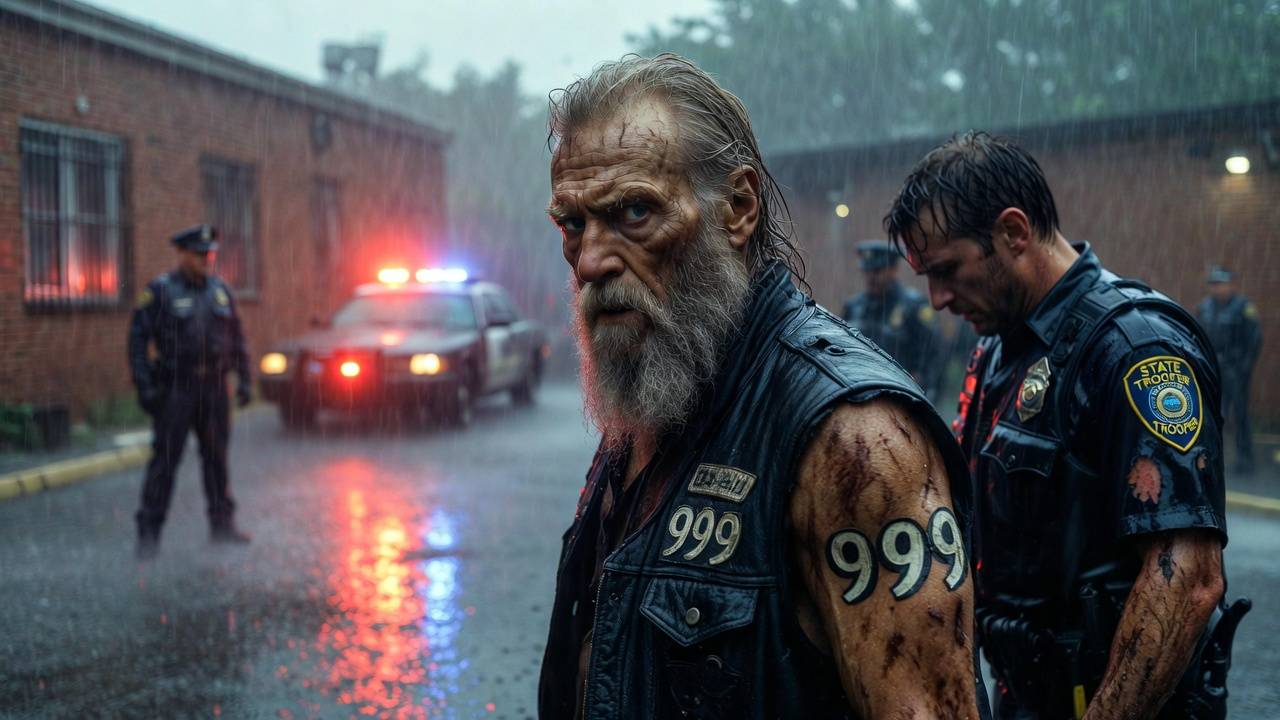
The rain in Pennsylvania doesn’t just fall; it punishes. It’s a cold, grey needles-and-pins kind of rain that soaks through denim and settles deep in the marrow of your bones. I stood there, the kickstand of my ’48 Panhead sinking into the softening asphalt of the 4th Precinct parking lot, watching the world I hated destroy the only thing I ever loved.
My son, Mark, was on his knees.
He was wearing the charcoal grey uniform of the State Troopers—the “Bastard’s Badge,” as the 999 Biker Club called it. It was the uniform he’d chosen over his own father ten years ago. It was the uniform that had sat across from me at Thanksgiving dinners where no one spoke, the fabric stiff and smelling of starch and arrogance.
Now, that uniform was torn at the shoulder. His hat was in a puddle. And the men he called “brothers”—men with shiny stars and clean haircuts—were mocking him.
“Look at him,” Captain Miller sneered, kicking Mark’s boot. “The golden boy. Turns out the apple doesn’t fall far from the tree, does it? Once a biker’s brat, always a criminal.”
Mark didn’t say a word. He just stared at the ground, his face a mask of shattered glass. They’d framed him. I knew it. He knew it. And Miller—the man currently tightening the cuffs until Mark’s wrists turned purple—certainly knew it.
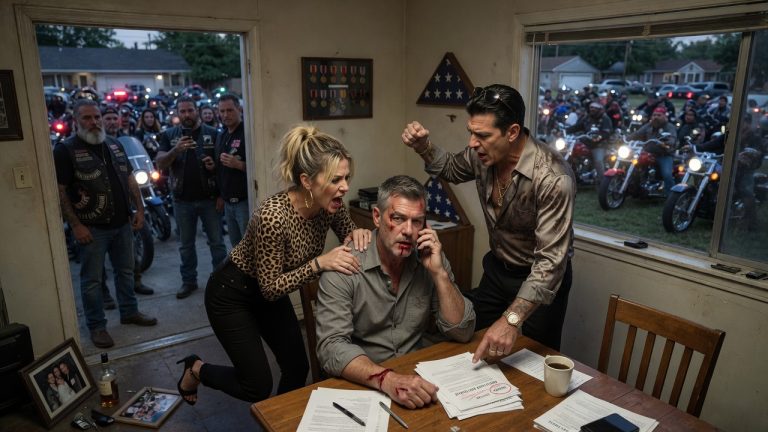
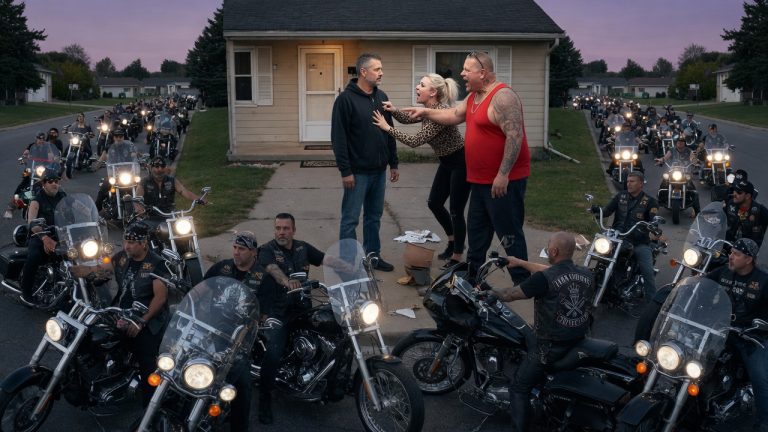
I felt the familiar growl in my chest, deeper than the rumble of the fifty bikes idling behind me. My brothers—the 999—were a wall of leather and chrome at my back. Men like “Lawless,” who’d spent his life looking for a reason to burn a precinct down, and “Pappy,” who had taught Mark how to ride before Mark decided he’d rather issue tickets than miles.
I stepped forward. The sound of my heavy boots on the wet pavement was the only thing that cut through the idling engines.
“Unchain my boy,” I said. My voice wasn’t loud, but it carried the weight of forty years of hard living.
Miller laughed, a dry, ugly sound. He reached for his sidearm, but he didn’t pull. He wasn’t that stupid. Not with fifty pairs of eyes watching him from under the brims of grease-stained hats. “This is police business, Judge. Go back to your clubhouse before I charge you with obstruction.”
“I’m not here as a club president, Miller,” I said, stopping three feet from him. I could smell the cheap coffee and the cowardice on him. “I’m here as a father. And you’re not taking him inside that building. Because we both know if he goes into that holding cell, he isn’t coming out alive.”
Mark finally looked up. His eyes met mine, and for the first time in a decade, I didn’t see the Trooper. I didn’t see the man who’d told me I was a “stain on the community.”
I saw my little boy. The one who used to sleep on a pile of leather jackets in the back of the garage.
“Dad,” he croaked. “Get out of here. You’ll go back to prison.”
I looked at the Captain, then back at my son.
“I’ve spent half my life behind bars, Mark,” I whispered, loud enough for the whole line of cops to hear. “I don’t mind spending the rest of it there if it means you don’t end up in a pine box because you trusted the wrong kind of family.”
I raised my hand, and behind me, fifty throttles opened up at once. The roar was deafening, a physical force that shook the windows of the precinct.
“Unchain him,” I growled, “or I’ll turn this precinct into a parking lot.”
Read the full story in the comments.
If you don’t see the new chapter, tap ‘All comments’.
FULL STORY
CHAPTER 2: THE BLOOD DEBT
The silence that followed the roar of the engines was heavier than the rain. Captain Miller’s hand was hovering over his Glock, his knuckles white. He looked at the line of bikes, then at his own men. The other officers were shifting uncomfortably. They were younger, most of them. They hadn’t been around long enough to know that Judge Sterling didn’t make empty threats.
“You’re making a mistake, Judge,” Miller said, his voice pitching an octave higher. “He’s dirty. We found the stash in his locker. Two kilos of civil forfeit cocaine. He was moving it for the Cartel.”
“Mark wouldn’t know how to find the Cartel if they were standing on his porch with a neon sign,” I spat. “He’s too honest for his own good. That’s why you’re doing this. He found something, didn’t he? Something about that warehouse fire in the Bottoms?”
Miller’s eyes flickered. A micro-expression. Guilt. Panic.
Mark looked at me, his brow furrowed. “How did you know about the warehouse?”
“Because I’m a criminal, remember?” I said, a bitter smile touching my lips. “We hear things. And I hear you’ve been asking the kind of questions that get people buried in the New Jersey marshes.”
I looked at Mark’s wife, Sarah, who was standing by her car at the edge of the lot, her face buried in her hands. She was a schoolteacher, a woman who had always looked at me like I was something she needed to bleach off her shoes. But right now, she was looking at me like I was the only life raft in a hurricane.
I remembered the day they got married. I wasn’t invited to the ceremony. I sat in my truck in the parking lot of the church, listening to the organ music through the cracked window, holding a gift I knew I could never give him—a vintage watch that had belonged to my own father.
Mark had wanted a clean life. He wanted the suburban house with the white fence and the 401k. He wanted to be the man I wasn’t. And for ten years, I’d let him hate me for it. I’d let him believe I was just a ghost in a leather vest, a reminder of a past he wanted to bury.
What he didn’t know was that his “clean life” was paid for by the very man he despised.
Five years ago, when Sarah got sick and the medical bills started piling up, Mark was a month away from losing that house. He was working double shifts, his eyes sunken, his soul breaking. He never asked me for a dime.
So, I set up a shell company. “Sterling Property Management.” I funneled club money—money from “clean” bike restorations and the occasional “tax” on local businesses—into that company. I’d been paying his mortgage for sixty months. Every time he opened his mail and saw that “grant” or “refinance credit,” he thought he was just lucky.
He wasn’t lucky. He had a father who loved him from the shadows.
“Captain,” a voice called out. It was the IA Director, a man named Henderson. He stepped out of the precinct’s side door, holding a folder over his head to keep off the rain. “What’s the holdup? Get him processed.”
Henderson was the snake in the grass. I knew him from way back. He was the one who processed my paperwork twenty years ago when I went up for assault. He was clean, polished, and as corrupt as a three-dollar bill.
“We have a situation, Director,” Miller called back, gesturing to the bikers.
Henderson looked at me. A slow, oily grin spread across his face. “Judge. Still breathing, I see. I heard you were retired.”
“I’m retired from everything but taking out the trash, Henderson,” I replied.
“Well, you’re looking at a pile of it,” Henderson said, pointing at Mark. “Your son is a disgrace to the uniform. He’s going to spend the next twenty years in a maximum-security cell. And since he’s a ‘brother in blue,’ I’m sure the other inmates will be very… welcoming.”
The threat was clear. They weren’t just going to jail him; they were going to have him murdered.
I looked at Pappy, the elder of the 999. He was eighty years old, with a tattoo of a soaring eagle on his neck that had faded into a grey blur. He nodded once. That was all the permission I needed.
“Lawless,” I said.
The man to my left, a giant with a scarred face and a penchant for chaos, stepped forward. He held up a small, black device. It was a body-cam, but it didn’t belong to the precinct.
“You see this?” I asked Henderson. “One of my guys was at that warehouse the night of the fire. He wasn’t there to loot. He was there because we’d heard rumors you were using it as a drop point. He recorded the whole thing. The meeting between you, Miller, and the guys from the Syndicate.”
The color drained from Henderson’s face. The rain seemed to stop for a second as the air grew thin.
“You’re lying,” Henderson hissed. “Bikers don’t use body-cams.”
“We do when we’re dealing with people more dishonest than us,” I said. “Unchain my son. Now. Or that footage goes live to every news station in the state in ten seconds.”
CHAPTER 3: THE RAT HOLE
Henderson didn’t move. Neither did Miller. They were caught in the space between a lie and the truth, and it was a narrow place to stand.
“You don’t have anything,” Miller barked, though his voice was shaking. “If you had that footage, you would have used it weeks ago.”
“I was waiting,” I said, my voice low and dangerous. “I was waiting to see if you’d actually go through with it. I thought maybe—just maybe—there was one decent man left in that building who would stand up for a partner. I wanted to see if Mark’s faith in the ‘blue wall’ was worth the ten years he gave you.”
I looked at Mark. He was staring at Miller, his partner of three years. The man who had been at his house for barbecues. The man who had held Mark’s daughter when she was born.
“Miller?” Mark asked, his voice barely a whisper. “Tell me he’s lying. Tell me you didn’t set me up.”
Miller didn’t look at him. He looked at his boots.
That was the answer.
Mark let out a sound—a choked, broken sob that he immediately tried to swallow. It was the sound of a man’s world collapsing. He had sacrificed his relationship with his father, his heritage, and his peace of mind for a badge that was now being used to choke him.
“The footage is real, Henderson,” I said, holding out my hand. Lawless handed me a tablet. I pressed play.
The screen was grainy, filtered through the green light of night vision, but the faces were unmistakable. There was Henderson, shaking hands with a man known as “The Vulture,” a high-level distributor for the local cartel. Behind them, the warehouse was a skeleton of fire. They were standing over crates of “evidence” that should have been in the precinct’s lockup.
“It’s timestamped,” I said. “Twelve-thirty A.M. last Tuesday. While you were filing the report saying the evidence was destroyed in the blaze.”
Henderson’s eyes darted around the parking lot. He was looking for an exit, but the 999 had boxed them in. The motorcycles were positioned like sentinels, their headlights cutting through the rain like searchlights.
“That’s inadmissible,” Henderson said, his voice turning shrill. “Obtained illegally by a known felon. It’ll never see a courtroom.”
“I don’t care about a courtroom,” I said. “I care about the street. And on the street, once people see this, you’re done. The Cartel won’t protect you once you’re a liability. Your own officers won’t follow a man who sells them out for a kickback.”
I walked closer, right into the “kill zone” between the cops and the bikers. I was an old man, unarmed, but I had never felt more powerful.
“Unlock the cuffs, Miller,” I commanded. “Now.”
Miller looked at Henderson. Henderson gave a nearly imperceptible nod.
The click of the handcuffs unlocking felt like a gunshot in the quiet lot. Mark stood up slowly, his legs shaky. He rubbed his wrists, the metal having left deep, angry red welts.
He didn’t run to me. He didn’t thank me. He just stood there, looking at the badge on his chest. Then, with a slow, deliberate motion, he unpinned it.
He looked at the piece of tin in his hand—the thing he’d worked his whole life for. He looked at Miller, then tossed it into the puddle at the Captain’s feet.
“I’m done,” Mark said.
“You’re not going anywhere!” Henderson shouted. “You’re still under arrest for the drugs in your locker!”
“What drugs?” I asked, holding up the tablet again. “You mean the ones Miller planted? Because we have footage of that, too. My guy followed him to the precinct parking lot four hours ago. He’s got a very nice telephoto lens.”
I was bluffing about the second video. But Henderson didn’t know that. And Miller—judging by the way he jumped—definitely believed it.
“Let them go,” Miller whispered. “Henderson, let them go. It’s over.”
“It’s not over,” Henderson snarled. “I’ll have every trooper in the state hunting you down!”
“Let them try,” I said, turning my back on him. It was the ultimate insult—to show a man with a gun that you didn’t fear him enough to watch him. “We’re leaving. And if anyone follows us, the upload button gets pressed.”
I walked over to Mark and put a heavy hand on his shoulder. He flinched at first, then leaned into it. He was shivering.
“Come on, son,” I said. “Let’s go home.”
“I don’t have a home,” Mark said, looking at Sarah, who was now running toward him. “They’ll take the house. They’ll take everything.”
“Nobody’s taking anything,” I said. “The house is paid for. It has been for years.”
Mark stopped dead in the rain. “What? What are you talking about?”
“Ask Sarah about the Sterling Property Management checks,” I said with a wink. “I might be a bastard, Mark, but I’m your bastard. Now get in the truck.”
CHAPTER 4: THE BROKEN SEAL
We retreated to the only place that felt safe: The Rusty Bolt, the 999’s clubhouse. It was a low-slung brick building on the edge of town, smelling of stale beer, sawdust, and freedom.
The bikes roared into the gravel lot, a victory lap that felt more like a funeral procession. Inside, the neon signs flickered to life. Pappy went behind the bar and started pouring shots of cheap whiskey. No one was cheering. We all knew that the war had just begun.
Mark sat at a scarred wooden table in the corner, Sarah clinging to his arm. He looked out of place in his uniform trousers and white undershirt, surrounded by men in patches and chains.
“Why did you do it, Dad?” Mark asked, his voice steady for the first time that night. “The house. The money. Why didn’t you just tell me?”
“Because you wouldn’t have taken it,” I said, sitting across from him. I pushed a glass of whiskey toward him. He stared at it but didn’t touch it. “You wanted to be your own man. You wanted to prove that you didn’t need the ‘criminal element’ in your life. If I’d told you, you would’ve moved out and slept in your car before taking a cent from me.”
“I hated you,” Mark whispered. “I told people my father was dead.”
“I know,” I said, and it didn’t hurt as much as it used to. “I would’ve hated me too. I wasn’t there when you were a kid. I was inside, or I was on the road. I gave you every reason to want a different life. But Mark… a badge doesn’t make a man honest. And a vest doesn’t make him a thief. It’s what’s inside the ribcage that counts.”
Pappy walked over, his heavy boots thudding on the floor. He laid a hand on Mark’s head—a gesture of benediction from a man who had seen more war than most generals.
“You did good tonight, kid,” Pappy said. “Tossing that badge. Took more guts than putting it on.”
“They’re going to come for us,” Sarah said, her voice trembling. “Henderson won’t just let this go. He has friends in the Governor’s office. He has the Syndicate.”
“He has a secret,” I corrected her. “And in this town, a secret is more dangerous than a gun. But you’re right. He’s a cornered rat. And a rat will bite.”
Just then, the front door of the clubhouse swung open. Lawless came in, his face grim.
“Judge. We got a problem.”
“What is it?”
“The footage,” Lawless said, holding up his phone. “It’s gone. The cloud server was wiped. Someone hacked the encryption.”
I felt a cold stone drop in my stomach. Henderson wasn’t just a cop; he had tech experts on the payroll. He’d tracked the upload and killed it before it could be shared.
“The physical drive?” I asked.
“In the safe at my place,” Lawless said. “But Judge… my place is crawling with SWAT. They moved fast. They’re calling it a ‘drug raid.’ They’re destroying everything.”
I looked at Mark. The hope that had begun to flicker in his eyes died out. Without that footage, it was his word against the entire department. And he was a “dirty cop” with two kilos of coke in his locker.
“He’s going to win,” Mark said, burying his face in his hands. “He’s going to kill us all and call it ‘police work.'”
I stood up, my joints popping. I looked around the room at my brothers. They were looking at me, waiting. They were outlaws, misfits, and rebels. But they were the only army we had left.
“No,” I said, my voice vibrating with a sudden, fierce clarity. “He’s not going to win. Because he forgot one thing.”
“What’s that?” Pappy asked.
“He forgot that we aren’t the only ones he’s betrayed,” I said. “Lawless, call the other clubs. The Pagans, the Warlords, even the guys from across the bridge. Tell them the 999 is calling in every favor. Tell them we’re going back to the precinct. Not to talk. Not to record.”
“Then what for?” Sarah asked, her eyes wide.
“To bear witness,” I said. “We’re going to bring the whole city to their front door. Let’s see how many ‘dirty’ deals they can make when a thousand bikes are blocking the sun.”