Chapter 1: The Wooden Statue
The Los Angeles sun isn’t a light source; it’s a physical weight. At the Vanguard Academy for Young Aesthetics, they don’t call it punishment. They call it “Compositional Endurance.”
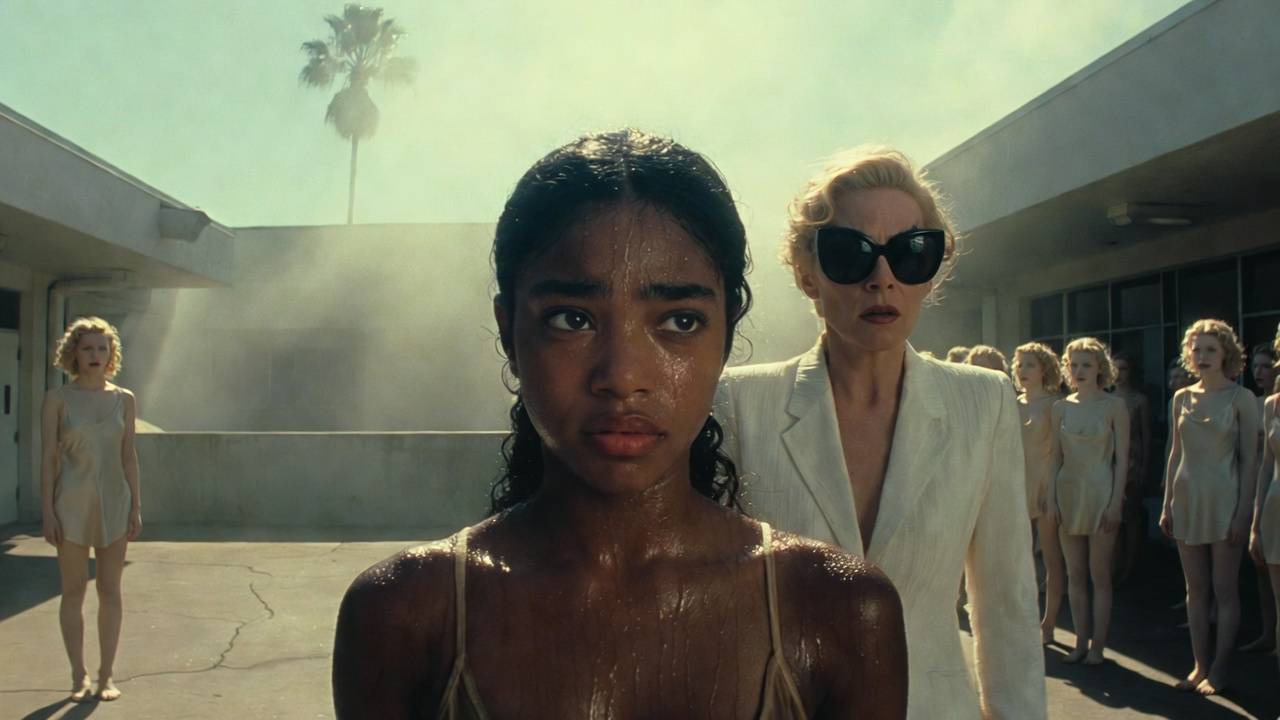
I had been standing on the concrete plinth for three hours. My skin, the color of deep espresso, was slick with a layer of sweat that felt like boiling oil. My hamstrings were screaming, a high-pitched mental siren that I had to bury under layers of forced dissociation.
“Don’t move, Nia,” Madame Valeska whispered. Her voice was like dry parchment rubbing together. She stood in the shade of a white linen umbrella, sipped an iced Pellegrino, and watched me through Dior shades. “You aren’t a girl right now. You are the negative space. You are the shadow that makes the ‘real’ girls pop.”
Ten feet away, the “real” girls stood in a semi-circle. There were five of them—The Porcelain Five. Chloe, Sarah, Mia, Britney, and Jade. They were all five-foot-ten, eighty-five pounds of blonde curls and blue-eyed vacancy. They wore $2,000 silk slips that didn’t have a single sweat stain.
They looked at me, and I saw the “Rule of the Crowd” in full effect. Individually, maybe Chloe felt bad for me. Maybe Sarah wanted to bring me a glass of water. But together? Together, they were a collective organism of indifference. They looked at me the way you look at a floor lamp. Necessary for the room’s vibe, but ultimately inanimate.
“The contrast is perfect,” Chloe chirped, her voice trembling just enough to betray her own fear of being next. “The way the light hits the dark wood… it makes my skin look like milk.”
“It’s not wood, Chloe,” Valeska snapped. “It’s a backdrop. Nia, your left shoulder is dropping. Correct it.”
I didn’t move. If I moved, I’d fall. If I fell, my mother’s three cleaning jobs—the ones paying for this ‘opportunity’—would be for nothing. We lived in a cramped apartment in Inglewood where the walls smelled like Pinesol and desperation. My mother believed beauty was my ticket out. She didn’t realize that at Vanguard, beauty was a manufacturing process, and I was just the scrap metal on the floor.
My vision started to swim. The white concrete began to turn into a lake of fire. A group of wealthy donors walked by on a tour of the academy. They stopped, pointing at the “composition.”
“Is she real?” one woman asked, fanning herself with a brochure.
“She’s a lesson in resilience,” Valeska lied, her smile as sharp as a scalpel.
The donors nodded, their eyes glazing over. They didn’t see the way my hands were shaking. They didn’t see the silent plea in my eyes. To them, I was just part of the architecture of perfection.
Then, the gate at the end of the courtyard creaked open. The air in the courtyard seemed to drop ten degrees. Valeska stood up so fast she spilled her water.
A man stepped out. He wasn’t wearing linen or Dior. He wore a grease-stained T-shirt, cargo pants, and a camera harness that looked like it had been through a war zone.
Julian Thorne. The man who had shot every Vogue cover that mattered for the last twenty years. The man who decided who lived and who died in the world of high fashion.
He didn’t look at Valeska. He didn’t look at the Porcelain Five.
He walked straight toward the plinth. He walked straight toward the girl the world had decided was just a shadow.
Read the full story in the comments.
If you don’t see the new chapter, tap ‘All comments’.
FULL STORY
Chapter 2: The Porcelain Debt
To understand why I was willing to die on that concrete plinth, you have to understand the debt. In America, beauty isn’t just a gift; it’s a high-interest loan.
My mother, Elena, had spent twenty years scrubbing the floors of the very people who now looked at me like a prop. Her hands were permanently red, the skin cracked from bleach. When a scout saw me at a bus stop in South Central, he didn’t see a person. He saw a “raw asset.”
“She has the bone structure of a Nefertiti and the eyes of a gazelle,” he had told my mother. “But she needs ‘refining.’ She needs Vanguard.”
Vanguard cost sixty thousand dollars a year. My mother took out a second mortgage on the house my grandfather had built. She took on three more houses to clean. Every night, she’d come home and massage my feet, her own hands shaking with exhaustion.
“You’re going to be on the side of a building in Times Square, Nia,” she’d whisper. “And no one will ever ask you to clean a floor again.”
But Vanguard wasn’t a school. It was a factory of erasure. On my first day, Madame Valeska sat me down in a room filled with mirrors.
“You are too ‘loud’,” she said, circling me. “Your hair is too textured. Your expressions are too emotional. To be a top model, you must be a blank canvas. But you? You have too much history in your face. We have to drown that out.”
The other girls—Chloe, Sarah, the rest—had been born into this. They were the daughters of studio executives and real estate moguls. They didn’t have history; they had brands. Chloe was “The All-American Sweetheart.” Sarah was “The Ethereal Nymph.”
I was “The Exotic Element.”
That was the nice way of saying I was the diversity hire used to make the academy look progressive while they spent eight hours a day teaching me how to hide everything that made me Black. They put me in the back of every group shot. They made me stand in the harshest light to “test the sensors.”
By the second month, the “Rule of the Third Party” had fully set in. The other girls stopped talking to me in the cafeteria. It wasn’t that they hated me; it was that I had become socially invisible. If they were seen with the “backdrop,” they might lose their status as “the focal point.”
I watched them from the edges of the room—a crowd of identical dolls, terrified of a single wrinkle, terrified of a single pound of fat. They were panicking in slow motion, starving themselves and crying in the bathrooms, but as soon as the cameras turned on, they were statues of perfection.
They were the children of perfection, and they were dying inside. And I was the only one who could see it, because I was the only one they didn’t bother to hide it from.
Chapter 3: The Secret in the Lens
The arrival of Julian Thorne at Vanguard was like a predator entering a petting zoo.
He didn’t play the game. He didn’t care about Valeska’s pedigree or the girls’ social media following. He was known for “The Fracture”—a style of photography that captured the exact moment a person’s facade broke.
“Julian! We weren’t expecting you until the gala tomorrow,” Valeska gushed, her voice hitting a register of desperation I’d never heard.
Thorne didn’t respond. He was adjusting a lens, his eyes scanning the courtyard. He looked at Chloe, who immediately struck her “Sweetheart” pose. He looked at Sarah, who tilted her chin to show off her jawline.
He looked through them. Literally. It was as if they were made of glass.
“Too much plastic,” Thorne muttered. It was loud enough for everyone to hear.
Chloe’s face winced. A tiny crack in the porcelain. The crowd of donors shifted uncomfortably, looking at each other. They had spent millions on these girls, and the world’s greatest eye had just called them trash.
“Julian, please,” Valeska said, her face reddening. “The girls have been training for months. The composition in the courtyard is exactly what you requested—’Light and Shadow’.”
“I see the light,” Thorne said, gesturing vaguely at the Porcelain Five. “It’s boring. It’s flat. It’s what you see on a cereal box.”
He turned his head. His eyes locked onto mine.
I was still on the plinth. I was still shaking. My skin was glowing with sweat, and my hair, which had escaped its tight bun from the heat, was beginning to coil around my face in defiant, tight curls. I looked like a mess. I looked like a failure.
“But the shadow…” Thorne whispered.
He walked toward me. The “Rule of the Crowd” broke. The donors, the students, the instructors—they all surged forward, a mass of confused, panicked bodies. They couldn’t understand why he was moving toward the “wooden statue.”
“Get out of the way,” Thorne snapped at a donor who was blocking his view.
He stopped at the foot of my plinth. He looked up at me. For the first time in six months, someone didn’t look at my bone structure or my “exoticism.”
He looked at my pain.
“How long have you been standing here?” he asked.
“Three hours and forty-two minutes,” I rasped. My voice sounded like gravel.
“Why?”
“Because they told me I was the only thing in this yard that didn’t matter,” I said. “So I decided to be the only thing that lasted.”
Thorne smiled. It wasn’t a nice smile. It was the smile of a man who had just found a diamond in a gutter.
“Get down,” he said.
“I can’t,” I whispered. “If I move, I’ll break.”
“Good,” Thorne said, raising his camera. “I want to see the break.”
Chapter 4: The Shattering
What happened next was a blur of high-fashion carnage.
Julian Thorne didn’t set up lights. He didn’t ask for a makeup artist. He told Valeska to shut up and stay back.
He stayed on the ground, looking up at me.
“Chloe! Sarah! Get in the shot!” Valeska commanded, trying to salvage the moment.
The Porcelain Five scrambled onto the plinth. They surrounded me, their silk slips shimmering. They tried to push me to the back, to make me the “shadow” again.
“No,” Thorne barked. “Nia stays center. You five… get on your knees. Turn your backs to the camera. I want your spines. I want your anonymity.”
The girls froze. To be told to turn their backs to Julian Thorne was the ultimate professional death sentence. Chloe started to cry—real, ugly tears that ruined her $500 mascara.
“I said turn around!” Thorne roared.
They obeyed. They were terrified. They knelt around me like mourners at a grave.
Then Thorne looked at me.
“Nia. Look at the sun. Don’t blink. I want to see the fire you’ve been hiding behind that ‘wooden’ face. I want to see the Inglewood bus stop. I want to see your mother’s hands. Give me the debt.”
I looked into the sun. The pain was blinding. I felt the “statue” mask shatter. Every emotion I had suppressed at Vanguard—the humiliation, the loneliness, the anger at seeing my mother work herself to death—it all surged to the surface.
I didn’t pose. I screamed. Not with my mouth, but with my soul.
Click.
The sound of his shutter was like a gunshot.
Click. Click. Click.
He was moving around the plinth like a dervish. He ignored the “Perfect” girls entirely. They were just white shapes in the foreground, blurred and secondary.
The crowd of donors was silent. The “Third Party” was finally witnessing something they couldn’t buy. They saw the raw, sun-scorched reality of a girl who refused to be erased.
“Enough,” Thorne said suddenly. He lowered his camera.
The courtyard was deathly quiet.
“Julian?” Valeska stepped forward, her voice trembling. “The girls… the group shot… we have the gala outfits ready—”
“The shoot is over,” Thorne said. He looked at me, and for a second, the predator was gone. “Go home, Nia. Tell your mother she can stop cleaning floors.”