Mia Rossi spent every night in a trailer park, her fingers dancing over a keyboard drawn in Sharpie on a piece of cardboard. She wasn’t just practicing; she was surviving, writing the masterpieces that the town’s golden girl, Isabella Sterling, claimed as her own.
For six months, Mia took the “under-the-table” cash to keep her little sister fed and the eviction notice off the door. She wore the hand-me-downs and kept her head low while Isabella’s face was plastered on every conservatory billboard.
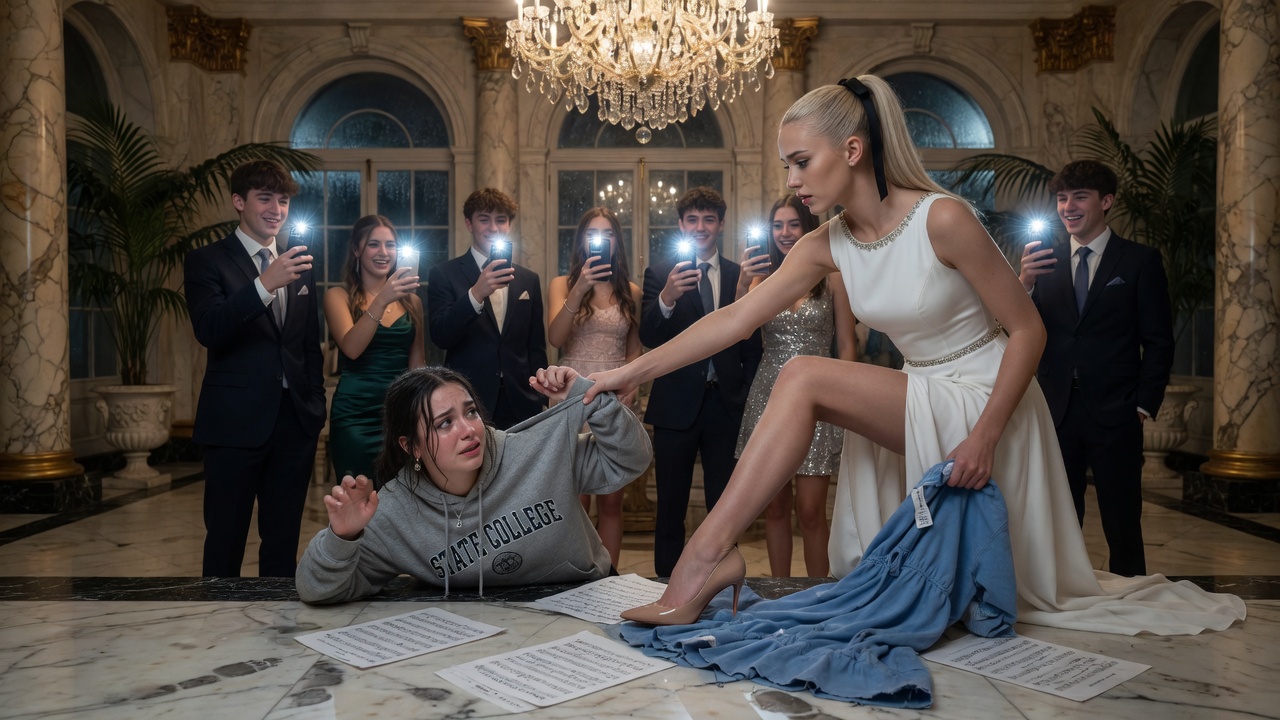
But at the Scholarship Gala, the cruelty found a new gear. In front of the wealthiest donors in the state, Isabella didn’t just mock Mia’s thrift-store audition dress—she threw it on the marble floor and ground her designer heel into the fabric.
Mia’s mother, working the catering line just ten feet away, watched in trembling silence, knowing one word of defense would cost them their home. The crowd didn’t help; they just pulled out their phones to record the “charity case” being put in her place.
Isabella thought the music was the only thing she’d stolen. She thought Mia was a ghost that didn’t know how to haunt. She grabbed Mia’s hoodie, laughing about “pity grants” and “trash,” completely unaware that the girl in front of her had nothing left to lose.
The shift didn’t happen with a scream. It happened in the quiet of Mia’s eyes when she finally stopped being afraid. She gave one warning, a soft, low plea for Isabella to let go, but privilege has a way of making people deaf to reality.
When Isabella shoved her, the air in the lobby changed. The “poor girl” from the trailer park didn’t crumble. She moved with the terrifying precision of someone who had spent a lifetime fighting for every inch of space.
The video is already everywhere, but it doesn’t show the whole truth. It doesn’t show what happens to a kingdom when the person who built the throne decides to tear it down.
Read the full story in the comments.
Chapter 1
The keyboard didn’t make a sound, but Mia heard the C-sharp in the marrow of her wrists.
It was a flattened piece of corrugated cardboard, the kind that smelled like old adhesive and damp basements. She’d used a black permanent marker to draw the eighty-eight keys, measuring the width of each one with a ruler she’d stolen from a middle school supply closet three years ago. The ink was faded where her fingers hit the most—the middle C, the aggressive reach of the octaves—leaving greyish smudges that looked like bruises on the paper.
Outside the trailer, the wind off the interstate rattled the thin aluminum siding. It was a rhythmic, metallic shivering that Mia tried to incorporate into the tempo of the Rachmaninoff piece she was “playing.” If she focused hard enough, the sound of the semi-trucks downshifting on the off-ramp became the low, rumbling bass notes her father used to play before he sold the Steinway.
“Mia, honey, you’re going to put a hole through that table.”
Her mother, Elena, stood at the kitchenette counter, her back a sharp curve of exhaustion. She was wearing her housekeeper’s uniform—the stiff, light-blue polyester that smelled like industrial lemon bleach and other people’s dust. She was counting out a stack of crumpled singles and five-dollar bills, her fingers moving with a mechanical, desperate speed.
“I need to get the bridge right, Mom,” Mia said, her fingers blurring across the cardboard. “If I don’t feel the reach now, I’ll fumble it when I get to the shop tonight.”
Elena sighed, the sound catching in a throat made raw by years of cleaning solutions. She didn’t look at the cardboard. She couldn’t. To Elena, that drawing was a tombstone for a life they used to have. “The shop. You’re going back to see Mr. Henderson?”
“He says the tuning is nearly done on the upright in the back. He lets me use it for two hours if I sweep the floors and oil the wood.”
“Two hours isn’t enough to win a scholarship, Mia. Not against those kids who have grand pianos in their bedrooms.” Elena finally turned, her eyes hollow. “The rent is short again. Forty dollars. If I ask Mrs. Sterling for an advance, she’ll look at me like I’m a dog begging for a scrap. I can’t do it. I can’t let her see me like that.”
Mia’s fingers stopped. The silence in the trailer felt heavy, like the air before a storm. “I have the money, Mom.”
Elena’s head snapped up. “What? From where?”
Mia reached into the pocket of her oversized gray hoodie and pulled out two crisp twenty-dollar bills. She’d hidden them behind her father’s old metronome, the one piece of his life he hadn’t sold because the wood was too cracked to be worth a dime.
“Isabella gave it to me,” Mia lied, though it was only a half-lie. “For the tutoring.”
“Tutoring,” Elena whispered, her expression shifting from suspicion to a fragile, dangerous hope. “She’s paying you forty dollars for an hour of music theory?”
“She’s wealthy, Mom. To her, forty dollars is a coffee and a cab ride. She needs to pass the mid-term if she wants to stay on the track for the national scholarship. She’s… she’s not as fast as I am.”
The truth was a jagged thing hidden under Mia’s tongue. Isabella Sterling wasn’t paying for tutoring. She was paying for the soul of a concerto Mia had written in the dead of night, scribbling notes on the back of eviction warnings. Isabella was buying the right to put her name on Mia’s genius, and Mia was selling it so they wouldn’t have to sleep in the old Honda Civic again.
“You’re a good girl, Mia,” Elena said, taking the money. Her touch was brief, her palm rough against Mia’s skin. “A better girl than this place deserves.”
Elena went back to her counting, her movements a little lighter, a little more human. Mia looked back down at her cardboard keyboard. She felt a phantom ache in her right wrist—a sharp, electric twinge that came from practicing eight hours a day on a surface that didn’t give. A repetitive stress injury was a luxury she couldn’t afford, yet it was the only thing she truly owned besides the music.
Her younger sister, Sofia, poked her head out from the “bedroom”—a space separated from the rest of the trailer by a hanging floral sheet. Sofia was ten, with eyes that were too large for her thin face and a habit of biting her nails until they bled.
“Are you going to play for real tonight?” Sofia asked, her voice a small, hopeful thread.
“Yeah, Sof. For real.”
“Can you play the one about the birds? The one Dad liked?”
Mia felt the old wound in her chest twist. Her father had been a man of crescendos and crashing finales until the booze and the pills turned his music into a slow, discordant rot. The day he sold the piano, he’d told Mia that some people were born to hold the keys and some were born to turn them for others.
“I’ll play it,” Mia promised.
She stood up, grabbing her backpack. Inside were the scores—the real ones. The ones Isabella would perform tomorrow at the preliminary hearing. Every note was a piece of Mia’s heart, packaged and sold for forty dollars and a chance to keep a roof over Sofia’s head.
As she stepped out of the trailer, the cold air hit her like a physical blow. The trailer park was a graveyard of rusted metal and broken dreams, tucked behind a screen of pine trees that didn’t quite hide the glow of the city.
The city was where the Sterling mansion sat on a hill, a fortress of white stone and heated floors. It was where Isabella Sterling practiced on a ten-thousand-dollar baby grand, her fingers moving over keys that Mia had paved with her own desperation.
Mia walked toward the bus stop, her hands shoved deep into her pockets. She flexed her fingers, feeling the ghost of the cardboard texture. She wasn’t just a tutor. She wasn’t just a ghostwriter. She was a secret waiting to explode, but as she watched a black SUV with the Sterling family crest drive past the park entrance, she knew that in the world of the “Old Money” gatekeepers, a secret was only as powerful as the person holding it. And right now, Mia was holding nothing but a backpack full of someone else’s future.
Chapter 2
The Conservatory of Music felt like a cathedral built for a god that Mia didn’t believe in. The floors were white marble, polished to a mirror finish that showed Mia exactly how frayed the cuffs of her jeans were. The air smelled of expensive wood polish, old paper, and the kind of silence that only comes from deep pockets.
“You’re late,” Isabella said.
She was sitting on a velvet bench in Practice Room 4, her blonde hair pulled back so tight it looked painful. She was wearing a cashmere sweater the color of cream and leggings that cost more than Mia’s bus pass for the year. Beside her sat a leather bag, and inside that bag was the power to make Mia’s mother disappear from the Sterlings’ payroll with a single phone call.
“The bus broke down on 4th,” Mia said, dropping her backpack. She didn’t apologize. She didn’t have the energy to pretend she was sorry for things she couldn’t control.
Isabella didn’t look up from her phone. “My mother says your mom missed the cobwebs in the chandelier in the foyer yesterday. She told her she’s getting sloppy. You should tell her to pay more attention. My mother hates sloppiness.”
Mia’s jaw tightened until her teeth ached. She could see her mother on a ladder, arms shaking as she reached for glass crystals, her vision blurring from the lemon bleach. “I’ll tell her.”
“Good. Now, the third movement. I can’t get the tempo right. It feels… clunky.”
“It’s not clunky,” Mia said, stepping toward the piano. It was a Steinway. Not a grand, but an upright that felt like a living thing compared to her cardboard. “You’re playing it like a math problem. It’s a confession, Isabella. It’s supposed to hesitate. You’re rushing the rubato because you’re afraid of the silence.”
Isabella rolled her eyes and slid off the bench. “Spare me the poetry, Mia. Just show me how to do it so I don’t look like an idiot in front of the board tomorrow. If I don’t get the scholarship, my dad is going to make me go to business school in London. Do you have any idea how boring that would be?”
Mia sat down. The keys felt cold, then warm, then perfect. She didn’t look at the sheet music; she didn’t need to. She’d breathed these notes into existence. She played the first few bars of the third movement—the part she’d written while watching her sister sleep on a thin mattress. It was a melody about wanting to be seen and knowing you never would be.
The sound filled the small room, rich and golden. For a moment, the marble walls and the expensive sweaters disappeared. There was only the vibration in the wood and the way the music felt like it was pulling the air out of her lungs.
When she finished, the room felt smaller, the silence more uncomfortable.
Isabella was staring at her, her expression unreadable. For a split second, there was a flash of something like genuine envy in her eyes, a recognition of a brilliance she could never buy. Then, she blinked, and the mask of bored privilege snapped back into place.
“Whatever,” Isabella said, reaching into her bag and pulling out an envelope. “Here’s the rest for the sonata. And I want the new piece by Friday. My mother is hosting a donor gala, and she wants me to debut something ‘fresh and soulful.’ Make sure it’s soulful, Mia. Not too depressing.”
Mia took the envelope. It was thick. “This is more than we agreed on.”
“Consider it a bonus for the ‘tutoring,'” Isabella sneered, leaning closer. “And a reminder that my mother is very happy with your mom’s work lately. Let’s keep it that way, okay? It would be a shame if she had to find a new house to clean in the middle of winter.”
The threat was delivered with a smile, the kind of casual cruelty that only people who have never been hungry can manage. Isabella knew exactly where the leverage was. She knew about the eviction notice. She knew about the CPS worker who had visited the trailer park last month after someone reported “substandard living conditions.”
Mia tucked the envelope into her hoodie. “I’ll have it by Friday.”
She walked out of the conservatory, the marble floors squeaking under her thrift-store sneakers. Every step felt like a betrayal. She was selling her voice to the person who was strangling it.
She didn’t go home. She couldn’t face the cardboard keyboard yet. Instead, she walked six blocks to a narrow alleyway behind a row of brick warehouses. At the end of the alley was a small, grimy shop with a sign that simply said: HENDERSON’S PIANO REPAIR.
The bell chimed as she entered. The shop was a forest of skeletons—pianos with their guts ripped out, wires hanging like nerves, wooden hammers waiting for a touch. The air was thick with the scent of sawdust and old felt.
In the back, an old man with thick glasses and a hearing aid turned around. This was Mr. Henderson. He’d been the best tuner in the tri-state area until a fever took most of his hearing ten years ago. Now, he “heard” through the vibrations in the floor and the way the strings felt under his calloused thumbs.
“You’re late, Rossi,” he grunted, but his eyes were kind.
“Bus broke down,” Mia said.
“Always the bus with you. Go on. The upright in the corner. I fixed the damper pedal. It’s as close to ‘refined’ as that piece of junk is ever going to get.”
Mia didn’t waste time. She sat at the battered upright, its wood scarred by years of neglect. She began to play, and Henderson stood nearby, his hand resting on the top of the piano. He wasn’t listening with his ears; he was feeling the “genius” in her touch.
“You’re playing with too much anger,” he said after a few minutes. “The notes are sharp. You’re trying to punish the strings.”
“Maybe the strings deserve it,” Mia muttered.
“The strings just do what they’re told. It’s the hand that makes the choice.” He leaned in, his voice dropping. “I heard a rumor at the music shop today. The Sterling girl is being hailed as a prodigy. People are talking about a ‘compositional depth’ that hasn’t been seen in years. Funny, though. I’ve heard her play. She’s got the technique of a player piano and the heart of a stone.”
Mia froze. “She’s… she’s practicing hard.”
“Is she?” Henderson looked at her, his gaze piercing. “Or is someone else doing the heavy lifting? Be careful, Mia. You can sell your time, and you can sell your labor. But when you sell your soul, you don’t get a receipt to buy it back later.”
“I have to keep my sister safe,” Mia said, her voice cracking.
“I know,” Henderson sighed. “But a cage made of gold is still a cage. And eventually, the person with the key is going to want to see you dance.”
He walked away, leaving Mia alone with the battered piano. She looked at her hands. They were trembling. The RSI in her wrist flared—a sharp, hot needle of pain that made her wince. She looked at the keys, then at the envelope in her pocket. She had the money. She had the secret. But as the sun began to set, casting long, jagged shadows across the floor, she realized she was running out of time before the secret became the only thing left of her.
Chapter 3
The dress was a deep, midnight blue. Mia had found it at the back of a Goodwill rack, buried under a pile of moth-eaten sweaters. It was silk—real silk—with a modest neckline and a skirt that felt like water when she moved. It cost twelve dollars, but when Mia put it on in the cramped trailer bathroom, she didn’t see the girl from the park. She saw a pianist.
“Oh, Mia,” Sofia whispered, standing in the doorway. “You look like a queen.”
“It’s just for the gala, Sof,” Mia said, trying to smooth a wrinkle that wouldn’t budge. “I’m just supposed to be there to ‘support’ Isabella. In case she forgets the fingerings for the new piece.”
“You’re the one who wrote it,” Sofia said, her voice rising with a rare flash of indignation. “You should be the one playing it. Everyone should know.”
“If everyone knows, we lose the money. If we lose the money, the landlord calls the sheriff. You want to move back to the car?”
Sofia went quiet, her shoulders slumping. “No.”
“Then I’m a tutor. That’s all. I’m a tutor who found a nice dress.”
Mia’s mother came in, her face pale. She’d worked a double shift at the Sterlings’ to prepare for the gala. “Mia, the car is here. Mrs. Sterling sent a car for us. She said she wants us there early to ‘help with the final touches.'”
The “car” was a black town car that looked like a sleek, predatory shark in the middle of the gravel lot. The neighbors stared through their plastic-covered windows as Mia and her mother walked toward it. Mia clutched her backpack, which contained her real scores—the ones she’d never show Isabella. They were her tether to reality, the proof that she still existed.
The Sterling estate was transformed into a glittering wonderland. String lights hung from the oak trees, and the air hummed with the sound of a hundred wealthy voices. Mia’s mother disappeared into the kitchen immediately, her head bowed as she took her place among the “help.”
Mia was led to the grand lobby, where the donors were gathered. The room was a sea of tuxedos and floor-length gowns. At the center of it all stood Isabella and her mother, Mrs. Sterling.
Mrs. Sterling was a woman of sharp angles and even sharper smiles. She was currently holding a glass of red wine, presiding over a circle of “Patrons of the Arts” like a queen regent.
“And here is our little shadow,” Mrs. Sterling said as Mia approached. Her voice was like honey poured over glass. “Mia, dear, you look… practical. Is that polyester? It’s so brave of you to wear something so durable to an event like this.”
A few of the women in the circle chuckled—a soft, polite sound that felt like a slap.
Isabella was standing next to her mother, looking radiant in a white designer gown that probably cost more than Mia’s trailer. She looked at Mia’s blue dress with a slow, sweeping gaze of pure contempt.
“I told her she could borrow one of my old ones from middle school,” Isabella said to the group. “But I guess she wanted to show off her ‘vintage’ find.”
“It’s silk,” Mia said, her voice steady.
“Is it?” Mrs. Sterling leaned in, her eyes narrowing. “It looks a bit… dusty. Like it’s been sitting in a bin for a decade. Isabella, darling, go check the piano. The committee members are arriving.”
As Isabella walked away, she brushed past Mia, her shoulder hitting Mia’s with a deliberate, forceful jolt. Mia stumbled, her backpack slipping from her shoulder.
“Oops,” Isabella whispered, not looking back.
Mia knelt to pick up her bag, her heart hammering against her ribs. She felt the weight of the room on her—the eyes of the donors, the pitying smiles of the waiters, the cold, distant stare of Mrs. Sterling.
She retreated to a corner near the grand staircase, trying to blend into the shadows. Her wrist was throbbing now, a dull, rhythmic ache that signaled she’d pushed it too far at Henderson’s shop. She took a deep breath, trying to center herself, trying to remember the music.
Ten minutes later, Isabella returned. She was holding a fresh glass of red wine, her face flushed with a dark, triumphant energy. She saw Mia and headed straight for her.
“The committee is asking about the inspiration for the ‘soulful’ piece,” Isabella said, her voice loud enough to carry to the nearby donors. “I told them it was about the ‘tragedy of the underprivileged.’ They loved it. They think I’m so empathetic.”
“It’s not about that,” Mia said, her voice low. “It’s about my father.”
“It’s about whatever I say it’s about, Mia. I bought the rights. Remember?” Isabella leaned in, her breath smelling of expensive grapes and malice. “You’re just the ghost. And ghosts don’t have fathers. They don’t even have names.”
“Isabella, stop,” Mia said, her hand tightening on her backpack strap.
“Or what? You’ll tell them? Go ahead. Tell them you’re a fraud who sells her work because her mom is a maid. See who they believe. The girl who donates a wing to the library, or the girl who lives in a tin box.”
Isabella took a step closer, crowding Mia’s space. She looked down at Mia’s blue dress, her lip curling. “You actually think you belong here, don’t you? In this cheap, dirty rag. You look like an embarrassment.”
“Don’t,” Mia said, her voice a warning.
“Oh, look,” Isabella said, her eyes glinting. “I think I see a stain.”
She didn’t trip. She didn’t slip. With a slow, deliberate motion, Isabella tilted her glass. The deep red wine poured out in a steady stream, soaking into the midnight blue silk of Mia’s only nice dress. It spread like a wound across her chest, cold and sticky.
The donors nearby gasped, but it wasn’t a gasp of horror for Mia. It was a gasp of social discomfort.
“Oh, Mia! I am so sorry!” Isabella cried out, her voice loud and fake. “I’m such a klutz. Mom! Mia’s dress is ruined. We should get her into something… appropriate for the kitchen before people start to notice.”
Mrs. Sterling appeared as if on cue. She looked at the red stain, then at Mia, with a look of profound, disgusted pity. “Oh, dear. That is a mess. Elena! Elena, come here and take your daughter to the back. We can’t have her looking like a bleeding heart in the middle of the lobby.”
Mia’s mother appeared, her face burning with shame. She looked at Mia’s ruined dress, then at the floor, her hands twisting her apron. “I’m sorry, Mrs. Sterling. I’ll take her. I’m so sorry.”
“Mom, don’t apologize,” Mia said, her voice trembling with a fury she’d spent seventeen years suppressing.
“Mia, please,” Elena whispered, grabbing Mia’s arm. “Just come to the kitchen. Please. We need this job.”
Mia looked at Isabella. The blonde girl was smiling—a tiny, razor-sharp smile of pure victory. She had taken the one thing Mia had tried to keep for herself: her dignity.
As Mia was led away toward the service entrance, she could hear the laughter resuming behind her. She felt the wet silk clinging to her skin, the smell of wine filling her head like a fever. She looked down at her backpack. The scores were still there. And for the first time, the “C-sharp” in her mind didn’t sound like a melody. It sounded like a scream.
Chapter 4
The service hallway smelled of roasted garlic and repressed panic. Mia stood by a stack of plastic crates, her mother frantically dabbing at the blue silk with a damp rag.
“It won’t come out,” Elena whispered, her voice hitching. “The silk is ruined, Mia. I’m so sorry. I should have bought you something new. I should have worked more hours.”
“It wasn’t an accident, Mom,” Mia said. She was remarkably calm now. The heat in her chest had crystallized into something cold and sharp, like a shard of ice. “She did it on purpose. She wanted everyone to see me as ‘the help.'”
“It doesn’t matter why,” Elena said, her eyes darting toward the kitchen door where the head caterer was shouting orders. “We have to stay invisible. If we make a scene, they won’t just fire me. They’ll make sure I can’t find work anywhere else in this city. You know how they are. They talk to each other.”
Mia looked at her mother—really looked at her. She saw the grey hair she hadn’t noticed before, the way her hands were perpetually red and swollen from lye. Her mother had spent her life becoming invisible so Mia could have a voice. And Mia had spent her life selling that voice to the people who made her mother disappear.
“I’m not going to the kitchen, Mom,” Mia said.
“Mia, don’t—”
“Go back to work. I’ll stay out of sight. I promise.”
Mia waited until her mother disappeared back into the fray of the kitchen. Then, she didn’t head for the exit. She headed back toward the lobby. She didn’t care about the stain anymore. The red mark on her chest felt like a badge of office.
She found her backpack near the service door where she’d dropped it. She pulled out the handwritten scores—the real ones. The ones Isabella had stolen earlier from her bag in Practice Room 4. Wait—no. She checked the side pocket. Her bag was empty.
Isabella hadn’t just spilled wine. She’d taken the only proof Mia had.
Mia walked back into the lobby. The crowd had shifted toward the grand staircase, where a podium had been set up next to a pristine 9-foot Fazioli grand piano. The air was thick with expectation. This was the moment of the debut.
Isabella was standing at the top of the stairs, the stolen scores clutched in her hand like a trophy. She looked down and saw Mia standing near the edge of the crowd, the red stain prominent against the blue silk. Isabella didn’t look afraid. She looked amused.
She walked down the stairs, the crowd parting for her. She stopped three feet from Mia, the donors watching with curious, predatory eyes.
“Oh, Mia,” Isabella said, her voice echoing in the marble space. “Still here? I thought my mom sent you to the back to wash dishes.”
She held up the handwritten scores. “I found these in your bag. They’re a bit… messy. I think I’ll keep them. As a souvenir of your ‘tutoring’ days. Since you won’t be needing them anymore.”
“Isabella,” Mia said, her voice low and dangerous. “Give them back. Those aren’t yours.”
“Everything in this house is mine, Mia. Including your time. And your talent.” Isabella leaned in, her sneer deepening. “Did you find this dress in the trash, or did my mom donate it? It’s hard to tell with the wine. You look like a bleeding dog.”
The crowd chuckled. Someone whispered, “The arrogance of these charity cases.”
Isabella reached out and grabbed the front of Mia’s hoodie—the one Mia had thrown on over her dress to hide the stain. She pulled Mia closer, her white designer heel stepping hard onto the blue silk of the dress’s hem that trailed on the floor. She ground her heel down, the sound of tearing fabric audible in the sudden hush of the room.
“You’re nothing,” Isabella whispered, her face inches from Mia’s. “You’re a ghost. Now go back to your hole before I have my dad call the police.”
“Isabella, don’t touch me,” Mia said. “I’m warning you. Let go of my clothes and give me my music.”
Isabella laughed—a high, sharp sound of pure privilege. “Or what? You’ll play at me? You’ll ‘C-sharp’ me to death?”
Isabella shoved Mia hard in the chest, trying to push her back toward the service door.
The world slowed down. The “click-clack” of the cardboard keyboard, the smell of bleach, the sound of her father’s disappearing footsteps—it all collapsed into a single point of focus. Mia didn’t stumble. She planted her lead foot, the marble cold beneath her thin sole.
Isabella reached out to shove her again, her face contorted with a cruel, childish rage.
Mia didn’t scream. She didn’t cry.
As Isabella’s hand came forward, Mia’s right hand—the one with the RSI, the one she’d trained for thousands of hours—snapped upward. She caught Isabella’s forearm in a sharp, downward arc, snapping the grip off her hoodie with a crack that sounded like a breaking branch. She didn’t stop there. She stepped deep into Isabella’s personal space, her shoulder turning off-axis, her entire body-weight shifting into her hip.
Isabella’s chest opened up, her balance vanishing as she was forced onto her heels.
Mia drove her palm-heel straight into Isabella’s sternum. It wasn’t a girl’s slap; it was a strike powered by the ground and seventeen years of being treated as lesser. The impact made a dull thud that silenced the room. Isabella’s white gown jolted, her shoulders snapping backward as the air was punched out of her lungs. Her feet scrambled, her expensive heels clicking frantically on the marble as she tried to find her center.
She didn’t find it.
Mia immediately planted her standing foot and drove a front push kick into the center of Isabella’s chest. Her sole connected with the white silk, pushing through the resistance. Isabella’s upper body snapped back, her hips lagging behind as she was launched backward.
She flew three feet, her heels slipping on the polished marble. She hit the floor hard on her backside, the sound of her body hitting the stone echoing up to the chandelier. A tray of champagne flutes on a nearby table rattled, one glass tipping over and shattering.
The crowd froze. Phones were raised, but the room was so quiet you could hear the hum of the refrigerator in the distant kitchen.
Isabella lay on the floor, her blonde hair splayed out, her white gown stained with the dust of the floor. She looked up at Mia, her face twisted in shock and a sudden, primal terror. She scrambled backward on her elbows, her breath coming in ragged, sobbing gasps.
“Stop!” Isabella cried, her voice cracking, her hand rising in a weak, defensive gesture. “Please! I’m sorry! Don’t hit me again!”
Mia stood over her. She didn’t look like a charity case. She didn’t look like a maid’s daughter. She looked like the storm that had finally arrived at the gates.
Mia reached down and snatched the handwritten scores from Isabella’s trembling hand. She looked at the girl on the floor—the girl who had everything and possessed nothing.
“Don’t ever look at me again,” Mia said, her voice a cold, steady vibration that filled the lobby. “And don’t ever touch my music. You’re nothing without my notes. You’re just a hollow girl in a white dress.”
Mia turned her back on the crowd, on the Sterlings, on the “Old Money” gatekeepers. She walked toward the service door, the blue silk of her ruined dress fluttering behind her like a tattered cape. She didn’t look back to see her mother’s wide, terrified eyes. She didn’t look back to see the donors filming her departure.
She had the scores. She had her soul. And as she stepped out into the cold night air, she knew the kingdom was finally burning.