Everyone in Oakhaven knew the Blackwoods were untouchable. They owned the town council, the local mill, and every debt that mattered.
When Elena Moretti opened “Prickly Peace,” she just wanted to blend in with the Vermont fog. She spent her days trimming eucalyptus and pretending her hands didn’t know how to do much else.
But Silas Blackwood didn’t like new people who didn’t bow. He liked to walk into shops and remind owners who the real landlord was.
Last night, he went too far in front of a packed tavern. He took Elena’s signature white lilies—the ones she spent all morning prepping—and ground them into the sawdust.
Then he put his hands on her collar. He thought he was grabbing a terrified middle-aged woman who would beg for mercy.
The crowd went silent, waiting for the inevitable. Nobody helps a Blackwood target; they just watch the wreckage.
But Silas didn’t see the way Elena’s feet planted. He didn’t see the cold, professional calculations happening behind her eyes.
When the quietest woman in town finally moved, the sound of the impact changed everything Oakhaven thought it knew about power.
The full story is in the comments.
Chapter 1
The air in the back of the shop always smelled like wet stone and crushed stems. It was a clean smell, one that didn’t remind Elena of the copper tang of a Chicago basement or the stale, recycled air of a federal courtroom. In Oakhaven, Vermont, the air was honest.
Elena reached for her shears. Her fingers were calloused in new places now—the pads of her thumbs toughened by thorns rather than the repetitive clicking of a high-end calculator. She was forty-two, but in the morning light filtering through the frost-patterned windows of Prickly Peace, she felt ancient. She was a woman living a second life, a ghost permitted to walk among the living as long as she kept her head down and her ledger clean.
The bell above the door chimed—a cheerful, tinny sound that usually signaled a grandmother looking for African violets or a husband making up for a forgotten anniversary. But the draft that followed was too cold, and the footsteps were too heavy.
Elena didn’t look up immediately. She finished trimming a stem of silver dollar eucalyptus, her movements methodical and precise. It was the same precision she had once used to hide twelve million dollars across six offshore accounts.
“I’ll be with you in a second,” she said, her voice leveled to a polite, shopkeeper’s hum.
“I don’t recall making an appointment, Lena.”
The voice was like a thumb rubbed over a serrated blade. Silas Blackwood. He was twenty-five, wearing a leather jacket that cost more than Elena’s monthly rent and a smile that never reached his eyes because his eyes were too busy looking for something to break.
Elena finally looked up. Silas wasn’t alone. Two of his “associates”—boys who had peaked in high school and found a second calling in intimidation—stood flanking the door. They looked like they were waiting for a command.
“Mr. Blackwood,” Elena said, setting the shears down. She kept them within reach. “The lilies for your mother’s luncheon aren’t ready until four.”
Silas didn’t walk; he sauntered. He bypassed the counter and began trailing a finger along the delicate petals of a display of Peace Roses. “The luncheon is canceled. My mother decided she didn’t like the color. Said they looked… cheap.”
Elena knew the roses were perfect. She also knew this wasn’t about flowers. It was about the “protection tax” she had politely declined three times in the last month.
“I’m sorry to hear that,” Elena said. “I’ll cancel the invoice.”
Silas stopped in front of a tall glass vase of white lilies. They were the pride of the shop, large and fragrant, their petals thick as cream. He reached out and plucked one. He didn’t smell it. He began to shred it, the white petals fluttering to the floor like wounded moths.
“You’re new here, Lena,” Silas said, stepping closer until he was crowding her space. “In Oakhaven, we don’t ‘refuse’ a Blackwood request. We think of it as a community contribution. You wouldn’t want the community to stop supporting you, would you?”
Elena felt the familiar coldness settle in her gut. It wasn’t fear. It was the “Black Ledger” mindset—the part of her that calculated risk, reward, and the exact amount of force needed to balance an account. She thought of her daughter, Sophie, currently in eighth-period math. She thought of the floorboards in the back room where her insurance policy—the real ledger—lay hidden.
“I pay my taxes to the state, Silas,” Elena said, her voice dropping the shopkeeper’s lilt. “I don’t have anything left for the ‘community.'”
Silas’s face darkened. The playfulness vanished, replaced by the raw entitlement of a boy who had been told he was a king in a town of peasants. He threw the shredded stem into her face.
“Pick that up,” Silas commanded. “Pick up the petals and tell me you’re sorry for being so disrespectful.”
Elena stood perfectly still. The silence in the shop wasn’t deafening—it was a heavy, pressurized thing. She could hear the hum of the refrigerator in the back and the distant sound of a truck on the main road.
“The shop is closed, Silas,” she said quietly. “Get out.”
Silas laughed, a harsh, jagged sound. He looked at his friends, then back at Elena. “You’ve got a lot of nerve for a woman with no husband and a kid who looks nothing like the locals. You sure you want to play this way?”
He reached out, his hand hovering near her cheek, a mocking, invasive gesture. Elena didn’t flinch. She watched his wrist, calculating the break point, the weight shift, the consequence.
“Four o’clock, Lena,” Silas whispered. “I’ll be back. And the price just doubled.”
He turned and kicked over a bucket of carnations on his way out. The water soaked into the floorboards, a dark, spreading stain. Elena didn’t move until the bell chimed again, signaling their departure.
She reached down and picked up the shredded lily. Her hand didn’t shake. It was a cold, hard fact of her life: she had moved to the middle of nowhere to escape monsters, only to find that monsters were local, too.
Chapter 2
The “Prickly Peace” wasn’t just a shop; it was Elena’s fortress of normalcy. After Silas left, she spent an hour mopping the floor and resetting the displays. She worked with a grim intensity that would have worried Sophie if she’d been there.
Around three, Mrs. Gable from the bakery next door slipped in. She was a woman made of flour and anxiety, her hands constantly twisting in her apron.
“I saw him leave, Elena,” Mrs. Gable whispered, glancing toward the street as if Silas might be lurking behind a snowbank. “He looked like he was in a state.”
“He was just leaving a message, Martha,” Elena said, carefully re-wrapping a bouquet of tulips.
“You have to pay him,” Martha said, her voice cracking. “We all do. It’s not much, really. A ‘marketing fee,’ they call it. If you don’t, things… they happen. My delivery van had its tires slashed three times last winter. My husband’s oven was ‘accidentally’ left on with the vents closed. Just pay the tax, honey. It’s easier.”
Elena looked at Martha. She saw the residue of years of small-town bullying—the slumped shoulders, the averted eyes. It was the same look the bookkeepers in Chicago had when the family came to collect the “skim.”
“I’ve spent my whole life paying people I don’t owe, Martha,” Elena said. “I’m done with that.”
“He’s not just a boy,” Martha warned. “His father, Arthur… he’s the one who really owns the town. Silas is just the dog they let off the leash to see who barks.”
“I’m not barking,” Elena said. “I’m just working.”
As Martha left, a dark green SUV pulled up across the street. Deputy Miller. He was a former Marine with a jaw like a cinderblock and eyes that saw too much. He’d been in town for two years, and he’d spent most of that time watching the Blackwoods with a quiet, simmering frustration.
He didn’t come in. He just sat there, his hands on the steering wheel, watching Elena through the glass. He knew. He knew Silas had been there, and he knew Elena wasn’t the “helpless florist” she pretended to be. He’d seen her once, months ago, when a drunk had tried to grab her arm outside the tavern. She’d moved with a grace and economy of motion that didn’t belong to a woman who spent her life with flowers.
Elena ignored him. She went to the back room and moved a heavy oak cabinet. She pried up the loose floorboard.
The Black Ledger was a small, leather-bound book. Inside were names, dates, and routing numbers that could dismantle the Chicago Outfit from the inside out. But it was also a map of her shame. Every entry was a life she had helped ruin, every number a debt of blood.
She didn’t open it. she just felt the weight of it. It was her only leverage. If the Blackwoods pushed too hard, she could use her skills to map their operations—she’d already started, noticing the way the local mill’s shipments didn’t match their production logs. She could destroy them.
But if she did, she’d be visible. And if she was visible, she was dead.
Sophie came home at four-thirty, her cheeks red from the cold. She was twelve, with Elena’s dark hair and a fierce, sharp intelligence that terrified Elena.
“How was the shop, Mom?” Sophie asked, dropping her backpack on the counter.
“Quiet,” Elena lied, the word tasting like ash. “Just getting ready for the weekend rush.”
“Did that guy Silas come by? I saw his car at the tavern. People were talking on the bus. They said he was looking for you.”
Elena felt a spike of ice in her chest. “He just wanted flowers for his mother, Sophie. Don’t listen to town gossip.”
“He’s a jerk,” Sophie said, her eyes narrowing. “He tried to make Toby stand in the snow without a coat yesterday just because Toby didn’t move off the sidewalk fast enough.”
“Stay away from him, Sophie. Promise me.”
“I’m not afraid of him.”
“That’s exactly why you should stay away,” Elena said, her voice sharper than she intended.
She watched her daughter walk into the kitchen. The weight of the secret felt heavier than the ledger. She was protecting Sophie from a past she couldn’t remember and a present that was trying to swallow them whole.
Chapter 3
The “hit list” was a mistake.
It happened on Friday morning. A delivery driver—new, harried, and clearly not from the area—dropped a manifest and a small, sealed box on Elena’s counter meant for “The Mill, c/o Blackwood.”
“Sign here,” he grunted, already halfway back to his truck.
Elena had signed before she realized it wasn’t her floral supply. She looked at the box. It was heavy, sealed with industrial tape. She should have called the driver back. She should have left it for Silas to pick up.
Instead, she took it to the back room.
She used her shears to slice the tape. Inside weren’t machine parts or office supplies. It was a stack of envelopes, each labeled with a name. She opened the one on top.
It was a list of businesses in Oakhaven and three neighboring towns. Next to each name was a number—the “contribution”—and a status. Martha’s Bakery was marked Current. The local hardware store was Delinquent.
And at the bottom, in fresh ink: Prickly Peace – Pending. Escalation required.
Underneath the list was a set of photos. They weren’t of the shops. They were of the owners. There was a photo of Martha Gable leaving her house. There was a photo of Deputy Miller at the gym.
And there was a photo of Sophie.
It was taken from across the street from the school. Sophie was laughing, holding a binder, her hair caught in the wind.
Elena’s vision tunneled. The room seemed to tilt. The “forensic accountant” in her brain, the one she had tried to drown in Vermont soil, surged to the surface. She didn’t see a photo; she saw a target. She saw a vulnerability being mapped.
She realized then that Silas wasn’t just a brat. He was a symptom of a system that was mimicking the very thing she’d run from. The Blackwoods weren’t just the local elite; they were a small-town syndicate using the same psychological tools of intimidation and surveillance.
She hid the box under the floorboards next to the ledger.
She spent the rest of the day in a state of hyper-vigilance. Every car that slowed down, every person who walked past the window, was a potential threat. Her “witness protection” mask felt like it was made of thin glass, ready to shatter at any moment.
That evening, she went to the tavern. It was a tactical move. In her old life, you didn’t hide when you were being threatened; you showed your face to gauge the enemy’s temperature.
The Oakhaven Tavern was a low-ceilinged place that smelled of woodsmoke and spilled beer. It was the social heart of the town, and tonight, it was crowded.
Elena sat at the far end of the bar, ordering a club soda. She saw the foil—Jim, the hardware store owner. He looked like a man who hadn’t slept in a week. He caught her eye and quickly looked away, his knuckles white around his glass.
Then the door swung open.
Silas entered like he was walking onto a stage. He had his entourage with him, and the energy in the room shifted instantly. The loud chatter dipped into a cautious murmur.
Silas spotted her immediately. He didn’t head for a table. He walked straight to the bar, sliding onto the stool next to her.
“Lena,” he said, his voice oily. “I heard you got a delivery meant for me today. The driver said you signed for it.”
“It was a mistake,” Elena said, her voice steady. “I have it at the shop. You can pick it up tomorrow during business hours.”
“I don’t like waiting, Lena. Especially not for things that belong to my father.”
He leaned in, the smell of his expensive cologne clashing with the tavern’s grit. “I saw that photo in the box. Beautiful girl. Looks just like you. It’d be a shame if she had to learn how the world works the hard way.”
The threat was direct. No subtext, no avoidance. He was holding her daughter over her head like a blade.
Elena turned her head slowly to look at him. For the first time, she let the mask slip just a fraction. The warmth of the local florist vanished, replaced by the glacial, predatory stillness of a woman who had survived the Chicago underworld.
“Don’t ever mention my daughter again, Silas,” she said, her voice so low it was almost a vibration.
Silas blinked, momentarily taken aback by the sudden change in her temperature. But his ego was too large to let him feel fear for long. He laughed, but it was a little too loud.
“Or what, Lena? You’re going to hit me with a bouquet?”
He stood up, looking around at the patrons who were carefully not watching. “Tomorrow. Four o’clock. If that box isn’t open and the ‘tax’ isn’t paid, we’re going to have a very different conversation.”
He walked away, but the residue of the encounter hung in the air like poison. Elena felt the eyes of the town on her—pity, fear, and a dark, shameful relief that the target wasn’t them tonight.
Chapter 4
Saturday at four o’clock was a gray, biting afternoon. The wind howled through the eaves of the shop, and the frost on the windows seemed to be trying to crawl inside.
Elena didn’t wait at the shop. She knew Silas. He wanted an audience. He wanted the humiliation to be a lesson for everyone.
She walked to the tavern.
She carried a bundle of white lilies, wrapped in simple brown paper. It was a peace offering that wasn’t a peace offering. It was a beacon.
When she entered the tavern, it was already half-full. The word had spread. The town knew the “pending” status of the florist was about to be resolved.
Silas was at a center table, a pitcher of beer in front of him. He looked up, a cruel grin spreading across his face as he saw her.
“Well, look at this,” Silas shouted, standing up. “The florist brought a gift.”
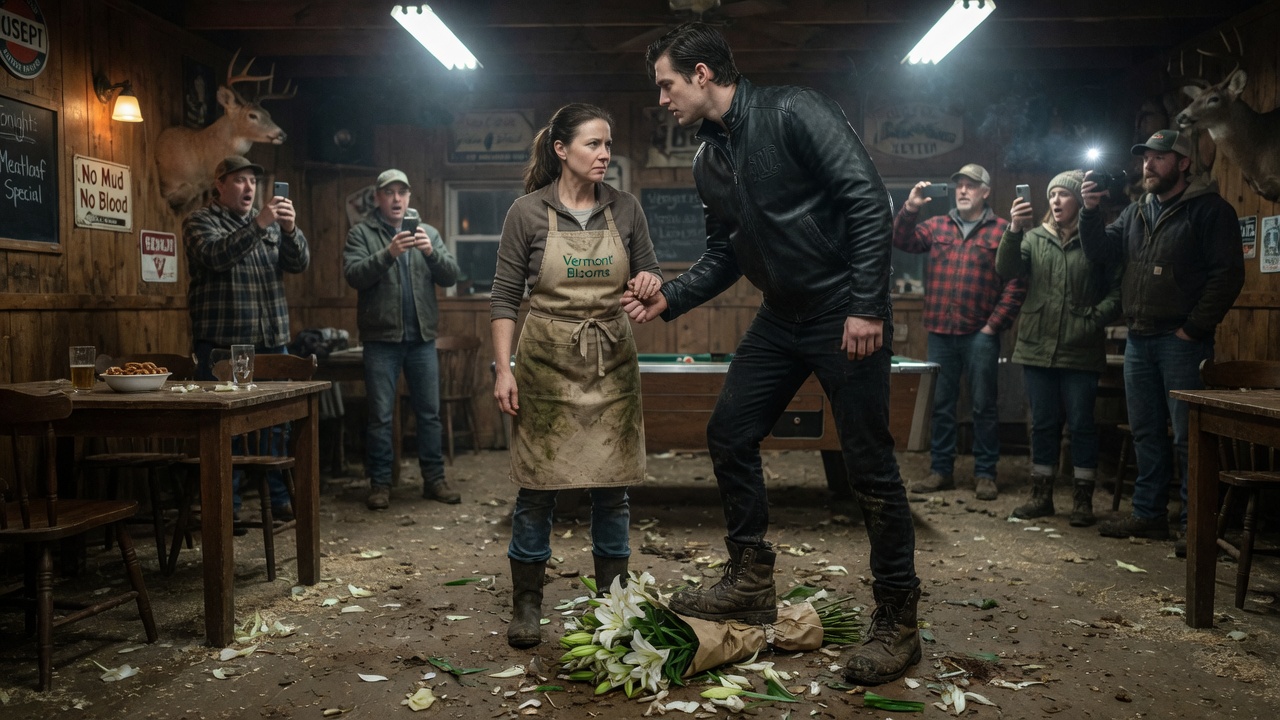
Elena walked toward him, her tan apron still on, the lilies held in her arms like a child. The crowd—the neighbors she had served for two years, Jim from the hardware store, Mrs. Gable—all watched with a collective, held breath. Phones were already being pulled from pockets.
“I have the box, Silas,” Elena said, her voice clear. “It’s safe. But we need to talk about the photos.”
Silas walked around the table, his muddy boots heavy on the floorboards. He stopped two feet from her. “We don’t talk, Lena. You listen. You pay. That’s the arrangement.”
He reached out and snatched the lilies from her arms. He looked at them with mock admiration. “Beautiful. Truly.”
He dropped them on the floor.
The sound of the bundle hitting the sawdust was dull. Silas raised his boot and brought it down hard, grinding the delicate white petals into the dirt. He twisted his heel, ensuring every bloom was crushed, every stem snapped.
“That’s what happens when things don’t go the Blackwood way,” he said.
The crowd flinched. Elena looked down at the ruined flowers. They weren’t just plants; they were the symbol of the quiet life she had tried to build.
Silas stepped forward, closing the remaining gap. He reached out and gripped the collar of her apron, his fingers twisting into the fabric. He yanked her toward him, forcing her to lean back, forcing her to look up at him from a position of weakness.
“You’re going to go back to that shop,” Silas hissed, his face inches from hers. “You’re going to get that box. And then you’re going to apologize to me for making me wait. Say it. Say ‘I’m sorry, Mr. Blackwood.'”
Elena’s heart was a steady, rhythmic thrum. The world slowed down. She saw the way his weight was distributed—too much on his front foot. She saw the tension in his left arm. She saw the phones in the background, recording her shame.
“Let go of my collar, Silas,” she said. “Right now.”
“Or what?” Silas mocked, tightening his grip, his other hand coming up to shove her shoulder, jarring her whole body. “You’re nothing. You’re a ghost in a town I own.”
He shoved her again, harder this time, his dominance total. He thought he had won. He thought he was breaking a florist.
He was wrong. He was touching a woman who had survived the wolves, and she was done pretending to be a sheep.
Elena’s left foot planted. She didn’t pull away; she moved in.
In one fluid, explosive motion, she brought her forearm down across Silas’s elbow, snapping his arm off-line with a crack that sounded like a dry branch breaking. His grip vanished. His shoulder turned off-axis, his chest opening up, his balance shattered.
Before he could even gasp, Elena stepped into his space. She drove a palm-heel strike into his upper chest, her entire body weight behind the blow.
Silas’s leather jacket compressed. His sternum jolted. His breath left him in a ragged “whoof” as his shoulders snapped backward. He started scrambling, his feet sliding on the sawdust, his eyes wide with a sudden, sharp terror.
Elena didn’t let up. She planted her standing foot and drove a front push kick directly into the center of his chest.
It wasn’t a tap; it was a structural collapse. Her heel made solid, heavy contact. Silas’s chest absorbed the force, his upper body snapping back while his hips lagged behind. He flew backward, his feet slipping on the crushed lilies, and he hit the floor with a bone-jarring thud that made the tavern’s glassware rattle.
The tavern went dead silent.
Silas lay on his back, clutching his chest, his face turning a panicked shade of purple as he struggled to find air. He raised one hand defensively, his slicked-back hair falling into his eyes, his “king of the town” persona evaporating into a cloud of sawdust and shame.
“Wait—stop!” Silas wheezed, his voice thin and high. “My chest… I can’t breathe! Please!”
Elena didn’t move toward him. She stood over the ruined lilies, her tan apron straight, her low ponytail undisturbed. She looked down at him with an expression that wasn’t anger—it was something far more terrifying. It was indifference.
“The next time you touch me, Silas,” Elena said, her voice carrying to every corner of the room, “I won’t stop at your ribs.”
She turned and walked out of the tavern.
The crowd didn’t move. They just stared at the phone screens, where the “untouchable” Silas Blackwood was currently curled in a ball on the floor, begging for air among the petals of the flowers he had tried to destroy.
Elena stepped out into the cold Vermont air. She knew the mask was gone. She knew the Blackwoods would retaliate. She knew the Chicago family might hear the whispers of a “florist with hands like a ghost.”
But as she walked toward her shop, her feet were steady. The account wasn’t settled—not yet—but for the first time in years, the balance was starting to shift.