For twenty years, Diane Thorne was just the “crazy librarian” in Oakhaven. She was the woman who stayed in the shadows, the one who never spoke up while the powerful families ran our town into the dirt.
But today, at the Founder’s Day festival, Mayor Julian Vane decided to remind her why he’s in charge. He didn’t just insult her—he brought out the one thing she had left of her old life and crushed it in front of everyone.
He thought she was weak. He thought she was broken because of what they did to her husband two decades ago. He stood on that stage, looking down at her, convinced that she would just take it like she always does.
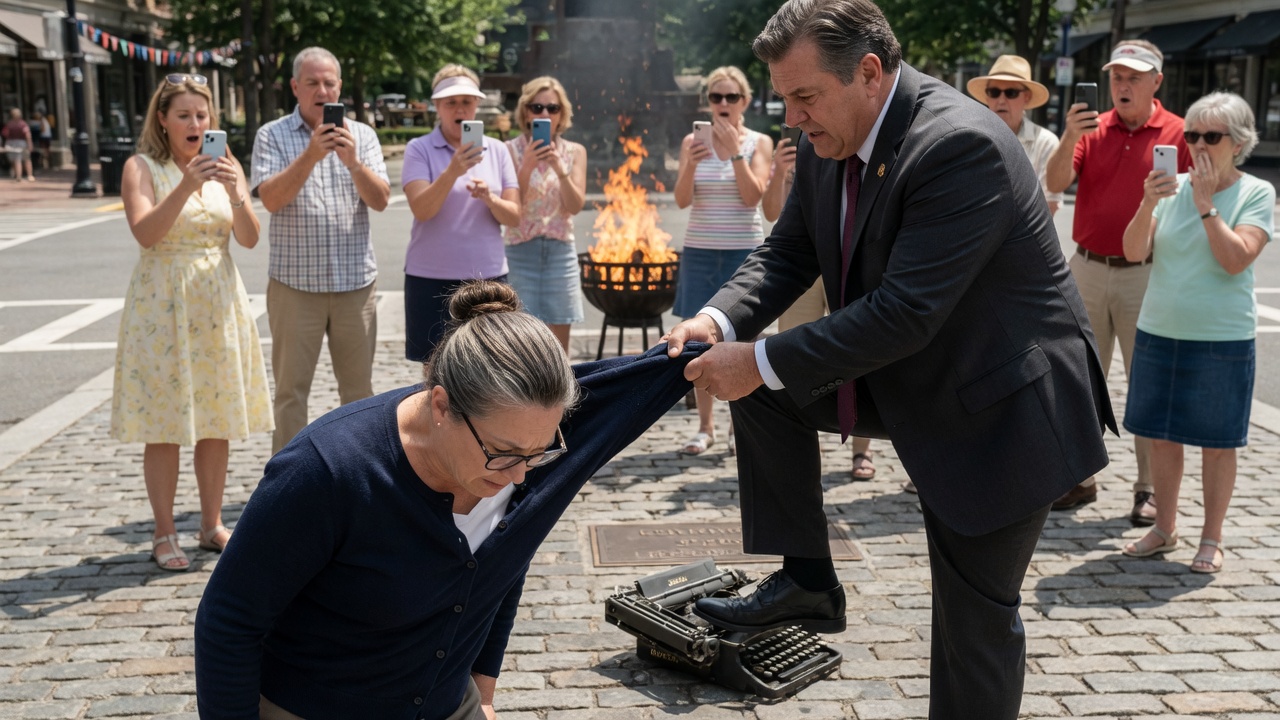
The crowd had their phones out, recording every second of her shame. Julian was laughing, his foot heavy on her most precious possession, pulling her closer just to whisper a final threat.
Then, Diane said one thing. She gave him exactly one chance to stop. When he ignored her and pushed harder, something in that library basement air must have finally snapped.
In three seconds, the man who “owns” this town was on the ground, begging a grandmother for mercy while the whole world watched his collapse.
Diane didn’t just fight back; she showed us that the “crazy librarian” has been keeping receipts on every single person in that square for twenty years.
The look on Julian’s face when he realized he wasn’t looking at a victim anymore, but at a legend coming back to life… I’ve never seen anything like it.
This isn’t a playground fight. This is the beginning of a war that Oakhaven isn’t prepared to lose.
I put the full story link in the comments.
Chapter 1
The Oakhaven Public Library smelled of things that had been forgotten on purpose. It was a scent composed of decomposing glue, damp masonry, and the distinct, metallic tang of the radiator that hissed like a cornered cat every time the Maine winter pressed against the stained-glass windows. Diane Thorne liked the smell. It was the scent of safety. It was the scent of a world that didn’t move unless she allowed it to.
She sat at the heavy oak circulation desk, her fingers resting lightly on the keys of a vintage Royal typewriter. It was an anachronism in a world of tablets and touchscreens, but the library board—mostly made up of Julian Vane’s cousins and business partners—let her keep it. They thought it was part of her “brand.” The eccentric, reclusive widow who lived among the stacks. They liked her quiet. They liked her predictable.
“Morning, Diane,” Abe called out from the doorway.
Abe was eighty, the library’s janitor for longer than Diane had been alive. He moved with a hitch in his hip that he blamed on a fall in ’94, but Diane knew better. She knew he’d been beaten by the county deputies thirty years ago for asking the wrong questions about a land deal. She knew because she had the medical report in a box labeled Vane Family: 1990-1995 in the basement archive.
“Morning, Abe,” Diane replied, not looking up. “The radiator in the reference section is knocking again.”
“I’ll give it a look. You working on your… stories?” Abe asked, his voice lowering.
“Just notes, Abe. Just notes.”
The “Encyclopedia of Secrets” wasn’t a book. It was a living, breathing map of Oakhaven’s rot. Two thousand pages of cross-referenced misery, buried in the basement behind a false wall in the periodicals section. Every affair, every embezzled cent, every “accidental” fire that cleared the way for a Vane-owned development was in there.
Diane had been a journalist once. A good one. A Pulitzer-winning one. But Oakhaven had a way of cutting the tongues out of people who talked too much. Twenty years ago, her husband Leo had been the lead investigator for the county. He’d found the link between the Vane family and the massive kickbacks from the highway project. He’d brought the files home to Diane. Two days later, Leo was dead—a “single-car accident” on a dry night—and the files were gone.
The town had expected her to leave. Instead, she’d taken the job at the library. She’d stayed in the house she couldn’t afford, raising their son Mark on a librarian’s salary and a diet of quiet, simmering rage.
The bell above the front door chimed. The sound was too sharp, too modern for the room. Diane felt the hair on her arms stand up before she even saw him.
Mayor Julian Vane walked in like he owned the oxygen. He was fifty-two now, his athletic build from high school having softened into the expensive bulk of a man who ate steak four nights a week. His charcoal suit was tailored to perfection, a stark contrast to the worn cardigans Diane favored.
“Diane,” he said, his voice a rich baritone that still had the power to make her stomach turn. “The place looks… dusty.”
“It’s a library, Julian. Dust is part of the inventory,” Diane said, her fingers finally leaving the typewriter keys.
Julian leaned against the desk, his presence crowding her. He smelled of sandalwood and the kind of power that didn’t need to raise its voice. Behind him, three members of the Library Board hovered like gargoyles.
“We’re here for the walk-through,” Julian said, flashing a smile that didn’t reach his eyes. “Founder’s Day is coming up. We want the building open for the gala. But I’m looking at the budget, and I’m seeing a lot of… fluff.”
“Fluff?” Diane asked, her voice steady.
“Archives. Periodicals. Things nobody reads anymore.” Julian reached out and tapped the frame of her typewriter. “Things that belong in a museum, not on the taxpayer’s dime. We’re thinking of converting the basement into a ‘Digital Innovation Hub.’ Which means we’ll need to clear out the old paper.”
Diane felt a cold spike of panic. The basement wasn’t just paper. It was her life’s work. It was the only thing keeping the Vane family from completely erasing the truth of what happened to Leo.
“The archives are the history of this town, Julian,” she said. “You can’t just throw history away.”
“History is whatever we say it is, Diane. You should know that better than anyone.” He leaned closer, his voice dropping to a whisper. “I hear you’ve been spending a lot of time down there. Late nights. Writing. I’d hate to think you were still trying to be… creative. It didn’t work out well for Leo, did it?”
The silence that followed was heavy, suffocating. The board members shifted their weight, looking at the floor. They knew. Everyone in Oakhaven knew.
Diane didn’t flinch. She couldn’t afford to. “Leo’s work is finished, Julian. I’m just a librarian.”
“Good,” Julian said, straightening up. “Keep it that way. We’ll be back on Friday with the contractors. Make sure the basement is accessible. All of it.”
He turned and walked out, his entourage trailing behind him. Diane waited until the door clicked shut before she let her breath out. Her hands were shaking.
“He’s coming for it, Diane,” Abe said, appearing from behind a stack of biographies. “He knows.”
“He suspects,” Diane corrected him. “He doesn’t know where it is. Not yet.”
She looked down at her typewriter. She had been “bugging” the library for twenty years—tiny, high-end microphones hidden in the study rooms, the board room, the vents. She had recorded Julian’s father, and now she was recording Julian. She had the evidence of the highway project, the offshore accounts, and the names of the men who had forced Leo’s car off the road.
But she had no way to release it without destroying her son’s life. Mark was the Sheriff now. He was a good man, but he was loyal to the town, to the Vanes who had “taken care of him” after his father died. If she burned Julian, she burned the town. And if she burned the town, she burned Mark.
The moral choice had been eating her alive for two decades. Die in silence, or destroy everything she loved to get justice.
The bell chimed again. This time, it was a young woman with a messenger bag and a look of caffeinated intensity. She looked about twenty-five, with a camera around her neck and a press pass hanging from her pocket.
“Can I help you?” Diane asked, her professional mask sliding back into place.
“I hope so,” the girl said, sticking out a hand. “I’m Sarah Miller. I’m a freelancer from the city. I’m doing a piece on ‘Small Town Legacies,’ and Oakhaven kept coming up. Specifically, the Thorne legacy.”
Diane froze. “There is no Thorne legacy here. Just books.”
Sarah smiled, and for a second, Diane saw a reflection of her younger self—the fire, the arrogance, the belief that the truth was a shield.
“That’s not what the archives at the New York Times say,” Sarah whispered. “They say Diane Thorne was the youngest woman to ever win a Pulitzer for Investigative Journalism. They say she disappeared into a library twenty years ago and hasn’t been heard from since. I don’t think you’re here for the books, Ms. Thorne. I think you’re here for the secrets.”
Diane looked at the girl, then at the door Julian had just walked through. The pressure was building. The past was rising like a flood, and the walls of her library weren’t going to hold it much longer.
“I think you should leave, Sarah,” Diane said, her voice like iron.
“I’m not leaving,” Sarah said. “I’m staying at the inn. Founder’s Day is in three days. I’ll be there. And I think you will be too.”
Diane watched her go, the weight of the Encyclopedia in the basement feeling like a mountain on her chest. She sat back down at her typewriter and typed one single sentence.
The fire is coming, and I am the one holding the match.
Chapter 2
The “Ladies Auxiliary” of Oakhaven arrived at the library on Tuesday morning with the coordinated precision of a riot squad. They were led by Evelyn Vane, Julian’s wife—a woman whose face was a masterpiece of expensive fillers and the kind of aggressive politeness that functioned as a weapon.
“Diane, darling!” Evelyn chirped, her voice echoing through the vaulted ceiling. “We’re here for the ‘Community Clean-Up.’ Julian said you might need a hand deciding what’s… obsolete.”
Six women followed her, all dressed in varying shades of pastel cashmere. They began moving through the aisles, pulling books from the shelves with a callousness that made Diane’s skin crawl. They weren’t looking for damaged covers; they were looking for ideas.
“This one,” Evelyn said, holding up a biography of a famous labor leader. “It’s so… polarizing. Don’t you think? We want the library to be a place of unity, Diane. Not conflict.”
“The library is a place for information, Evelyn,” Diane said, stepping around the desk. “All of it. Not just the parts that make you comfortable.”
Evelyn smiled, a thin, sharp thing. “Julian says you’ve become very protective of the ‘old ways.’ But Oakhaven is moving forward. We’re a destination now. We have the vineyard, the boutiques. We don’t need these dusty old grievances cluttering up the place.”
She dropped the book into a cardboard box with a dull thud. It was a small humiliation, a public dismissal of Diane’s authority in her own domain. The other women watched, their eyes bright with the thrill of the hunt. They had spent years treating Diane like a “crazy old cat lady,” a tragic relic of a family that had dared to challenge the status quo.
“You’re checking out the basement today, right?” one of the women asked, a younger socialite named Claire who spent most of her time on Instagram. “I heard there are boxes down there that haven’t been opened since the nineties. It’s so… creepy.”
“The basement is closed to the public,” Diane said firmly.
“Oh, we aren’t the public, Diane,” Evelyn said, stepping closer. She smelled of lilies and entitlement. “We’re the Board’s delegates. Julian wants a full inventory of the ‘Thorne Collection’ before the gala. He’s worried about… fire hazards.”
The word fire hung in the air like a threat. Diane knew exactly what they were looking for. They weren’t looking for books. They were looking for the typewriter. They were looking for the archive.
The social pressure was a physical weight. These were the women who ran the school board, the charities, the social life of the town. They could make Diane’s life impossible with a single phone call. They could have her evicted from her home, which was technically owned by a trust Julian controlled. They could make sure Mark never got promoted beyond Sheriff of a dying town.
“I’ll handle the inventory,” Diane said.
“We’ll see,” Evelyn said, her eyes scanning the room. She stopped at the circulation desk, her gaze falling on the Royal typewriter. “And this. This really must go, Diane. It’s an eyesore. It makes the library look like a junk shop.”
“It stays,” Diane said.
Evelyn reached out, her manicured fingers brushing the cold metal. “We’ll see about that, too. Founder’s Day is about celebrating our success. Not our failures.”
As they left, Sarah Miller slipped in through the back door, her camera hidden in her bag. She had been watching from the stacks.
“They’re terrified of you,” Sarah whispered, leaning against a shelf of true crime.
“They’re terrified of what I know,” Diane replied, her voice weary. “There’s a difference.”
“I found something,” Sarah said, her voice dropping. “I spent the morning at the county clerk’s office. I found the original survey for the highway project. The one your husband was working on. There’s a signature on the final approval that shouldn’t be there. It’s Julian Vane’s father, but the date… the date is three days after the project was supposedly finalized.”
Diane felt a familiar hum in her blood. The reporter’s itch. “It was a back-dated easement. It allowed them to run the road through the wetlands they’d bought for pennies. It’s in the Encyclopedia.”
“The what?”
“Nothing,” Diane said. “Why are you doing this, Sarah? You’re young. You have a career. Why Oakhaven?”
Sarah looked at her, and the arrogance was gone. “My father was the editor who killed your last story, Diane. The one about the Vanes. He took a payout to keep it out of the papers. He died last year, and I found the check in his safe. I’m not here for a Pulitzer. I’m here for penance.”
Diane felt the air leave the room. The betrayal went deeper than she’d ever imagined. Even the people she’d trusted in the city had been bought.
“You can’t win here, Sarah,” Diane said. “They own the law. They own the land. They own the memories.”
“Then let’s change what they own,” Sarah said.
That afternoon, Diane’s son, Mark, stopped by the library. He was in his uniform, his badge gleaming. He looked so much like Leo it hurt to look at him sometimes—the same broad shoulders, the same steady gaze. But his heart was different. Mark believed in the peace. He believed that if you didn’t stir the water, nobody would drown.
“Mom,” he said, sitting on the edge of her desk. “Julian called me. He’s worried about you.”
“Is he?”
“He says you’re getting… obsessive again. About the archives. He says the library needs to move on, and you’re holding it back. He’s asking me to talk to you about ‘early retirement.'”
Diane felt the betrayal like a physical blow. “He’s using you, Mark.”
“He’s trying to help us, Mom! He kept us in this house when Dad died. He made sure I got into the academy. He’s been a friend to this family when nobody else was.”
“He’s the reason you don’t have a father!” Diane snapped, the words escaping before she could stop them.
Mark’s face hardened. This was the old wound, the one they never talked about. “The accident was twenty years ago. The investigation was closed. Why can’t you let it go? Why do you have to keep digging up graves?”
“Because the truth doesn’t stay buried, Mark. It just rots.”
“If you keep this up, I can’t protect you,” Mark said, his voice dropping. “The Council is losing patience. They want the library ‘modernized’ for the gala. If you fight them on this, they’ll vote to terminate your contract. You’ll lose everything.”
“I lost everything twenty years ago,” Diane said softly.
Mark looked at her, a mix of pity and frustration in his eyes. “I just want you to be happy, Mom. Just… let it go. For me?”
He left, and Diane was alone in the silence of her books. She felt the residue of the conversation—the shame of her son’s ignorance, the rage of her own silence. She went down to the basement, to the false wall. She pulled out the Vane Family box and looked at the photo of Julian’s father standing next to her husband. They had been friends once. Until the money became more important than the man.
She reached for her typewriter, the one thing Julian couldn’t control. She began to type. Not a story. Not an article.
A list.
A list of every witness to her husband’s “accident.” A list of every bribe. A list of every soul Julian Vane had stepped on to get to the top.
She wasn’t just a librarian anymore. She was a ghost with a keyboard. And the haunting was about to begin.
Chapter 3
The tension in Oakhaven was a physical thing by Wednesday evening, like the static before a summer storm. The town was being draped in bunting. Red, white, and blue ribbons hung from every lamppost, and a massive stage was being erected in the town square, right in front of the historic clock tower.
Founder’s Day was the Vane family’s crowning achievement. It was the day they reminded everyone that the town existed because of them.
Diane spent the day moving the “Encyclopedia of Secrets” page by page. She didn’t trust the basement anymore. She knew Abe was loyal, but Abe was old. If the contractors came with sledgehammers, they would find the false wall.
She began stashing the pages inside the hollowed-out covers of the “obsolete” books the Ladies Auxiliary had flagged for removal. The History of Modern Labor now held the records of the 1998 land grab. Environmental Ethics held the soil samples from the toxic dump site Julian had authorized behind the high school.
“You’re playing a dangerous game, Diane,” Abe whispered as he helped her crate the books.
“It’s the only game left, Abe,” she said.
That evening, Julian Vane returned to the library. He was alone this time. The masks were off. He didn’t look like a mayor; he looked like a predator who had finally cornered his prey.
“I saw the young reporter leaving your house last night,” Julian said, walking toward her. He didn’t stop until he was inches away, his shadow falling over her. “You’re making a mistake, Diane. A big one.”
“She’s just interested in the history of the town, Julian. Isn’t that what we’re celebrating?”
“We’re celebrating the future. Not the garbage your husband tried to dig up.” He reached out and grabbed her chin, forcing her to look at him. His fingers were cold. “I loved you once. In high school, I thought we’d be the ones running this place together. But you chose Leo. And Leo chose to be a martyr.”
“Leo chose the truth,” Diane spat.
Julian laughed, a harsh, dry sound. “The truth is a luxury for people who don’t have anything to lose. You have a son, Diane. You have a house. You have a reputation. Do you really want to see Mark lose his badge because his mother couldn’t keep her mouth shut?”
The threat was direct. The cost was clear. Diane felt the old familiar fear—the fear that had kept her silent for twenty years. But beneath it, there was something new. A cold, hard certainty.
“What are you afraid of, Julian?” she asked. “If there’s nothing to find, why are you so worried about a ‘crazy old lady’ and a freelancer?”
Julian’s eyes darkened. He let go of her chin, but he didn’t back away. “Founder’s Day is tomorrow. I’m giving the keynote. We’re going to have a ceremonial burning of ‘Oakhaven’s Fictions.’ It’s a symbolic gesture. Out with the old, in with the new. I want you there, Diane. In the front row.”
“Why?”
“Because I want you to watch. I want you to see what happens to things that don’t belong here anymore.” He looked at the Royal typewriter on the desk. “Bring that toy with you. We’ll make it the centerpiece.”
“It’s not for sale, Julian.”
“It’s not a request,” he said. “If you aren’t on that stage tomorrow, I’ll have the sheriff’s department—your son—serve the eviction notice on your house by sunset. And then I’ll send the bulldozers to the basement.”
He walked out, leaving the air tasting of ozone.
Diane sat in the dark for a long time after he left. She thought about Leo. She thought about the way his hands used to feel when he was excited about a lead. She thought about the way the light hit the trees on the night he didn’t come home.
She went to the periodicals section and pulled a framed copy of her Pulitzer-winning article from the wall. The Price of Progress: Corruption in the County. It was the piece that had made her a legend, and the piece that had marked her for destruction.
Sarah Miller appeared at her side. “He’s going to burn it, isn’t he? The article. Your history.”
“He’s going to try,” Diane said.
“We have enough for a story, Diane. We could go to the state police. We could go to the Attorney General.”
“No,” Diane said, her voice vibrating with a chilling intensity. “In Oakhaven, the law is just another thing they bought. If we want to burn them, we have to do it where everyone can see the fire.”
She looked at Sarah. “I need you to do something for me. I need you to set up your equipment near the clock tower. Not the hidden stuff. The big cameras. I want everyone to know they’re being recorded. Every face. Every reaction.”
“What are you going to do?”
Diane reached into her cardigan pocket and pulled out a small, high-capacity thumb drive. “This is the audio. Twenty years of ‘study room’ conversations. Julian, his father, the Council. Everything. It’s synced to the Encyclopedia.”
“Diane, if you do this, there’s no going back. They’ll destroy you.”
“They already did,” Diane said. “Now it’s my turn.”
She spent the rest of the night at the typewriter. She didn’t write a list this time. She wrote a confession. Not hers. Julian’s. She mapped out the final confrontation, the psychological pressure points she knew would make him snap.
She had been training for this. Not just with her archives, but with her body. Every morning for twenty years, she had practiced the self-defense moves Leo had taught her—the ones he’d learned in the academy. She wasn’t just a librarian; she was a weapon that had been kept in cold storage.
As the sun began to rise over Oakhaven, Diane Thorne dressed in her best navy cardigan. She picked up her Royal typewriter. She felt the weight of it, the solid, honest metal.
The residue of her silence was gone. All that was left was the promise of total exposure.
Chapter 4
Founder’s Day in Oakhaven was a carnival of choreographed joy. The smell of grilled corn and kettle corn filled the air, competing with the salty breeze off the Atlantic. A brass band played on the corner of Elm and Main, while children with faces painted like tigers ran between the legs of their parents.
In the center of the square, a massive stage stood draped in bunting. A ceremonial fire pit, three feet wide and filled with dry cedar, sat at the front of the stage. Next to it was a podium with the town seal.
Diane Thorne walked through the crowd, carrying her Royal typewriter like a sacred relic. People stepped aside, some whispering, some looking away in shame. They knew what was coming. They knew the Mayor had finally decided to finish the job he started twenty years ago.
She saw her son, Mark, standing near the stage. He looked uncomfortable, his hand resting nervously on his belt. When he saw her, he tried to move toward her, but Julian Vane stepped out from behind the curtain, intercepting him.
“Front row, Diane!” Julian called out, his voice booming over the speakers. “We’re about to start.”
The crowd gathered, a semicircle of five hundred people. Sarah Miller was positioned near the clock tower, her long lens trained on the stage. Other townsfolk had their phones out, sensing the blood in the water. This was the Oakhaven way—public humiliation as a form of civic entertainment.
Julian took the podium. He spoke for ten minutes about “unity,” about “clearing the path for the future,” and about the “burdens of the past.” He looked every inch the benevolent leader, but Diane could see the tremor in his hands. He was desperate.
“And now,” Julian said, his voice dropping to a theatrical hush. “We have a special guest. Our town librarian, Diane Thorne. Diane, would you bring up the… Thorne Collection?”
The crowd went silent. Diane walked up the stairs, her footsteps echoing on the plywood. She placed the typewriter on a small table next to the fire pit. Julian reached into a box and pulled out the framed copy of her Pulitzer-winning article.
“This,” Julian said, holding it up for the crowd to see. “Is a story about Oakhaven. It’s a story about ‘corruption’ and ‘secrets.’ It’s a story that nearly destroyed us once.”
He looked directly at Diane, his eyes burning with a cruel triumph. “But Oakhaven doesn’t live in stories anymore. We live in the truth. And the truth is, Diane, your ‘fictions’ have no place here.”
He held the framed article over the fire pit. “It’s time to put these stories to bed.”
He dropped the frame into the flames. The glass shattered, and the paper ignited instantly, the edges curling into black ash. The crowd cheered—a hollow, practiced sound.
Julian turned to Diane, his face inches from hers. “You’re done, Diane. The basement is being cleared as we speak. There is no Thorne legacy. There’s just a crazy old woman who doesn’t know when to quit.”
He stepped toward the table, his heavy leather dress shoe coming down hard on the Royal typewriter. The metal groaned, the keys snapping under his weight. He grabbed Diane by the collar of her navy cardigan, bunching the fabric in his fist and forcing her to lean down toward the broken machine.
“This toy is done, Diane,” Julian hissed, the microphone catching his words. “Just like your career.”
The crowd was silent now, phones raised. They were watching the Mayor humiliate the librarian in front of the whole world. Diane felt the pressure of his hand, the heat of the fire, the shame of the eyes on her.
“Take your foot off my machine, Julian,” Diane said. Her voice wasn’t a whisper. It was a command.
Julian laughed, a sharp, ugly sound. He pushed her shoulder back, crowding her space, his boot grinding deeper into the typewriter’s carriage. “Or what? You’ll write a mean letter to the editor? You’re nothing, Diane. You’re a ghost.”
He shoved her again, harder this time, expecting her to tumble back.
Diane Thorne didn’t tumble.
She planted her lead foot, the cobblestones firm beneath her. In one fluid, sharp motion, she snapped her arm downward, her forearm striking Julian’s wrist with a sickening crack. His grip on her cardigan vanished. His balance, centered on his heavy boot, shifted violently.
His shoulder turned off-axis. His chest opened wide.
“Move 1,” Diane whispered, though only she could hear it.
Before Julian could scramble, Diane stepped inside his space. She drove her palm-heel upward, her entire body weight behind the strike. It landed squarely on Julian’s sternum. The impact made his charcoal suit jacket jolt. His breath escaped in a ragged wheeze as his shoulders snapped backward.
His feet started scrambling, his leather soles slipping on the stage.
He was falling, but Diane wasn’t finished. She planted her standing foot, lifted her knee, and drove a front push kick directly into the center of his chest. It was a driving, heavy strike. Her sole made visible contact, pushing through his centerline.
Julian Vane didn’t just fall; he was launched. He hit the plywood stage with a heavy thud, sliding back toward the edge of the fire pit. Dust and ash kicked up around him.
The crowd gasped, a collective intake of breath that sounded like a vacuum.
Julian stayed on the ground, his face pale, his breath coming in jagged gasps. He scrambled back on his elbows, raising one hand defensively as Diane stepped toward him.
“Stop! You’re crazy, Diane!” Julian begged, his voice cracking, the dominant Mayor replaced by a terrified man.
Diane Thorne stood over him, her shadow long across the stage. She looked down at him—not with rage, but with the chilling, detached focus of a woman who had already won.
“Don’t ever touch my things again,” she said, her voice carrying to the very back of the square. “This is just the beginning.”
She turned to the crowd, to the five hundred phones recording her every move. She looked directly into Sarah Miller’s lens.
“My name is Diane Thorne,” she said. “And I have the receipts.”
She reached into her pocket and pulled out the thumb drive. She didn’t hand it to the Mayor. She didn’t hand it to her son. She walked to the edge of the stage and handed it to the young reporter.
“Go,” Diane said.
Mark stepped onto the stage, his face a mask of shock and horror. “Mom, what did you do?”
“I started the fire, Mark,” Diane said, looking at the burning remains of her Pulitzer. “Now we see who survives the heat.”
The square was a sea of murmurs and sirens. Julian was still on the ground, his hand clutching his chest, his power evaporating with every second that passed. The public humiliation had reversed, and the residue was thick enough to choke the town.
Diane Thorne walked off the stage, leaving her broken typewriter behind. She didn’t look back. She had twenty years of secrets to unleash, and the first match had just been struck.