Miller doesn’t talk much. In a world of Malibu millionaires and high-end designers, he’s the “slow” carpenter with the buzzed hair and the steady hands.
Nobody on the crew knows about the Navy SEAL Trident hidden under his workbench. Nobody knows about the TBI that makes his words come out a little late.
To Alistair Thorne, the world-famous designer in the $4,000 suit, Miller is just an expensive tool that’s starting to malfunction.
Alistair wanted perfection. Miller gave him a mahogany mantel that was a masterpiece, hand-carved with a patience Alistair couldn’t understand.
Then, Alistair decided to make a point. In front of the entire crew, he didn’t just fire Miller. He tried to break him.
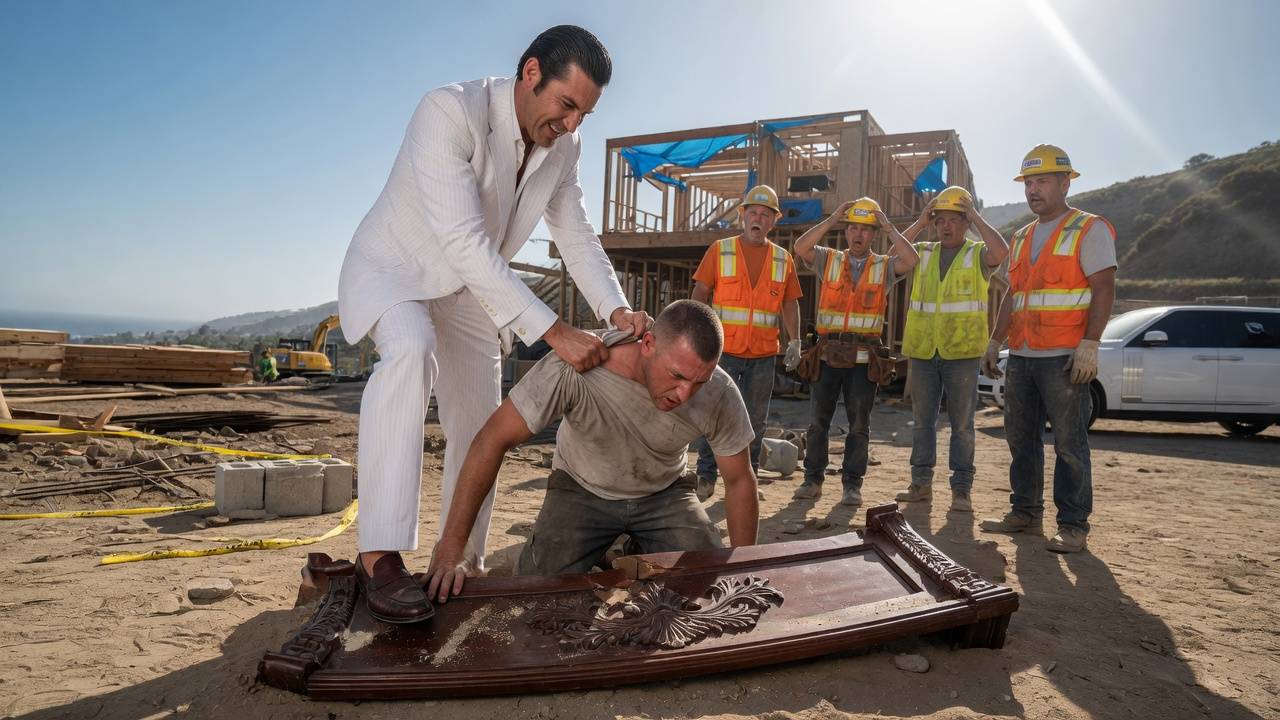
He stepped on the wood. He put his hands on a man who had survived things Alistair couldn’t even dream of in his worst nightmares.
Miller gave him one warning. Just one. But Alistair was too busy being the most important man in the room to listen.
In three seconds, the power in that glass-and-steel mansion shifted forever. The “slow” guy wasn’t slow anymore.
Now, a viral video is circling the job site, and Alistair Thorne is finding out that some doors, once they’re locked, never open again.
The full story is in the comments.
Chapter 1
The morning started with the static. That was what Miller called it—the high-pitched hum that lived in the space between his ears, a remnant of a breached door in Ramadi that had decided to stay with him forever. It wasn’t a sound, exactly. It was a pressure. A reminder that his brain didn’t quite sit in its cradle the way it used to.
He sat on the edge of his bed in the small, rented cottage in Topanga, his thick fingers tracing the grain of the pine floorboards. He counted to ten. Then he did it again. That was the ritual. If he could count to ten without losing the thread, he was okay to drive. If the numbers started to slip, he stayed home and called his sister, Sarah.
“One,” he whispered. The wood felt cool under his calloused palm. “Two. Three.”
By the time he reached ten, the static had receded to a dull throb. He stood up, his joints popping. At forty-two, his body felt like a topographical map of every hard landing he’d ever taken. He dressed in his usual uniform: heavy work pants, a grey t-shirt that had seen better days, and steel-toed boots that were polished to a mirror shine. Habits from the Teams didn’t die; they just moved into different theaters.
He drove his beat-up F-150 down the winding canyon roads toward Malibu. The job was a monster—a thirty-million-dollar “architectural statement” perched on a cliffside over the Pacific. It was all glass, steel, and ego. Miller had been hired for the finish carpentry because he was the only man in three counties who could handle the exotic woods the owners demanded without cracking them.
He pulled into the staging area, the salt air hitting him the moment he opened the door. The site was already crawling. Plumbers, electricians, and drywallers moved in a chaotic dance, but Miller kept his eyes on his own corner.
“Morning, Miller,” Leo said, looking up from a pile of sawdust. Leo was twenty-two, with a frantic energy and a genuine respect for the craft that Miller found tolerable. “The designer’s already in there. He’s… on one today.”
Miller nodded, not needing the warning. Alistair Thorne didn’t enter a room; he colonized it.
Miller walked into the great room, where the floor-to-ceiling glass framed the ocean like a trophy. In the center of the room stood Alistair, draped in a white linen suit that looked like it had never seen a speck of dust. He was pointing a slender finger at the fireplace surround where Miller had been working for three weeks.
“It’s too heavy,” Alistair was saying to a pair of wealthy-looking clients who nodded like bobbleheads. “It lacks the… ethereal quality I requested. It feels like something from a mountain cabin. It’s pedestrian.”
Miller stopped ten feet away. He waited. Rule one of the site: never interrupt the ego when it’s feeding.
Alistair turned, his eyes raking over Miller with a practiced disdain. “Ah, the craftsman. Miller, tell me—do you only work in ‘sturdy’? I asked for a whisper of mahogany. You’ve given me a shout.”
Miller took a breath. He had to process the words, translate the “design-speak” into something technical. Sometimes, there was a delay. He knew how it looked. He looked like a man who was struggling to keep up.
“The specs called for a four-inch depth to support the weight of the stone above it,” Miller said, his voice low and deliberate. “Any thinner and the grain will shear under the tension.”
Alistair let out a sharp, theatrical laugh. He turned back to the clients. “You see? This is the problem with hiring from the trades. They’re so bogged down in ‘tension’ and ‘shearing’ that they forget about the soul of the space. Miller is a very good hammer, but a hammer doesn’t understand the nail’s feelings.”
The clients chuckled. Miller felt the static in his head spike. He looked at his hands—the hands that had held a rifle for twelve years and now held a chisel with a precision that bordered on the holy.
“I can adjust the profile by a quarter inch,” Miller said. “But the structural integrity—”
“I don’t care about the integrity of the wood, Miller. I care about the integrity of my vision,” Alistair snapped, stepping closer. He smelled of expensive cologne and entitlement. “You’re slow, Miller. I’ve watched you. You stare at the wood for an hour before you make a cut. Is it the head thing? The… what do they call it? The veteran’s fog?”
The room went quiet. Even the drywallers in the next room seemed to stop their sanding.
Miller didn’t move. He felt the heat rising in his neck, the old instinct to bridge the gap and neutralize the threat. But he saw Sarah’s face in his mind. He saw the medical bills for the neuro-specialist. He saw the quiet life he was trying to build out of the wreckage of the war.
“I’ll have it adjusted by Monday,” Miller said.
Alistair smirked, sensing the retreat. He reached out and flicked a piece of sawdust off Miller’s shoulder. “Good man. Try to be a little more ‘whisper’ and a little less ‘grunt,’ okay? We’re building a sanctuary here, not a bunker.”
Alistair turned his back, dismissing Miller as if he were a piece of scaffolding. Miller walked back to his workbench, his heart hammering against his ribs like a trapped bird. He picked up his chisel. His hand was shaking—only a fraction of a millimeter, but to him, it was an earthquake.
He had to finish this. He had to pay the bills. But as he looked at the mahogany, he realized he wasn’t just carving wood anymore. He was carving his own restraint, and the wood was getting thinner every day.
Chapter 2
The mahogany mantel was Miller’s masterpiece. It was a single, massive beam of African mahogany that he’d spent a month sourcing and another month preparing. He’d spent his nights in his shop in Topanga, hand-carving a subtle, flowing pattern into the underside—a pattern that looked like the receding tide of the Malibu coast.
It was his way of speaking without having to find the words that often got stuck in the static of his TBI.
“You really did it, man,” Leo whispered as they prepped the heavy-duty mounting brackets. “If Alistair doesn’t like this, he’s literally blind.”
“He doesn’t look at the wood, Leo,” Miller said, his voice gravelly. “He looks at the reflection of himself in the wood.”
Miller was tired. The treatment sessions with the specialist were draining his bank account and his mental energy. They were doing “cognitive loading” exercises—trying to rewire the pathways the blast had scorched. It felt like trying to rebuild a bridge while a line of cars was trying to cross it.
The site was louder today. The Vances—the billionaire homeowners—were on-site with Alistair and a “lifestyle consultant” who looked like she hadn’t eaten since 2019.
“Miller!” Alistair’s voice cut through the air like a whip. “Bring the piece over. I want the Vances to see the ‘progress’ we’ve struggled to make.”
Miller and Leo lifted the mantel. It was heavy—near two hundred pounds of dense, dark wood. They carried it across the great room, their boots echoing on the polished concrete. They set it down on a pair of padded sawhorses in front of the massive fireplace.
Mr. Vance, a man who had made his billions in data mining, stepped forward. He touched the wood, his fingers tracing the carving Miller had spent sixty hours on. “This is… incredible. The detail is remarkable.”
Alistair’s face shifted for a micro-second—a flicker of annoyance that he wasn’t the one being complimented. He quickly stepped between Vance and the wood.
“Yes, it’s a start,” Alistair said smoothly. “I had to guide Miller through the process quite extensively. He has a tendency toward the… let’s say, ‘brutalist’ school of thought. I had to insist on this organic flow to soften his natural instincts.”
Miller felt a pulse of heat in his temples. He’d never seen Alistair’s “guidance” beyond a few vague sketches on a napkin that defied the laws of physics.
“Actually,” Miller started, his voice a bit too loud. He stopped, reset. “The design for the carving came from the topography of the cove outside. I took the measurements myself.”
Alistair turned, his smile as sharp as a razor. “Oh, Miller. How quaint. He thinks he’s an artist. It’s adorable, really. Like a bear trying to play the flute.”
The lifestyle consultant giggled. Mrs. Vance looked uncomfortable, but Alistair was already moving on.
“However,” Alistair said, his voice dropping to a theatrical whisper as he turned back to the wood. “I noticed a flaw. Right here.” He pointed to a section of the grain where the mahogany naturally darkened into a deep, bruised purple. “It looks like a stain. It’s inconsistent with the purity of the room.”
“That’s the heartwood,” Miller said. “That’s where the strength of the tree is. You can’t remove that without compromising the integrity of the beam.”
“I don’t want ‘strength,’ Miller. I want ‘aesthetic,'” Alistair snapped. He looked at the Vances. “I’m afraid Miller’s… condition… makes it difficult for him to grasp the finer points of luxury. He sees things in terms of survival. It’s a very common trait in those with his background. Very binary. Very… limited.”
The word ‘limited’ hit Miller harder than any physical blow. He felt the static in his head swell into a roar. He could feel the eyes of the other contractors on him—the drywallers, the electricians. They were watching him get picked apart by a man who had never bled for anything in his life.
“I’m not limited,” Miller said, his jaw so tight it ached.
“Of course not, dear,” Alistair said, patting Miller’s arm with a patronizing firmness. “You’re a hero. We all know that. But here? In this house? You’re just the help. Now, take this back and sand out that ‘strength.’ I want it uniform. I want it invisible.”
Alistair turned his back to lead the Vances toward the kitchen. Miller stood over the mantel, his hands curled into fists. Leo stepped up beside him, his face pale.
“He’s a prick, Miller. Just ignore him,” Leo whispered.
Miller looked down at the heartwood. It was the most beautiful part of the piece—the part that had endured the most pressure, the part that held the whole thing together. Alistair wanted it sanded away until it looked like plastic.
“I can’t sand this out, Leo,” Miller said, his voice a ghost of itself.
“I know, man. I know.”
“No,” Miller said, looking at Alistair’s retreating back. “You don’t understand. If I sand this out, there’s nothing left to hold the weight.”
He wasn’t just talking about the wood. He was talking about himself. He was the heartwood of this site, the one who actually knew how things were built, how they stayed up when the wind came off the ocean. And he was being told he was an eyesore.
Chapter 3
The following Tuesday, Miller sat in a sterile office in West LA. Dr. Aris, the neuro-specialist, was reviewing his latest scans.
“The neuroplasticity is there, Miller,” Aris said, leaning back. “But you’re under a tremendous amount of stress. Your cortisol levels are spiking, and that’s causing the ‘static’ to worsen. You need to avoid high-pressure environments.”
Miller laughed, a dry, hacking sound. “I’m a carpenter in Malibu, Doc. High pressure is the only thing they sell there.”
“If you don’t find a way to regulate,” Aris warned, “the lapses will get longer. You might start losing more than just words. You might lose time.”
Miller thought about that as he drove back to the site. Losing time. It was the ultimate fear for a man who had spent his life needing to account for every second.
When he arrived at the mansion, the atmosphere had changed. There was a frantic energy. The Vances had moved their move-in date up by two weeks. That meant Alistair was in a state of high-velocity panic, which he channeled into cruelty toward anyone within reach.
Miller went straight to the library. He’d been tasked with the “safe room” installation—a high-security panic room hidden behind a bookcase. Alistair had designed the exterior, but Miller had designed the internal locking mechanism.
It was Miller’s secret. He’d built in a mechanical override—a “kill switch” that could lock the door from the outside in a way that no electronic signal could bypass. He’d done it because he didn’t trust Alistair’s “vision” of security. He’d done it because he knew that in a real crisis, an “ethereal” door was just an expensive coffin.
Elias, the lead architect, was in the library, looking at Miller’s shop drawings. Elias was the only one who treated Miller as a peer.
“The way you’ve integrated the weight distribution on these hinges, Miller… it’s brilliant,” Elias said. “Alistair doesn’t know what he has in you.”
“He thinks I’m a hammer,” Miller said.
“He’s a fool,” Elias replied. “But be careful. He’s looking for a scapegoat for the delays. The Vances are breathing down his neck about the budget, and he’s already pointing toward the ‘slow’ woodwork.”
“The wood takes the time it takes,” Miller said.
Later that afternoon, the confrontation happened in the great room. The mahogany mantel had been installed, but Miller hadn’t sanded out the heartwood. He’d finished it with a clear oil that made the deep purple grain glow like a bruise. It was honest. It was perfect.
Alistair walked in, his eyes immediately darting to the fireplace. He stopped. He didn’t say a word for a long minute. The silence was heavy, vibrating with the sound of the ocean outside.
“I told you to remove it,” Alistair said, his voice dangerously low.
“I told you why I couldn’t,” Miller replied. He was standing by his workbench, his hand resting near his heavy framing hammer.
“You defied me,” Alistair said, turning to face him. His face was flushed, his expensive suit looking suddenly tight. “In front of my clients. You chose your ‘craft’ over my instructions.”
“I chose the house,” Miller said. “That beam supports the weight of the stone. If I’d sanded it, it would have failed. I’m not putting a structural failure in a thirty-million-dollar house just because you don’t like the color purple.”
Alistair stepped toward him, his eyes wide. “You think you’re so important, don’t you? With your little carvings and your ‘technical precision.’ You’re nothing, Miller. You’re a broken-down soldier with a hole in his head. You’re lucky I even let you on this site. You should be sweeping floors at a VFW hall, not touching my designs.”
Miller felt the “glitch” happen. For a second, the room blurred. He wasn’t in Malibu anymore. He was back in the dust, the smell of cordite in his nose, the sound of the radio screaming for a medevac. He blinked, hard.
“Go home, Alistair,” Miller said, his voice vibrating with a subterranean threat.
“Oh, I’m not going anywhere,” Alistair sneered. “But you are. You’re done. I’m having this piece ripped out tomorrow and replaced with a veneer. And I’m withholding your final payment for breach of contract. You won’t see a dime of that treatment money.”
Alistair had done his homework. He knew exactly where Miller was vulnerable.
“I need that money for my sister,” Miller said, his voice flat.
“Then you should have been a better tool,” Alistair said. He walked over to Miller’s workbench. He picked up a small, hand-carved mahogany bird Miller had been making for Sarah’s birthday. It was a delicate thing, carved with an intimacy that felt almost painful.
“This is what I think of your craft,” Alistair said.
He dropped the bird on the concrete floor and stepped on it. The wood crunched under his loafer.
Miller watched the bird shatter. He didn’t move. He didn’t speak. But the static in his head vanished, replaced by a cold, crystalline clarity. The “veteran’s fog” was gone. In its place was the hunter—the man who knew exactly how much force was required to break a structure.
“Alistair,” Miller said, his voice so quiet it barely carried over the waves. “You shouldn’t have done that.”
“What are you going to do, Miller? Forget to hit me?” Alistair laughed. “Get off my site. Now.”
Miller watched him walk away. He looked at the shattered bird. He looked at his hands. For the first time in years, they weren’t shaking at all.
Chapter 4
The next morning was the final installation of the library bookcase. The mood on the site was suffocating. Everyone knew Miller had been fired, and everyone knew why. Alistair was parading around like a conquering king, his white suit blinding in the Malibu sun.
Miller arrived early. He didn’t go to the library. He went to the great room. He stood in front of the mahogany mantel. He touched the heartwood one last time.
“What are you still doing here?” Alistair’s voice boomed. He was walking toward Miller, a latte in one hand and his phone in the other. A group of four contractors followed him, sensing blood in the water.
“I’m finishing the job,” Miller said.
“The job is over, Miller. Security is on their way to escort you off the property,” Alistair said, stopping five feet away. He looked at the mantel. “I’ve already hired a real carpenter to rip this garbage out.”
Alistair looked down at Miller’s workbench, which was still set up near the fireplace. On it sat the Trident insignia Miller had carved into the underside of the wood—his quiet signature.
Alistair smirked. He walked over and deliberately kicked the leg of the workbench, sending Miller’s tools scattering across the floor. He then stepped on the mahogany fragment from the shattered bird, grinding it into the dust with a slow, theatrical motion.
“You’re a failure, Miller. As a soldier, as a man, and as a carpenter,” Alistair said. He reached out and grabbed Miller by the collar of his grey t-shirt, pulling him close enough that Miller could smell the mint on his breath. “Now, get out before I have the police haul your ‘broken brain’ to a psych ward.”
Miller looked Alistair in the eye. He didn’t pull away. He didn’t flinch. He looked at the CROWD of workers who had gathered—Leo, the drywallers, the plumbers. They were all watching.
“Take your foot off my work,” Miller said, his voice like grinding stones. “Last warning, Alistair.”
Alistair laughed, a high, mocking sound. “Or what? You’ll forget who I am in ten minutes?”
Alistair shoved Miller back, his hand still bunched in the shirt, trying to humiliate him further by forcing him to stumble.
But Miller didn’t stumble.
The moment Alistair’s hand moved to shove again, Miller’s training took over. It wasn’t a choice; it was physics.
MOVE 1: Miller planted his lead foot, his body becoming an anchor. He brought his right hand up in a sharp, downward arc, snapping Alistair’s grabbing arm off his chest with a crack that sounded like a dry branch breaking. He stepped deep into Alistair’s personal space, his shoulder turning Alistair’s chest open, destroying his balance.
MOVE 2: Before Alistair could even gasp, Miller drove the heel of his palm directly into Alistair’s sternum. It wasn’t a punch; it was a transfer of mass. Miller’s rear foot pushed off the concrete, his hips rotated, and the strike landed with a sickening thud. Alistair’s white suit jacket buckled at the point of contact. His air left him in a single, ragged wheeze. His feet began to scramble, his shoulders snapping backward.
MOVE 3: Miller didn’t give him the chance to recover. He planted his standing foot, drove his hip forward, and launched a front push kick that caught Alistair dead-center in the chest. It was a driving force, Miller’s boot sole connecting with the pristine white linen. Alistair didn’t just fall; he was launched. He flew backward four feet, his loafers skidding on the dust-covered concrete, before he hit the ground with a heavy, ungracious slam.
A cloud of sawdust and construction dust kicked up around him. Alistair lay on his back, his face turning a panicked shade of grey as he struggled to find his breath. The CROWD was frozen. Nobody moved. Nobody spoke. The only sound was the waves and Alistair’s desperate, wet gasping.
Miller stood over him, his shadow falling across Alistair’s face. He didn’t look angry. He looked like a man who had finally finished a difficult cut.
Alistair scrambled backward on his elbows, his eyes wide with a terror that was purely primal. He raised one hand, his fingers trembling.
“Wait! Stop! I’m sorry! Don’t… please!” Alistair begged, his voice a pathetic squeak.
Miller looked down at him for a long, silent moment. He reached into his pocket and pulled out a small, heavy brass key—the override for the safe room bookcase. He dropped it onto Alistair’s chest.
“The next time you touch me,” Miller said, his voice calm and terrifyingly clear, “I won’t stop at three.”
Miller turned to Leo. “Pack my tools, Leo. We’re done here.”
Miller walked out of the mansion, his boots steady on the concrete. Behind him, Alistair Thorne lay in the dust of his own vision, a white suit ruined, his dignity shattered into smaller pieces than the mahogany bird.
The static in Miller’s head was gone. The world was quiet. And for the first time in years, he knew exactly what was going to happen next.