Cap Hayes has spent twenty years trying to drown the memory of the night that cost him everything.
They called him a hero for saving that girl in the Atlantic, but the Navy called it desertion of his post.
Now, his boat is in chains, his bank account is empty, and his son looks at him like a stranger.
Enter Richard Belmont, a man who thinks money can buy the coordinates to a secret Hayes swore to keep.
Belmont didn’t just want the location; he wanted to see the “disgraced” captain crawl.
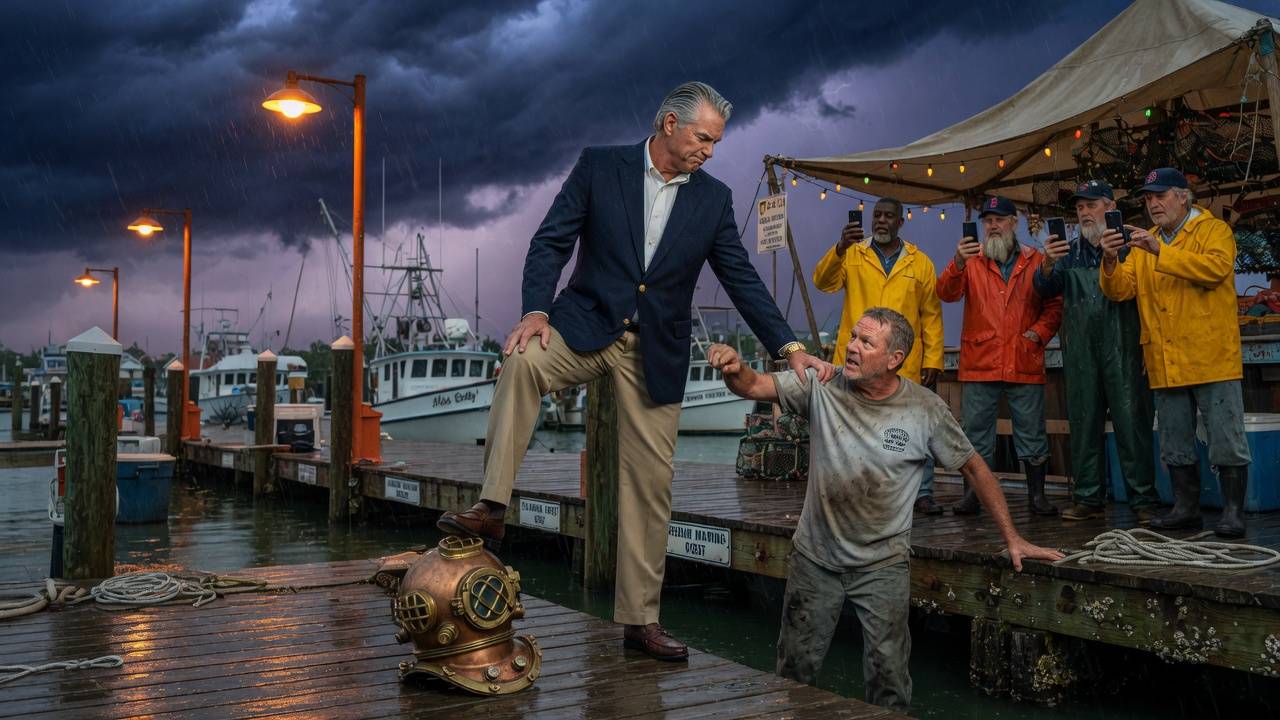
In front of the entire marina, he put his polished shoe on the only thing Hayes had left of his father.
He thought the old man was too desperate for a paycheck to fight back.
But there’s a difference between being broke and being broken.
When the brass helmet cracked under Belmont’s boot, the storm didn’t just stay in the sky.
The video of what happened next is already tearing through the county, and Belmont is learning that some things are better left at the bottom of the sea.
Read the full story in the comments.
Chapter 1
The diesel engine of The Mercy didn’t roar; it coughed, a wet, metallic hack that vibrated through the soles of Elias “Cap” Hayes’s boots. It was the sound of a lung infection in a machine that had seen too many hurricanes and not enough maintenance. Hayes wiped a grease-stained rag over the manifold, his knuckles scarred and thick from decades of underwater welding and barroom stubbornness.
“She’s tired, Cap,” Benny said, leaning against the companionway. Benny was twenty-two, wore mirrored sunglasses even in the shade, and spent more time checking his phone than the bilge. He was the only deckhand Hayes could afford, which meant he was the only deckhand who didn’t mind getting paid in IOUs and the occasional bag of blackened shrimp.
“She’s not tired. She’s seasoned,” Hayes grunted. He stood up, his back popping in a way that made him wince. At forty-eight, he felt sixty. The Florida humidity was a physical weight, a wet wool blanket draped over the St. Jude’s Marina.
“Seasoned is what you call a steak, Cap. This is a salvage job waiting to happen.” Benny checked his phone again. “Bank’s coming back at noon. You heard from them?”
Hayes didn’t answer. He didn’t need to. The yellow “Notice of Seizure” was already taped to the glass of the wheelhouse, flapping in the stagnant breeze. The marina owner, a man named Miller who used to be Hayes’s friend until the arrears hit five figures, had finally stopped looking him in the eye. The boat was impounded. Hayes was allowed on board to “retrieve personal effects,” a grace period that was currently being stretched into its third day of denial.
He walked to the stern, where a heavy, wooden crate sat bolted to the deck. Inside, nestled in custom foam, was a Mark V diving helmet. It was copper and brass, weighing nearly sixty pounds, a relic from the days when men went down into the dark with nothing but a hose and a prayer. It had been his father’s. It was the only thing Hayes owned that wasn’t underwater, literally or figuratively.
“He’s here,” Benny said, his voice dropping an octave.
Hayes looked toward the pier. A silver Mercedes-Benz G-Wagon sat idling near the bait shop, its polished chrome looking like an insult against the backdrop of rusted cranes and sun-bleached skiffs. Richard Belmont stepped out. He was tall, dressed in a navy blazer that cost more than Hayes’s truck, with a smile that was too symmetrical to be trusted. He was accompanied by two men who looked like they were carved out of granite—ex-military types in tactical polos, their eyes scanning the docks with professional indifference.
Belmont walked down the wooden pier, his leather loafers clicking with an arrogant rhythm. The local fishermen, the “salty” regulars who usually spent their mornings grumbling about fuel prices, went quiet. They watched the city man approach the ruin of a legend.
“Captain Hayes,” Belmont called out, stopping ten feet from the boat’s gunwale. He didn’t offer a hand. He just looked at the seizure notice and chuckled. “I see the vultures have finally circled.”
“You’re a long way from the golf course, Richard,” Hayes said, stepping off the boat. His boots were caked in dried salt. He felt small next to Belmont, not just in height, but in status. In this marina, everyone knew Hayes was the guy who could dive deeper and stay longer than anyone else, but they also knew he was the guy with the “Other Than Honorable” discharge papers buried in his desk.
“I’m here to offer you a lifeline,” Belmont said, gesturing to the men behind him. “My associates tell me the storm is going to hit by tomorrow night. The ‘Mercy’ won’t survive a Category 2 at this dock, not in her condition. She’ll be kindling by Friday.”
“I’ve ridden out worse,” Hayes lied.
“Maybe. But you won’t be on her. Miller told me the sheriff is coming to chain the slip at three o’clock.” Belmont stepped closer, his voice dropping. “I need the coordinates, Elias. The Sovereign. You know where she settled after the gale. Don’t tell me you don’t.”
The Sovereign was a hundred-foot yacht that had disappeared six months ago. The official report said she went down in the trench, but Hayes had seen the debris field two miles north of the shelf while he was chasing grouper. He knew exactly where she was. He also knew why Belmont wanted her. It wasn’t the boat; it was the three million dollars in “uninsured jewelry” that Belmont had claimed on his taxes before the SEC started breathing down his neck.
“I don’t know what you’re talking about,” Hayes said.
Belmont’s smile didn’t flicker. He looked past Hayes at the Mark V helmet on the deck. “Beautiful piece of history. Your father’s, right? It would be a shame if that ended up in a police auction. Or at the bottom of the slip because you were too proud to take a check.”
“The answer is no.”
Belmont sighed, a sound of mock disappointment. “You were a hero for five minutes twenty years ago, Hayes. You saved one girl and lost a career. Now look at you. You’re a bottom-feeder. You’re the guy we hire to find the trash we lose.”
One of the muscle guys stepped forward, his presence a silent threat. Hayes felt the eyes of the marina on him. The shame was a cold prickle at the base of his neck. He could feel Benny watching, the kid’s greed practically vibrating off his skin.
“Get off my pier,” Hayes said, his voice steady but thin.
“It’s not your pier anymore,” Belmont replied. “I just bought your debt from Miller. I own the slip. I own the notice. And by five o’clock today, if you don’t give me those numbers, I’m going to have my friends here help you pack.”
Belmont turned and walked away, leaving the scent of expensive cologne and the crushing weight of reality in his wake. Hayes stood there, his hand resting on the cold brass of his father’s helmet, watching the storm clouds gather on the horizon like a firing squad.
Chapter 2
The rain began as a fine mist, the kind that didn’t wash anything away but made the grease on the docks slick and dangerous. Hayes sat in the small office of the bait shop, the smell of frozen squid and stale coffee thick in the air. Across from him sat Sarah Vance, a Coast Guard lieutenant who had been stationed at the marina for three years. She was the only person who still called him “Captain” without a hint of irony.
“He’s going to bury you, Elias,” Sarah said, sliding a folder across the laminate table. “I ran a check on Belmont’s associates. They aren’t just bodyguards. They’re recovery specialists with a history of ‘disappearing’ evidence. If you’re involved with that yacht—”
“I’m not involved,” Hayes interrupted. “I just found it. I didn’t touch it.”
“Then tell me where it is. Let us handle the recovery. If there’s fraud involved, we can protect you.”
Hayes looked out the window. His son, Toby, was standing by the impounded boat, looking at the yellow tape. Toby was twelve, with Hayes’s stubborn jaw and a heart that still believed his father was the man in the old Navy photos—the one standing on the deck of a destroyer, chest out, world at his feet.
“If I tell you, Belmont loses the insurance money,” Hayes said. “And if he loses that, he has no reason to pay off my debt. My boat goes to the breakers, Sarah. I lose my house. I lose everything I’m supposed to leave for that boy.”
“You’re already losing it,” she said softly. “The marina is talking. They saw him talking down to you this morning. They see you taking the hits.”
“Let them talk.”
“Toby hears them, Elias. He’s at the age where he notices when his father stops being the biggest man in the room.”
That hit harder than anything Belmont could have said. Hayes stood up, the chair screeching against the linoleum. He walked out into the mist, his boots splashing in the puddles. He found Toby by the Mercy. The boy was trying to peel back a corner of the seizure notice.
“Don’t touch that, son,” Hayes said.
Toby turned, his eyes searching Hayes’s face. “Benny said we’re moving. He said a rich guy bought the boat.”
“Benny talks too much.”
“Is it true?” Toby’s voice was small. “Are we losers, Dad? Like the guys in the park?”
Hayes felt a surge of something hot and sharp in his chest—not anger at the boy, but a deep, suffocating shame. He reached out to pat Toby’s shoulder, but his hand was greasy, and he pulled it back. “We’re just in a rough patch. Like a bad current. You just have to keep your head down and swim through it.”
“But you’re the Captain,” Toby said. “Captains don’t keep their heads down.”
Hayes had no answer for that. He watched Toby walk away toward their rusted pickup truck, the boy’s shoulders slumped in a way that mirrored his own.
He spent the next three hours in the engine room of the Mercy, working by the light of a flickering headlamp. He wasn’t fixing anything; he was hiding. He was checking the coordinates he had etched into a small piece of lead beneath the floorboards. He knew he should destroy them. He knew he should walk away. But the thought of the boat being towed away—the boat where he had taught Toby to tie a bowline, the boat that carried his father’s legacy—was a physical pain.
A shadow fell over the hatch.
“The wind is picking up, Cap.”
It was Benny. The kid looked nervous, his eyes darting toward the pier.
“Go home, Benny. I’ll see you tomorrow.”
“Belmont called me,” Benny blurted out. “He said… he said if I could find where you kept the logbook, he’d give me five grand. Enough to get my own skiff.”
Hayes stopped. The wrench in his hand felt heavy. “And what did you tell him?”
“I told him I didn’t know,” Benny said, his voice trembling. “But he knows you have it, Cap. He’s coming back. He’s not going to wait for the sheriff. He knows the storm is the perfect cover for things to go wrong.”
“Thanks for the warning,” Hayes said, his voice flat.
“He’s not a good man, Elias. But he has the money. Maybe just… give it to him? What’s a sunken boat compared to staying alive?”
“It’s not just a boat,” Hayes whispered, but Benny was already gone, disappearing into the grey curtain of the rain.
Hayes climbed out of the hold and looked at the Mark V helmet. He picked it up, the sixty pounds of brass familiar and grounding. He carried it into the wheelhouse and sat in the captain’s chair. He waited. He knew the predator would return when the light was low and the witnesses were few.
Chapter 3
The wind began to howl through the rigging of the nearby sailboats, a high-pitched whistling that sounded like a choir of ghosts. By 6:00 PM, the marina was a graveyard of swaying masts and creaking wood. The tropical storm was still fifty miles out, but its fingers were already raking the coast.
Hayes was on the pier, trying to secure a loose cleat, when the headlights of the G-Wagon cut through the gloom. It didn’t stop at the gate this time. It drove right onto the gravel path leading to the docks.
Belmont stepped out, followed by his two shadows. He wasn’t wearing the blazer anymore. He had on a high-end rain jacket and a look of cold, sharpened intent.
“Time’s up, Elias,” Belmont said, walking onto the wooden planks. The pier groaned under the weight of the four men. “The sheriff stayed home. The Coast Guard is busy with distress calls. It’s just us and the tide.”
Hayes stood up, wiping his hands on his thighs. He had the Mark V helmet sitting on a nearby bait table. He had been cleaning the glass faceplate, a mindless ritual to keep his hands from shaking.
“I told you the answer,” Hayes said.
“I don’t think you understand the math here,” Belmont said, stepping into Hayes’s personal space. One of the muscle guys, a man with a scarred eyebrow named Vance, moved to Hayes’s left. The other moved to the right. “You have a son. You have a reputation—as thin as it is. I can make both of those things very difficult for you.”
“Are you threatening a kid?” Hayes’s voice went low, a vibration in his chest that felt like the Mercy’s engine.
“I’m stating a reality. This pier is old. People slip. Accidents happen during storms.” Belmont looked at the helmet. “And this… this is just junk. It’s a reminder of a man who died in a decompression chamber because he was as stubborn as you are.”
“Don’t talk about my father,” Hayes said.
Belmont laughed. He reached out and grabbed the helmet, lifting it with a grunt. He held it over the edge of the pier, over the churning, black water of the harbor. “You want this back? Give me the numbers.”
“You don’t want to do that, Richard.”
“Don’t I?” Belmont’s eyes were wild. The pressure of the SEC, the crumbling of his empire—it was all surfacing in his face. He was a man who had never been told no, and he was unraveling.
A few feet away, a group of fishermen had gathered under the awning of the bait shop. They were watching, their faces grim. Among them was Miller, the marina owner, and Sarah Vance, who had her hand on her radio. But they were twenty yards away, and the wind was screaming.
“You’re a disgraced diver, Elias,” Belmont spat. “You’re a man who broke the rules because you thought you were better than the Navy. You’re nothing but a ghost in a rusty boat.”
Belmont slammed the helmet down onto the wooden boards. It hit with a heavy, metallic thud that seemed to vibrate through the entire pier. Then, with a slow, deliberate motion, he raised his leather boot and planted it firmly on the top of the brass dome.
“Diving is about pressure, isn’t it?” Belmont sneered. “Let’s see how much you can take.”
Hayes looked at the boot on the helmet. He felt the twenty years of “Other Than Honorable,” the twenty years of being the man people whispered about, the twenty years of trying to be “controlled” for Toby’s sake. The pressure was reaching the breaking point.
“Richard,” Hayes said, his voice dangerously calm. “Take your foot off that helmet. This is the last time I’m going to ask you.”
Belmont leaned his weight into the boot, the brass creaking under the stress. “Or what? You’ll dive in and save it? You couldn’t even save your own career.”
Belmont reached out and grabbed Hayes by the collar of his t-shirt, bunching the fabric and pulling him forward. He forced Hayes to look down at the helmet, then shoved him back against the railing, the wood groaning behind him.
“You’re going to get in that truck, you’re going to write down the coordinates, and you’re going to thank me for the opportunity,” Belmont said, his face inches from Hayes’s. “Because if you don’t, I’m going to kick this piece of trash into the channel, and then I’m going to have Vance here show you what real pressure feels like.”
The fishermen were moving closer now, phones out, recording the humiliation. They saw the “Hero of the Atlantic” being manhandled by a man in a rain jacket. They saw the Captain being treated like a deckhand.
Hayes looked at Sarah. She was moving toward them, but Belmont’s men stepped into her path, their hands visible and steady.
“Last chance, Captain,” Belmont mocked. “What’s it going to be?”
Hayes didn’t look at Belmont. He looked at the helmet. He remembered the smell of his father’s sweat inside it. He remembered the weight of the world when he was at a hundred feet. And then, he felt the release.
Chapter 4
The rain was a horizontal sheet now, stinging the skin like needles. Richard Belmont stood triumphant, his foot grinding into the brass of the Mark V helmet, his hand still gripping Hayes’s collar. The witnesses—the men Hayes had shared beer and silence with for two decades—stood paralyzed by the sheer, ugly arrogance of the display.
“You’re just a bottom-feeder, Hayes,” Belmont yelled over the wind. “Get in the water and find my money, or stay here and lose the only thing your old man left you.”
Hayes looked up. His eyes weren’t filled with fear anymore. They were flat, cold, and as deep as the trench he’d spent his life exploring. The “controlled” man was gone. The man who had been terrified of Toby seeing his failure was gone. In his place was a Navy-trained diver who knew exactly how to break a seal under pressure.
“Take your foot off that helmet, Richard,” Hayes said, his voice cutting through the gale like a siren. “Last warning.”
Belmont’s lip curled. “You’re in no position to—”
Belmont didn’t finish. He tightened his grip on Hayes’s collar, preparing to shove him again, to end the conversation with a display of physical dominance.
Hayes didn’t hesitate. He planted his lead foot on the wet wood, his weight shifting with the practiced grace of a man who lived on moving decks. As Belmont lunged forward to shove, Hayes brought his left arm up in a sharp, rising arc. He snapped his forearm against Belmont’s wrist, the force of the strike breaking Belmont’s grip and sending his arm flying off-line.
Belmont’s shoulder jerked back, his chest opening up, his balance instantly compromised by the sudden disappearance of the resistance he’d been pushing against. He stumbled, his expensive loafers slipping on the rain-slicked boards.
Hayes didn’t give him a second to breathe. He stepped deep into the pocket, his rear foot driving into the pier. He rotated his hips, his shoulder following in a blur of motion. He drove a short, compact palm-heel strike directly into the center of Belmont’s sternum.
The contact was loud—a fleshy, heavy thwack that sounded like a hammer hitting a side of beef. Belmont’s navy blazer jolted. The air left his lungs in a sharp, strangled wheeze. His upper body snapped backward, his spine arching as the force of the strike traveled through his core. His feet scrambled, one loafer dragging across the wood as he tried to regain his center.
But Hayes was already in the air. He planted his left foot firmly and drove his right leg forward in a piston-like front push kick. His heel made direct, crushing contact with the center of Belmont’s chest, right over the spot he’d just hit.
The impact was absolute. Belmont didn’t just fall; he was launched. He flew backward four feet, his arms flailing as he tried to grab the air. He hit the wooden deck with a sickening thud, his body bouncing once before sliding toward the edge of the pier.
The brass helmet rattled as Belmont’s foot slipped off it, the copper dome ringing out like a funeral bell.
Belmont scrambled on the boards, his face a mask of pure, unadulterated terror. He looked up at Hayes, his slicked-back hair falling over his eyes, his mouth working but no sound coming out but a pathetic, wet gasp. He raised one hand, palm out, a gesture of desperate begging.
“Don’t… please!” Belmont choked out, his voice cracking. “I’ll pay… I’ll pay for the helmet! Just stay back!”
The two muscle guys started to move, but they stopped when they saw the circle of fishermen closing in. Miller was in the front, a heavy iron gaff in his hand. Sarah Vance had her sidearm unholstered but held at her side, her eyes locked on Hayes.
Hayes didn’t look at the guards. He stepped forward, standing over Belmont, his shadow long and menacing under the flickering orange pier lights. He looked down at the man who had tried to buy his soul.
“The Mercy is done taking orders from a rat like you,” Hayes said, each word a cold stone. “Take your money and your dogs and get off my dock. If I see you in this marina after the tide turns, you won’t be worried about insurance fraud. You’ll be worried about how long you can hold your breath.”
Belmont didn’t argue. He scrambled to his feet, clutching his chest, and stumbled toward the G-Wagon. His men followed, their professional indifference replaced by the urgent need to be somewhere else. The Mercedes roared to life and peeled out of the gravel lot, its tail lights disappearing into the grey curtain of the storm.
Silence fell over the pier, save for the screaming of the wind.
Hayes knelt down. He picked up the Mark V helmet. There was a scuff on the brass where Belmont’s boot had been, a scar that would never quite polish out. He tucked it under his arm and looked at the crowd.
Toby was standing at the back, his eyes wide, his mouth slightly open. He wasn’t looking at a “loser.” He was looking at the Captain.
“Cap,” Miller said, stepping forward. He looked at the seizure notice on the Mercy. “I’m tearing that down. Belmont’s check cleared my account an hour ago. Technically, the debt is paid. And technically, I don’t remember him ever buying the deed.”
Hayes nodded, but there was no smile. He felt the residue of the anger, the sharp tang of adrenaline, and the heavy knowledge of what came next. He had defended his honor, but he had also made a very powerful, very desperate enemy. And the storm was only just beginning.
“Get to the trucks,” Hayes told Toby. “We have to batten down the hatches. It’s going to be a long night.”
As he walked toward the pickup, Hayes felt Sarah’s hand on his arm.
“That was a hell of a combo, Elias,” she whispered. “But you know he’s going to the police. He’ll call it assault. He’ll use everything he has to ruin you for real this time.”
“Let him,” Hayes said, looking out at the dark water. “I’ve spent twenty years at the bottom. I know how to live in the dark.”