Silas spent fifteen years in the infantry before a “disobeyed order” cost him his rank and sent him back to a sleepy county road in neon orange polyester. Now, he’s just the guy who holds the “Slow” sign at 2:00 AM on Highway 49.
But Silas wasn’t just directing traffic tonight. He was holding the line.
When Colton Sterling roared into the construction zone in a quarter-million-dollar sports car, he didn’t expect a middle-aged road worker to stand his ground. Colton was coming from Mile 42, where a hit-and-run victim was still cooling on the asphalt.
Colton didn’t just want to pass. He wanted to humiliate the man who dared to stop him.
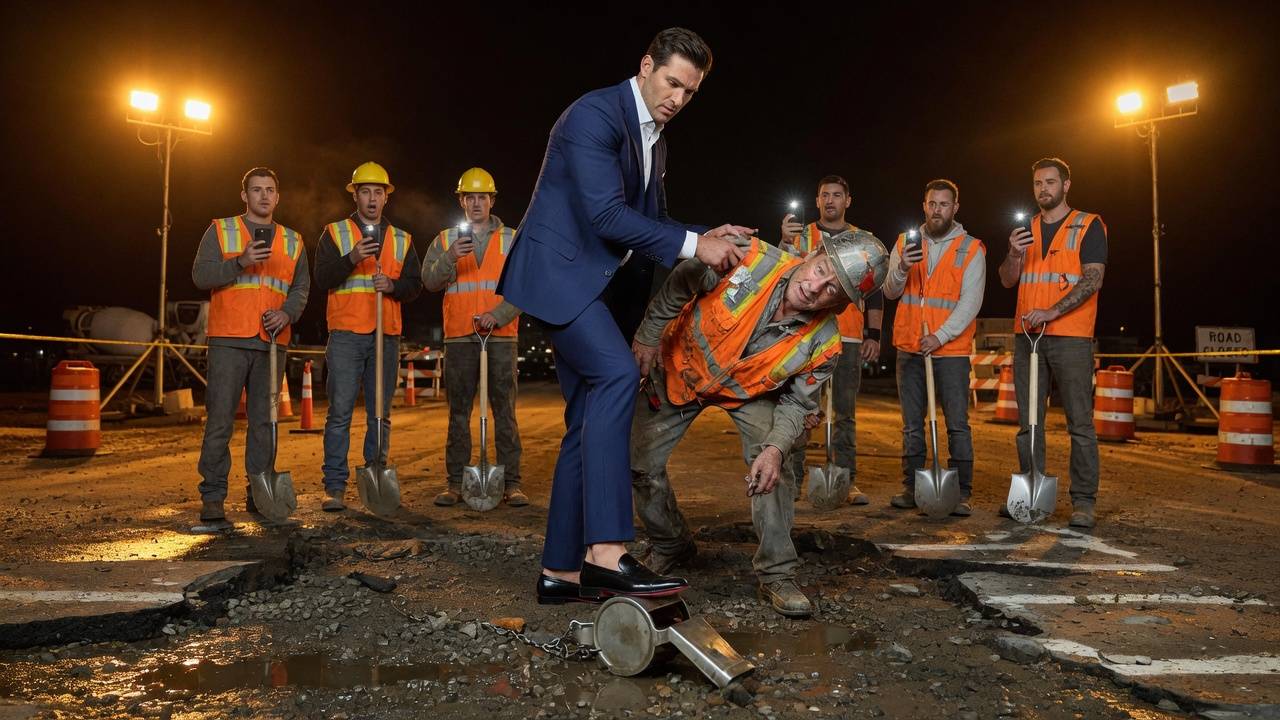
In front of the entire night crew, Colton threw a stack of hundreds into the dirt and demanded Silas get on his knees to earn them. Then, he saw the tarnished silver whistle around Silas’s neck—the only thing Silas had left from the service.
When Colton’s designer shoe came down on that silver whistle, the air in the construction zone went cold.
Colton thought he was bullying a janitor with a flashlight. He didn’t realize he was cornering a man who had survived three tours in the mountains of Afghanistan.
The dashcam caught everything. The grab. The insult. And the three seconds that followed.
By the time the dust settled, the “powerful” son of the Senator was begging for his life in the gravel, and the true guardian of Highway 49 was just getting started.
I put the full story link in the comments.
Chapter 1
The humidity on Highway 49 didn’t just hang; it clung to you like a wet wool blanket, smelling of pine sap and cooling asphalt. Silas adjusted the straps of his reflective vest, the neon orange mesh scratching against the back of his neck where the salt from a ten-hour shift had dried. It was 1:45 AM, the hour when the world felt like it was made of nothing but diesel fumes and the rhythmic, amber pulse of the construction floodlights.
He held the “Slow” sign with a loose, practiced grip, his boots planted firmly in the loose gravel of the shoulder. Beside him, a massive milling machine roared, chewing up the old, cracked skin of the highway. The noise was a physical weight, a constant vibration that rattled his teeth and drowned out the sound of his own thoughts. To most of the crew, it was a nuisance. To Silas, it was a shield. The noise meant he didn’t have to talk. It meant he could just exist in the periphery, a ghost in a high-visibility vest.
“Hey, Sarge. You want a coffee?”
Silas turned his head slightly. It was Miller, a kid barely twenty with a permanent smear of grease across his forehead and a desperate need for approval. Miller was the only one who called him “Sarge,” a title Silas had tried—and failed—to bury three years ago when he’d been discharged. It felt like wearing a suit that didn’t fit anymore, tight in the shoulders and frayed at the cuffs.
“I’m good, Miller,” Silas said, his voice gravelly from hours of silence.
“You sure? It’s gonna be a long one. Foreman says we’re pushing all the way to the bridge before sunrise. Coffee’s fresh, mostly.”
“I’m sure. Keep your eyes on the lane. The drunk-driving hour is just starting. They don’t see the cones until they’re hitting them.”
Miller nodded, his expression shifting from eager to somber. Everyone on the crew knew Silas didn’t do small talk. They knew he was the guy who had come back from the desert with a chest full of medals and a record that ended in a “General Under Honorable Conditions” discharge. The military’s way of saying you did the right thing, but you broke the rules to do it. In the eyes of the law, he was a civilian with a clean record; in the eyes of the Army, he was a liability who’d been invited to leave.
Silas reached into his vest pocket and felt the cool, hard surface of his silver whistle. It was a relic from his grandfather, a man who had survived the Chosin Reservoir. It was the only thing Silas had kept. No medals, no uniforms, no photos of the men he’d led. Just the whistle. It was his anchor. When the world felt too loud or the memories of that village in Helmand started to bleed into the dark woods of Mississippi, he would touch the silver. It reminded him that he was still here. That he was still a man who stood between the chaos and the innocent.
He glanced toward the small, corrugated metal tool shed at the edge of the construction site, partially obscured by a stack of jersey barriers. The door was padlocked from the outside, but Silas knew what was inside. Or rather, who.
Two hours ago, a girl had stumbled out of the woods, her dress torn, her eyes wide with a terror that Silas recognized instantly. She hadn’t said a word, just pointed back toward the highway and then curled into a ball on the dirt. Silas hadn’t called the local police. Not yet. He knew who lived in the mansions five miles up the road, the “Sterling Estates” that owned the local economy. He knew that calling the local sheriff meant calling the very people who played poker with the girl’s pursuers.
So, he had hidden her. He’d given her his water bottle and locked her in the shed, telling her to stay silent until the sun came up and he could get her across the county line.
“Car coming,” Miller called out, snapping Silas back to the present.
Silas looked down the long, dark stretch of the northbound lane. A pair of headlights was cutting through the gloom, moving fast. Too fast. The car wasn’t slowing for the orange cones. It wasn’t slowing for the flashing “Lane Merging” signs. It was a silver Ferrari, a low-slung predator that looked entirely out of place on a rural highway undergoing repair.
Silas stepped toward the center of the lane, raising his sign. He felt the familiar tightening in his chest—the transition from man to barrier. He wasn’t Silas the road worker anymore. He was the Guard.
The Ferrari screeched to a halt inches from Silas’s boots, the front end dipping as the brakes bit hard. The scent of hot ceramic and expensive leather wafted into the humid air, clashing with the smell of diesel.
The window rolled down, revealing a young man with blonde hair and the kind of symmetrical, arrogant face that only comes from generations of money and zero consequences. Colton Sterling.
“Move the sign, old man,” Colton said, his voice thick with liquor and a jagged, dangerous kind of boredom. “I’m in a hurry.”
Silas didn’t move. He looked past Colton at the passenger seat. It was empty, but there was a dark, wet smear on the dashboard. Silas had seen enough trauma to know exactly what it was.
“This is a closed construction zone, sir,” Silas said, his voice flat. “You need to turn around and take the detour at Mile 40.”
“Do you have any idea who I am?” Colton sneered, leaning out the window. “My father pays your salary. My father is this county. If I want to drive through this pile of dirt, I’m driving through it.”
Silas looked him dead in the eye, his expression unreadable. “Then your father should have taught you how to read a sign. This lane is closed. Turn the car around.”
Colton’s face twisted into a mask of pure, unadulterated rage. He looked at Silas’s worn vest, his dusty boots, and the tarnished silver whistle peeking out of his pocket.
“You’re a nothing,” Colton whispered. “A piece of human trash standing in the middle of the road. Now move, or I’ll drive right over you.”
Silas didn’t blink. Behind him, Miller and the rest of the crew had stopped working. The roar of the milling machine continued, but the human world had gone silent. Silas could feel the eyes of his crew on him, waiting to see if the Sarge was still in there.
Chapter 2
The Ferrari’s engine revved, a predatory growl that made Miller jump back toward the jersey barrier. Silas didn’t move an inch. He could feel the heat radiating from the car’s hood against his shins, a physical pressure that he met with a stillness that had been forged in much worse places than a Mississippi highway.
“Colton, man, just take the detour,” a voice called out from the back of the Ferrari. Silas hadn’t noticed the two other passengers until now—young men in expensive polos, their faces pale and sweating. They weren’t arrogant; they were terrified. They were looking at the blood on the dash, then at Silas, then at the dark woods behind them.
“Shut up, Leo!” Colton snapped, his eyes never leaving Silas’s. “This loser thinks he’s some kind of hero. He’s a flagger. He’s a speed bump in an orange vest.”
Colton reached into his center console and pulled out a thick wad of hundred-dollar bills, bound by a heavy gold clip. He held it out the window, waving it in Silas’s face. The bills were crisp, a stark contrast to the grease and dirt on Silas’s hands.
“Here. Take five grand. Open the gate, tell your boss you didn’t see anything, and go buy yourself a life that doesn’t involve holding a stick in the mud.”
Silas looked at the money, then back at Colton’s dilated pupils. “You hit something at Mile 42, didn’t you? A cyclist or a pedestrian.”
The silence that followed was heavy, punctuated only by the idle of the high-performance engine. The two boys in the back seat looked at each other, their breathing audible even over the machinery. Colton’s grip on the money tightened until his knuckles were white.
“I don’t know what you’re talking about,” Colton said, though his voice had lost its edge of boredom. It was sharp now. Cornered.
“There’s blood on your dash, Colton. And your front right headlight is shattered. The reports of a hit-and-run just came over the scanner. You’re not going anywhere until the Highway Patrol gets here.”
Colton laughed, a harsh, jagged sound. “The Highway Patrol? You think they’re going to arrest me? Based on the word of a man on probation? I know your file, Silas. I know why you’re out here instead of at the VA. You’re one bad day away from a jail cell yourself.”
Silas felt a sting of shame, the old wound reopening. Colton’s father had a long reach; he had clearly pulled strings to find out about Silas’s legal situation. Silas was on a two-year probation for an “altercation” at a bar six months ago—a fight he hadn’t started, but one he had finished too efficiently.
“I’m doing my job, Mr. Sterling,” Silas said, his voice tight. “Now, turn off the engine and step out of the vehicle.”
Colton’s eyes narrowed. He looked at the crew of workers. They were all watching, their smartphones raised to record the confrontation. The social pressure was building, but for a man like Colton, it didn’t feel like a deterrent. It felt like a stage. He needed to win. He needed to humiliate the man who had dared to say ‘no’ to him in front of an audience.
Colton opened the door and stepped out of the car. He was taller than Silas, broader, his suit tailored to emphasize his gym-built physique. He smelled of expensive gin and cold, inherited entitlement.
“You want to play the hero, Silas?” Colton asked, stepping into Silas’s personal space. He was so close that Silas could see the broken capillaries in his eyes. “You think that little whistle makes you a soldier again? You think these guys respect you?”
Colton reached out and flicked the silver whistle where it hung against Silas’s chest. “It’s garbage. Just like you. You’re a failure who couldn’t even follow orders when it mattered.”
“Back off,” Silas said, his hands remaining at his sides, fingers slightly curled. He could feel the adrenaline beginning to pump, the familiar ‘click’ of his combat brain. He had to suppress it. He had to be the target. If he struck first, he lost everything. His daughter, Maya, was waiting for him at home. He had promised her he wouldn’t get into any more trouble. He had promised her he’d be there to walk her to school on Monday.
“Or what?” Colton challenged, his voice rising for the benefit of the cameras. “You gonna blow your little whistle? You gonna call for help?”
Colton turned to the crew, spreading his arms wide. “Look at him! The big, bad war hero. He’s terrified. He’s shaking because he knows his life is over if he touches me.”
Silas wasn’t shaking. He was vibrating with the effort of staying still.
Colton looked down and saw Silas’s boots. “You’re getting dust on my car, Silas. These tires cost more than your house. Probably more than your daughter’s future.”
Colton suddenly shoved Silas. It wasn’t a hard shove, but it was enough to make Silas stumble back a step into the wet gravel. The crew gasped. Miller took a step forward, his shovel held like a weapon, then stopped when Colton’s bodyguard—a man who had been sitting silently in the passenger seat—stepped out of the car. The guard was a wall of muscle in a black suit, his hand resting conspicuously near his waistband.
“Stay back, kid,” the guard told Miller. “This doesn’t involve you.”
Colton looked at Silas, a triumphant grin on his face. “See? Nobody’s coming to save you. You’re just a man in a vest, standing in the dirt where you belong. Now, pick up that money I dropped and get on your knees. Maybe then I won’t tell the Sheriff you threatened me.”
Chapter 3
The next twenty minutes were a slow-motion nightmare. Colton didn’t drive through the barricade. Instead, he decided to turn the construction site into his private playground of cruelty. He knew the Highway Patrol was coming, but he also knew his father was already on the phone with the District Attorney. He felt untouchable, and he wanted Silas to feel his own insignificance.
He moved to the Ferrari’s trunk and pulled out a bottle of champagne. He popped the cork, letting the foam spray over Silas’s boots and the “Slow” sign. The crew watched in a mixture of horror and fascination. This wasn’t just a traffic stop anymore; it was a ritual of class warfare.
“Hey, Silas,” Colton called out, leaning against the hood of his car. “I heard about that village in Garmis. You refused to call in the strike, didn’t you? Let the targets walk because there were kids in the building. Noble. Very Disney.”
Silas closed his eyes for a second. The screams. The dust. The way the Captain had looked at him when Silas had smashed the radio. He could still smell the ozone of the battery acid.
“You thought you were saving lives,” Colton continued, pacing in front of Silas like a prosecutor. “But all you did was ruin your own. Now look at you. You’re forty-five years old, you have no pension, no health insurance, and you’re guarding a pile of dirt for fifteen dollars an hour. Was it worth it? Does that girl you saved send you Christmas cards?”
“Lives are always worth it,” Silas said, his voice a low vibration.
Colton walked over to the tool shed—the one where the girl was hiding. Silas’s heart skipped a beat.
“What’s in here, anyway?” Colton asked, rattling the padlock with his manicured hand. “More of your precious gear? Or maybe you’re hiding some beer for after your shift? Or maybe… something else?”
“It’s just tools, Colton,” Silas said, his voice more urgent now. “Stay away from the shed. It’s company property.”
Colton’s eyes lit up. He’d found a nerve. He walked back to Silas, his face inches from his. “You’re hiding something. I can see it in your eyes. You’re a terrible liar, Silas. That’s why you failed as a soldier. You have too much of that… what do you call it? Integrity? It’s a disease for people like you.”
Colton reached out and grabbed Silas by the ear, twisting it. It was a petty, schoolyard move, designed to make Silas look ridiculous in front of his crew. Silas winced, the cartilage crunching, but he didn’t move. He felt the heat of humiliation rising in his chest, a thick, black tide. He looked at Miller. The kid was looking at the ground, his face red with shame.
“Say it,” Colton commanded, twisting harder. “Say, ‘I’m a loser, Mr. Sterling.'”
“Turn off the engine, Colton,” Silas repeated.
Colton let go of Silas’s ear and shoved him again, harder this time. Silas fell back against a stack of orange cones, the plastic rattling.
“You’re boring me now,” Colton said. He looked at the silver whistle hanging from Silas’s neck. “Give me that. It’s the only thing on you that’s worth anything.”
“No,” Silas said.
“Give it to me, or I’ll tell the Sheriff you tried to pull a knife on me. And my friends back there? They’ll back me up. You’ll be back in a jumpsuit by morning, and your daughter will be in the system. Is that what you want?”
Silas looked at the boys in the car. They wouldn’t look at him. They were the witnesses, the social weight that made the bullying possible. They were the ones who would ensure the lie became the truth.
Colton reached out and yanked the whistle. The black cord snapped, stinging Silas’s neck.
“Look at this piece of junk,” Colton said, holding the silver whistle up to the floodlights. “It’s dented. It’s old. It’s pathetic. Just like the man who wore it.”
He dropped the whistle into the wet dirt and champagne.
Silas stared at it. The silver caught the amber light, a small, shining point of dignity in the mud. He felt something in him snap. Not the rage—he knew how to handle rage. It was the restraint. The realization that he had been protecting a world that didn’t want him, and standing in front of a man who didn’t deserve his mercy.
“Pick it up,” Silas said.
“What was that?” Colton asked, stepping closer.
“Pick it up. And apologize for what you did at Mile 42.”
Colton laughed. He raised his foot—a thousand-dollar leather loafer—and positioned it directly over the whistle.
“You want me to pick it up? How about I give it a little more character first?”
“Colton,” Silas said, his eyes locking onto the blonde man’s with a terrifying, dead intensity. “If you step on that whistle, the man you’re talking to disappears. And the man who replaces him is someone you really don’t want to meet.”
Colton’s grin widened. “I love it. The ‘quiet man’s’ threat. So dramatic. Watch me, Silas.”
Colton’s foot began to descend.
Chapter 4
The world narrowed down to the space between Colton’s shoe and the silver whistle.
“Kiss the dirt, you glorified crossing guard!” Colton shouted, his voice echoing off the milling machine.
He slammed his foot down. The sound of silver crunching into the gravel was small, but to Silas, it sounded like a building collapsing.
Colton didn’t stop there. He reached out and grabbed Silas by the front of his neon vest, his fingers bunching the fabric and pulling Silas’s face toward his. He forced Silas to bend, to stoop lower, a deliberate act of public degradation. Silas could smell the champagne on Colton’s breath, the scent of a man who thought he had won.
“Look at it!” Colton hissed, pointing at the crushed whistle. “That’s your legacy, Silas. Trash in the dirt. Now, say it. Say you’re nothing.”
Silas looked down at the whistle. The silver was flattened, the black cord tangled in the mud. He felt the weight of every silent year, every swallowed insult, every moment he had chosen to be the victim so his daughter could have a father.
He looked at the crowd. Miller was holding his phone, the lens reflecting the amber light. The other workers were frozen, their faces pale under the floodlights.
“Take your foot off my whistle, Colton,” Silas said. His voice was a whisper, but it carried over the roar of the machinery. “Last warning.”
Colton’s eyes danced with cruel delight. “Or what, speed bump? You gonna—”
Colton didn’t finish. He shoved Silas’s head down one more time, his hand open-palmed against Silas’s forehead, a final, insulting gesture.
The ‘click’ in Silas’s brain was final. The soldier was back.
MOVE 1: ARM SNAP / STRUCTURE BREAK
As Colton’s hand moved to shove again, Silas’s left hand shot up like a piston. He didn’t just block the arm; he caught Colton’s wrist and snapped it outward with a violent, downward torque.
Colton’s entire body jolted. The sudden break in his structure forced his shoulder to rotate backward, his chest opening wide, his balance shattering. The smug grin was replaced by a look of sudden, sharp confusion. He was no longer the hunter; he was a target.
MOVE 2: SHORT BODY-WEIGHT STRIKE
Silas didn’t wait for Colton to recover. He stepped his right foot into the gap he’d created, his hips rotating with the practiced grace of a machine. He drove a short, compact palm-heel strike directly into Colton’s sternum.
There was a wet thud as the blow landed. Colton’s navy blue suit jacket compressed under the force. His lungs seized, the air driven out of him in a ragged gasp. His head snapped back, his feet scrambling for purchase on the loose gravel.
MOVE 3: DRIVING FRONT PUSH KICK
Silas planted his lead foot and brought his right knee up to his chest. He didn’t just kick; he drove his entire body weight through his heel, striking Colton squarely in the center of his chest.
Colton was launched backward. He didn’t stumble; he flew. He hit the ground hard, his expensive suit skidding through the dirt and champagne-soaked gravel. He rolled once and came to a stop at the feet of his own bodyguard.
The silence that followed was absolute. Even the milling machine seemed to quiet down as the workers reached to kill the engines.
Colton lay on his back, gasping for air like a fish out of water. He tried to sit up, but his arms gave way. He looked up at Silas, his slicked-back hair now matted with mud, his face a mask of pure terror.
“Wait—stop!” Colton managed to wheeze, raising a trembling hand defensively. “I’m sorry! I’m sorry!”
The bodyguard took a step forward, his hand moving toward his waist. Silas didn’t turn his head, but his posture shifted, his weight settling into his heels.
“If you pull that piece of plastic, you better be ready to use it,” Silas said, his voice flat and deadly. “Because if you miss, I will feed it to you.”
The guard froze. He looked at Colton, then back at Silas. He saw the way Silas was standing—perfectly balanced, eyes cold, hands relaxed but ready. He’d seen that look before, on men who didn’t care if they lived or died. The guard took his hand off his belt and stepped back.
Silas walked over to the flattened whistle. He reached down and picked it up, wiping the mud off with his thumb. It was ruined, the silver bent out of shape.
He stepped over to Colton, who was cowering on the ground, his designer loafers digging into the gravel as he tried to back away.
“Pick up the whistle,” Silas said, dropping the silver shard onto Colton’s chest.
Colton clutched it with shaking fingers, his chest heaving.
“And stay down,” Silas added.
At that moment, the blue and red lights of the Highway Patrol appeared on the horizon, cutting through the dark like a promise. Silas didn’t run. He didn’t hide. He stood tall in his neon orange vest, the amber floodlights behind him, looking like a giant carved from shadow.
“Miller,” Silas called out.
“Yeah, Sarge?” Miller asked, his voice shaking with awe.
“Call the Sheriff. Tell him we have a hit-and-run suspect in custody. And tell him there’s a witness in the shed who needs a ride home.”
Colton Sterling, the man who thought he owned the county, began to sob quietly in the dirt. The road was closed. And for the first time in years, Silas felt like he was finally exactly where he was supposed to be. But as the police cars slowed, Silas knew the real fight—the legal one, the one against the Sterling name—was only just beginning. He looked at the crushed whistle in Colton’s hand and knew he’d have to pay a price for what he’d just done. He just hoped Maya would understand why he wasn’t going to be home for dinner.