Sterling Graves walked into my library like he owned the soul of this town. He didn’t just come for the building; he came for the dignity of everyone who ever sought refuge between these shelves. To him, these books are just “obsolete trash” standing in the way of a new casino floor.
He didn’t know I spent fifteen years in the shadows before I ever touched a library card. He didn’t know that the quiet man behind the desk has seen things that would make his blood turn to ice.
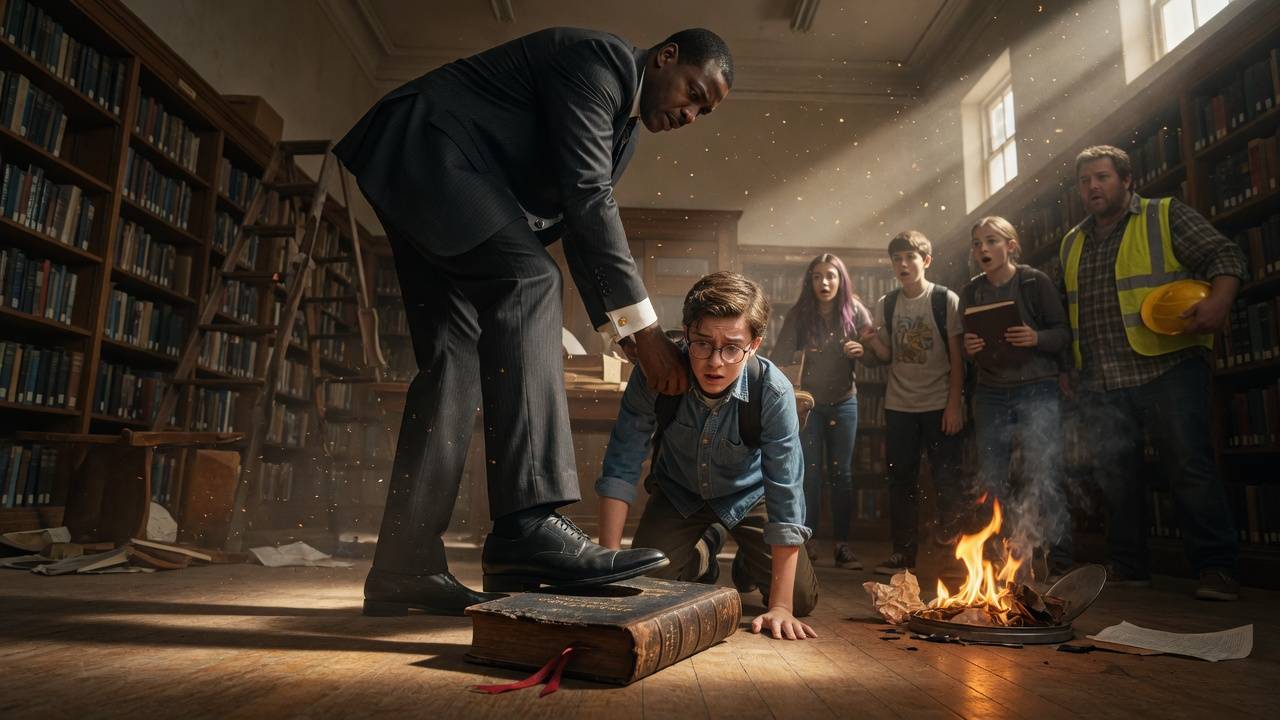
Today, Graves crossed a line he can’t uncross. He took my mother’s magnifying glass—the last thing I have of the woman who taught me to love the truth—and he ground it into the floorboards under his $900 shoes. He did it in front of the kids who come here after school to feel safe.
He thought my silence was weakness. He thought my trembling was fear. He didn’t realize I was just trying to remember the man I promised I wouldn’t be anymore.
When he grabbed me, I saw the phones come out. I saw the fear in the students’ eyes. And I realized that if I didn’t stand up now, these kids would grow up thinking that money can stomp on anything it wants.
What happened next wasn’t about a library. It was about a debt that was finally due.
The look on his face when he hit the floor is something this town won’t forget for a long time. But the consequences are only just beginning, and the secrets I’ve kept in these books are finally starting to bleed out.
The full story is in the comments.
Chapter 1
The smell of old paper and floor wax was the only thing that kept Jude’s heart from hammering out of his ribs most mornings. It was a sterile, comforting scent, the smell of a life that had no sharp edges. He liked the way the morning light hit the dust motes in the West St. Library—it made the air look solid, like something you could lean against.
He was fifty-two, and he moved with a deliberate, slow grace that people in town mistook for fragility. They saw a man who wore cardigans in October and spent too much time worrying about the humidity levels in the Rare Books room. They didn’t see the way he mapped every exit in the building every time he walked through a door. They didn’t see the way his eyes tracked the hands of every stranger who walked up to the circulation desk.
“Morning, Jude,” Sarah said, dropping a stack of returned memoirs on the counter. She was twenty-two, bright-eyed, and convinced that the library was the heart of the community. She didn’t know it was a tomb.
“Morning, Sarah. The roof leak?”
“Held up through the storm. But Jude… Sterling Graves’s people were out front again. Taking measurements. They were taking pictures of the cornerstone.”
Jude felt a cold needle of dread prick the base of his spine. “They don’t have the permit yet, Sarah. The council hasn’t voted.”
“They’re acting like they have,” she whispered, leaning in. “Graves was on the news last night. He called this place a ‘structural liability.’ He said it was a waste of prime real estate.”
Jude didn’t answer. He turned to the computer, his fingers hovering over the keys. He wasn’t looking at the library catalog. In his mind, he was looking at a series of encrypted files he’d buried nearly two decades ago. Ten thousand names. Ten thousand lives that had been “liquidated” on paper by a government that didn’t want the paperwork. He had saved them. He had printed them in microscopic QR codes, hidden inside the woodcut illustrations of 19th-century botanical journals, and shelved them here, in the middle of nowhere, Ohio.
The library wasn’t just a building. It was a hard drive made of paper.
The bell above the heavy oak doors chimed. It wasn’t the soft, rhythmic chime of a regular. It was a loud, aggressive clang.
Sterling Graves didn’t walk; he conquered space. He was forty, tanned, and wore a suit that cost more than Jude made in a year. Behind him stood two men who looked like they were built out of concrete and bad intentions.
“Mr. Graves,” Jude said, his voice level. “We’re not open to the public for another ten minutes.”
Graves didn’t stop until he was leaning over the mahogany desk, his presence crowding Jude into the back of his chair. He picked up a small, brass-rimmed magnifying glass sitting on a velvet cloth near the register. Jude’s pulse spiked. It had been his mother’s.
“You know, Jude—can I call you Jude?—I admire the dedication,” Graves said, turning the glass over in his manicured fingers. “Most men would have realized the ship was sinking and jumped. But you’re still here, polishing the brass.”
“It’s a public trust, Mr. Graves. Not a ship.”
Graves laughed, a sharp, dry sound. He set the magnifying glass down, but he didn’t let go of it. He slid it across the wood like a chess piece. “It’s a pile of bricks and moldy paper. The town needs a tax base. It needs jobs. It doesn’t need a man in a dusty sweater guarding books that nobody reads.”
He leaned closer, his voice dropping. “I’m going to level this place, Jude. And I’m going to do it with a smile. You should start packing your things. Especially the stuff that isn’t on the inventory.”
Graves’s eyes flickered to the Rare Books door. It was a brief, predatory look. Jude felt the sweat break out under his arms. Did he know? Or was he just guessing?
“The library stays,” Jude said, the words feeling like stones in his mouth.
“We’ll see about that,” Graves said. He tapped the magnifying glass once, a dismissive, mocking gesture, and turned on his heel.
As they walked out, one of the guards purposely bumped into a display of New Arrivals, sending them sprawling across the floor. They didn’t look back. Jude stood there for a long time, the silence of the library suddenly feeling very thin, like a veil that was about to be torn.
Chapter 2
By Tuesday, the pressure had moved from the shadows to the sidewalk. A chain-link fence had been erected ten feet from the library’s main entrance, ostensibly for “safety inspections.” It forced the high schoolers who came for the tutoring program to squeeze through a narrow gap, watched by Graves’s private security team.
Jude watched from the window of his second-floor office. He saw Leo, a fifteen-year-old with a stutter and a genius for calculus, get stopped by one of the guards. The guard made Leo empty his backpack on the pavement.
Jude was down the stairs before he realized he’d moved.
“Is there a problem here?” Jude asked, stepping onto the sidewalk. The air was cold, smelling of wet asphalt.
The guard, a man named Miller with a neck wider than his head, looked down at Jude with visible contempt. “Checking for prohibited items. Site safety.”
“This is still a public sidewalk, and that’s a minor,” Jude said. His voice was too steady. It was the voice he’d used in the “Vault” back in D.C., the one that didn’t betray the fact that he was currently committing treason.
“It’s okay, Mr. J-J-Jude,” Leo said, his face beet red as he scooped up his folders.
“It’s not okay, Leo,” Jude said.
Graves appeared from behind a black SUV parked at the curb. He was holding a latte, looking like he’d just stepped off a yacht. “Is there a problem, Miller?”
“Librarian’s got a mouth on him, sir,” Miller grunted.
Graves walked over, his eyes scanning the crowd of townspeople who had gathered to watch the fence go up. He saw the tension. He loved it. He thrived on the asymmetry of it.
“Jude, you’re making a scene,” Graves said smoothly. “We’re just trying to ensure that when the demolition starts, no one gets hurt by the… instability of your building.”
“The building is fine, Sterling. The only instability here is your ego.”
The crowd gasped. Jude knew he shouldn’t have said it. He was supposed to be invisible. He was supposed to be the man who didn’t exist.
Graves’s smile didn’t falter, but his eyes turned into chips of flint. He walked right into Jude’s personal space, forcing Jude to step back toward the fence. Graves was taller, broader, and radiated the kind of confidence that comes from never being told ‘no.’
“You’re a tiny man, Jude,” Graves whispered, loud enough for Leo and the others to hear. “You’re a remnant. You’re the guy who stayed behind because he was too scared to go out into the real world. You think these books make you smart? They just make you heavy. And heavy things are easy to crush.”
He reached out and flicked Jude’s library ID badge, which was clipped to his pocket. The plastic snapped against Jude’s chest. “Go back inside and play with your alphabet, old man. Before you get hurt.”
Jude felt the shame wash over him, hot and prickly. It wasn’t just for himself; it was the way Leo looked at him. The boy was looking for a hero, and all he saw was a librarian getting bullied by a man in a suit.
“Inside, Leo,” Jude said, his head down.
He spent the rest of the day in the Rare Books room. He pulled down a copy of The Flora of the Ohio Valley, printed in 1884. He opened it to page 112. There, in the corner of a lithograph of a Lady’s Slipper orchid, was a tiny, ink-black square. It looked like a printing error to the naked eye. Under a 20x loupe, it was a map to a mass grave in a country that no longer appeared on maps.
He touched the page. The paper was dry, brittle. If Graves brought the wrecking ball, this history—the only proof that these people had ever lived—would become ash.
He couldn’t call the police. He couldn’t call the papers. To do so would be to signal his location to the men who had been looking for “The Archivist” for twenty years.
He was trapped between two different kinds of ruin.
That night, he didn’t go home. He sat in the dark in the main reading room, listening to the building groan. He thought about his mother. She had died in a chair just like this one, her thumb marking a page in a book she’d never finish. She had told him once that books weren’t just stories; they were promises that the past wouldn’t be forgotten.
He realized then that he had been so focused on saving the data that he had forgotten how to save the place that held it. He was a coward who had hidden behind a cardigan.
Chapter 3
Wednesday morning brought the “Notice of Imminent Hazard.” Graves had bypassed the council by filing an emergency injunction through a judge he likely played golf with. The library was to be vacated by noon on Thursday.
The town was in an uproar, but it was a disorganized, helpless kind of noise. People brought coffee and donuts to the staff, but no one was willing to stand in front of the bulldozers.
Jude spent the morning in a feverish calm. He wasn’t packing books. He was preparing the “Residue.”
He met Leo and four other students in the basement. They were angry, their faces tight with the kind of righteous fury only teenagers can sustain.
“He can’t just d-d-do this,” Leo said, slamming a fist into a palm.
“He can,” Jude said. “Unless we change the narrative.”
He handed Leo a small, high-capacity flash drive. “Leo, I need you to do something for me. I need you to go to the computer lab at the school. Don’t use the library’s network. Upload the files on this drive to the cloud link I’ve written on this paper. It’s a secure drop. If anything happens to this building… if anything happens to me… you make sure that link gets sent to every major news outlet in the state.”
Leo looked at the drive like it was a live grenade. “What’s on it?”
“The truth about why Mr. Graves wants this land so badly,” Jude lied. It was partially true. Graves wanted the land for a casino, but the drive actually contained the decrypted keys to the “Archive” hidden in the books. If the books were destroyed, the drive was the only way to prove the digital backup was real.
“Jude,” Sarah called from upstairs. “He’s back. And he brought a crew.”
Jude stood up. He felt a strange lightness in his limbs. The fear was still there, but it had settled into a cold, hard lump in his gut. It was a familiar feeling. It was the feeling he’d had right before he’d walked out of the NSA building with a stack of forbidden printouts tucked into his waistband.
He walked up to the main floor. The light was golden, the sun setting behind the stained-glass windows.
Sterling Graves was standing in the center of the lobby. He was wearing an orange hard hat, a mocking accessory that made the construction workers behind him chuckle. They were carrying sledgehammers and crowbars.
“Noon tomorrow is too long to wait,” Graves said, his voice echoing off the high ceiling. “I’ve decided to start with the ‘cosmetic’ removals today. We’re taking the doors off the hinges, Jude. Just to get the air flowing.”
“You don’t have the legal right to be in here until the injunction is finalized tomorrow,” Jude said.
“I have a crew of twenty men and a checkbook that says I can do whatever I want,” Graves replied. He walked over to the circulation desk. The magnifying glass was still there. Jude had kept it there as a reminder.
Graves picked it up. He held it up to the light, peering through it at Jude’s face. “You look old through this, Jude. Old and small.”
“Put it down, Sterling.”
“Or what? You’ll shush me?” Graves laughed. He turned to his men. “Did you hear that? The librarian is getting tough.”
One of the workers, a younger guy with a cynical sneer, stepped forward. “Maybe he wants to show us his ‘forbidden’ section.”
Graves’s eyes narrowed. He looked at Jude, really looked at him, for the first time. He saw the way Jude was standing—feet shoulder-width apart, weight balanced, hands relaxed but ready. He didn’t see a librarian. He saw a threat he didn’t understand.
And because Graves didn’t understand it, he decided to crush it.
“You know what I think?” Graves said, his voice turning vicious. “I think you’ve got something hidden in here. Something that isn’t yours. Something that’s making you think you’re more important than you are.”
He dropped the magnifying glass onto the hardwood floor. It landed with a dull thud.
“Sterling, don’t,” Jude said. His voice was a low, dangerous hum.
Graves raised his foot. He looked Jude right in the eyes, a slow, predatory smile spreading across his face. “Knowledge is power, right Jude? Let’s see how much power this has.”
He slammed his heel down. The sound of the glass shattering was louder than any sledgehammer.
Chapter 4
The sound of the glass breaking seemed to suck all the air out of the room. The teenagers standing by the biography section froze, their phones already out, recording the scene. The construction workers shifted, the bravado suddenly replaced by an uncomfortable tension.
Jude didn’t move. He looked down at the shards of his mother’s magnifying glass. The brass rim was twisted, the lens a thousand sparkling diamonds against the dark oak. It was more than a tool. It was the last thread connecting him to a woman who had believed that some things were sacred.
“Now,” Graves said, his voice dripping with satisfaction. “Pick up the trash, librarian. You’re as obsolete as these books.”
Graves reached out and grabbed the front of Jude’s denim shirt. He was strong, his grip bunching the fabric and lifting Jude slightly off his heels. He pulled Jude close, so close Jude could smell the expensive peppermint on his breath.
“You’re nothing,” Graves whispered. “You’re a ghost in a haunted house. And I’m the one who’s tearing it down.”
He shoved Jude backward, forcing him toward his knees. Jude stumbled, his hand hitting the floor near the shattered glass. The crowd of students gasped. Sarah let out a small, choked sob.
“Take your foot off that glass, Sterling,” Jude said. His voice wasn’t a plea. it was a cold, clinical statement. “Last warning.”
Graves let out a bark of a laugh, his foot still grinding the shards into the wood. “Or what, Jude? What are you going to do?”
Graves stepped forward, intending to grab Jude’s collar again, his hand reaching out with a contemptuous shove.
In that second, the librarian vanished. The man who worried about humidity and alphabetizing disappeared, and the man who had been trained by the state to neutralize threats in four seconds took his place.
Jude didn’t scramble away. He planted his left foot, a solid anchor on the hardwood. As Graves’s hand reached for his shirt, Jude’s right hand snapped up. It wasn’t a punch; it was a sharp, percussive strike to Graves’s forearm, snapping the limb off-line.
Graves’s balance vanished. His shoulder turned, his chest opening up like a target. He looked confused for a fraction of a second—the look of a man who had never had his physical will countered.
Jude didn’t give him the second. He stepped deep into Graves’s space, his lead foot planting firmly. He drove the heel of his palm into the center of Graves’s chest, right on the sternum. It was a short, compact movement, but it carried every ounce of Jude’s weight and twenty years of repressed rage.
Graves’s suit jacket jolted. His breath left his body in a violent oof. His shoulders snapped back, and his feet began a frantic, uncoordinated scramble to stay upright.
Jude didn’t wait for him to recover. He pivoted on his standing foot and drove a front push kick directly into the center of Graves’s chest. His sole made solid, wet contact.
Graves didn’t just fall; he was launched. He flew backward three feet, his polished shoes skidding across the floor before his legs gave out entirely. He hit the ground hard, the weight of his body landing with a bone-jarring thud. A stack of “Quiet Please” signs on a nearby table rattled and fell.
The silence that followed was absolute.
Graves scrambled backward on his elbows, his face pale, his expensive suit rumpled and covered in library dust. He looked up at Jude, his eyes wide with a primal, animal terror.
“Wait, stop!” Graves stammered, raising a hand defensively, his voice cracking. “I’m sorry! Don’t!”
Jude stood over him. He wasn’t breathing hard. He wasn’t shaking. He looked down at Graves with a cold, detached clarity that was far more terrifying than anger.
“The library is closed to people like you,” Jude said, his voice echoing in the rafters. “Get out.”
Graves didn’t argue. He scrambled to his feet, nearly tripping over his own workers, and bolted for the door. His security team followed, their eyes fixed on the floor, suddenly very interested in the exit.
Jude stood in the center of the lobby. He felt the eyes of the students on him. He saw Leo holding his phone, the screen glowing.
“Mr. Jude?” Leo whispered.
Jude looked down at the broken magnifying glass. The residue was already setting in. He knew that by tomorrow morning, that video would be everywhere. He knew the men in D.C. would see it. They would recognize the way he moved. They would see the “Archivist.”
He had saved the library, but he had ended his life as Jude.
“Sarah,” Jude said, his voice finally trembling a little. “Call the Board of Trustees. Tell them we’re going to need a new magnifying glass. And maybe a lawyer.”
He walked toward the Rare Books room, the shards of glass crunching under his boots. The war was no longer in the shadows. It was in the light, and for the first time in twenty years, Jude was ready to be seen.