I spent twenty years serving a country that forgotten me, only to end up guarding the “masterpieces” of a man who wouldn’t know sacrifice if it bled on him. Julian Thorne thinks because he owns the gallery, he owns the souls of the people inside it.
Tonight, in front of the most powerful people in the city, he decided to show them what a “broken man” looks like. He took the only thing I had left of my father—his silver medal—and dropped it on the floor like a piece of trash.
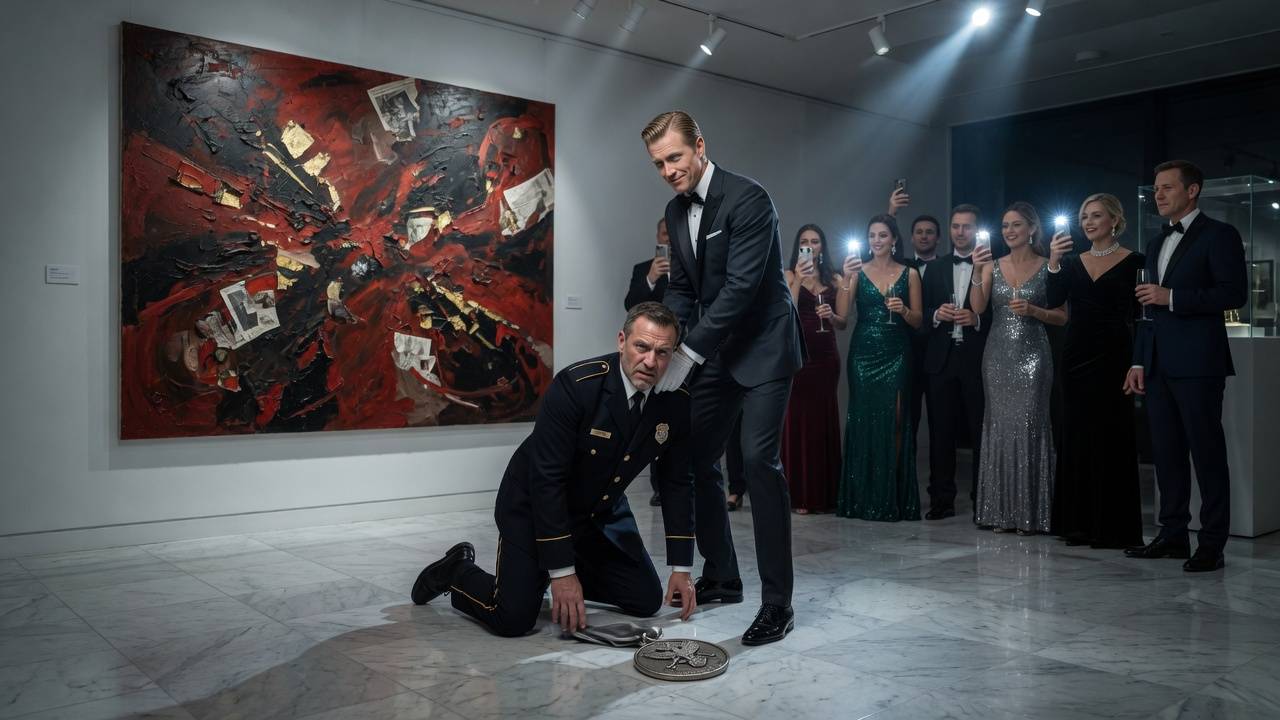
The guests didn’t look away. They leaned in. They held up their phones, waiting for me to break, waiting for me to beg for my job while Julian ground his expensive Italian leather shoe into my history.
He thought I was just a uniform. He thought the “eyes of a failing soldier” couldn’t see the truth hidden in his gallery or the weakness in his own posture. He told me to clean the floor with my dignity.
But Julian forgot one thing. I wasn’t just trained to watch. I was trained to neutralize threats. When his foot stayed on that medal and his hand reached for my throat, the gala guests got a different kind of show.
Now he’s the one looking up from the marble floor, and the silence in this room is the loudest thing I’ve ever heard. The video is already spreading, but they don’t know the half of it.
The full story is in the comments.
Chapter 1
The air in the Thorne Gallery didn’t circulate so much as it lingered, heavy with the scent of expensive floor wax and the faint, metallic tang of the climate-control system. Elias stood at the edge of the East Wing, his hands clasped behind his back, feet exactly shoulder-width apart. It was a posture born of two decades in tactical intelligence—a stance that looked passive to a layman but felt like a coiled spring to him.
His navy blue uniform was pressed with a sharpness that made the other guards look like unmade beds. Elias didn’t mind. The uniform was a skin he knew how to wear. It was the “security guard” label that felt like a cheap costume.
In the center of the wing hung The Crimson Veil, an abstract monstrosity Thorne had purchased for eight figures. To the donors sipping Chardonnay, it was a bold exploration of visceral emotion. To Elias, through the lens of his infrared-modded flashlight tucked into his belt, it was something else entirely.
“Checking the dust again, Elias?”
The voice was high, polished, and carried the effortless cruelty of inherited wealth. Julian Thorne walked into the wing, his charcoal tuxedo catching the track lighting. Behind him trailed Marcus, the head of security—a man who looked like he spent more time at the gym than he did reading a briefing.
“Just ensuring the perimeter is clear, Mr. Thorne,” Elias said, his voice flat, neutral.
Julian stopped in front of him, invading Elias’s personal space. He smelled of sandalwood and old money. “You look like you’re bracing for an insurgent attack, not a cocktail party. Relax. You’re a glorified doorman now. Try to smile. It makes the donors feel less like they’re being watched by a ghost.”
Marcus let out a short, guttural bark of a laugh. “The old man’s still in the trenches, Julian. He thinks a painting is a high-value target.”
Elias didn’t blink. He had watched men far more dangerous than Julian Thorne crumble under interrogation. He had seen the way a human face looked right before the soul left it. Julian was just a boy playing with his father’s toys. But the toys were dangerous.
“The lighting on the Veil seems… uneven tonight,” Elias remarked, his eyes shifting to the painting.
Julian’s smile didn’t reach his eyes. “Art is about perception, Elias. Something I wouldn’t expect a technician like you to grasp. You see lines and colors. I see legacy. My father built this gallery on legacy.”
Your father built this gallery on the blood of my team, Elias thought, though his face remained a mask of professional boredom. He knew what Julian was hiding under that red paint. He had seen the scan. The underlying brushstrokes weren’t art; they were a topographical map of a classified border sector, encrypted with a color-offset technique Elias hadn’t seen since the Fall of Kabul.
Julian reached out, flicking a piece of invisible lint off Elias’s shoulder. It was a small gesture, but in the hierarchy of the room, it was a slap. “Keep your eyes on the doors, not the art. If I catch you staring at the paintings instead of the people again, I’ll have Marcus escort you to the unemployment line. And we both know your… checkered record wouldn’t survive another black mark.”
Julian walked away, his laughter echoing against the vaulted ceiling. Elias felt the familiar heat in his chest, the old rage that tasted like copper. He reached into his pocket and felt the jagged edge of the silver medal. His father’s medal. The only thing he had left that wasn’t a lie.
He watched Julian greet a group of investors near the bar. The social pressure was a physical weight—the way the guests looked through him as if he were part of the architecture, the way the younger guards snickered when he did his rounds. He was the “eye that failed,” the man who had supposedly let a traitor slip through his fingers.
He hadn’t let anyone slip. He had been framed by Julian’s father, the very man who had mentored him. And now, the son was finishing the job.
Elias moved toward the shadows of the North corridor. He had three hours until the gala ended. Three hours to decide if he was going to remain a ghost, or if he was going to burn the Thorne legacy to the ground.
Chapter 2
The second hour of the gala brought the crowd, a sea of silk and tailored wool that filled the gallery with a low, humming roar of gossip and self-congratulation. Elias moved through the periphery, a silent shadow in navy blue. He was hyper-aware of the security cameras—thirty-two of them, high-definition, infrared-capable, all controlled from Marcus’s office in the basement.
He found Sarah in the restoration lab, a small, glass-walled room tucked behind the 19th-century portraits. She was hunched over a microscope, her fingers steady as she worked on a damaged landscape.
“You’re late,” she whispered, not looking up.
“Julian is hovering,” Elias replied, standing near the door so his body blocked the view from the hallway. “He’s nervous, Sarah. He’s pushing the ‘legacy’ narrative harder than usual.”
Sarah pulled back from the lens, her face pale under the fluorescent lights. She was the only person in the building who knew Elias wasn’t just a guard. She was the one who had noticed the anomalies in the pigment of The Crimson Veil during its last cleaning. “The scans came back. You were right. The underlying layer isn’t mineral-based. It’s a synthetic polymer used in high-security document printing. Elias, if that painting leaves for the auction in London tomorrow, that map is gone. The evidence of what Thorne’s father did… it disappears.”
“I know,” Elias said. He felt the weight of the flashlight in his belt. “He’s selling the country’s secrets as ‘abstract expressionism.’ It’s brilliant, in a sick way.”
“What are you going to do?”
“I’m going to take it.”
Sarah’s breath hitched. “There are twelve pressure sensors under that frame. Three laser grids. Marcus has two men stationed at the exit. You won’t make it to the parking lot.”
“I don’t need the parking lot,” Elias said, his voice dropping an octave. “I just need the truth to be seen.”
A heavy knock on the glass made them both jump. Julian stood on the other side, his face distorted by the curve of the glass. Beside him was the young guard, Leo—the one Elias had been trying to mentor. Leo wouldn’t look him in the eye.
Julian stepped into the lab, his presence instantly making the room feel smaller. “Private conversations in the restoration lab, Elias? I don’t recall that being in your post orders.”
“Sarah was concerned about the humidity levels in the East Wing,” Elias lied, the words coming out smooth and practiced. “I was checking the logs.”
Julian walked over to Sarah’s desk, picking up a small palette knife. He turned it over in his hands, the blade catching the light. “Sarah is a professional. She doesn’t need a security guard to help her read a hygrometer.” He turned to Leo. “What did you see, Leo?”
Leo cleared his throat, his voice thin. “They’ve been talking for ten minutes, sir. Elias was blocking the door. It looked… suspicious.”
Elias felt a cold sinkhole open in his stomach. The mirror. The boy he had shared his sandwiches with, the boy he had taught how to spot a forced entry, had traded him for a chance at a promotion.
Julian smiled, a slow, ugly thing. “Loyalty is such a rare commodity these days. Don’t you agree, Elias? You of all people should value it.” He leaned in closer, the scent of his cologne overwhelming. “I know why you’re here. I know about the ‘special’ scans you’ve been running. My father told me you were too smart for your own good. He also told me how to break you.”
Julian reached into Elias’s pocket. Elias’s hand flew up to stop him, but Marcus appeared in the doorway, his hand on his holster. Elias froze. The rules of the room had changed.
Julian pulled out the silver medal. He held it up by the ribbon, letting it dangle like a dead bird. “A Silver Star. For gallantry in action. My father said you cried when he pinned this on you. He said it was the proudest moment of your pathetic life.”
“Give it back, Julian,” Elias said, his voice vibrating with a low, dangerous frequency.
“Or what? You’ll attack the owner of the gallery in front of five hundred witnesses? You’ll prove everything they said about your ‘instability’ was true?” Julian tucked the medal into his own tuxedo pocket. “I think I’ll keep this. As a reminder of what happens when the help forgets their place.”
He turned to Leo. “Go to the East Wing. Tell the catering staff we need more ice. And Elias? Get back to your post. I want you standing directly under The Crimson Veil. I want everyone to see exactly who is protecting my father’s masterpiece.”
As Julian walked out, he whispered over his shoulder, “Don’t bother looking for the scans, Sarah. I’ve already wiped the server.”
Elias stood in the silent lab, the ghost of his father’s medal still burning in his palm. He looked at Sarah, whose eyes were filled with a terrifying mix of pity and fear. He didn’t feel like a guard anymore. He felt like a man who had finally been stripped of everything except his training.
Chapter 3
The East Wing was a gilded cage. Elias stood beneath the massive canvas of The Crimson Veil, the red paint looking like dried blood under the intense track lights. Every thirty seconds, a guest would walk by, their eyes sliding over him as if he were a mannequin. He could hear the whispers from the main hall—the tinkling of glass, the artificial laughter, the sound of a world that didn’t care about the maps hidden in the art.
Marcus stood twenty feet away, leaning against a marble pillar, his eyes never leaving Elias. He was waiting for a twitch, a move, any excuse to put Elias on the floor.
Elias focused on his breathing. Square breathing. Four seconds in. Four seconds hold. Four seconds out. Four seconds hold. It was the only way to keep the adrenaline from clouding his judgment.
He knew how the Thorne family operated. Julian’s father hadn’t just been a traitor; he had been an architect of human misery. He had sold the coordinates of the safe house in Panjshir, the one where Elias’s team had been resting. Six men had died in their sleep because of a map exactly like the one hidden under this paint. And then, the elder Thorne had used his influence to blame the “intelligence leak” on Elias, the sole survivor.
The medal in Julian’s pocket wasn’t just metal. It was the only proof that Elias had ever been more than a failure.
“You look like you’re having a heart attack, Elias.”
Leo had returned from the kitchen. He stood a few feet away, pretending to adjust a velvet rope.
“Why, Leo?” Elias asked, not turning his head.
“I have a family, man,” Leo whispered, his voice cracking. “Thorne promised me a supervisor role. He said you were going down anyway. He said you were crazy, that you were obsessed with some conspiracy about his dad. I couldn’t go down with you.”
“The truth isn’t a conspiracy, Leo. It’s just heavy.”
“Just let it go,” Leo pleaded. “Take the pension. Walk away. You can’t win this.”
“I already lost everything that mattered,” Elias said. “That makes me the most dangerous person in this room. You should move to the West Wing, Leo. Now.”
Leo looked at him for a long moment, seeing something in Elias’s eyes that terrified him. He didn’t argue. He turned and walked away, disappearing into the crowd.
Elias checked his watch. 10:15 PM. The auction announcement was scheduled for 10:30. Julian would take the stage, announce the sale of the Veil, and the map would be out of the country by dawn.
He saw Julian entering the wing, followed by a cluster of the city’s elite. Julian was glowing, his face flushed with the triumph of a man about to turn a treasonous secret into a hundred million dollars. He caught Elias’s eye and smirked, patting the pocket where the medal lay.
The social pressure began to mount. Julian began to speak to a small group of investors directly in front of Elias. “And here, of course, is the crown jewel. My father’s favorite. He always said this painting represented the complexity of truth. How it’s layered, hidden, only visible to those with the vision to see it.”
A woman in a gold dress peered at the painting. “It’s so… aggressive. Almost violent.”
“Like the man who guards it,” Julian said, loud enough for the entire wing to hear. He turned to Elias. “Isn’t that right, Elias? You find it violent, don’t you? Reminds you of your glory days? Before the… incident?”
The crowd turned as one. A dozen pairs of eyes, cold and curious, landed on Elias. He felt the familiar prickle of shame, the weight of a dozen different judgments. He was the “eye that failed,” the man who couldn’t protect his own.
Julian stepped closer, his voice dropping to a theatrical whisper. “He still carries his little medal around, you know. Like a child with a security blanket. He thinks a piece of silver makes up for the men he lost.”
Elias felt his jaw tighten. The “checkered record” Julian mentioned wasn’t just a threat; it was the chain that held him in place. If he struck back, he’d be in a cell before the sun came up. Thorne had the lawyers, the police, and the narrative.
But Elias had the map.
“The truth is under the paint, Julian,” Elias said, his voice steady and clear. “Your father didn’t buy legacy. He bought silence. But silence has a shelf life.”
The room went deathly quiet. Julian’s face turned a deep, mottled purple. The playfulness was gone, replaced by a raw, jagged malice. He looked at the crowd, then back at Elias, realizing that the “ghost” had finally spoken.
“Marcus,” Julian said, his voice trembling with rage. “Clear the wing. Except for our guests of honor. It’s time we reminded Mr. Elias what happens to ‘doormen’ who forget how to shut their mouths.”
Chapter 4
The crowd didn’t leave. They drifted back, forming a loose semicircle of silk and diamonds, their phones already beginning to rise like a forest of digital glass. This was what they had really paid for—not the art, but the friction. The sight of a master putting a servant in his place.
Julian stepped into the center of the floor, his charcoal tuxedo shimmering under the track lights. He reached into his pocket and pulled out the silver medal. With a slow, deliberate motion, he dropped it onto the white marble floor.
It landed with a sharp, crystalline clink that seemed to echo forever.
“Oops,” Julian said, his voice dripping with mock concern. “My hand slipped.”
Elias looked down at the medal. It looked so small on that vast, expensive floor. He started to reach for it, but Julian moved faster. He planted his polished leather shoe directly onto the silver star, the weight of his body grinding the metal into the stone.
“You want it?” Julian asked, leaning forward. He reached out and grabbed Elias by the navy blue collar of his uniform, twisting the fabric until it choked him. “Then get down and get it. On your knees, Elias. Show everyone how a failure begs.”
The crowd was silent. A few people flinched, but nobody moved. The social shame was a physical force, a suffocating heat that made the room feel like it was running out of oxygen. Elias felt Julian’s breath on his face, heard the wet, frantic sound of Julian’s heartbeat.
Julian pulled Elias closer, forcing him lower, trying to break his posture. “Clean this trash off my floor, old man,” Julian hissed. “Do it now, or I’ll make sure you spend the rest of your life in a hole so deep you’ll forget what the sun looks like.”
Elias looked Julian in the eye. He didn’t see a powerful man. He saw a frightened boy clinging to a dead man’s sins. He felt the cold, hard clarity of the battlefield return. The “ghost” was gone.
“Take your foot off the medal, Julian,” Elias said. It wasn’t a plea. It was a command, spoken with the weight of twenty years of cold-room briefings.
Julian laughed, a jagged, ugly sound. “Or what? You’ll call for backup? You’re nothing, Elias. You’re a stain on this gallery.” He shoved Elias’s head back with his free hand, a sharp, dismissive strike meant to humiliate.
That was the physical escalation. The line was crossed.
Elias didn’t hesitate. He planted his left foot, the rubber sole of his utility shoe gripping the marble like iron. As Julian tried to shove him a second time, Elias’s hand came up like a blur, snapping Julian’s grabbing arm off-line to the right. He didn’t just block it; he broke Julian’s structure, stepping deep into Julian’s personal space.
Julian’s shoulder turned off-axis. His tuxedo jacket pulled tight, his chest opening up, his balance shifting onto his heels. For a fraction of a second, his face registered pure, unadulterated shock.
Elias didn’t give him time to process it. He drove a short, compact palm-heel strike directly into Julian’s upper sternum. He didn’t use his arm; he used his entire body weight, driving from the ground through his hip and shoulder.
Thump.
The sound was heavy, like a sledgehammer hitting a sandbag. Julian’s tuxedo jacket jolted at the contact point. His shoulders snapped backward, the air leaving his lungs in a sharp, wheezing gasp. His feet began to scramble, his expensive shoes sliding fruitlessly on the marble.
Elias didn’t stop. He planted his standing foot firmly and drove a front push kick into Julian’s chest. His heel made solid, punishing contact with Julian’s sternum. He didn’t just touch him; he pushed through him, extending his leg with a snap of hip-driven force.
Julian flew backward. His feet left the ground for a heartbeat before he crashed into a side table, a champagne glass shattering as he hit the floor with a heavy, wet thud.
The room exploded into a deafening silence.
Julian lay on the marble, his blonde hair mussed, his charcoal tuxedo stained with spilled wine. He scrambled backward on his elbows, his eyes wide and leaking tears of pure panic. He raised one hand defensively, his fingers trembling.
“Wait—stop!” Julian begged, his voice high and thin, a pathetic contrast to the man who had been mocking Elias seconds before. “I’ll pay you! Just stay back! Marcus! Someone help me!”
Elias didn’t move toward him. He didn’t need to. He stood perfectly still, his navy uniform unruffled, his face a mask of cold, professional resolve. He looked down at the silver medal, now free of Julian’s shoe. He picked it up, wiped the marble dust off the ribbon, and tucked it into his breast pocket.
He looked at Julian, who was cowering against the base of a marble pillar. The crowd was still holding their phones, but the lenses were now capturing a different story—the collapse of a dynasty.
“Don’t ever touch my history again,” Elias said, his voice echoing in the vaulted wing.
He turned toward The Crimson Veil. He reached into his belt and pulled out the infrared-modded flashlight. He didn’t look at the crowd. He didn’t look at Marcus, who was standing frozen by the door, his hand hovering over a gun he no longer knew if he should use.
Elias clicked the light on. He swept the beam across the painting, the high-intensity infrared light cutting through the layers of red oil.
“Look at the screen, Julian,” Elias said, pointing to the massive security monitor on the wall that was slaved to his handheld unit. “Let’s show your guests what the Thorne legacy is really made of.”
On the monitor, the abstract painting vanished. In its place, a crisp, glowing topographical map of the northern border appeared, dotted with classified markers and logistics routes.
The silence that followed wasn’t the silence of a gallery. It was the silence of a crime scene.