Silas spent twenty years serving a country that eventually forgot his name. Now, he’s just a ghost guarding a rusted-out oil rig in the middle of nowhere, fighting a battle with a body that’s failing him.
Every day is a struggle for breath, a quiet war against the chemicals that are eating him from the inside out. He stayed quiet. He took the insults. He let them treat him like a relic of a war they wanted to pretend never happened.
But then Colonel Vance showed up. The man who left Silas for dead years ago came back to finish the job, bringing a pack of hired guns to clear out the only “family” Silas has left.
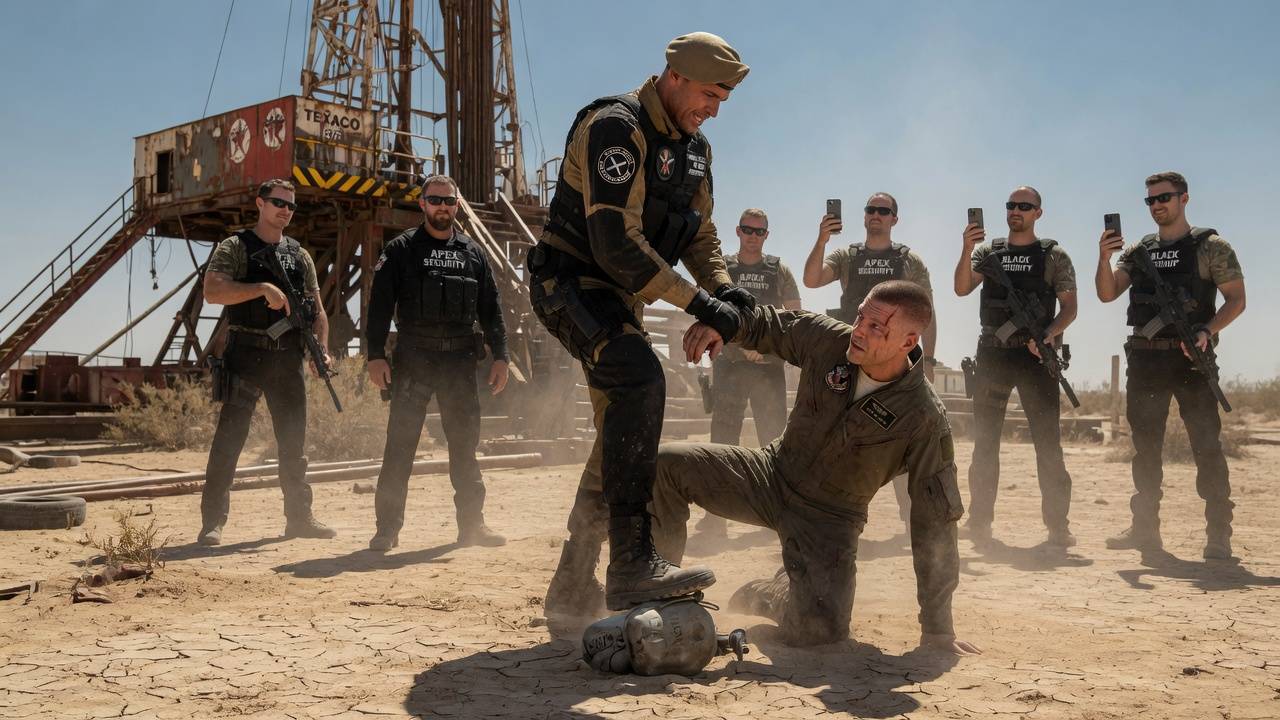
Vance thought a sick man was an easy target. He stood there in the burning sun, mocking the very badge Silas once wore. He took the one thing Silas had left—a dented military canteen that carried more than just water. It carried the memory of the men who didn’t make it back.
When Vance dropped that canteen in the dirt and stepped on it, telling Silas to “be a good dog,” something shifted. The sickness didn’t matter anymore. The pain disappeared.
The mercenaries had their phones out, ready to record a hero’s final humiliation. They didn’t expect what happened when Silas finally stood up.
In ten seconds, the power in that desert flipped. The man who thought he was a king ended up begging in the sand.
The full story is in the comments.
Chapter 1: The Weight of Dry Air
The heat in the Permian Basin doesn’t just sit on you; it interrogates you. It asks how much water you have left, how much pride you’re still carrying, and how long you think your lungs can keep filtering the fine, red silt that kicks up with every shift of the wind. Silas sat on the rusted porch of the foreman’s shack, his back against the corrugated tin, watching the horizon shimmer.
His lungs felt like they were lined with glass. Every third breath caught in a jagged, rattling cough that tasted like copper. It was the “Desert Gift,” as the guys in the unit used to call it—the slow-motion rot from the burn pits and the chemical plumes they’d breathed in while the brass watched from air-conditioned trailers. Silas didn’t mind the dying so much; it was the waiting that got to him.
“You’re late with the perimeter check,” a voice rasped from the shadows of the shack.
Silas didn’t turn his head. He knew the gait and the scent of Miller—stale tobacco and cheap antiseptic. Miller was seventy, a man whose skin looked like a topographical map of the badlands. He was one of the four “ghosts” Silas was hiding.
“Vance’s scouts were on the ridge an hour ago,” Silas said, his voice a low, gravelly rasp. “I had to stay low. If they see me moving too much, they’ll wonder why a simple night watchman is patrolling three miles out.”
Miller stepped out, leaning on a piece of rebar he used as a cane. He looked at Silas’s trembling hands. “The tremors are getting worse. Did the doctor bring the vials?”
“She brought them,” Silas said, reaching into the pocket of his faded olive flight suit. He pulled out a small, dented steel military canteen. He unscrewed the cap and took a tiny sip. It wasn’t water. It was a cocktail of heavy-duty suppressants and morphine the volunteer doctor, Elena, had risked her license to smuggle out of the VA. “It’s enough to keep me standing. For now.”
“Vance isn’t going to wait for the cancer to finish you, Silas,” Miller said softly. “He wants that drive. He wants the names. He knows as long as you’re breathing, there’s a record of what he did in the valley.”
Silas tightened his grip on the canteen. It was a battered thing, covered in scratches and a deep dent from a shrapnel hit in ’04. It was the only thing he’d kept. “He wants to bury his mistakes. I’m just the last one left above ground.”
The sound of an approaching engine cut through the stillness. It wasn’t the rattling hum of the mỏ dầu’s old work trucks. It was the high-pitched, expensive whine of a turbo-diesel. A white dust cloud blossomed a mile out, heading straight for the rig.
Silas stood up, his joints popping like dry kindling. He felt the familiar surge of adrenaline, that old, bitter fire that used to define him. But then the cough came—a deep, chest-wracking spasm that forced him to double over. He clutched the porch railing, his knuckles white, until the world stopped spinning.
“Get inside,” Silas commanded, wiping a fleck of blood from his lip. “Get the others into the sub-cellar. Don’t come out unless you hear the signal.”
“Silas—”
“Go, Miller. Now.”
Silas watched the black SUV roar into the clearing, followed by two open-top Jeeps filled with men in black tactical vests. They weren’t soldiers. They were private security—mercenaries hired to do what the law wouldn’t touch.
The SUV stopped ten feet from the shack, spraying gravel against the siding. The doors opened in unison. From the back seat, a man stepped out into the glare. Colonel Vance looked exactly as he had twelve years ago: pressed tan fatigues, a beret perched perfectly on his head, and eyes that saw people as either assets or obstacles.
Vance surveyed the rusted derricks and the rotting equipment with a look of profound disgust. Then his gaze settled on Silas.
“Look at you,” Vance said, his voice smooth and cold. “From the finest scout in the regiment to a scavenger in a graveyard. It’s poetic, in a miserable sort of way.”
Silas didn’t move. He stood on the porch, the canteen clutched in his hand, feeling the weight of the men behind him—the ghosts in the cellar who were counting on him to be the shield one last time.
“You’re trespassing, Colonel,” Silas said. “This is private property. My employer doesn’t like visitors.”
Vance smiled, but it didn’t reach his eyes. “Your employer is a shell company I bought three days ago, Silas. Which means I own this dirt. I own that shack. And technically, I own the air you’re struggling to breathe.”
He gestured to his men. They began to fan out, rifles held at low ready. One of them, a younger kid with a nervous twitch, caught Silas’s eye. The boy looked away quickly.
“I’m here for the ledger, Silas,” Vance said, stepping closer. “Give me the drive, and I’ll make sure you spend your last few weeks in a real hospital. Clean sheets. Real morphine. You won’t have to die in the dust like a stray dog.”
Silas felt the cold metal of the canteen against his palm. “I think I’d rather the dust. It’s more honest than anything you’ve ever offered.”
Vance’s face darkened. He nodded to the mercenary closest to the porch. “Bring him down here. Let’s see how much fight is left in the martyr.”
Chapter 2: The Social Cost of Silence
The mercenary, a thick-necked man with a jagged scar across his chin, didn’t hesitate. He lunged onto the porch, grabbing Silas by the shoulder and jerking him forward. Silas’s legs, weakened by the months of sickness, buckled. He tumbled down the three wooden steps, landing hard on his side in the dirt.
The breath left him in a wheezing rush. He stayed there for a second, face pressed into the grit, feeling the heat of the earth.
“Stand him up,” Vance commanded.
The mercenary hauled Silas to his feet, pinning his arms behind his back. The other guards moved in, forming a semicircle. Some of them pulled out their phones, the screens glinting in the sun. They weren’t just here for a recovery mission; they were here for the spectacle. In their world, humiliating a legend like Silas was a badge of honor.
Vance walked over, his polished boots clicking on the stones. He reached out and flicked the frayed collar of Silas’s flight suit. “You still wear it. Why? To remind yourself of the day I left you? Or to remind yourself that you were the only one stupid enough to stay behind?”
“To remind me what a coward looks like in a uniform,” Silas rasped.
The mercenary holding him tightened his grip, snapping Silas’s arms upward. A sharp, white-hot pain flared in Silas’s chest, triggering another coughing fit. He slumped, his head hanging, as he fought for air.
“He’s pathetic,” one of the guards laughed, recording the scene. “This is the guy you told us about, Colonel? The ‘Sentinel’? He looks like he’d blow over in a light breeze.”
Vance ignored the guard. He was looking at the canteen Silas had dropped in the fall. He picked it up with two fingers, turning it over. “This is it, isn’t it? Your holy relic. The one thing you took from the valley.”
“Put it down,” Silas said, his voice gaining a sudden, dangerous edge.
“I remember this,” Vance mused. “You used it to give water to that insurgent’s kid while we were under fire. You nearly got a whole squad killed for a gesture that didn’t matter. You always had a problem with priorities, Silas.”
Vance looked at the small group of mercenaries. “You see this, boys? This is what happens when you let sentiment cloud your judgment. You end up guarding a pile of junk in a desert, dying of a disease no one will acknowledge, clutching a piece of tin.”
He looked back at Silas. “Where is the drive? I know it’s not in the shack. My boys searched it while you were out on your little walk this morning.”
Silas felt a cold dread. They’d been inside. They hadn’t found the cellar yet, but it was only a matter of time. He needed to keep Vance focused on him. He needed to be the target.
“The drive is somewhere you’ll never find it,” Silas lied, his voice steady despite the tremors in his legs. “It’s already set to upload. You kill me, the world sees the coordinates of the mass graves. They see your signature on the disposal orders.”
Vance’s eyes narrowed. He knew Silas wasn’t a liar, but he also knew Silas was desperate. He walked closer, until he was inches from Silas’s face. The smell of Vance’s expensive cologne was suffocating in the dry air.
“You’re bluffing,” Vance whispered. “You’re holding onto it because it’s the only leverage you have to keep those ‘ghosts’ of yours safe. I know they’re here, Silas. I can smell the rot.”
Vance turned to the young guard with the nervous twitch. “Jackson, go get the gas cans from the Jeep. If he won’t talk, we’ll see if the shack has anything to say when it’s on fire.”
“Colonel?” Jackson hesitated. “There might be people in there.”
Vance’s voice turned to ice. “Did I ask for an inventory, son? I asked for the gas. Move.”
Silas struggled against the mercenary’s grip. “Vance, don’t! It’s between us. Leave the building out of it.”
“Then give me what I want,” Vance said, his voice rising for the benefit of the cameras. “Show these men what loyalty to a dead cause gets you. Kneel.”
Silas stared at him. The heat was making the edges of his vision go grey. His heart was hammering a frantic, uneven rhythm against his ribs.
“I said kneel, Silas,” Vance repeated, stepping back and gesturing to the ground. “Show them the ‘Sentinel’ in his natural habitat. On the floor, begging for a life he already lost.”
Silas didn’t move. The mercenary behind him kicked the back of his knees. Silas went down, his joints hitting the hard-packed earth with a sickening thud. He stayed there, on his knees, breathing in the dust of his own defeat.
Vance smiled, a slow, predatory baring of teeth. “That’s better. Now, let’s talk about that canteen.”
Chapter 3: The Breaking Point
The sun was a physical weight now, pressing Silas further into the dirt. Around him, the mercenaries moved with a casual, bored cruelty. They were circling, their shadows crossing over him like vultures. Jackson had returned with two red plastic gas cans, setting them near the porch steps. He wouldn’t look at Silas.
Vance held the canteen up, the light glinting off the dented steel. “You know, Silas, I’ve often wondered why you didn’t just take the payout. We offered you enough to disappear. You could have been in a clinic in Switzerland, getting the best treatment money can buy. Instead, you chose… this.”
He gestured to the rusted rig, the heat-scorched sand, and the silence.
“Some things aren’t for sale,” Silas said, his voice coming from deep in his chest. “But you wouldn’t know anything about that. You sold your soul the minute you signed those orders.”
Vance’s expression didn’t change, but his grip on the canteen tightened. “My soul is doing just fine. It’s your body that’s the problem.”
He unscrewed the cap of the canteen and sniffed the contents. “Antiseptics and morphine. Elena’s handiwork. She always was too soft for this business. She thinks she’s saving you, but she’s just dragging out the inevitable.”
Vance walked to the edge of the clearing, where a patch of particularly dry, scrubby brush grew. He tilted the canteen, pouring a slow, deliberate stream of the precious medicine into the sand.
“No!” Silas lunged forward, but the mercenary holding his arms jerked him back, nearly dislocating his shoulder.
Silas watched as the liquid—his only chance at staying conscious, his only shield against the pain—vanished into the thirsty earth. The sand darkened for a second, then the heat swallowed it whole.
“Now you have a choice,” Vance said, tossing the empty canteen back toward Silas. It clattered against a rock, a hollow, tinny sound that felt like a death knell. “You can watch Jackson burn that shack to the ground with your friends inside, or you can tell me where the drive is.”
“There’s nobody in there,” Silas said, his voice cracking. “It’s just me. Burn it if you want, but you’ll burn the drive with it.”
Vance looked at the shack, then back at Silas. He saw the flicker of fear in Silas’s eyes—not for himself, but for the people hidden beneath the floorboards.
“You were always a terrible liar, Silas. It was your only flaw as an operator.” Vance turned to his men. “Search the perimeter of the shack. Look for vents, crawlspaces, anything. If you find so much as a rat hole, pump the gas in.”
The mercenaries moved with terrifying efficiency. They began kicking at the lattice-work under the porch, poking rifles into the shadows. Inside the shack, Silas knew Miller and the others were holding their breath, huddled together in the dark, waiting for the end.
Silas looked at the young guard, Jackson. The boy was standing near the gas cans, his hand trembling on the handle. He looked sick.
“Jackson,” Silas whispered.
The boy’s head snapped toward him.
“You don’t have to do this,” Silas said. “You know what he is. You know what he’s doing.”
“Shut up!” the mercenary holding Silas barked, slamming a fist into Silas’s kidney.
Silas collapsed forward, gasping, his forehead touching the hot sand. The world was beginning to tilt. The lack of medication was already starting to take its toll; a dull, throbbing ache was blooming behind his eyes, and his muscles felt like they were being threaded with live wire.
Vance walked back over, standing directly over Silas. He looked down with a mixture of pity and contempt. “It’s over, Silas. Look at you. You can’t even hold your own weight. You’re a ghost guarding a tomb. Give me the drive, and I’ll let them walk. I give you my word.”
Silas looked up through the sweat stinging his eyes. “Your word? Your word is the reason twenty-two men are in a trench in the valley. Your word is why I’m coughing up my lungs.”
Vance’s face hardened into a mask of pure malice. He stepped forward, his boot coming down heavily on the dented canteen, pinning it into the dirt. He reached down, grabbing Silas by the flight suit’s collar, and jerked him upward.
“I’m tired of the speeches, Silas,” Vance hissed, his breath hot on Silas’s face. “The world doesn’t care about your honor. It cares about results. And the result today is that you lose everything.”
He pulled Silas closer, forcing him to look at the mercenaries who were now pouring gasoline along the base of the shack. The smell was sharp and dizzying.
“Last chance,” Vance said, his voice echoing in the quiet of the desert. “Where is it?”
Silas looked at the canteen under Vance’s boot. He looked at the shack. Then he looked Vance directly in the eye. The tremors in his hands stopped. The pain in his chest seemed to move to a different room in his mind.
“You should have left me in the valley, Vance,” Silas said softly.
Chapter 4: The Sentinel Awakes
Vance sneered, tightening his grip on Silas’s collar until the fabric strained. “Drink it from the dirt, Silas. Be a good dog.”
He gave Silas a sharp, mocking shove, forcing him further down toward the sand where the medicine had been spilled. Around them, the mercenaries laughed, their phones steady, capturing every second of the “Sentinel’s” fall.
Silas felt the heat of the sand against his skin. He felt the weight of Vance’s boot on the canteen—the only thing he had left of the men who actually mattered. He felt the cold, hard logic of the desert settle into his bones. He wasn’t a watchman anymore. He wasn’t a patient.
He was the man they had trained to survive when there was nothing left to breathe.
“Take your boot off my canteen, Vance,” Silas said.
The voice didn’t sound like a dying man’s. It was hollow, resonant, and stripped of all emotion.
Vance didn’t even blink. He laughed, a short, sharp sound of disbelief. “Or what? You’ll cough on me? You’re nothing, Silas. You’re a corpse that forgot to lay down.”
Vance raised his other hand, intending to slap Silas across the face—a final, degrading insult for the cameras.
The moment Vance’s weight shifted to deliver the blow, Silas moved.
It wasn’t the frantic struggle of a victim. It was the explosive, mechanical precision of a weapon being triggered. Silas’s lead foot slammed into the dirt, anchoring his weight. His right hand snapped upward, not to block, but to trap. He caught Vance’s wrist and elbow in a synchronized grip, his thumb pressing into the nerve cluster behind the joint. With a sharp, violent twist, he pivoted his hips, snapping Vance’s arm off-line.
Vance’s eyes widened as his balance vanished. His shoulder turned off-axis, his chest opening up, his polished boots scrambling for purchase in the loose silt.
“Wait—” Vance started, but the word died in his throat.
Silas didn’t give him a second to breathe. He stepped inside Vance’s guard, his body weight shifting forward with the momentum of a falling mountain. He drove a short, compact palm-heel strike directly into the center of Vance’s sternum.
There was a sickening thud—the sound of meat hitting bone. Silas felt the resistance of the tactical vest, but he drove through it, his hip rotation adding a thousand pounds of pressure to the strike.
Vance’s breath left him in a wheezing spray of saliva. His shoulders snapped backward, his torso jolting as the impact traveled through his spine. He staggered, his feet tripping over each other, his hands clawing at the air.
Before Vance could even register the pain, Silas finished it. He planted his standing foot, his core locking tight, and drove a front push kick straight into the center of Vance’s chest.
It wasn’t a tap. It was a rhythmic, driving force. Silas’s heel made heavy contact, the fabric of Vance’s tan fatigue shirt compressing under the sole of the boot. Silas pushed through the contact, extending his leg fully, sending the Colonel flying backward.
Vance hit the ground five feet away. He landed hard on his back, the air whooshing out of him in a desperate, panicked groan. He skidded through the dirt, a cloud of red dust erupting around his body.
The silence that followed was absolute.
The mercenaries froze. The phones stayed up, but the hands holding them were shaking. Jackson, the young guard, dropped the gas can he was holding, the red plastic thudding softly in the sand.
Vance was on the ground, his beret gone, his face covered in grit. He tried to sit up, but his chest wouldn’t work. He scrambled backward on his elbows, his eyes wide with a terror he hadn’t felt in decades. He looked at Silas, then at his men, then back at Silas.
He raised one hand, palm out, a pathetic, defensive gesture. “Wait—Silas, stop! Please!”
Silas stood over him. He wasn’t wheezing. He wasn’t trembling. He looked like the desert itself—vast, uncaring, and inevitable. He reached down and picked up his canteen, brushing the dirt from the steel.
“The desert doesn’t forget, Vance,” Silas said, his voice carrying across the clearing like a bell. “And neither do I.”
He looked at the mercenaries. “Pick him up. Get in your trucks. If I see a dust cloud on that ridge in the next ten minutes, the upload goes live. And I won’t be the one coming for you.”
The guards didn’t wait for a second order. Two of them lunged forward, grabbing Vance by the arms and hauling him toward the SUV. They threw him into the back seat like a sack of grain. Engines roared to life, tires spinning in the gravel as the convoy fled, leaving nothing but a wall of choking dust behind them.
Silas watched them go until the sound faded into the wind. Then, slowly, the fire in his veins began to cool. The tremors returned, worse than before. His knees hit the dirt, and the cough came—a violent, bloody spasm that forced him onto his side.
“Silas!”
The shack door flew open. Miller and the others scrambled out, Elena the doctor running toward him with a medical bag.
Silas clutched the dented canteen to his chest, closing his eyes. He had won the moment, but he knew the war was just beginning. The video was on those phones. The world was about to see that the Sentinel was still awake. And Vance was the kind of man who would burn the whole world down just to hide his shame.