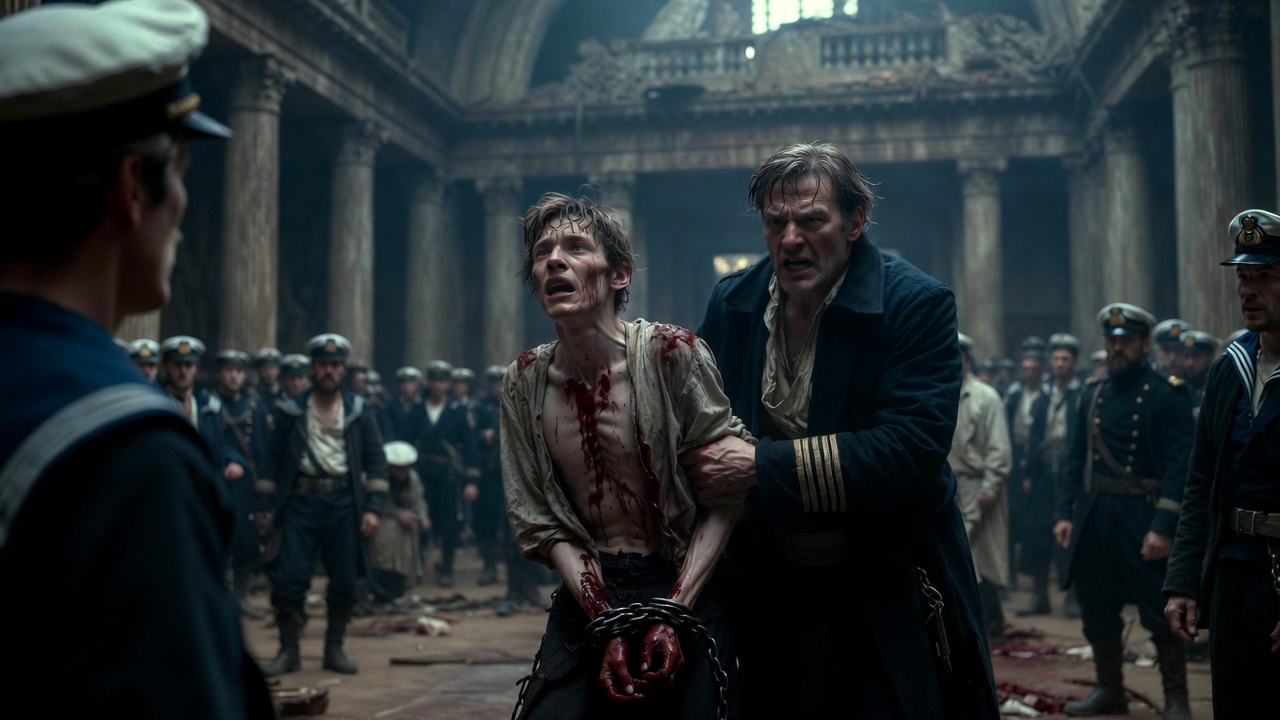
I was only six years old when the men in black armor tore me from my mother’s arms. I don’t remember the warmth of a home, or what it feels like to have a full stomach. For twelve long years, my world has been nothing but the burning heat of the Pharaoh’s stone quarries, the heavy weight of limestone blocks, and the sting of the leather whip across my back.
In the quarries, we weren’t humans. We were just tools. Flesh and bone meant to be broken under the blazing Egyptian sun.
My name is Kem. At least, that is the name my mother whispered to me before she died of the quarry fever when I was ten. I had nothing left of her except a tiny, tarnished bronze amulet shaped like a scarab, which I kept hidden deep inside the lining of my ragged loincloth. It was my only treasure. My only proof that I belonged to someone once.
But in the Great Quarry of Thebes, mercy does not exist. Especially not from Lord Hemon, the Grand Overseer of the Pharaoh’s monuments.
Hemon was a man of immense power and bottomless cruelty. He wore robes of the finest white linen, and his fingers were heavy with gold rings. He loved to watch us suffer. To him, the thousands of slaves sweating in the dirt were just ants to be crushed. He took a special pleasure in targeting me because, despite the hunger and the beatings, I refused to look at the ground when he passed. I kept my head up. And a cruel man hates nothing more than a slave who refuses to break.
The day my life changed forever started like any other. The heat was suffocating, rising from the desert floor like waves from a furnace. My hands were bleeding from hauling a massive sandstone block destined for the new temple steps.
Suddenly, a loud commotion broke out near the overseer’s shaded pavilion.
“Where is it?!” Lord Hemon’s voice boomed across the quarry, dripping with fury. “Find it! Search every piece of filth in this pit!”
Within minutes, the royal guards rounded us up. We were forced to kneel in the burning sand, our heads bowed. Lord Hemon strode down the line, followed by his personal guards. In his hand, he held a shattered golden necklace. It was a royal piece, adorned with lapis lazuli.
“The Pharaoh’s personal tribute has been defiled,” Hemon roared, his eyes scanning the terrified faces of the slaves. “Someone broke into my pavilion and stole the sacred gems from the center of this piece. Who did it?”
Silence hung heavy over the quarry. No one dared to breathe.
Hemon stopped right in front of me. A twisted, dark smile spread across his face. He reached down, grabbing my hair, and violently yanked my head back.
“You,” he whispered, his breath smelling of sour wine. “You have that arrogant look in your eyes again, boy. I bet it was you.”
“I didn’t touch it, my Lord,” I gasped, the pain in my scalp forcing tears to my eyes. “I have been at the eastern wall since sunrise. Ask the guard.”
The guard Hemon looked at immediately shook his head. He knew better than to contradict his master. “I didn’t see him there, Lord Hemon. He was wandering near the pavilion.”
It was a lie. A blatant, horrific lie. They needed a scapegoat, and Hemon had finally found his excuse to destroy me.
“Thief!” Hemon screamed, kicking me hard in the chest. I flew backward into the dirt, coughing violently as the wind was knocked out of me. “Guards! Drag this worthless rat to the palace. Let him be judged before the High Court. Let everyone see what happens to a slave who steals from the gods!”
I was dragged through the dusty streets of Thebes, chained like a wild animal. The local villagers watched in silence, some throwing rotten fruit, others looking away in pity. I was just another nameless slave about to be executed for the entertainment of the rich.
We entered the grand palace. The sheer scale of it was breathtaking—towering sandstone pillars carved with the images of ancient gods, floors of polished black granite that reflected the torchlight, and walls covered in pure gold leaf. It was beautiful, but to me, it felt like a gilded tomb.
The heavy bronze doors of the Great Throne Hall swung open.
At the far end of the massive room sat the Pharaoh himself. High Pharaoh Thutmose. He sat upon a throne of solid gold, wearing the double crown of Upper and Lower Egypt. His expression was cold, distant, and majestic. Next to him stood his high priests and noble advisors, all dressed in silks and gold.
“Great Pharaoh!” Lord Hemon announced, throwing himself to the floor in a theatrical display of loyalty. “I bring before you a wretched thief. A quarry slave who dared to steal and defile the sacred jewels meant for your majesty’s altar.”
The Pharaoh looked down, his eyes bored and tired. To a god on earth, a dispute over a stolen gem from a slave was beneath his dignity. “If he is a thief, Hemon, punish him according to the law. Why bring this filth into my presence?”
Hemon smiled, a sickening gleam in his eyes. He knew exactly what he was doing. He wanted to show the entire court how fiercely he protected the Pharaoh’s honor.
“My Lord, simple execution is too merciful for a slave who steals from the living god,” Hemon said loudly, ensuring every noble in the hall could hear. “I request permission to use the Desert Pit. Let him be cast among the sacred scorpions of Anubis. Let the court witness the justice of Egypt.”
A collective murmur passed through the crowd. The Desert Pit was a deep hole carved right into the center of the throne hall’s lower courtyard, covered by a heavy iron grate. Inside lived hundreds of deadly, aggressive desert scorpions. A fall into the pit meant a slow, agonizing death as the venom paralyzed the body.
The Pharaoh shrugged his shoulders slightly. “Grant the request. Let it be done quickly.”
“No! Please!” I cried out, my voice cracking with desperation. I struggled against the guards, but their grip was like iron. “I am innocent! I never stole anything!”
Lord Hemon walked up to me, his face twisted with malicious joy. “Cry all you want, rat. No one can hear you. You are nothing.”
With a brutal shove, the guards pushed me toward the edge of the pit. The iron grate was already being pulled back by two heavy chains. I looked down into the dark abyss. I could hear them. The dry, horrific scratching sound of hundreds of armored tails moving in the shadows.
Hemon grabbed the collar of my torn linen tunic, pulling me close to whisper one last insult. “Die in the dark, where you belong.”
With a twisted face of rage, the overseer poured a small flask of boiling water right near my feet to make me jump, then gave me a violent shove toward the dark pit.
I stumbled, my balance completely gone. As I fell toward the opening, my torn tunic caught on a sharp bronze decorative spike near the edge of the pit.
The fabric tore completely open with a loud RIP, exposing my bare upper body and left shoulder to the entire room.
I managed to catch myself on the very ledge, my fingers gripping the stone for dear life, dangling over the scratching horrors below. I screamed in terror, looking up at the ceiling, my face drenched in sweat and dirt.
The entire throne hall suddenly went dead silent.
It wasn’t because of my scream. It was because of what the torn fabric had revealed on my left shoulder.
I heard a loud clatter. I looked toward the dais.
The Pharaoh had stood up from his golden throne. His face was completely pale, stripped of all its royal color. His hand was empty. His golden scepter, the symbol of absolute power over Egypt, had dropped from his hand and was rolling down the stone steps, making a ringing sound that echoed through the silent hall.
The Pharaoh wasn’t looking at Hemon. He wasn’t looking at the guards. His eyes were glued to my shoulder.
I know you’re curious about what happens next—Read the full story in the comments.
CHAPTER 1
The burning sand of the Great Quarry of Thebes was the only world I truly knew. For twelve years, since the age of six, my hands had been rubbed raw by limestone and my back mapped with the raised, white scars of the overseer’s lash. I was a slave. To the high-born of Egypt, I was less than the donkeys that hauled the water skins. I was a nameless, faceless fragment of filth sweating under the relentless glare of Ra, the sun god.
My mother had died in these same pits when I was ten. I remember her cracked lips, her eyes sunken from the quarry fever, and the final, desperate words she whispered into my ear as the life left her body. “Never forget who you are, my beautiful boy. Keep your head high. The desert may hide the truth for a season, but the Nile always returns to its banks.”
She had pressed a tiny object into my small, dirty palm. It was a crude, tarnished bronze amulet shaped like a sacred scarab, hanging from a frayed piece of leather. It wasn’t gold. It wasn’t silver. It held no value to the slave drivers, which was the only reason they hadn’t stolen it from her corpse. I kept it hidden deep inside the waistband of my ragged, sweat-stained loincloth, pressing it against my skin whenever the despair threatened to swallow me whole. It was my only connection to a life before the chains.
But dignity is a dangerous thing for a slave to possess.
Lord Hemon, the Grand Overseer of the Pharaoh’s royal monuments, hated me for it. He was a massive, imposing man whose belly swelled from fine wines and roasted meats, a stark contrast to the rib-exposed skeletons of the men who worked his quarries. He wore robes of woven white linen so fine they looked like spun silver, and his fingers were weighted down with gold rings bearing the seals of powerful dynasties. He walked through the dusty pits like a god among insects, followed by a personal guard of ruthless mercenaries armed with heavy bronze spears.
Hemon took a twisted, personal pleasure in breaking those who seemed unbroken. And no matter how many times his guards forced me to my knees, I could never completely extinguish the fire in my eyes. I refused to look at the dirt when he walked past. I looked him dead in the eye, not with defiance, but with a quiet, steady gaze that screamed I am a human being.
To a man like Hemon, that look was a capital offense.
The day of my undoing began under a sky so hot it felt like molten copper. I was part of a crew hauling a massive, twelve-ton block of red granite destined for the facade of the Pharaoh’s new mortuary temple. The ropes bit deep into the raw flesh of my shoulders. Sweat blinded my eyes, stinging the fresh cuts from a whipping I had received two days prior.
Suddenly, a sharp, piercing trumpet echoed from the shaded pavilion where Lord Hemon spent his afternoons drinking cooled pomegranate wine.
“Stop! All of you, freeze!” a guard captain shouted, his bronze sword drawn.
The heavy granite block groaned to a halt. We collapsed in the dirt, catching our breath, trembling from exhaustion. Within moments, a dozen heavily armed guards surrounded our specific work detail, shoving us violently into a tight circle.
Lord Hemon strode out of the pavilion. His face was flush with a dangerous, dark rage. In his shaking right hand, he held a magnificent golden collar, thick with inlaid lapis lazuli and turquoise. It was a masterpiece of royal craftsmanship, a tribute sent from the southern kingdoms to be presented to the Pharaoh. But the center of the collar was a ruined mess. The sacred central medallion—a rare, flawless black diamond shaped like the eye of Horus—had been violently pried out.
“The Pharaoh’s tribute,” Hemon hissed, his voice trembling with a mixture of fury and fear. He knew that if the Pharaoh discovered a royal tribute had been defiled under his watch, his own neck would be on the chopping block. “A thief has infiltrated my inner sanctuary. Someone pried the sacred eye from this collar while I rested.”
He walked down our line of kneeling slaves, his heavy leather sandals kicking dust into our faces. “The thief is among you. Tell me who it is, or I will execute every fifth man in this pit by sunset.”
Terrified murmurs broke out among the slaves. Men began to weep, begging the gods for mercy, pleading their innocence. I remained silent, kneeling on the jagged rocks, my eyes fixed on the ground directly in front of Hemon’s sandals. I knew how this worked. In the quarries, truth didn’t matter. Only a victim mattered.
Hemon stopped. The shadow of his massive frame fell directly over me.
“You,” he whispered.
I didn’t move. I kept my gaze steady on the dirt.
He reached down with sudden, shocking speed, grabbing a fistful of my matted, dusty hair and yanking my head backward with brutal force. A sharp pain shot down my spine, and I gasped, my teeth clenching as I was forced to look up into his bloated, cruel face.
“You have been wandering near the pavilion all morning, haven’t you, rat?” Hemon sneered, his breath hot and foul against my skin.
“No, my Lord,” I managed to choke out, the muscles in my neck straining against his grip. “I have been bound to the transport ropes since the third hour of dawn. I have not left the eastern wall. The guards on the platform saw me.”
Hemon turned his head slightly, glaring at the guard captain who stood nearby. The captain, a cowardly man named Sebni who frequently took bribes from Hemon’s treasury, immediately understood what his master required. He stepped forward, his face hardening into a lie.
“He is lying, Lord Hemon,” Captain Sebni declared loudly, his voice echoing across the silent quarry. “I saw this slave lurking near the back entrance of the pavilion just before the noon bell. When I called out to him, he fled into the crowds.”
A cold dread pooled in my stomach. It was a coordinated strike. Hemon didn’t care about the real thief; he wanted to rid himself of the one slave who refused to fear him, and at the same time, present a culprit to the palace to save his own skin.
“You worthless, arrogant piece of filth!” Hemon roared. He released my hair, only to bring his heavy, ring-laden hand across my face in a devastating backhand blow.
The force of the strike shattered my lip and sent me spinning into the dirt. The taste of copper filled my mouth. I lay there, coughing, my vision swimming with dark spots as the courtly rings had sliced deep into my cheek.
“Guards! Bind his hands with raw hide!” Hemon commanded, wiping a stray drop of my blood from his gold ring with a silk cloth. “We are going to the palace. The High Pharaoh Thutmose is hosting the feast of the Nile’s rising today. Let us bring his majesty some entertainment. We will show the entire royal court what happens to the vermin who dare to steal from the living god!”
The guards threw themselves upon me. They dragged me to my feet, pulling my arms behind my back so tightly the bones in my shoulders popped. Thick, abrasive ropes were knotted around my wrists until the blood flow stopped. I was thrown into the back of a wooden prison cart, bound like a sacrificial calf destined for the altars of Anubis.
The journey through the grand avenues of Thebes was a blur of pain and humiliation. The city was alive with celebration. Banners of blue and gold fluttered from the white-walled houses. The wealthy citizens, dressed in pristine linen and wearing scented wax cones upon their wigs, crowded the streets. As our cart rumbled past, Lord Hemon rode ahead on a magnificent black chariot, loudly proclaiming my alleged crime to the public.
“Behold the thief of the Pharaoh’s tribute!” Hemon shouted to the crowds. “A rat from the dirt who thought he could steal the wealth of the gods!”
People shouted curses at me. Someone threw a heavy clay shard that struck my forehead, opening a shallow cut that sent a stream of dark blood down into my eyes. I blinked through the red mist, keeping my jaw clenched. I looked up at the sky, watching a solitary falcon soaring high above the city, completely free. Mother, I thought bitterly, is this the end you promised? Is this the justice of the Nile?
The cart ground to a halt before the massive bronze gates of the Grand Palace of Pharaoh. The scale of the structure was terrifying. Giant obelisks pierced the blue sky, their tips plated in electrum that caught the blinding sunlight. Two colossal stone statues of Pharaoh Thutmose guarded the entrance, their unblinking eyes staring out into the eternal desert.
The guards dragged me out of the cart. Because my legs were weak from hunger and the beatings, I collapsed onto the courtyard stones. A guard kicked me brutally in the ribs, forcing me to crawl.
“Get up, filth! You don’t lay down in the house of the living god!”
I was hauled through a labyrinth of towering corridors. The walls were covered in brilliant, colorful paintings depicting the Pharaoh crushing his enemies, riding chariots over mounds of fallen warriors, and offering sacrifices to the gods. The floors were made of polished black granite, chilled by the shade of the high ceilings. It was so clean, so smooth, that my bleeding feet left a trail of dark, smeared footprints on the pristine stone.
Finally, we reached the massive, double-leaved cedar doors of the Great Throne Hall. The doors were wrapped in sheets of pure gold, carved with scenes of creation.
Two giant royal guards, wearing heavy bronze breastplates and helmets shaped like the head of a jackal, pushed the doors open.
The wall of sound that hit me was immense. The hall was packed with hundreds of people—noble lords, high-ranking military commanders, foreign ambassadors, and beautiful court women with heavily outlined kohl eyes and elaborate golden jewelry. Musicians played harps and flutes in the corners, and the air was thick with the sweet, heavy scent of burning frankincense and myrrh.
At the far end of the long hall, elevated on a high sandstone dais, sat the High Pharaoh Thutmose.
He was a young man, perhaps no older than twenty-four, but he carried himself with an ancient, terrifying authority. He wore the high white and red double crown of Egypt. In his hands, he held the golden crook and flail crossed over his chest. His face was a mask of absolute stone—beautiful, distant, and completely unreadable. To the people in this room, he was not a man. He was the living embodiment of Horus on earth. His word was life; his glance was death.
“Make way for the Grand Overseer!” the royal herald cried out, his voice cutting through the chatter of the court.
The crowd parted like the waters of the Red Sea. Lord Hemon strode forward, his posture transforming into one of deep, exaggerated humility. He threw himself prostrate onto the black granite floor, his nose touching the stone, several paces before the foot of the dais.
Behind him, the guards violently kicked the back of my knees. I crashed down onto the hard floor, my chained hands twisting painfully behind me.
“Speak, Hemon,” the Pharaoh’s voice resonated through the vast hall. It was deep, calm, and carried a natural weight that commanded instant silence. The musicians stopped playing. The whispers died down. All eyes were fixed on us.
Hemon raised his head, his face a picture of manufactured sorrow and outraged loyalty. “O living god, sun of the Two Lands, protector of Ma’at! I bring before your sacred presence a crime that cries out to the heavens. This slave—this miserable, ungrateful dog from the Great Quarry—has committed an act of supreme sacrilege.”
Hemon stood up, holding high the damaged golden collar for the entire court to see. A collective gasp rippled through the nobles.
“This morning, while the quarry prepared the stones for your eternal monument, this vermin snuck into the royal pavilion. He defiled the tribute sent by the princes of the south. He stole the sacred Eye of Horus diamond from its center, intending to smuggle it out to the black markets of the desert!”
I looked up, my vision blurred by blood and sweat. “He is lying!” I screamed, the words tearing from my throat before I could stop them. “Great Pharaoh, he is lying! I never entered the pavilion! I am innocent!”
The court went completely still. A slave speaking without permission in the presence of the Pharaoh was unheard of. It was an insult to the divine order.
Captain Sebni immediately stepped forward, driving the butt of his spear hard into my shoulder blade. I gasped, collapsing forward, my chest hitting the cold stone floor. “Silence, dog! Speak again and I will cut your tongue out before the throne!”
Lord Hemon looked down at me with absolute contempt, then turned back to the Pharaoh. “As you can see, your Majesty, the boy is not only a thief but possesses a dangerous, rebellious spirit. He has no respect for the divine laws of Egypt. Simple execution in the quarry would be too kind. It would not send a strong enough message to the thousands of other slaves who work the stone.”
The Pharaoh Thutmose leaned back slightly on his golden throne. His dark eyes shifted from Hemon to my broken, dirty form on the floor. He looked entirely detached, as if discussing the disposal of a broken clay pot.
“What is your recommendation, Overseer?” Pharaoh asked coldly.
Hemon’s eyes flashed with a predatory triumph. He turned toward the center of the hall. “I request that he be cast into the Sacred Pit of Anubis, right here, before the eyes of the court. Let the holy scorpions of the desert cleanse his sacrilege. Let the nobles witness the swift and terrifying justice that falls upon those who dare to steal from the Pharaoh.”
A murmur of excitement and horror washed over the court. The Sacred Pit was famous. It was an ancient, deep chamber carved into the foundations of the palace, visible through a large opening in the lower courtyard floor, usually sealed by a massive iron grate. It was used only for the most heinous crimes—treason, sacrilege, and regicide. Inside lived a specific, deadly breed of black desert scorpions, kept starved and aggressive by the temple priests. Their sting did not kill instantly; it paralyzed the lungs slowly, causing a terrifying, suffocating death that took hours.
Pharaoh Thutmose looked at me one last time. There was no pity in his eyes. To him, I was just a drop of dirt fouling his beautiful palace.
“The request is granted,” the Pharaoh said, his voice flat and absolute. “Let the law of Ma’at be fulfilled. Cleanse the palace of this filth.”
“No! Please, Great Pharaoh! Look at my hands! Look at my arms!” I cried out, struggling wildly as the guards grabbed my shoulders to drag me toward the lower courtyard. “I have worked your stones for twelve years! I have never stolen! Mercy!”
My cries were met with laughter from the nobles. A wealthy court lady covered her mouth with a painted linen fan, whispering a cruel joke to her husband. To them, my terror was a pleasant diversion from a long day of political speeches.
Lord Hemon walked beside the guards as they dragged me toward the center of the room, where the heavy iron grate was already being lifted by a system of pulleys operated by two muscular temple servants. The deep, dark mouth of the pit opened up in the stone floor.
Even from several feet away, the stench of dry earth, old rot, and something foul washed over me. And then came the sound. A horrific, collective rustling. The clicking of hundreds of armored legs and the sharp scratching of venomous tails scraping against the stone walls of the pit.
“You thought you could look at me like an equal, didn’t you?” Hemon whispered in my ear, his hand gripping the back of my torn linen tunic as the guards held me over the edge. “You are nothing but dirt, boy. And today, the dirt claims you.”
With a twisted face of rage, Hemon reached into his robes and pulled out a small earthen flask. He unstoppered it and poured boiling water directly onto the stone near my bare, bound feet. The searing heat scalded my skin, causing me to reflexively jump and lose my footing.
At the same instant, Hemon gave me a violent, powerful shove straight toward the open darkness of the pit.
I screamed, a sound of pure, unadulterated terror that echoed off the high rafters of the throne hall. As my body fell into the opening, the ragged, coarse linen of my tunic caught on a decorative bronze spike shaped like a lotus flower that jutted out from the rim of the pit.
The ancient, rotted fabric could not hold my weight. With a loud, violent RIP, the entire tunic was torn completely away from my body.
The fabric tore open from my collar down to my waist, completely exposing my bare back, chest, and left shoulder to the entire room.
The momentum threw me sideways, but by some miracle of desperation, my bound hands managed to catch on the very inner ledge of the stone rim. My fingers, slick with sweat and blood, clawed at the polished granite. My lower body dangled helplessly in the dark abyss. Below my bare feet, just inches away, I could see the writhing, black mass of hundreds of giant scorpions, their stingers arched and dripping with clear, deadly venom.
I hung there, screaming, my muscles tearing, fighting for every second of life.
But above me, the entire throne hall suddenly went dead silent.
The laughter stopped instantly. The whispers died. The musicians dropped their instruments. A heavy, suffocating silence fell over the hundreds of nobles, so absolute that you could hear the flickering of the torches on the walls.
I didn’t understand why. I thought they were just watching me die.
Then, I heard a loud, metallic clatter echo from the front of the hall. It was a heavy, solid sound that bounced off the stone walls.
I forced my head upward, my face drenched in tears, sweat, and blood, my breath coming in ragged gasps.
High Pharaoh Thutmose had stood up from his golden throne.
His face was no longer a mask of stone. It was completely pale, stripped of all royal majesty, replaced by a look of sheer, unbridled shock. His mouth was slightly open. His hands were empty. The golden scepter of Egypt, the symbol of his absolute power over life and death, had dropped from his trembling fingers. It was rolling down the sandstone steps of the dais, making a sharp, ringing sound as it hit each step before settling in the dirt.
The Pharaoh wasn’t looking at Lord Hemon. He wasn’t looking at the sacred pit.
His eyes were locked entirely on my exposed left shoulder.
CHAPTER 2
I hung over the abyss of the scorpion pit, my finger joints turning white as they gripped the smooth granite edge. Every muscle in my arms screamed in agony. Below me, the scratching of the venomous hoard grew louder, as if they could sense my terror, waiting for my grip to fail.
Yet, the silence in the grand hall above me was so thick it felt heavier than the quarry stones.
Lord Hemon broke the silence, his voice tight with confusion and an underlying tremor of panic. He had noticed the Pharaoh’s reaction, but he didn’t understand it. He stepped toward the edge of the pit, glaring down at me, then looked back up at the dais.
“Great Pharaoh?” Hemon called out, his voice cracking slightly. “The… the vermin has caught himself on the ledge. Shall I have the guards break his fingers so he falls? We must not disrupt the purity of your hall with his wretched screams.”
Pharaoh Thutmose did not answer. He didn’t even acknowledge Hemon’s existence.
Slowly, as if in a trance, the living god of Egypt stepped down from his high dais. He walked past his high priests, past the grand vizier, and down the steps where his golden scepter lay forgotten in the dust. His eyes never wavered from my left shoulder.
I didn’t know what he was looking at. To me, my shoulder was just another part of my broken body. But I knew what was there. Beneath the dirt, sweat, and the fresh blood from the quarry work, there was a birthmark. It was a dark, perfectly shaped mark that looked exactly like a flying falcon, its wings spread wide across my skin. My mother used to trace it with her thumb when I was a toddler, whispering that the gods had kissed me before I was born. To me, it was just a strange spot.
But to the Pharaoh, it seemed to be something terrifying.
As the Pharaoh walked down the central aisle, the nobles threw themselves to the ground, their faces pressing against the black granite floor. Only Hemon remained standing, his face morphing from arrogance to deep confusion.
“Bring him up,” the Pharaoh commanded. His voice wasn’t loud, but it possessed a cold, vibrating intensity that made the guards tremble.
“But… your Majesty,” Hemon stammered, stepping into the Pharaoh’s path with his hands raised. “He is a convicted thief! He defiled your sacred tribute! The law of Ma’at dictates—”
“I said,” the Pharaoh interrupted, his dark eyes snapping toward Hemon with a fury that could melt mountains, “Bring him up. Now.”
The two jackal-helmeted guards didn’t hesitate. They lunged forward, grabbing my raw wrists and yanking me out of the mouth of the pit. They threw me onto the solid, safe stone of the courtyard floor. I collapsed into a ball, coughing violently, my chest heaving as I clutched my stomach. I was alive, but I was trembling so hard my teeth clicked together.
The Pharaoh stopped exactly three paces away from me.
The entire court held its breath. No one moved. The only sound was my ragged breathing and the distant rustling of the scorpions below.
Pharaoh Thutmose slowly knelt down. A god on earth, kneeling in the dirt next to a quarry slave. The nobles who dared to peek through their fingers gasped. The high priest of Ra gripped his golden staff so tightly his knuckles turned white.
The Pharaoh reached out a long, well-manicured hand. His fingers hovered just above my left shoulder. He took a corner of his own pristine silk sash and gently, almost reverently, wiped away the layer of gray limestone dust and dark blood that partially obscured my skin.
As the dust fell away, the falcon-shaped mark was revealed in perfect, stark clarity against my pale, scarred skin. It wasn’t just a birthmark. At the center of the falcon’s chest was a tiny, raised, golden-brown dot—a rare phenomenon that made the mark look exactly like the royal crest of the founding dynasty of Thebes.
The Pharaoh’s hand began to shake violently. He pulled his hand back, his eyes searching my face. He looked at my jawline, my nose, and the shape of my eyes.
“What is your name?” Thutmose whispered, his voice cracking with an emotion nobody in the court had ever heard from him before.
“Kem, my Lord,” I rasped, my throat dry as sand. “My mother called me Kem.”
“Who was your mother?” he demanded, leaning closer, his breath hitching.
“She… she was a slave in the quarries, your Majesty,” I wept, the fear completely overtaking me. “She died of the fever four years ago. She told me she was once a servant in the city before the soldiers took us.”
The Pharaoh closed his eyes for a brief moment, a single tear cutting through the heavy kohl makeup on his cheek. When he opened them, they were filled with a mixture of profound sorrow and an absolute, terrifying rage.
He looked down at my waist. The movement of my breathing had caused the lining of my torn loincloth to shift. The corner of my mother’s hidden bronze amulet had slipped out, catching the light of the torches.
Before I could protest, the Pharaoh reached down and pulled the frayed leather string from my clothing. He held the tiny, tarnished bronze scarab in his palm. He turned it over. On the flat underbelly of the bronze bug, deep, crude hieroglyphs were engraved.
The Pharaoh reads the inscription. His chestheaved.
“Prince Prince Prince Amenhotep,” the Pharaoh whispered aloud, the name echoing like thunder through the silent hall.
The high priest of Ra dropped his staff. It clattered loudly against the floor. “By the gods… the lost prince,” the priest whispered, his old legs buckling as he fell to his knees.
Lord Hemon’s face turned from pale to a sickening green. He stepped back, his eyes darting toward the exit doors, but the royal guards instantly shifted their bronze spears, blocking his path.
Fourteen years ago, the royal palace had been attacked by a faction of nomadic desert rebels. During the chaos, the Pharaoh’s younger brother, the infant Prince Amenhotep, had vanished along with his royal nurse. It was believed the child had been slaughtered in the desert or thrown into the Nile. The old Pharaoh had died of a broken heart, and Thutmose had ascended the throne, forever mourning the loss of his brother.
The “servant” mother who had raised me in the slave quarters wasn’t my biological mother. She was my royal nurse, who had hidden me in the absolute last place anyone would look for a royal prince—among the faceless, nameless slaves of the Great Quarry, branding me with a common name to keep me alive.
The Pharaoh stood up slowly. The vulnerability vanished from his face, replaced by the terrifying aura of an absolute monarch who had just discovered a monstrous truth. He looked at me, his eyes filled with a fierce protection.
Then, he turned his gaze onto Lord Hemon.
“Hemon,” the Pharaoh said, his voice dropping to a dangerous, deadly whisper that made the entire room temperature feel as though it had dropped.
“Yes… yes, my Great Pharaoh?” Hemon stuttered, falling to his knees and pressing his forehead against the floor, sweating profusely. “I… I did not know! I swear by the light of Ra, I did not know! The boy was found in the quarters! He… he is a thief! He stole the tribute!”
“Silence!” the Pharaoh roared, a sound so loud and powerful it caused several court women to shriek. “You claim my brother is a thief? You claim the blood of my father stole a petty stone from your corrupt hands?”
The Pharaoh turned to the guard captain, Sebni. “Captain. You stated under oath that you saw this boy near the pavilion at noon. Is that correct?”
Captain Sebni’s knees were knocking together. He looked at Hemon, then at the Pharaoh’s cold eyes. He knew his life was forfeit. He collapsed, weeping. “Mercy, your Majesty! Mercy! Lord Hemon paid me! He paid me twenty silver shekels to lie! He defiled the collar himself during a drunken rage, and he needed a slave to blame so you wouldn’t execute him! It was Hemon! It was all Hemon!”
The entire court erupted into chaotic murmurs. The nobles looked at Hemon with disgust and horror. The man who had been the most powerful overseer in Egypt just minutes ago was now a exposed monster.
Lord Hemon looked up, his face twisted with a mixture of terror and desperate malice. Realizing he had no escape, his fear turned into a frantic, chaotic rage. He scrambled to his feet, pulling a small, concealed bronze dagger from the folds of his expensive white linen robes.
“If I am to die, I will finish what the desert rebels started!” Hemon screamed, lunging wildly toward me as I lay bound on the floor.
“Guard!” the Pharaoh shouted.
But before the guards could even take a step, a strange, beautiful sound filled the throne hall. A loud, piercing screech echoed from the high palace windows.
A massive, golden desert falcon flew through the upper openings, its wings beating the air with a ferocious power. It dived straight down into the hall, its sharp talons extended, aiming directly for Lord Hemon’s face.
Hemon screamed in agony as the sacred bird of Horus struck him, its claws ripping through his cheeks and eyes. He stumbled backward, dropping the dagger, flailing his arms wildly as the bird circled above his head, screeching in divine fury.
Hemon lost his balance entirely. His heel caught on the raised stone border of the courtyard.
With a desperate cry, the powerful lord tipped backward, falling straight into the wide, dark mouth of the open execution pit.
A horrific, blood-curdling scream echoed from the depths of the stone floor. The sound of hundreds of scorpions swarming a fresh target filled the room.
The Pharaoh didn’t look into the pit. He walked over to me, drawing a small, golden-handled dagger from his belt. With a single, swift motion, he cut the raw hide ropes binding my wrists. My hands fell free.
He reached down, gripping my dirty, calloused hand, and pulled me up to stand beside him.
“Behold,” Pharaoh Thutmose announced, his voice carrying to every corner of the grand hall. “The desert has kept the secret, but the Nile has returned. Prince Amenhotep has returned to his throne.”
The entire royal court—the lords, the priests, the commanders, and the very guards who had kicked me—simultaneously threw themselves down onto the floor, chanting my royal name in a deafening chorus of reverence.
I stood there, a starving, scarred slave boy covered in dirt, looking down at the people who had just mocked me, now groveling at my feet. For the first time in my life, I felt the warmth of the sun not as a punishment, but as a blessing. The chains were gone, and justice had finally washed over the land of Egypt like the rising waters of the sacred river.