The hot desert sand burned my bare feet as Commander Hekha dragged me through the heavy bronze gates of the palace. I wanted to scream, to beg for mercy, to tell the gathering crowd that I was completely innocent. But no sound could leave my throat. My voice had been stolen from me years ago, taken by the very fires that destroyed my childhood. To the wealthy nobles of Egypt, I was just a nameless, mute street rat who deserved to be crushed under the weight of the Pharaoh’s law.
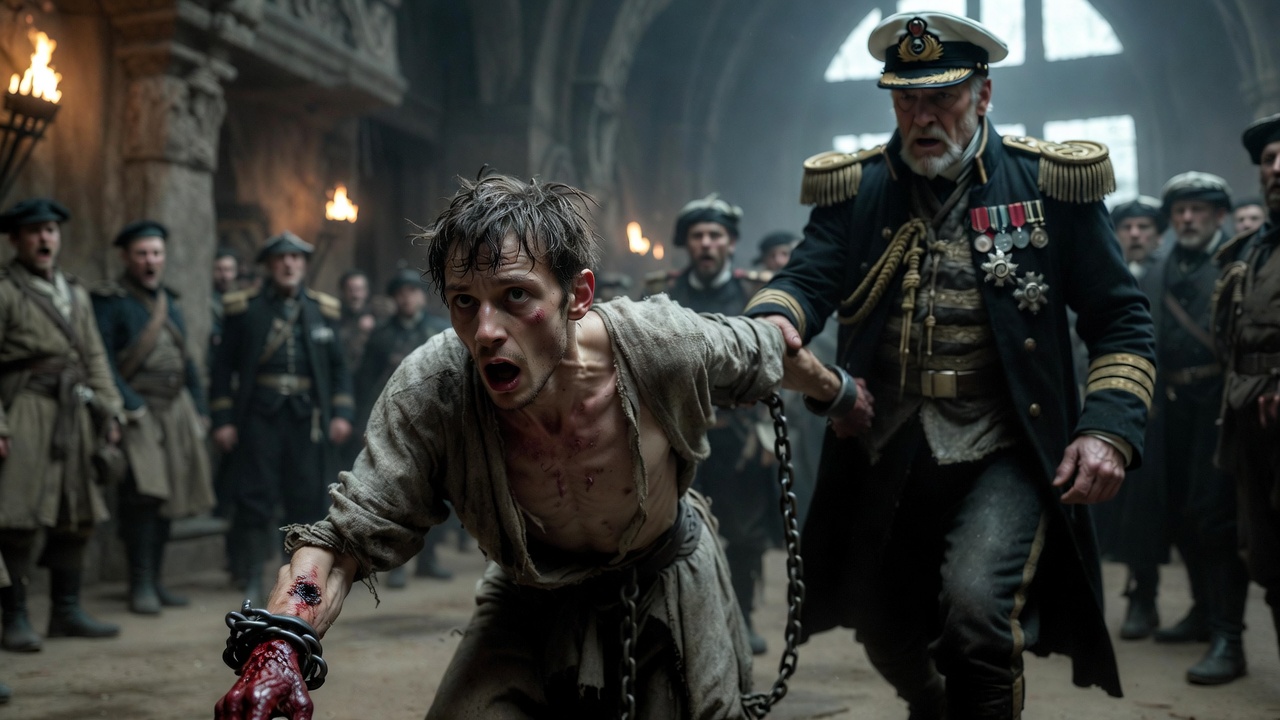
Commander Hekha threw me hard onto the cold limestone floor of the grand throne hall. The impact knocked the breath from my lungs, and I gasped silently, my chest heaving against the dust. All around us, the laughter of the court echoed like the hissing of desert vipers. They looked down at my torn linen rags, my skeletal ribs, and the dirt caked onto my skin. To them, my life was worth less than a single drop of water in the Great Sand Sea.
“Behold the thief, Your Majesty!” Hekha’s voice boomed through the massive chamber, dripping with false righteousness. He kicked me in the side, forcing me to roll over onto my back. “This worthless wretch sneaked into the sacred granaries. He has stolen from the gods themselves, and the law demands his blood.”
I looked up, my eyes wide with terror, searching for any spark of pity. But the high nobles only sneered. Hekha knelt down, his heavy bronze armor clanking loudly, and grabbed me by my matted hair, pulling my head back so everyone could see my terror. He leaned close, his breath foul, whispering so only I could hear, “Nobody will save you, boy. You die today, and the secrets of the past die with you.”
The Pharaoh sat high upon his golden throne, his face an unreadable mask of stone. Beside him stood the High Priest, already reciting the ancient prayers for the condemned. The law was clear: those who stole from the sacred temples were to be thrown into the deeper pits of the arena, where the shadow-beasts—starved and savage—tore human flesh to pieces for the entertainment of the court.
“Let the judgment be carried out,” the Pharaoh commanded, his deep voice vibrating through the stone walls.
Hekha grinned, a cruel, twisted smile of victory. He grabbed my arm, twisting it violently behind my back to drag me toward the edge of the pit. I thrashed wildly, my feet sliding against the polished floor, fighting with every ounce of strength my starving body had left. In my desperate struggle, the tattered sleeve of my dirty tunic tore open, completely exposing my left wrist to the bright, harsh sunlight streaming through the high palace windows.
The Pharaoh suddenly gasped. It was a sharp, agonizing sound that cut through the noise of the entire room.
“Stop!” the Pharaoh roared, his voice shaking with an emotion nobody had ever heard from the ruler of Egypt before. He stood up from his golden throne so fast that his royal headdress nearly fell. The entire room went completely dead silent.
Hekha froze, his grip still tight on my arm, his arrogant smile turning into a mask of pure confusion. The Pharaoh wasn’t looking at the commander. His eyes were locked entirely on my wrist, staring at a faded, deep purple birthmark shaped like a sacred falcon—a mark that only one royal bloodline in the history of the kingdom had ever carried.
I know you’re curious about what happens next—Read the full story in the comments.
CHAPTER 1
The hot desert sand burned my bare feet as Commander Hekha dragged me through the heavy bronze gates of the palace. I wanted to scream, to beg for mercy, to tell the gathering crowd that I was completely innocent. But no sound could leave my throat. My voice had been stolen from me years ago, taken by the very fires that destroyed my childhood. To the wealthy nobles of Egypt, I was just a nameless, mute street rat who deserved to be crushed under the weight of the Pharaoh’s law.
Commander Hekha threw me hard onto the cold limestone floor of the grand throne hall. The impact knocked the breath from my lungs, and I gasped silently, my chest heaving against the dust. All around us, the laughter of the court echoed like the hissing of desert vipers. They looked down at my torn linen rags, my skeletal ribs, and the dirt caked onto my skin. To them, my life was worth less than a single drop of water in the Great Sand Sea.
“Behold the thief, Your Majesty!” Hekha’s voice boomed through the massive chamber, dripping with false righteousness. He kicked me in the side, forcing me to roll over onto my back. “This worthless wretch sneaked into the sacred granaries. He has stolen from the gods themselves, and the law demands his blood.”
I looked up, my eyes wide with terror, searching for any spark of pity. But the high nobles only sneered. Hekha knelt down, his heavy bronze armor clanking loudly, and grabbed me by my matted hair, pulling my head back so everyone could see my terror. He leaned close, his breath foul, whispering so only I could hear, “Nobody will save you, boy. You die today, and the secrets of the past die with you.”
The Pharaoh sat high upon his golden throne, his face an unreadable mask of stone. Beside him stood the High Priest, already reciting the ancient prayers for the condemned. The law was clear: those who stole from the sacred temples were to be thrown into the deeper pits of the arena, where the shadow-beasts—starved and savage—tore human flesh to pieces for the entertainment of the court.
“Let the judgment be carried out,” the Pharaoh commanded, his deep voice vibrating through the stone walls.
Hekha grinned, a cruel, twisted smile of victory. He grabbed my arm, twisting it violently behind my back to drag me toward the edge of the pit. I thrashed wildly, my feet sliding against the polished floor, fighting with every ounce of strength my starving body had left. In my desperate struggle, the tattered sleeve of my dirty tunic tore open, completely exposing my left wrist to the bright, harsh sunlight streaming through the high palace windows.
The Pharaoh suddenly gasped. It was a sharp, agonizing sound that cut through the noise of the entire room.
“Stop!” the Pharaoh roared, his voice shaking with an emotion nobody had ever heard from the ruler of Egypt before. He stood up from his golden throne so fast that his royal headdress nearly fell. The entire room went completely dead silent.
Hekha froze, his grip still tight on my arm, his arrogant smile turning into a mask of pure confusion. The Pharaoh wasn’t looking at the commander. His eyes were locked entirely on my wrist, staring at a faded, deep purple birthmark shaped like a sacred falcon—a mark that only one royal bloodline in the history of the kingdom had ever carried.
The silence in the grand hall was heavy, thick with sudden tension. The wealthy nobles, who had been laughing just moments before, now leaned forward, their colorful linen robes rustling as they whispered nervously among themselves. They looked from the Pharaoh down to me, trying to understand what had caused the living god of Egypt to lose his composure.
“Bring the boy closer to me,” the Pharaoh whispered, his voice trembling so much it barely carried across the stone floor.
Commander Hekha swallowed hard, his heavy jaw tightening. He didn’t move immediately. Instead, his grip on my arm tightened, his rough fingers digging into my fragile skin until it bruised. He looked up at the throne, trying to force his usual confident smile back onto his face.
“Your Majesty,” Hekha said, his voice forced and strained. “The boy is a diseased street rat. He is filthy, and he cannot speak. He is dangerous. There is no need for you to look upon such filth. Let my guards throw him to the shadow-beasts as you have commanded.”
“I said, bring him closer!” the Pharaoh roared, slamming his golden scepter onto the stone floor. The sound cracked through the hall like a clap of thunder.
Hekha flinched. Realizing he had no choice, he dragged me roughly across the floor, throwing me down at the base of the royal steps. I collapsed onto my hands and knees, my heart hammering against my ribs like a trapped bird. I could smell the expensive perfumes of the court mixed with the scent of my own sweat and fear.
The Pharaoh descended the golden steps slowly, his heavy royal robes dragging softly against the stone. Every step he took felt like a heartbeat. The nobles held their breath. Nobody moved. Nobody dared to breathe.
When the Pharaoh reached the bottom of the steps, he knelt down right in front of me, directly in the dust. The court gasped in unison. A Pharaoh never knelt. He was the ruler of the Nile, the son of the sun god Ra. Yet, there he was, his knees pressing into the same dirt that covered my skin.
He reached out a trembling hand, his gold rings catching the sunlight. He didn’t touch me at all at first, as if he was afraid I would disappear like a mirage in the desert. Gently, his fingers brushed against my left wrist, wiping away the layers of mud and soot that had hidden the skin for years.
The birthmark was fully visible now. It wasn’t a scar, and it wasn’t painted on. It was a deep, natural purple mark in the perfect shape of a falcon with its wings spread wide. It was identical to the ancient seal carved into the very throne the Pharaoh sat upon.
“It cannot be,” the Pharaoh murmured, his eyes filling with tears that he did not try to hide. He looked into my eyes, searching my face, looking past the dirt and the scars. “The eyes… you have her eyes.”
I stared back at him, my mind spinning. I didn’t know who “she” was. I didn’t remember my mother. All I remembered was a night of fire, screams, and a woman with a gentle voice who had pushed me into a hidden space beneath the floorboards before the ceiling collapsed. I remembered a man with a scarred face laughing as the house burned.
“Your Majesty,” Hekha interrupted, stepping forward quickly, his face pale underneath his bronze helmet. “This is a trick! The boy must have branded himself to look like the royal crest. It is a common deception among the thieves of the lower districts. He is a criminal!”
The Pharaoh didn’t look up at Hekha. He kept his eyes locked on mine, his hand still gently holding my wrist.
“Tell me your name, child,” the Pharaoh said softly, his voice full of a strange, desperate hope.
I opened my mouth, trying with all my might to force a sound out. I wanted to tell him that I didn’t know my name. I wanted to tell him that the streets called me the Silent Shadow. But only a dry, raspy wheeze escaped my throat. I shook my head in frustration, tears of anger finally spilling down my cheeks.
“He cannot speak, Your Majesty,” the High Priest said, walking down the steps to stand beside the Pharaoh. “He has been mute since he was brought into the city as a child. He has no name, no family, and no past.”
“He has a past,” the Pharaoh whispered, his voice tightening with a sudden, dark fury. He slowly stood up, turning his gaze toward Commander Hekha. The sadness in his face instantly turned into something terrifying. “And someone in this palace has spent the last ten years trying to erase it.”
Hekha took a half-step back, his hand instinctively dropping to the hilt of his bronze khopesh sword. “My lord, I only serve the crown. I found this boy stealing from the sacred stores. I am doing my duty.”
“Your duty?” the Pharaoh asked, his voice dangerously low. He stepped toward the commander, his stature looming large. “Ten years ago, my younger brother’s estate was burned to the ground. My brother, his wife, and their infant son were supposedly consumed by the flames. We found no bodies, only ashes. And you, Hekha, were the captain of the guard who investigated the fire. You told me there were no survivors.”
“There weren’t!” Hekha insisted, his voice cracking slightly as sweat began to bead on his forehead. “This boy is an impostor. A mere beggar who happens to bear a resemblance. Do not let a street rat mock the memory of your royal family!”
The Pharaoh looked down at me again, then back at Hekha. “The royal birthmark of the Falcon bloodline cannot be faked, Commander. It is passed from father to son, hidden beneath the skin, visible only to those who carry the true blood. But a birthmark alone does not prove identity in a court of law. We need the token.”
The Pharaoh turned to the High Priest. “Bring the Royal Ledger of Births. And call for the old blind servant, Ameni. He was the one who nursed my brother’s child before the fire.”
Hekha’s eyes darted toward the high windows, then toward the heavy bronze doors of the hall. He looked like a trapped animal, realizing that the web of lies he had spun for a decade was beginning to unravel. He looked at me, his eyes filled with a murderous hatred so intense it made me shiver.
I shrank back against the base of the throne steps, my small body trembling. I was just a boy who had been looking for a scrap of bread to survive the winter. Now, I was caught in the middle of a storm that could destroy the entire kingdom.
“Until the truth is revealed,” the Pharaoh announced, his voice echoing to every corner of the room, “the boy will be kept in the private royal quarters. He will be fed, he will be clothed, and he will be guarded by my personal shields. And you, Commander Hekha… you will not leave this palace.”
Hekha bowed low, but I could see the muscles in his neck straining. “As you command, my Pharaoh.”
As the royal guards stepped forward to lift me gently from the floor, Hekha caught my eye one last time. He raised a single finger to his lips, a silent, chilling warning. He knew something I didn’t. He knew that even in the heart of the Pharaoh’s palace, the shadows could still kill.
CHAPTER 2
The royal quarters were unlike anything I had ever seen. Instead of the cold, hard dirt of the alleyways, my feet sank into thick, woven rugs from the southern lands. The air smelled of sweet myrrh and fresh cedarwood, not the rot and waste of the slums. They had washed the dirt from my skin with warm water and scented oils, and dressed me in fine, white linen that felt as light as air.
But I couldn’t rest. I sat on the edge of a massive gilded bed, my legs dangling, staring at the grand balcony that overlooked the Nile River. The water glittered like liquid gold under the setting sun. For the first time in my life, my stomach wasn’t aching with hunger, yet I felt a knot of pure terror tightening inside me.
A soft knock on the wooden door made me jump.
The door opened, and a servant entered, leading an old man whose eyes were covered by a thick strip of white linen. The old man walked with a heavy wooden staff, his footsteps slow and deliberate. His face was deeply wrinkled, carved by a lifetime of desert sun, but there was a strange dignity about him.
“This is Ameni,” the servant whispered to me, though I could not reply. The servant then bowed and exited the room, closing the heavy doors behind him, leaving me alone with the blind man.
Ameni stood still for a moment, tilting his head as if listening to the sound of my breathing. He smiled softly, a gentle, sad expression.
“Do not fear me, child,” the old man said, his voice raspy but incredibly warm. “I have no eyes to see your rags or your royalty. I only have my memories, and a heart that has broken every day for ten long years.”
He walked forward, using his staff to guide him until he reached the edge of the bed. He sat down beside me, the wood creaking slightly under his weight. He reached out a frail, wrinkled hand, gesturing for me to give him my arm.
I hesitated, pulling back slightly. On the streets, showing weakness or letting someone touch you usually meant pain. But there was something about the old man’s presence that felt familiar, like a half-forgotten dream of safety. Slowly, I placed my left wrist into his palm.
Ameni’s rough fingers traced the skin of my wrist. He didn’t just look for the birthmark; his thumb moved over a small, jagged scar right next to it. It was a scar I had carried for as long as I could remember, a small crescent-shaped mark near the bone.
The moment his fingers touched that scar, the old man’s breath hitched. His hand began to shake violently. He dropped his staff, and it clattered loudly against the floor.
“Maako…” the old man whispered, a single tear escaping from beneath his linen blindfold and tracking down his wrinkled cheek. “It is you. My sweet little prince.”
I stared at him, my lips parting, but no sound came out. Prince? The word felt heavy, impossible, like a story told to children before sleep. I was a boy who ate garbage thrown to the dogs. How could I be a prince?
“They told us you died in the fire,” Ameni wept, pressing my hand against his cheek. “They said the flames consumed the entire estate. But I knew… I knew Hekha was lying. He was the one who led the guards that night. He claimed he went in to save your family, but he came out with nothing but blood on his sword.”
The old man leaned closer, his voice dropping to a harsh whisper. “Listen to me carefully, Maako. Your father, the Pharaoh’s younger brother, had discovered a terrible truth. He found evidence that Hekha was selling royal secrets to the desert warlords of the East, allowing them to raid our borders and slaughter our people. Your father was going to present the evidence to the Pharaoh the very next morning.”
The pieces of the puzzle began to fall into place in my mind. The fire wasn’t an accident. It was a execution.
“Hekha burned the house to destroy the evidence and kill your family,” Ameni continued, his voice trembling with anger. “But your mother… your beautiful mother hid you. She must have escaped with you or hidden you well enough that the flames didn’t reach you before someone found you. But Hekha has been looking for you ever since. He knew that if a child with the Falcon birthmark ever appeared, his crimes would be exposed.”
Suddenly, the heavy wooden doors of the chamber burst open with a loud bang.
I jumped up from the bed, my heart leaping into my throat. Standing in the doorway was not the Pharaoh, and not the gentle royal guards. It was Commander Hekha himself, flanked by two giant mercenaries holding heavy bronze spears. The guards who were supposed to be protecting my door were nowhere to be seen.
Hekha walked into the room, his heavy boots thudding against the fine rugs. His face was twisted into a dark, murderous sneer. He looked at the blind old man, then at me.
“A touching reunion,” Hekha mocked, drawing his bronze khopesh from his side. The metal gleamed wickedly in the torchlight of the room. “The blind fool and the mute brat. It’s almost a pity I have to end it.”
Ameni stood up, placing himself bravely between me and the commander, raising his arms. “You will not touch him, Hekha! The Pharaoh knows the truth now! The birthmark proves who he is!”
“The birthmark proves nothing if the boy is dead before the morning court,” Hekha snarled, stepping closer. “The Pharaoh is weak. He wants to believe his family is alive, but he is a fool. By tomorrow morning, this boy will have ‘succumbed’ to a sudden illness, or perhaps he will have tried to escape and fallen from the balcony into the river. And you, old man, will join his father in the underworld.”
I looked at the open balcony behind me. The drop to the Nile was steep, surrounded by jagged rocks below. I looked at Hekha, who was raising his sword, his eyes filled with the same murderous fire I remembered from the night my childhood died.
With a sudden burst of movement, Hekha shoved the old man out of the way. Ameni crashed into the wall, groaning as he fell to the floor. Hekha lunged at me, his blade whistling through the air, aiming directly for my throat.
I ducked instinctively, rolling across the fine bed sheets as the sword sliced through the linen fabric, tearing the pillows apart. I scrambled toward the balcony, my only escape route, but Hekha was already turning around, his face red with rage.
“There is nowhere to run, little prince!” Hekha shouted, blocking the only door out of the room. He raised his sword again, cornering me against the stone railing of the high balcony. The wind from the river whipped through my hair as I looked down at the dark, swirling waters far below.