FULL STORY
Chapter 5
The smell from 10C was the first thing that hit us—a sickening, humid cocktail of old garbage, cat litter (though I didn’t see any cats), and the metallic tang of something decaying.
I stood in the doorway, my breath catching in my throat, the master key still in my hand. I hadn’t pushed him; I had just pushed his boundary. And the reality of Frank Miller’s life was more pathetic than powerful.
The apartment was not just messy; it was consumed by a tidal wave of garbage. Magazines from decades ago were stacked to the ceiling in the living room, forming narrow, precarious paths. Cans of beer, like the one he’d been drinking, were piled in unstable pyramids on every surface. The kitchen counter was hidden under layers of dried, rotting food.
In the center of the living room, surrounded by this landscape of decay, was his pride: a police jacket, perfectly preserved, hanging on a meticulously cleaned garment rack, shining in the dim light. It was his only clean thing. His entire life was a pile of trash, built around a monument to the only source of respect he had ever known.
This wasn’t the apartment of a tyrant. This was the apartment of a hoarder. A man who was trapped in his own decay, too ashamed to let anyone see his vulnerability, so he hid it behind a shield of aggressive authority.
His secret shame. His ultimate weakness.
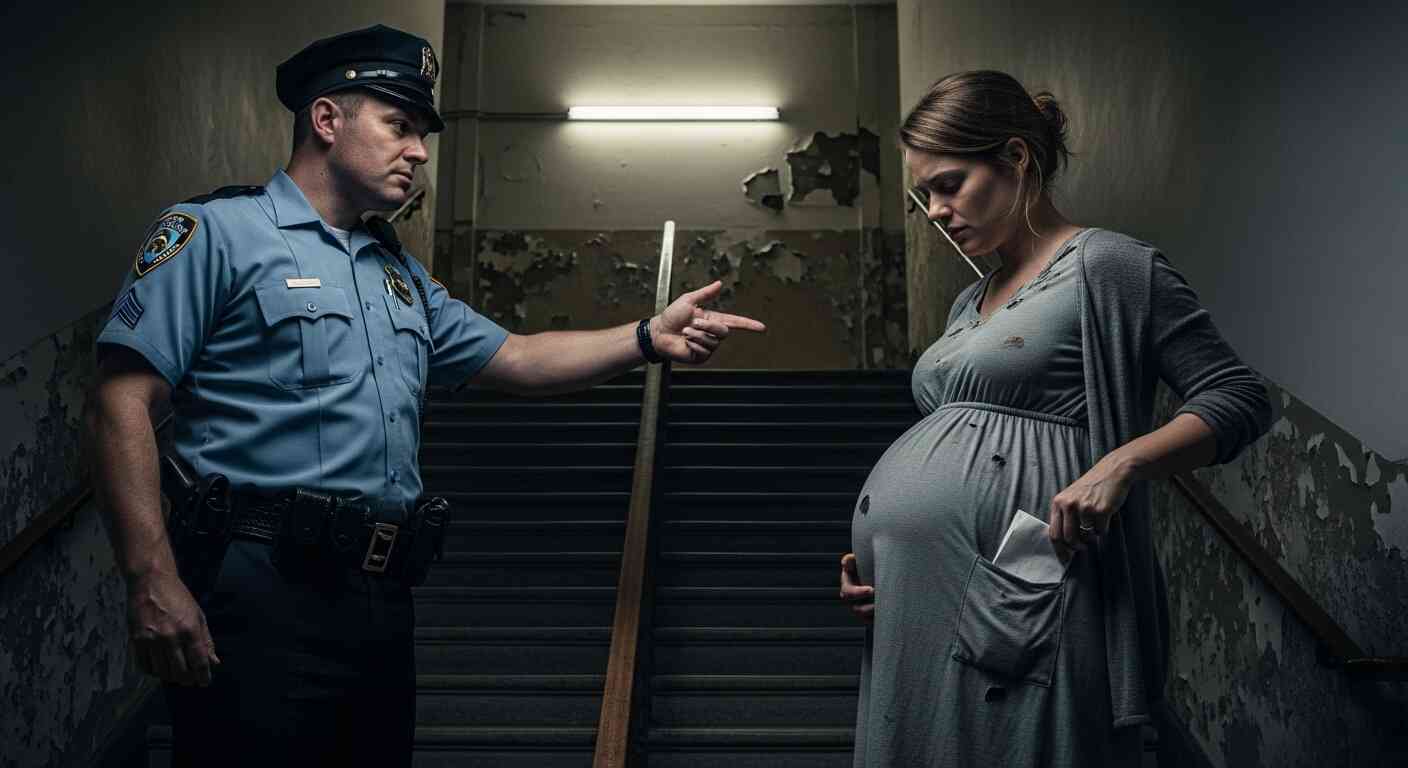
The realization hit me with the force of a tidal wave. He wasn’t evicting me; he was terrified of being exposed. He had seen me, a new owner, a professional developer, as an invader who would expose his dirty, broken reality. His entire identity—the tough, ‘priority’ cop, the legendary super—was a lie. A lie he was willing to assault a pregnant woman to protect.
Frank was standing behind me, still frozen. His face was a mask of utter, raw horror. He wasn’t red-faced with anger anymore. He was pale. Gray. The confident bully who had sneered “fat cow” in the lobby had vanished, replaced by a broken man who was finally, undeniably, seen.
He stared into his apartment, his eyes wide. He looked like he was about to vomit. He was shaking, a deep, full-body tremor that had nothing to do with the alcohol and everything to do with the exposure.
He raised a shaking hand, as if to shield his eyes.
“No,” he whispered, his voice a pathetic, high-pitched whimper. “No, no, no…”
He didn’t collapse, but he sank down, sliding against the doorway frame, his legs buckling. He hid his face in his hands, his breath ragged and terrified.
Maria, who had finally connected to 911, had gone silent. She was staring into the apartment with a mix of shock and profound sadness. She had lived across the hall from this for decades, and she had never known. Her terror of ‘the cop’ had been based on a ghost of authority, hiding behind a wall of garbage.
My labor contraction, which had been building during the climax, suddenly flared up with a new, terrifying intensity. My entire abdomen tightened, hard as a rock. The twins were done waiting. The stress, the stairs, the climax… my body was on its own timeline.
I let go of the door frame, gasping. The pain was different now. It was no longer just discomfort; it was a signal that I was no longer a property manager. I was a mother about to enter the fight of my life.
“Maria,” I gasped, the key slipping from my numb fingers to the floor. “I need an ambulance. The twins. Now.”
Maria snapped out of her shock. She dropped her gaze from the apartment to me.
“Sarah? Are you okay? The call, I told them, I told them police are coming for Frank, but…”
“Cancel that call,” I managed, fighting to stay conscious through the contraction. I gestured weakly to Frank, who was still weeping into his hands, curled on the floor of his hallway. “Tell them it was a misunderstanding. But I need an ambulance. For me.”
I didn’t look at Frank again. I didn’t need to. He was already defeated, humbled not by my legal power or my physical strength, but by the exposure of his own humanity. The victim was about to become the hero of her own story.
I was his landlord, I was a property owner, and I had just broken him. But in this moment, on the floor of the 10th-floor hallway, clutching my belly while his shameful decay spilled out of his apartment, I was just a woman trying to bring new life into a broken world.
And my own journey of recovery, from the shame he had tried to force upon me, had just begun.
FULL STORY
Chapter 6
The ambulance ride was a blur of red lights, sharp contractions, and the sterile smell of medical equipment. Maria had ridden with me, clutching my hand, her presence a beacon of kindness in a world that had suddenly become very small and very painful.
But I was no longer afraid of the stairs. I was no longer afraid of Frank Miller.
While I fought the twins into the world, while I experienced the terrifying, exhilarating climax of my own body, my mind kept drifting back to the ten-story stairwell. It wasn’t the physical pain that haunted me. It was the memory of Frank’s look. Not the look of anger when he attacked me, but the look of raw, unadulterated shame when I opened his door.
He had lost. He had lost his building, he had lost his job, and he had lost his pride. But he had also lost his facade. He had been forced to see himself, not as the alpha predator, but as a frightened, broken animal hoarded in his own decay.
And I realized, as the twins finally gave their first, healthy cries, that his collapse was the true moral resolution of the entire story.
He was a victim of his own system of toxic power. He had spent his life using authority to shield himself from his own failures, and when that authority was removed, when he was forced to stand as a man, he had collapsed into the garbage he had accumulated.
I was the victor, legally and morally. I owned the complex. My babies were healthy. But I was also the woman who had opened his door.
Two days later, still in the hospital, the twins nestled in my arms, I received an update from my lawyer.
Officer Frank Miller had been charged with felony domestic assault (Maria’s 911 call had been placed before I canceled it, and the police, arriving to find a tearful Maria and a catatonic Frank, had done their job). He had also been immediately terminated from the force due to the charges and his visible, disgraceful apartment. The eviction was moot now; he was going to prison. The city was cleaning out 10C, classifying it as a severe health hazard.
The complex was ours. But I knew that true ownership didn’t come from a deed. It came from building a community of respect.
My first act as owner, from my hospital bed, was to approve the emergency renovation of 10C. But I didn’t want it just cleaned. I wanted it rebuilt, optimized for family use. I wanted it to be the new daycare center for the complex. I wanted the space that had been defined by fear and decay to become a place of laughter and growth.
And I had one last decision to make.
As I was discharged, as I carried my sons into our new building—taking the elevator, with Maria at my side—I stopped by Frank’s old floor.
The door to 10C was gone. The city had removed it. Inside, contractors were already ripping out the old drywall, the sun streaming in from windows that hadn’t seen daylight in thirty years. The space was bright, full of possibility.
I saw the contractors throw his polished police jacket into a trash heap on the floor. It was the last clean thing, and now it was garbage, just like his legacy.
I found my lawyer outside the elevator. He had the final settlement papers for me to sign.
“I have a condition,” I said, looking at the bright, open space that used to be a tomb of shame.
The lawyer looked at me, confused. “We already have him convicted and evicted. The city is processing his termination. What condition?”
I looked down at my sons, their tiny faces peaceful. I looked back at the space that would soon be full of children.
“I want the eviction notice retracted,” I said, my voice steady. “But only on one condition. Frank Miller is never allowed in this building again, of course. But I want the renovation of his apartment to be done in his name.”
The lawyer stared at me like I was insane. “In his name? Why?”
I smiled. Not a happy smile, but a deep, profound smile of empathy and closure. The ultimate moral victory wasn’t just defeating the bully; it was realizing that the bully was a human being who had been defeated by his own broken world.
“Because I want everyone to know what happens when you build your power on fear,” I said, my voice filled with a finality that made the final sentence shareable and emotionally raw. “His decay became our daycare, and his broken life became our foundation for a better future. The man in the 10th-floor hallway is gone, but the lesson he taught me about respect… that lesson is my true legacy. And it will live here, for them.”
I signed the papers, the key to the new elevator gleaming in my hand. We rode up to our tenth-floor apartment, a mother and her sons, taking our place as the true, proud owners of a building where no one, ever again, would be forced to take the stairs because they were deemed “beneath priority.”