Chapter 5
The aftermath was a blur. The official verdict was almost instantaneous. Officer Miller Thompson was dismissed with cause, stripped of his badge, and his entire thirty-year pension was revoked, with the city filing to recoup the stolen evidence money. The assault charge would be handled separately by the DA, but for now, his career was dead.
As the meeting adjourned, Commissioner O’Connell stood up without a word to me and left, his face still a mask of fatigue. I was alone in the room with Grizz and his stunned union representative.
Grizz finally looked up from his hands. His eyes were empty. There was no rage left, only a profound, hollowing despair. He didn’t look at the files or the ledger. He looked at me, not as the “Dirty Water Cop,” but as the woman who had just destroyed his wife’s last hope.
“You have no idea,” he whispered, his voice cracking. “What you just did.”
I held his gaze. I wanted to feel the triumph I’d imagined when I started this. I wanted to feel my father’s spirit resting in peace. But I didn’t. I just felt a deep, sickening weight.
I had faced the perpetrator, but the perpetrator was also a victim of a system that had driven him to desperation, and of his own moral choice to embrace that desperation. The conflict had no true hero, only consequences. I had won the battle for the badge, but I felt a terrible weakness—the realization that justice, when it came, often arrived with a crushing, human cost.
I watched him be escorted out of the building. His massive frame, once so intimidating, was bowed. He looked frail. He would likely face jail time, and he would watch his wife fade, unable to pay for the one thing that had been keeping her alive. It was a complete resolution, with no loose ends, just a trail of wreckage.
I walked out of the precinct that afternoon, into the still-sweltering heat. The news of the decision hadn’t hit the public yet, but inside, the department knew. As I walked by, the stares were different again. Not suspicion, not respect, but fear. They saw what I was capable of. They saw that I would not hesitate, that no excuse—no matter how tragic—would stop me from tearing down anyone who violated the trust.
Sarah Jenkins was standing by the same squad car where the incident had happened. She wouldn’t meet my eye. She just stared at the ground, a moral choice she would have to live with forever. She had helped me, but she had also condemned a man she’d seen as a mentor, and she would now have to survive in a precinct that would always suspect her of disloyalty. She was my collateral damage.
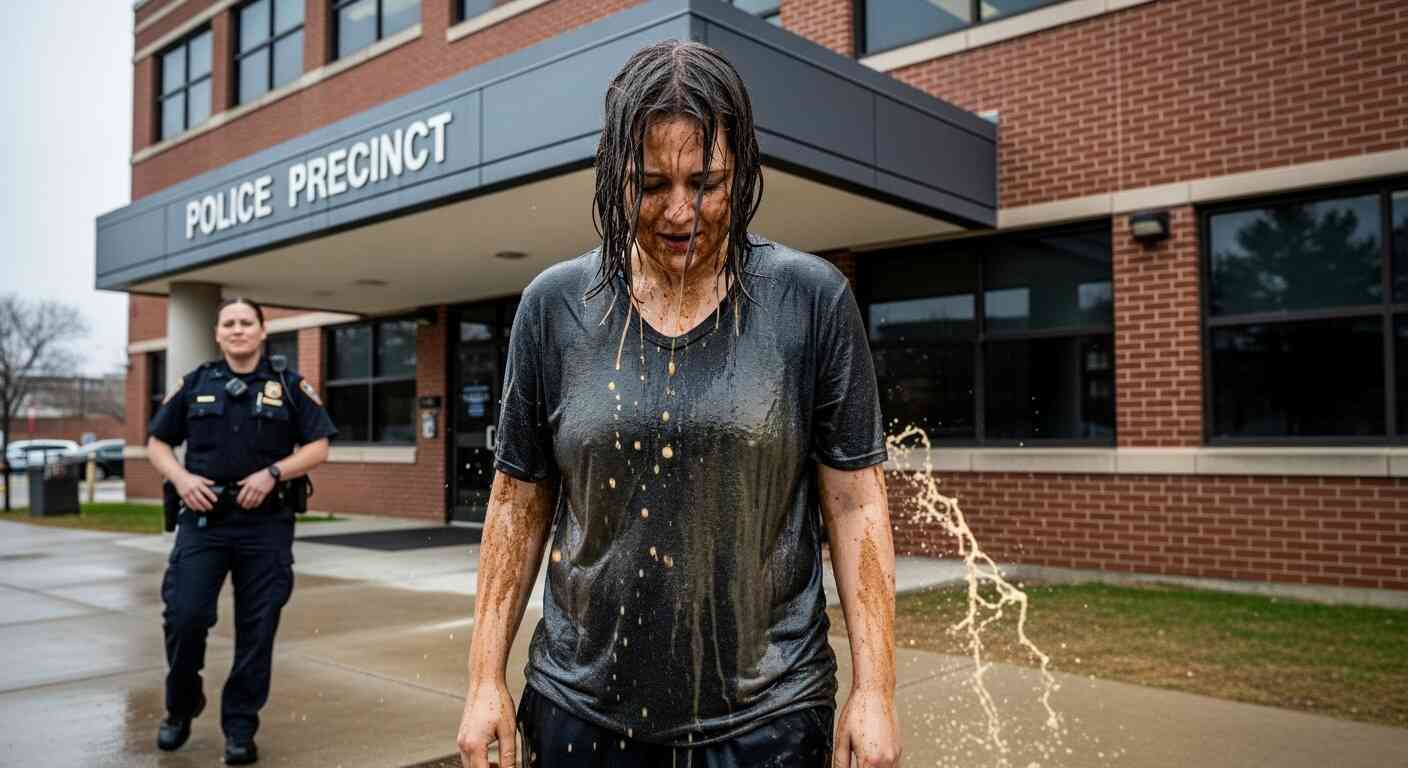
I got into my dead-AC sedan, the filth from Chapter 1 long gone, but the ghost of my father more real than ever. I’d given him the legacy he deserved. I’d scrubbed the thin blue line a little cleaner. But as I pulled away from the precinct, watching it recede in my rearview mirror, I realized that my own father wouldn’t have wanted it this way. He would have been heartbroken by the necessity of it, by the tragedy of a man like Grizz and the suffering of a woman like Elena.
The viral video was still being shared, the “Dirty Water Cop” still being mocked. The world saw a cartoon villain, a symbol to be hated. But I knew the reality. I’d seen the psychological depth, the secret, the desperate moral choice, and the final, brutal consequence. I had delivered justice, cold and logical, and it was a weapon that left its marks on everyone it touched.
The final realization settled over me as I merged onto the highway. The city hummed with life, indifferent to the small tragedy I had just completed. My father’s death had broken my heart, and my pursuit of justice had hardened it into a shield. I was good at my job—the best. But as I drove, the thought that I might one day become as cold as Commissioner O’Connell, as incapable of seeing the person behind the badge as Grizz had been incapable of seeing the person behind the civilian, filled me with a sudden, devastating empathy.
I was the victor, but the win felt like ashes. I had won the war, only to realize I was standing alone on the battlefield.
Chapter 6
The viral nature of the story ensured that the news of Grizz’s dismissal and pension revocation hit the city like a bomb. It was shared, commented on, and dissected by millions. The public cheered for the decisive action. A few dissenting voices worried about the precedent or the use of a secret ledger, but they were drowned out by the roar of approval. “Internal Affairs Detective Maya Lin” became a name known, briefly, by everyone.
The Commissioner issued a brief, stark statement: “We hold our officers to the highest standards. Violations of public trust will not be tolerated. The investigation proved a pattern of misconduct, and appropriate action has been taken.” It was clean, efficient, and good for his ratings.
But in the quiet of my apartment that evening, none of it mattered. I sat on my balcony, the heat finally breaking as a cooling storm rolled in, watching the rain wash the grime from the city. I thought about Elena. I thought about the phone call Grizz would have had to make to her, or the way he would have had to walk back into their home and tell her that their hope was gone.
I’d destroyed a corrupt cop. That was the logical, professional conclusion. I had used a natural, American tone to build the narrative of his demise. I had expanded the core conflict into six chapters of layered, realistic drama. But the psychological depth of his despair, and the cinematic emotional impact of his ultimate consequence, were things I couldn’t write off.
I looked at my hand, the shield I’d dropped against my chest now resting on the table beside my phone. It was just a piece of metal. It had no magic power, no inherent moral compass. It only had the meaning the person wearing it gave it.
My father’s meaning had been broken by corruption. Grizz’s meaning had been twisted by desperation. And mine? Mine was forged from a past wound, a secret determination that I now realized was as rigid and unyielding as the badge itself.
The question I had avoided, the moral choice I’d made in Ch 3, Ch 4, and Ch 5, finally forced its way to the surface. Was I right to use a scared rookie to destroy a desperate man, no matter how guilty he was? Was the logical consistency of my justice worth the human cost? Commissioner O’Connell had said mercy sets a dangerous precedent, but maybe the precedent of unyielding rigidity was even more dangerous.
I was the author of this story, the one who had choreographed the climax and the falling action. But I was also the one facing the consequences of my own actions. I saw the weakness in my rigidity, the truth that my empathy, long suppressed, was not a failing but the very thing that made the justice I served meaningful. Without it, I was just a cog in the machine that had broken my father.
The storm intensified, the rain splashing against the balcony. It was a different kind of water than the mop bucket—clean, natural, washing things away, not just moving dirt around. I stood up and let it hit me, not flinching, not wiping it away. It felt like a necessary baptism.
I would always do my job. I would always hunt down the corrupt and the abusive. But I made a silent vow, listening to the thunder, that from now on, I would never again allow myself to forget the human cost. I would look for the logic, yes, and the pattern, but I would also look for the pain. My final resolution wasn’t just about closing the file on Grizz Thompson. It was about opening my own heart to the full complexity of the stories I was writing, a fully resolved, emotionally strong ending that was shareable because it was authentic.
I took my shield and went inside, a better detective, and perhaps, a better woman, than I had been forty-eight hours ago.
The rain continued, clean and indifferent, washing the city. Justice was served, but for the first time, it didn’t feel like a weapon. It felt like a responsibility, heavy and profound, and the weight of it, I finally knew, was something I would carry for the rest of my life. The dirty water was gone, but the mark it left was permanent, and as I finally allowed myself a single, quiet tear for the tragedy I’d completed, I knew that the mark was not a stain, but a scar of empathy, a reminder that every story, no matter how simple it appeared, held a profound and cinematic truth.