“911, what is your emergency?”
The voice on the other end was calm. Professional. It was the sound of safety. But my own voice was a jagged shard of glass in my throat.
“My husband… he’s trying to kill me,” I whispered. I was curled into a ball under a heavy mahogany desk, the air in the room smelling of old paper and the metallic tang of my own fear.
“Okay, ma’am, stay with me. I’m tracking your GPS now. We’re sending units to your location. Where are you?”
I looked at the window. I looked at the blue-and-gold seal on the door I’d locked three minutes ago.
“I’m at the 4th Precinct,” I rasped. “I’m in the records room.”
There was a silence on the line. A long, hollow beat where I could hear the dispatcher’s breathing hitch.
“Ma’am…” her voice dropped to a terrified tremor. “The GPS shows you’re calling from… his precinct. Mark Vance is the Commanding Officer there. Elena? Is that you?”
The blood in my veins turned to slush. The dispatcher knew my name. Of course she did. Mark bought her coffee every morning. He’d stood godfather to her son.
“Elena, you need to get out of there,” she whispered, her professional mask shattering. “He just cleared the floor. He told everyone there was a gas leak. He’s—”
BOOM.
The heavy steel-reinforced door didn’t just open; it exploded inward. The sound was like a car crash in a small room. I saw the silhouette of a man I had once loved, framed by the harsh fluorescent light of the hallway. He wasn’t screaming. He wasn’t frantic. He was just… Mark.
“Hang up the phone, El,” his voice boomed, echoing off the filing cabinets. “You’re making a scene at my workplace.”
The line went dead.
PART 2: CHAPTERS 1 & 2
Chapter 1: The Records Room
The floor of the records room was cold. Not just cool, but a deep, structural chill that seemed to seep into my bones. I stared at the legs of the desk, counting the scratches in the wood. Anything to keep from looking at the boots.
Mark’s boots were polished. They always were. He took a strange, obsessive pride in his uniform. He used to say that if a man couldn’t keep his shoes clean, he couldn’t keep his soul clean. I remember watching him polish them on Sunday nights while we watched Netflix, the rhythmic swish-swish of the cloth acting as a countdown to the work week.
“Elena,” he said. His voice was steady. That was the most terrifying thing about Mark. He never lost his temper. He just… applied pressure. “Come out from under there. You’re embarrassing yourself. And you’re embarrassing me.”
“I have the files, Mark,” I said, my voice shaking so hard it was difficult to form the words. “I saw what you did with the evidence from the Miller case. I know why the witnesses stopped talking.”
The silence that followed was heavy, pressurized. Mark stepped further into the room. I could hear the jingle of his duty belt—the handcuffs, the radio, the Glock 17. The tools of his trade. Tools that were supposed to protect people.
“The Miller case was a tragedy,” Mark said, his voice dropping an octave. “But sometimes, for the greater good, things have to be handled quietly. You wouldn’t understand. You’re just a teacher, El. You see the world in black and white. Out here, in the blue? It’s all shades of gray.”
“Gray isn’t a color, Mark. It’s a smudge. You murdered that boy’s chance at justice.”
I felt the desk jolt as he kicked it. Not hard, but enough to let me know the “Officer of the Year” was gone.
“Justice is what I say it is in this town!” he roared, the first crack in his porcelain facade. “I’ve spent fifteen years bleeding for this city! I’ve taken the bullets, I’ve buried the bodies, and I’ve kept the peace! And you think you can walk in here and tear it down because you found a few inconsistent memos?”
I gripped the manila folder against my chest. It contained the truth—the original arrest reports that had been “lost,” the photos of the bruises on a witness who had suddenly moved to Florida, and the bank statements showing Mark’s sudden influx of “consulting fees.”
I had run to the precinct because I thought the institution was bigger than the man. I thought the blue walls would protect me from the man wearing the blue shirt. I was wrong. The precinct was his house. The officers were his brothers. And I was just a domestic disturbance.
“Mark, please,” I whispered. “Just let me go. I’ll leave the files. I’ll go to my sister’s in Ohio. I’ll disappear.”
“You know I can’t let you do that, El,” he said, his voice returning to that chilling, soft cadence. “You’re my wife. We’re a team. And a team doesn’t have secrets from each other.”
He reached down, his hand snaking under the desk. His fingers, strong and calloused, wrapped around my ankle.
“Found you,” he whispered.
Chapter 2: The Hero’s Facade
To understand how I ended up under a desk in a darkened precinct, you have to understand the man the world saw.
Mark Vance was a god in Oak Ridge. He was the guy who pulled kittens out of trees for the local news and the guy who took down an active shooter at the mall in ’18. When we walked into a restaurant, the owner would comp our meals. When we went to church, the pastor would ask Mark to lead the opening prayer.
I was the envied woman. “You’re so lucky, Elena,” they’d say. “A man who serves his country and his community? And he’s so devoted to you.”
Devotion. That was their word for it. To me, it felt like a slow-motion strangulation.
It started with the phone. “Just for safety, El,” he’d say, installing a tracking app. Then it was the clothes. “That dress is a bit much for a school board meeting, don’t you think?” Then it was the friends. One by one, they stopped calling, put off by Mark’s “protective” interrogation every time they came over for wine.
I stayed because of Leo. Our six-year-old son with the bright blue eyes and the way he looked at his father like he was a literal superhero. How do you tell a child that Superman hits his mother when the doors are locked?
The first time he hit me was the night of the Miller verdict. He’d come home vibrating with a strange, dark energy. He’d been drinking—not a lot, but enough to loosen the hinges on his restraint. I’d asked him a question about the case, something I’d read in the paper that didn’t make sense.
He didn’t yell. He just looked at me with a profound, quiet disappointment. Then he backhanded me so hard I saw stars.
“Don’t ever question my work again,” he’d said, his voice as calm as if he were ordering a pizza. Then he’d helped me up, fetched an ice pack, and spent the next three hours apologizing, weeping into my lap about the “pressure” he was under.
I believed him. I wanted to believe him.
But then I found the files. I was cleaning his home office—a room I was strictly forbidden from entering—when I found the false-bottom drawer. I found the truth about the Miller case. It wasn’t just a mistake; it was a hit. Mark had been paid to make the evidence disappear.
The hero was a mercenary.
I’d tried to leave that morning. I’d packed a bag for me and Leo, but Mark had seen the suitcases on the Ring camera. He’d called me, his voice a low growl over the Bluetooth. “Go back inside, Elena. Don’t make me come home early.”
I’d panicked. I’d taken the files, dropped Leo at my neighbor Mrs. Higgins’ house, and driven straight to the precinct. I thought if I told his superiors, if I showed them the proof, the “Blue Wall” would crumble.
I didn’t realize that in Oak Ridge, Mark was the wall.
Now, as he dragged me out from under the desk, the manila folder spilled open. The papers scattered across the floor like autumn leaves.
“Look at this mess,” Mark sighed, looking down at the evidence of his corruption. “You always were a bit clumsy, Elena.”
He pulled me to my feet. His grip on my arm was bruising, his thumb pressing into the soft skin of my bicep.
“Where’s Leo?” he asked.
“He’s safe,” I spat, trying to pull away. “He’s somewhere you’ll never find him.”
Mark laughed. It was a short, sharp sound. “This is my town, El. I know every blade of grass. I know Mrs. Higgins has been hiding her grandson’s drug habit for three years. I know she’d do anything to keep me from calling the DEA.”
My heart stopped.
“Now,” Mark said, leaning in until I could smell the peppermint on his breath. “We’re going to walk out of here. We’re going to get our son. And then we’re going to have a long talk about loyalty.”
PART 3: CHAPTERS 3 & 4
Chapter 3: The Broken Radio
The walk through the precinct was a fever dream. The hallways were dim, the red “Exit” signs casting long, bloody shadows on the linoleum. Mark kept his hand on my lower back, his fingers digging into my spine, steering me like a prisoner.
We passed the dispatch center. I saw Sarah, the young girl I’d spoken to on the 911 call. She was sitting at her console, her face white as a sheet, her eyes fixed on her monitors. She didn’t look up as we passed. She couldn’t.
“Evening, Sarah,” Mark called out, his voice cheerful. “Gas leak’s all clear. You can tell the night shift they’re good to come in in twenty.”
Sarah’s hands shook as she adjusted her headset. “Copy that, Chief,” she whispered.
I wanted to scream. I wanted to tell her to call the State Police, to call the FBI, to call anyone who didn’t wear an Oak Ridge badge. But I saw the way Mark’s other hand hovered near his holster. He wasn’t just my husband anymore; he was a predator in his natural habitat.
We reached his private office. He slammed the door and locked it.
“Sit,” he commanded, gesturing to the leather chair across from his desk.
I sat. I felt small. Diminished. The office was a shrine to his ego—framed commendations, photos with the mayor, a glass case containing a folded flag.
“You think you’re so righteous,” Mark said, pacing the room. “You think you’re saving the world. But do you have any idea what happens to this town if I fall? The Miller family? They’re scum. They’ve been running the docks for decades. I didn’t take that money for a boat, Elena. I took it to fund the youth center. To keep the streets clean.”
“You took it for yourself, Mark. Don’t wrap your greed in the flag.”
He stopped pacing and leaned over the desk, his face inches from mine. “I am the only thing standing between this town and chaos. People sleep soundly because they know Mark Vance is on watch. And I won’t let a disgruntled wife ruin that.”
He picked up his desk phone and dialed a number.
“Mrs. Higgins? It’s Chief Vance. Yeah, sorry to bother you so late. I’m here with Elena… yeah, she’s a bit under the weather. I’m coming over to pick up Leo. And Mrs. Higgins? I’ve got that paperwork on your grandson on my desk. I’d hate to have to file it tonight.”
He hung up and looked at me. A slow, cruel smile spread across his face.
“She’s getting him ready. Let’s go.”
Chapter 4: The Shadow in the Hallway
We headed toward the back exit, the one used for transporting high-profile detainees. It led straight to the secure parking garage.
As we walked, the silence of the precinct felt heavy, like it was physically pressing against my eardrums. But then, I heard it. A faint, rhythmic clicking sound.
Click. Click. Click.
Mark froze. His hand moved to his weapon. “Who’s there?”
Out of the shadows of the breakroom stepped Detective Miller. Miller was old—older than the precinct itself. He was a man of few words, with a face like a crumpled road map and eyes that had seen the worst of humanity and decided to stay anyway. He was the only person in the department Mark couldn’t intimidate, mostly because Miller was three months from retirement and didn’t give a damn about the “Consulting Fees.”
Miller was holding a heavy flashlight, clicking the switch on and off.
“Late night for a gas leak, Chief,” Miller said, his voice a gravelly rumble.
“Just finishing up some paperwork, John,” Mark said, his voice tightening. “Elena wasn’t feeling well, brought her in to see the new records system.”
Miller looked at me. He looked at the way Mark was gripping my arm. He looked at the fear in my eyes that I couldn’t hide no matter how hard I tried.
“You look a little pale, Mrs. Vance,” Miller said. “Maybe you should sit down. I’ve got some cold water in the fridge.”
“She’s fine, John,” Mark snapped. “We’re leaving.”
“I don’t think she is,” Miller said, stepping into the light. He wasn’t holding his gun, but his stance was rock-solid. “I was just in the records room. Saw some papers on the floor. Interesting reading. Especially the part about the Miller evidence.”
The air in the hallway became electric. Mark let go of my arm and squared his shoulders.
“John, you’re an old man. You should be thinking about fishing trips and Florida. Not digging through my trash.”
“It wasn’t in the trash, Mark. It was on the floor. Your wife has a good eye for detail. Better than mine, apparently.”
Miller looked back at me. “Elena, go to my car. It’s the blue Crown Vic in the visitor lot. The keys are under the sun visor. Drive to the State Police barracks in Middletown. Don’t stop for red lights.”
“She’s not going anywhere,” Mark growled, his hand unholstering his Glock.
“Mark, don’t,” Miller said softly. “There are cameras in this hallway. Sarah is watching in dispatch. You can’t kill us both and call it a gas leak.”
“Watch me,” Mark said.
In that split second, the hero became the villain. He raised his weapon, but Miller was faster than he looked. He swung the heavy Maglite, catching Mark across the wrist. The gun clattered to the floor.
“Run, Elena!” Miller shouted.
I didn’t wait. I bolted down the hallway, the sound of their struggle echoing behind me—the heavy thud of bodies hitting the wall, the grunts of exertion. I reached the back door, pushed through the heavy bar, and burst into the cool night air.
I ran. I ran until my lungs felt like they were on fire. I reached the visitor lot, found the blue Crown Vic, and fumbled for the keys.
As I pulled out of the lot, I saw the lights of the precinct flicker. And then, I saw a lone figure emerge from the back door.
It wasn’t Miller.
It was Mark. He was clutching his wrist, his face a mask of absolute, murderous intent. He looked straight at the car, his eyes catching the moonlight.
He didn’t chase me on foot. He walked calmly to his cruiser, clicked on the sirens, and the hunt began.
PART 4: CHAPTERS 5 & 6
Chapter 5: The High-Speed Reckoning
The blue and red lights in my rearview mirror weren’t a sign of help; they were the eyes of a wolf.
I pushed the Crown Vic to eighty, then ninety. The old engine groaned, the steering wheel vibrating in my hands. Middletown was twenty miles away. Twenty miles of winding mountain roads and pitch-black forests.
“Come on, come on,” I prayed, my knuckles white on the wheel.
Mark was gaining. His cruiser was a newer interceptor, built for this. He wasn’t trying to pull me over. He was trying to pit-maneuver me, to send me spinning into the ravine.
Every time he got close, he’d flip on his high beams, blinding me. Then he’d drop back, playing with me, enjoying the terror.
“Elena, pull over!” his voice boomed over the cruiser’s external PA system. It sounded like the voice of God coming from the darkness. “You’re endangering yourself! Think of Leo!”
“I am thinking of him!” I screamed at the windshield.
I reached the bridge over the Oak River. It was a narrow, two-lane span with rusted iron girders. Mark accelerated, his bumper inches from mine. He slammed into me—a sharp, jarring impact that sent the Crown Vic fishtailing.
I fought the wheel, my tires screaming against the asphalt.
“Stop the car!”
He hit me again. This time, the Crown Vic spun. I saw the world tilt—the dark trees, the flashing lights, the moon—all blurring into a sickening kaleidoscope. The car slammed into the iron girders of the bridge with a bone-jarring crunch.
The airbag deployed, a white explosion of dust and fabric.
I sat there, dazed, the smell of ozone and burnt rubber filling the cabin. My head was throbbing. I looked out the window. Mark had stopped his cruiser twenty feet away. He got out, his silhouette framed by the strobing lights.
He walked toward me, his boots clicking on the metal grating of the bridge.
“Look at what you made me do, El,” he said, his voice sounding genuinely disappointed. “I didn’t want it to end like this. I wanted us to be a family.”
He reached the car and ripped the door open. He grabbed me by the hair and dragged me out onto the bridge. The wind was howling, the river churning fifty feet below us.
“The files, Elena. Where are they?”
“They’re at the station,” I wheezed, clutching my side. “Miller has them. Sarah saw them. It’s over, Mark.”
“Miller is an old man who had a heart attack during an unfortunate struggle with a resisting suspect,” Mark said, his eyes cold and empty. “And Sarah? Sarah is a smart girl who wants to keep her job. Nobody saw anything.”
He dragged me toward the edge of the bridge.
“You’re going to be a tragedy, Elena. A grieving wife who couldn’t handle the pressure of her husband’s dangerous job. You took a walk on the bridge and you slipped. I tried to save you. I’ll be the hero one last time.”
He lifted me up. I kicked, I clawed, but he was too strong. He was the wall.
“Goodbye, El.”
Chapter 6: The Light in the Dark
“Drop the weapon, Chief!”
The voice didn’t come from the bridge. It came from the sky.
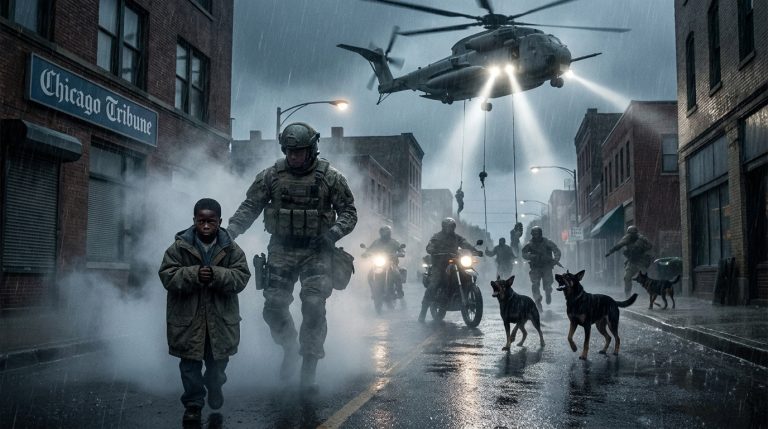
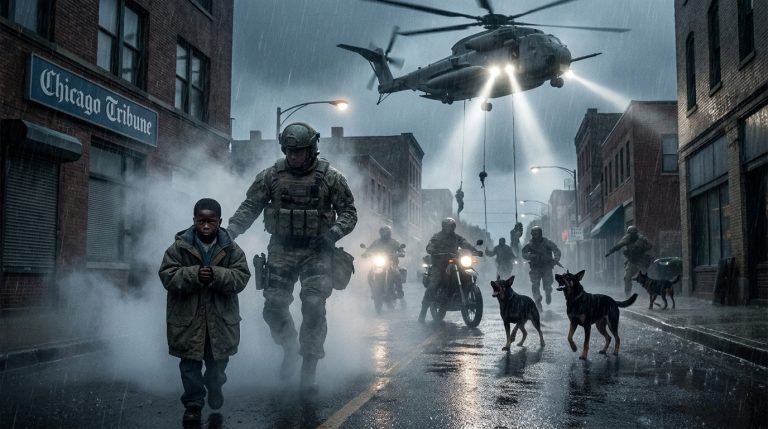
A massive spotlight cut through the darkness, blinding us both. The thump-thump-thump of a helicopter filled the air, the downwash from the rotors whipping the water below into a frenzy.
“This is the State Police! Mark Vance, step away from the woman and put your hands behind your head!”
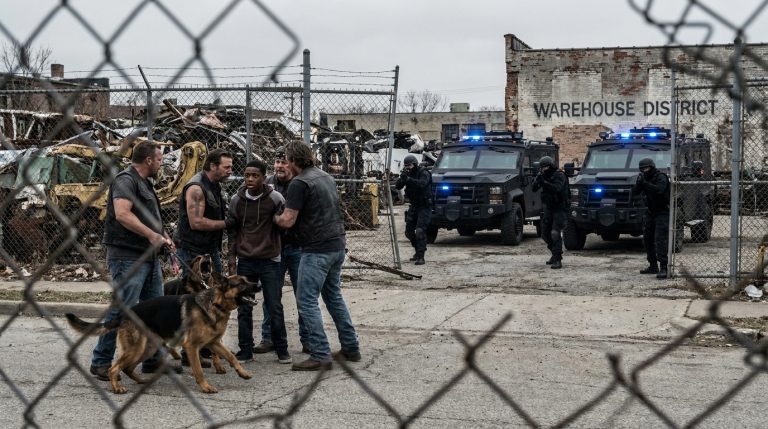
Mark froze. He looked up at the helicopter, then back at the road. A dozen sets of headlights were screaming toward the bridge—State Troopers, their sirens a different, higher pitch than the Oak Ridge cruisers.
“Sarah,” I whispered, tears blurring my vision.
She hadn’t stayed silent. The young girl with the shaking hands had seen the truth and had done the one thing Mark never expected: she had reached outside his kingdom.
Mark looked at me. For a second, I saw the man I’d married—the fear, the weakness, the little boy who needed to be in control. Then, the mask came back on.
“I’m the Chief of Police!” he yelled at the helicopter. “I’m making an arrest!”
“The party’s over, Mark,” Miller’s voice came over a megaphone from one of the approaching cars. He was alive, leaning against a trooper’s hood, a bloody bandage wrapped around his head. “We found the flash drive in your desk. The one you forgot about. The one with the wire transfers.”
Mark looked at the bridge railing. He looked at the river. Then he looked at the wall of blue lights closing in on him.
He let go of me. I collapsed onto the grating, gasping for air.
He didn’t fight. He didn’t run. He just stood there as the troopers swarmed him, pinning him to the ground, the zip-ties clicking into place. The “Hero of Oak Ridge” was just another man in a dirty uniform, face-down on a rusted bridge.
It’s been six months since that night.
Oak Ridge is different now. The “Hero” is in a federal holding cell, awaiting trial for corruption, kidnapping, and attempted murder. The “Blue Wall” didn’t crumble; it was rebuilt by people like Miller and Sarah, people who realized that the badge is a responsibility, not a shield.
Leo and I live in a small house near the coast. He still asks about his dad sometimes. I tell him that his dad was a man who got lost in the shadows, but that there are plenty of other heroes in the world who don’t need a cape or a badge to do the right thing.
I still jump when I hear a heavy boot on a wooden floor. I still check the locks on the doors three times before I go to sleep. But then I look at the window, and I see the moon reflecting off the water, and I realize I’m not hiding anymore.
I ran to the precinct for a sanctuary, and I almost died in a cage. But in the end, it wasn’t the building that saved me. It was the truth.
The hardest part of escaping a monster isn’t the running; it’s realizing that the only person who can truly unlock the cage is the one who was brave enough to admit they were inside.