FULL STORY
Chapter 5: The Town That Remembered
The trial of Tyler Vance was short. The video from his own friend’s phone was the star witness. But the real punishment wasn’t the community service or the probation. It was the “Oakhaven Walk.”
General Vance had made a deal. Tyler would avoid prison if he performed one thousand hours of service for the Veterans’ Affairs office, under the direct supervision of Sergeant Miller.
Every morning at 6:00 AM, the town saw Tyler Vance—no longer in his varsity jacket, but in a plain orange vest—cleaning the memorial park. He had to polish the names on the Vietnam wall, one by one, with a soft cloth. He had to read every name out loud.
And every afternoon, he had to go to the hospital, and later, the rehabilitation center, to sit with Elias Thorne.
The first week, Tyler sat in silence, his face red with resentment.
The second week, Elias asked him to read the newspaper.
By the third week, Tyler was asking questions.
“How did you do it?” Tyler asked one rainy Tuesday, looking at Elias’s hands. “How did you stay there when everyone else was gone?”
Elias looked out the window. “I wasn’t alone, Tyler. I had my brothers. When you realize that the person next to you is more important than your own fear, you don’t feel the pain as much.”
Tyler looked down at his own hands. They weren’t shaking, but for the first time in his life, they felt empty.
Meanwhile, the town of Oakhaven was changing. The Sunoco put up a plaque. The diner where Sarah worked started a “Reserved for Heroes” table that was never empty. People started stopping Elias on the street—not to mock, but to offer a hand, a ride, or just a quiet “Thank you, Colonel.”
But the biggest change was yet to come.
General Vance had been quiet, working behind the scenes. He had seen the shame in his town and the rot in his own home, and he knew that a simple apology wouldn’t fix it. It required a reckoning.
FULL STORY
Chapter 6: The Last Salute
Six months later, the Oakhaven high school football stadium was packed. It wasn’t for a game.
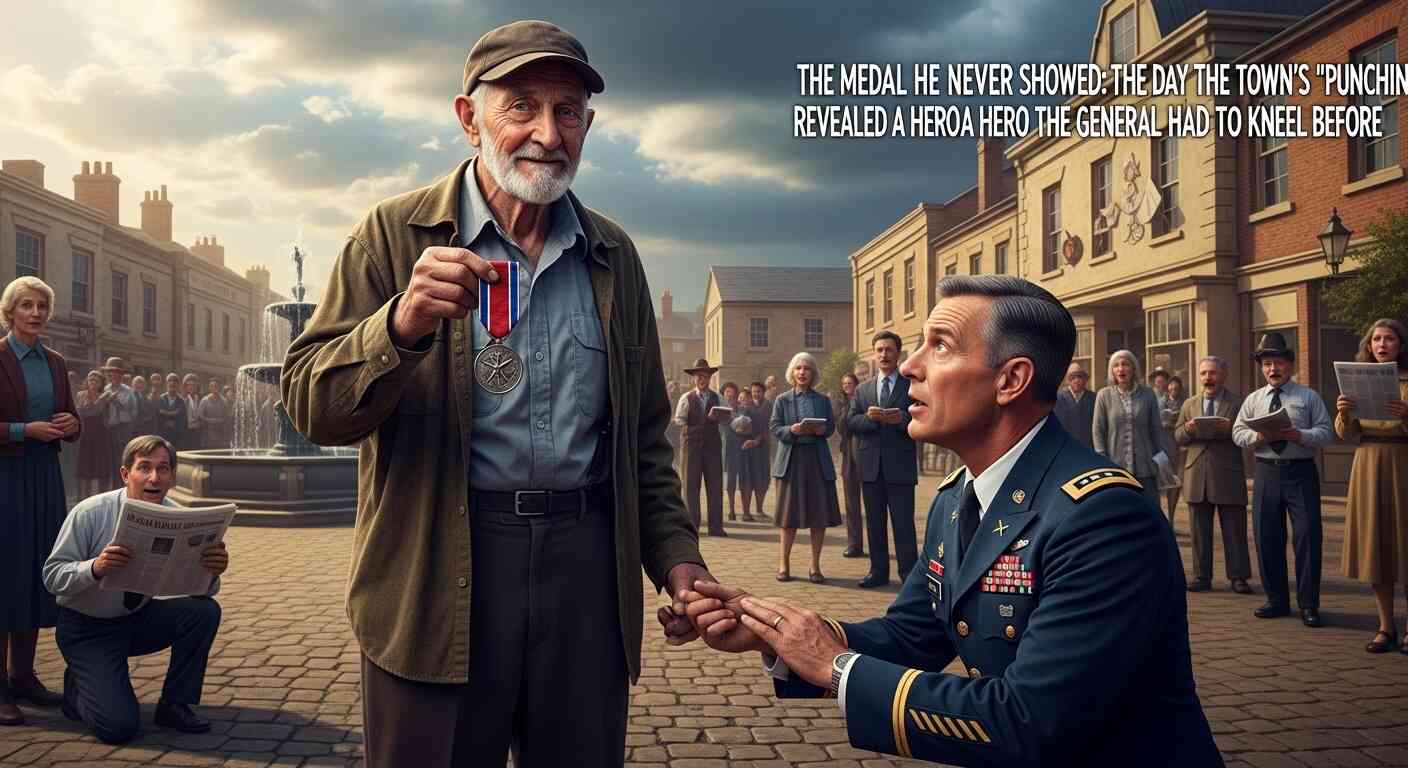
In the center of the field stood a small dais. Elias Thorne sat in a wheelchair, dressed in a new, crisp uniform that General Vance had personally ordered. The Medal of Honor hung around his neck, catching the golden light of the setting sun.
Beside him stood Tyler. The boy was thinner, his face more thoughtful, the arrogance replaced by a quiet, subdued gravity.
General Vance stepped to the microphone.
“We spent years looking past a giant because he was wrapped in a tattered coat,” the General told the silent crowd. “We allowed ourselves to believe that strength is found in status, and that entertainment is found in the weakness of others. We were wrong.”
He turned to Elias. “Colonel Thorne, for fifty years you carried the honor of this nation in silence. Today, this town carries you.”
The General stepped back and did something that no one expected. He didn’t just salute. He walked to the front of the wheelchair, removed his cover, and knelt on one knee.
One by one, the soldiers of the convoy—Miller, the medic, the drivers—lined up and did the same.
Then, the veterans in the stands began to stand. Then the families. Then the students.
Tyler was the last. He looked at Elias, the man he had once forced to “dance.” With tears streaming down his face, Tyler knelt in the grass at Elias’s feet.
“I’m sorry,” Tyler whispered, so low only Elias could hear. “I didn’t see you.”
Elias reached out. His hand was shaking, the tremors as rhythmic as a heartbeat. He placed that shaking hand on Tyler’s head.
“You see me now, son,” Elias said softly. “That’s all that matters.”
The ceremony ended, but the story didn’t. Elias lived out the rest of his days in a small house the town built for him, with a porch that faced the sunset. And every Sunday, a young man named Tyler would come by to sit with him, to help him with his tea, and to listen to the stories of the men who never came home.
Elias Thorne died two years later, in his sleep, his hands finally still.
At his funeral, the procession was three miles long. And at the very front, carrying the casket with the strength of a man who finally understood the weight of honor, was Tyler Vance.
He didn’t need to dance for anyone anymore; he finally knew how to walk with purpose.
True honor isn’t found in how we stand, but in who we choose to lift up when they fall.