FULL STORY
Chapter 5
The recovery was slower than Arthur liked to admit. Broken ribs at seventy aren’t the same as broken ribs at twenty. He spent three weeks in a high-end private wing of the hospital, courtesy of Julian, much to the confusion of his daughter, Elena.
Elena was a public school teacher, a woman who had inherited her father’s stubbornness and his heart. She had spent years worrying about him, watching him go off to his “janitor job” with a lunch pail and a weary smile.
“Dad, I don’t understand,” she said, sitting by his bed on the tenth day. “The news said there was a massive bust at Vance Precision. They said the mechanics were part of a luxury car theft ring. And they said… they said you were the one who caught them? And now the billionaire Julian Vance is paying for your hospital room?”
Arthur took a sip of water, his chest still taped up. “I told you, Elena. I was just doing my job.”
“Your job was to mop floors!”
“My job,” Arthur corrected gently, “was to look after a friend.”
He didn’t tell her the whole story yet—not the part about the freezing water ten years ago, or the “Ghost” firmware. He wanted her to see him as her father, not as some hero in a tech thriller.
While Arthur healed, Julian was busy. He didn’t just fire the mechanics; he leveled the entire culture of that shop. He realized that in his pursuit of “modernity” and “performance,” he had allowed a toxic environment to fester. He had valued speed over character, and it had nearly cost the man who saved his life everything.
Julian visited every day. He brought blueprints, not flowers.
“The Valkyrie II,” Julian said, spreading a digital schematic across Arthur’s hospital over-bed table. “I’m moving the security sensors into the chassis itself. If the frame detects a non-standard impact—like, say, a sledgehammer—it doesn’t just record. It locks the building and notifies the nearest precinct instantly.”
Arthur looked at the design, his engineering mind clicking back into gear. “The latency is too high on this bus, Julian. You need to bypass the central hub and go straight to the satellite link. If they cut the power, your ‘modern’ car is just a very expensive paperweight.”
Julian grinned. “See? This is why I need you. The board of directors thinks I’m crazy for appointing a ‘janitor’ to the executive level.”
“Are you?” Arthur asked.
“No,” Julian said, his voice turning serious. “I’m finally listening to the smartest person I know.”
By the end of the month, Arthur was back on his feet. He walked out of the hospital not into a bus station, but into a waiting car driven by Julian himself.
They didn’t go to the corporate headquarters. They went back to the garage.
The shop had been completely renovated. The glass walls were still there, but the atmosphere had changed. The new staff was a mix of ages—some young, some grey-haired. There was a sense of quiet respect in the air.
At the center of the bay sat a new car, covered in a silk sheet.
“We couldn’t fix the old one,” Julian said. “The frame was too compromised. So we built something else. For you.”
Julian pulled the sheet back. It wasn’t a supercar. It was a classic 1967 Mustang Fastback, restored to a level of perfection that made Arthur’s eyes mist over. It was painted the same deep blue as Arthur’s old work jumpsuit.
“It’s beautiful,” Arthur whispered.
“Open the door,” Julian urged.
Arthur reached for the handle. As the door opened, a small screen on the dashboard flickered to life. It didn’t show GPS or a radio. It showed a live feed of the garage’s security cameras.
In the bottom corner of the screen, there was a small inscription etched into the leather: Property of Arthur Miller: The Man Who Sees Everything.
“I thought you might want to keep an eye on things,” Julian said. “Even from the road.”
FULL STORY
Chapter 6
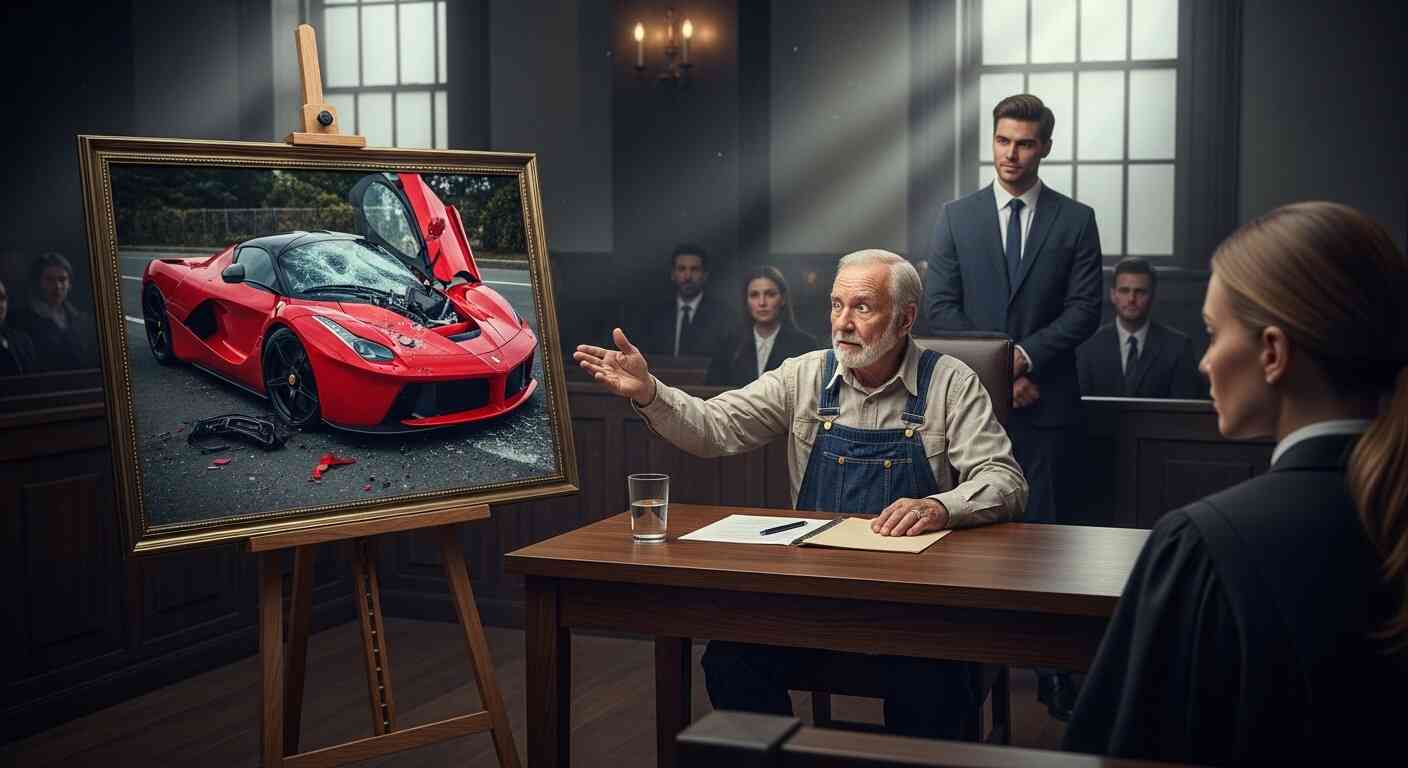
Six months later, the trial of Mark Reynolds and Sarah Jenkins became a local sensation. The “Supercar Sabotage” case, as the media called it, highlighted the growing tension between entitled youth and the “silent” working class.
The defense tried to argue that the video was a deepfake, that Julian Vance had manufactured the evidence to avoid paying out Arthur’s pension. It was a desperate, ugly tactic.
Arthur took the stand on the final day of the trial. He didn’t wear a suit. He wore a simple button-down shirt and slacks. He looked exactly like what he was: a man who had worked hard his entire life and expected nothing in return.
The defense attorney paced in front of him. “Mr. Miller, isn’t it true that you felt resentful toward these young, successful mechanics? Isn’t it true you were bitter about your position in the company?”
Arthur looked at the attorney, then past him to Mark, who was sitting at the defense table. Mark looked different now—haggard, his designer clothes replaced by a cheap suit that didn’t fit. For a moment, Arthur felt a flicker of pity.
“I wasn’t bitter,” Arthur said, his voice steady and clear. “I was disappointed.”
“Disappointed in what?”
“In the idea that because I had a broom in my hand, I had no value,” Arthur said. “I’ve spent fifty years building things, fixing things, and protecting things. Mark and Sarah saw a man who was ‘old’ and assumed I was ‘finished.’ They thought my silence was weakness. But in my world, silence is where you learn how things actually work.”
He looked directly at Mark. “You didn’t just break a car that night, son. You broke the trust of the people who were trying to teach you. And that’s a lot harder to repair than carbon fiber.”
The jury reached a verdict in less than an hour. Guilty on all counts.
As Arthur walked out of the courthouse, the sun was bright and the Michigan air was crisp. Elena was waiting for him, her eyes beaming with pride. She hugged him tight, and for the first time in a long time, Arthur didn’t feel the ache in his ribs.
“Ready to go home, Dad?” she asked.
“Not yet,” Arthur said. “I have one more thing to do.”
He drove the blue Mustang back to the Vance headquarters. He didn’t go to the executive offices. He went to the basement, to the maintenance closet where his old gear was still stored.
He found his old, battered lunch pail. He opened it and pulled out a small, silver wrench—the first tool his father had given him when he was twelve years old.
He walked out to the main garage bay. A young man, barely twenty, was mopping the floor near the entrance. He looked tired, his shoulders slumped as the high-powered executives walked past him without a second glance.
Arthur stopped beside him.
“You missed a spot by the drain,” Arthur said kindly.
The young man looked up, startled. “Oh, sorry, sir. I’ll get it right away.”
Arthur reached out and handed him the silver wrench.
“Keep it,” Arthur said. “And remember something. Every person in this building, from the CEO to the guy who empties the trash, is part of the same engine. If one part thinks it’s more important than the rest, the whole thing eventually breaks.”
The young man looked at the wrench, then back at Arthur. “Who are you?”
Arthur smiled, a cinematic, heartfelt glint in his eyes as he turned toward the exit where Julian was waiting.
“I’m just the guy who knows where the cameras are,” Arthur said.
He walked out into the light, leaving the past behind, knowing that justice hadn’t just been served—it had been engineered.
The true value of a man isn’t found in what he owns, but in what he’s willing to protect when no one thinks he’s looking.