Chapter 1: The Sound of Falling Kings
The silence in the Grand Ballroom of the St. Regis wasn’t the peaceful kind. It was the heavy, suffocating silence of a hundred people holding their breath, waiting for a heart to stop.
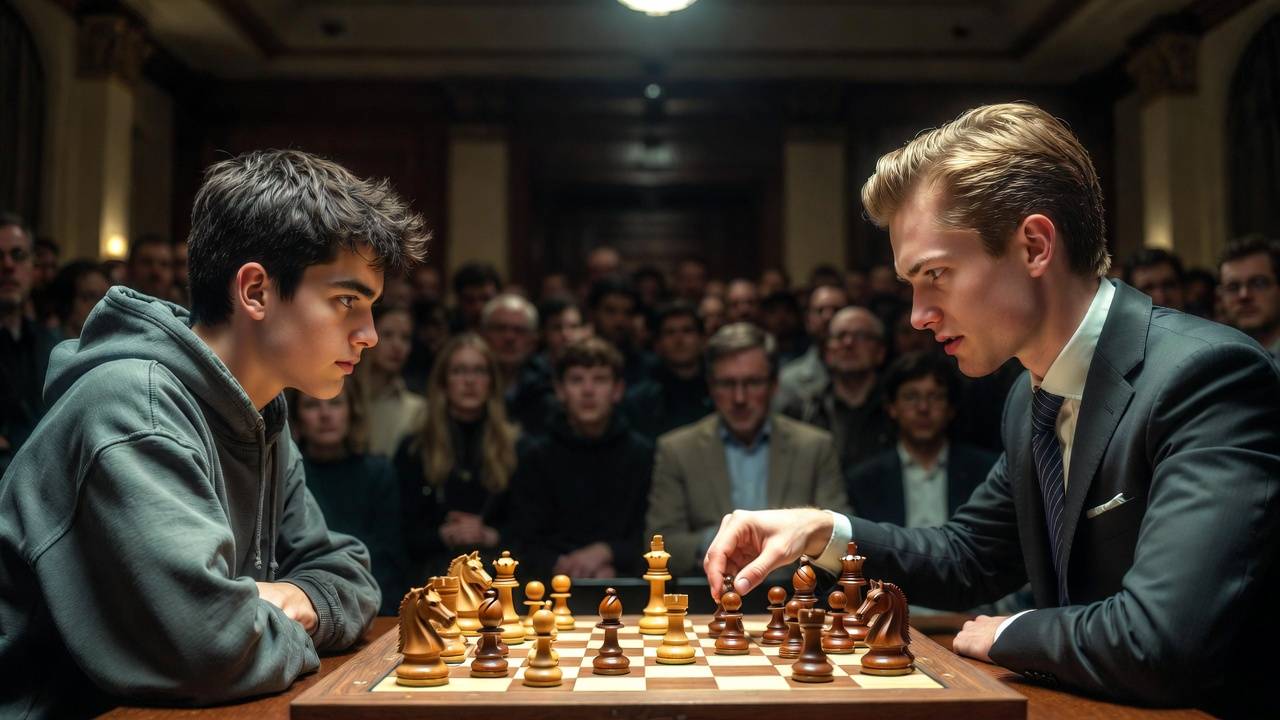
I could smell the expensive cologne wafting off Julian Vane—something that cost more than my foster mother’s monthly rent. I could see the way his fingers twitched over his ivory bishop. He was the “Prince of the Chess World,” the three-time National Champion, and the boy whose face was currently appearing on every sports broadcast from New York to Los Angeles.
And I was just Leo. The kid in the $12 thrift store hoodie. The kid who had spent the last eight hours dismantling his empire, piece by piece.
“Your move, Julian,” I said softly. My voice didn’t shake. I’d learned how to stop shaking years ago in the back of a social worker’s Corolla.
Julian’s face went from pale to a dangerous, mottled red. His eyes darted across the board, searching for an escape that didn’t exist. I had him. In three moves, his King would have nowhere to run. The “Golden Boy” was about to lose to a ghost.
Then, the world exploded.
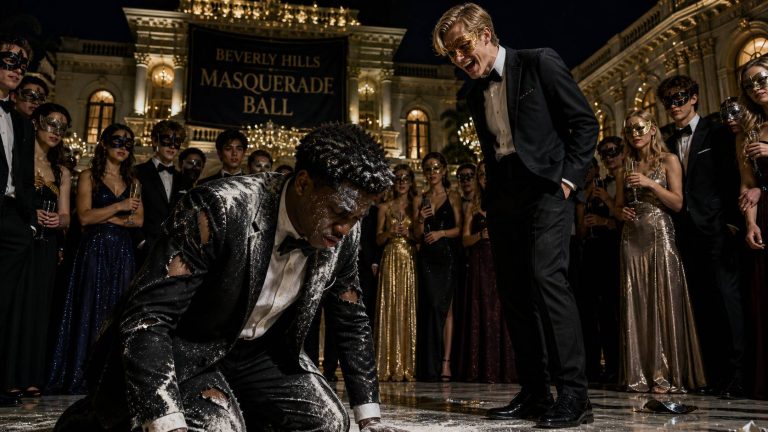
With a roar of pure, unadulterated rage, Julian stood up. His chair screeched against the polished hardwood like a dying animal. He didn’t just resign. He reached out and swept his arm across the board with a violent, jagged motion.
The sound was horrific. Hand-carved ebony and ivory pieces—sets that had been in the tournament’s history for fifty years—clattered across the floor. They bounced off the legs of the spectators and rolled under the heavy velvet curtains.
The crowd gasped. I heard a woman in the front row let out a small, muffled cry.
Julian leaned over the table, his face inches from mine. His breath smelled like expensive peppermint and entitlement.
“You think this matters?” he hissed, his voice carrying through the silent hall. “You think winning a game makes us equals? Look at you, Vance. You’re a charity case. You’re a footnote in a story about people who actually matter.”
He reached into his pocket, pulled out a gold-plated money clip, and tossed a hundred-dollar bill onto the empty table. It fluttered like a wounded bird before settling on the wood where my Queen should have been.
“Buy yourself a soul,” Julian sneered. “You win at chess, but in life, money delivers the checkmate. And people like me? We own the board.”
He turned on his heel, expecting me to crumble. He expected me to look at the floor, to be humiliated by the mess he’d made, to realize my place in the American hierarchy.
But I didn’t look down.
I looked at the doorway at the back of the room. I looked at the tall man in the charcoal suit who had been standing there since the first clock started ticking. Arthur Sterling—a man whose net worth could buy Julian’s father’s hedge fund and still have enough left over to purchase the city of Philadelphia.
Arthur didn’t move. He just gave me a nearly imperceptible nod.
I reached into my hoodie pocket and pulled out the one piece I’d palmed during the chaos—my black Queen.
“Julian,” I called out.
The Grandmaster stopped and looked back, a bored, cruel expression on his face.
“You forgot something,” I said.
The room watched, paralyzed, as I walked to the center of the empty table and placed the Queen down with a sharp, definitive thud. My eyes never left his.
“I don’t need your hundred dollars. I already own the bank.”
Read the full story in the comments.
If you don’t see the new chapter, tap ‘All comments’.
FULL STORY
Chapter 2: The Boy Who Wasn’t There
To understand why Julian Vane hated me, you have to understand the geography of privilege in America. Julian was born on the right side of the glass. He was the product of elite coaching, private tutors, and a family tree that looked like a list of Ivy League donors.
I was born in a storm.
My earliest memory wasn’t a chess board; it was the smell of damp cardboard and the sound of my mother’s coughing in a studio apartment in Akron, Ohio. By the time I was seven, she was gone, and I was a ward of the state. I became “the quiet kid” in the back of the classroom. I was the boy people looked through, not at.
I discovered chess in a community center basement because it was the only place that was warm in January. The instructor, a grizzled veteran named Miller, saw me watching a game through the window for three days before he finally opened the door.
“You want to play, kid? Or are you planning on burning a hole in the glass with your eyes?”
I didn’t tell him that I’d already memorized every move of the game I’d been watching. I didn’t tell him that I could see the board in my head when I closed my eyes at night—a perfect, logical grid where everything had a place and every move had a consequence. In the foster system, life was chaos. In chess, life was math.
I spent the next ten years climbing. Not through social circles, but through the rankings. I played in park tournaments against old men who smelled of tobacco and regret. I played in online blitz matches until my eyes bled. I won because I had to. If I lost, I was just a foster kid with nothing. If I won, I was a player.
Julian Vane entered my orbit when I was sixteen. We were the same age, but we lived in different universes. He was the face of American chess—the handsome, articulate prodigy who spoke to reporters about “the geometry of the soul.”
I was the “unaffiliated” player who showed up to regionals on a Greyhound bus with a backpack full of peanut butter sandwiches.
The first time we played, in a small qualifier in Chicago, Julian didn’t even look at me. He spent the entire match checking his watch and whispering to his father, a man with a jawline like a hatchet and a heart to match. When I forced a draw against him, Julian didn’t shake my hand. He wiped his palm on his trousers as if I’d left a stain on him.
“Lucky break, kid,” he’d said then. “Don’t let it go to your head.”
But I hadn’t been lucky. I had been patient. I had spent that year studying him like a scientist studies a virus. I knew his weaknesses. I knew that Julian Vane was brilliant when he was winning, but brittle when he was challenged. He didn’t know how to bleed.
And now, a year later, at the National Finals, I had finally made him bleed in front of the entire world.
As Julian stood there in the St. Regis, staring at my black Queen on the empty table, the “brittleness” I’d sensed a year ago began to shatter. The crowd was still whispering, the sound like dry leaves skittering across pavement.
“What are you talking about?” Julian sneered, though his voice lacked its previous venom. “You own the bank? You’re wearing a hoodie that looks like it was used to mop a garage floor.”
I didn’t answer him. I didn’t have to.
From the back of the room, the clicking of polished leather shoes on the hardwood floor began to drown out the whispers. The crowd parted like the Red Sea.
Arthur Sterling didn’t look like a billionaire. He looked like an architect of reality. He was sixty, with silver hair and eyes that seemed to record everything they touched. He stopped beside me, placing a hand on my shoulder. It was the first time in my life I’d felt a hand on my shoulder that didn’t feel like it was trying to push me away.
“Is there a problem here, Leo?” Arthur asked. His voice was quiet, but it had the weight of a mountain.
Julian’s father, Robert Vane, came rushing forward, his face a mask of practiced corporate sycophancy. “Mr. Sterling! I—I didn’t realize you were attending the youth finals. We’re so honored.”
Arthur didn’t even look at Robert. He kept his eyes on Julian. “I asked if there was a problem. It seems your son has a difficult time with the concept of sportsmanship. And property.”
“It was a heated moment,” Robert stammered, grabbing Julian’s arm and squeezing it hard. “The pressure of the finals… surely you understand.”
“I understand pressure,” Arthur said coldly. “What I don’t understand is why your son thinks a hundred dollars covers the cost of disrespecting my heir.”
The word hit the room like a physical blow. Heir.
Julian’s jaw dropped. Robert Vane turned a shade of gray that matched the carpet.
“Your… heir?” Julian whispered.
Arthur looked down at me, and for a second, the iron in his eyes softened into something that looked like pride. “Leo Vance is the most brilliant mind I have encountered in thirty years of tech development. And as of three months ago, he is legally my son.”
I looked at Julian. The boy who thought money was the ultimate checkmate. I watched the realization sink in—that the “peasant” he had just insulted now held the leash to his father’s future.
“The game isn’t over, Julian,” I said, my voice low and steady. “I can recreate every piece on this board from memory. I know exactly where we were. I know exactly how I was going to beat you.”
I leaned in, mimicking the way he had hovered over me moments before.
“Would you like to finish the match? Or should we just let the world know you’re a coward as well as a loser?”
Chapter 3: The Reconstruction
The Tournament Director, Sarah Miller, stepped forward. She was a sharp-featured woman who had seen a thousand chess matches, but never one that looked like a Shakespearean tragedy. She looked at the scattered pieces, then at Arthur Sterling, then at me.
“Leo,” she said, her voice trembling slightly. “The rules state that if a board is disrupted by a player in a fit of emotion, the game is forfeited. Julian has already lost.”
“No,” I said, my eyes still locked on Julian’s. “I don’t want a win by default. I want him to see it.”
Julian was shaking now. Not with rage, but with the sudden, cold terror of a boy who had realized the floor beneath him was actually a trapdoor. His father was whispering frantically in his ear, probably telling him to apologize, to grovel, to do anything to salvage the Sterling connection.
“I… I can’t,” Julian stuttered. “The pieces… we don’t know where they were.”
“I do,” I said.
I turned to the crowd. “Does anyone have a camera? A recording of the last ten minutes?”
A dozen phones went up.
“I don’t need them,” I said, turning back to the table. “Julian, sit down.”
It wasn’t a request. It was an order. Slowly, like a man walking toward a firing squad, Julian Vane sat.
I began to walk around the room. I picked up a white knight from under a chair. I found a black pawn near the buffet table. I gathered them in the hem of my hoodie. The crowd was silent, following my every move. They weren’t just spectators anymore; they were witnesses to a ritual.
I walked back to the table and began to place the pieces.
Clack. White King to G1.
Clack. Black Rook to D8.
Clack. White Bishop to F4.
One by one, the board reappeared. I didn’t hesitate. I didn’t second-guess. I moved with a terrifying, mechanical precision. Every piece went back to its exact coordinate, down to the slight tilt of the knights.
When I was finished, the board was exactly as it had been thirty seconds before Julian had destroyed it. The tension in the room was so thick you could have cut it with a clock-hand.
“It’s your move, Julian,” I said. “You have one minute and twelve seconds left on your clock. I have four minutes. You’re down a knight, and my Queen is threatening your back line. What’s it going to be?”
Julian looked at the board. He looked at the pieces he had tried to erase. He looked at the Queen I had held in my pocket—the piece that had survived his tantrum.
He reached out a trembling hand. He touched his Rook. He moved it to E1. A defensive move. A desperate move.
I didn’t even sit down. I reached over the table and moved my Bishop.
“Check,” I said.
Julian’s eyes widened. He hadn’t seen it. He had been so focused on the Queen that he’d forgotten the Bishop I’d tucked away in the corner of the board three moves ago.
He moved his King.
I moved my Knight.
“Check.”
He was breathing hard now, the sound loud in the silent hall. He moved his King again, trapped in the corner of his own making.
I picked up my Queen. The one I’d kept. I placed it directly in front of his King.
“Checkmate.”
The total time since we’d resumed? Three seconds.
Julian stared at the board. The “Golden Boy” looked like he had aged twenty years in three minutes. He didn’t scream. He didn’t sweep the board again. He just sat there, staring at the little ivory king that had nowhere left to go.
The room erupted. It wasn’t just applause; it was a roar of catharsis. The “Third Party”—the hundreds of people who had spent the day watching a rich kid bully a poor one—were finally free to cheer. They weren’t just cheering for a chess win. They were cheering for the moment the world finally made sense.
But I wasn’t looking at them. I was looking at Arthur.
He wasn’t cheering. He was just smiling—a small, private smile that said everything I’d ever wanted to hear. You did it, son.
Chapter 4: The Price of a Soul
The aftermath was a blur of flashbulbs and frantic questions. Reporters who had been waiting to interview Julian Vane were now swarming around me like sharks.
“Leo! How does it feel to be the new National Champion?”
“Is it true you were living in a group home just six months ago?”
“Mr. Sterling, can you comment on the adoption?”
Arthur handled them with the grace of a man who had been navigating the press since before I was born. He kept a protective arm around me, ushering me toward the exit.
“My son will give a full statement when he’s ready,” Arthur told them, his voice firm. “Right now, we have a dinner to attend.”
As we reached the heavy oak doors of the ballroom, I felt a hand grab my sleeve. I turned to see Robert Vane. His face was slick with sweat, his eyes darting around the hallway to see if anyone was watching.
“Mr. Sterling… Arthur, please,” Robert hissed. “About the merger… about the venture capital for Vane Holdings. Surely what happened in there doesn’t change the business fundamentals. Julian is a kid. He was under stress.”
Arthur stopped. He turned slowly, and the air around us seemed to drop ten degrees.
“Robert,” Arthur said, his voice dangerously soft. “You told me once that the most important thing in business is recognizing a bad investment before it drains your accounts.”
Robert nodded frantically. “Yes, exactly!”
“Well,” Arthur said, glancing at me and then back at Robert. “I’ve just realized that investing in a family that treats people like disposable pawns is a very bad investment indeed. My lawyers will be in touch tomorrow. We’re pulling out of the merger. All of it.”
Robert’s face went white. “Arthur, you can’t! That’s sixty percent of our operating capital! You’ll ruin us!”
“Money delivers the checkmate, Robert,” I said, repeating Julian’s words back to his father. “Isn’t that what your son said?”
We walked out of the St. Regis and into the crisp, cool air of a New York evening. A black SUV was waiting at the curb. The driver opened the door, and for the first time in my life, I didn’t feel like I was stepping into someone else’s world. I felt like I was stepping into mine.
As we pulled away from the curb, I looked out the window and saw Julian Vane standing on the sidewalk. He was alone. His father was still inside, likely begging for his financial life. Julian’s expensive suit was rumpled, and he was clutching his runner-up trophy as if it were a life preserver.
He looked small. For the first time, he didn’t look like a prince. He just looked like a boy who had never been told “no.”
“You okay, Leo?” Arthur asked, leaning back in the leather seat.
I looked down at my hands. They were finally still.
“I spent my whole life thinking that if I just won enough games, people would finally see me,” I said. “But you saw me before I ever won a trophy, Arthur. Why?”
Arthur looked out at the city lights. “Because I knew your mother, Leo. Briefly. A long time ago. She was the smartest woman I ever met, and she had the same fire in her eyes that you do. She didn’t have the luck you have, or the resources. But she had the soul.”
He turned to me, his expression earnest. “I didn’t adopt you because you’re a genius, Leo. I adopted you because you’re hers. The chess? That’s just the language you use to tell the world you’re here.”
I felt a lump in my throat that no amount of victory could swallow. I realized then that the “The Game of Thrones” wasn’t played on a wooden board with ivory pieces. It was played in the quiet moments between people who cared. It was played in the decision to stand up for someone who had nothing.
“I think I’m ready to go home,” I said.