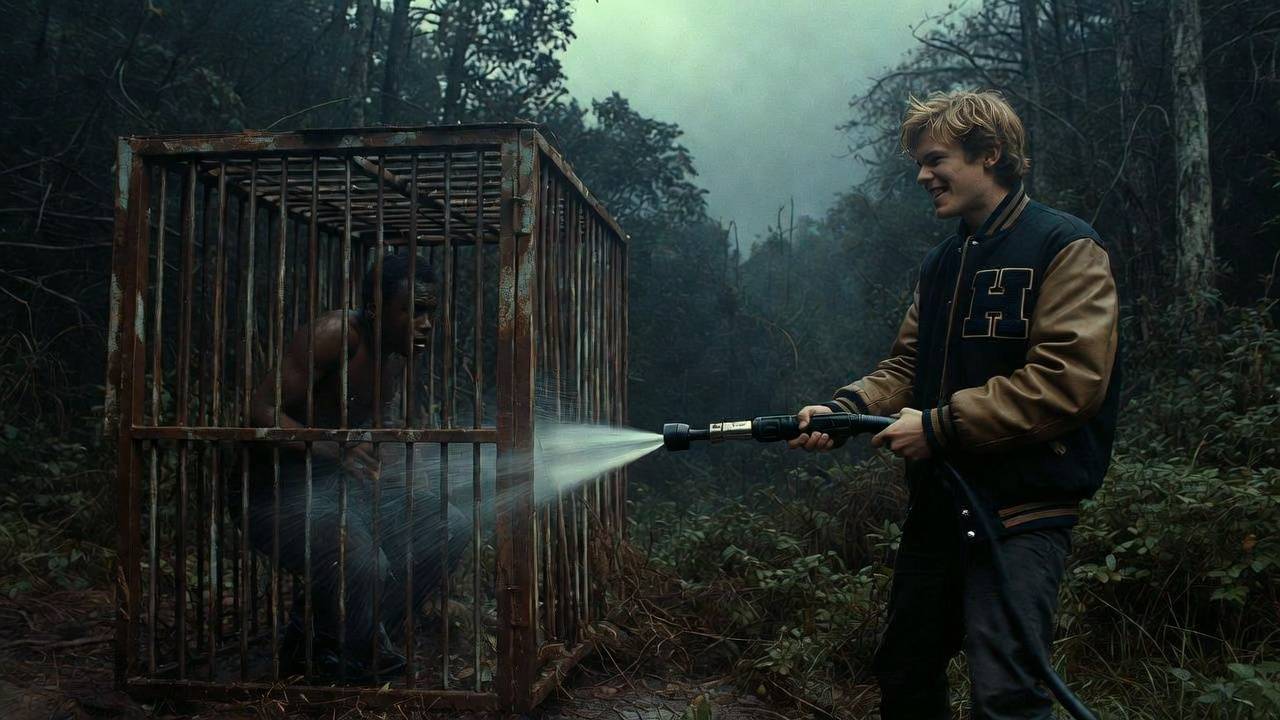
CHAPTER 1: THE CAGE
The iron bars of the kennel didn’t smell like rust. They smelled like old blood and forgotten things.
I sat in the mud, the cold Oregon dampness seeping through my jeans, watching Miller’s designer sneakers stop just inches from the gate. Above us, the Douglas firs groaned under the weight of a sky that had turned the color of a fresh bruise.
“Comfortable, Elias?” Miller asked. He didn’t wait for an answer. He never did.
Behind him stood the “Crowd.” That’s what I called them. The twenty other kids from the Purge Camp who watched everything and did nothing. They were a sea of expensive North Face jackets and carefully coiffed hair, their faces a mask of “better him than me.”
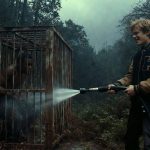
Miller reached for the industrial hose attached to the side of the kennel block. He turned the brass nozzle with a slow, deliberate twist.
“You’ve been acting real quiet lately,” Miller said, his voice dropping to a low, jagged edge. “Like you think you’re better than us. Like your daddy being a survivalist makes you some kind of king of the woods.”
The first blast of water hit me square in the chest. It was ice-cold, straight from the mountain runoff. It knocked the air out of my lungs, a physical punch that sent me reeling back against the cage wall.
“Learn to adapt to nature,” Miller sneered, the spray misting around his head like a halo of spite. “You’re just a wild animal anyway.”
I didn’t scream. I didn’t beg. My father had taught me three things before he died: Watch the wind, find the weakness, and never let them see you shiver.
I gripped the bars, my knuckles turning ashen. I looked past the water, past the spray, and straight into Miller’s eyes. He wanted to see a beast. He wanted to see a broken boy.
But as the wind picked up, carrying the scent of ozone and the promise of a localized supercell storm, I felt something shift inside me. I wasn’t just a boy in a cage anymore. I was a part of the woods. And the woods were about to wake up.
I saw Caleb, Miller’s right-hand man, shift uncomfortably in the back. He looked at the darkening horizon, then back at me. He knew what a storm like this could do to a camp built on a slope. But he said nothing. He just tightened the hood of his jacket.
“The rain’s coming, Miller,” I whispered, though my voice was drowned out by the hiss of the hose.
He didn’t hear me. He was too busy laughing. He didn’t notice that while he was spraying me, my fingers were busy. I wasn’t just holding the bars. I was feeling the tension in the hinges. I was feeling the way the cage moved.
Most importantly, I was looking at their tents—those $500 North Face shelters lined up perfectly in the clearing. They looked sturdy. They looked safe.
They weren’t.
Read the full story in the comments.
If you don’t see the new chapter, tap ‘All comments’.
FULL STORY
CHAPTER 2: THE ECHO OF SILENCE
The crowd eventually dispersed when the first heavy drops of real rain began to fall. Miller tossed the hose aside, leaving it to snake across the mud like a discarded skin. He gave the kennel one last kick—a jarring clang that vibrated through my teeth—and walked away, flanked by his laughing lieutenants.
Silence returned to the clearing, but it wasn’t the peaceful silence of the forest. It was the heavy, suffocating silence of human indifference.
I watched them go. I watched Sarah, the junior counselor who had a “Human Rights” sticker on her water bottle, turn her back and head toward the main cabin. She didn’t look back. None of them did. To them, I was a temporary inconvenience, a role played in a ritual they didn’t have the courage to stop.
My father used to call this “The Crowd’s Blindness.” He told me that in the wild, animals either help or they hunt. Humans are the only creatures that can watch a member of their own kind drown and worry about getting their shoes wet.
I waited until the camp lights flickered on, casting long, sickly yellow shadows across the mud. The temperature was dropping fast. In Oregon, a spring storm isn’t just rain; it’s a predatory cold that hunts for any exposed skin.
My hands were shaking, but not from fear. It was the onset of mild hypothermia. I reached into the hidden pocket of my cargo pants—a pocket I’d sewn in myself. My fingers found the small, jagged piece of flint I’d picked up during the morning hike.
I didn’t need to pick the lock. Miller was arrogant, but he wasn’t stupid; the lock was a heavy-duty Master Lock. However, the kennel was old. The wood frame it was bolted to had been rotting for years, hidden under layers of cheap green paint.
I began to scrape.
The sound was tiny, lost in the rising howl of the wind. I worked with the precision of a man who had spent his childhood carving bow-drills and skinning rabbits. Every stroke of the flint took a sliver of rotted cedar away.
As I worked, I thought about Marcus. Marcus was the only kid who had tried to share his trail mix with me on the first day. He was currently sitting in the mess hall, probably staring at his plate, feeling the weight of the cage in his gut. He was a good kid, but he was weak. He was a victim of his own kindness, paralyzed by the fear that if he spoke up, he’d be in the cage next to me.
I didn’t blame him. In a world of predators and prey, the “Third Party” was just the environment. And I knew how to use the environment.
The bolt finally gave way. The wood crumbled like damp cake. I pushed the gate, and it swung open with a mournful groan.
I stepped out into the rain. The wind whipped my wet shirt against my skin, but I didn’t feel the cold anymore. I felt the focus. I felt the “Mountain Code” humming in my blood.
Miller and his crew were in the main cabin, probably playing cards and bragging about their “dominance.” Their tents were empty, standing like a row of white teeth in the dark.
It was time to pull them.
CHAPTER 3: THE CODE OF THE MOUNTAIN
My father was a man of few words and many scars. He’d been a Search and Rescue lead for twenty years before the mountains finally took his knees and his health. He didn’t teach me how to play baseball or how to talk to girls. He taught me how to read the clouds.
“Elias,” he’d say, pointing to the way the pine needles turned upward before a gale. “Nature isn’t cruel. It’s just honest. It has no ego. It doesn’t care if you’re rich or if you’re poor. It only cares if you’re prepared.”
The Purge Camp was supposed to be a “leadership retreat” for elite high schoolers. But without the structure of the city, it had quickly devolved into a primitive hierarchy. Miller was at the top because his father donated the most to the school board. I was at the bottom because I didn’t fit the aesthetic.
I moved through the camp like a ghost. My father had taught me the “fox walk”—landing on the outer edge of the foot and rolling inward to dampen the sound of snapping twigs.
I reached Miller’s tent first. It was a high-end dome tent, held down by heavy-duty aluminum stakes. To the untrained eye, it looked impenetrable.
But I saw the flaw. The soil here was heavy with clay. When it got wet, it became slick, losing its grip on anything shallow.
I didn’t pull the stakes. That would be too obvious. Instead, I used my flint to fray the tension cords just enough. Under the weight of a normal breeze, they would hold. But when the gusts hit forty miles per hour—as the darkening cumulonimbus clouds promised they would—the fibers would snap one by one.
I moved to Caleb’s tent. Then the others. I wasn’t being cruel; I was being an equalizer.
“Why are you doing this, Elias?”
I froze. A figure stood in the shadows of the mess hall porch. It was Marcus. He was wrapped in a thick wool blanket, his eyes wide and watery.
“They’re going to kill you if they catch you,” he whispered, his voice trembling.
I looked at him. I saw the pain in his face—the pain of a bystander who hated himself for his own silence.
“They already tried to kill the person I was,” I said softly. “Now they’re just going to meet the person I am.”
“Let me help,” Marcus said, stepping into the rain.
I shook my head. “Go back inside, Marcus. Stay by the fire. This isn’t your fight. You’re part of the crowd, remember? Just keep watching.”
It was the meanest thing I’d ever said to him, but it was necessary. If he helped me, he’d be an outcast forever. If he stayed silent, he was just another face in the forest.
He looked at me for a long beat, the shame visible even in the dark. Then he turned and walked back into the warmth.
I finished the last tent. The wind was screaming now, a high-pitched whistle through the pines. The first true crack of lightning split the sky, illuminating the camp in a strobe-light flash of silver.
I retreated to the edge of the woods, finding a natural hollow beneath a fallen cedar. I built a small, invisible fire—a “Scout’s fire”—shielded by the trunk and the earth. I stripped off my wet shirt, wrung it out, and began the slow process of warming my core.
I was safe. I was warm.
The bullies, however, were about to find out what happens when you treat the world like your playground.
CHAPTER 4: THE COLLAPSE
The storm hit at midnight with the force of a freight train.
From my vantage point, I watched the camp transform into a theater of chaos. The “Purge Camp” sign was the first thing to go, ripped from its moorings and sent tumbling into the ravine.
Then came the screams.
It started with Miller’s tent. Just as I’d calculated, the frayed cords snapped under a massive gust. The wind caught the rain-fly like a sail, ripping the aluminum stakes out of the slick clay. In seconds, the $500 sanctuary was nothing more than a wet, flapping corpse of nylon.
Miller tumbled out into the mud, dressed only in his silk boxers. He looked small. He looked pathetic.
One by one, the other tents followed. The “elite” leaders of the next generation were suddenly standing in a deluge, their expensive gear scattered across the woods, their sleeping bags soaking up the freezing runoff like sponges.
They ran for the main cabin, but the door was locked from the inside. The head counselor, a man who loved “discipline” until it applied to him, had barricaded himself in with the staff, fearing the falling limbs of the old-growth trees.
The Rule of the Third Party was in full effect. The kids who still had tents didn’t open their flaps to let the others in. They zipped themselves tight, listening to their friends scream in the dark, praying the wind wouldn’t find them next.
I sat in my hollow, the small fire reflecting in my eyes. I felt a strange sense of peace. For the first time in three weeks, the hierarchy was gone. There was no “Ghostwriter,” no “Master Concept Creator,” no “Black boy in a cage.” There was only the cold.
I saw Miller huddled under the eaves of the mess hall, his skin turning a sickly blue-grey. He was shivering violently—the “uncontrolled shiver” that signals the body is losing the war.
Caleb was crying, a raw, ugly sound that the wind tore to pieces.
They weren’t “animals” now. They were just children who had forgotten that the world doesn’t owe them a roof.
I stood up. I didn’t have to. I could have stayed in my warm hollow and watched them freeze. That would have been the logical conclusion. That would have been the “eye for an eye” that the movies promised.
But I remembered my father’s face when he’d rescued a hiker who had spent three days in a crevasse. The hiker had been a jerk—a man who had ignored every warning sign.
“Why’d you save him, Pop?” I’d asked.
“Because the mountain doesn’t have a heart, Elias,” he’d said. “So we have to bring our own.”
I grabbed a bundle of dry kindling I’d stashed and a heavy emergency blanket I’d liberated from the supply shed earlier.
I stepped out of the shadows.