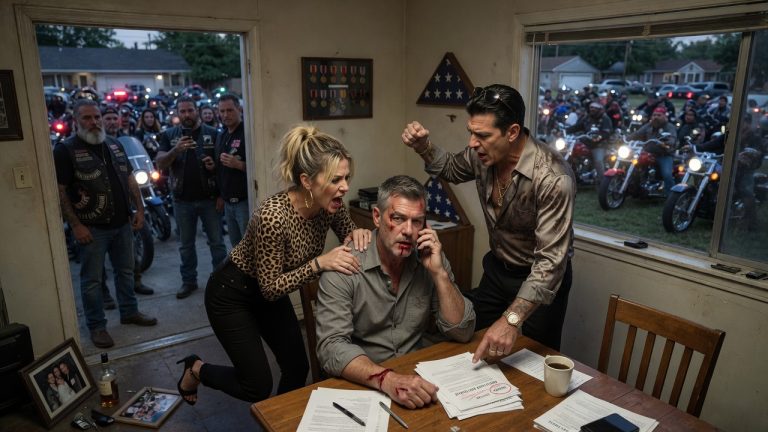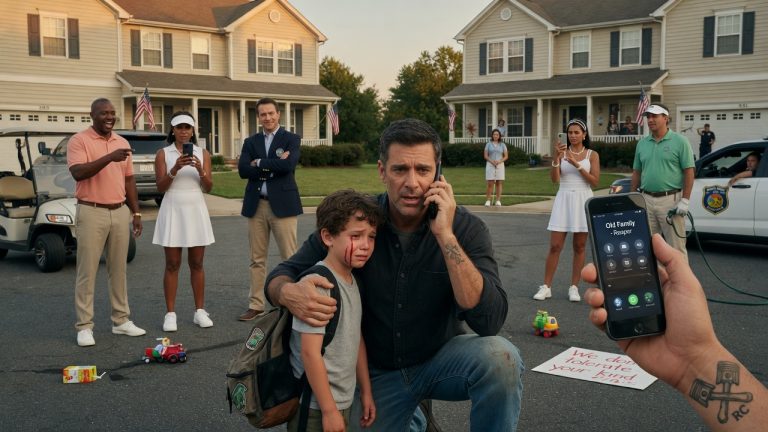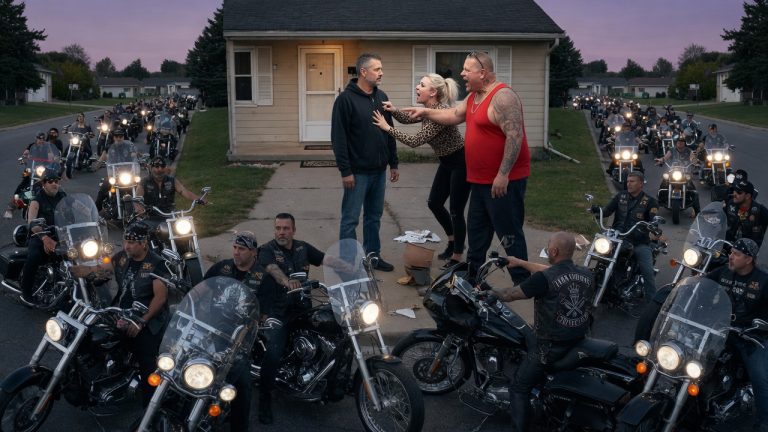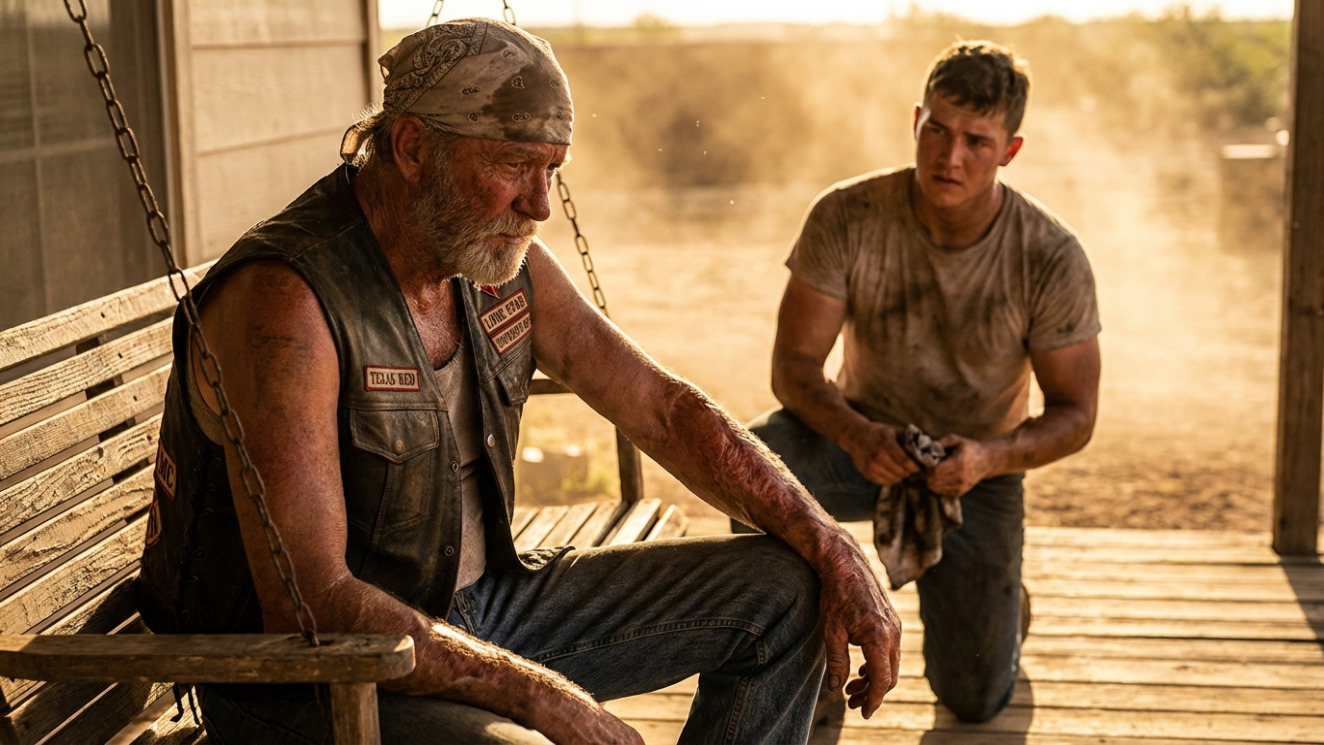
“Texas” Red didn’t lead five hundred bikers through a wall of flame because he was brave. He did it because he was the one who lit the match.
For twenty years, he’s lived as a legend in the scorched plains of West Texas. He has the scars to prove his “heroism,” and a son who worships the ground he rides on. But the man he framed for the crime is back, broken and dying, and the MC is looking for blood to protect their brother.
An insurance investigator is closing in. The club is arming up. And Red is realizing that the only way to save an innocent man is to kill the legend of the father his son loves.
.
Chapter 1
The Texas heat doesn’t care about your history. It just sits on your skin like a wet wool blanket, pulling the salt out of you until you’re nothing but grit and bad temper. Red sat on the porch of the Lone Star Garage, watching the asphalt shimmer.
His left arm felt tight. It always felt tight when the humidity dropped. The skin there wasn’t really skin anymore; it was a patchwork of shiny, fused tissue that looked like melted wax. He’d earned those scars twenty years ago, on the night the sky turned orange and the mesquite trees exploded like Roman candles.
“You okay, Pop?” Junior asked, stepping out of the garage. He was wiping grease onto a rag that had seen better decades. At nineteen, Junior was all shoulders and jawline, the kind of kid who looked like he belonged on a recruitment poster.
“Fine,” Red said, his voice a low rasp. “Just the weather.”
“Smokey called. The boys are meeting at the Crossroads at six. They want you leading the formation for the anniversary ride. Five hundred bikes, Pop. Everyone’s coming out for the man who saved the club.”
Red looked at his son. He saw the pride there, thick and unearned. It felt like a stone in his throat. He wanted to tell the boy to go inside, to stop looking at him like he was some kind of saint in a leather vest. Instead, he just nodded and reached for his Luckies.
FULL STORY
Chapter 1
The morning of the twentieth anniversary of the Great Fire started like every other day in Odessa: with the smell of sulfur and the sound of an engine that didn’t want to turn over. Red sat on the edge of his cot, the springs groaning under his weight. He didn’t turn on the light. He didn’t need to. He knew the geography of his own body by touch alone.
He reached back with his right hand to rub the puckered skin of his left shoulder. The scars started at his jawline, a jagged red shoreline that moved down his neck, over his chest, and down the entirety of his left arm. In the dark, they felt like a topographical map of a country he never wanted to visit again. The doctors had called it a miracle. The club called it “The Mark.”
Red called it a bill he hadn’t finished paying.
He stood up, pulled on a gray undershirt, and then a heavy denim work shirt. Even in the hundred-degree heat of a West Texas July, Red wore long sleeves. He wasn’t hiding the scars from the world—everyone in three counties knew what he looked like—he was hiding them from himself. If he couldn’t see the shiny, hairless skin, he could almost pretend he was the man he used to be. The man who wasn’t afraid of a flickering pilot light.
In the kitchen, his son, Junior, was already moving. The kid was a mirror image of Red at twenty, before the fire took the softness out of his face. Junior was humming a country tune, flipping eggs in a pan that had lost its Teflon coating years ago.
“Big day, Pop,” Junior said, not looking back. “Smokey says the contingent from El Paso is already at the county line. They’re saying this might be the biggest turnout yet. People want to ride with the man who beat the Devil.”
“It was just a fire, Junior,” Red said, sitting at the small, Formica-topped table. “Trees and wind. Don’t make it more than it was.”
“Five hundred men would’ve been cinders if you hadn’t found that creek bed,” Junior countered, sliding a plate of eggs and greasy bacon in front of him. “You led ’em through a literal wall of flame. Don’t act like you just took a wrong turn at a stoplight. You’re the reason I have a father. You’re the reason Smokey has a club.”
Red picked up his fork. The eggs were runny, just the way he liked them, but he suddenly didn’t have an appetite. Every word out of Junior’s mouth felt like a lash. The “Hero of the Great Fire” was a title Red wore like a noose. He had been the Sergeant-at-Arms back then, a thirty-year-old hothead with a fast bike and a faster temper. He had been responsible for the club’s business, and that night, the business had been dirty.
“Eat,” Junior urged. “We gotta be at the garage by eight. The news crew from Midland is supposed to be there.”
“I told Smokey no press,” Red snapped, his voice cracking.
Junior held up his hands in a defensive gesture. “Hey, don’t bark at me. You know how Smokey is. He says the club needs the good PR. Since that shootout in Waco, the cops have been crawling up everyone’s tailpipes. He thinks if they see the community loves you, they’ll back off the MC.”
Red pushed the plate away. He stood up and went to the window. Outside, the plains stretched out, flat and unforgiving. Twenty years ago, he’d stood on a similar patch of dirt, twenty miles north of here. He’d been trying to burn a ledger—a record of a stolen parts ring that would’ve put half the club in Huntsville for life. He’d picked a night with a high wind, thinking the fire would stay small and contained in a trash barrel.
He’d been wrong. A spark had caught a patch of dry buffalo grass. Within ten minutes, the horizon was screaming. By the time he realized he couldn’t stop it, the fire was a monster, moving faster than a man could run. The club had been camped out for a rally three miles downwind. He’d ridden into the camp, screaming for everyone to mount up. He hadn’t been leading them through the fire out of bravery; he’d been leading them because he knew where the fire had started and which way the wind was pushing the death he’d created.
“Pop?” Junior’s voice broke through the memory. “You with me?”
“Yeah,” Red said, turning back. “I’m with you. Let’s go to the shop.”
The Lone Star Garage was a corrugated metal building on the edge of town, smelling of burnt oil and old cigarettes. When they pulled up in Red’s rusted F-150, there were already twenty bikes lined up out front. The chrome was polished so bright it hurt to look at.
Smokey was there, leaning against a customized Road King. He was seventy now, his beard a stained yellow-white, but his eyes were still sharp as tacks. He walked over and clapped a hand on Red’s good shoulder.
“The man of the hour,” Smokey boomed. “You ready to lead the pack, Red?”
“I’d rather just work on that shovelhead in the back, Smokey. You know I don’t like the parade.”
“It ain’t a parade, it’s a pilgrimage,” Smokey said, his voice dropping to a more serious register. “Half these younger guys joined because they heard the story of Texas Red. You’re the backbone of this chapter. Don’t let ’em down.”
Red looked past Smokey. A man was standing across the street, leaning against a nondescript silver sedan. He was wearing a cheap, off-the-rack suit and sunglasses that didn’t fit his face. He wasn’t a cop—Red knew the look of an Odessa cop. This guy looked like an accountant who had lost his way to a funeral.
“Who’s the suit?” Red asked.
Smokey glanced over and spat a stream of tobacco juice into the dust. “Don’t know. Been hanging around for two days. Asked a few questions at the bar last night about the fire. I told him to move along, but he seems real interested in history.”
Red felt a cold prickle at the base of his neck. “What kind of questions?”
“Questions about the point of origin,” Smokey said, shrugging. “Wanted to know if I remembered where you came from that night before you hit the camp. I told him I was too busy not dying to check your GPS.”
Red forced a laugh, but it sounded hollow in his ears. He walked toward the garage door, his boots crunching on the gravel. As he passed the suit, the man didn’t move. He just watched Red.
“Mr. Callahan?” the man called out.
Red stopped. He didn’t turn around. Only people who wanted something called him “Mr. Callahan.” To everyone else, he was Red.
“Who’s asking?” Red said.
The man walked closer. Up close, he smelled like peppermint and starch. He pulled out a business card. Arthur Vance. Senior Investigator, Lone Star Mutual & Casualty.
“I’m looking into some old claims,” Vance said. His voice was flat, professional. “Claims that were settled twenty years ago. There’s some new technology—satellite thermal mapping from back then that’s finally been declassified and digitized. It’s interesting stuff.”
Red finally turned. He kept his expression neutral, the way he’d learned to do when the feds came around. “The fire was twenty years ago, Mr. Vance. The insurance company paid out. People moved on.”
“Most people did,” Vance agreed. He adjusted his glasses. “But Danny Miller didn’t. He spent twenty years in a state facility because the fire started on his property, and the witness testimony—specifically yours—suggested he was burning brush in a high wind.”
“He was,” Red said, his heart hammering against his ribs.
“See, that’s the thing,” Vance said, leaning in. “The new mapping shows the fire didn’t start at the brush pile behind Miller’s shack. It started about a quarter-mile east. Right where an old service road ends. A road that led straight back to this garage.”
Red didn’t blink. He couldn’t afford to. “Fires jump, Vance. You know that. Wind picks up a coal, carries it. That’s West Texas for you.”
“Maybe,” Vance said. He looked at Red’s scarred neck. “That’s a hell of a price to pay for a lie, Red. I’m just wondering if you’re tired of paying it.”
“I don’t know what you’re talking about,” Red said.
“I think you do,” Vance whispered. “I’ll see you at the Crossroads tonight. I want to see the hero in action.”
Vance turned and walked back to his car. Red stood there, the sun beating down on his head, feeling the ghost of the heat from twenty years ago. He looked over at Junior, who was laughing with Smokey, showing off a new set of handlebars.
The boy looked so happy. He looked so proud.
Red reached into his pocket and felt the small, charred matchbook he’d kept in a tin box in his dresser for two decades. He’d taken it from the crime scene before the fire consumed the evidence. He didn’t know why he’d kept it. Maybe as a penance. Maybe as a reminder of what he was capable of.
“Pop! Let’s go!” Junior shouted.
Red climbed onto his bike. He kicked the engine over, and the roar of the Harley filled the air, drowning out the sound of his own breathing. He shifted into first gear, his scarred hand gripping the clutch, and for a moment, he thought about just riding. Not to the Crossroads. Not to the anniversary. Just riding until the gas ran out and the desert swallowed him whole.
But he didn’t. He followed his son into the sun, the hero leading the way into the smoke.
Chapter 2
The Crossroads was a dusty intersection of two state highways that led to nowhere, marked only by a dilapidated gas station and a bar called The Rusty Bolt. By 5:00 PM, the sound was a physical weight. Five hundred motorcycles didn’t just make noise; they vibrated the earth. The air was thick with the scent of unburnt fuel and the blue haze of exhaust.
Red stood by his bike, his helmet resting on the seat. He felt the eyes on him. He always felt them. To the younger bikers, he was a legend, a man who had stared down the apocalypse and won. To the older ones, he was the reason they were still drawing breath.
“Check out the ink on that guy,” Junior whispered, nodding toward a biker from the San Antonio chapter who had a full mural of the Great Fire tattooed across his back. In the center of the tattoo was a figure on a bike, silhouette against a wall of orange, leading a line of riders.
It was Red. He was a piece of folk art now.
“It’s just skin, Junior,” Red said, his voice tight.
“It’s history, Pop. Own it.”
Red turned away. He needed a drink, but he knew if he started now, he wouldn’t stop until he was at the bottom of a bottle, and he couldn’t afford to be sloppy. Not with Vance lurking somewhere in the crowd.
He scanned the faces. He saw Smokey holding court, telling the story for the thousandth time. He saw the “Old Ladies” of the club setting up a barbecue pit. And then, he saw him.
A man was sitting on a rusted folding chair near the edge of the parking lot, tucked away in the shadow of a dumpster. He was thin—skeletal, really—with a face that looked like a crumpled paper bag. He was clutching a plastic cup of something clear, his hands shaking so violently that the ice rattled.
Danny Miller.
Red felt a surge of nausea. He hadn’t seen Miller in fifteen years, not since the man had been released from the psychiatric wing of the prison system. Miller hadn’t been a biker. He’d been a tinkerer, a guy who lived in a shack and fixed lawnmowers. He’d been the perfect scapegoat. He was quiet, he had no family, and he’d been drunk the night the fire started.
Red walked toward him, his boots heavy in the sand. He didn’t want to go, but he couldn’t stop himself. It was like a magnet was pulling at the metal in his soul.
Miller looked up as Red approached. His eyes were milky, unfocused. He squinted against the sun.
“Red?” Miller croaked. His voice sounded like dry leaves scraping on a sidewalk.
“Danny,” Red said. He stopped a few feet away. “What are you doing here?”
Miller let out a wet, rattling laugh. “Came for the show. See the big hero. See the man everyone loves.” He took a shaky sip of his drink. It smelled like the cheapest vodka money could buy. “I live in a trailer park three miles down the road. Hard to miss the noise.”
“You shouldn’t be here, Danny. The boys… they don’t have a high opinion of you.”
“Because of what you told ’em?” Miller’s eyes suddenly cleared, a flash of old, sharp pain cutting through the alcoholic fog. “Because you told the judge I was out there with a kerosene can? You told ’em I was ‘muttering to the trees’?”
“You were drunk, Danny. You didn’t know where you were.”
“I knew I wasn’t at the service road,” Miller whispered, leaning forward. “I knew I wasn’t burning evidence of a chop shop. I might be a drunk, Red, but I ain’t a liar. I spent twenty years being the ‘Madman of the Mesa.’ Twenty years because you didn’t want to go to jail for some stolen carburetors.”
Red looked around. No one was listening, but the air felt charged. “I saved those men, Danny.”
“You saved ’em from yourself!” Miller hissed. He tried to stand up, his knees buckling. Red reached out to catch him, but Miller shoved his hand away. “Don’t touch me with that meat. That burnt meat. You think those scars make you a martyr? They’re just the fire trying to take back what belongs to it.”
“Hey!”
Red turned. Junior was standing ten feet away, his face flushed with anger. He’d seen the interaction, though he couldn’t have heard the words.
“What’s this guy’s problem, Pop?” Junior stepped between Red and Miller, his chest puffed out. He looked at Miller with pure, unadulterated disgust. “Is this the guy? The one who started it?”
Red felt the world tilting. “Junior, back off. He’s just a drunk.”
“He’s the guy who tried to kill you,” Junior said, his voice rising. “He’s the reason you can’t go to the beach without a shirt. He’s the reason the club lost the old clubhouse.” Junior turned to Miller, his finger inches from the old man’s nose. “You’re lucky my old man is a better person than I am, old man. If it were up to me, I’d throw you back into the pit.”
“Junior, stop!” Red grabbed his son’s arm, pulling him back.
Miller looked at Junior, then at Red. A slow, terrifying smile spread across his face. “He doesn’t know, does he? The little prince doesn’t know his daddy is a thief and a coward.”
Junior lunged, but Red held him firm. The strength in Red’s scarred arm was surprising, a product of years of wrenching on heavy machinery.
“Get out of here, Danny,” Red said, his voice low and dangerous. “Go. Now.”
Miller picked up his cup and shuffled away, his shoulders hunched. He didn’t look back.
“Why didn’t you let me hit him?” Junior demanded, shaking off Red’s grip. “He insulted you. He insulted the club.”
“Because he’s nothing,” Red said, his heart cold. “He’s a ghost. You don’t fight ghosts.”
“Smokey says we should’ve handled him years ago,” Junior muttered. “He says the only reason that guy is still breathing is because you’re too soft.”
Red didn’t answer. He walked back to the formation, his head throbbing. He saw Vance standing near the gas pumps, watching the whole scene. Vance raised a soda bottle in a mock toast.
The ride began shortly after. Red took his place at the front, with Smokey on his right and Junior on his left. The roar of five hundred engines drowned out the world. As they pulled out onto the highway, the sun began to set, painting the sky in the same terrifying shades of orange and red that had haunted Red’s dreams for two decades.
They rode through the plains, the wind whipping past them. This was the route the fire had taken. On either side of the road, the mesquite was still stunted, the earth still bearing the faint, charred memory of the heat.
Red looked in his rearview mirror. A sea of headlights followed him. Five hundred men, all believing a lie. Five hundred men who would kill for him, because they thought he had nearly died for them.
He felt the matchbook in his pocket. It felt heavy, like lead.
They reached the memorial site—a simple stone plinth in the middle of a blackened field where the old clubhouse had stood. The riders dismounted in silence. The only sound was the clicking of cooling engines.
Smokey stepped forward, holding a ceremonial torch. “Twenty years ago,” he began, his voice carrying over the flat land. “A man showed us what brotherhood means. He didn’t run. He didn’t hide. He rode into the mouth of hell and pulled us out.”
Red stood at the front, his head bowed. He felt the heat of the torch. He felt the weight of five hundred gazes.
And then he saw something that made his blood freeze.
In the back of the crowd, Miller had appeared again. He’d followed them. But he wasn’t alone. Two of the younger club prospects were standing on either side of him, gripping his arms. They looked like they were waiting for a signal.
Red looked at Smokey. Smokey wasn’t looking at the crowd. He was looking at Red, a grim, knowing expression on his face.
“We heard some talk today,” Smokey said, his voice dropping. “Talk from a man who’s been slandering our brother. Talk from a man who says the fire wasn’t an accident. We think it’s time to settle the debt, Red. Once and for all.”
The crowd shifted. A path opened up. The prospects dragged Miller toward the center of the circle, toward the stone plinth. Miller was crying now, his legs dragging in the dirt.
“Tell us, Red,” Smokey said, handing him the torch. “Is this the man who tried to burn us alive? Give the word, and we’ll give him the same mercy he gave the trees.”
Red looked at the torch. He looked at Miller, who was staring at him with wide, terrified eyes. And then he looked at Junior.
Junior was nodding, his face hard with the misplaced righteousness of the young. “Do it, Pop. Finish it.”
Red’s hand shook. The fire in the torch danced, reflecting in his eyes. He could end it here. He could let them take Miller. Miller was a drunk, a man with no one. The world would forget him in a week. The lie would be sealed in blood, and Red would be a hero forever.
His thumb brushed the scarred skin of his palm.
“I can’t,” Red whispered.
“What was that?” Smokey asked.
“I said I can’t,” Red said louder, his voice cracking.
He looked at the sea of faces, all waiting for the legend to act. He looked at the investigator, Vance, who was standing at the very edge of the light, waiting for the truth to finally break cover.
Chapter 3
The silence that followed Red’s words was more oppressive than the roar of the engines had been. It was the kind of silence that precedes a storm—heavy, thick with the scent of ozone and expectation.
Smokey narrowed his eyes, the torchlight flickering in his pupils. “What do you mean, you can’t, Red? The man is a cancer. He’s been eating at the reputation of this club for twenty years. You’re the one who saw him. You’re the one who gave the statement.”
Red looked at Miller. The old man was slumped in the grip of the prospects, his chin on his chest, sobbing quietly. He looked small. He looked like what he was: a man whose life had been subtracted from him, day by day, for two decades.
“Let him go,” Red said. His voice was steadier now, though his heart was a panicked bird in his chest.
“Pop, what are you doing?” Junior stepped forward, his brow furrowed in confusion. “This is the guy. This is the one who hurt you.”
Red didn’t look at his son. He couldn’t. If he looked at Junior, he’d see the pedestal crumbling, and he wasn’t ready for that. Not yet. “I said let him go, Smokey. He’s an old man. He’s drunk. He doesn’t know what he’s saying.”
Smokey didn’t budge. “He knows exactly what he’s saying. He’s saying you lied. He’s saying the club is built on a fraud. That ain’t something we just walk away from, Red. Not in this MC. Not ever.”
One of the prospects, a kid named Jax who was trying too hard to be tough, tightened his grip on Miller’s arm. “Give the word, Red. We got a gallon of 91 octane in the truck. We can make it poetic.”
“You touch him,” Red said, stepping toward Jax, “and you’ll be the one bleeding in the dirt. You understand me?”
The tension spiked. The club members looked at each other, confused. The hierarchy was being challenged by the man who sat at the top of it. Smokey stepped between Red and the prospect, his face inches from Red’s.
“You’re acting strange, brother,” Smokey whispered. “Is there something you want to tell me? Something that suit in the silver car told you?”
“The suit is an investigator, Smokey. He’s got tech. Satellite stuff. He knows where the fire started.”
Smokey’s expression didn’t change. He didn’t look surprised. He just looked tired. “I don’t care about satellites, Red. I care about the club. I care about the five hundred men who follow that patch on your back. If you let this drunk cast doubt on you, you’re casting doubt on all of us.”
“It’s not doubt if it’s the truth,” Red said.
The words hung in the air like a death sentence. Smokey stared at him for a long beat, then slowly reached out and took the torch back from Red’s hand.
“Take him to the clubhouse,” Smokey ordered the prospects. “Both of ’em. Red and Miller. We’re gonna have a table meeting. Now.”
The ride back to the clubhouse was different. The formation was jagged, the riders whispering among themselves. Red was flanked by Smokey and two of the older board members. Junior rode behind them, his head down, his bike trailing smoke.
The clubhouse was a converted warehouse on the outskirts of town, surrounded by a chain-link fence topped with concertina wire. It was a fortress of secrets. They went into the back room—the “Church”—a space with a long oak table and a single hanging lightbulb.
Miller was pushed into a corner, where he collapsed onto a stack of tires. Red sat at the head of the table, his scarred arm resting on the wood. Smokey sat opposite him. Junior stood by the door, acting as a guard, though his eyes were fixed on his father.
“Talk,” Smokey said.
Red looked at the walls. They were covered in photos of the club’s history. There were photos of the rally twenty years ago—men laughing, holding beers, unaware that the world was about to burn.
“I was burning the ledger,” Red said. His voice was flat, devoid of emotion. “The one from the chop shop in Midland. The feds were sniffing around, and I didn’t want the trail leading back here. I thought I could do it quick. But the wind… the wind in West Texas doesn’t play fair.”
Junior made a small, choked sound. Red ignored it. He had to finish.
“A spark jumped the barrel. It hit the grass. I tried to stomp it out, but my boots caught. That’s how I got the leg scars. By the time I got to my bike, the whole ridge was lit. I knew if I admitted it, the arson investigators would find the remains of the ledger. They’d find the parts. The club would be over. Everyone would go down for the theft and the fire.”
He looked at Miller. “So I rode to Miller’s place. I knew he was passed out. I moved the barrel near his shack, then I rode to the camp and played the hero.”
“You lied for twenty years,” Junior whispered from the door. “You let me grow up thinking… you let me tell everyone my dad was a god.”
Red finally looked at his son. The disappointment in the boy’s eyes was worse than the fire had been. It was a cold, soul-deep rejection. “I did it to save the club, Junior. If I hadn’t, half these guys would still be in prison.”
“Don’t wrap your cowardice in the patch, Red,” Smokey said. His voice was quiet, which was worse than if he’d been screaming. “You didn’t do it for us. You did it because you were scared of a cell. You let this man rot in a psych ward so you could have a parade every year.”
“I took care of him!” Red shouted, slamming his good hand on the table. “Who do you think has been leaving envelopes of cash at his trailer for fifteen years? Who do you think paid his medical bills when his liver started failing? I’ve been paying for that night every single day!”
“With money you made from the club,” Smokey countered. “Money you earned because of the legend. You’ve been paying a debt with stolen coins, Red.”
Miller looked up from the tires. He wasn’t crying anymore. He looked almost peaceful. “It wasn’t the prison that killed me, Red. It was the look on people’s faces. The way they looked at me like I was a monster. I used to fix their mowers. I used to wave at ’em at the grocery store. Then, overnight, I was the man who tried to kill five hundred people. You didn’t just take my time. You took my name.”
The door to the Church opened. Vance stepped in. He looked out of place in his cheap suit, but he carried an authority that no one in the room could match.
“I believe I have enough for a statement now,” Vance said, holding up a small digital recorder.
Smokey stood up, his hand going to the knife on his belt. “You’re a long way from home, suit. This is club business.”
“It’s insurance business,” Vance said, unfazed. “And it’s state business. Mr. Callahan, if you sign a confession, the company will waive the civil suits against the MC. We’ll go after you personally for the restitution, but the club stays clear. If you don’t… well, I’ve got enough evidence to trigger a RICO investigation into the entire chapter’s history, starting with that chop shop you mentioned.”
The room went cold. The “brotherhood” was a powerful thing, but it had its limits. Every man at that table was thinking about his own freedom.
Smokey looked at Red. There was no love in his eyes now. Only the cold calculation of a leader protecting his herd. “He’s right, Red. You started this fire. You’re the one who has to put it out.”
Red looked at the paper Vance placed on the table. He looked at the pen. Then he looked at Junior.
“Junior,” Red said.
“Don’t,” the boy said. He opened the door and walked out into the night. The sound of his bike starting up a moment later felt like a shot to the heart.
Red picked up the pen. His scarred hand was shaking, the skin tight and pulling at his knuckles. He thought about the twenty years of being a hero. He thought about the parades, the tattoos, the respect. It had all been smoke.
He signed his name.
Chapter 4
The aftermath of a confession isn’t like the movies. There are no dramatic handcuffs in the moonlight, no swelling music. There was just the sound of Vance’s car driving away and the heavy, metallic smell of the clubhouse.
Smokey didn’t say a word. He walked to the wall and took down the framed photo of Red leading the ride. He didn’t break it. He just laid it face down on the table.
“You have until sunrise to get your things out of the garage,” Smokey said. “The patch stays. The bike stays. It was bought with club funds.”
“I built that bike from a frame, Smokey,” Red said, his voice dead.
“With stolen parts and club money,” Smokey replied. “You’re lucky we’re letting you walk out of here at all. If it weren’t for the fact that you actually did lead us out of the fire—even if you started it—you’d be buried in the mesa tonight. Now get out.”
Red stood up. His legs felt like lead. He looked at Miller, who was still sitting on the tires.
“Come on, Danny,” Red said. “I’ll give you a ride home.”
“I’ll walk,” Miller said. He stood up, shaky but upright. He looked at Red with something that might have been pity. “I’ve been walking in the dark for a long time. I’m used to it.”
Red walked out of the clubhouse. The parking lot was full of bikers, but as he passed, they turned their backs. It was a silent wall of leather and denim. He saw his truck, the old F-150, parked near the gate. He climbed in and sat there for a long time, his forehead resting on the steering wheel.
He went to the garage first. He didn’t have much there—just a few personal tools, an old leather jacket that didn’t have the club colors, and a cardboard box of records. He worked in the dim light of a single bulb, the silence of the shop echoing in his ears.
He found the tin box in the back of a drawer. He opened it. Inside was the matchbook, charred and brittle. He looked at it for a long time, then he took out a lighter and set it on fire. He watched it curl into ash on the concrete floor.
“I guess you’re happy now,” a voice said from the shadows.
Red turned. Junior was sitting on a workbench in the back, a bottle of beer in his hand. He looked like he’d been crying, though he was trying to hide it behind a mask of indifference.
“I’m not happy, Junior,” Red said. “I’m tired.”
“You lied to me my whole life,” Junior said. “Every time I got into a fight, every time I tried to be ‘tough’ like you, I was trying to live up to a guy who didn’t exist.”
“I’m still your father, Junior. That part wasn’t a lie.”
“Wasn’t it?” Junior stood up, his voice rising. “You taught me that the patch was everything. You taught me that honor was about protecting your brothers. But you were just protecting yourself. You let that old man rot. You let me hate him.”
“I was trying to keep us together,” Red said. He walked toward his son, but Junior backed away.
“You kept us in a lie,” Junior said. “I’m going with Smokey. He says I can stay at the clubhouse. He says I can start my prospect year early.”
Red felt a cold dread. “Don’t do that, Junior. This life… it isn’t what you think it is. You saw what they did tonight. They turned on me in a heartbeat.”
“They turned on a liar,” Junior snapped. “I’m not a liar. I’m going to be the man you pretended to be.”
Junior walked past him, his shoulder clipping Red’s. He didn’t look back.
Red spent the rest of the night driving. He drove past the old service road. He drove past the trailer park where Miller lived. He ended up at the edge of the mesa, where the Great Fire had finally been stopped by a shift in the wind and a sudden, violent rainstorm.
He got out of the truck and stood at the edge of the blackened earth. The moon was high and bright, illuminating the scars of the land. It had been twenty years, but the earth didn’t forget. The trees were still twisted, the soil still thin.
He sat on the tailgate of his truck and waited for the sun.
When it finally crested the horizon, it wasn’t orange and terrifying. It was a pale, dusty yellow. Red felt the heat start to build again, the familiar pull of the Texas sun. He reached up and touched the scars on his neck. They didn’t feel like a mark of heroism anymore. They just felt like old skin.
His phone buzzed in his pocket. It was a text from an unknown number.
Miller passed away this morning. Heart failure. He died in his sleep. He had your confession in his hand. – Vance.
Red closed his eyes. He felt a strange, hollow sense of relief. Miller was gone, but he’d gone out knowing the truth. It wasn’t enough to make up for twenty years, but it was all Red had left to give.
He started the truck and headed back toward town. He didn’t know where he was going. He didn’t have a job, he didn’t have a club, and he didn’t have a son. He was just a man with a scarred arm and a tank of gas.
He passed the Rusty Bolt. The parking lot was empty, save for a few stray pieces of trash blowing in the wind. The anniversary was over. The legend was dead.
As he drove, he saw a young man on a bike on the shoulder of the road. It was Junior. He was pulled over, his helmet off, staring at a map. He looked lost.
Red slowed down. He considered pulling over. He considered trying one more time to explain, to apologize, to tell the boy that the world wasn’t as simple as patches and fire.
But he didn’t. He knew Junior had to find his own way through the smoke.
Red stepped on the gas and kept driving, leaving the ghosts of the mesa behind him, moving toward a future that was finally, painfully, his own.