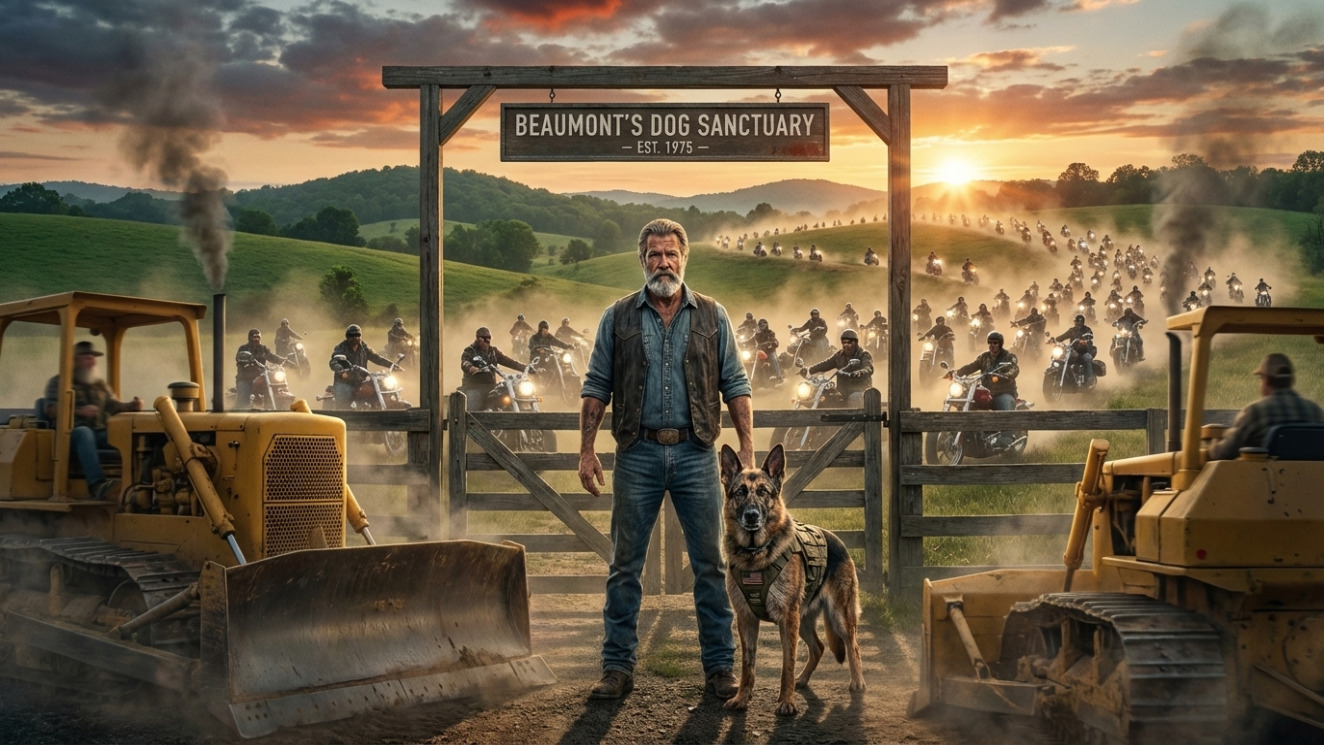
Bo Beaumont didn’t want a fight. He just wanted a quiet place for old dogs to die.
In the hills of Kentucky, Bo spent his days cleaning kennels and tending to “Ranger,” the German Shepherd that had survived a blast in Kandahar that Bo’s own sergeant hadn’t. The sanctuary was his penance for the lives he couldn’t save—both in the war and during his years as an enforcer for the Iron Horse MC.
But the world doesn’t let men like Bo stay quiet. When a fracking company discovers what’s under his soil, and a corrupt Sheriff signs the warrant to bulldoze the sanctuary, Bo is backed into a corner.
He has two choices: Let the law take the land and uncover the secret buried beneath the barn—a secret that would put his old brothers in federal prison—or call for the one kind of help that doesn’t use a courtroom.
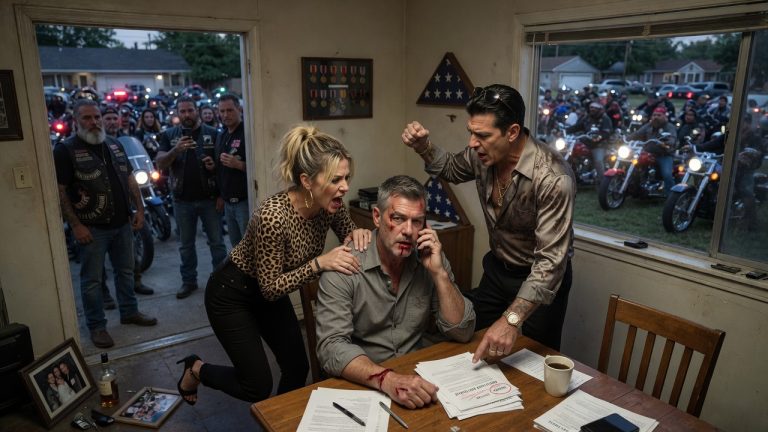
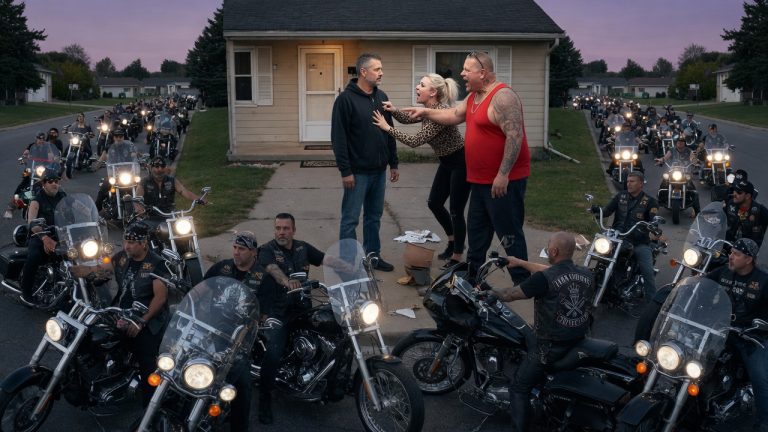
As the bulldozers idle at the gate, the hills begin to shake. Not from the machines, but from the arrival of five hundred men who remember what Bo Beaumont did for them.
FULL STORY
Chapter 1
The mud in Owsley County doesn’t just stick; it claims. It gets into the treads of your boots, the wheel wells of your truck, and the cracks of your skin until you’re the same color as the Kentucky hills. Bo Beaumont stood on his porch, watching the rain turn his gravel driveway into a soup of red clay and limestone.
Beside him, Ranger gave a low, wet cough. The German Shepherd’s back legs were failing, the hips clicking like a faulty transmission every time he tried to shift his weight. Bo reached down, his hand—nearly the size of a dinner plate—resting gently on the dog’s skull.
“Easy, old man,” Bo murmured. “Ground’s just soft today. That’s all.”
Bo was a big man, the kind of big that made people in town look twice and then quickly look away. He wore a canvas work coat stained with grease and dog hair, and his beard was a thick, unruly thicket of salt and pepper. He looked like a man who had spent his life breaking things, which was true enough, though for the last five years, he’d been trying to mend them.
The sanctuary, Beaumont’s Rest, was home to twelve dogs. All of them were “retired”—a polite word for broken. Some were K9s from police departments that couldn’t afford the vet bills for aging animals; others were service dogs whose owners had passed away. Ranger was different. Ranger had been in the sandbox. He’d seen the same dust Bo had, smelled the same copper tang of blood in the heat, and carried the weight of a dead sergeant on his conscience.
The sound of an engine broke the morning quiet. It wasn’t the rhythmic thrum of a bike—the sound Bo still heard in his dreams—but the high-pitched whine of a late-model SUV.
A black Chevy Tahoe pulled into the drive, its tires spinning for a second before catching the gravel. It stopped twenty feet from the porch. The driver’s side door opened, and Sheriff Miller stepped out. He was a man who took his uniform too seriously, the creases in his tan shirt sharp enough to cut paper.
“Bo,” Miller said, nodding. He didn’t come closer. He stayed by the Tahoe, one hand resting habitually near his belt.
“Sheriff,” Bo replied. He didn’t move. He didn’t offer coffee. He just stood there like a piece of the architecture.
“You got my message? The one I left with the girl at the vet clinic?”
“Suzy told me you called. I didn’t see the point in calling back.”
Miller sighed, a sound of practiced frustration. “Look, I know you’re attached to this place. But the county council signed off on the easement. Global Energy needs that access road, Bo. It’s not just about your forty acres. It’s about the jobs they’re bringing to the valley.”
“Jobs,” Bo said, the word tasting like ash. “You mean the three guys they’ll hire to guard the gate while they poison the well water?”
“Don’t start with the politics. I’ve got a court order. They’re moving the equipment in on Thursday. That’s forty-eight hours, Bo. You need to have these animals moved.”
Ranger let out a low growl, a vibration that started deep in his chest. Bo didn’t silence him.
“Moved where, Wayne? These dogs have terminal hip dysplasia, heartworms, and PTSD. You want me to put ’em in the county shelter? They’ll be dead by Friday night.”
Miller looked at his boots. “That ain’t my problem. My problem is executing a legal warrant. If you’re still here when the dozers arrive, I’m gonna have to arrest you for obstruction. And then the dogs go to animal control anyway. Use your head.”
“My head is fine,” Bo said. “It’s my memory that’s the problem. I remember you when you were just a deputy taking kickbacks from the strip mines. Now you’re taking ’em from the gas companies. Seems like the only thing that changes in this county is the name on the check.”
Miller’s face flushed a deep, angry red. He took a step forward, then stopped when Ranger’s lips pulled back to show yellowed, blunt teeth.
“Thursday morning, Bo,” the Sheriff said, his voice dropping an octave. “Six A.M. Have ’em gone, or I’ll have ’em cleared.”
He got back in the Tahoe and backed out of the drive too fast, spraying red mud against Bo’s mailbox.
Bo watched the taillights disappear into the mist. He felt the familiar itch in his hands, the one that used to only be satisfied by a throttle or a heavy wrench. He looked down at Ranger.
“He thinks it’s just about the land,” Bo whispered.
He looked past the kennels, toward the old tobacco barn that sat on the edge of the woods. The barn was leaning to the left, its grey slats weathered by a century of Kentucky winters. Underneath that barn, buried three feet deep in a plastic-lined hole, was a crate. It was a crate Bo hadn’t touched since the night he’d ridden away from the Iron Horse clubhouse in Louisville with blood on his vest and a hole in his soul.
If the fracking company brought in their heavy drills, they’d be tearing up the “Lower Forty” within a week. They’d find the crate. And inside that crate were six unregistered AR-15s, four silencers, and a ledger that detailed five years of “security” payments made to the club by every construction foreman from here to Lexington.
It wasn’t just Bo’s peace at stake. It was the lives of the only brothers he’d ever known. And the Iron Horse MC didn’t take kindly to brothers who left their laundry out for the feds to find.
Bo walked down the porch steps, his knees popping. He headed toward the barn. He needed to see if he could still dig.
Chapter 2
The vet clinic in Booneville smelled like floor wax and cheap coffee. Suzy, a woman in her late thirties with tired eyes and a permanent smudge of ink on her forearm, didn’t look up when the bell chimed.
“I’m out of the Rimadyl, Bo. The shipment didn’t come in from Lexington because of the washouts on Highway 11,” she said, her voice raspy from twenty years of cigarettes.
“I’m not here for the meds, Suzy. Well, I am, but that’s not the main thing.” Bo stood by the counter, feeling too large for the cramped waiting room. “Miller came by this morning.”
Suzy finally looked up, her expression softening. She’d been the one to help Bo set up the sanctuary. She was the only person who knew that the “gentle giant” was actually a man who’d spent a decade as a “Leg” for one of the most violent motorcycle clubs in the South. She also knew why he’d quit—because he’d seen a dog in a combat zone get treated better than the people his club was extorting.
“What did he say?”
“He’s coming Thursday. With dozers. He’s got the easement signed.”
Suzy leaned back, her chair squeaking. “He’s been in Miller’s pocket—the CEO of Global Energy, I mean. Guy named Marcus Reed. He’s been buying up the mineral rights like he’s playing Monopoly. He doesn’t care about a dozen dying dogs, Bo.”
“I can’t move them, Suzy. Toby’s got that infection, and Ranger… Ranger won’t make a trip in a crate. It’ll kill his heart.”
“Then what are you going to do? You can’t fight the county. They’ll throw you in a cell and let the machines do the work.”
Bo looked out the window at a rusted Ford truck idling in the lot. “I might have to make a call.”
Suzy’s face went pale. “No. Bo, don’t. You worked five years to get clear of them. You start owing them favors again, and you’re right back in the middle of it. They won’t just help you out of the goodness of their hearts.”
“I know,” Bo said. “But it’s not just about the dogs. There’s… stuff on that land. Stuff that belongs to the club. If Global Energy starts digging, the feds will be crawling all over Owsley County within forty-eight hours. I’m not the only one who loses if that happens.”
“Bo Beaumont,” Suzy said, her voice a warning. “Don’t you dare bring those people back here.”
Bo didn’t answer. He took the small bottle of antibiotics she pushed across the counter and walked out.
When he got back to the sanctuary, there was a motorcycle parked in his drive. It wasn’t a cruiser; it was a stripped-down, flat-black Dyna. Sitting on the porch steps was a man who looked like a younger, harder version of Bo. He wore a denim vest with the “Iron Horse” rocker on the back.
“K9,” Bo said, stopping at the base of the steps.
The younger man looked up and grinned, showing a chipped front tooth. “Hey, Big Bo. Heard you were having some trouble with the local law.”
“Word travels fast,” Bo said, his voice flat.
“Word travels at seventy-five miles per hour on the interstate,” K9 said, standing up. He was lean and wiry, his arms covered in tattoos of paw prints and barbed wire. He’d been the one Bo had mentored before leaving. K9 was the club’s resident animal lover—the only one who didn’t laugh when Bo started the sanctuary. “The President sent me. He says you left some property behind that needs protecting.”
“I didn’t leave it. I buried it.”
“Same thing in this weather. The club’s worried, Bo. That ledger… that’s a lot of names. Names that don’t like being in the news.”
“I’m not gonna let ’em dig, K9.”
“How you gonna stop ’em? You’re one man with a bunch of three-legged dogs. You need a presence. You need a wall.”
Bo looked at the barn. He could feel the weight of the secret under the floorboards. It was a poison he’d kept in the ground, hoping it would just dissolve over time. But secrets in Kentucky don’t dissolve; they just wait for the rain to wash away the topsoil.
“I’m not coming back to the club,” Bo said.
“Nobody’s asking you to,” K9 replied, though they both knew it was a lie. “We’re just saying… brotherhood is a two-way street. You keep our secrets, we keep your land. Simple math.”
“Nothing’s simple with you guys.”
K9 walked over to his bike and pulled a leather jacket from the sissy bar. He tossed it to Bo. It was Bo’s old club jacket. The “Enforcer” patch had been removed, but the “Original 13” remained.
“Wear it on Thursday,” K9 said. “Make ’em understand that they aren’t just messing with a dog-walker. They’re messing with the Horse.”
Bo caught the jacket. The leather was cold and smelled of old exhaust and stale tobacco. It felt heavy—heavier than it had five years ago.
“I’ll think about it,” Bo said.
“Don’t think too long,” K9 warned, kicking his bike to life. “Miller’s already got the state police on standby. He’s looking for a reason to break you, Bo. Don’t give him one he can use.”
As K9 roared out of the drive, Ranger came out of the house and stood by Bo’s leg. The dog sniffed the leather jacket and let out a short, sharp bark of disapproval.
“I know, Ranger,” Bo said, dropping the jacket on the porch rail. “I don’t like the smell of it either.”
Chapter 3
That night, the memory came back. It wasn’t a nightmare, exactly—just a clear, high-definition replay of a Tuesday afternoon in Kandahar.
Bo had been a Sergeant then, attached to a K9 unit. He wasn’t the handler; that was a kid named Miller (no relation to the Sheriff) who was barely twenty. The dog was a Belgian Malinois named Jax. They were clearing a compound on the edge of a poppy field.
Bo had seen the wire. He’d opened his mouth to shout, but the air was too thick with dust. Jax had stepped on the pressure plate. The blast hadn’t killed the dog instantly. It had just… broken him. Bo had stayed in the dirt for three hours, pinned down by sniper fire, watching Jax try to crawl back to his handler on two legs.
Bo had promised himself then that if he ever got home, he wouldn’t let anything die like that again. Not alone. Not in the dirt.
He woke up in his armchair with Ranger’s head resting on his knee. The house was cold. He got up and walked to the kitchen, his joints aching in the damp air. He checked his watch: 3:15 A.M.
He took a flashlight and headed out to the barn.
The floor of the tobacco barn was a mix of packed earth and rotting hay. Bo moved a stack of empty kibble bags and started to dig with a short-handled spade. His breath came in ragged huffs. The ground was hard beneath the surface mud, packed tight by decades of heavy equipment and stored leaf.
After an hour, the spade hit metal with a dull clack.
Bo cleared the dirt away with his hands. The crate was still there. He pried the lid open. The weapons were wrapped in oilcloth, looking as pristine and deadly as the day he’d put them there. Underneath the rifles was a leather-bound book—the ledger.
He opened it. His own handwriting stared back at him. Names of local contractors, dates, amounts. It was a map of every sin he’d committed in the name of “loyalty.”
“Looking for something?”
Bo spun around, his hand instinctively reaching for a rifle he hadn’t yet unwrapped.
Standing in the barn door was a man who didn’t belong in Owsley County. He was wearing a slim-fit navy suit and Italian leather shoes that were currently being ruined by the mud. He looked like he’d stepped off a private jet in Lexington and taken a wrong turn.
“You must be Marcus Reed,” Bo said, standing up and wiping his hands on his jeans. He kicked a tarp over the crate, but it was too late. The flashlight beam had already hit the steel.
“And you’re the man standing in the way of progress,” Reed said. His voice was smooth, educated, and entirely devoid of empathy. “I’ll be honest, Mr. Beaumont. I expected a fanatic. A PETA activist, maybe. Not an ex-con with a cache of illegal firearms.”
“You’re trespassing,” Bo said.
“Technically, I’m inspecting the easement my company just purchased from the county,” Reed countered. He stepped into the barn, unfazed by the smell of damp earth and rot. “I’m a businessman, Bo. I don’t care about your past. I don’t even care about those guns. But I do care about my schedule. Every day those dozers sit idle, it costs my investors eighty thousand dollars.”
“Then find another way around. There’s three hundred acres of scrub brush to the west.”
“The west has a geological fault line. Your land has the sweet spot. It’s simple geography.” Reed smiled, a flash of perfectly white teeth. “Here’s the deal. You move the dogs by tomorrow night, and I’ll personally donate fifty thousand dollars to a charity of your choice. You stay, and I’ll make sure the Sheriff brings a federal marshal when he serves that warrant. And we both know what happens when a man with your record is found sitting on a crate like that.”
Bo looked at the crate, then at Reed. “You think everything’s a commodity, don’t you? The land, the dogs, the people.”
“Everything is a commodity, Bo. Some things just have a higher price than others. What’s yours?”
Bo stepped closer. He was a head taller than Reed and a hundred pounds heavier. He could feel the old heat rising in his chest—the “Enforcer” wanting to come out and play.
“My price is peace,” Bo said. “And you can’t afford it.”
Reed didn’t flinch. “Forty-eight hours, Mr. Beaumont. After that, the price goes up. And the currency changes to years in a cage.”
Reed turned and walked out of the barn, his expensive shoes squelching in the mud.
Bo sat back down on the dirt floor. He looked at the ledger. He could burn it, but the guns were still there. The land was still under threat. He realized then that he couldn’t win this as a “gentle giant.” The world didn’t want the man he’d become; it wanted the man he used to be.
He reached into his pocket and pulled out the flip phone. He scrolled through the contacts until he found a number he hadn’t called in half a decade.
“Prez?” Bo said when the line picked up. “It’s Bo. I’m at the wall. I need the brothers.”
Chapter 4
Wednesday was the quiet before the storm. The air was heavy, the kind of stillness that precedes a tornado. Bo spent the morning moving the dogs into the main house. He didn’t want them in the kennels near the fence line where the noise of the machines would terrify them.
Suzy arrived around noon. She saw the look on Bo’s face and didn’t ask about the meds. She just started helping him move the orthopedic beds into the living room.
“You called them, didn’t you?” she asked, her voice tight.
“I didn’t have a choice, Suzy. Reed was here. He saw the crate.”
Suzy stopped, a bag of dog food in her arms. “He saw it? Bo, you’re dead. If the club finds out you let a civilian see that ledger…”
“They won’t find out from me. And Reed won’t say anything as long as he thinks he can use it as leverage. But once the dozers start moving, he’ll drop the dime to the feds just to clear the path.”
A tan cruiser pulled into the drive. It wasn’t the Sheriff’s Tahoe. It was a deputy’s car. A young man named Law got out. He was local, a boy Bo had seen grow up in the church pews before Bo had left for the army. Law was one of the few deputies who didn’t look at Bo like he was a ticking bomb.
“Bo,” Law said, walking up to the porch. He looked uncomfortable, his eyes darting toward Suzy. “I shouldn’t be here.”
“Then why are you?”
Law leaned against the porch rail, lowering his voice. “Miller’s planning to move early. He’s telling the press it’s for ‘safety reasons’ to avoid protesters. They’re coming at four A.M. tomorrow. And he’s bringing the riot squad from London.”
“Riot squad for a dozen dogs?” Suzy snapped.
“It ain’t about the dogs anymore,” Law said, looking at Bo. “The Sheriff knows you called the Horse. He’s got scouts out on the highway. He wants a confrontation, Bo. He wants to show the fracking company that he can ‘clean up’ the county. If blood spills, he’ll just say he was defending the law against a criminal gang.”
Bo nodded. He wasn’t surprised. Wayne Miller had always been more interested in the optics of power than the practice of justice.
“Thanks, Law,” Bo said. “You should get out of here. I don’t want you caught in the middle.”
“I’m already in the middle, Bo. I took an oath. But I also remember you pulling my dad out of that car wreck when I was ten. Just… don’t let it get ugly. Please.”
Law left, his tires crunching softly on the gravel.
Bo turned to Suzy. “You need to go, too. Take the medical records. If they arrest me, I need you to have the paperwork to get the dogs out of animal control.”
“I’m not leaving you, Bo.”
“Yes, you are. Because if you’re here, you’re an accomplice. I need someone on the outside who can talk to the press. Reed hates bad PR. That’s our only real weapon.”
Suzy looked like she wanted to argue, but she saw the finality in Bo’s eyes. She hugged him—a quick, fierce squeeze—and then loaded the files into her car.
As the sun began to dip behind the hills, the silence was broken.
It started as a low hum, like a swarm of bees in the distance. Then it grew into a rhythmic throb that Bo could feel in his teeth. It was the sound of a hundred V-twin engines, synchronized and relentless.
They came in a long, dark line, their headlights cutting through the dusk like a funeral procession for the law. K9 was in the lead, his black vest fluttering in the wind. Behind him were men from the Louisville chapter, the Lexington chapter, even a few from as far away as Nashville.
They didn’t stop at the house. They lined their bikes up along the fence line, wheel to wheel, facing the road. They didn’t get off their bikes. They just sat there, engines idling, a wall of leather and chrome.
K9 walked up to the porch. He wasn’t smiling today. He looked at Bo, who was now wearing his old club jacket.
“We got three hundred bikes on the way, Bo,” K9 said. “By midnight, we’ll have five hundred. We’re blocking the county road from both ends. No dozers get through unless they want to drive over a lot of expensive machinery.”
Bo looked at the wall of men. Some of them he recognized; others were new faces, young and hungry for a fight. He saw the way they looked at the house, at the dogs peering through the windows. They weren’t here for the dogs. They were here for the secret, and for the chance to spit in the eye of a system that had been trying to lock them up for years.
“No guns,” Bo said.
K9 paused. “Bo, they’re bringing the riot squad.”
“I said no guns. If a single shot is fired, the feds come in, and everyone in this line goes to the wall. We’re a wall, K9. Just a wall. We don’t move, and we don’t swing. We just exist.”
K9 spat a stream of tobacco juice into the mud. “Fine. No guns. But if they start swinging clubs, my boys aren’t gonna just sit there and take it.”
“Then tell them to hold the line,” Bo said. “That’s what brothers do, right?”
Bo walked out to the fence. He stood in the center of the line, his hand resting on the handlebars of K9’s bike. He looked out at the dark road, waiting for the first flicker of blue and red lights. He felt the weight of the past behind him and the weight of the future in front of him. For the first time in years, he felt like he was exactly where he was supposed to be.