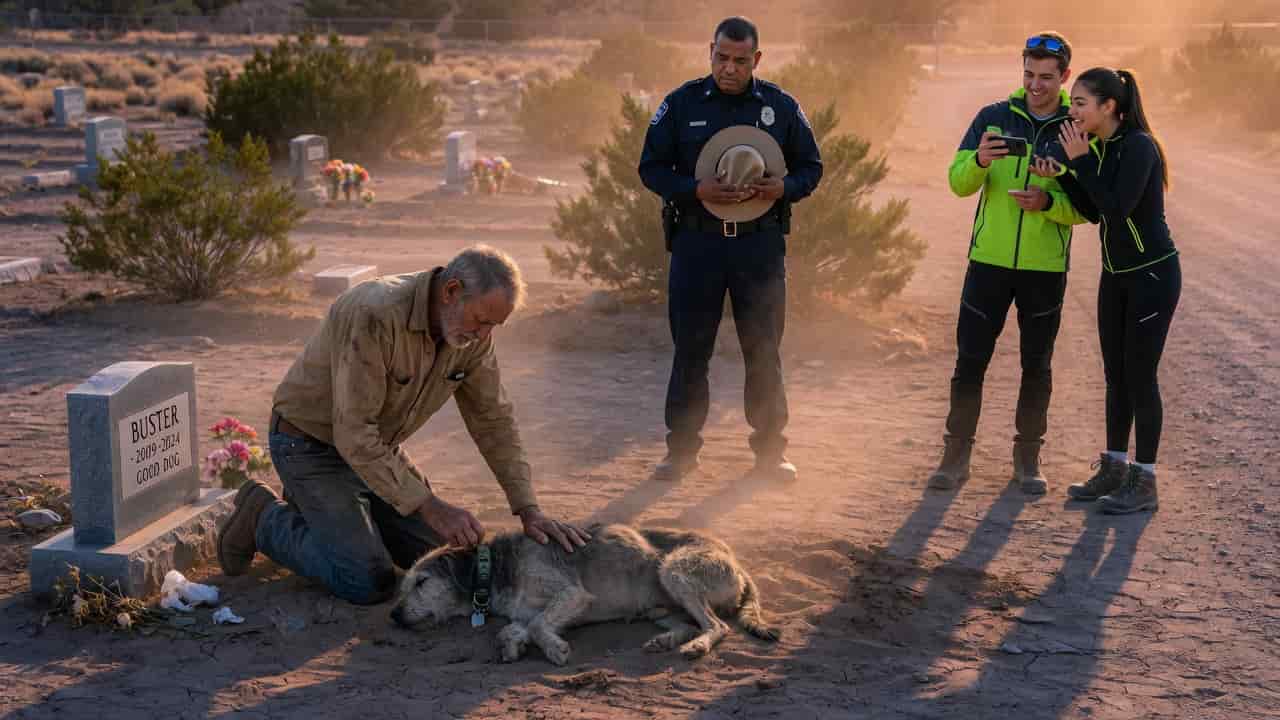
“Is that thing even alive, or are you just talking to the dirt?”
Thomas didn’t look up. He couldn’t. His knees were buried in the New Mexico grit, and his heart was hammering against the suicide note tucked into his front pocket. It was his tenth anniversary—the day he’d planned to finally let go.
For a decade, he’d lived in a house that smelled like dust and regret. He’d told himself that when Martha died, the world took everything else with her. He’d assumed the dog had perished in some lonely shelter years ago. He’d never checked. He’d just accepted the silence as his punishment.
But then he saw the tail move.
“Hey, I’m talking to you, old man!” the kid with the smartphone laughed, stepping closer to catch the ‘content’ of a man falling apart. “That dog looks like a rug. Gross.”
Thomas finally reached out. His fingers brushed a familiar texture—braided leather. It was the collar he’d made by hand, a perfect match for the belt he still wore. The dog was ancient, skeletal, and clearly at the very end of his journey, but he had spent his final strength getting to this one spot.
“He’s been here a week, sir,” the cemetery guard said, stepping in to block the kid’s camera. “I thought he was a stray until I saw him sleeping on your wife’s marker. He wouldn’t leave. I think… I think he was waiting for you.”
Thomas looked at the boy with the phone, then back at the dog who had refused to give up on a man who had already given up on himself.
Chapter 1: The Anniversary of the End
The heat in Belen, New Mexico, didn’t just sit on you; it pressed. It was a physical weight, a thick, dry blanket that smelled of baked earth and creosote. Thomas felt it in his marrow as he climbed out of his rusted Ford F-150, the hinges screaming a protest that matched the ache in his lower back. He stood there for a moment, hand resting on the hot metal of the door, watching the shimmering distortion of the horizon.
Today was the seventh of April. Ten years.
He reached into his breast pocket, his fingers grazing the crisp edge of the envelope. It was heavy—not with money, but with the finality of words. He’d spent three nights writing it, tearing up drafts that sounded too angry or too pathetic, until he landed on something that was simply… done. He wasn’t a man of many words, never had been. Martha had been the talker. She’d been the one who filled the gaps in the air, the one who made a house feel like it wasn’t just a collection of wood and nails. Without her, the silence had grown teeth.
He grabbed the small bunch of store-bought carnations from the passenger seat. They were already beginning to wilt in the cab’s oven-like interior. He didn’t like carnations—they were cheap and smelled like a funeral parlor—but the grocery store didn’t have anything else, and he couldn’t bring himself to drive all the way into Albuquerque.
The cemetery was a desolate stretch of land, more dust than grass, populated by weathered headstones and plastic flowers bleached white by the sun. Thomas walked with a slow, deliberate gait, his boots crunching on the gravel path. He knew the way by heart. Section C, Row 4. Near the twisted juniper tree that looked like it was trying to crawl out of the earth.
As he approached Martha’s grave, he felt the familiar tightening in his chest. It was a grief that had long since lost its sharpness, replaced by a dull, constant throb. But as he got closer, he noticed something that wasn’t right. There was a shape—a dark, matted heap—resting right against the base of Martha’s headstone.
At first, he thought it was a discarded coat or a pile of trash blown in by the wind. Then, the heap shifted.
Thomas froze. His heart, usually a sluggish thing, gave a frantic kick against his ribs. The shape resolved into the form of a dog. It was a small-to-medium animal, its fur a tangled mess of gray and brown, so thin its ribs looked like the hull of a wrecked ship. It was lying on its side, its head resting on the concrete footer of the grave.
“Hey,” Thomas croaked. His voice sounded like gravel rubbing together. “Get on now. Move.”
The dog didn’t move. It didn’t even lift its head. Only its eyes moved—cloudy, milky-blue orbs that fixed on Thomas with a terrifyingly lucid intensity. And then, a sound. A soft, rhythmic thud-thud-thud.
The dog was wagging its tail.
Thomas felt a cold sweat break out on his forehead despite the hundred-degree heat. He dropped the carnations. He didn’t notice they’d landed in the dirt. He took a step forward, then another, his legs feeling like they belonged to someone else.
He knelt. The grit of the cemetery floor bit into his jeans, but he didn’t care. He looked at the dog’s neck. Buried deep in the matted, filthy fur was a collar. It wasn’t nylon or chain. It was leather—thick, dark brown leather, braided in a four-strand weave that Thomas recognized because he had spent three hours at his kitchen table making it twelve years ago.
“Buster?” he whispered.
The dog let out a low, shaky whine. It tried to lift its head, but the effort was too much. It slumped back down, its breath coming in short, raspy hitches.
Thomas reached out, his hand trembling so violently he almost pulled back. When his fingers touched the dog’s ear, the animal leaned into his palm. The skin was hot—too hot—and paper-thin.
“It can’t be,” Thomas said to the empty air. “You’re gone. I thought… they told me you were gone.”
Ten years ago, in the chaotic weeks following Martha’s death, Buster had disappeared. Thomas had been a ghost himself then, wandering the house in a bourbon-soaked fog. He’d left the gate open one night. Or maybe he hadn’t. He couldn’t remember. When he’d finally sobered up enough to look, the dog was gone. He’d called the shelters once, maybe twice, and when they said they didn’t have a wire-haired terrier, he’d simply given up. He’d decided that life was a series of subtractions, and Buster was just another thing he didn’t deserve to keep.
But the dog was here. In the middle of a desert cemetery, at the foot of the woman who used to feed him scraps of bacon under the table.
“How?” Thomas asked, his voice breaking. “How did you find her?”
He looked at the collar again. He looked at his own waist, at the belt he’d made from the same hide on the same night. The symmetry of it felt like a physical blow. He wasn’t alone. He hadn’t been alone for ten years because this creature had been out there, somewhere, surviving on nothing but the memory of a smell and the direction of the wind.
The weight of the note in his pocket suddenly felt like a mountain. He had come here to say goodbye to everything, but the universe had sent a witness. A dying, starving witness who had spent a decade trying to find his way home.
Chapter 2: The Audience
The sound of gravel crunching behind him made Thomas stiffen. He didn’t want to be seen like this—kneeling in the dirt, talking to a dying animal at the foot of a grave. He wiped his eyes with the back of his hand, trying to reclaim some shred of the stoic, silent man he presented to the world.
“Oh my god, Caleb, look,” a girl’s voice chirped. It was high, bright, and entirely too loud for a place of rest. “Is that a coyote?”
Thomas didn’t turn around. He kept his hand on Buster’s head, feeling the faint, rapid heartbeat beneath the skin.
“Nah, looks like a dog,” a young man replied. “Or what’s left of one. Jesus, that’s depressing.”
Thomas heard the familiar click of a smartphone camera. He felt a surge of hot, oily rage. He turned his head just enough to see them. They were in their early twenties, dressed in gear that looked like it had never seen a speck of actual dirt. The boy, Caleb, was holding his phone up, framing the shot with a practiced, cynical eye. The girl, Mia, was leaning into him, her face twisted in a look of performative pity that didn’t reach her eyes.
“Hey,” Thomas said, his voice stronger now, honed by anger. “Move along. This isn’t a tourist attraction.”
Caleb didn’t lower the phone. “Take it easy, pops. We’re just taking a walk. It’s a public cemetery, right?” He stepped a little closer, his sneakers kicking up a small cloud of dust. “Is that your dog? Because he looks like he’s about five minutes away from being part of the landscape.”
Mia giggled, a sharp, nervous sound. “Caleb, stop. It’s sad.” She looked at Thomas, her gaze flickering to the sweat stains on his shirt and the dirt on his knees. “Do you need help? Like, do we need to call animal control or something? He looks… diseased.”
Thomas flinched as if she’d slapped him. Diseased. Buster wasn’t diseased. He was exhausted. He was at the end of a ten-year marathon.
“He’s fine,” Thomas snapped. “Just leave us be.”
“He doesn’t look fine,” Caleb said, his thumb tapping the screen of his phone. “He looks like a prop from a horror movie. You really shouldn’t have him out here in the heat, man. That’s like… animal cruelty.”
Thomas stood up. It was a slow process, his joints popping, his balance precarious. He was taller than Caleb, and though he was thin, he had the hard-won strength of a man who had spent forty years in a machine shop. He stepped between the couple and the grave, his shadow falling over Buster.
“You think this is funny?” Thomas asked. “You think you can just walk in here with your cameras and turn a man’s life into a joke?”
Caleb smirked, though he took a half-step back. “Who’s joking? I’m just documenting reality, man. People like this kind of stuff. The ‘grieving old guy and his mangy dog’ vibe. It’s very… gritty.”
“It’s my wife’s grave,” Thomas said, his voice trembling. “And that dog… that dog has more heart in his little finger than you’ll ever have in your whole body. Now get out of here before I forget I’m in a house of God.”
“Whoa, okay, easy there, Tiger,” Caleb said, finally lowering the phone, though he didn’t turn it off. “We’re going. No need to get all aggressive. Come on, Mia. The vibes here are officially ruined.”
They turned and walked away, their voices carrying back to Thomas in the still air.
“Did you see his face?” Mia whispered. “He looked like he was going to cry. And that dog… I think I smelled it from here.”
“I got it all on video,” Caleb said, his voice filled with a smug satisfaction. “That’s going to get so many hits. ‘Crazy old man at the cemetery.’ Absolute gold.”
Thomas watched them go, his fists clenched at his sides. He felt a profound sense of shame—not for himself, but for the world. He looked down at Buster, who had watched the whole exchange with those milky, knowing eyes.
The dog didn’t care about the teenagers. He didn’t care about “vibes” or “hits.” He only cared that Thomas was there.
Thomas knelt back down, the anger draining out of him, leaving him hollow. He reached into his pocket and felt the note. He had planned for this to be his last day. He had planned to go home, sit in his armchair, and take the pills he’d been saving. But now…
He looked at the wilted carnations. He looked at the dog.
“I’m sorry, Buster,” he whispered. “I’m so sorry I stopped looking.”
The dog let out a long, shuddering sigh and closed his eyes. For a terrible second, Thomas thought he was gone. Then, the chest rose again. One more breath. Then another.
He was holding on. He was waiting for something.
Chapter 3: The Witness
“I thought that was your truck out front, Thomas.”
The voice was deep, steady, and familiar. Thomas looked up to see Ray, the cemetery’s lone security guard, walking toward him. Ray was a man of similar vintage to Thomas, though he carried himself with a quiet authority that Thomas had long since lost. He’d worked the cemetery for fifteen years; he was the only person who had seen Thomas every single month for the last decade.
Ray stopped a few feet away, taking in the scene. He looked at the carnations in the dirt, then at the dog, and finally at the raw, exposed look on Thomas’s face.
“Those kids bother you?” Ray asked, gesturing toward the gate where the neon-clad couple was disappearing. “I saw them filming. I can trespass them if you want.”
Thomas shook his head. “Doesn’t matter. They’re just… they don’t know any better.”
Ray nodded slowly, his eyes settling on Buster. He didn’t recoil. He didn’t call the dog “diseased.” He took off his cap and wiped his brow with a clean handkerchief.
“He’s still here, then,” Ray said softly.
Thomas looked up, sharp. “What do you mean, still here?”
Ray sighed and stepped closer, kneeling a respectful distance away. “That dog showed up about a week ago. I tried to catch him, thought maybe he was a stray from the neighborhood, but he was too fast. Well, he was faster then. He’d hide in the brush whenever I got close.”
“A week?” Thomas repeated.
“Every morning when I did my rounds, I’d see him,” Ray continued. “He was always right here. Right on Martha’s plot. I brought him some water and a bit of my sandwich, but he wouldn’t touch it if I was watching. He’d wait until I drove off. He looked like he was on a mission, Thomas. Like he was keeping watch.”
Thomas felt a lump in his throat so large it felt like he was choking. “He’s been here a week… waiting for me.”
“I think so,” Ray said. “I didn’t recognize him at first. He’s changed a lot since… well, since the old days. But I saw that collar. I remembered you making that. You were so proud of that braid.”
Thomas looked down at his own belt. The leather was identical—the same oil, the same tension in the weave. He’d made them together. One for him, one for his best friend.
“I thought he died, Ray,” Thomas said, and for the first time in ten years, he let the tears come. They were hot and salt-stung, carving tracks through the dust on his cheeks. “I thought everyone was gone. I just… I stopped looking. I stayed in that house and I let the world go dark.”
Ray reached out and put a heavy hand on Thomas’s shoulder. It was a simple gesture, but it felt like an anchor. “The world didn’t go dark, Thomas. You just closed your eyes. There’s a difference.”
The two men sat in silence for a long moment, the only sound the wind whistling through the juniper and the raspy breathing of the dog.
“He’s not going to make it through the night, is he?” Thomas asked, his voice a ragged whisper.
Ray looked at Buster. The dog’s breathing was shallower now, his body limp. “I don’t think so. He’s spent everything he had just to get here. He’s running on nothing but ghost-fuel now.”
Thomas looked at the headstone. Martha Anne Miller. Beloved Wife. He had spent ten years resenting her for leaving him. He had spent ten years feeling like a victim of a cruel universe. But Buster had spent those same ten years fighting to get back to a place of love.
The shame Thomas felt now wasn’t the sharp, biting kind. It was a profound, transformative realization. He had been so focused on his own pain that he had ignored the living, breathing loyalty that was still in the world.
He reached into his pocket and pulled out the envelope. The paper was damp from his sweat.
“Ray?”
“Yeah, Thomas?”
“I don’t suppose you have a trash can nearby?”
Ray looked at the envelope, then at Thomas’s eyes. A small, knowing smile touched the corners of the guard’s mouth. “I think I can find one.”
Thomas handed him the note. He didn’t look back as Ray walked away. He didn’t need the words anymore. The story had changed.
Chapter 4: The Lifting
The sun was dipping below the horizon now, painting the New Mexico sky in violent shades of purple and orange. The heat was finally beginning to break, replaced by the cool, sharp air of the high desert.
Thomas knew he couldn’t leave Buster here. He couldn’t let him spend his last hours on the hard, cold dirt of the cemetery, even if it was at Martha’s feet. He needed to bring him home. He needed to show him, even for a few minutes, that he was still wanted.
“Okay, buddy,” Thomas whispered. “I’m going to pick you up now. It might hurt a little, but I’ve got you. I promise.”
He slid one arm under the dog’s front legs and the other under his hindquarters. Buster was shockingly light—hardly more than a bag of bones and fur. As Thomas lifted him, the dog let out a soft, pained groan, his head falling against Thomas’s shoulder.
Thomas stood up, his legs shaking under the meager weight. He felt a sudden, sharp pain in his chest—not the dull ache of grief, but the physical strain of a man who hadn’t exerted himself in years. He ignored it. He focused on the feeling of Buster’s warm breath against his neck.
He began the long walk back to the truck. Every step was a struggle. The gravel seemed deeper, the incline of the path steeper. He passed the juniper tree, the branches reaching out like skeletal fingers. He passed the rows of white-bleached flowers.
Halfway there, his breath started coming in ragged gasps. He had to stop. He leaned against a large marble monument, his chest heaving.
“Almost there, Buster,” he panted. “Just a little further.”
The dog shifted slightly, his nose brushing against Thomas’s collarbone. He was still there. He was still fighting.
As Thomas reached the gate, he saw the young couple again. They were sitting on the tailgate of a sleek, expensive SUV, drinking sparkling water and looking at their phones. When they saw Thomas approaching, carrying the dog, they went silent.
Caleb reached for his phone again, but Mia put her hand on his arm. She looked at Thomas—really looked at him this time. She saw the tears, the dirt, the trembling limbs, and the way he was cradling the dog like a child.
The mockery vanished from her face. It was replaced by something else—a sudden, uncomfortable realization of the weight of the moment. She looked away, her face flushing.
Caleb hesitated, then slowly put his phone in his pocket. He didn’t say anything as Thomas passed by. He didn’t make a joke. The “gritty” content had become too real, too human, for his cynical lens to capture.
Thomas reached his truck and carefully laid Buster on the bench seat, which he’d covered with an old wool blanket. He climbed into the driver’s seat, his heart still racing, his hands slick with sweat.
He sat there for a moment, the engine idling, the heater vents blowing cool air onto the dog. He looked at Buster, who had his eyes open again, watching him.
“We’re going home,” Thomas said.
He put the truck in gear and drove out of the cemetery. As he passed through the gates, he saw Ray standing by the guard shack. Ray raised a hand in a silent salute.
Thomas didn’t head for the pharmacy. He didn’t head for the liquor store. He drove straight to the small, dusty house at the end of the county road—the house that had been a tomb for ten years.
He didn’t know what would happen tomorrow. He didn’t know how he would face the silence once Buster was gone. But for tonight, the house wouldn’t be empty.
As he pulled into the driveway, the porch light—which he’d forgotten to turn off that morning—flickered in the twilight. It looked like a beacon.
He carried Buster inside, through the door that had seen so much sorrow, and laid him on the rug in front of the cold fireplace. He knelt beside him, stroking the matted fur, feeling the slow, steady rhythm of a life that had refused to give up.
“You’re home,” Thomas whispered. “You finally made it home.”
Buster’s tail gave one last, soft thump against the floor.
And for the first time in ten years, Thomas Miller felt like he could breathe.
Chapter 5: The Weight of the Living
The house smelled like stale air and the metallic tang of a swamp cooler that hadn’t been serviced in three seasons. It was a small, boxy rancher on the edge of Belen, where the pavement gave way to the kind of soft, treacherous sand that swallowed tires if you weren’t careful. For ten years, Thomas had treated this place like a storage unit for a life he no longer wanted to lead. He kept the curtains drawn against the New Mexico sun, let the mail pile up on the laminate counter until it threatened to slide off, and moved through the rooms with the gingerly gait of a man who didn’t want to wake the ghosts.
But as he carried Buster through the front door, the silence of the house felt different. It wasn’t empty anymore; it was expectant.
He laid the dog down on an old Navajo rug in the living room, right in the square of moonlight that managed to pierce through a gap in the heavy drapes. Buster didn’t try to move. He just lay there, his ribcage expanding and contracting in a rhythmic, liquid struggle. Thomas stood over him, his own breath coming in short, panicked bursts. He felt a sudden, frantic need to do something, to apply the machinist’s logic he’d used for forty years to a problem that didn’t have a blueprint.
“Water,” Thomas muttered to himself. “You need water.”
He went to the kitchen, his boots clattering on the linoleum. He reached for a glass, then realized it was covered in a fine layer of dust. He washed it twice, his hands shaking under the tap, then filled it with cool water. He found a shallow ceramic bowl Martha used to use for mixing dip—a cheerful yellow thing with a chipped rim—and filled that too.
Back in the living room, he knelt beside the dog. Buster’s eyes followed him, the pupils dilated. Thomas dipped his fingers into the bowl and let the droplets fall onto the dog’s parched tongue. Buster lapped at them feebly, a rasping sound that tore at Thomas’s chest.
“That’s it, buddy. Just a little. Slow and easy.”
For the next hour, Thomas didn’t move. He sat on the floor, his back against the worn fabric of his armchair, and hand-fed the dog water, drop by drop. He watched the way the dog’s throat worked, the way his ears twitched at every small sound from the desert outside—the scuttle of a lizard, the distant hum of a freight train on the BNSF tracks.
The physical reality of the dog’s presence began to sink in. Buster was a wreck of matted fur, burrs, and old scars. There was a jagged notch in his left ear that hadn’t been there ten years ago. His paws were calloused and cracked, the pads worn down to the quick. He looked like he’d walked across the entire state of New Mexico twice over, and maybe he had.
Thomas reached out and gently unbuckled the leather collar. As it came away, he saw the raw skin beneath it, the fur rubbed thin by years of wear. He took the collar into the kitchen and sat under the harsh fluorescent light of the stove hood. He pulled a rag and a tin of saddle soap from a drawer he hadn’t opened since Martha’s funeral.
He began to clean the leather. It was a ritual he knew by heart—the circular motions, the pressure of the thumb, the way the grease worked into the pores of the hide. As the dirt came away, the braid he’d labored over twelve years ago revealed itself. It was still tight, still strong. He’d used a heavy-duty waxed thread to lock the ends, and the knots had held.
“You didn’t break,” Thomas whispered, his voice cracking in the quiet kitchen. “You just got dirty.”
He thought about the note Ray had taken. The words he’d written there—about the pointlessness of the sun coming up, about the way the walls of the house felt like they were slowly moving inward—felt like they belonged to a stranger. He looked at his hands, covered in the dark oil of the saddle soap, and then at the door to the living room.
He couldn’t do it. Not tonight. Not while there was something in the house that needed him to keep the water bowl full.
He went to the pantry and found a dusty can of chicken broth. He warmed it on the stove, the smell filling the kitchen, a domestic scent that felt foreign and sharp. He brought it back to Buster and held the bowl steady as the dog drank. When Buster finished, he let out a long, shuddering breath and rested his chin on Thomas’s knee.
The contact was electric. It was the first time in a decade that Thomas had felt the warmth of another living thing in his home. He felt a wave of nausea roll over him—the sheer, staggering weight of the time he’d wasted. He’d spent three thousand, six hundred, and fifty days waiting to die, and all that time, this dog had been out there, fighting to live.
“I’m sorry,” Thomas said, his forehead resting against the dog’s damp fur. “I’m so sorry I wasn’t there to open the gate.”
He stayed there on the floor as the moon moved across the sky, tracing the slow arc of the night. He didn’t sleep. He couldn’t afford to. He spent the hours talking to Buster in a low, steady stream of consciousness, telling him things he’d never said to Martha, things he’d buried under the floorboards of his mind. He talked about the shop, about the way the brass shavings used to curl off the lathe like ribbons, about the fear he felt every morning when he woke up and realized he was still breathing.
Buster listened. His tail didn’t thump anymore—he didn’t have the strength for that—but his eyes stayed fixed on Thomas, a steady, unwavering witness to a man’s late-night confession.
Around three in the morning, the wind picked up, rattling the windowpanes. Thomas got up to check the locks—a habit he’d developed after the break-ins at the machine shop years ago. As he passed the hallway mirror, he stopped.
He looked like a man who had crawled out of a wreck. His hair was a chaotic nest of silver, his eyes were bloodshot and rimmed with red, and his shirt was stained with cemetery dirt and dog saliva. But there was something else in his reflection. A spark. A jagged, painful kind of life that hadn’t been there when he’d left for the cemetery that morning.
He went back to the living room and sat down. He picked up the braided collar and held it in his lap. He realized then that the rescue hadn’t happened at the grave. The rescue was happening right now, in the middle of a dark house in a dying town, where an old man and an older dog were simply refusing to let go of the thread.
“We’re going to make it to morning, Buster,” Thomas promised. “Just hold on until the light comes. That’s all we have to do.”
He reached out and stroked the dog’s ear, his hand finally steady. The silence of the house no longer felt like a grave. It felt like a workshop, a place where things were being repaired, slowly and painfully, one breath at a time.
Chapter 6: The Dawn and the Debt
The light in New Mexico doesn’t arrive softly; it breaks over the Manzano Mountains like a physical strike. One minute the world is a bruised purple, and the next, the desert is ablaze with a golden, unforgiving clarity.
Thomas woke up with a start, his neck stiff and his legs cramped from the hours spent on the floor. The house was quiet, but it was the quiet of a finished race, not an empty tomb. He looked down at the Navajo rug.
Buster was still there. But the rhythmic hitching of his chest had stopped. His head was still resting on the spot where Thomas’s knee had been, his eyes closed as if he were merely sleeping in a patch of sun. He looked peaceful—smaller, somehow, but no longer in pain.
Thomas sat there for a long time, his hand hovering over the dog’s cold flank. He didn’t cry this time. The tears had been burned out of him during the night. Instead, he felt a profound, heavy sense of duty. The dog had finished his journey; now it was up to Thomas to finish the story.
He stood up, his bones protesting the movement, and went to the kitchen. He made a pot of coffee—the first time he’d used the machine in weeks. The smell was sharp and grounded. He drank a cup standing at the window, watching the dust motes dance in the light.
He saw a white truck pull into his driveway. It was Ray.
Thomas met him on the porch. The security guard was still in his uniform, though he looked like he’d been up all night too. He held a small cardboard box in his arms.
“I figured,” Ray said softly, looking at Thomas’s face. “He made it home, though. That’s the main thing.”
“He made it home,” Thomas agreed.
Ray handed him the box. “I went back to the spot after I finished my shift. Found these. Thought you might want them.”
Inside the box were the carnations Thomas had dropped—shriveled now, but gathered together—and a small, weathered tennis ball that Ray must have found near Martha’s grave.
“Thank you, Ray,” Thomas said.
“There’s something else,” Ray said, shifting his weight. “That kid. The one with the phone. He posted that video last night. It… it went around. People in town saw it. My daughter showed it to me this morning.”
Thomas felt a flicker of the old shame, but it didn’t take root. “What are they saying?”
“Most of them are calling the kid a prick,” Ray said with a grim smile. “But a few people recognized you. Mrs. Higgins from the bakery? She said she remembers you and Martha walking that dog every Saturday ten years ago. She’s coming over later with some food. And Mike from the garage said he’s got an old kennel if you… well, if you ever decide you need one.”
Thomas looked out at the desert. The social residue of his breakdown at the cemetery was already changing the shape of his world. He’d spent ten years trying to be invisible, and in five minutes of recorded humiliation, he’d become a neighbor again.
“I need to bury him, Ray,” Thomas said. “I don’t want to go back to the cemetery. Not today.”
“I brought a shovel,” Ray said. “I’ll help.”
They spent the morning in the backyard, behind the shed where Thomas used to keep his tools. The ground was hard—New Mexico caliche that fought the shovel with every strike. They worked in silence, the two men trading off when their breath grew short. It was a machinist’s work—precise, physical, and honest.
When the hole was deep enough, Thomas went inside and wrapped Buster in the old wool blanket. He tucked the tennis ball into the folds of the fabric. Before he carried him out, he picked up the braided collar. He didn’t put it in the grave. He looped it over the bedpost in his room, right next to Martha’s wedding photo.
They laid Buster in the earth. Thomas threw the first handful of dirt. It made a soft, final sound against the blanket.
“Goodbye, partner,” he whispered. “Thanks for waiting.”
After Ray left, Thomas went back into the house. It felt bigger now, as if the air had been cleared of a decade’s worth of smoke. He went to the kitchen counter and began sorting through the mail. He found a bill for the water, a circular for the grocery store, and a letter from the machine shop union about his pension.
He didn’t throw them away. He sat down and started writing out a check.
The phone on the wall—the landline he’d kept only because it was too much effort to cancel—rang. It was a sharp, jarring sound. Thomas hesitated, his hand hovering over the receiver.
“Hello?”
“Thomas? It’s Sarah Higgins. I heard… well, I heard you had a rough day yesterday. I’ve got a pot of green chile stew that’s too big for me and the cat. I was wondering if I could drop it by this evening?”
Thomas looked at the spot on the rug where Buster had spent his last night. He thought about the note in Ray’s trash can. He thought about the way the light was hitting the mesa in the distance.
“I’d like that, Sarah,” Thomas said. “I think I’d really like that.”
He hung up the phone and walked to the front door. He grabbed the handle of the heavy curtains and, with one decisive motion, yanked them open. The sunlight flooded into the living room, illuminating the dust, the worn furniture, and the empty Navajo rug.
It was messy. It was old. It was a house that had been lived in by people who were gone. But as Thomas stood there, the warmth of the sun hitting his face, he realized he wasn’t a ghost anymore. He was a man with a clean collar on his bedpost and a pot of stew on the way.
He went to the kitchen, found a screwdriver, and headed out to the porch. The swamp cooler needed a new belt, and the afternoon was going to be hot. He had work to do.