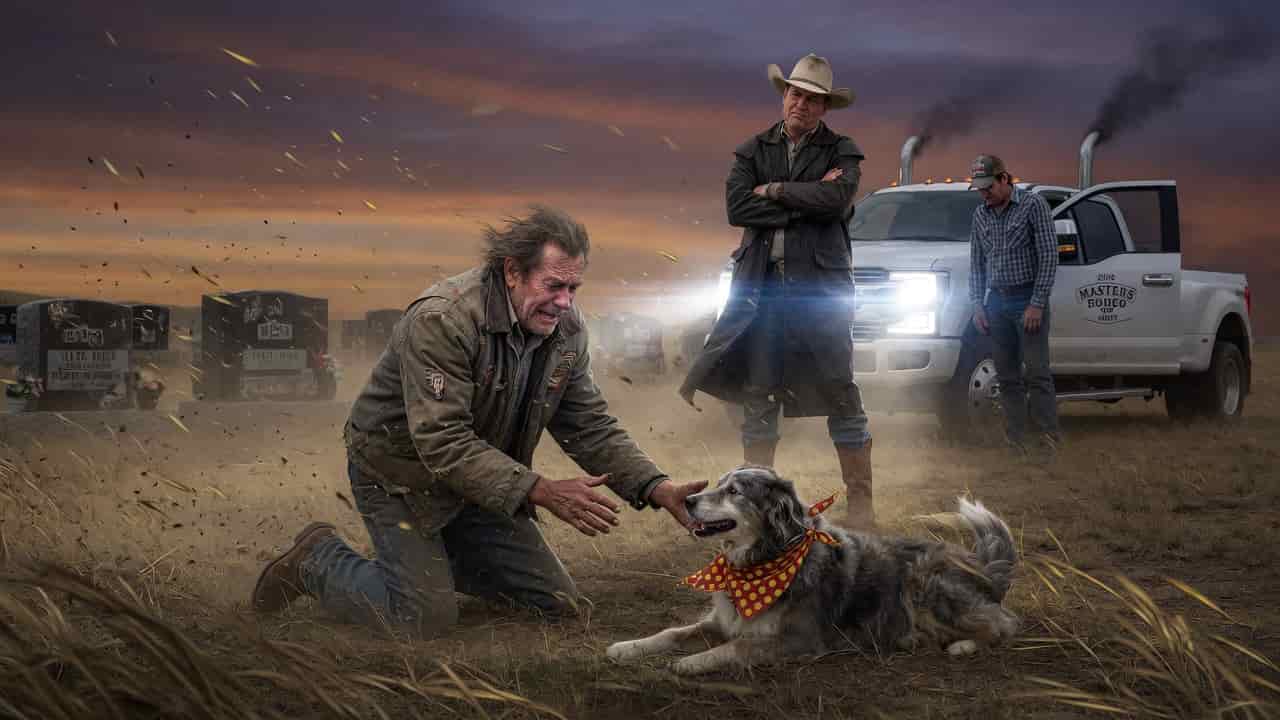
“You told me he was safe, Buck. You looked me in the eye and said he was on a porch in Cheyenne.”
Ray was on his knees in the dry Wyoming grass, his hands shaking as they touched the matted fur of the dog he’d spent a decade in the dirt with. Toby wasn’t on a porch. He was skeletal, his eyes clouded with cataracts, still wearing the same red-and-yellow polka-dot bandana they’d used for their big finale.
Buck Masters didn’t even get out of his truck at first. He just rolled down the window, the smell of expensive leather and air conditioning drifting out into the heat. He looked at Ray—broken-down, limping, penniless Ray—and he didn’t show a flicker of regret.
“He’s a dog, Ray,” Buck said, his voice flat and bored. “And you’re a man who can’t even climb a fence anymore. Did you really think I was going to pay for a nursing home for a mutt? I told you what you needed to hear to get you out of my hair.”
Jeb, the ranch hand standing by the tailgate, looked at his boots. He knew. They all knew. They’d watched Ray take a thousand literal bull-horns to the ribs to keep the stars safe, and this was the thanks he got—being mocked in a graveyard alongside the only friend he had left.
Ray tried to stand, his knee clicking like dry wood, but the shame was heavier than the injury. He was being laughed at by a man who had everything, all because he’d dared to care about something that didn’t have a price tag.
Chapter 1
Ray’s left knee didn’t just hurt; it felt like someone had driven a rusted railroad spike through the patella and left it there to oxidize. It was four in the morning in Cody, Wyoming, and the air inside the trailer was thin and smelled of stale coffee and the Ben-Gay he smeared on himself like war paint. He sat on the edge of the narrow bed, feet flat on the cold linoleum, waiting for the joint to acknowledge the day.
Outside, the wind was doing that low, mournful whistle through the gaps in the window seals. It was a lonely sound, the kind that reminded a man he was sixty-five and living in a tin box on the edge of a gravel lot.
He reached for the cane—a sturdy piece of hickory he’d carved himself—and pushed upward. His body protested in a series of staccato pops and groans. This was the residual of thirty years as a rodeo clown. People saw the face paint and the oversized pants and the barrel, and they thought it was comedy. Ray knew it was physics. It was about being the target so the boys on the bulls didn’t become the casualties. He’d been stepped on, gored, tossed, and trampled. He’d had his spleen removed in an emergency room in Amarillo and his jaw wired shut in Reno.
But it was the last hit—the one three years ago—that had ended it. A three-thousand-pound Brahman bull named Midnight Terror had decided the barrel Ray was crouching in was a personal insult. The bull hadn’t just hit the barrel; it had flattened it. Ray had woken up three days later with a titanium plate in his leg and a career that was suddenly, violently over.
The worst part wasn’t the pain. It was the silence. For ten of those thirty years, the silence of the morning had been broken by the wet nose and rhythmic thumping tail of Toby. Toby was a crossbreed with more heart than sense, a dog that had learned to dance, to “save” Ray from the barrel, and to take a bow that brought the house down.
When Ray was discharged from the hospital, Buck Masters, the owner of the Masters’ Rodeo Circuit, had come to see him. Buck was a man who smelled of success and expensive cigars, a man who didn’t like “loose ends.”
“Ray, you’re done,” Buck had said, not unkindly, though his eyes were already on the door. “But I’ll take care of Toby. A cousin of mine has a ranch near Cheyenne. Big porch, plenty of steak scraps, no more loud speakers. He’s earned it.”
Ray had cried then, shameful tears of relief. He couldn’t walk, couldn’t feed himself, let alone a high-energy working dog. He’d watched Buck’s men load Toby into a crate. He’d watched that red-and-yellow bandana disappear down the driveway.
Now, three years later, Ray hobbled to the kitchenette and put the kettle on. He had eighteen dollars in his wallet and a check from Social Security that barely covered the lot rent. He was a “has-been,” a term the younger guys at the arena used when they thought he wasn’t listening.
He had to go to the arena today. Buck owed him a back-payment for some consulting work Ray had done on the new livestock pens. It wasn’t much, but it was the difference between eggs and air for the next week.
The Masters’ Arena was a cathedral of dust and galvanized steel. As Ray pulled his beat-up Ford into the lot, he saw the new generation. They were younger, faster, and wore gear that looked like it belonged in a motocross race. They didn’t understand the craft of the clown. They thought it was just about being a distraction. They didn’t know it was an art of timing and sacrifice.
He found Buck near the chutes, flanked by Cody, the current star bull rider. Cody was twenty-two, had a jawline like a hatchet, and possessed the arrogance of a man who hadn’t yet realized his bones were breakable.
“Well, if it isn’t the legend,” Cody smirked, leaning against the railing. “Coming to show us how to fall down, Ray? Or did you just forget where you parked your wheelchair?”
The surrounding hands chuckled. It was a shallow, sycophantic sound. Ray ignored him, focusing on Buck. Buck didn’t look up from his clipboard.
“Buck. I’m here for that check,” Ray said, his voice gravelly.
“Consulting fee?” Buck asked, finally looking over his glasses. He looked Ray up and down, lingering on the stained jacket and the way Ray leaned heavily on the hickory cane. “Right. Jeb! Get the checkbook from the office.”
Jeb, a man Ray had known for twenty years, nodded and headed toward the trailer. He wouldn’t meet Ray’s eyes. That was the first prickle of unease. Jeb always had a word for Ray. Today, he looked like he’d seen a ghost.
“How’s Toby?” Ray asked, the question he always asked. “Cheyenne treating him okay?”
Buck paused, his pen hovering over the clipboard. For a fraction of a second, his face went blank, a mask falling into place. “Oh, yeah. Living the dream, Ray. Probably forgotten all about the dirt and the greasepaint by now.”
“I’d like to see him sometime,” Ray said. “Maybe this summer, if I can get the Ford tuned up.”
Buck made a clicking sound with his tongue. “I wouldn’t. Cousin says he’s gotten real territorial. Might not even recognize you. Better to let him keep his peace, don’t you think?”
Cody laughed, a sharp, ugly sound. “Yeah, Ray. Why would a dog want to remember a guy who let himself get turned into a pancake? Dogs like winners.”
Ray felt the heat rise in his neck. He wasn’t a man of words, but the disrespect was a physical weight. “He was my partner, Cody. We did things in that arena you don’t have the guts to try.”
Cody stepped forward, invading Ray’s space. He was a head taller and fifty pounds of lean muscle. “Is that right? Well, maybe you should get back in the barrel and prove it. Oh, wait. You’d need someone to hoist you into it first.”
Buck didn’t stop him. He just watched, a faint, amused smile on his face. He liked the friction. He thought it kept his riders sharp.
“That’s enough, Cody,” Buck finally said, though there was no weight behind it. He took the check Jeb handed him and held it out. Ray reached for it, but Buck didn’t let go immediately. “Ray, I’m doing you a favor here. This ‘consulting’… it’s charity. Don’t come back next month expecting more. The circuit’s moving on. We’re going digital with the replays, bigger screens, more pyro. The old-school stuff? It’s dead.”
Ray took the check. His hand shook, not from age, but from the sheer effort of not swinging the hickory cane at Buck’s teeth. “It’s never been about the pyro, Buck. It’s about the man in the dirt.”
“Exactly,” Buck said, turning back to his clipboard. “And right now, you’re just getting the dirt on my boots. Move along.”
Ray turned, his knee screaming as he pivoted. As he walked away, he heard Cody’s voice, intentionally loud so it would carry across the wind.
“Hey Jeb, did you tell him? About the ‘Cheyenne ranch’?”
Jeb’s voice was a frantic mumble. “Shut up, Cody. Just shut up.”
Ray stopped. The wind seemed to die down for a second, leaving a vacuum in his chest. He didn’t turn around. He just kept walking, but the seed of a terrible, cold doubt had been planted in the Wyoming frost.
Chapter 2
The “Silver Dollar” was the kind of diner where the grease on the walls was older than the waitresses. Ray sat in a corner booth, the check from Buck Masters sitting on the table like a lead weight. He’d ordered a black coffee, but he hadn’t touched it.
He couldn’t get Cody’s voice out of his head. Did you tell him?
Ray wasn’t a stupid man, though people often mistook his silence for a lack of wit. He’d survived three decades in a violent industry by being observant. He’d noticed the way Jeb looked away. He’d noticed the way Buck had used the word “territorial”—a classic lie people told when they didn’t want you to visit a dog.
He pulled out his old flip phone. He didn’t have many contacts. He scrolled through until he found the number for Sarah, a vet tech who’d worked the circuit five years ago. She’d always had a soft spot for Toby.
“Ray?” she answered, sounding surprised. “God, it’s been ages. How’s the leg?”
“It’s a leg, Sarah. It gets me from A to B,” Ray said, trying to keep his voice steady. “Listen, I’m looking for Buck’s cousin. The one with the ranch near Cheyenne. I never got the name of the place, and I’m thinking of heading down that way.”
There was a long silence on the other end. Too long.
“Sarah?”
“Ray… I thought you knew,” she whispered. Her voice was thin, filtered through miles of wire and a heavy dose of pity.
“Knew what?”
“Buck doesn’t have a cousin in Cheyenne. He doesn’t have a cousin with a ranch anywhere.”
Ray felt the air leave the booth. The diner suddenly felt too small, the smell of frying onions making his stomach churn. “He told me… he said Toby was retired there. Steak scraps and a porch.”
“Ray,” Sarah’s voice broke. “When you were in the hospital, Buck told the hands that Toby was ‘surplus equipment.’ He didn’t want to pay the kennel fees while you were in rehab. He told Jeb to… to take care of it.”
“Take care of it?” Ray’s voice was a ghost. “He told Jeb to kill him?”
“No,” Sarah said quickly. “Jeb couldn’t do it. I know Jeb. He’s a softy. He told me he took the dog out to the old foothills, near the county line, and let him go near one of the sheep camps. He thought a shepherd might take him in. But Ray… that was three years ago. Toby was already ten.”
Ray closed the phone. He didn’t say goodbye. He couldn’t.
He stood up, his knee giving a sharp, agonizing crack. He didn’t care about the pain. He walked out of the diner, leaving the coffee and the check on the table. He drove back to the arena.
He didn’t go to the office. He went to the equipment shed, where Jeb was power-washing the mud off a horse trailer. Jeb saw him coming and tried to turn the nozzle away, but Ray walked right into the spray, the cold water soaking his canvas jacket.
“Ray, dammit! Get back!” Jeb yelled, shutting off the water.
Ray didn’t stop until he was a foot away from the younger man. He was shorter than Jeb, and he was hobbled, but at that moment, he looked like a prehistoric force.
“Where is he, Jeb?”
Jeb’s face went pale. He dropped the power-washer wand. “Ray, I didn’t have a choice. Buck said he was a liability. Said if I didn’t do it, he’d find someone who would. I couldn’t shoot him, Ray. I couldn’t.”
“Where did you leave him?” Ray’s voice was low, vibrating with a rage that had been dormant for years.
“The old cemetery,” Jeb whispered, his eyes darting toward the main office, terrified Buck would see them. “The one out by the Miller property. There’s a shepherd’s shack about a mile north. I figured he’d find food there. I left him with a bag of kibble and his bandana. I’m sorry, Ray. I’m so damn sorry.”
“You left a senior dog in the middle of a Wyoming winter,” Ray said. It wasn’t a question.
“I didn’t have a choice!” Jeb’s voice rose in a frantic, cracking pitch. “Buck owns everything in this town, Ray! My house, my truck, my job. What was I supposed to do? Fight him for a dog?”
“Yeah,” Ray said, his voice cold as the runoff from the mountains. “That’s exactly what you were supposed to do.”
Ray turned to leave, but a shadow fell across the gravel.
Cody was standing there, a gatorade in one hand, a smirk on his face. He’d heard enough.
“Still crying about the mutt, Ray? Jesus. It’s been three years. The coyotes probably picked him clean before the first snow fell.”
Ray didn’t even think. He swung the hickory cane. He didn’t aim for the head—he wasn’t trying to kill the boy. He swung it with the precision of a man who had spent his life gauging the movement of beasts. The heavy wood caught Cody square in the ribs.
The air left Cody in a wheezing rush. He crumpled to the gravel, clutching his side, his face turning a mottled purple.
“Cody!” Jeb scrambled forward, but Ray stepped between them.
“He’s fine,” Ray said, looking down at the gasping rider. “He’s just learning about physics. Hard objects meet soft egos. It’s a lesson you should have learned a long time ago.”
Ray walked to his truck. His heart was hammering against his ribs like a trapped bird. He knew what he was doing was a fool’s errand. Three years. A senior dog. The Wyoming wilderness was a cruel mistress to the healthy, let alone the aged.
But as he pulled out of the lot, he saw Buck Masters standing on the porch of the office. Buck wasn’t smiling anymore. He was watching Ray with a look of pure, calculated malice. He’d seen the strike. He’d seen the defiance.
Ray didn’t care. He drove toward the Miller property, toward a place of silence and stones, praying to a God he hadn’t spoken to in decades that the lie hadn’t been a death sentence.
Chapter 3
The drive out to the Miller property took Ray across the skeleton of the county. The paved roads gave way to washboard gravel, then to two-track dirt paths that hadn’t seen a grader since the nineties. The Wyoming wind was picking up, carrying the scent of incoming rain and the bitter tang of sagebrush.
His truck, an old Ford F-150 that burned more oil than gas, groaned as it climbed the ridges. Ray’s leg was throbbing in time with the engine. He’d overdone it with the cane. The strike on Cody had felt good—a momentary release of decades of swallowed pride—but the residue was a dull, aching heat in his hip and a tightening in his chest.
He kept seeing Toby’s face. Toby at two years old, jumping through a hoop of fake fire. Toby at six, standing guard over Ray after a bull had clipped his shoulder. The dog hadn’t just been a performer; he’d been a witness to Ray’s life. He knew the smell of Ray’s fear and the sound of his loneliness. And Ray had let him be taken away in a crate because he was too weak to say no.
The old cemetery.
It was a place for the people the county had forgotten—miners who died in cave-ins, ranch hands with no kin, infants lost to the flu. It sat on a rise overlooking a valley that felt like the edge of the world.
Ray pulled the truck to a stop at the rusted gate. He sat there for a long time, the engine ticking as it cooled. He was afraid to get out. He was afraid of what he wouldn’t find. Or worse, what he would.
He forced himself out of the cab. The wind hit him like a physical blow, cold and relentless. He leaned on his cane and began to walk.
The cemetery was a graveyard of tilted wood and cracked granite. The grass was waist-high and bleached white by the sun.
“Toby?” Ray called out. His voice was swallowed by the wind. He felt ridiculous. It had been three years.
He walked toward the center of the rise, where a cluster of older graves sat. There was a small stone there, barely more than a rock, marking the grave of an old clown Ray had known in his youth—pauper’s grave for a man named ‘Happy’ Miller who’d died with nothing but his makeup kit.
Ray stopped.
There, curled in the lee of the stone, was a shape. It looked like a pile of old, grey rags at first. Just another piece of debris blown in by the storm.
Ray’s breath hitched. He stepped forward, his cane sinking into the soft dirt.
The shape moved.
A head lifted. It was slow, agonizingly slow. The fur was matted with burrs and mud, turned a dusty, universal grey. The eyes were milky with cataracts, squinting against the harsh light. But around the neck, faded and torn but unmistakably red-and-yellow, was a polka-dot bandana.
“Toby?” Ray’s voice broke. He fell to his knees, ignoring the scream of his joint.
The dog didn’t bark. He didn’t jump. He let out a low, shaky whine that sounded like a hinge that hadn’t been oiled in a century. He tried to stand, his back legs trembling, his ribs showing through his skin like the hull of a wrecked ship.
He looked at Ray, and for a second, the fog in those eyes seemed to clear. He recognized the scent of Ben-Gay and stale coffee. He recognized the man who had always been his anchor.
Toby did something then that nearly shattered Ray’s heart. He tucked his head down, sliding his front paws forward into the dirt, his hindquarters shaking as he tried to perform their old “big finale” bow. It was a gesture of ingrained loyalty, a ghost of a trick performed for a ghost of a man.
But his strength failed. His front legs buckled, and he tumbled into the dirt, letting out a soft, defeated huff.
“No, no, boy. You don’t have to do that,” Ray sobbed, pulling the dog into his lap. Toby was light—so light. He felt like he was made of nothing but feathers and memories.
The dog licked Ray’s hand, his tongue sandpaper-dry. He was alive, but only just. He’d survived on mice, rainwater, and the sheer, stubborn will to wait for the man who had left him.
Ray was rocking him, whispering apologies into the matted fur, when he heard the sound of a heavy engine.
A white dually pickup truck pulled up to the gate, its tires throwing gravel. The headlights stayed on, blinding in the growing dusk.
Buck Masters climbed out of the driver’s side. He was still wearing the duster, looking like a king surveyng a conquered territory. Jeb was with him, looking like he wanted to sink into the earth.
Buck walked through the gate, his boots crunching on the dry grass. He stopped ten feet away, looking down at the broken man and the dying dog.
“Well,” Buck said, his voice carrying that familiar, oily layer of contempt. “I see you found your surplus equipment, Ray. I have to admit, I’m impressed. Most mutts wouldn’t have lasted the first week out here.”
Ray didn’t look up. He kept his hand on Toby’s head. “You lied to me, Buck. You left him here to starve.”
“I didn’t leave him,” Buck said, gesturing to Jeb. “I gave an order. Jeb was the one who lacked the spine to finish it. But in a way, this is better. It’s poetic, isn’t it? The clown and his dog, both of them too stubborn to realize they’re already dead.”
“He’s not dead,” Ray said, his voice dropping into a dangerous register.
“He might as well be,” Buck stepped closer, his shadow falling over them. “And after what you did to Cody today, you’re not far behind. I could have you arrested for assault, Ray. I could take that trailer, that truck, and every cent of that check I just gave you. You’re nothing. You’ve always been nothing. Just a suit filled with padding to keep the real stars safe.”
Ray looked up then. His face was a mask of grief and something much older—the cold, hard clarity of a man who had nothing left to lose.
“You think power is about who owns the land, Buck,” Ray said quietly. “But power is about who stays in the dirt when the bulls come out. You’ve never been in the dirt. You’ve only ever watched from the fence.”
Buck’s face twisted in a sneer. He looked at Jeb. “Jeb, get the shovel from the truck. Let’s end this little drama. The dog’s suffering, and Ray clearly needs a lesson in how the world actually works.”
Jeb didn’t move. He stood by the gate, his hands jammed into his pockets.
“Jeb!” Buck barked. “I said get the shovel.”
The wind howled through the headstones, and for the first time in his life, Ray saw the power structure of the county begin to fray.
Chapter 4
The silence in the cemetery was louder than the wind. Jeb stood by the truck, his face half-hidden in the shadow of his cap. Buck was trembling, not from cold, but from the sheer, unadulterated outrage of being ignored.
“Jeb, I am talking to you!” Buck’s voice was a whip-crack. “Get the damn shovel. Now.”
Jeb took a slow step forward. His boots sounded heavy on the gravel. He looked at Ray, then at Toby, who was shivering in Ray’s arms. The dog’s red-and-yellow bandana was fluttering in the breeze, a bright, garish spark in the gloom.
“I can’t do it, Buck,” Jeb said. His voice was quiet, but it didn’t shake.
Buck spun around, his duster flaring. “What did you say?”
“I said I can’t do it. I already tried three years ago, and I couldn’t do it then. I won’t do it now.” Jeb walked past Buck and stood near Ray. He didn’t look like a subordinate anymore. He looked like a man who had finally found the bottom of his shame and decided to stand on it.
Buck laughed, a high, strained sound. “You’re fired, Jeb. You realize that? You’re done. I’ll have you out of that company house by morning. I’ll make sure nobody in this state hires you to muck a stall.”
“Then I’ll go to Montana,” Jeb said simply. He looked down at Ray. “Ray, I’m sorry. I should have told you. I should have fought him.”
“You’re fighting him now,” Ray said, his voice thick. He felt a strange, hollow sense of triumph. It didn’t fix Toby’s health, and it didn’t fix his own broken life, but the air felt cleaner.
Buck stepped toward them, his face purple. He looked at the two of them—the crippled clown and the disloyal hand—and his world-view, built on the absolute certainty of his own importance, seemed to shatter. He reached into his duster, pulling out a heavy, leather-bound wallet. He began pulling out hundred-dollar bills, dropping them onto the dry grass near Ray’s knees.
“Is this what it’s about?” Buck spat, the money fluttering like dead leaves. “You want more? Fine. Take it. Take a thousand. Take two. Just get this pathetic, dying animal out of my sight. It’s an eyesore. It’s an insult to everything I’ve built.”
Ray looked at the money in the dirt. He looked at the man who thought everything had a price, including loyalty and memory.
“It’s not an eyesore, Buck,” Ray said, his voice gaining strength. He used the cane to pull himself up, a slow, agonizing process. He didn’t let go of Toby, cradling the dog against his chest like a child. “He’s a witness. He’s a witness to the fact that you’re a coward. You couldn’t handle the fact that a dog was more loved than you were. You couldn’t handle the fact that people looked at us in that arena and saw something real, while they looked at you and only saw a checkbook.”
Buck took a swing. It wasn’t a fighter’s punch; it was a desperate, flailing strike born of a man who had never been told no. Ray didn’t even flinch. He just leaned back slightly, the movement instinctive, and Buck’s fist whistled through the air, the momentum carrying him forward until he stumbled into the very headstone Toby had been hiding behind.
Buck landed hard on his knees in the dirt, right on top of the money he’d just thrown down.
“Look at you, Buck,” Ray said, looking down at the owner. “Right where you belong. In the dirt. Surrounded by your riches and not a soul who gives a damn if you get back up.”
Buck looked up, his Stetson falling off and rolling into the weeds. For the first time, he looked small. He looked like a man who realized that all his land and all his cattle couldn’t buy him a single moment of genuine respect.
“Get out of here,” Jeb said to Buck. “Before I decide to tell the Sheriff exactly what you told me to do three years ago. Animal cruelty’s a felony in this county now, Buck. And I’ve got the dog right here to prove it.”
Buck scrambled to his feet, grabbing his hat but leaving the money in the grass. He didn’t say another word. He ran to his truck, the engine roaring as he sped away, the taillights disappearing into the Wyoming night.
Jeb sighed, the tension leaving his shoulders. He looked at Ray. “He’ll come after us, Ray. You know that. He’s got the lawyers and the banks.”
“Let him,” Ray said. He looked down at Toby. The dog’s breathing was shallow, his heart a faint, erratic drum against Ray’s ribs. “We’ve got the truth. And for the first time in a long time, that feels like enough.”
Ray started to walk toward his own truck, his limp heavy, his body screaming. But as he reached the gate, Toby let out a soft, satisfied sigh and licked Ray’s chin.
The wind was still blowing, but it didn’t feel so cold anymore. Ray looked back at the cemetery, at the graves of the forgotten, and he knew he wasn’t one of them. Not yet. He had a partner to take home. He had a life to finish, and for the first time since the bull hit the barrel, he knew exactly who he was.
He was Ray. He was a clown. And he was finally, truly, standing his ground.
He placed Toby gently on the bench seat of the Ford, tucking his own canvas jacket around the shivering dog. He looked at the red-and-yellow bandana, then at the road ahead.
“Let’s go home, partner,” he whispered. “We’ve got a lot of steak scraps to catch up on.”
The truck groaned to life, the headlights cutting through the dark, and Ray drove away from the stones and the shadows, leaving the money in the dirt where it belonged.
Chapter 5
The drive back from the Miller property was a blur of high-beam shadows and the wet, metallic scent of Toby’s breath against the dashboard. Every time the Ford hit a frost heave in the gravel, Ray’s heart jumped into his throat, terrified the jar would be the thing that finally snapped the dog’s fragile connection to the world. But Toby stayed tucked in Ray’s old canvas jacket, a small, shivering lump of heartbeat and matted fur.
When they reached the trailer park on the outskirts of Cody, the neon sign for the Lariat Lot was buzzing, a sickly orange hum that matched the vibration in Ray’s leg. He parked the truck as close to the metal stairs as he could. His body felt like it had been put through a rock crusher, but the adrenaline—the sharp, cold spike of it from the cemetery—was still holding him upright.
He carried Toby inside. The trailer was small, smelling of the peppermint tea Ray drank to settle his stomach and the faint, permanent odor of damp insulation. He laid the dog down on a pile of old blankets in the corner of the kitchenette, the most level spot in the place.
“Stay there, partner,” Ray whispered. His voice sounded like it had been dragged over a mile of broken glass. “Just stay right there.”
Ray’s hands were shaking as he filled a bowl with water. He didn’t have any dog food, hasn’t had any for three years, so he took a tin of tuna from the cupboard and mashed it into a paste with some warm water. Toby didn’t move at first. He just watched Ray with those milky, silver-screen eyes. Then, with an effort that made his whole frame tremble, the dog stretched his neck out and began to lap.
It was a slow, rhythmic sound—the sound of survival. Ray sat on the linoleum floor next to him, his bad leg stretched out stiffly, and watched. He didn’t turn on the overhead lights. He didn’t want to see the reality of the room yet—the peeling wallpaper, the stack of unpaid utility notices on the counter, the sheer impossibility of what he was trying to do.
A heavy knock at the door made Toby flinch. Ray reached out a hand, steadying the dog’s shoulder. He knew that knock. It wasn’t Buck—Buck didn’t knock on trailer doors—it was Jeb.
Ray pushed himself up, his knee screaming a protest that he ignored, and opened the door. Jeb was standing under the porch light, his eyes red-rimmed and his cap pulled low. He was holding a heavy plastic bag and a small cardboard box.
“I brought some things,” Jeb said. He didn’t wait for an invite. He stepped inside, smelling of diesel and the cold night air. He set the bag on the counter. “High-protein kibble. Some wet stuff. And Sarah… she gave me this.”
He opened the box. It contained a bottle of liquid anti-inflammatories and a syringe of sub-cutaneous fluids.
“She can’t come out here tonight,” Jeb whispered, glancing nervously at the window as if Buck’s Mercedes might appear in the gravel at any moment. “But she said if he’s still breathing, give him half a milliliter of this. It’ll take the edge off the pain.”
Ray looked at the supplies. He looked at Jeb. “You’re really done over there, aren’t you?”
Jeb sat at the small dinette table, his shoulders slumped. “Buck’s been on the phone with the Sheriff’s office for the last hour. He’s claiming you stole the dog, Ray. Claiming I helped you. He’s talking about ‘interfering with private property.’ To Buck, everything is just a line item. Toby. Me. You. All just things he owns until he doesn’t want to anymore.”
“He doesn’t own this trailer,” Ray said, though he knew how thin that defense was. He didn’t own the land it sat on.
“He owns the bank that holds the lease on this lot, Ray. Don’t be a fool. He’ll have a notice on this door by noon tomorrow. He doesn’t care about the dog. He cares that you made him look small in front of a witness. He can’t have that. If word gets out that an old, crippled clown stood him down in a graveyard, he loses his grip on the circuit.”
Ray knelt back down by Toby, his movements slow and deliberate. He took the medicine from the box. His hands were steady now. When a man has spent his life timing the charge of a bull, he knows how to find a pocket of calm inside the storm. He administered the dose, watching the way Toby’s eyes fluttered but didn’t close.
“Let him come,” Ray said. “I’ve spent thirty years getting hit by things a hell of a lot bigger than Buck Masters. I’m not moving.”
“He’ll make it ugly, Ray. He’ll bring Cody. He’ll bring the whole damn crew to watch you get tossed out on the street. He wants a show. He wants to prove that the old ways are gone and he’s the one who decided it.”
Ray looked around the trailer. In the shadows, he could see the shapes of his life. His old makeup kit, the brass latches tarnished. A photo of him and Toby in the Cheyenne Frontier Days arena, both of them in the air, a blur of motion and color. A shelf of trophies that didn’t pay the rent but proved he had once been essential.
“People think being a clown is about the jokes, Jeb,” Ray said, his voice low and intimate. “It isn’t. It’s about being the only thing between a man and a thousand pounds of muscle that wants to kill him. You learn a lot about what a person’s worth when you’re looking at them from the dirt. Buck? He’s nothing but a loud voice and a thick wallet. Take those away, and there isn’t enough man left to fill a pair of boots.”
Jeb stood up to leave, pausing at the door. “Sarah will be here at seven. She’s going to check his heart. If he’s too far gone, Ray… you have to listen to her. Don’t let him suffer just because you’re mad at Buck.”
“I know,” Ray said. “I’m not doing this for me.”
After Jeb left, the trailer settled into a heavy, expectant silence. Ray spent the next four hours working on Toby. He got a bowl of warm water and a soft cloth, and he began the painstaking process of cleaning three years of neglect out of the dog’s fur. He worked in small circles, softening the mats, pulling out the burrs that had worked their way deep into the skin.
As the mud came away, the dog’s true color started to show—the mottled Australian Shepherd blues and greys. Ray found a scar on Toby’s flank he’d forgotten about—a nick from a trailer door back in 2021. He found the grey hairs around the muzzle that hadn’t been there when they’d been separated.
Toby didn’t fight him. He just lay there, his head resting on Ray’s knee, letting out a long, shuddering sigh every few minutes. It was as if he were finally letting go of the tension of the cemetery, finally believing he didn’t have to be on guard anymore.
By 3:00 AM, the dog was clean, fed, and sleeping in the first deep rest he’d likely had in years. Ray, however, couldn’t close his eyes. His leg was a thrumming engine of pain, a reminder of every mistake and every hit he’d ever taken. He sat in his armchair, the one with the sagging springs, and watched the dawn begin to gray the edges of the Wyoming sky.
He thought about the “residue” Buck had mentioned. The idea that everything was surplus. He’d seen it happen to the horses, the bulls, and the men. You were a hero on Saturday night, and by Monday morning, you were just a medical bill the insurance company didn’t want to pay. He’d spent his life being the protector, the one who took the hit so the young riders could keep their dreams. And in return, the industry had waited until he was at his most vulnerable to discard him.
The psychological weight of it was heavier than the titanium in his leg. It was the realization that he’d traded his body for a lie. He’d thought there was a brotherhood in the dirt. He’d thought the greasepaint meant something.
At 7:00 AM, a light blue sedan pulled into the lot. Sarah got out, carrying a medical bag. She looked tired, her eyes tight with the stress of working a double shift and then driving out to help a man the boss wanted ruined.
She didn’t say much. She went straight to Toby. She listened to his heart for a long time, her face unreadable. She checked his gums, his hydration, the way his pupils reacted to the light.
“Well?” Ray asked. He was standing by the kitchenette, gripping the counter so hard his knuckles were white.
Sarah sat back on her heels, sighing. “His heart is enlarged, Ray. His kidneys aren’t great. The exposure… it did a lot of damage.”
Ray felt a cold wave of dread wash over him.
“But,” Sarah continued, looking up with a small, weary smile. “He’s stubborn. Just like you. He’s not in active failure yet. With the meds and some decent food, he might have some time. A few months, maybe. Maybe a bit more if he gets lucky.”
Ray let out a breath he felt like he’d been holding since the hospital bed three years ago. “Months. I can do months.”
“Buck sent out the notices, Ray,” Sarah said, her voice dropping. “I saw the lawyer’s clerk at the diner this morning. They’re coming at ten. Sheriff’s deputy, the lot manager, and Buck. He’s making it a spectacle. He’s telling everyone you’re a thief and a danger to the community.”
“Let them come,” Ray said again. He looked down at Toby, who had woken up and was watching Sarah with a curious, calm expression. The dog wasn’t afraid. He was home.
Ray went to the closet. He reached past his flannel shirts and his one good suit. He pulled out a heavy, battered trunk. Inside, wrapped in tissue paper that had yellowed with age, was his last set of clown gear. The oversized polka-dot pants, the suspenders, the frantic, multicolored wig. And the makeup kit.
He sat at the small vanity mirror in the bathroom. His hands, usually clumsy and stiff, moved with a grace born of ten thousand repetitions. He applied the white base, the red nose, the exaggerated, joyful mouth. He didn’t do the “sad clown” look. He never had. He was a protector, and protectors wore smiles so the victims wouldn’t be afraid.
When he was done, he didn’t look like an old man in a trailer. He looked like the Ghost of Cheyenne. He looked like the man who had faced down Midnight Terror and lived to tell the tale.
He walked back into the living room. Toby tilted his head, his tail giving a single, tentative thump against the floor. He recognized the face. He recognized the man.
“Ten o’clock,” Ray said to the empty room. “Showtime.”
He wasn’t fighting for a dog anymore. He wasn’t even fighting for himself. He was fighting for the idea that a life spent in the dirt had value, and that no amount of money could buy the right to treat a living thing like trash. He sat in his chair, fully suited, Toby at his feet, and waited for the sound of the Mercedes on the gravel.
Chapter 6
The clock on the trailer wall ticked with a mechanical indifference that felt like a countdown. At exactly 10:02 AM, the crunch of multiple tires on the lot’s gravel announced the arrival of the execution party. Ray didn’t move. He sat in his armchair, the oversized clown shoes peeking out from beneath his canvas jacket, which he wore over his flamboyant costume like a shroud.
Toby was awake, his head resting on Ray’s mismatched socks. The dog seemed to sense the change in the air—the sudden, artificial tension that comes when a room is about to be invaded.
Through the thin walls of the trailer, Ray heard the voices. Buck Masters, loud and performative. Cody, laughing at something, likely a joke at Ray’s expense. And the dry, bureaucratic tone of a man who could only be the lot manager.
The knock wasn’t a knock; it was a demand. Three heavy blows that shook the door on its hinges.
Ray stood up. His knee gave a sharp, sickening pop, but he didn’t stumble. He reached down and gave Toby one final pat on the head. Then, he reached for the door.
He didn’t open it halfway. He swung it wide, stepping out onto the small metal porch.
The group in the gravel lot froze.
Buck Masters was there, dressed in a grey suit that cost more than Ray’s truck, flanked by a Sheriff’s deputy who looked like he’d rather be anywhere else. Cody was leaning against Buck’s Mercedes, a sneer plastered on his face that began to melt into confusion as he processed Ray’s appearance. Behind them stood a handful of other hands from the circuit, men Ray had known for years, their faces a mixture of pity and morbid curiosity.
Ray stood there in full greasepaint, the bright red smile vivid against the white base, his eyes sharp and clear beneath the chaotic wig. He looked like a nightmare and a hero all at once.
“Well,” Ray said, his voice carrying across the lot with the trained resonance of a man used to shouting over the roar of a stadium. “You’re early, Buck. I haven’t finished my coffee.”
“What the hell is this, Ray?” Buck asked, his face reddening. He looked around at the deputy, then back at Ray. “You think a costume is going to stop an eviction? You’ve got three hours to clear this lot. You’re in violation of the moral turpitude clause in your lease, and you’re in possession of stolen property.”
Ray didn’t look at the deputy. He looked straight at the men in the back—the ranch hands, the riders, the guys who actually did the work.
“You tell them, Buck?” Ray asked. “You tell them how you left a ten-year-old partner in a cemetery to starve? You tell them that the retirement you promised was just a lie to get a crippled man out of your office?”
The hands shifted uncomfortably. A few of them looked at their boots. The ‘residue’ of the truth was starting to stick to them, and they didn’t like the feel of it.
“He was a liability, Ray!” Buck shouted, losing his composure. “He was a broken-down dog and you’re a broken-down man! I’m running a business, not a charity ward for has-beens!”
“A business,” Ray repeated softly. He stepped down the first metal stair. The oversized shoes made a heavy, rhythmic thud. “You hear that, boys? That’s what you are to Buck. Liabilities. Wait until your first bad fall. Wait until your knee doesn’t hold or your back gives out. You think he’s got a porch in Cheyenne waiting for you? Or are you just going to be another ‘surplus’ item left in the dirt?”
Cody pushed off the Mercedes, his face twisted in rage. “Shut up, old man! You’re pathetic. Look at you. You’re a joke. A literal joke.”
Ray stopped on the bottom step. He was eye-level with Cody now. The greasepaint made his expression impossible to read, which made it terrifying.
“I am a joke, Cody,” Ray said, his voice dropping to a whisper that somehow felt louder than the shouting. “That’s the point. I’m the joke that keeps you alive. I’m the one who stands between you and the thing that wants to kill you. And the difference between me and you is that I know what I’m worth. I’m worth every hit I ever took. I’m worth every scar on that dog’s back. What are you worth, Cody? What happens to you when you’re not the star anymore? Because in Buck’s world, you’re already halfway to the cemetery.”
The silence that followed was absolute. Even the wind seemed to hold its breath. The deputy stepped forward, looking at the ground.
“Ray, listen,” the deputy said, his voice low and apologetic. “I’ve got the papers. Buck’s got the legal right to the lot. I don’t like it, but I’ve got to enforce it. You’ve got to go.”
Ray nodded. He wasn’t surprised. He knew how the world worked. He knew that the men with the gold made the rules. But he also knew that he’d already won the only fight that mattered.
“I’ll go,” Ray said. “But I’m not leaving anything behind.”
He turned back toward the trailer. Toby was standing in the doorway, his tail giving a weak but steady wag. Jeb stepped out from behind the crowd, walking toward the porch. He didn’t look at Buck. He looked at Ray.
“I’ve got my truck, Ray,” Jeb said. “We’ll hook the trailer up. I know a spot up in the Bighorns. My brother’s got some land. No leases, no clauses. Just grass and peace.”
Buck stepped forward, his face contorted. “Jeb, if you touch that hitch, you’re never working in this state again!”
Jeb didn’t even slow down. He walked past Buck, bumping his shoulder with a deliberate, dismissive force. “I don’t want to work in your state, Buck. I’d rather shovel manure for a man with a heart than sit in a leather chair with a coward.”
The next hour was a blur of frantic activity. The hands—the men who had come to watch the eviction—didn’t stay to help Buck. One by one, they turned their backs and walked toward their trucks. Even Cody stayed by the Mercedes, looking unsettled, his bravado stripped away by the raw, unpainted truth of Ray’s words.
Ray stripped off the canvas jacket, standing in the bright Wyoming sun in his full, glorious clown gear. He didn’t take off the makeup. He wanted Buck to see it. He wanted every person on that lot to remember the face of the man they had tried to bury.
They hooked up the trailer. Ray packed the last of Toby’s meds and his own hickory cane. He helped Toby into the cab of Jeb’s truck, the dog settling into the seat with a sense of calm that felt like a blessing.
Before he climbed in, Ray walked over to Buck. Buck was standing by the entrance to the lot, alone now. His suit looked wrinkled, and his expensive Stetson was clutched in his hands. He looked like a man who had won a battle but realized he’d lost the war.
“You think this is over, Ray?” Buck hissed, though there was no heat left in it. “You’re a penniless cripple with a dying dog. You won’t last the winter.”
Ray looked at him, the red smile fixed and terrifying. “Maybe not, Buck. But when I go, I’ll be surrounded by friends. I’ll be remembered by the men who stood in the dirt with me. You? You’ll just be a name on a ledger that nobody wants to read.”
Ray didn’t wait for an answer. He climbed into the truck next to Jeb and Toby.
As they pulled out of the lot, the trailer swaying behind them, Ray looked in the side mirror. He saw the Lariat Lot sign fading into the distance. He saw the small, lonely figure of Buck Masters standing in the gravel, surrounded by nothing but the money he’d used to buy his own isolation.
They drove north, toward the mountains. The air was getting colder, but the heater in Jeb’s truck was working fine. Toby rested his chin on Ray’s knee, his breathing deep and even.
Ray took a rag from the glove box and began to wipe away the greasepaint. He didn’t do it quickly. He savored the feeling of the skin underneath—the weathered, wrinkled, honest skin of a man who had lived.
“You okay, Ray?” Jeb asked, his eyes on the road.
“Yeah,” Ray said. He looked out the window at the vast, open Wyoming landscape. It was a hard land, a land that didn’t give anything for free. But it was also a land where a man could still find a place to stand, as long as he wasn’t afraid to get a little dirt on his hands.
He looked down at Toby. The dog was asleep, his paws twitching as he dreamed of a younger version of themselves, running through the lights, the crowd roaring, the greasepaint bright and the future wide open.
Ray closed his eyes for the first time in days. He wasn’t a legend anymore. He wasn’t a star. He was just a man with a dog and a long road ahead of him. And for the first time in his sixty-five years, that was exactly enough.
The truck moved steadily upward, climbing toward the Bighorns, leaving the lies and the noise in the valley below. There was no clean bow at the end of this finale. There was no applause. There was only the low hum of the engine, the warmth of a loyal friend, and the quiet, undeniable dignity of a life reclaimed.
The residue of the hit was still there—the pain in his knee, the uncertainty of the winter, the knowledge that Toby’s time was short. But as the sun dipped behind the peaks, casting long, purple shadows over the sagebrush, Ray knew he had earned his peace. He’d taken the last hit, and he was still standing.
And in the end, that was the only trick that ever really mattered.