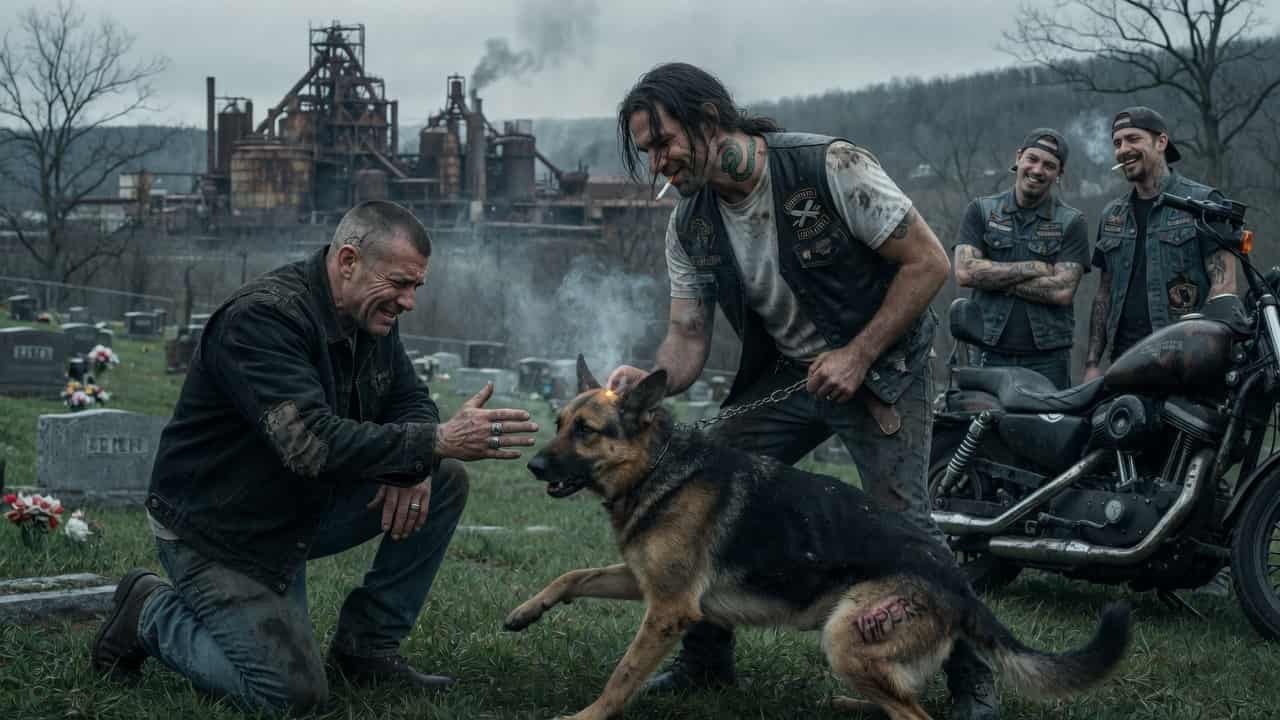
I looked at the dog—the only thing I had left of the woman I lost while I was behind bars. Diesel was cowering in the dirt of the cemetery, right next to Elena’s headstone, but he wasn’t looking at me with the love he used to have. He was looking at me like I was the one who had spent the last three years hurting him.
Across from me stood the man who had taken him. The man who knew that as long as I was on parole, I couldn’t lay a finger on him without going back to a cell. He held a lit cigarette just inches from the dog’s ear, mocking me, showing me exactly who owned what was left of my family. The guys from my old club were watching from the fence, laughing, waiting for me to break.
They think I’ve gone soft because I’m trying to go straight. They think they can humiliate the last piece of my wife’s memory and I’ll just stand there and take it.
They’re half right. I have to take it for now. But they forgot one thing about why I went away in the first place. I don’t get mad anymore. I get even. And I’m starting with the man holding that cigarette.
Chapter 1
The air in the Mahoning Valley always tasted like copper and wet pavement, a lingering ghost of the steel mills that had once been the heartbeat of the county. Now, those mills were just rusted carcasses, and I felt like one of them. I stood at the edge of the St. Jude’s cemetery, my boots sinking slightly into the soft, rain-soaked turf. It was Tuesday. I liked Tuesdays because the crowds of mourners were thin, and the groundskeepers usually stayed near the maintenance shed, leaving me alone with the quiet.
I wasn’t supposed to be here. My parole officer, a man named Miller who wore his suspicion like a cheap suit, had told me to stay away from “sites of emotional volatility.” That was his way of saying I shouldn’t go looking for the life I’d managed to destroy. But some things don’t stay buried, no matter how much dirt you throw on them.
Elena’s headstone was simple. Elena Vance. 1982–2023. Beloved Wife. I’d missed the funeral. I’d missed the three months she spent in the oncology ward, too. I’d been sitting in a six-by-nine in Grafton, counting the days until my hearing while her cells were betraying her. I hadn’t even been there to hold her hand when the machines went quiet. That was the debt I carried, a weight that made my knees ache more than the prison yard ever had.
As I approached the plot, I saw something that made the breath hitch in my throat. A shape. Low to the ground, huddled against the grey granite of the stone. At first, I thought it was a stray, some starving mutt looking for a place to die. But as I got closer, the silhouette became familiar. The broad chest, the notched left ear, the way the fur gathered in thick tufts at the scruff.
“Diesel?” I whispered. The name felt like a piece of glass in my mouth.
The dog didn’t bolt. He didn’t bark. He just shivered. This was the dog I’d bought for Elena on our fifth anniversary. I’d brought him home in a cardboard box, a ball of black and tan fluff that had eventually grown into eighty pounds of muscle and loyalty. He was supposed to be her protector while I was out on the road with the club. When I went away, he was the last thing I saw in the rearview mirror of the transport bus—Elena standing on the porch, her hand on the dog’s head.
He looked different now. He was thin, his ribs mapping out a story of neglect under a coat that had lost its shine. But it was the way he looked at me that hurt the most. There was no recognition. There was only a profound, vibrating terror.
“Hey, boy. It’s me,” I said, dropping to one knee. I kept my hands visible, palms up. I knew dogs. I knew how to read the tension in a spine, the set of a tail. Diesel was coiled like a spring, his eyes blown wide, showing the whites.
“Long way from home, isn’t he?”
The voice came from behind me, sharp and oily. I didn’t have to turn around to know who it was. Snake. He’d been a prospect when I was the Sergeant at Arms for the Iron Reapers. Back then, he wouldn’t have dared speak to me without permission. Now, he walked with the swagger of a man who knew he held all the cards.
I stood up slowly, my joints popping. Snake was leaning against a rusted Harley-Davidson parked on the narrow cemetery path. He wasn’t alone. Two younger guys, kids really, wearing the Reapers’ denim vests, stood behind him. They were the “witnesses.” Everything in the club was about witnesses. If nobody saw you do it, it didn’t happen. If everyone saw you take a hit and stay down, you were done.
“What are you doing with my dog, Snake?” I asked. My voice was flat, the way I’d practiced it in the mirror of my halfway house. No emotion. No leverage.
Snake pushed off the bike and walked toward the grave, his boots crunching on the gravel. He didn’t look at me; he looked at the dog. Diesel whimpered, a sound so small and broken it made my vision tunnel. The dog tried to press himself into the dirt, trying to disappear into the shadow of Elena’s headstone.
“Your dog?” Snake laughed, a dry, hacking sound. He reached into his vest pocket and pulled out a pack of Luckies. “Funny. I found this animal wandering the highway about six months ago. Just after your girl passed. Seems like he didn’t want to stay in that empty house any more than you did.”
“He was supposed to be with her sister,” I said. “I checked. She said he ran off.”
“Maybe he did,” Snake said, sparking a Zippo. The flame cast a harsh light on his face, highlighting the jagged scar that ran through his eyebrow. “Or maybe he knew where the real party was. He’s been living in my garage. Haven’t you, boy?”
Snake reached down. I expected him to pet the dog. Instead, he grabbed Diesel by the scruff, yanking him upward. The dog didn’t fight. He just went limp, his tail tucked so tight it was pressed against his belly.
“Get your hands off him,” I said. The words were a low rumble in my chest, a warning I hadn’t used in years.
Snake didn’t flinch. He knew the rules. “You’re on paper, Jax. One phone call to Miller and you’re back in the hole for a parole violation. ‘Aggressive behavior.’ That’s the term, right?” He blew a cloud of smoke into the damp air. “I don’t think you want to go back. Not when you just got out.”
He turned his hand, showing me the dog’s flank. I felt a coldness settle into my marrow. There, burned into the skin where the fur had been hacked away, was a brand. It wasn’t a club symbol. It was a crude, blackened ‘S’.
“He’s property now,” Snake whispered, loud enough for the guys at the fence to hear. “My property. And honestly? He’s a pathetic creature. Cries in the middle of the night. Won’t eat unless I kick him first. Just like his old man.”
The witnesses laughed. It was a practiced, sycophantic sound. They were watching to see if the legendary Jax Vance was really the ghost everyone said he was.
“I’ll buy him from you,” I said, my hands clenched into fists inside my jacket pockets. “Tell me the price.”
“He’s not for sale,” Snake said. He leaned down, bringing the glowing tip of his cigarette close to Diesel’s ear. The dog flinched, a pathetic, high-pitched whine escaping his throat. “I like having him around. He reminds me of the old days. Reminds me that even the biggest dogs eventually end up in a cage.”
Snake flicked the ash directly onto the dog’s back. Diesel didn’t move. He just looked at me, and for one second, I saw a flicker of the dog he used to be. A plea for help that I couldn’t answer without ruining the only chance I had at a life.
“Walk away, Jax,” Snake said, his voice dropping the mockery for a moment, replaced by a pure, concentrated venom. “Go back to your halfway house and your dishwashing job. This dog belongs to the Reapers now. And so does she.” He gestured vaguely at Elena’s grave with his boot.
I stood there, the grey sky pressing down on me, the smell of burnt tobacco and industrial rot filling my lungs. I wanted to kill him. I wanted to wrap my hands around his neck and feel the life leave him right there on the hallowed ground where my wife was trying to rest.
But I didn’t. I stayed rooted to the spot, watching as Snake whistled and Diesel, the dog who used to sleep at the foot of my bed, followed him toward the bike like a broken slave.
The residue of the moment stayed with me as they rode off, the roar of the engines drowning out the quiet of the graves. I looked down at Elena’s stone. I had failed her again. I had let them take the last thing she loved.
I didn’t leave right away. I stayed until the sun went down, my shadow stretching out over the grass, long and jagged and alone.
Chapter 2
The dishwashing station at O’Malley’s Pub was a humid purgatory of steam and the smell of stale beer. It was the only job I could get that satisfied the “gainful employment” clause of my parole. The owner, a man named Artie who had lost a finger in a meat grinder and his soul in a divorce, didn’t care that I’d been in prison. He only cared that I showed up on time and didn’t steal the silverware.
I worked the sprayer with a rhythmic, mindless intensity. My mind was back at the cemetery. Every time I closed my eyes, I saw that ‘S’ branded into Diesel’s skin. It was a mark of ownership, but more than that, it was a message. Snake wasn’t just keeping the dog; he was keeping a trophy of my failure.
“Vance! Front of house. Someone’s here for you,” Artie yelled over the roar of the industrial washer.
I wiped my hands on my apron and walked out. Sitting at a corner booth was Miller, my parole officer. He had a file folder open and a cup of black coffee that he wasn’t drinking. Miller was a man who believed that people didn’t change; they just got better at hiding who they were.
“Sit,” Miller said without looking up.
I sat. The booth felt too small for my frame. I felt like a bear in a child’s chair.
“I got a call today, Jax,” Miller said, finally meeting my eyes. His gaze was clinical, devoid of empathy. “Someone reported an altercation at the St. Jude’s cemetery. Said a man matching your description was threatening people.”
“I wasn’t threatening anyone,” I said. “I was visiting my wife.”
“And the motorcycle club members?”
“They showed up. I didn’t seek them out.”
Miller leaned forward, his voice dropping. “Listen to me. You’ve got eighteen months left. You’re doing well. Don’t throw it away over a grudge. Those guys? They’re looking for a reason to pull you back in. They want you to swing first so they can call the cops and watch you disappear again. Is that what you want?”
“I want my dog back,” I said.
Miller sighed, a sound of profound boredom. “It’s an animal, Jax. In the eyes of the law, it’s property. If they have the papers and you don’t, there’s nothing I can do. If you try to take it by force, you’re a felon in possession of a stolen item and committing assault. Think about the math.”
“The dog is being abused, Miller. I saw the marks.”
“Then call Animal Control. But stay away from Snake. Stay away from the club. If I hear your name mentioned in a police report again, I’m signing the revocation papers before the ink is dry on the arrest. Do we understand each other?”
“Perfectly,” I said.
I went back to the kitchen, but the steam felt like it was choking me. After my shift, I didn’t go back to the halfway house. Instead, I drove my beat-up Ford Ranger to the only place I thought might help.
The Valley Veterinary Clinic was a low-slung brick building on the edge of town. It stayed open late for emergencies. I walked inside, the bell above the door chiming with a cheerful sound that felt out of place.
The woman behind the counter was middle-aged, her hair pulled back in a severe bun. Her name tag said Sarah, DVM. She looked up from a computer screen, her expression shifting from professional curiosity to guarded caution as she took in my size and the fading tattoos on my forearms.
“We’re closing in ten minutes,” she said.
“I don’t have an animal with me,” I said. “I need advice.”
She leaned back, crossing her arms. “Advice is usually free, but treatment isn’t. What’s the problem?”
I told her about Diesel. I didn’t mention the club or the prison time. I just told her about a dog I used to own that I’d seen again. I described the weight loss, the cowering, and the brand.
Sarah’s expression softened, but only slightly. “A brand? Like a cattle brand?”
“Cigarette burns, too,” I said. “And he didn’t know me. He was terrified of my hand.”
She looked at me for a long moment, her eyes searching mine. “It’s called ‘shattered bonding.’ When an animal is subjected to prolonged, systematic abuse by a human, they stop seeing humans as individuals. They see us as a source of pain. Reclaiming a dog in that state… it’s not like the movies, Mr.—?”
“Vance. Jax Vance.”
“It’s not a quick fix, Jax. Even if you get him back, he might never be the dog you remember. He might bite you. He might never stop shaking. Sometimes, the damage is so deep that the most ‘humane’ thing is to let them go.”
“I’m not letting him go,” I said. “He’s the only thing left of my wife.”
Sarah stood up and walked around the counter. She was shorter than me, but she held herself with a quiet authority that commanded respect. “If he’s being abused, you need to document it. Take photos. Get witnesses. But if the person who has him is as dangerous as you’re implying, you’re asking for a war. Is a ‘damaged’ animal worth your life?”
“He’s not an animal,” I said, my voice cracking for the first time. “He’s my loyalty. And someone stole it.”
Sarah looked away, her gaze falling on a photo on her desk—a golden retriever running through a field. “I’ve seen men like you before, Jax. You think you’re saving the dog, but you’re really trying to save yourself. Just be careful. Sometimes when you try to pull something out of the wreckage, you just end up getting crushed by the debris.”
I thanked her and walked out into the cold night. The residue of the conversation was a bitter taste in my mouth. She saw Diesel as “damaged property.” Miller saw him as a “parole risk.” Snake saw him as a “trophy.”
Nobody saw him as the puppy who had licked the tears off Elena’s face when she got her diagnosis.
I drove past the Iron Reapers’ clubhouse on the way home. It was a fortified warehouse surrounded by a chain-link fence topped with razor wire. A dozen bikes were parked out front. Somewhere inside that building, Diesel was in a cage, listening to the roar of the world that had broken him.
I gripped the steering wheel until my knuckles turned white. I was a man of peace now. That’s what the state told me. That’s what I told myself every morning. But as I looked at that clubhouse, I felt the old Jax—the one who didn’t care about paper or math—stirring in the dark.
I wasn’t going to call Animal Control. They wouldn’t get past the gate. And I wasn’t going to wait eighteen months.
I was going to find a way to make Snake give him back. Or I was going to burn the whole thing down trying.
Chapter 3
The “Roadhouse” was a bar that smelled like floor wax and bad decisions. It was neutral ground, or as close to it as you got in this part of the state. It was where the bikers went when they wanted to drink without worrying about a rival patch walking through the door, though everyone knew the Reapers owned the local cops.
I walked in on a Thursday night. The jukebox was playing something loud and distorted—heavy on the bass, light on the melody. I saw Snake immediately. He was at a center table, surrounded by his “brothers.” He had a pitcher of beer in front of him and a smirk that seemed permanent.
I didn’t head for the bar. I headed for his table.
The room didn’t go silent, but the air changed. People noticed the way I walked—shoulders back, head up. It was the walk of a man who was done being a ghost.
“Vance,” Snake said, not looking up as he poured a glass of beer. “You’re a long way from the dish-pit. Artie give you a night off for good behavior?”
“I want the dog, Snake,” I said. I stood at the edge of the table, my shadow falling over his glass. “I’m not asking again.”
Snake finally looked up. His eyes were small and dark, like a bird’s. “You’re becoming a bit of a nuisance, Jax. I thought we settled this at the cemetery. The dog is mine. He’s got my mark on him. That’s the law of the land around here.”
“There is no law here,” I said quietly. “There’s just what you can hold onto. And you’re not going to hold onto him.”
One of the younger guys, a kid they called ‘Rat,’ stood up. He was thin and twitchy, the kind of guy who did the dirty work just to feel important. He shoved his chest against mine. “The man told you to beat it, old man. You’re past your prime. Go back to your graveyard and cry over your dead wife.”
The room did go quiet then.
I looked at Rat. I could have broken his nose in three places before he even saw my hand move. I could feel the heat rising in my neck, the familiar itch in my knuckles. But I looked past him at Snake. Snake was watching me, his hand hovering near the heavy glass pitcher. He wanted me to swing. He wanted the witnesses to see me lose control.
“Is that how it is now?” I asked, my voice steady. “The Reapers used to have a code. We didn’t mess with family. We didn’t mess with the dead. You’ve turned this club into a pack of scavengers.”
Snake laughed, but it didn’t reach his eyes. “The code went away when you did, Jax. We’re in the business of power now. And right now, I have the power to make that dog scream every time I think about your face.”
He stood up, kicking his chair back. He was a head shorter than me, but he had the confidence of a man with a gun tucked into his waistband. He reached out and poked me in the chest, right over my heart.
“You want the dog? You come to the garage tomorrow. High noon. In front of the whole club. You beg for him. You get on your knees and you tell everyone how much of a coward you were for leaving him behind. Maybe then, I’ll think about it.”
He leaned in closer, his breath smelling of hops and cheap cigarettes. “But we both know you won’t do that. You’ve got too much pride. And that pride is going to be the death of that animal.”
He turned to the room, raising his glass. “To Jax Vance! The man who loved a dog more than his own freedom!”
The bar erupted in mocking cheers. I stood there, the target of a hundred eyes, feeling the humiliation wash over me like cold water. I was the joke. I was the man who had been replaced by a coward with a brand.
I walked out of the bar without saying another word. The cool night air felt like a slap. I leaned against my truck, my heart hammering against my ribs.
The residue of the confrontation was a thick, oily shame. I had let them insult Elena. I had let them mock my grief. And I had done nothing.
But as I drove away, I realized something. Snake had given me an opening. He wanted a show. He wanted a public execution of my dignity. He thought he knew me—he thought he knew that I would never crawl.
He was right about one thing. I wouldn’t beg.
But he was wrong about the rest. I wasn’t the same man who went into prison. That man had fought for his patch. This man was fighting for the only thing that mattered.
I stopped at a 24-hour convenience store and bought a disposable camera. Then I drove to Sarah the vet’s house. I didn’t care that it was midnight. I didn’t care that I was breaking every rule Miller had set for me.
I knocked on her door until the porch light flickered on. She opened it, wearing a bathrobe, her eyes squinting against the dark.
“Jax? What happened?”
“I need you to come with me tomorrow,” I said. “I’m going to get the dog. And I need a witness who doesn’t wear a patch.”
“Jax, I told you—”
“You told me I was trying to save myself,” I interrupted. “Maybe you’re right. But if I don’t do this, there won’t be anything left to save. Please. Just be there. If things go sideways, you call Miller. But if I get him out, I need you to document what they did to him.”
Sarah looked at me for a long time. The wind whipped around us, carrying the scent of the coming rain. “You’re going to get yourself killed, aren’t you?”
“I’ve been dead since the day Elena died,” I said. “I’m just trying to make sure Diesel doesn’t have to stay there with me.”
She sighed, a heavy, reluctant sound. “Noon. I’ll meet you down the street from the clubhouse. But I’m not going inside without a reason.”
“I’ll give you a reason,” I said.
Chapter 4
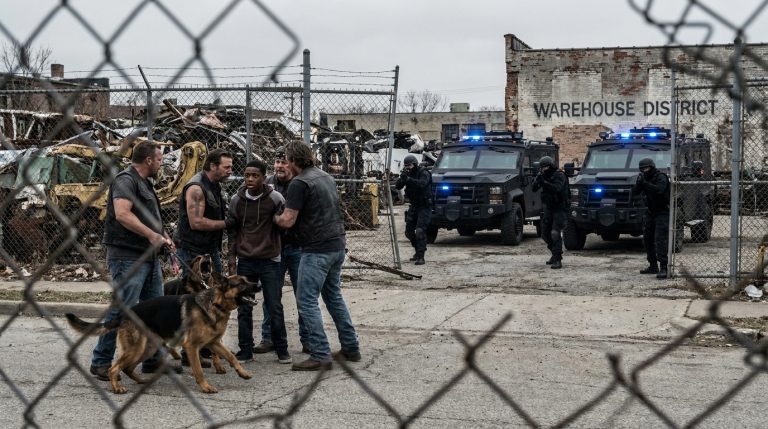
The Iron Reapers’ garage was a cavernous space filled with the smell of grease, gasoline, and old grudges. It was located in the industrial district, a place where the police didn’t go without an armored van. When I pulled up in my Ranger, there were at least twenty bikes lined up outside.
I saw Snake standing in the center of the garage, under the flickering fluorescent lights. He had Diesel on a short, heavy chain. The dog was lying on the concrete, his head between his paws. He looked even smaller in this space, a fragment of life in a world of cold steel.
The club members were gathered around the perimeter, leaning against tool chests and half-assembled bikes. They were quiet, the kind of silence that precedes a storm.
I walked in alone. I had left Sarah in her car two blocks away.
“Look who showed up,” Snake shouted, his voice echoing off the corrugated metal walls. “The prodigal son. Come to claim his prize.”
I walked to within ten feet of him. “I’m here, Snake. Let him go.”
Snake yanked on the chain, forcing Diesel to stand. The dog stumbled, his legs shaky. “You remember the terms, Jax. On your knees. In front of the patch. Tell us what a failure you are.”
I looked around the room. I saw faces I’d known for decades. Men I’d bled with. Men I’d protected. They were watching me, their expressions a mix of curiosity and contempt. They wanted to see the legend break.
I took a breath. My heart was steady now. The fear was gone, replaced by a cold, crystalline purpose.
“I’m not getting on my knees, Snake,” I said. My voice was quiet, but it carried to every corner of the room.
Snake’s face darkened. “Then you just signed his death warrant.” He reached for a heavy iron pipe leaning against a workbench.
“Wait,” I said. I reached into my pocket and pulled out a small, leather-bound notebook. It was Elena’s. I’d found it in the glove box of my truck. “You want to talk about the code? You want to talk about who belongs here and who doesn’t?”
“I don’t care about your stories, Jax,” Snake spat.
“You should care about this one,” I said. I opened the book to the back page. “This is a ledger. Elena kept the books for the club for three years while I was away. She did it because she thought you were family. She did it to keep the lights on while the rest of you were busy snorting the profits.”
A few of the older members shifted uncomfortably.
“She kept a record of every cent that went missing,” I continued. “Every ‘lost’ shipment. Every ‘unaccounted’ bribe. And you know whose name shows up the most, Snake?”
I looked directly at the President of the club, an old man named ‘Iron’ Bill who sat in a chair in the back, watching with hooded eyes.
“Snake wasn’t just stealing my dog,” I said. “He was stealing from the club. He used the chaos after Elena died to bury the evidence. He thought if he had the dog, he could keep me quiet. He thought I’d be too broken to look.”
Snake lunged at me, the pipe swinging. I didn’t move. I didn’t have to.
Two of the older members stepped forward, blocking his path. They didn’t do it for me. They did it for the money.
“Is this true, Jax?” Iron Bill asked, his voice like grinding stones.
“The book is right here, Bill. You can check the dates against the bank drops. Snake’s been skimming twenty percent off the top of the meth runs for eighteen months. He used the money to buy that new bike out front and a house in the suburbs while the rest of the prospects are living in trailers.”
The room changed. The mockery was gone. The “witnesses” were no longer looking at me; they were looking at Snake.
Snake backed away, his eyes darting around the room. “He’s lying! He’s a snitch! He’s trying to save his hide!”
“Then let Bill see the book,” I said, holding it out.
Snake didn’t wait. He didn’t think. He did exactly what a cornered rat does. He swung the pipe at the nearest member and bolted for the back exit.
He didn’t get far.
In the chaos, I didn’t look at the fight. I didn’t look at the betrayal. I looked at the dog.
I walked over to Diesel. The chain was still attached to the workbench. I reached down and unclipped it.
“Hey, boy,” I whispered.
Diesel looked at me. For the first time, he didn’t cower. He didn’t know me yet—not fully—but he saw the hand that had freed him. He stood up and pressed his head against my thigh.
I led him out of the garage. Behind me, I heard the sounds of the club dealing with Snake. It wasn’t my business anymore. I had used their own greed to break the cage.
I walked out into the sunlight, Diesel limping beside me. Sarah was waiting at the corner. She saw us and hopped out of the car, her medical bag in hand.
But as I reached the truck, I felt a hand on my shoulder. I turned around. It was Iron Bill.
He looked at the dog, then at me. “You’re lucky, Jax. The book is real. If it wasn’t, you wouldn’t be walking out of here.”
“I know,” I said.
“Don’t come back,” Bill said. “Not for your wife’s grave. Not for anything. You’re dead to this club.”
“I’ve been dead a long time, Bill,” I said. “I’m just finally starting to breathe.”
I loaded Diesel into the back of the truck. He curled up on the old blanket I’d brought from home. He was still scarred. He was still thin. He was still branded with an ‘S’ that would take months to heal.
But as I started the engine, he rested his chin on the center console and let out a long, shuddering sigh.
The residue of the day was heavy. I was a dead man to the only family I’d had left. I was probably going to lose my job for missing my shift. Miller would be waiting for me at the halfway house with a dozen questions I couldn’t answer.
But I looked at the dog in the rearview mirror.
“We’re going home, boy,” I said.
Diesel didn’t bark. He just closed his eyes.
I drove away from the industrial valley, the smoke of the mills fading in the distance. I had reclaimed my loyalty. Now, I just had to figure out how to live with the cost.
Chapter 5
The fluorescent lights of the Valley Veterinary Clinic hummed with a low, medicinal frequency that seemed to vibrate in the back of my skull. It was after-hours, the kind of quiet that feels heavy and thick, like the air right before a thunderstorm. Sarah had her glasses perched on the end of her nose, her fingers moving with a practiced, detached efficiency as she shaved the matted fur away from the brand on Diesel’s flank.
I stood by the dog’s head, my hands hovering just inches from his ears. I wanted to touch him, to tell him he was safe, but I remembered what Sarah had said about shattered bonding. To Diesel, my hands weren’t a source of comfort; they were just more tools of potential pain. He was sedated, his breathing shallow and ragged, but even in sleep, his paws twitched, running through some dark, internal field.
“It’s not just the brand, Jax,” Sarah said, her voice tight. She pointed a gloved finger at a series of small, circular scars near the base of his tail. “Chemical burns. Probably battery acid or industrial cleaner. They weren’t just trying to mark him. They were trying to break his spirit.”
I felt the familiar heat rising in my chest, that old, jagged rage that had lived in me since the day they slammed the cell door shut. I gripped the edge of the stainless steel table until the metal bit into my palms. “He was a good dog, Sarah. He was the only thing that made Elena smile toward the end.”
“He is a good dog,” she corrected, finally looking up. Her eyes were tired, the skin beneath them bruised with exhaustion. “But he’s a different creature now. Animals don’t have the luxury of rationalization. They don’t know why things happen; they just know that the world is a place where they get hurt. You can’t talk him out of that. You have to live him out of it.”
She finished cleaning the wound and applied a thick, silver-colored salve. “He needs a quiet place. No loud noises, no sudden movements. And Jax? No bikes. If he hears an engine like the ones that belonged to the men who did this, he’ll go into a fugue state. He might never come back from it.”
I nodded, though the reality of what she was saying was starting to sink in. I lived in a halfway house on the edge of the industrial district. My neighbors were addicts in various stages of collapse and men who had forgotten how to speak without shouting. My truck sounded like a bag of hammers in a dryer. My entire life was a loud noise.
“Take these,” she said, handing me a bottle of anti-inflammatories and a sedative for the night terrors. “And take this, too.” She pushed a small, frayed nylon leash across the table. “It’s light. He won’t feel the weight of a chain. It’s a start.”
I thanked her, the words feeling small and inadequate. As I carried Diesel out to the truck—he was eighty pounds of dead weight, a ghost in a fur coat—the residue of the clinic stayed with me. The smell of antiseptic and old blood, the clinical reality of what humans are capable of when they have a little bit of power and a lot of cruelty.
The next morning, the world didn’t give me a chance to breathe.
I arrived at O’Malley’s Pub ten minutes early, ready to lose myself in the steam of the dishwasher. I needed the routine. I needed the mindless labor to keep the images of the garage out of my head. But Artie was waiting for me at the back door, leaning against a stack of empty kegs, his face a mask of reluctant regret.
“Don’t even go inside, Vance,” Artie said, looking at his boots.
“I’m early, Artie. I can catch up on the prep,” I said, trying to move past him.
He stepped in front of me, his hand on my chest. “You don’t get it. Miller was here this morning. Then two detectives from the county. They were asking about an ‘altercation’ involving a stolen ledger and the Iron Reapers. They said your name is all over a witness list for a stabbing that happened at the clubhouse last night.”
I went cold. Snake. I knew the club wouldn’t let him walk, but I hadn’t expected the cops to move that fast. “I didn’t see any stabbing, Artie. I took my dog and I left.”
“It doesn’t matter what you saw. It matters who you are,” Artie said, finally looking up. There was a flicker of fear in his eyes. “The Reapers have been by twice this morning, circling the block. I got a business to run, Jax. I got a daughter in community college and a mortgage that’s three months behind. I can’t have a war starting in my kitchen.”
“I’ve done my work. I haven’t missed a day,” I argued, though I knew it was useless.
“You’re a good worker, Jax. Probably the best I’ve had. But you’re a lightning rod. And I don’t want to be the one holding the pole when the bolt hits. Here.” He reached into his pocket and handed me a wad of cash—my last week’s wages and a little extra. “Go. Don’t come back. For your sake and mine.”
I took the money. The weight of it felt like lead. As I walked back to my truck, I realized I was officially a cliché. No job, a traumatized dog, and a parole officer who was probably currently typing up my revocation papers.
I drove back to the halfway house, but I didn’t go inside. I couldn’t face the narrow hallways and the smell of bleach. Instead, I sat in the cab of the truck with Diesel. He was awake now, huddled in the corner of the passenger seat, his eyes fixed on the glove box. He didn’t look at me when I spoke to him. He didn’t wag his tail when I touched his head. He just existed in a state of permanent, vibrating readiness for the next blow.
“It’s just us, boy,” I whispered. “Just a couple of ghosts in a rusted-out Ford.”
The pressure was building. I could feel it in the way the air felt too tight, the way every passing car made me check the rearview mirror. I was waiting for the other shoe to drop, for the club to decide that the ledger wasn’t enough to pay for my disrespect. Or for Miller to show up with a pair of handcuffs and a lecture about ‘associating with known criminals.’
I spent the afternoon in a small park near the river, far from the noise of the mills. I sat on a bench, holding the light nylon leash, watching Diesel sniff at a patch of clover. It was the first time I’d seen him show curiosity since I’d found him. It was a small thing, a tiny fracture in the wall of his trauma, but it felt like a miracle.
But then, the sound of a heavy engine rumbled in the distance. A Harley. I felt Diesel’s body go rigid before I even saw the bike. He didn’t bark. He didn’t run. He just collapsed into the grass, his eyes rolling back in his head, a low, guttural whine escaping his throat.
I dropped to the ground beside him, shielding his body with mine. I didn’t care who was watching. I didn’t care if it looked like I was losing my mind. I just held him, my heart hammering against his ribs, until the sound of the engine faded into the distance.
The residue of that moment was a profound, aching clarity. I couldn’t live like this. I couldn’t keep him in a world where every passing shadow was a threat. I had saved him from the cage, but I hadn’t saved him from the fear. And as I looked at the ‘S’ branded into his skin, I realized that as long as I stayed in this town, as long as I stayed in this life, he would never be free.
I had to leave. Not just the neighborhood, but the entire valley. I had to break my parole. I had to become a fugitive for the sake of a dog that didn’t even know my name.
The moral math was simple: My freedom, or his peace.
I looked at the river, the grey water churning over the rocks, and I made my choice. I wasn’t going back to the halfway house. I wasn’t going back to the dish-pit. I was going to disappear.
I reached out and gently stroked Diesel’s ear, the one that wasn’t scarred. He didn’t flinch. He just leaned his head, ever so slightly, against my hand.
“Okay,” I said. “Let’s go.”
Chapter 6
The problem with disappearing is that you have to have somewhere to go. For a man like me, the map was a series of dead ends. Every town in this state had a sheriff who knew my face or a club chapter that remembered my name. I needed a place where the air didn’t taste like steel and the past didn’t have a long memory.
I spent the next forty-eight hours living out of the truck. I stayed in truck stops, sleeping in two-hour bursts, my hand always resting on Diesel’s back. He was getting better at the truck. He’d found a spot on the floorboards where he felt safe, tucked under the dashboard like a piece of forgotten luggage. He still wouldn’t eat from my hand, but he’d started eating the kibble I left in a bowl on the seat. Progress was measured in ounces of trust.
I was headed north, toward the lake. I had an old friend up there, a man named Silas who had done time with my father. Silas lived on a piece of land that was mostly swamp and scrub pine, a place where the law only went if there was a body to recover.
But the past isn’t something you can just outrun. It’s more like a shadow; the faster you move, the closer it sticks to your heels.
I was gassing up at a lonesome station near the county line when I saw the black SUV. It didn’t have a club patch, but it had the look—tinted windows, oversized tires, a certain aggressive stillness. My stomach dropped. I hadn’t been followed. I’d been intercepted.
I didn’t try to run. The Ranger wouldn’t win a chase, and I didn’t want to put Diesel through another high-speed panic. I walked back to the cab, reached inside, and grabbed the heavy iron lug wrench from under the seat. It wasn’t a gun, but it was a piece of the world I knew.
The SUV doors opened. Out stepped Miller and two men in suits. Not Reapers. Feds.
“You’re a hard man to find, Jax,” Miller said, walking toward me. He looked older in the harsh light of the gas station, his face lined with a frustration that went beyond paperwork. “You missed your check-in. You missed your shift. I should be calling the marshals right now.”
“Then call them,” I said, leaning against the truck. “I’m not going back to that house, Miller. Not with the dog.”
Miller stopped five feet away. He looked at Diesel, who was watching from the floorboards, his ears pinned back. “We found Snake, Jax. Or what was left of him. He’s in the ICU at St. Elizabeth’s. He told the cops everything. About the ledger, the skimming… and the dog.”
“He told the truth for once? That must have hurt more than the stabbing,” I said.
“He’s terrified, Jax,” one of the feds said, stepping forward. “He knows the Reapers are going to finish the job as soon as he leaves the hospital. He’s looking for a deal. And he says you’re the only one who can verify the entries in that ledger.”
“I gave you the book,” I said. “That’s all I have.”
“The book is coded, Jax. We need a key. And we think Elena left one with you.”
I looked at the horizon. The sun was setting, casting long, bloody streaks across the sky. I remembered a small, silver locket Elena used to wear. It had a tiny scroll of paper inside, something she said was her ‘insurance policy.’ I’d buried it with her.
“I don’t have it,” I said. “And even if I did, I wouldn’t give it to you. Every time I get involved in your ‘deals,’ someone I love ends up in a box.”
Miller sighed. “Listen to me, Jax. If you help them, they can fix your status. Not just a halfway house. Full release. A new start. Different name, different state. You and the dog could walk away from all of this.”
“At what cost?” I asked. “I spend the rest of my life looking over my shoulder for a Reaper with a grudge? No thanks. I’d rather take my chances in the woods.”
“You won’t make it to the woods,” the fed said, his voice hardening. “We have a warrant for your arrest as a material witness. You can come with us the easy way, or we can take the dog to the pound and you to the county lockup.”
The word ‘pound’ hit me like a physical blow. I looked at Diesel. He was looking at me now, his dark eyes searching mine. He didn’t know about ledgers or feds or parole. He just knew that I was the one who had opened the cage.
I felt a sudden, sharp clarity. The rescue force wasn’t the feds. It wasn’t Silas. It was the choice I was about to make.
“Give me five minutes with him,” I said.
Miller nodded to the feds. They backed off, returning to the SUV.
I knelt down by the open truck door. Diesel shifted, moving closer to the edge of the seat. I didn’t reach for him. I just talked.
“You remember her, don’t you?” I whispered. “The way she smelled like lavender and old books? The way she’d give you the crusts off her sandwiches even when I told her not to?”
Diesel’s tail gave a single, hesitant thump against the floorboards.
“I’m sorry I wasn’t there, boy. I’m sorry I left you with them. But I’m here now. And I’m going to make sure nobody ever touches you again.”
I reached into my pocket and pulled out the small, leather-bound notebook—the one I’d shown Bill in the garage. I hadn’t given them the real ledger. I’d given them a copy I’d made at the pub. The real one was still in my hand.
I walked over to Miller and handed it to him.
“Everything you need is in the margins,” I said. “The key is the date of our wedding. Tell them to start there.”
Miller took the book, his expression unreadable. “Why now, Jax?”
“Because he’s tired of running,” I said, gesturing to the dog. “And so am I.”
The deal went through, though it wasn’t as clean as the movies make it look. I spent three months in a safe house, a nondescript suburban home with bars on the windows and a yard that was mostly gravel. I told the feds everything I knew about the Reapers’ finances, every name, every drop-off point, every dirty cop on the payroll. I dismantled the world I’d helped build, piece by piece.
Diesel stayed with me the whole time. Sarah came to visit once a week, bringing specialized food and toys that didn’t squeak. We worked on the bonding. Slow walks. Gentle touches. The first time he licked my hand, I sat on the floor and cried for twenty minutes.
The residue of the past didn’t disappear, but it began to fade. The Iron Reapers were decimated by the federal indictments. Snake disappeared into the witness protection program, a man without a face in a town without a name.
Six months later, I was standing on a pier in a small town on the coast of Maine. The air didn’t taste like copper; it tasted like salt and pine. I had a new name—John—and a job hauling lobster traps for a man who didn’t ask questions about my tattoos.
I looked down at the dog sitting at my feet. Diesel’s fur had grown back, thick and glossy, though the ‘S’ brand was still a faint, hairless scar on his flank. He wasn’t the same dog he’d been before the cage. He was still jumpy around loud noises, and he slept with one eye open. But he was here.
He looked up at me, his ears perked at the sound of a seagull. I reached down and scratched the spot behind his ear, the one that used to make his back leg kick. He leaned into my hand, a deep, contented sigh vibrating through his chest.
I looked out at the Atlantic, the grey water stretching out toward a horizon that finally felt open. I had lost Elena. I had lost my name. I had lost the life I thought I was supposed to lead.
But as Diesel stood up and nudged my hand with his cold nose, I realized I hadn’t lost everything. I had saved the only piece of loyalty that was worth keeping. And in the quiet of the morning, that was enough.
The wind picked up, carrying the scent of the sea, and for the first time in three years, I didn’t look back. I just walked down the pier, the dog trotting steady beside me, toward a world that didn’t have any cages left.