“It’s just a dog, Silas. Sign the papers so we can all go home.”
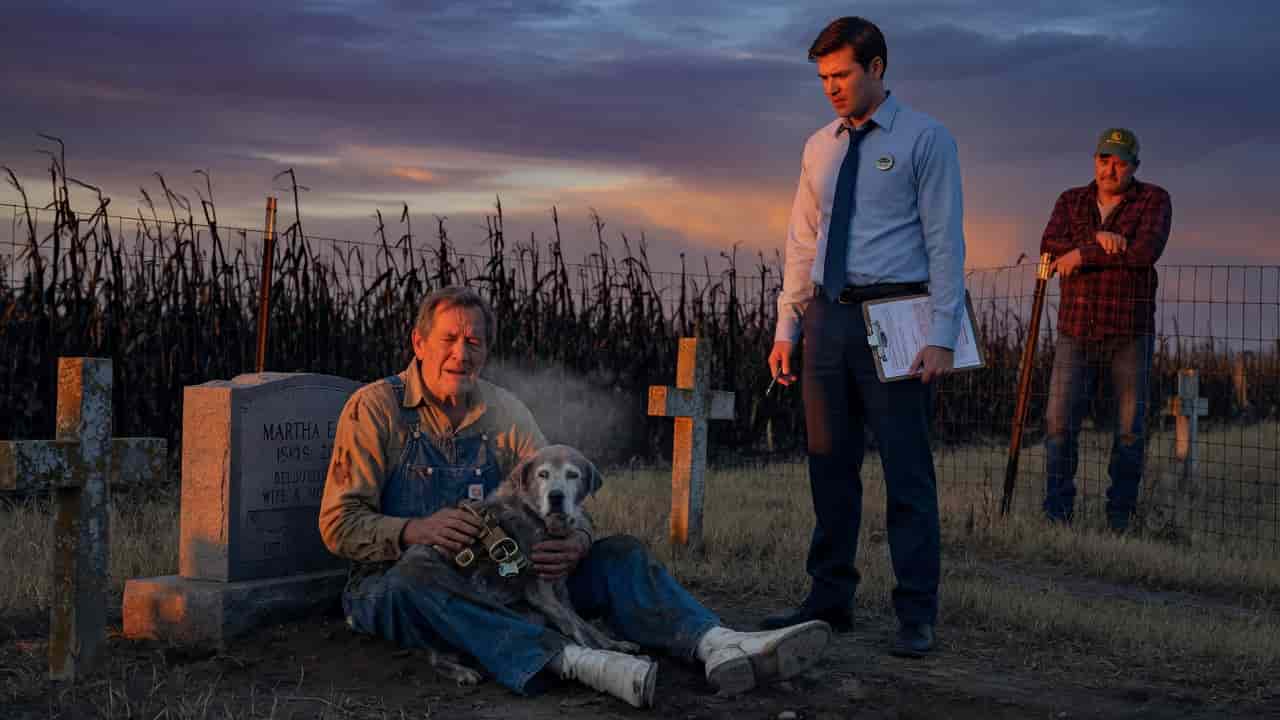
Caleb stood there in his ironed shirt, his polished shoes scuffing the dirt of the family cemetery where my Martha has been resting for a decade. He didn’t see the animal in my lap. He saw an ‘expired asset.’ He saw a reason to keep his clipboard moving.
But I saw the gray muzzle and the cloudy eyes of the friend I sold for eight hundred dollars to pay for Martha’s last round of chemo. I’d told her he ran off into the woods. I’d let her go to her rest thinking her best friend had abandoned her, all because I was too proud to tell her we were broke.
Now, twelve years later, the hunting kennel I sold him to has gone under. Somehow, that old dog found his way back to this ridge. He didn’t go to the porch. He didn’t go to the barn. He came straight here, to Martha’s side, just in time for the bank to kick me off the dirt I’ve spent fifty years sweating over.
Caleb stepped forward, his shadow covering Martha’s name on the stone. “The sheriff is at the gate, Silas. Don’t make this harder than it has to be.”
I looked at the rusted collar in my hand, the one I’d kept hidden in a coffee tin behind the flour. The dog let out a long, shuddering breath against my ribs, finally still.
“He waited twelve years for a lie, Caleb,” I said, my voice finally breaking. “And I’m the one who told it. You want this land? You’re going to have to dig me into it.”
Chapter 1: The Dust of the Ledger
The dust in the hallway of the Harrison County Courthouse tasted like old paper and forgotten promises. Silas sat on the wooden bench, his knees cracking like dry kindling every time he shifted his weight. He was seventy, but in this light, under the buzzing fluorescent tubes that hummed with a headache-inducing frequency, he felt like a hundred. He adjusted his cap, the fabric thin and greasy from years of wiping sweat, and stared at the door marked Foreclosure & Mediation.
He’d spent fifty-one years on the acre. It wasn’t just land; it was a diary written in dirt. There was the north pasture where the drainage always failed in July, the creek bed where he’d proposed to Martha with a ring that had cost him three months of corn seed, and the small, fenced-in square on the ridge where the wind always seemed to whisper her name.
The door opened, and a young man stepped out. He couldn’t have been more than twenty-five, with a haircut that cost more than Silas’s monthly grocery bill and a light-blue shirt that hadn’t seen a day of real work in its life. Caleb Miller. The bank’s “Resolution Specialist.”
“Mr. Vance? We’re ready for you,” Caleb said. He didn’t look at Silas’s eyes. He looked at the clipboard, then at the clock on the wall.
Silas stood up, his joints protesting. He followed the boy into a room that smelled of industrial lemon cleaner and stale coffee. There were no windows. Just a table, four chairs, and a stack of paper thick enough to wedge a barn door open.
“Sit down, Silas,” Caleb said, his voice practiced and smooth. “I’ve gone over the latest submission from your counsel. Or, well, the legal aid office.”
“They said there was a grace period for the drought relief,” Silas said. He kept his hands flat on the table. They were massive, calloused things, the skin stained with the permanent grease of a thousand engine repairs. They looked out of place on the polished laminate.
Caleb sighed, a sound of polite exhaustion. “That program expired in June, Silas. We sent the notices. Three of them. Certified mail.”
“I saw ’em,” Silas said. “Didn’t change the fact that the rain didn’t come. Didn’t change the fact that the price of diesel tripled while the price of beef plummeted. You want blood out of a stone, Caleb? I’ve got plenty of stone, but the blood’s run dry.”
Caleb leaned forward, and for a second, Silas saw a flicker of something human in the boy’s eyes—maybe pity, maybe just a desire to be done with the unpleasantness. “The bank isn’t a charity. We’ve extended the line of credit twice. You haven’t made a principal payment since Martha passed. We can’t justify the risk anymore.”
The mention of Martha’s name hit Silas like a physical blow. He felt the air leave his lungs. He thought of the house—the way the kitchen felt too big now, the way he still slept on only one side of the bed, the way her sewing machine sat under a sheet like a ghost in the corner of the living room.
“I need through the harvest,” Silas said, his voice dropping an octave. “If I can get the soy in, I can cover the arrears.”
“The projections don’t support that, Silas. Even with a bumper crop, you’re looking at a thirty-percent shortfall. The board has decided to move forward with the auction. We have a buyer interested in the parcel—a development group out of Des Moines. They want the highway frontage.”
“They want to put a gas station over my wife,” Silas said.
Caleb blinked. “The cemetery plot is a deeded easement, technically. They’d have to build around it. But the farmhouse, the barn… those would be cleared.”
Silas looked down at his hands. He thought about the secret he’d kept buried longer than the drought had lasted. He thought about the dog.
Blue.
Twelve years ago, when the cancer had first started eating Martha from the inside out, the bills had come in like a flood. They had insurance, but it was the kind that had more holes than a bait net. One night, Silas had sat at the kitchen table with a pile of “Final Notice” stamps staring back at him. Martha needed a specific treatment, something the doctors said might buy her a few more years, but the deductible was eight hundred dollars.
They didn’t have eight hundred dollars. They barely had eight dollars.
Old Man Miller—Caleb’s grandfather, ironically—had run a hunting kennel three counties over. He’d seen Blue, Silas’s top-tier bird dog, working the brush a month prior. He’d offered a thousand for the dog on the spot. Silas had laughed him off. Blue wasn’t just a dog; he was Martha’s shadow. He slept at the foot of her bed. He walked her to the mailbox.
But that night, watching Martha struggle to breathe, Silas had made a choice. He’d loaded Blue into the back of the truck while Martha was asleep. He’d driven the two hours in silence, the dog’s head resting on his shoulder the whole way. He’d taken the eight hundred dollars—Miller had talked him down because the dog was ‘getting on in years’—and he’d lied.
He told Martha that Blue had jumped the fence after a coyote and vanished into the timber. He’d spent a week “searching” for him, calling the dog’s name into the empty woods while Martha cried on the porch. He’d bought her the medicine with the money, and it had worked. It gave her three more years.
But she’d died still wondering where that dog was. She’d died thinking her best friend had left her when she was at her weakest.
“Silas?” Caleb’s voice broke the memory. “I need you to acknowledge the timeline. We’re giving you thirty days to vacate. If you sign the voluntary surrender today, the bank will waive the remaining deficiency. You walk away clean. No debt.”
“I don’t have anywhere to walk to,” Silas said.
“There are senior apartments in town. The county has a voucher program.”
Silas looked at the boy. He saw the polished shoes. He saw the clipboard. He felt a sudden, sharp surge of contempt—not just for Caleb, but for the whole system that turned a man’s life into a “deficiency.”
“I’m not signing anything today,” Silas said, standing up.
“It won’t change the outcome, Silas. It only makes it harder.”
“I’ve been a farmer for fifty years, son,” Silas said, leaning over the table until he was inches from Caleb’s face. “Hard is the only thing I know. You tell your board that if they want my dirt, they’re going to have to come get it themselves. And tell them to bring a shovel.”
He walked out of the room, the sound of his boots echoing like gunshots in the quiet hall. He didn’t look back. He drove home in his rusted F-150, the engine knocking with a rhythmic, dying heart. When he pulled into the gravel drive, the silence of the farm settled over him like a shroud.
He walked to the edge of the cornfield, toward the ridge. He sat down on the dry earth next to Martha’s headstone and pulled a rusted brass collar out of his pocket. He’d kept it all these years.
“I’m sorry, Martha,” he whispered. “I’m so damn sorry.”
He looked out over the fields, and for a second, he thought he saw a flash of gray movement in the tall grass at the edge of the woods. But it was just the wind. It was always just the wind.
Chapter 2: The Ghost of a Thousand Acres
The next morning, the heat arrived before the sun did. It was a thick, wet heat that smelled of turning soil and the slow decay of unpicked crops. Silas stood at the kitchen sink, splashing cold water on his face, staring at the empty bowl on the floor that hadn’t held food in twelve years. He hadn’t moved it. He couldn’t.
A heavy knock rattled the screen door. Silas wiped his face with a dish towel and walked to the porch.
Grady was standing there, his old John Deere cap pulled low over his eyes. Grady farmed the section to the east, four thousand acres of corporate-backed corn that made Silas’s little plot look like a garden. But Grady had been the first one at the house when Martha passed, and he was the only one who didn’t look at Silas like he was an exhibit in a museum of a dying era.
“Morning, Silas,” Grady said, shifting a heavy thermos from one hand to the other.
“Grady. You’re up early for a man with a GPS-guided tractor.”
Grady managed a thin smile. “Even the machines don’t like the heat. Listen, I heard about the meeting yesterday. Word travels fast at the diner.”
“Caleb Miller has a loud mouth,” Silas muttered. “Come on in. Coffee’s mostly mud, but it’s hot.”
They sat at the scarred oak table. Grady took a long pull of his coffee and sighed. “Silas, I’m gonna be straight with you. The bank’s been talking to me. They want to know if I’ll manage the lease once the development group takes over. They’re trying to keep it ‘local,’ they say.”
Silas felt a cold knot tighten in his stomach. “And what did you tell ’em?”
“I told ’em to go to hell, mostly. But then I got to thinking. If it isn’t me, it’ll be some outfit from Chicago that doesn’t know a drainage tile from a hole in the ground. If I take the lease, I can keep the cemetery clean. I can make sure nobody touches the ridge.”
Silas looked at his friend. He saw the logic, but it felt like being asked to pick which wolf got to eat your prize calf. “I appreciate that, Grady. I really do. But I ain’t leaving yet.”
“Silas, you’re seventy. The well is low, the barn roof is sagging, and the bank has more lawyers than you have teeth. Why fight ’em?”
“Because I owe it to her,” Silas said, gesturing toward the ridge. “I lied to her, Grady. About the dog. About the money. I let her die thinking I was a better provider than I was, and I let her die thinking her heart was broken by a stray pup. I ain’t letting ’em move her. Not while I’m drawing breath.”
Grady looked down at his coffee. “About the dog, Silas… that’s actually why I’m here. I saw something yesterday. Down by the old Miller place—the one the county shut down last month after the old man died.”
Silas froze. “The kennel?”
“Yeah. The bank’s clearing out the livestock. Most of the hounds went to the state, but there was one… an old gray thing. Blind as a bat. Miller’s grandson—Caleb—he told the workers to just ‘dispose’ of the ones that weren’t worth the transport fee.”
Silas’s hand shook, the coffee sloshing over the rim of his mug. “A gray Lab?”
“Matted as hell. Scars all over his ears from the brush. But when I drove past in the grain truck, that dog sat up. He put his nose in the air, Silas. He caught a scent of the wind coming off your ridge. I’d bet my best combine that it’s Blue.”
Silas didn’t say a word. He grabbed his keys off the counter and headed for the door.
“Silas! Wait!” Grady called out, following him to the porch. “You can’t just go over there. It’s bank property now. Caleb’s overseeing the liquidation. He’ll have you arrested for trespassing.”
“Let him,” Silas growled, climbing into the truck. “He’s already taking my land. He might as well take my dignity while he’s at it.”
The drive to the Miller kennel was a blur of dust and adrenaline. Silas’s heart hammered against his ribs like a trapped bird. Twelve years. A dog shouldn’t live that long in a kennel, especially not a working hound. But Blue was a fighter. He was the kind of dog that didn’t know how to quit, even when the odds were buried in the mud.
When Silas pulled into the Miller drive, he saw the silver Buick parked by the main barn. Caleb Miller was there, looking at a clipboard—always with the damn clipboard—while two men in coveralls loaded cages into a trailer.
Silas slammed the truck into park and hopped out before the engine had even stopped rattling.
“Mr. Vance?” Caleb called out, shielding his eyes from the sun. “What are you doing here? This is a restricted site.”
“I’m here for my property,” Silas said, walking toward the back of the kennel.
“The bank owns the contents of this estate, Silas. Everything here is under lien.”
“I’m not talking about a tractor, boy,” Silas spat. He pushed past Caleb, ignoring the young man’s protests.
He walked toward the last row of cages, the ones meant for the ‘culls.’ The air was thick with the smell of ammonia and old hay. In the very last run, a dog was lying on its side. It was a skeleton covered in gray fur. One of its ears was half-gone, and its breathing was a wet, ragged rattle.
“Blue?” Silas whispered.
The dog didn’t move at first. Then, very slowly, one cloudy, milky eye opened. The tail, bald at the tip, gave a single, weak thump against the concrete.
“Oh, god,” Silas choked out. He reached through the chain-link fence, his fingers catching on the wire. The dog struggled to its feet, his legs shaking, his head tilted as if trying to hear a voice from a dream.
“Mr. Vance, step away from the cage,” Caleb said, his voice rising in pitch. “That animal is diseased. He’s scheduled for euthanasia this afternoon. It’s a liability issue.”
Silas turned on him, his eyes burning with a cold, terrifying light. “You call it a liability? I call it a debt. Twelve years ago, your grandfather bought this dog from me so I could keep my wife alive. He worked this dog until he broke him, and now you want to throw him away like a rusted tin can?”
“I didn’t know the history,” Caleb said, stepping back. “But the paperwork is finalized. The dog belongs to the bank.”
“Then I’m stealing from the bank,” Silas said. He looked at the gate. It was locked with a simple padbolt. He didn’t ask for the key. He looked at a heavy iron pry bar leaning against the barn wall.
“Don’t do it, Silas,” Caleb warned. “I’ll have to call the sheriff.”
Silas picked up the bar. He felt the weight of it in his hands—the same weight as a plow, the same weight as a shovel. He swung it with every bit of rage he’d been bottling up since the first foreclosure notice arrived. The bolt snapped with a sharp crack.
He stepped into the cage and knelt in the filth. He gathered the old dog into his arms. Blue was light—so light it was like holding a bundle of dry sticks. The dog let out a soft whine and buried his gray muzzle into the crook of Silas’s neck.
“I’ve got you, Blue,” Silas whispered, his tears soaking into the dog’s fur. “I’ve got you. We’re going home.”
He carried the dog past Caleb, who was standing with his phone in his hand, his thumb hovering over the screen. Caleb looked at the dog, then at the old man whose shirt was now covered in kennel grime and dog hair. He didn’t press the button.
“You have twenty-four hours, Silas,” Caleb said, his voice trembling. “After that, the sheriff comes to the farm. For the land. For you. For all of it.”
“Then we’ll be ready,” Silas said.
He laid Blue on the bench seat of the truck, resting the dog’s head on a folded-up coat. As he drove back toward the ridge, Silas didn’t look at the fields. He looked at the dog, whose tail was thumping a steady, rhythmic beat against the upholstery.
The debt was being called in. And for the first time in twelve years, Silas felt like he might finally be able to pay it.
Chapter 3: The Residue of a Secret
The farmhouse felt different with Blue in it. The silence wasn’t empty anymore; it was filled with the sound of the dog’s heavy, labored breathing and the occasional scratch of a claw against the floorboards. Silas had cleared a space in the living room, laying down Martha’s old patchwork quilt—the one she’d been working on when her hands got too weak to hold the needle.
He’d spent the afternoon cleaning the dog. He’d moved slowly, using a warm washcloth to wipe away years of kennel grit. He found scars he hadn’t seen before—a long jagged one across the flank, a notch in the nose. Each one felt like a lash across Silas’s own back.
“I should have come for you sooner,” Silas murmured, dipping the cloth back into the basin. “I should have found a different way.”
Blue licked Silas’s hand, his tongue rough and dry. The dog was blind, that much was clear. He tracked Silas by sound and scent, his head turning toward every creak of the floor. But he was calm. There was a profound, quiet dignity in the way the animal accepted the care, as if he’d been expecting Silas to show up for twelve years and was simply relieved the wait was over.
By evening, the heat had broken into a restless, electrical tension. Thunder rumbled over the horizon, but no rain fell. Silas sat in his armchair, a glass of cheap bourbon in his hand, watching the dog sleep.
A set of headlights cut through the darkness, sweeping across the living room walls. Silas didn’t move. He knew the sound of that engine.
A moment later, the screen door groaned. Grady stepped inside, carrying a small cardboard box. He looked at the dog on the quilt and let out a long breath.
“You actually did it,” Grady said, setting the box on the table. “I figured you’d be in a cell by now.”
“Caleb Miller’s got a conscience buried under that starch somewhere,” Silas said. “Or maybe he just didn’t want the paperwork of arresting a seventy-year-old for stealing a dying dog.”
Grady opened the box. It was filled with cans of high-quality wet food and a bottle of veterinary-grade anti-inflammatories. “I stopped by the vet in town. Told him I had an old hound with stiff joints. He gave me the good stuff.”
“Thanks, Grady.”
“Silas… the sheriff called me. He’s a cousin on my mother’s side. He’s got the papers for tomorrow morning. Ten o’clock. He says he has to enforce the lockout. The bank’s bringing in a private security firm to clear the house.”
Silas took a slow sip of his bourbon. The burn in his throat felt good. “Ten o’clock.”
“Come stay at my place,” Grady said, his voice pleading. “We’ll load up your furniture, Martha’s things. We can put ’em in my machine shed. You don’t have to be here to watch ’em do it.”
“I do have to be here,” Silas said. “I’m not leaving her. And I’m not leaving him.”
He looked at the dog. Blue had woken up and was sniffing the air toward the box of food. Silas got up, his own knees popping, and opened a can. He mashed it up with a fork and set it down. The dog ate with a desperate, shaky intensity.
“He’s lived his whole life for a man who didn’t love him,” Silas said softly. “Just so I could buy three more years with a woman I couldn’t save. That’s a lot of weight for a dog to carry.”
“You did what you had to do, Silas. Martha would have understood.”
“No, she wouldn’t have,” Silas snapped, turning to face his friend. “She loved this dog more than she loved the house. She would have told me to let the cancer take her if it meant keeping Blue. That was the kind of woman she was. I made the choice for her, and then I lied about it. Every time she cried about him, I patted her hand and told her he was probably happy in the woods. I looked her in the eye while she was dying and I kept that secret.”
The room went quiet, save for the sound of the dog licking the bowl. Grady didn’t have an answer for that. There wasn’t one.
“I’m going to the ridge tomorrow,” Silas said. “If they want me off this land, they’re going to have to carry me past her grave.”
“Silas, don’t do something foolish. Don’t make them use force.”
“Force is the only thing they understand, Grady. It’s the only thing that’s real anymore.”
After Grady left, Silas didn’t go to bed. He went to the kitchen and pulled a small coffee tin from behind the flour jar. Inside was the rusted brass collar. He polished it with a bit of oil until the name ‘Blue’ and the date of Silas and Martha’s wedding—which Silas had stamped into the back of the plate years ago—shone through the tarnish.
He knelt beside the dog. “Let’s see if this still fits.”
The leather was stiff and cracked, but it settled around the dog’s neck with a familiar click. Blue let out a soft huff, his tail giving a single, rhythmic thump against the floor.
That night, Silas slept on the floor next to the quilt. He dreamed of the farm the way it used to be—the corn ten feet high, the barn painted a bright, defiant red, and Martha laughing on the porch as a young, black-coated dog chased butterflies through the yard.
He woke up at dawn to the sound of a mockingbird. The air was still and heavy. Today was the day. He dressed in his best overalls and a clean shirt. He spent the morning packing a small bag—Martha’s Bible, her wedding ring, a few photos. He didn’t touch the furniture. It belonged to the house, and the house didn’t belong to him anymore.
Around nine-thirty, he heard the first car. Then another.
He picked up Blue. The dog was weaker today, his legs buckling when he tried to stand. Silas carried him like a child, out the back door and across the yard. He walked past the sagging barn, past the rusted tractor, and up the gentle slope of the ridge.
He sat down in the tall, dry grass beside Martha’s headstone. He placed the dog in his lap, the rusted collar glinting in the morning sun.
“We’re here, Blue,” he whispered. “We’re home.”
Below them, in the driveway, a line of vehicles appeared. The silver Buick. A white SUV with ‘Sheriff’ on the side. And a large, black truck with ‘Heritage Development’ decaled on the door.
Silas gripped the dog tighter. He could feel the animal’s heart—a slow, irregular thrumming against his own chest.
“I’m not moving, Martha,” Silas said to the stone. “I’m finally telling the truth.”
Chapter 4: The Final Acre
The walk up the ridge was a slow, deliberate procession of power. Caleb Miller led the way, his silver clipboard held like a shield. Beside him was Sheriff Miller—no relation to the bank rep, but a man Silas had known since he was a boy. Behind them were two men in black tactical vests, looking deeply uncomfortable in the Iowa heat.
Grady was there, too, standing by the fence line, his hands jammed deep into his pockets. He looked like he was attending a funeral.
Silas didn’t look up as they approached. He kept his eyes on Blue’s head. The dog was resting his chin on Silas’s forearm, his breathing shallow and rattling.
“Mr. Vance,” the Sheriff said, his voice soft. “Silas. It’s ten o’clock.”
“I know what time it is, Ben,” Silas said.
Caleb stepped forward, his shoes crunching on the dry grass. He looked at the dog, then at the headstone. “Silas, we’ve already secured the house. The locks have been changed. We need you to come down now. We have a car waiting to take you to the transition center.”
“I’m not going to a center,” Silas said. He looked at Caleb. “You see this dog? You told me he was a liability. You told me he was worth nothing.”
Caleb shifted his weight. “Silas, don’t do this here. Not in front of… your wife.”
“Why not? She’s been waiting for him. For twelve years, she’s been waiting.” Silas’s voice was steady, but it had an edge to it that made the Sheriff put a hand on his belt. “I sold him to your grandfather, Caleb. For eight hundred dollars. To pay for the medicine that kept her alive. I lied to her every day until she died.”
Caleb looked at the papers on his clipboard. He looked like he wanted to be anywhere else on earth. “That’s… that’s a private matter, Silas. It doesn’t change the lien on the property.”
“It changes everything!” Silas roared, the sound echoing off the barn below. He held up the rusted collar. “This land, this house—it was built on sweat and honesty. But it was saved by a betrayal. I traded a friend for time. And now the time is up. You want the land? Fine. But you aren’t taking him. And you aren’t taking me.”
“Silas,” the Sheriff said, stepping closer. “Come on, now. Let’s not make this ugly. You’re a good man. Everyone knows that.”
“A good man doesn’t lie to his wife about her best friend,” Silas said, his voice cracking. “A good man doesn’t let a dog rot in a cage for twelve years.”
He looked down. Blue’s eyes were closed. The dog’s body was heavy, a dense weight of bone and gray fur. Silas felt a sudden, terrifying stillness. He pressed his hand to the dog’s side.
The heart had stopped.
A long, shuddering breath escaped Silas’s lips—a sound of pure, unadulterated grief that made even the men in the tactical vests look away. He pulled the dog closer, burying his face in the matted fur.
“He’s gone,” Silas whispered. “He waited until he got back to her. He waited for me to tell the truth.”
The ridge went silent. The only sound was the wind whistling through the dry cornstalks.
Caleb Miller stood frozen. He looked at the old man cradling the dead dog next to the grave. He looked at the foreclosure papers in his hand. For the first time, the numbers didn’t seem to add up. The “deficiency” was suddenly, blindingly clear.
“Silas…” Caleb started, his voice barely a whisper.
“Get off my ridge,” Silas said, not looking up. “Get off my land.”
“We have to execute the order,” one of the men in the black vests said, taking a step forward.
The Sheriff put a hand out, stopping him. “Give him a minute.”
“We don’t have a minute,” the man said. “The demolition crew is scheduled for noon. We have to clear the site.”
Grady moved then. He climbed over the fence, his boots hitting the dirt with a heavy thud. He walked up the ridge and stood behind Silas, his hand resting on the old man’s shoulder.
“The demolition crew can wait,” Grady said, his eyes fixed on Caleb. “And if they can’t, they can start with my fence. Because I’m not letting anyone touch this ridge today.”
Caleb looked at Grady, then at the Sheriff. He looked at Silas, who was rocking slightly, whispering something to the dog that no one else could hear.
Caleb took the top sheet of the foreclosure file—the one Silas was supposed to sign. He slowly crumpled it into a ball and dropped it into the dry grass.
“The site isn’t cleared,” Caleb said to the men in the vests. “There’s a… there’s a biological hazard. We can’t proceed until the remains are handled. We’re pushed back twenty-four hours.”
“That’s not the protocol,” the man said.
“I’m the bank representative,” Caleb snapped, his voice finally finding its strength. “And I’m saying we’re pushed back. Now get back to the trucks.”
The men grumbled but turned and headed down the hill. The Sheriff stayed for a moment longer, nodding to Silas, before following them.
Caleb stood there for another minute. He looked at the rusted collar in Silas’s hand. He reached into his pocket, pulled out a pen, and wrote something on the back of his business card. He set it on the corner of Martha’s headstone and walked away without a word.
Silas didn’t move. He sat there with Blue in his lap, the sun beating down on them.
“You’re home, Blue,” he whispered. “You’re both home now.”
He picked up a small hand trowel he’d brought in his bag. He began to dig. It was slow work, the earth hard and stubborn, but Silas didn’t mind. He had all the time in the world. He was a farmer, and he knew how to work the dirt.
He dug until the hole was deep enough. He laid Blue inside, still wearing the rusted collar. He covered him with the Iowa soil, the same soil that had fed his family for generations.
When he was done, he sat back and looked at the business card Caleb had left.
I’ll find a way to save the ridge. I’m sorry.
Silas closed his eyes. The residue of the secret was gone, buried in the earth. He was a man with no house, no land, and no debt. He was just a man on a ridge, waiting for the sun to go down.
He stayed there long after the trucks had gone, long after the dust had settled. He stayed until the stars came out, shining like silver coins over the dark, quiet fields.
Chapter 5: The Geography of Debt
The night didn’t bring any coolness to the ridge. Instead, the air just grew heavy, a thick, invisible blanket that smelled of damp limestone and the iron-scent of freshly turned earth. Silas sat in the bed of his F-150, his back pressed against the rusted wheel well. He’d backed the truck up as close to the cemetery fence as the terrain allowed, its tires biting into the tall, yellowed grass that he hadn’t mowed since the first foreclosure notice arrived.
His house—the place where he’d lived for fifty-one years, where he’d carried Martha across the threshold when the wood was still pale and smelling of pine—was a dark silhouette against the moonlight. The bank had changed the locks four hours ago. He’d watched from the ridge as two men in gray uniforms had methodically snapped the old brass tumblers and replaced them with shiny, soulless deadbolts. They’d slapped a neon-orange “Seized Property” sticker on the front door, the color garish and insulting under the porch light.
He didn’t care about the furniture. He didn’t care about the kitchen table where the oak was worn smooth by fifty years of coffee and bills. What he cared about was the silence. Without the dog’s breathing, without the soft click of Blue’s claws on the linoleum, the farm felt like a body with its heart cut out.
He reached into his pocket and pulled out the business card Caleb Miller had left. In the moonlight, the handwritten note on the back was hard to read, but Silas knew the words by heart. I’ll find a way to save the ridge. I’m sorry.
“Sorry don’t pay the interest, boy,” Silas whispered to the empty air.
He looked at the fresh mound of earth beside Martha’s stone. He’d spent three hours hauling river rocks up from the creek bed to cover the grave, a final barrier against the coyotes and the bureaucracy. His hands were raw, the skin split at the knuckles, but the pain was a grounding thing. It reminded him he was still there. He was still the steward of this particular acre, even if the ledger in Des Moines said otherwise.
A pair of headlights cut through the trees at the bottom of the drive. They moved slowly, bouncing over the ruts Silas hadn’t had the money to fill with gravel. The engine was low and rhythmic—Grady’s truck.
The truck stopped at the base of the ridge. The lights cut out, and a moment later, the sound of heavy boots echoed up the slope. Grady appeared at the edge of the fence, carrying a Coleman cooler and a rolled-up sleeping bag.
“You’re a stubborn old mule, Silas,” Grady said, his voice gravelly with exhaustion. He set the cooler on the tailgate with a heavy thud.
“Mules have more sense than me,” Silas replied. He didn’t move from his spot against the wheel well. “They know when the cart’s too heavy to pull.”
Grady climbed up into the bed of the truck and sat on the opposite side. He opened the cooler and handed Silas a plastic container of cold fried chicken and a thermos of coffee that smelled like it had been sitting on a gas station burner for a week.
“My wife made the chicken,” Grady said. “She said if I let you starve on this hill, she’d lock me out too.”
Silas took a piece of chicken. He wasn’t hungry, but the grease felt like fuel. He chewed slowly, looking out over the dark expanse of the farm. From up here, you couldn’t see the rust on the grain bin or the way the siding was peeling off the barn. It looked like the kingdom it had once been.
“Caleb Miller called me an hour ago,” Grady said, staring at his boots.
Silas paused, a wing halfway to his mouth. “And?”
“He was at the bank office. Said he was going through his grandfather’s old personal ledgers. The ones from the kennel. He sounded… different, Silas. Not like that kid with the clipboard. He sounded scared.”
“He should be,” Silas said. “He’s the one holding the pen.”
“He said there was something wrong with the way the dog was handled. Back in 2014. Apparently, when his grandfather bought Blue from you, he didn’t put it through the business accounts. He used bank funds—part of an old ‘agricultural acquisition’ fund that was supposed to be for equipment leases. He basically used the bank’s money to buy a personal hunting dog, then wrote it off as a loss when the dog got too old to work.”
Silas frowned. “What’s that got to do with the price of corn?”
“It means the original transaction was fraudulent, Silas. And since the bank was the entity that technically ‘owned’ the dog, and they allowed it to be mistreated for twelve years… Caleb thinks he has enough leverage to gum up the works with the development group. He’s trying to argue that the bank has an outstanding moral and legal liability to you that hasn’t been settled in the foreclosure.”
“That sounds like a lot of lawyer-talk for ‘we screwed up,'” Silas said.
“It is. But in this state, lawyer-talk is the only thing that stops a bulldozer.” Grady leaned forward, his face etched with worry. “The demolition crew is still scheduled for tomorrow at noon, Silas. The bank board is pushing the sale through anyway. They want the highway frontage for that truck stop. Caleb’s fighting ’em, but he’s just one kid in a suit.”
Silas looked at the grave. “They come for the ridge, Grady, and they’re going to find out what fifty years of being ‘stubborn’ looks like.”
“I know. That’s why I brought the sleeping bag. I figured if we’re both sitting here, maybe the Sheriff will take a little longer to find his keys.”
They sat in silence for a long time, the only sound the chirping of crickets and the distant hum of the interstate. It was the sound of a world that didn’t stop for an old man’s grief. Silas thought about Martha—the way she’d look in the mornings, her hair a silver halo in the light of the kitchen window. He thought about the lie he’d carried, the weight of it finally lifted but replaced by a hollow ache that felt twice as heavy.
He realized then that he hadn’t just been fighting for the land. He’d been fighting for the right to be forgiven. And the dog, in his final, blind trek home, had given him that. Blue hadn’t come back for the food or the warmth. He’d come back to the scent of the man who had sold him, and he’d chosen to die in his arms. It was a grace Silas didn’t deserve, and he knew it.
Around 2:00 AM, the wind shifted. It brought the smell of ozone and the distant flicker of lightning. A real storm was coming this time.
“You should head home, Grady,” Silas said. “Your crops need you.”
“My crops can wait for the rain,” Grady said, settling back against the truck cab. “I’m staying.”
While Silas sat on the ridge, forty miles away in a glass-walled office in Des Moines, Caleb Miller was staring at a computer screen until his eyes burned.
The bank’s records were a labyrinth of cold numbers and clinical descriptors. But the personal journals of his grandfather, Silas Miller Sr., were different. They were written in a cramped, aggressive script that smelled of bourbon and entitlement. Caleb had spent the last six hours cross-referencing dates.
He found it under October 2014.
“Acquired the Vance hound today. Eight hundred from the ‘Ag-Lease Discretionary.’ Dog is top-tier. Silas is a desperate man. Easy mark.”
Caleb felt a sick heat rise in his chest. He remembered his grandfather as a pillar of the community, a man who built churches and funded libraries. He didn’t remember him as a man who weaponized another farmer’s desperation.
He looked at the foreclosure file for the Vance farm. The debt was real—Silas had missed payments, the interest had compounded, and the market had shifted. Legally, the bank was within its rights. But the moral foundation was rotting.
The phone on his desk buzzed. It was his supervisor, a man named Henderson who viewed the world in terms of “basis points” and “exit strategies.”
“Caleb? Why are you still in the building? The Vance file is closed. The contractors are on-site at 0800 for the equipment sweep.”
“The file isn’t closed, sir,” Caleb said, his voice steadier than he felt. “There’s an issue with the underlying asset valuation. Specifically, a history of predatory accounting involving my grandfather and the debtor.”
There was a long, chilling silence on the other end of the line. “Caleb. Be very careful. You’re talking about the man whose name is on the lobby wall.”
“I’m talking about a liability that will cost the bank ten times the value of that highway frontage if it hits the press,” Caleb countered. “I have proof of misappropriated funds used to coerce a signature on a secondary lien back in 2015. Silas Vance didn’t just lose his farm because of a drought. He lost it because we—this bank—actively undermined his equity for over a decade.”
“You’re overreaching,” Henderson said, but his voice lacked conviction. “The board wants that development deal. They’ve already taken the earnest money.”
“Then they should be prepared to spend it on a PR firm,” Caleb said. “I’m driving back out to the site. I’m not signing off on the demolition.”
“If you go out there, Caleb, you don’t have a job to come back to.”
“I think I’m okay with that,” Caleb said. He hung up the phone and grabbed his jacket.
He drove through the night, the rain finally beginning to fall in fat, heavy drops that smeared the windshield. He thought about Silas sitting on that ridge. He thought about the dog. He thought about the way his grandfather used to talk about “the weight of the land.” He’d always thought it meant the value of the dirt.
Now he realized it meant the weight of the people who were buried in it.
He reached the county line just as the sky began to turn a bruised, sickly purple. The storm was hitting hard now, the wind whipping the cornfields into a frenzy. He saw the orange strobe lights of the demolition crew’s trucks gathered at the entrance to the Vance driveway.
He didn’t slow down. He drove past the barricade, his tires throwing up plumes of mud. He had to get to the ridge before the light hit the barn. He had to show Silas that he wasn’t just another boy with a clipboard.
Chapter 6: The Weight of the Dirt
The dawn didn’t bring light; it just turned the world a hazy, vibrating gray. The rain was coming down in sheets, a relentless, drumming roar that turned the ridge into a peninsula of mud. Silas and Grady stood under a tarp they’d stretched between the truck and the cemetery fence, watching the yellow shapes of the heavy machinery move into position at the bottom of the hill.
There were three of them—two excavators and a massive D9 bulldozer, their engines a low, guttural growl that vibrated in Silas’s teeth. A white foreman’s truck was parked near the barn, its wipers flicking back and forth with mechanical indifference.
“They’re starting early,” Grady shouted over the rain.
Silas didn’t answer. He was holding the shovel he’d used to bury Blue. He wasn’t sure what he was going to do with it—you couldn’t stop a forty-ton machine with a piece of sharpened steel—but he wasn’t going to meet them with empty hands.
The foreman stepped out of the truck, wearing a bright yellow slicker. He looked up at the ridge, shielding his eyes from the rain. He picked up a radio, and a moment later, the lead excavator began to crawl forward, its metal tracks clanking and screeching against the gravel.
It moved toward the barn first. The massive hydraulic arm reached out, the bucket’s teeth catching the edge of the roof. With a sickening groan of splintering wood, the bucket ripped away a section of the eaves.
Silas felt the sound in his own bones. That barn had been built by his father in 1948. Every beam was hand-hewn. Every nail had been driven with a prayer for a good harvest.
“They’re tearing it down, Silas,” Grady said, his voice thick with a mix of rage and helplessness.
“Let ’em have the wood,” Silas said, his grip tightening on the shovel. “As long as they stay off the ridge.”
But the excavator didn’t stop at the barn. After three more passes, the structure was a sagging, broken skeleton. The machine turned its massive body, the engine revving as it began to climb the slope.
Silas stepped out from under the tarp. The rain hit him instantly, soaking through his shirt, turning his white hair into a matted cap. He walked to the edge of the fence, the mud sucking at his boots.
“That’s far enough!” he roared, though the wind swallowed the words before they could reach the driver.
The machine kept coming. It was fifty yards away. Forty. The driver was a shadow behind a rain-streaked window, focused only on the grade of the hill.
Suddenly, a silver Buick lurched into view, coming from the direction of the house. It fishtailed through the mud, its engine screaming as it bypassed the demolition crew’s trucks and slammed to a halt directly in the path of the excavator.
Caleb Miller jumped out of the car. He wasn’t wearing a jacket. His blue shirt was plastered to his skin, and his hair was a mess. He ran toward the machine, waving his arms like a madman.
The excavator slowed, its bucket hovering ten feet above the Buick’s roof. The foreman in the yellow slicker ran toward Caleb, shouting something that was lost in the wind.
Caleb didn’t back down. He stood his ground in the mud, pointing a finger at the foreman’s chest, then pointing up at the ridge. He pulled a thick folder of papers from inside his shirt—wrapped in plastic to keep them dry—and shoved them into the foreman’s hands.
The two men stood there for what felt like an eternity, the rain lashing at them. The foreman looked at the papers, then looked up at Silas, then back at Caleb. He picked up his radio.
The excavator’s engine dropped to an idle. The arm retracted, the bucket lowering slowly to the ground.
Caleb turned and began to climb the ridge. He was slipping and sliding, his polished shoes useless in the Iowa muck, but he kept coming. He reached the fence line, gasping for air, his face pale and streaked with dirt.
“Silas,” he choked out, leaning against the wire.
“You’re late, boy,” Silas said, though the hardness in his voice had begun to crack.
“I found it,” Caleb said, holding up the folder. “The secondary lien from 2015. It was never notarized correctly. My grandfather… he bypassed the county clerk to avoid a disclosure audit. Because the dog’s purchase was tied to the original credit line, and the dog was used as collateral without a legal appraisal… the whole contract is contested. It’s a ‘clouded title,’ Silas. The bank can’t sell the land to the developers until a forensic audit is completed. That takes years.”
Silas looked at the broken barn at the bottom of the hill. “The barn’s gone, Caleb.”
“I know,” Caleb said, his eyes filled with a raw, honest shame. “I couldn’t stop that. But the ridge… and the house… we can file for a stay. Henderson’s going to fire me, and the bank’s going to sue me for breach of confidentiality, but the records are public now. I filed them with the county registrar on my way out of town.”
Grady stepped forward, looking at the papers. “You’re saying he stays?”
“I’m saying the bank doesn’t have a clear right to evict him,” Caleb said. “And after what I found in those journals… if they try to push it, I’ll take every record I have to the Des Moines Register. They’ll settle, Silas. They’ll give you a life estate just to make this go away.”
Silas looked at the boy. He saw the shivering shoulders, the mud-caked clothes, and the terrified but resolute look in his eyes. He saw a man who had finally decided what his own name was worth.
“Why?” Silas asked.
Caleb looked at the grave, then at the rusted collar hanging from the fence post. “Because my grandfather didn’t just steal a dog, Silas. He tried to steal a man’s dignity. And I’m tired of living on the interest of a lie.”
The rain began to taper off, the heavy roar fading into a steady, rhythmic patter. The machines at the bottom of the hill began to reverse, their warning beeps sounding like a retreat. The foreman walked back to his truck, and a moment later, the strobe lights vanished into the gray mist.
Silas stood there for a long time, the shovel still in his hand. He looked at Grady, who was wiping his eyes with the back of a calloused hand. He looked at Caleb, who was still shaking, his breath coming in ragged bursts.
“Come on under the tarp, son,” Silas said, his voice quiet and rough. “You’re going to catch your death out there.”
They sat in the bed of the truck, the three of them, while the storm moved off to the east. Grady shared the rest of the coffee. It was cold and bitter, but no one complained.
“What happens now?” Grady asked.
“Now,” Silas said, looking at the fresh mound of earth where Blue rested next to Martha. “Now, I think I’m going to sit here until the sun comes out. And then I’m going to start cleaning up the mess.”
“I’ll bring the tractor over tomorrow,” Grady said. “We can salvage the beams from the barn. They’re good oak. We can use ’em to build a proper fence for the ridge.”
Caleb looked down at his ruined shoes. “I don’t have a job. Or a car that’s going to make it back to Des Moines. I think the transmission gave out in the driveway.”
Silas looked at the boy. He thought about the eighty-year-old debt that had finally been paid in full. He thought about the dog who had walked home on a lie just to bring back the truth.
“The guest room’s still got a bed in it,” Silas said. “Assuming the locks haven’t jammed. You can stay until the car’s fixed. Or until the lawyers show up. Whichever comes first.”
Caleb looked up, a small, tentative smile touching his lips. “Thanks, Silas.”
The sun finally broke through the clouds around noon. It was a pale, watery light, but it caught the green of the corn and the gray of the gravestones. Silas walked over to Martha’s stone. He reached out and touched the granite, the surface cool and wet from the rain.
“He’s home, Martha,” he whispered. “We’re all home.”
He looked out over his land. It was broken, and it was scarred, and half the buildings were gone. But the dirt was still his. The weight of it didn’t feel like a burden anymore. It felt like an anchor.
He picked up his bag and the rusted brass collar. He walked down the ridge, his boots heavy with mud, Caleb and Grady following behind him. As he reached the house, he didn’t look for the key. He just put his shoulder to the door, and with one steady, stubborn push, he walked back into his life.
The silence in the house was still there, but it was different now. It wasn’t the silence of a secret. It was the silence of a man who had nothing left to hide.
He sat at the kitchen table and watched the light move across the floor. He was seventy years old, and he was starting over. And for the first time in twelve years, when he closed his eyes to sleep, he didn’t see the woods or the cages.
He saw a dog running through the tall grass, and a woman waiting at the edge of the field, and a ridge that would never, ever be moved.