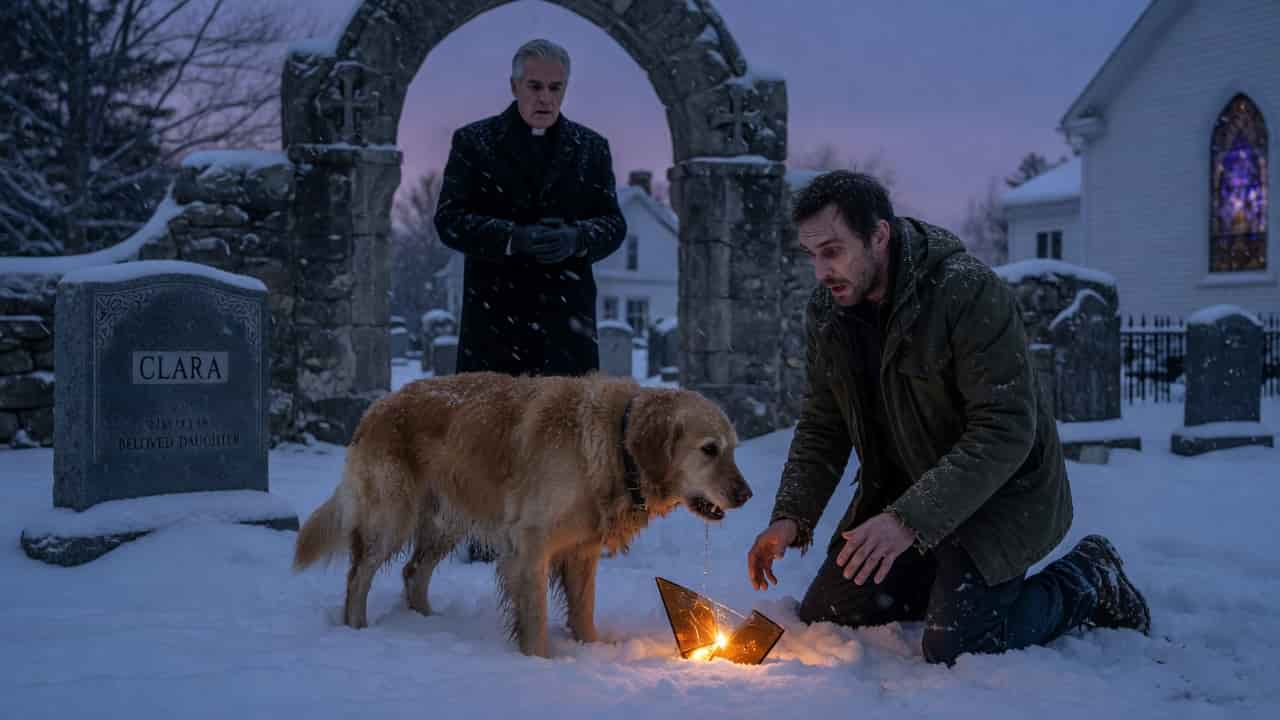
“Barnaby, drop it,” I whispered, my voice cracking in the freezing New England air.
I hadn’t seen the dog in fourteen months. Not since the night the car came out of the dark and took my sister, Clara. They called it a tragic accident. They called me a drunk who couldn’t be trusted to walk a dog, let alone protect a human being.
But as the Golden Retriever stood over Clara’s headstone, he didn’t bark. He didn’t wag his tail. He just stared at me with eyes that had seen things I’d spent a year trying to forget.
When he opened his mouth, something fell into the snow.
It wasn’t a bone. It wasn’t a toy.
It was a jagged shard of amber glass from a broken headlight—the exact color of the luxury SUV owned by the man who pays my rent and calls himself my “benefactor.”
Behind me, the local priest was watching from the church doors, his face turning as white as the drifts. He knew. The whole town knew. And they’d all watched me drown in guilt for a year while the evidence was hidden in the woods.
Chapter 1: The Weight of Winter
The Old Oak didn’t smell like history anymore; it smelled like stale Pine-Sol and the kind of desperation that only settles in after the third round of generic gin. I sat at the far end of the bar, the spot where the lighting was most forgiving to a man whose face had become a map of bad decisions. The mirror behind the rows of bottles told a story I didn’t want to read: eyes rimmed with red, a jawline that had gone soft from a diet of liquid calories, and a field jacket that had seen better decades.
“Another one, Julian?” Benny asked, not looking up from the glass he was polishing.
Benny had been tending bar in Oakhaven since I was in high school. He’d seen me as the star quarterback, the hotshot investigative reporter for the Boston Globe, and finally, the town’s most visible cautionary tale. He didn’t pity me, which was why I still drank here. He just served the glass and took the crumpled bills.
“Make it a double,” I said. My voice sounded like it had been dragged over gravel. “And put a splash of tonic in it. I’m feeling festive.”
“It’s snowing,” Benny said, nodding toward the window. Large, heavy flakes were beginning to coat the windshields of the pickup trucks lined up outside. “You walking home tonight, or am I calling you a cab?”
“Walking,” I said. “The cold helps.”
It didn’t help, of course. It just made the joints ache and the memory of the night Clara died feel sharper, like a blade being drawn across my skin. It had been a night just like this one—heavy snow, visibility down to ten feet, the world muffled and white. I was supposed to be the one walking Barnaby. I was supposed to be the one who looked both ways. But I’d been three drinks deep in the kitchen, arguing with a source on the phone, and Clara had grabbed the leash.
“I’ll be right back, Jules,” she’d said. “Don’t finish that bottle.”
She never came back. And neither did the dog.
I finished the gin, the burn a welcome distraction from the silence that always seemed to follow me. I dropped ten dollars on the bar and stood up, my head swimming just enough to make the floor feel like the deck of a ship. I zipped the M65 jacket to my chin and stepped out into the New England night.
The air hit me like a physical blow. Oakhaven was a town built on old money and older secrets, a place where the stone walls were meticulously maintained and the scandals were buried deep in the frozen earth. I started walking toward the north side of town, my boots crunching on the fresh powder. I didn’t intend to go to the cemetery. I told myself I was just taking the long way home to clear the fog in my brain.
But the iron gates of St. Jude’s always had a way of pulling me in.
The graveyard was a sea of white mounds and jagged grey teeth. I navigated the familiar path toward the Vance family plot, my breath coming in ragged plumes. When I reached Clara’s headstone, I stopped.
The snow was disturbed.
At first, I thought it was a deer. They often came down from the ridge to forage. But as I moved closer, I saw a shape huddled against the granite. It was large, golden-brown, and shivering so hard I could hear the rhythmic clicking of its teeth.
“No,” I whispered. The word felt like a stone in my throat.
The dog looked up. His fur was a disaster—matted with burrs, stained with mud, and thin in patches where the skin looked raw. A jagged white scar ran through his left eyebrow, pulling the eye into a permanent, mournful squint. It was Barnaby.
He didn’t bark. He didn’t growl. He just looked at me with a steady, haunting intelligence that made me want to turn and run.
“Barnaby?” I knelt in the snow, the cold seeping through my jeans instantly. My heart was thumping against my ribs like a trapped bird. “Where the hell have you been, boy?”
The dog didn’t move toward me. He remained pressed against the base of the headstone, right over the spot where Clara’s name was etched in cold stone. I noticed his collar then—a thick, blackened leather strap I didn’t recognize. There was a slight bulge beneath the leather, something stitched into the lining.
“Come here, pal,” I said, reaching out a hand. My fingers were shaking, and it wasn’t just the cold.
Barnaby tilted his head. He had something in his mouth. A small, dark object held firmly between his front teeth.
“What’s that? Did you find something?” I moved closer, my knees sinking into the drift. “Drop it, Barnaby. Come on. Drop it.”
The dog’s eyes flickered toward the stone archway of the church, fifty yards away. I followed his gaze. A figure was standing there, framed by the yellow light of the vestibule. Father Michael. He was a pillar of the community, a man who had presided over Clara’s funeral with a stoicism that had felt more like a warning than a comfort. He was watching us, his hands clasped tightly in front of his black overcoat.
“Julian?” the priest called out. His voice was stern, echoing off the stone walls. “What are you doing out here in this weather?”
“It’s the dog, Father!” I shouted back, my voice breaking. “It’s Barnaby! He’s back!”
Father Michael didn’t move for a long moment. Then, he began to walk toward us, his boots sinking deep into the snow. He looked less like a man of God and more like a man facing a firing squad.
I turned back to Barnaby. “Drop it, boy. Right now.”
The dog opened his jaws.
Something small and sharp fell into the snow. It glinted even in the low light—a jagged, triangular shard of amber glass. I picked it up, the edges biting into my thumb. It was a piece of an automotive headlight. But it wasn’t the cheap plastic from a sedan. This was heavy, high-quality glass, the kind used in European luxury vehicles.
The same kind of glass used in the fleet of SUVs owned by Arthur Sterling, the man who had paid for Clara’s funeral, the man who had set up a trust fund for my “rehabilitation,” and the man who currently held the deed to my house.
I looked at the shard, then at the dog, then at the priest who was now standing five feet away, his face pale and tight.
“You should go home, Julian,” Father Michael said, his voice low and dangerously soft. “The cold is playing tricks on you. That’s just a stray. And that’s just trash.”
“This isn’t trash,” I said, my fingers closing around the glass until it drew blood. “And this isn’t a stray.”
Barnaby let out a low, guttural whine, a sound that seemed to come from the very bottom of his lungs. He looked at the priest, then back at me, and in that moment, I knew the bottle wasn’t the only thing that had been keeping me in the dark.
Chapter 2: The Patron’s Price
The Sterling estate sat on the highest hill in Oakhaven, a sprawling colonial mansion that looked more like a fortress than a home. It was a place of polished brass, heated driveways, and the kind of silence that suggested the walls were built to keep sound in, not just the weather out.
I stood in the grand foyer, Barnaby sitting stiffly at my side. I’d refused to leave him in the car, and to my surprise, the housekeeper hadn’t argued. She’d just looked at the dog with a strange, flickering recognition before leading us into Arthur Sterling’s study.
“Julian, my boy. You look like you’ve been dragged through a hedge backward.”
Arthur Sterling rose from a heavy mahogany desk. At seventy, he was still a formidable presence—broad-shouldered, with a mane of silver hair and eyes the color of a winter sea. He wore a cashmere sweater that probably cost more than my car, and he smelled of expensive tobacco and cedar.
He didn’t look at me first. He looked at the dog.
“Is that…?” Arthur trailed off, his hand hovering over a crystal decanter.
“Barnaby,” I said. “He showed up at the cemetery tonight. At Clara’s grave.”
Arthur’s expression shifted instantly. The warmth vanished, replaced by a mask of professional concern. He poured a finger of scotch and handed it to me. I stared at the amber liquid. Usually, my hand would have reached for it before he even finished pouring. Today, I didn’t move.
“That’s… miraculous,” Arthur said, though he didn’t sound like he believed in miracles. “After all this time. The poor creature looks half-dead. We should get him to a vet immediately. I’ll call my personal specialist.”
“He brought me a gift, Arthur,” I said. I reached into my pocket and pulled out the amber shard, setting it on the polished surface of his desk. It looked ugly there, a serrated tooth of reality in a room full of curated lies.
Arthur didn’t flinch. He leaned in, peering at the glass through his gold-rimmed spectacles. “A piece of a bottle? Julian, the town is full of litter. Don’t tell me you’ve been listening to the wind again.”
“It’s not a bottle. It’s a headlight shard. 2023 Range Rover, amber turn signal housing.” I stepped closer, my pulse thrumming in my ears. “The police said they never found any physical evidence at the scene. They said the snow must have covered it before the morning shift arrived. But Barnaby found it. Or maybe he’s been holding onto it.”
Arthur sighed, a long, weary sound. He walked around the desk and placed a heavy hand on my shoulder. “Julian. We’ve talked about this. The police investigation was thorough. Officer Reed spent weeks on it. It was a tragedy, yes. A hit-and-run in a blizzard. But chasing shadows won’t bring her back. It’ll only send you back to the clinic.”
The threat was subtle, but it was there. The “clinic” was the high-end facility Arthur had paid for six months ago, the one that had kept me from a prison sentence after I’d totaled my own car into a telephone pole.
“Why do you have three Range Rovers in the garage, Arthur?” I asked. My voice was steady, surprising even me. “And why did you have the silver one detailed and ‘serviced’ forty-eight hours after Clara died?”
Arthur’s grip on my shoulder tightened. Not enough to hurt, but enough to let me know he could. “Because I like fine machinery, Julian. And because I was trying to help a grieving family by making sure life in this town continued as normally as possible. I have supported you. I have kept you out of the gutter. Is this the thanks I get? Accusations birthed in a barroom?”
“I wasn’t at the bar when I found him,” I said.
“Weren’t you?” Arthur smiled, but his eyes remained cold. “Benny tells a different story. He called me, you know. He was worried about you walking in the snow. He said you were ‘festive’ tonight.”
I felt the shame wash over me, thick and suffocating. It was the lever he always used. My own unreliability was his greatest weapon. If I was a drunk, my observations were hallucinations. If I was a charity case, my questions were ingratitude.
Barnaby let out a low growl. It wasn’t directed at Arthur, but at the desk. The dog moved forward, his nose pressing against the side of the mahogany.
“Get that animal away from the furniture,” Arthur snapped, his composure slipping for a fraction of a second.
I grabbed Barnaby’s collar to pull him back. As I did, my fingers brushed against the underside of the thick leather. There was a slit in the lining, a small pocket that had been crudely stitched shut. Inside, I felt something hard and rectangular.
“I’ll take him home,” I said, backing away. “You’re right, Arthur. I’m tired. I’m not thinking straight.”
“Good,” Arthur said, the warmth returning to his face like a sunbeam through a cloud. “Go home. Sleep. I’ll have some groceries sent over tomorrow. And Julian… don’t lose that dog again. It would be a shame if something happened to the only thing you have left of her.”
I walked out of that house with the amber shard in my pocket and a secret beneath my fingers. As the heavy front door clicked shut behind me, I didn’t feel like a man who had been comforted. I felt like a man who had just been given an expiration date.
Chapter 3: The Witness in the Woods
The drive back to my small, drafty cottage was a blur of white lines and paranoia. Every pair of headlights in my rearview mirror felt like a predator. When I finally locked the door and slid the bolt home, I collapsed onto the floor beside Barnaby.
The dog was exhausted. He slumped onto the rug, his breathing heavy and rattling.
“Let’s see what you’ve got, pal,” I whispered.
I took a kitchen knife and carefully sliced the stitches on the inside of his collar. A small, black plastic object fell out. A flash drive. It was encased in a waterproof mini-bag, the kind hikers use.
I stared at it for a long time. My laptop sat on the cluttered dining table, surrounded by unpaid bills and empty takeout containers. I knew that once I plugged that drive in, there was no going back. I’d be an investigative reporter again, and in Oakhaven, that was a dangerous thing to be.
I pushed the drive into the port. A single folder appeared: OAKHAVEN DEVELOPMENT – PHASE 4.
I clicked through the files. They weren’t just business contracts. They were logs. Someone had been recording the movement of Sterling’s vehicles for months. There were photos of the silver Range Rover—photos taken inside a private garage. One image showed the front bumper. The amber headlight housing was cracked. A small, jagged piece was missing.
The timestamp on the photo was 3:45 AM, January 12th.
Clara had been hit at 11:15 PM on January 11th.
“Who took these, Barnaby?” I asked.
The dog didn’t answer. He was staring at the door.
A heavy knock echoed through the house. I jumped, nearly knocking the laptop off the table. I moved to the window and peeled back the curtain. A police cruiser was idling in the driveway, its blue and red lights painting the snow in violent hues.
Officer Reed was standing on the porch. He was a man in his fifties with a permanent scowl and a reputation for being Arthur Sterling’s personal bulldog on the force. We’d gone to school together, but the only thing we shared now was a mutual dislike.
I opened the door six inches. “Bit late for a social call, isn’t it, Reed?”
“Got a report of a stolen animal,” Reed said, his eyes scanning the room behind me. He spotted Barnaby. “Arthur says you picked up a stray at the cemetery. Claims it might be the dog that went missing a year ago, but he’s worried about rabies. Says the dog looked aggressive.”
“He’s not a stray, and he’s not aggressive,” I said. “He’s my dog. You know that.”
“I know what the paperwork says, Julian. And the paperwork says you surrendered ownership rights when you went into the state-mandated program.” Reed stepped forward, forcing me to either back up or be hit by the door. “Now, Arthur wants the dog checked out by a professional. For your safety. Why don’t you let me take him down to the station? We’ll have the vet look at him in the morning.”
“No,” I said. “He stays here.”
Reed’s expression hardened. He looked at the laptop on the table, then back at me. He knew I was looking into it. The whole town was a web, and I’d just plucked a string.
“You’re making this very difficult for yourself,” Reed said. “You’re on probation, Julian. One phone call about a public intoxication incident at the Old Oak tonight, and I can have you in a cell before sunrise. Arthur’s been protecting you, but even his patience has limits.”
“Is that what he told you to say?” I felt a surge of cold, sober rage. “Or did he tell you to find the flash drive?”
Reed’s eyes narrowed. For a split second, the mask of the law-abiding officer slipped, revealing a flicker of genuine panic. He didn’t know about the drive, but he knew there was something.
“I don’t know what you’re talking about,” Reed said. “I’m here about the dog. Final warning, Julian. Hand him over.”
Barnaby stood up then. He didn’t growl. He just walked to the door and sat beside my leg, his scarred face turned up toward Reed. The officer looked down at the dog, and for the first time, I saw him flinch. He looked away, his jaw working.
“Fine,” Reed spat. “Keep the mutt. But don’t be surprised if the health inspector shows up tomorrow. This house is a pigsty, and you’re a mess. You won’t hold onto him for long.”
He turned and stomped back to his cruiser. I watched him drive away, but I didn’t feel like I’d won. I felt like I’d just triggered a countdown.
I went back to the laptop. I needed to know who had taken those photos. I scrolled to the bottom of the file list. There was a text document titled READ_ME_JULES.
My heart stopped.
Jules, if you’re reading this, it means Barnaby found his way back. I knew he would. He’s smarter than both of us. I saw the car that night. I saw who was driving. I couldn’t tell you then because I was scared of what he’d do to you. He owns this town, but he doesn’t own the truth. Go to Mrs. Gable’s house. Ask her about the night the lights went out.
The note wasn’t signed, but I knew the syntax. I knew the way the letters were phrased.
It was from Clara. She’d been investigating Sterling before she died. She hadn’t been walking the dog; she’d been tracking a killer. And I’d been too drunk to notice.
Chapter 4: The Public Humiliation
The Oakhaven Community Center was draped in black and gold for the annual “Clara Vance Memorial Scholarship” gala. It was the centerpiece of the town’s social calendar, a night where the elite gathered to pat themselves on the back for their generosity while sipping champagne and pretending the girl the scholarship was named after hadn’t been left to freeze in a ditch.
I hadn’t slept. I’d spent the night at Mrs. Gable’s—a terrified woman who had seen the silver SUV speed away from the scene—and the morning gathering the last pieces of the puzzle. I looked like hell, but I’d traded my field jacket for a wrinkled charcoal suit I’d dug out of the bottom of my closet.
I walked into the ballroom, Barnaby at my side on a new, sturdy leash. The music stopped for a heartbeat as we entered. The whispers started immediately, a low hiss of judgment that followed us like a shadow.
“Is that him?”
“He brought the dog? How tasteless.”
“I heard he was back on the bottle.”
I ignored them. I scanned the room until I saw Arthur Sterling. He was standing on the stage, a microphone in his hand, looking every bit the benevolent king. Father Michael was seated in the front row, looking miserable.
“And so,” Arthur’s voice boomed, “we honor the memory of a young woman taken too soon. Clara Vance was a light in our community. And while her brother, Julian, has struggled with his… demons… we must remember that the Sterling Foundation is committed to supporting those who cannot support themselves.”
He looked directly at me then, a cruel, triumphant smile playing on his lips.
“Julian,” Arthur said into the microphone, his voice dripping with feigned pity. “I’m so glad you could join us. Although, perhaps you should have left your companion at home. This is a black-tie event, not a kennel.”
A ripple of mocking laughter went through the room. I felt the heat rise in my neck, the old familiar shame trying to pull me under.
“I have something to say, Arthur,” I said. My voice was amplified by the silence of the room.
“I’m sure you do,” Arthur said, stepping down from the stage. He approached me, the crowd parting like the Red Sea. He leaned in close, his voice dropping to a whisper that only I could hear. “Don’t do this, Julian. You’re drunk. Everyone can see it. You smell like a distillery. If you say one word, I’ll have Reed escort you to the county lockup for public disturbance. I’ll make sure you never see that dog or this town again.”
“I’m not drunk, Arthur,” I said, loud enough for the front row to hear. “For the first time in a year, I’m perfectly sober.”
I pulled the amber shard from my pocket and held it up. The crystal chandeliers caught the light, making the glass glow like a coal.
“This is a piece of your car, Arthur. The one you had repaired the morning after my sister died. And I have the photos to prove it. Photos taken by Clara. She knew what you were doing with the development funds. She knew you were skimming from the town’s heritage trust. And when she tried to stop you, you ran her down.”
The room went dead silent. Arthur’s face didn’t change, but his eyes went dark with a murderous intensity.
“He’s delusional,” Arthur said to the room, his voice steady. “Someone call the paramedics. He’s having a breakdown.”
“I’m not the one having a breakdown,” I said. I looked at Father Michael. “Father, tell them. Tell them about the dog. Tell them why you were at the cemetery last night, waiting for Barnaby to show up. You knew she’d hidden the evidence on him, didn’t you? You were the one who helped her, until you got scared.”
Father Michael stood up, his face ashen. He looked at Arthur, then at me, then at the scarred dog sitting at my feet.
“Julian…” the priest started, his voice trembling.
“Say it!” I shouted. “Say it in front of all these people you’ve been lying to! Tell them what happened on January 11th!”
Reed stepped out from the side of the stage, his hand on his holster. “That’s enough, Julian. You’re under arrest.”
He grabbed my arm, twisting it behind my back. The amber shard fell from my hand, clattering onto the hardwood floor. The crowd gasped, but nobody moved to help. Arthur stood over me, looking down with a cold, detached contempt.
“You always were a disappointment, Julian,” Arthur whispered. “Just like your sister.”
Barnaby lunged then. He didn’t bite, but he threw his weight against Reed’s legs, knocking the officer off balance. I wrenched my arm free and grabbed the microphone from the stand near the edge of the stage.
“The flash drive is already with the state police!” I lied—it was still in my pocket, but I needed the leverage. “If anything happens to me or this dog, the whole world finds out who really runs Oakhaven!”
Arthur froze. For the first time, I saw the fear. It was a small, flickering thing, deep in the back of his eyes, but it was there.
“Reed,” Arthur said, his voice tight. “Let him go.”
“Arthur?” Reed looked confused.
“Let him go!” Arthur roared.
Reed stepped back, his face a mask of fury. I stood there, breathing hard, the silence of the ballroom pressing in on me like a physical weight. I had the room, but I didn’t have the victory. Not yet.
I looked down at Barnaby. The dog was staring at Arthur, his lips pulled back in a silent snarl.
“We’re leaving,” I said.
I walked out of that ballroom with my head held high, the eyes of the town on my back. But as I stepped out into the cold night air, I felt the first sting of the retaliation I knew was coming. I had poked the beast, and now I had to survive the bite.
Chapter 5: The Residue of Truth
The drive back from the Community Center felt like navigating a tunnel that was slowly collapsing. My hands were clamped so tight on the steering wheel that my knuckles looked like polished bone. Beside me, Barnaby was a warm, heavy weight, his rhythmic breathing the only thing keeping me from spinning the car into the nearest stone wall just to see if the world would finally stop shaking.
I’d done it. I’d stood in front of the town’s golden calf and called him a butcher. But the adrenaline that had carried me through the ballroom was curdling into a cold, hollow dread. In Oakhaven, you didn’t challenge the weather, and you didn’t challenge Arthur Sterling. Doing both in one night felt less like bravery and more like a suicide note written in amber glass.
I didn’t go back to the cottage. I knew Reed would be there within twenty minutes, “probation check” or not. Instead, I pulled onto a dirt track that wound through the dense hemlock forest toward the old boat house on Blackwood Pond. It was a property my grandfather had owned before the Sterling Foundation “acquired” it in a tax lien sale six years ago. It was dilapidated, forgotten, and currently sat in a legal limbo that meant it was the only place in town where I might have a ghost of a chance at a head start.
The snow was coming down in thick, wet sheets now, the kind that turned the world into a featureless white void. I parked the rusted Subaru under a cedar overhang and sat in the dark for a long minute, watching the flakes melt against the windshield.
“We’re in it now, Barnaby,” I whispered.
The dog shifted, his head resting on the center console. He looked at me with that same haunting, steady gaze. He wasn’t scared. He’d lived in the woods for a year; he knew how to survive the cold. It was the man in the charcoal suit who was out of his element.
I pulled the laptop and the flash drive from my bag. My fingers were numb, making it hard to navigate the trackpad. My mind kept drifting back to the night Clara died. I could see her standing in the kitchen, the light catching the gold in her hair. I could see the bottle of Tanqueray sitting on the counter, three-quarters empty. I could hear the way I’d snapped at her for interrupting my phone call.
“Just go, Clara. The dog needs a walk and I need to finish this story.”
I’d wanted that story—some meaningless piece about local zoning corruption—more than I’d wanted to keep her safe. The shame was a physical taste in my mouth, like copper and bile. Sterling hadn’t just taken her life; he’d weaponized my own failure to ensure I could never be the one to seek justice. He’d spent a year feeding my addiction, paying my bills, and keeping me in a state of perpetual, grateful haze. Every check he’d signed was a shovel full of dirt on Clara’s memory.
I clicked into a second folder on the drive, one I hadn’t seen earlier. It was labeled LOGS.
There were audio files. I hit play on the first one.
“…I know you’re listening, Arthur. I know about the offshore accounts. I know the scholarship fund is just a laundry for the land acquisition in the valley. You think because you bought my brother, you own me too?”
It was Clara. Her voice was sharp, fearless, and so vibrantly alive that I had to close my eyes to keep the tears from spilling.
“I’m not Julian,” she continued, her voice dropping to a low, dangerous hiss. “I don’t need your money. And I don’t need your forgiveness. I’m going to the state authorities on Monday. If you want to stop me, you better find a way to make the whole town disappear.”
Then there was a second recording. It was muffled, recorded from inside a pocket.
“She’s becoming a liability, Arthur.” That was Reed’s voice. “The girl is digging into the environmental impact reports for the north ridge. She’s got documents.”
“Then handle it, Reed,” Sterling’s voice was unmistakable—resonant, calm, and utterly devoid of empathy. “Not like the last time. Make it look like a tragedy. People expect tragedy in the winter. It’s part of the New England charm.”
I felt the air leave my lungs. It wasn’t just a hit-and-run. It was a planned execution. And they’d timed it for a night when they knew I’d be too drunk to provide an alibi, too intoxicated to be a credible witness, and too broken to fight back.
A sudden flash of light hit the rearview mirror.
I slammed the laptop shut and shoved it into my bag. Two sets of headlights were coming down the dirt track, moving fast. They weren’t police cruisers. They were the black SUVs that belonged to Sterling’s “security team”—the men who handled the things Reed couldn’t do in uniform.
“Move, Barnaby!”
I threw the car into reverse, tires spinning wildly on the ice. I didn’t have a plan. The boat house was a dead end. To the left was the frozen pond, to the right was the forest. The only way out was through them.
I shifted into drive and floored it, aiming the Subaru directly at the gap between the two approaching vehicles. The roar of the engine filled the cabin, a desperate, mechanical scream. One of the SUVs veered to the side, trying to box me in, but I clipped their front bumper, the impact jolting my teeth. The Subaru fishtailed, the rear end swinging out over the embankment, but the tires caught a patch of gravel and propelled us forward.
I didn’t look back. I drove with a frantic, focused clarity I hadn’t felt in years. The gin was gone, replaced by a cold, needle-sharp adrenaline. I knew these roads better than Sterling’s hired muscle did. I knew where the frost heaves were, where the black ice settled, and where the old logging trails cut through the ridge.
I turned off my headlights, navigating by the pale moonlight reflecting off the snow. It was a move born of pure desperation, a trick I’d seen in movies but never thought I’d have to use. The world turned into a ghostly landscape of grey and silver. I could feel Barnaby’s breath on my neck, his paws bracing against the seat as we bounced over the uneven terrain.
We reached the old covered bridge at the edge of the county line. I pulled the car into the shadows of a collapsed barn and cut the engine. The silence that followed was terrifying. I sat there, chest heaving, listening to the ticking of the cooling metal.
“They’re not going to stop,” I said, more to myself than the dog. “Sterling can’t let us leave the county.”
I looked at the flash drive. I had the evidence, but evidence was only useful if you were alive to present it. In Oakhaven, the law was a garment Sterling wore when it suited him and stripped off when it didn’t.
I reached into my pocket and pulled out the amber shard. I looked at it for a long time. It was the key to everything—the physical proof that linked Sterling’s car to the scene. But it was also a mirror. It reflected the man I’d been for the last year: a man who had sold his sister’s life for the comfort of a bottle and a patron’s lie.
“I have to go back,” I whispered.
Barnaby let out a low, mournful whine. He knew. He’d been waiting for me to say it.
I couldn’t just run. If I ran, I was proving Sterling right. I’d be the disgraced drunk who stole a dog and vanished into the night with a head full of delusions. To win, I had to face him in the one place where his power was most vulnerable: the center of the town he thought he owned.
I started the car. My hands were steady now. The residue of the gala, the shame of the bar, the weight of the winter—it was all still there, but it wasn’t holding me down anymore. It was the fuel.
“We’re going to finish this, Clara,” I said. “I’m going to finish the story.”
Chapter 6: The Final Edition
The Oakhaven Town Hall was a Greek Revival monument to local pride, its white pillars glowing under the high-intensity streetlamps of the square. It was 3:00 AM, and the town was a tomb of white and shadow. I knew Sterling would be there. It was his second office, the place where he signed the deals that slowly strangled the life out of the valley.
I walked through the front doors, Barnaby at my heel. The night janitor, an old man named Sal who had known my father, didn’t even look up from his mop. He just nodded, his eyes weary. Everyone in this town knew something was coming. The air felt charged, like the moment before a lightning strike.
I took the stairs to the second floor. Arthur Sterling’s private office was at the end of the hall, the door slightly ajar. A sliver of warm yellow light spilled out onto the hardwood.
I pushed the door open.
Sterling was sitting in a high-backed leather chair, a glass of brandy in his hand. He didn’t look surprised. He looked bored. Officer Reed was standing by the window, his hand resting on his belt, his face a mask of exhausted frustration.
“You’re a difficult man to help, Julian,” Sterling said, his voice smooth and resonant. “I’ve given you every opportunity to live a quiet, comfortable life. I’ve cleaned up your messes. I’ve paid for your sins. And yet, here you are, dragging that poor beast into a situation you don’t understand.”
“I understand it perfectly, Arthur,” I said. I walked to the center of the room and set my laptop on the conference table. I didn’t open it. Not yet. “I understand that Clara found out about the offshore accounts. I understand that you couldn’t buy her off like you bought me. And I understand that you told Reed to ‘handle it’.”
Sterling laughed, a dry, mirthless sound. “Allegations from a man who spent his evening at the Old Oak. Do you really think anyone will listen? You’re a footnote, Julian. A tragic, alcoholic footnote.”
“I’m an investigative reporter,” I said, my voice dropping an octave. “And I have the audio logs.”
Reed shifted, his eyes darting toward Sterling. The billionaire’s smile faltered for a fraction of a second. It was the only opening I needed.
“I have the recordings of you and Reed discussing her ‘liability’,” I continued. “I have the photos of the damaged Range Rover in your private garage. And I have the amber shard that matches the housing on that car—the one Barnaby found at the grave.”
“Give me the drive, Julian,” Sterling said. The warmth was gone now. His voice was cold, clinical. “Give it to me, and I’ll make sure you get out of this town alive. I’ll give you enough money to disappear. You can drink yourself to death in the Caribbean for all I care. Just give me the drive.”
“That’s the difference between us, Arthur,” I said. I reached out and stroked Barnaby’s head. The dog leaned into my hand, his presence a solid, grounding force. “You think everything has a price. You think my sister’s life was just a line item in a budget. But the truth doesn’t have a price. It just has a cost.”
I opened the laptop and hit ‘Send’.
“What did you do?” Reed stepped forward, his face pale.
“I didn’t send it to the state police,” I said. “I sent it to the Boston Globe. To my old editor. He’s been waiting for a reason to dig into your foundation for years. By 6:00 AM, it’ll be on the front page of the digital edition. By noon, it’ll be on every news cycle in the country.”
Sterling stood up, his face contorting into a mask of pure, unadulterated rage. He looked like he wanted to leap across the table and choke the life out of me.
“You’ve ruined yourself,” Sterling hissed. “Do you think you’re a hero? You’re the reason she’s dead! You were the one who let her go out into that storm! You were the one with the bottle!”
“I know,” I said. The words felt like they were being ripped out of my chest. “I have to live with that every second of every day. That’s my sentence. But yours? Yours is just beginning.”
Reed looked at Sterling, then at me, then at the door. He was a man realizing the ship was sinking and he was the only one still holding the anchor.
“Arthur,” Reed whispered. “We have to go.”
“I’m not going anywhere,” Sterling spat. He looked at me with a hatred so deep it felt like a physical heat. “You think the world cares about one girl in a small town? I built this valley. I own the banks. I own the roads. I’ll be out on bail before the sun sets, and I’ll bury you so deep the worms won’t even find you.”
“Maybe,” I said. “But you’ll never be the King of Oakhaven again. Everyone will know. Every time you walk down the street, every time you sit in that church, they’ll see the man who ran down a girl and hid behind a drunk.”
I turned and walked toward the door. Barnaby followed me, his claws clicking on the polished floor.
“Julian!” Sterling screamed behind me. “You have nothing! You’re nothing!”
I didn’t look back. I walked down the stairs, through the foyer, and out into the biting New England wind. The snow had stopped, and the clouds were breaking, revealing a sliver of pale, pre-dawn light on the horizon.
I sat on the steps of the Town Hall and pulled Barnaby close. The dog leaned his head against my shoulder, his fur smelling of pine and cold earth. For the first time in fourteen months, the silence didn’t feel like a threat. It felt like a beginning.
I reached into my pocket and pulled out the amber shard one last time. I looked at it, then leaned over and pressed it into the soft, fresh snow of the flowerbed. It vanished instantly, buried in the white.
“It’s over, Clara,” I whispered.
I wasn’t a hero. I was still a man with a thousand regrets and a long, hard road of sobriety ahead of me. I was still the man who had failed his sister when she needed him most. But as I watched the first true rays of the sun hit the white pillars of the square, I knew I wasn’t a ghost anymore.
The story was out. The residue of the past was still there, but it wasn’t the only thing left.
I stood up, whistled for the dog, and started walking. We didn’t have a home to go back to, and we didn’t have a patron to protect us. But for the first time in my life, I knew exactly where I was going.
We walked away from the center of town, two shadows moving against the brightening white, leaving a trail of deep, steady prints in the virgin snow. The world was cold, and the truth was dangerous, but as the day broke over Oakhaven, the silence finally felt like peace.