“Arthur, get your hands out of that dirt. You’re making a scene in front of the whole town.”
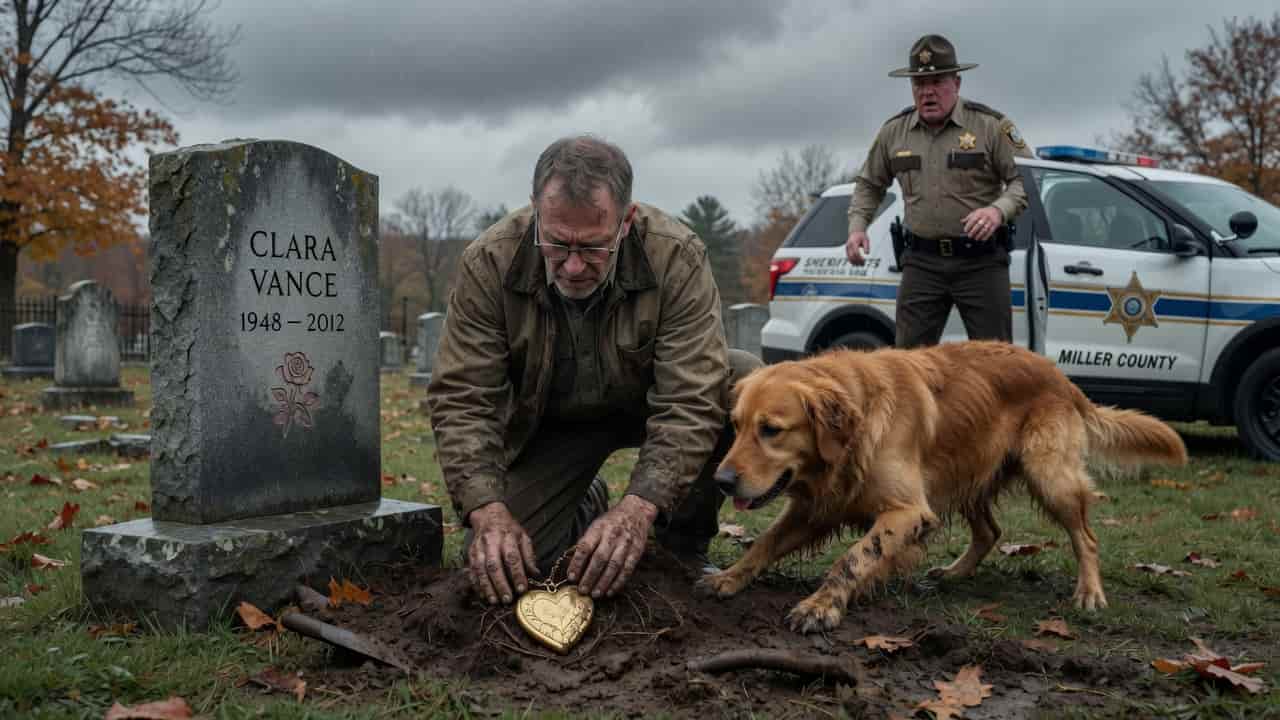
I didn’t look up at Jim. I couldn’t. My fingers were brushed against the cold, tarnished gold of the locket—the one Jim had sworn under oath was lost on the mountain the day Clara fell. My wife’s dog, Ranger, stood over the hole he’d spent the last hour digging, his ribs showing through matted fur, his eyes fixed on the man in the tan uniform.
“He found it, Jim,” I whispered, my voice cracking like dry timber. “He’s been gone seven years, and the first thing he does is lead me here to find the proof you said didn’t exist.”
Jim stepped into my space, the shadow of his Stetson blotting out the grey New England sky. I felt his hand wrap around my wrist, his grip tight enough to bruise, his breath smelling of stale coffee and panic.
“I said give it to me, Arthur. You’re not well. Everyone in this town knows you’ve been losing it since she died. Don’t make me haul you out of here in cuffs for desecrating a grave.”
I looked at the locket, then at the man who had been my brother-in-law for thirty years. For seven years, I’d believed his story. For seven years, I’d lived in the silence of his lies.
But Ranger wasn’t lying. And the blood on the gold was still there.
Chapter 1: The Tick of the Seventh Year
Arthur Vance lived his life by the escapement. In the quiet, cedar-scented air of his workshop, the world was reduced to the predictable movement of brass gears and the steady, rhythmic pulse of hairsprings. To the people of Blackwood, New Hampshire, Arthur was a relic—a man who spent twelve hours a day squinting through a jeweler’s loupe at the guts of grandfathers and cuckoos. They called him “The Clockwork Man,” a nickname that carried a hint of pity. They thought the precision of his work was a shield against the messiness of his grief.
They weren’t entirely wrong.
It was October 7th, the seventh anniversary of the day the world stopped making sense. Arthur sat at his bench, the guts of a 19th-century French mantle clock spread across a velvet cloth. His hands were steady, a result of forty years of muscle memory, but his mind was a fractured thing. Every year on this date, the gears in his head seemed to slip.
“Arthur? You in there?”
The bell above the door chimed—a bright, silver sound that felt like a needle in Arthur’s ear. He didn’t look up. He knew the heavy, rhythmic tread. He knew the smell of Pine-Sol and cheap leather.
Sheriff Jim Miller leaned against the counter, his tan uniform crisp despite the humidity rolling off the Atlantic. Jim was a large man, built like a localized weather system, all broad shoulders and cooling humidity. He’d married Clara’s sister thirty years ago, and since Clara’s “accident,” he had assumed the role of Arthur’s self-appointed guardian.
“Closing up early?” Jim asked. His voice was too loud for the room, a blunt instrument in a space meant for scalpels.
“In a minute,” Arthur said, finally setting down his tweezers. He popped the loupe from his eye, blinking at the sudden blur of the room. “The mantle clock is stubborn. Someone used WD-40 on the pivot. People treat things they don’t understand like they’re rusty hinges.”
Jim grunted, his eyes roaming the shop. He stopped at the small, framed photo of Clara sitting on the edge of Arthur’s desk. In the photo, she was laughing, a Golden Retriever puppy named Ranger jumping at her knees. “Seven years, Artie. Long time to keep the clocks wound for a ghost.”
Arthur felt the familiar prick of heat behind his neck. “I don’t keep them wound for her, Jim. I keep them wound because that’s what they’re for.”
“Right. Look, the girls are having a dinner tonight. Sarah wants you there. She’s worried. You haven’t been answering your phone.”
“I’m going to the cemetery,” Arthur said, his voice flat. “Like I do every year.”
Jim’s expression shifted. The forced conviviality slid away, replaced by a weary, professional hardness. “It’s an empty grave, Arthur. The fall was three hundred feet into the ravine. The search and rescue team… we did everything. The mountain doesn’t give back what it takes. You’re just staring at a piece of granite.”
“I’m staring at the only thing I have left of her,” Arthur replied. He stood up, his bones popping. He felt older than sixty-five. He felt like one of his clocks—overwound and nearing the point where the mainspring snaps.
Jim sighed, a sound of profound theatrical patience. “Fine. Go. But don’t stay out there until dark. The weather’s turning.”
Arthur watched him leave, the bell chiming again as the door closed. He waited until the cruiser pulled away before he grabbed his canvas jacket.
The Blackwood Cemetery sat on a ridge overlooking the town, a collection of leaning slate and polished marble that had been catching the wind for two centuries. Clara’s stone was near the back, under a sprawling oak that had dropped a carpet of orange leaves across the grass.
Arthur knelt. He didn’t pray; he didn’t believe in a God who would let a woman like Clara slip off a trail while her husband was fifty yards ahead, looking at a hawk. He just sat. He talked to her about the clocks. He talked about the way the light hit the workshop in the afternoons.
Then, he heard it.
It wasn’t a ghost. It wasn’t the wind. It was a low, ragged breathing. A wet, rhythmic sound that shouldn’t have been there.
Arthur turned his head.
Standing at the edge of the woods, where the manicured grass gave way to the tangled undergrowth of the mountain, was a dog. It was skeletal, its ribs standing out like the rafters of a ruined house. Its fur, once a bright, honey-gold, was now a grey-brown mat of burrs, mud, and something darker. One ear was torn, and its gait was a limping, painful shuffle.
Arthur’s heart didn’t beat; it hammered. “Ranger?”
The dog stopped. It tilted its head, a gesture so familiar it made Arthur’s vision swim. Then, with a sudden, desperate whine, the animal broke into a run—or as much of a run as its failing body could manage. It collapsed against Arthur’s chest, a mass of wet fur and trembling heat.
“You’re alive,” Arthur whispered, his hands disappearing into the dog’s matted coat. “How are you alive?”
The dog didn’t answer. It pushed past him, its nose hitting the base of Clara’s headstone. With a sudden, frantic energy, Ranger began to dig. His claws, worn to the quick, tore at the damp turf.
“Ranger, stop. Buddy, hey.” Arthur tried to pull him back, but the dog growled—a sound of pure, concentrated urgency.
Arthur watched, paralyzed, as the dog unearthed a layer of fresh New Hampshire loam. And then, something caught the grey light of the afternoon. A flash of gold.
Arthur reached into the hole. His fingers closed around something cold and hard. He pulled it free, wiping away the mud with his thumb.
It was a locket. A gold heart, the hinge bent, the surface scratched. But it wasn’t empty. And it wasn’t clean. There was a dark, reddish-brown crust dried into the crevices of the engraving.
“Arthur! What the hell are you doing?”
The voice cracked like a gunshot. Arthur looked up. Jim Miller was standing ten feet away, his cruiser idling at the cemetery gate. He must have followed him. But Jim wasn’t looking at Arthur. He was looking at the dog.
Jim’s face wasn’t just pale; it was the color of unbaked dough. His hand was resting on the grip of his pistol, his knuckles white.
“That dog,” Jim stammered, his voice climbing an octave. “That dog was dead. I saw the trail. I saw the blood. There’s no way…”
“He found her locket, Jim,” Arthur said, his voice strangely calm as he stood up. He held the gold heart out. “The one you told the insurance company was lost in the ravine. The one you said wasn’t in the evidence bag.”
Jim took a step forward, his boots heavy on the grass. The panic in his eyes had turned into something sharper, something more dangerous. “Give me that, Arthur. You’re confused. You’re having an episode. That’s not a locket, it’s… it’s trash. Give it here.”
Ranger stood between them, a low growl vibrating in his thin chest. For the first time in seven years, the tick-tock of Arthur’s world didn’t just stop. It reversed.
Chapter 2: The Residue of Gold
The drive back to the workshop was a blur of neon signs and the heavy, metallic smell of the dog in the passenger seat. Arthur had refused to let Jim touch the locket, and more importantly, he had refused to let Jim touch Ranger. The confrontation at the cemetery had ended in a stalemate—Jim backing off only because a car of local teenagers had pulled into the graveyard to drink, their headlights illuminating the Sheriff’s hand on his gun.
“He needs a vet, Arthur,” Jim had shouted as Arthur pulled away. “The dog is a stray. It’s dangerous! You hear me?”
Arthur heard him. He just didn’t care.
Now, in the safety of the workshop, Arthur locked the door and flipped the sign to ‘Closed.’ He led Ranger to the back room, where a small cot sat among stacks of old clock cases. The dog collapsed instantly, his breathing heavy and rattling.
Arthur moved with a singular, cold focus. He got a bowl of water, a soft cloth, and a bottle of antiseptic. He didn’t think about the logistics of how a dog survived seven years on the mountain. He didn’t think about the odds. He thought about the locket.
He placed the gold heart on his jeweler’s block. Under the harsh, focused light of his workbench, the object looked like a crime scene. He took a soft brush and began to clean the mud away, his hands rock-steady despite the adrenaline coursing through his veins.
As the dirt fell away, the engraving became clear. C.V. – Always.
It was his gift to her on their twentieth anniversary. He remembered the weight of it in his hand the day he bought it. He remembered the way it had rested against the hollow of her throat.
He took a fine pick and carefully pried the bent hinge. The locket popped open.
Inside, the small photo of Arthur was gone, replaced by a jagged scrap of paper. It was a corner of a map—a topographic map of the Blackwood Ridge. And smeared across the paper, dried into the very fibers, was a dark, mahogany stain. Blood.
Arthur felt a cold shiver crawl up his spine. This wasn’t just a lost piece of jewelry. It was a message.
He turned to Ranger. The dog was watching him, his cloudy eyes fixed on the locket.
“Where were you, Ranger?” Arthur whispered. “Where did you find this?”
The dog whined, a sound of profound grief, and rested his head on his paws.
Arthur spent the next three hours cleaning the dog. He worked slowly, clipping away the matted fur, treating the raw sores on the animal’s legs. As he worked, he realized the dog hadn’t just been wandering. There were scars on Ranger’s neck—deep, circular indentations that looked like the marks of a heavy chain.
Ranger hadn’t been lost. He’d been kept.
A heavy knock sounded on the front door. Arthur froze, his hand mid-stroke on Ranger’s head. He didn’t move. He didn’t breathe.
“Arthur? I know you’re in there. I can see the light under the door.”
It was Sarah, Jim’s wife. Clara’s sister. Her voice was thick with the same performative concern Jim used, but there was an edge to it tonight. A tremor.
Arthur walked to the door but didn’t open it. “I’m tired, Sarah. The dog needs rest.”
“Jim told me, Arthur. He said you found a stray and you’re… you’re talking to it like it’s Ranger. Honey, Ranger died in the ravine. Jim saw the blood on the rocks. You’re hurting yourself.”
“He has the locket, Sarah,” Arthur said through the wood.
The silence on the other side of the door was sudden and absolute. It lasted for five seconds, then ten.
“What locket?” Sarah’s voice was different now. High. Thin.
“The one Clara was wearing. The one Jim said was lost.”
“Arthur, open the door. We need to talk about this. You’re not thinking straight. Let us help you.”
“I don’t need help,” Arthur said. “I need to know why my brother-in-law lied about a dead dog and a lost locket.”
He heard her footsteps retreat, fast and uneven.
Arthur went back to the workbench. He picked up the scrap of paper from inside the locket. He held it under the magnifying lamp. On the back of the map fragment, written in a cramped, hurried hand that he recognized instantly as Clara’s, were four numbers: 14 – 22 – 09.
A combination.
Arthur looked around his shop. He didn’t have a safe. Clara hadn’t kept a lockbox at home. But Jim did. Jim had a heavy, steel floor safe in the basement of the Sheriff’s office—a safe he used for “sensitive” evidence that didn’t go into the county locker.
The gears were turning now, but they weren’t the gears of a clock. They were the gears of a trap. Arthur looked at Ranger. The dog was asleep, but his paws were twitching, as if he were still running, still trying to escape the mountain.
“We’re going back, Ranger,” Arthur whispered. “Not to the cemetery. To the office.”
He knew the risks. He knew that in a town like Blackwood, the Sheriff wasn’t just the law; he was the history. But Arthur looked at the blood on the gold locket and realized that for seven years, he hadn’t been a clockmaker. He’d just been a man waiting for the pendulum to swing back.
And the swing had finally begun.
Chapter 3: The Pressure of the Past
The Sheriff’s office in Blackwood was a brick building that had once been a general store. It sat on the corner of Main and Elm, its windows dark except for the glow of the streetlights reflecting off the glass. It was 2:00 AM.
Arthur sat in his old Volvo, parked a block away. Ranger was in the back seat, silent, his head resting on the upholstery. Arthur felt the weight of the locket in his pocket. It felt like a hot coal.
He knew Jim’s routine. On Tuesday nights, the deputy on duty was usually Tommy Vance—Arthur’s distant cousin, a boy who spent most of his shift watching baseball on a tablet in the back room.
Arthur didn’t have a plan so much as a compulsion. He walked to the side door, the one that led to the basement stairs. He’d been here a hundred times for town council meetings or to drop off coffee for Jim. He knew the lock was a simple Baldwin deadbolt.
He took out a small kit of tools—the same ones he used to pick the locks on antique clocks when the keys were lost. His hands didn’t shake. The precision of the work calmed him. Click. Click. Turn.
The door groaned as it opened. Arthur slipped inside, the smell of damp concrete and old paper rising to meet him. He moved down the stairs, his flashlight a thin needle of light in the darkness.
The basement was a maze of filing cabinets and confiscated property. In the far corner, bolted to the floor and tucked under a wooden desk, was the safe.
Arthur knelt. He felt like a thief, but as he looked at the steel door, he felt a strange sense of justice. He touched the dial.
14… 22… 09.
The handle turned with a heavy, satisfying thud.
The safe wasn’t full of money or drugs. It was full of folders. One folder, thicker than the rest, was labeled: VANCE, CLARA – CASE CLOSED.
Arthur pulled it out. He sat on the floor, the flashlight held between his shoulder and his ear. He flipped through the pages. The autopsy report. The witness statements. Jim’s own notes.
He stopped at a photo. It was a crime scene shot of the trail where Clara had fallen. There was a section of the wooden railing that had been “rotted through.” But as Arthur looked at the high-resolution print, he saw something the investigators had missed—or ignored.
The wood hadn’t rotted. It had been sawed. The edges were too clean, the splinters pointing in the wrong direction.
“Find what you were looking for, Arthur?”
The light in the basement flickered on, blindingly bright.
Jim Miller was standing at the bottom of the stairs. He wasn’t in uniform. He was wearing a t-shirt and jeans, but he was holding his service weapon. His face was a mask of weary, murderous disappointment.
“I hoped you wouldn’t do this,” Jim said. His voice was low, vibrating with a tension that made the air in the room feel thick. “I hoped you’d just take the dog and go home and play make-believe for a few more years.”
“You killed her,” Arthur said. The words felt heavy in his mouth, like stones. “You sawed the rail. Why, Jim? She was your sister-in-law. She loved you.”
Jim took a step forward, the gun steady in his hand. “She didn’t love me, Arthur. She found out about the land deals. She found out I was taking kickbacks from the developers on the ridge. She was going to the DA. She wouldn’t listen to reason. I tried to talk to her, but she was like you—obsessed with things being ‘right.’ Obsessed with the truth.”
“So you pushed her.”
“I didn’t push her,” Jim snapped, his face reddening. “She fell. I just… I didn’t help her up. And that damn dog… he wouldn’t stop barking. He wouldn’t leave the body. I had to take him. I couldn’t kill him, Sarah wouldn’t have stayed with me if I’d killed the dog. So I chained him up at the old logging camp. I thought he’d die in the winter. I guess Ranger is tougher than he looks.”
Arthur stood up, the file clutched to his chest. “The whole town is going to see this, Jim. The railing. The locket. The dog.”
Jim laughed, a harsh, dry sound. “Who are they going to believe, Arthur? The Sheriff who’s kept this town safe for twenty years, or the crazy clockmaker who thinks a stray dog found a magical locket? You’re trespassing. You’re stealing evidence. I could end this right here and nobody would ask a single question.”
He raised the gun, aiming it at Arthur’s chest.
In that moment, a sound erupted from the top of the stairs. A roar—not a bark, but a primal, guttural sound of pure fury.
Ranger.
The dog hadn’t stayed in the car. He had followed the scent. He launched himself from the top of the stairs, a blur of grey and gold.
Jim pivoted, his eyes widening in terror. He fired, the sound deafening in the small concrete room. The bullet went wild, shattering a light fixture.
Ranger didn’t stop. He slammed into Jim’s chest, his teeth sinking into the man’s shoulder. Jim screamed, falling backward against the desk. The gun skittered across the floor.
Arthur didn’t hesitate. He grabbed the gun.
He stood over Jim, the weapon heavy and cold in his hand. Jim was on the floor, clutching his bleeding shoulder, Ranger standing over him, a low growl vibrating through the room.
“Get the dog off me!” Jim shrieked. “Arthur, please!”
“He’s not a stray, Jim,” Arthur said, his voice trembling with a rage he hadn’t known he possessed. “He’s a witness.”
Arthur looked at the man who had stolen seven years of his life. He looked at the dog who had survived the impossible to bring the truth home.
“I’m calling the State Police,” Arthur said. “And Jim? Don’t move. Ranger hasn’t had a good meal in a long time.”
Chapter 4: The Residue of the Ridge
The aftermath of the basement confrontation was a whirlwind of blue lights and radio chatter. Arthur sat on the bumper of an ambulance, a blanket draped over his shoulders. The State Police had arrived within twenty minutes, alerted by a neighbor who had heard the gunshot.
Jim Miller was being loaded into a different ambulance, his hands cuffed to the gurney. He looked small. Without the uniform and the authority, he was just a middle-aged man with a bleeding shoulder and a ruined life.
Sarah was there, too. She stood across the parking lot, her face buried in her hands. She wouldn’t look at Arthur. She wouldn’t look at the dog. She knew. She had always known, or at least suspected, and the weight of that silence was now her own prison.
“Mr. Vance?”
A woman in a dark suit approached him. Detective Miller—no relation to Jim—from the State Bureau of Investigation. She held the gold locket in a plastic evidence bag.
“We found the logging camp,” she said. “The chain was still there. And we found more of your wife’s things buried under the floorboards of the cabin. Jim wasn’t just hiding the truth; he was keeping trophies.”
Arthur nodded. He felt hollow. The adrenaline had faded, leaving behind a cold, aching exhaustion.
“What happens to the dog?” the detective asked, looking at Ranger. The dog was lying at Arthur’s feet, his head resting on Arthur’s boots. He looked smaller now, his mission finally over.
“He goes home,” Arthur said. “He goes home with me.”
The next few days were a blur. The news of the Sheriff’s arrest tore through Blackwood like a wildfire. People came by the shop—some to apologize, some to gawk, some to bring food for Ranger. Arthur ignored them all. He kept the door locked.
He spent his time in the back room. He fed Ranger small, frequent meals of boiled chicken and rice. He brushed the dog’s coat until the gold began to shine through the grey. He talked to him, not about the clocks, but about Clara.
But the peace was temporary.
On Friday afternoon, there was a knock at the door. Not a heavy, authoritative knock, but a hesitant, light one.
Arthur opened it to find Tommy Vance, the young deputy. He looked like he hadn’t slept in days. He was holding a small, weathered notebook.
“Arthur,” Tommy said, his voice barely a whisper. “I found this in the back of Jim’s desk while we were cleaning it out. The State guys missed it.”
Arthur took the notebook. It was a ledger. Not for money, but for dates. Dozens of them, stretching back ten years. And next to each date was a name.
Arthur recognized the names. They were people who had died in Blackwood. “Accidents.” A drowning at the lake. A car off the bridge. A fire in a trailer park.
“He wasn’t just taking kickbacks, Arthur,” Tommy said, his eyes wet. “He was a cleaner. If someone got in the way of the developers, Jim made sure they ‘fell.’ My dad… he died in that fire at the mill. Jim was the one who signed the report.”
The horror of it hit Arthur with the force of a physical blow. Clara hadn’t just been a victim of Jim’s greed. She had been a victim of a system. A system that Arthur had lived in, quietly winding his clocks, while the man across the dinner table was a monster.
Arthur looked at Ranger. The dog was watching him, his ears pricked.
“It’s not over, is it?” Arthur asked.
“No,” Tommy said. “The developers. The guys who paid Jim. They’re still in town. And they know what’s in that safe.”
As if on cue, a black SUV pulled up across the street. Two men in dark glasses sat inside, their eyes fixed on the clock shop.
Arthur felt the familiar tick-tock in his head. But this time, it wasn’t the sound of a mantle clock. It was the sound of a timer.
He turned to the bench and picked up his heavy brass mallet. He looked at the gear-work of his life and realized that sometimes, to make things right, you had to break the machine.
“Tommy,” Arthur said, his voice hard. “Go get your car. We’re going for a drive.”
“Where?”
Arthur looked at the ridge, where the trees were turning the color of dried blood. “To the mountain. We’re going to finish what Clara started.”
Ranger stood up, a low growl starting in his throat. The old dog was ready. And for the first time in seven years, so was Arthur.
He stepped out of the shop, the heavy mallet in his hand, and walked toward the SUV. The residue of the past was gone. There was only the weight of the hammer and the cold, sharp precision of the truth.
Chapter 5: The Weight of the Mountain
The drive up the Blackwood Ridge was a journey through a landscape that had become a cemetery of secrets. The winding asphalt, cracked by decades of New Hampshire winters, clung to the side of the mountain like a fraying ribbon. Arthur gripped the steering wheel of the Volvo, his knuckles white, his eyes fixed on the rearview mirror. The black SUV was still there, a predatory shadow maintaining a precise distance of three car lengths. It didn’t try to pass; it simply hovered, a silent reminder that the men Jim Miller served were not finished with the Vance family.
Beside him, Tommy Vance sat with his hands between his knees, staring out at the blurred skeletons of birch trees. The young deputy had traded his uniform jacket for a heavy flannel shirt, but he still looked like a boy playing at a man’s war.
“My dad always said the ridge was cursed,” Tommy whispered, his voice barely audible over the hum of the engine and the rattle of the gravel. “He used to say the trees up here didn’t grow straight because they were trying to lean away from whatever was buried in the dirt. I thought he was just being an old drunk. I thought he was looking for an excuse for why the mill went under and took his spirit with it.”
Arthur didn’t look at him. He was focused on the rhythmic ticking of the turn signal as they approached the turn-off for the Old Logging Road. “Your father knew the rhythm of this town, Tommy. Most people look at a mountain and see beauty or timber. Men like Jim and the people in that SUV see leverage. They see places where things can disappear.”
Arthur pulled the Volvo onto the dirt track, the suspension groaning as the tires sank into the deep, muddy ruts. He checked the mirror again. The SUV slowed, then turned onto the track behind them.
“They’re coming,” Tommy said, his hand reaching for the door handle.
“I know,” Arthur replied. “That’s why we’re here.”
He drove another half-mile before the road became impassable, ending at a rusted iron gate that led to the abandoned camp Jim had mentioned. Arthur killed the engine. The silence that rushed into the car was heavy, smelling of damp cedar and the metallic tang of approaching snow. In the back seat, Ranger sat up, his ears pricked, a low, tectonic vibration starting in his chest.
Arthur reached for the heavy brass mallet he had taken from his workbench. It was a tool designed for striking steel with precision, balanced and weighted to deliver a specific force. In his hand, it felt like more than a tool; it felt like an extension of the gears and springs that had been winding inside him for seven years.
“Stay close to the dog,” Arthur commanded as he stepped out into the biting air.
The SUV stopped fifty feet back. The doors opened with a heavy, synchronized thud. Two men stepped out. They weren’t the caricatures of thugs Arthur might have expected. They wore expensive, weatherproof parkas and hiking boots that looked like they’d never seen a speck of mud until today. They looked like consultants. They looked like the kind of men who signed checks and approved blueprints over expensive Scotch.
“Mr. Vance,” the taller one said, his voice smooth and professional, as if they were meeting in a boardroom. “You’ve had a very stressful week. We’d like to help you bring this to a close before anyone else gets hurt. You have something that belongs to our associates. A ledger. Some files.”
Arthur stood his ground, the mallet held loosely at his side. Ranger moved to the front, his lip curling back to reveal teeth that were yellowed but still formidable.
“What belongs to your associates is a prison cell,” Arthur said. “And what belongs to this mountain is the truth about my wife.”
The man smiled, but his eyes remained as cold as the granite beneath their feet. “Clara was an unfortunate accident, Arthur. A tragedy of timing. But the ledger Tommy found… that’s a different matter. That involves the future of this county. High-speed rail, regional hubs, jobs. You’re standing in the way of progress for a town that’s been dying since the sixties.”
“My father died for that ‘progress,'” Tommy shouted, stepping around the car. His voice cracked with a decade of repressed grief. “You burned the mill for insurance money and to clear the land for your hub. You killed four men in that fire!”
The man in the parka sighed, a sound of weary disappointment. “The mill was a fire hazard, Deputy. The investigation proved that. Jim saw to it.”
“Jim is in a cage,” Arthur said. “And the State Police are on their way up here right now. I called them before we left the shop. I told them exactly where to find the physical evidence Jim hid at the logging camp. The trophies.”
The man’s smile flickered. He looked toward the taller trees, then at his partner. The atmosphere changed instantly. The professional veneer evaporated, replaced by a sharp, lethal urgency.
“Then we don’t have much time,” the man said. He reached into his jacket.
“Ranger, now!” Arthur roared.
The dog didn’t bark. He launched. He was a seventy-pound blur of gold and fury, covering the distance before the man could draw his weapon. Ranger slammed into the man’s chest, his jaws snapping shut on the thick fabric of the parka. The man screamed, falling backward into the mud.
The second man lunged for Arthur, but Tommy was faster. He tackled the man around the waist, the two of them crashing into the side of the SUV.
Arthur moved with a clarity he hadn’t felt since he was a young man. He didn’t see the men as people; he saw them as flaws in the mechanism. He saw them as grit in the gears that had killed his wife. He stepped toward the man struggling with Tommy, the brass mallet raised.
The man kicked Tommy away and started to rise, his hand clawing for a holster at his hip. Arthur didn’t hesitate. He swung the mallet, the heavy brass head connecting with the man’s forearm with a sickening crack. The man let out a strangled cry, his gun falling into the muck.
“Arthur, stop!” Tommy yelled, scrambling to his feet.
Arthur stood over the man, his chest heaving, the mallet trembling in his hand. He looked down at the “consultant,” now clutching a shattered arm, his face twisted in pain and fear. In the background, Ranger had the first man pinned to the ground, his teeth inches from the man’s throat, a low, terrifying growl pulsing from his lungs.
“This is how you did it,” Arthur whispered, his voice cold. “You didn’t use guns. You used money and silence. You used men like Jim to do the dirty work so you could keep your hands clean in your offices in Concord.”
He looked up at the ridge, at the spot where the trail disappeared into the clouds. He could almost see Clara there, standing at the rail, looking out at the valley she loved. He could see the moment the wood gave way. He could see the terror in her eyes as she realized the man who was supposed to protect her was the one who had set the trap.
The sound of sirens began to echo through the valley—low and distant at first, then rising into a frantic, mechanical wail. The State Police were coming.
“It’s over,” Tommy said, his hand on Arthur’s shoulder. “It’s really over, Arthur.”
Arthur lowered the mallet. The weight of it suddenly felt unbearable. He looked at Ranger. The dog looked back at him, his eyes clear for the first time in days. The matting in his fur was still there, the scars of the chain were still there, but the haunting look of the mountain was gone.
The police cruisers crested the hill, their lights strobing against the grey sky. Officers poured out, weapons drawn. Arthur watched as the two men were handcuffed and dragged toward the cars. He watched as the detectives began to cordons off the old logging cabin, their flashlights revealing the hollowed-out floorboards where Clara’s remaining life had been stored like trash.
Arthur didn’t talk to the officers. He didn’t answer their questions about the mallet or the dog. He walked to the edge of the clearing, where the land dropped away into the ravine.
The wind picked up, carrying the first flakes of the winter’s first snow. They landed on his face, cold and fleeting.
“We found her, Clara,” he whispered into the void.
He felt a nudge at his hand. Ranger was standing beside him, his tail giving a single, slow wag. The dog had survived seven years of winter, seven years of hunger, and seven years of chains just to bring this moment to life.
Arthur sat down on a fallen log, his head in his hands. He didn’t cry. He just sat there, listening to the sirens and the wind, feeling the slow, heavy tick of the world starting to turn again. The seventh year was over. The clock was reset. But as he looked at his scarred, dirty hands, he knew that some things—some residues of the past—could never be cleaned away. They were part of the mechanism now. They were the friction that made the movement real.
Chapter 6: The Final Escapement
Winter settled over Blackwood with a finality that seemed to mirror the closure of the Vance case. The trial of Jim Miller and the developers from the North Ridge Group became a national sensation, a grim fairy tale of small-town corruption and a dog that wouldn’t die. But inside the clock shop on Main Street, the world was quiet.
Arthur sat at his bench, the French mantle clock finally assembled. It sat in the center of the velvet cloth, its brass polished to a mirror shine, its escapement ticking with a heartbeat so steady it was almost hypnotic. He had spent weeks on it, meticulously replacing the gears that had been damaged by the WD-40, cleaning every pivot with the care of a surgeon.
Ranger lay in his usual spot by the radiator. The dog had gained weight, his coat thick and lustrous once again. He still limped when the weather turned cold, a reminder of the mountain, but the growl had left his chest. He was a dog again, no longer a ghost.
A soft knock came at the door. Arthur didn’t need to look up to know it was Sarah.
She had stayed in Blackwood, despite the whispers and the stares. She had divorced Jim the day after the indictment, but the town wasn’t ready to forgive her for the years of silence. She walked into the shop, her coat buttoned to her chin, her face pale.
“It’s beautiful, Arthur,” she said, nodding toward the clock.
“It’s finished,” Arthur replied. He didn’t offer her a chair. The residue of her husband’s crimes still hung between them, a cold fog that wouldn’t lift.
“Jim was sentenced today,” she said, her voice trembling. “Life. No parole. The developers… they’re taking plea deals, but they’re going away for a long time.”
Arthur picked up a small screwdriver and adjusted a tiny screw on the pendulum. “It doesn’t bring her back, Sarah.”
“I know. I just… I wanted to say I’m sorry. I suspected something was wrong with that land deal. I saw the way Jim looked when Clara’s name came up. I should have spoken. I was just so afraid of being alone.”
Arthur finally looked at her. He saw the grief in her eyes, but he also saw the cowardice that had allowed a monster to thrive in their living room. “Fear is a powerful thing, Sarah. It makes people do things they never thought they were capable of. It makes them stay silent while the people they love are erased.”
He turned back to the clock. “But silence has a cost. You’re paying it now. We all are.”
Sarah stood there for a moment, her eyes fixed on Ranger. The dog didn’t look at her. He didn’t acknowledge her presence. He had moved on in a way the humans never could.
“Take care of him, Arthur,” she whispered before turning and walking out into the snow.
Arthur watched her go, then he stood up and walked to the front door. He flipped the sign to ‘Closed.’ He wasn’t sure if he would ever open the shop again. The precision of the clocks felt different now. They were just machines, marking time that was finite and fragile.
He went to the back room and grabbed his coat. “Come on, Ranger. One last trip.”
They drove up to the cemetery. The snow was deep now, covering the headstones in a pristine, white shroud. Arthur shoveled a path to Clara’s grave. He didn’t talk this time. He just stood there, looking at the granite.
He reached into his pocket and pulled out the locket. It had been returned to him by the State Police after the trial. He had cleaned it again, but he hadn’t replaced the scrap of map or the blood-stained paper. He wanted it exactly as Ranger had found it.
He knelt and placed the locket on the small ledge of the headstone.
“You did it, Clara,” he said. “You stopped them.”
He felt a sense of lightness he hadn’t expected. The anger was still there, a dull ache in his bones, but the weight of the mystery—the crushing pressure of the ‘not knowing’—had evaporated. He had the truth. It was ugly, it was violent, and it had cost him everything, but it was his.
He walked back to the car, Ranger trotting beside him. As they drove back down the ridge, Arthur looked at the valley. The lights of Blackwood were twinkling in the dusk, a small cluster of warmth in the vast, cold wilderness.
The town would change. New people would come, the corruption would be forgotten by the next generation, and the ridge would grow over the scars of the logging camp. But Arthur would remember. He would remember the tick of the seventh year.
Back at the shop, he sat in his armchair by the fire, Ranger’s head resting on his knee. He picked up a book, but he didn’t read. He just listened.
In the corner, the French mantle clock began to strike the hour.
One. Two. Three.
The sound was clear and resonant, echoing through the quiet workshop. It didn’t sound like a countdown anymore. It sounded like a beginning.
Arthur closed his eyes. The gears were aligned. The springs were tensioned. The world was moving forward, one second at a time, and for the first time in seven years, he wasn’t trying to hold the pendulum back.
He reached down and scratched Ranger behind the ears. The dog sighed, a long, contented sound of a witness who could finally rest.
Outside, the snow continued to fall, burying the mountain, burying the secrets, and leaving only the steady, rhythmic pulse of a life reclaimed from the dark. Arthur Vance, the clockmaker of Blackwood, was no longer a man out of time. He was exactly where he was supposed to be.