“Whose name is on this, Cooper?”
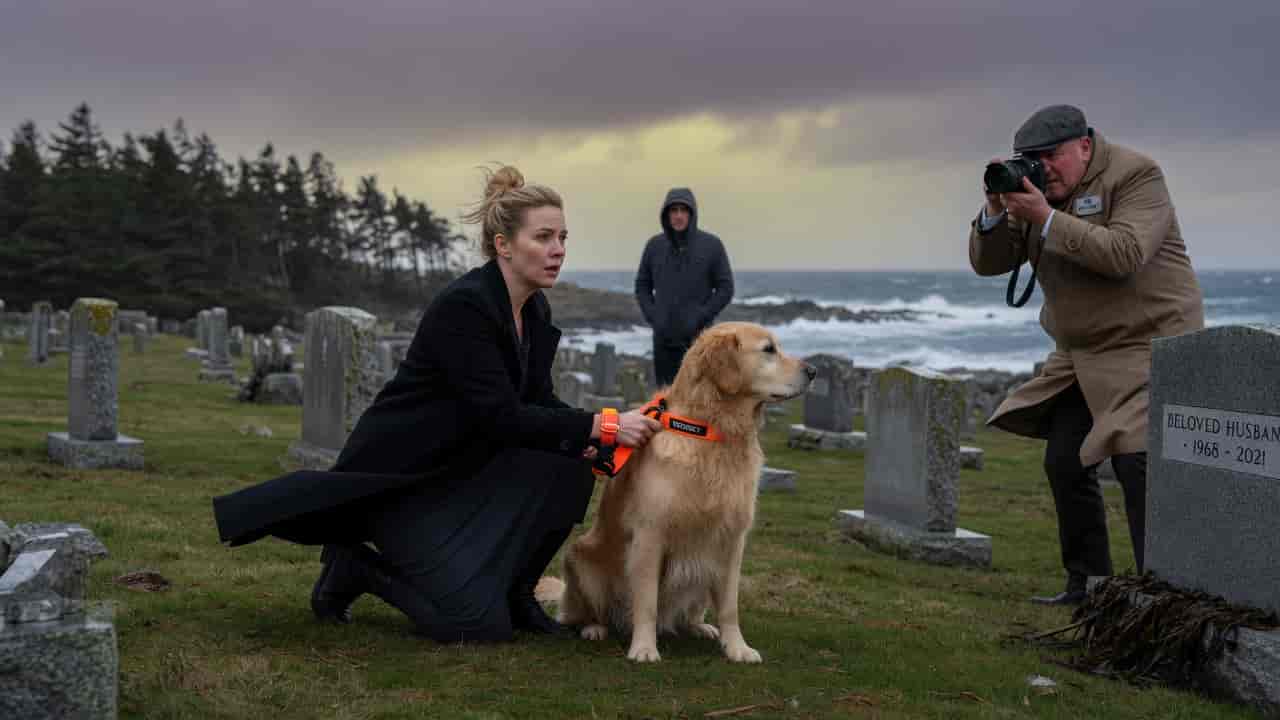
Sarah’s hands were shaking so hard she could barely unbuckle the neon-orange collar. It was brand new. It didn’t have the salt-rot of the ocean or the wear and tear of the woods. It was expensive, the kind of tech her husband, Mark, used for his offshore trips.
Behind her, the gravel crunched. She didn’t have to turn around to know it was Investigator Vance. He’d been following her since the day the boat was found drifting and empty. He didn’t see a grieving widow; he saw a woman trying to cash in a two-million-dollar policy.
“Nice trick, Sarah,” Vance said, his voice dripping with practiced contempt. He stood there with his camera, taking photos of her kneeling in the dirt. “Did you have a friend drop the dog off? Or is Mark hiding in the tool shed?”
“He was on the boat, Vance,” she whispered, her voice cracking. “The dog was with him. If Cooper is alive, then Mark…”
“Then Mark is a man who just committed the biggest fraud in the county,” Vance snapped, stepping into her space, blocking her view of the road. “And you’re the one who’s going to prison for it. So, tell me—where is he staying?”
Sarah looked past him, toward the tree line at the edge of the cemetery. For a second, a flash of grey moved between the pines. Someone was watching. Someone who knew exactly how she’d feel when she found that collar.
Chapter 1: The Salt in the Wound
The Atlantic didn’t give things back. That was the rule in Oakhaven. It took the hulls of old fishing boats, the lures of careless boys, and the lives of men who thought they knew the tides better than the moon did. Sarah stood on the edge of the bluff, her black wool coat buttoned up to her chin, feeling the fine mist of salt spray coat her skin like a second, colder skin.
Below her, the memorial service was winding down. It was a hollow affair, literally. The casket they had lowered into the sandy soil of the coastal cemetery was empty. No body had been recovered from the Sea Sprite. They had found the boat four miles off the coast of Montauk, engine idling, fuel tank half-full, and the deck slick with a mixture of seawater and scales. But Mark was gone. And so was Cooper.
“Sarah? We’re heading back to the house. Jenna’s putting the coffee on.”
Sarah didn’t turn. She knew the voice. It was her sister’s husband, Pete. He meant well, but he spoke to her with that hushed, fragile tone people reserved for the terminally ill or the recently broken. She hated it. She hated the way everyone looked at her, searching for a tear they could validate or a collapse they could catch.
“I’ll be down in a minute, Pete,” she said, her voice sounding thin against the wind.
“The investigator is still here,” Pete added, lowering his voice. “He’s sitting in his car by the gate. Sarah, you don’t have to talk to him. Not today.”
“I know.”
She waited until she heard Pete’s heavy footsteps retreat down the gravel path. Only then did she let her shoulders drop. Her grief wasn’t a sudden sharp pain anymore; it was a dull, heavy weight, like carrying a wet wool blanket everywhere she went. She looked out at the horizon, where the grey sky met the grey water in a blurred line of nothingness.
Mark had been a good man, or at least a believable one. They had been married for eight years, built a life out of weekend boat trips and a small architectural firm that was finally starting to turn a profit. He was careful. He was the kind of man who checked the weather three times before unhooking the trailer. The idea that he’d just… fallen off? It didn’t sit right. It felt like a story with the middle pages ripped out.
She turned to leave, her boots sinking slightly into the soft earth. As she reached the edge of the treeline that bordered the cemetery, she stopped.
A flash of movement caught her eye. It wasn’t a bird or a deer. It was something low to the ground, moving with a familiar, rhythmic gait. Her heart hammered once, a hard, painful thud against her ribs.
“Cooper?” she whispered.
The dog emerged from the shadows of the pines. He looked terrible. His golden fur was matted into clumps, stained with mud and grey salt. He was thinner, his ribs showing through his coat, and he walked with a slight limp in his front right paw. But it was him. The same wide head, the same white patch on his chest.
“Cooper!” she cried out, her voice breaking the silence of the graveyard.
The dog stopped. He didn’t bark. He didn’t wag his tail. He just stood there, staring at her with eyes that looked older, darker. He looked like he had seen the underside of the world and hadn’t quite made it back yet.
Sarah scrambled toward him, ignoring the mud ruining her dress. She fell to her knees, burying her face in his neck. He smelled like rotting kelp and pine needles. He let out a low, shaky whine but remained stiff in her arms.
“How?” she sobbed. “How are you here?”
She pulled back to check him for injuries, her hands running over his shivering frame. That’s when she felt it.
Underneath his old leather collar—the one with his name and her phone number—was a second collar. It was made of heavy-duty, neon-orange plastic. Attached to it was a small, black rectangular box with a single, blinking green light.
A GPS tracker.
Sarah froze. Her breath hitched in her throat. She looked at the tracker, then back at the woods. The orange was too bright, too clean. It hadn’t been in the ocean. It hadn’t been in the woods for three weeks.
“Who gave you this?” she asked the dog.
Cooper didn’t answer. He turned his head and looked past her, toward the trees. Sarah followed his gaze. For a split second, she saw it—a silhouette. A man in a dark grey sweatshirt, standing perfectly still among the trunks. He was too far away to make out a face, but he was watching.
She opened her mouth to scream, but the sound died in her throat as a shadow fell over her.
“Found something interesting, Mrs. Sterling?”
She scrambled backward, nearly tripping over a headstone. Investigator Vance was standing three feet away. He hadn’t made a sound. He had a professional-grade camera around his neck, and he was looking at Cooper with the cold, calculated hunger of a man who had just found a smoking gun.
“He came back,” Sarah gasped, her hand still clutched around Cooper’s new collar. “He just walked out of the woods.”
Vance didn’t look happy for her. He didn’t even look surprised. He just raised his camera and took a photo. The flash was blinding in the grey afternoon.
“That’s a very expensive piece of hardware for a stray dog to be wearing,” Vance said, stepping closer. He gestured to the orange collar. “And he looks remarkably well-fed for a dog that supposedly spent twenty days lost at sea or in the brush.”
“He’s not well-fed, he’s starving,” Sarah snapped, her grief flashing into defensive anger. “And I don’t know where the collar came from.”
“I’m sure you don’t,” Vance said. He leaned down, his face inches from hers. He smelled like stale coffee and cigarettes. “But here’s the thing, Sarah. Dogs don’t buy GPS trackers. People do. People who want to keep track of their assets.”
He looked up at the treeline, his eyes narrowing. The man in the grey hoodie was gone.
“Your husband’s life insurance is for two million dollars, Sarah,” Vance whispered. “If he’s alive, and you’re helping him, that’s not a tragedy. That’s a felony. And I’m going to make sure the state of New York knows exactly which one it is.”
He turned on his heel and walked toward his car, leaving Sarah alone in the mud with a dog that wouldn’t look at her and a tracker that was still blinking, recording every second of her fear.
Chapter 2: The Predator in the Hallway
The Sterling house felt like a museum dedicated to a life Sarah no longer recognized. Mark’s shoes were still by the door, a little bit of dried mud flaking off the soles. His half-finished book was on the nightstand, a receipt from a local hardware store marking page 142. Every object was a sharp edge she kept walking into.
Jenna was in the kitchen, aggressively organizing the Tupperware containers of lasagna and potato salad that neighbors had dropped off. She stopped when Sarah walked in, trailed by a limping, shivering Cooper.
“Oh my god, Sarah! Is that—?”
“It’s him,” Sarah said, her voice flat. “He came back.”
Jenna didn’t move toward the dog. She looked at him with a strange sort of dread, as if he were a ghost that had forgotten to stay dead. “How? Where has he been?”
“I don’t know.” Sarah led Cooper to the utility room, where she began drying him with a towel. The dog sat motionless, his head hanging low. When she reached for the orange collar again, her fingers brushed the plastic casing. It felt warm. It was active.
“What is that?” Jenna asked, standing in the doorway.
“A tracker,” Sarah said. She looked at her sister. Jenna’s face was a map of pity and exhaustion. “Vance thinks I put it on him. He thinks Mark is alive.”
Jenna let out a long, shaky breath. “Sarah… people don’t survive three weeks in the Atlantic in October. You saw the boat. It was a mess. The Coast Guard said—”
“The Coast Guard said they didn’t find him, Jenna. That’s all they said.” Sarah stood up, her damp coat still heavy on her shoulders. “If Mark is dead, who put this on the dog? Who fed him? He’s thin, but he’s not a skeleton. He’s been somewhere.”
“Maybe a hiker found him? Maybe someone kept him and then felt guilty when they saw the news?”
“With a GPS collar? Why wouldn’t they just call the number on his tags?” Sarah shook her head. The logic was a tangled knot. “And there was someone at the cemetery. A man. Watching us.”
Jenna walked over and put her hands on Sarah’s shoulders. Her grip was tight, almost painful. “Listen to me. You are grieving. You’re exhausted. Vance is a predator; he’s trying to get into your head so you’ll make a mistake and the insurance company won’t have to pay. Don’t let him turn this miracle into a conspiracy.”
“It’s not a conspiracy if there’s a blinking light on my dog, Jenna!”
Sarah pushed past her sister and went into the living room. She needed a drink, but more than that, she needed to think. She sat on the sofa, the one she and Mark had picked out together three years ago. She remembered the day it was delivered—Mark had made a joke about how they were finally ‘real adults’ because they owned furniture that didn’t come in a flat box.
The memory felt like a lie now.
There was a knock at the door. Not the polite, hesitant knock of a grieving neighbor, but a loud, authoritative rap that rattled the glass panes.
Sarah opened it to find a man she didn’t recognize. He was younger than Vance, maybe in his late thirties, with a sharp, angular face and a suit that cost more than her car. He held up a badge.
“Mrs. Sterling? I’m Miller. I’m a private investigator. I’ve been retained by the firm that handles your husband’s professional liability insurance.”
“I’ve already talked to the police. And Vance. I have nothing left to say.” She started to close the door, but Miller put a hand out. It was a gentle movement, but firm.
“I’m not here about the life insurance, Sarah. I’m here because your husband’s firm noticed some… irregularities in the accounts in the weeks leading up to the accident. Large sums of cash were moved. Accounts were closed.”
Sarah felt the room tilt. “Mark wouldn’t do that. He was the most honest person I knew.”
“Everyone is honest until they aren’t,” Miller said, his voice devoid of judgment. It was worse than Vance’s hostility; it was indifferent. “I heard about the dog. That’s quite a story. Can I see the collar?”
“No,” Sarah said, her voice rising. “You can’t. You can leave. Get off my porch.”
“I’m going,” Miller said, stepping back. “But Sarah, think about this: if Mark is alive, he didn’t just leave the boat. He left you. He left you to face the police, the debt, and the shame alone. Is that the man you’re trying to protect?”
He turned and walked down the steps. Sarah slammed the door and leaned against it, her heart racing. She looked at Cooper, who was now lying on the rug. The green light on the collar blinked. Green. Green. Green.
It was a heartbeat. Not Mark’s, maybe. But someone’s.
She went to the kitchen and grabbed a pair of heavy-duty garden shears. She walked back to Cooper, who watched her with those hollow, dark eyes.
“I’m sorry, buddy,” she whispered.
She slipped the blades under the orange plastic. She expected it to be hard to cut, but the shears sliced through it like butter. The collar fell to the floor with a dull thud.
She picked up the small black box. On the back, in tiny, etched letters, were coordinates. And a date.
The date was tomorrow.
The coordinates were for a location four miles north, at an old, abandoned boatyard called Miller’s Reach. It was where Mark used to take the Sea Sprite for repairs before the owner passed away and the place went to seed.
Sarah felt a cold shiver run down her spine. This wasn’t a tracker for the dog. It was a message for her.
She looked out the window. Vance’s car was still parked at the end of the driveway, the silhouette of his head visible through the glass. He was waiting for her to move. He was waiting for her to lead him to the truth.
She realized then that she was trapped. If she went to the boatyard, she was a criminal. If she didn’t, she might never know if her husband was a ghost or a coward.
She went to her bedroom, pulled a small backpack from the closet, and started packing. She didn’t take much. A flashlight. A sweater. A hunting knife Mark had given her for their first anniversary.
“You stayed on the boat, didn’t you, Mark?” she whispered to the empty room. “You stayed on the boat, and you let me drown.”
Chapter 3: The Ghost of the Harbor
The rain started around midnight, a cold, needle-like drizzle that turned the coastal roads into ribbons of black glass. Sarah didn’t take her car. She knew Vance was out there, his eyes probably glued to the red taillights of her SUV. Instead, she took the old bicycle she’d kept in the garage since college, pedaling down the back trails that cut through the salt marshes.
Her lungs burned. The damp air felt like lead in her chest, but she pushed harder, the chain of the bike rattling with every rotation. She kept her lights off, relying on the pale, filtered moonlight to guide her.
Miller’s Reach was a graveyard for things that had outlived their usefulness. Dozens of rusted hulls sat on wooden cradles, their paint peeling away like dead skin. The smell here was different from the cemetery—it was more industrial, a mix of old diesel, rotting timber, and stagnant water.
She ditched the bike in a thicket of overgrown reeds and moved toward the main shed. It was a massive corrugated iron structure that groaned in the wind. The coordinates on the tracker had pointed exactly here.
“Mark?” she whispered.
The only answer was the slap of the tide against the rotting pilings of the pier.
She pulled out her flashlight but didn’t turn it on yet. She moved by instinct, her boots crunching on broken glass and oyster shells. She reached the side door of the shed and found it slightly ajar.
The interior of the shed was a cavern of shadows. Dust motes danced in the dim light of her flashlight as she finally clicked it on. It landed on an old workbench, covered in rusted tools and empty oil cans.
And something else.
In the center of the bench sat a small, wooden carving. It was a rough, hand-carved figure of a Golden Retriever.
Sarah’s breath caught. Mark used to whistle and whittle when he was stressed. He’d made dozens of these over the years, leaving them on the windowsills of their house like little wooden guardians.
She reached out to touch it, her fingers trembling. The wood was fresh. It hadn’t been sitting here for years. It still smelled like cedar.
“I know you’re here!” she shouted, her voice echoing off the metal walls. “I found the dog! I found the tracker! Just come out!”
A footstep sounded behind her. Sharp. Deliberate.
She spun around, the flashlight beam swinging wildly. It landed on a man standing near the back of the shed.
It wasn’t Mark.
It was Elias, the boat mechanic who had serviced the Sea Sprite for years. He was an older man, his face a roadmap of deep-set wrinkles and grease stains. He looked terrified.
“Sarah,” he said, squinting against the light. “You shouldn’t have come here.”
“Where is he, Elias?” Sarah stepped toward him, her hand going to the knife in her pocket. “You worked on the boat the day before he vanished. You knew something was wrong with the engine, didn’t you?”
Elias looked down at his boots. “The engine was fine, Sarah. It was the man that was breaking.”
“What does that mean?”
“Mark came to me a month ago,” Elias said, his voice a low gravelly rasp. “He was scared. He said people were looking into the firm. He said he’d found out things he wasn’t supposed to know. He asked me if I could make a boat look like it had been in a collision without actually sinking it.”
Sarah felt a wave of nausea wash over her. “He faked it. He really faked it.”
“He had to,” Elias insisted, looking up. “He said if he didn’t disappear, they’d come after both of you. He wanted to protect you, Sarah.”
“By letting me bury an empty casket? By letting me get hounded by investigators and accused of fraud?” She was screaming now, the anger bubbling up like acid. “That’s not protection, Elias! That’s abandonment!”
“He’s not gone,” Elias whispered. “He’s been staying in the old bait shack on the north end of the reach. He’s the one who sent the dog back. He wanted to see if you were being watched. He wanted to see if you’d come for him.”
“He used the dog as bait,” Sarah said, the realization hitting her like a physical blow. “He used Cooper to test the waters.”
“He’s desperate, Sarah. He’s got no money, no identity. He’s just a man in a shack.”
Sarah turned away, her head spinning. Every memory of the last three weeks—the sleepless nights, the pills she’d taken to stop the shaking, the way she’d looked at the ocean and wished it would just take her too—all of it was a lie. A performance for an audience of one.
“Where is the shack, Elias?”
“North end. Behind the dunes. But Sarah… someone followed you.”
The heavy sliding door of the shed groaned as it was shoved open. The silhouette of a man stood in the frame, backlit by the rainy night.
Investigator Vance.
“Well, well,” Vance said, stepping into the light. He wasn’t smiling anymore. He looked tired and dangerous. He was holding a heavy flashlight in one hand and a thick folder in the other. “The mechanic and the widow. I should have known.”
“Get out, Vance,” Sarah said, her voice cold.
“I don’t think so. I’ve been listening, Sarah. I’ve been recording.” He tapped his chest, where a small wire was clipped to his coat. “Everything Elias just said is on the record now. Your husband is alive. He’s a fugitive. And you’re an accessory.”
He looked at Elias. “And you, old man. You’re going to tell me exactly where that bait shack is, or you’re going to spend the rest of your life in a cage.”
Elias looked at Sarah, his eyes pleading. Sarah looked at Vance, the man who had made her life a living hell for three weeks. And then she looked at the wooden dog on the table.
She realized then that Mark wasn’t the only one who could play a game.
Chapter 4: The Pressure Point
Vance moved with a surprising, predatory grace for a man of his size. He stepped between Sarah and the door, his presence filling the cramped space of the shed. The rain hammered on the roof, a rhythmic, deafening sound that made the world outside feel miles away.
“Give me the coordinates, Elias,” Vance commanded. He didn’t look at the mechanic; his eyes were fixed on Sarah. He wanted to see her break. He wanted the satisfaction of the kill.
“I don’t have coordinates,” Elias stammered, his hands shaking as he wiped them on his grease-stained overalls. “I just… I just know where the shack is.”
“Then you’re going to show me,” Vance said. He turned to Sarah. “And you’re going to come along. I want to see the reunion. I want to see his face when he realizes he’s the reason his wife is going to prison.”
Sarah felt the shame of the last few weeks morphing into something harder. Something sharper. She looked at Vance, at the way he puffed out his chest, the way he enjoyed the power he held over her. He wasn’t just doing his job. He liked the humiliation. He liked watching her squirm in the mud of the cemetery.
“You’ve been enjoying this, haven’t you?” Sarah asked, her voice steady.
Vance smirked. “I enjoy the truth, Sarah. People like you—people who think they’re too good for the rules—you always think you can outrun the bill. But the bill always comes due.”
“You think I knew?” Sarah stepped toward him, her hands clenched at her sides. “You think I wanted to spend my nights wondering if my husband was being eaten by crabs at the bottom of the bay? You think I enjoyed the pity of my neighbors? The way you looked at me like I was trash?”
“I think you’re a great actress,” Vance said. “But the show’s over.”
He grabbed Sarah’s arm, his fingers digging into her skin through the wool coat. It was a rough, dismissive grip, meant to remind her that she was no longer in control of her own body.
“Let go of her,” Elias said, a flicker of courage in his eyes.
Vance didn’t even look at him. He shoved Sarah toward the door. “Move. Both of you.”
They walked out into the rain. The boatyard was a labyrinth of rust and shadow. Vance kept his grip on Sarah’s arm, forcing her to stumble over the uneven ground. He was filming now with his phone, the small screen glowing in the dark. He was documenting her degradation, her forced march to her husband’s hiding spot.
“Stop,” Sarah said as they reached the edge of the dunes.
“Keep moving,” Vance growled.
“No. Look.” She pointed toward the treeline near the marsh.
A figure was standing there. The man in the grey hoodie. He wasn’t blurred anymore. He was twenty feet away, and the light from Vance’s flashlight caught the edge of his face.
It was Mark.
He looked different. He’d grown a beard, thick and ragged. His eyes were sunken, and he looked smaller, as if the weight of his secret had physically compressed him. He was staring at Sarah with a look of such profound regret that it made her stomach turn.
“Sarah,” he whispered.
“Mark!” Vance shouted, his voice full of triumph. He let go of Sarah and reached for his belt, pulling out a pair of handcuffs. “Mark Sterling, stay right where you are!”
Mark didn’t run. He just looked at Sarah. “I’m sorry. I was coming to get you. I just had to be sure.”
“Be sure of what, Mark?” Sarah asked, her voice cracking. “Be sure that I was miserable enough? Be sure that I’d keep your secret even while this man was tearing my life apart?”
“I did it for us,” Mark said, stepping out of the shadows. “The money… the people I was working with… they were going to kill us both, Sarah. I had to make them think I was gone.”
“And what about the dog, Mark?” Sarah gestured toward the invisible house where Cooper was waiting. “Was he part of the plan too? Throwing him overboard so people would believe the accident?”
Mark flinched. “He jumped after me. I didn’t want him to, but he jumped. I found him two days later on a sandbar. I’ve been taking care of him.”
“You’ve been taking care of a dog while your wife was planning your funeral,” Vance interrupted, stepping between them. He grabbed Mark’s wrist and jerked it behind his back. “Save it for the lawyers. You’re done, Sterling.”
As Vance clicked the first cuff onto Mark’s wrist, a second light appeared.
It was Miller, the private investigator from the insurance firm. He was standing on the ridge of the dune, holding a heavy-duty spotlight that cut through the rain like a blade.
“Is there a problem here, Investigator Vance?” Miller asked, his voice calm and terrifying.
Vance froze. “I’ve got him, Miller. I found the husband. The fraud is confirmed.”
“Is it?” Miller stepped down the dune, the light never wavering. He looked at Sarah, then at the cuffed Mark. “Because I’ve been looking at those ‘irregularities’ I mentioned earlier. And it turns out, Mark wasn’t the one moving the money. Someone was moving it for him. Someone with access to the insurance company’s internal settlement accounts.”
Vance’s face went pale. He tried to pull Mark away, but Mark resisted, his boots sliding in the mud.
“What are you talking about?” Vance demanded.
“I’m talking about you, Vance,” Miller said. “I’m talking about the three other ‘widows’ you’ve hounded into giving up their claims over the last five years. Claims that were then quietly paid out to offshore accounts you control.”
Sarah looked at Vance. The man who had humiliated her, who had followed her to her husband’s grave, was now the one being exposed. The power in the room—the power in the salt air—shifted.
Vance looked at the marsh, then back at Miller. He realized he was cornered. He still had his hand on Mark’s arm, but he wasn’t the hunter anymore.
“You can’t prove that,” Vance hissed.
“I don’t have to,” Miller said. He looked at Sarah. “But I think Mrs. Sterling might have something to say about how you’ve treated her. About the coercion. About the illegal surveillance.”
Sarah looked at Mark. Her husband. The man who had abandoned her. Then she looked at Vance. The man who had tormented her.
She felt the weight of the tracker in her pocket. The blinking green light.
“He’s not the only one with a recording,” Sarah said, her voice cold and sharp. She pulled out her own phone. She’d been recording since she entered the shed. “I have every word you said to me, Vance. Every threat. Every insult.”
Vance lunged for her, his face twisted in rage. He let go of Mark, his heavy boots splashing in the puddles as he reached for her throat.
“You bitch!” he screamed.
Mark stepped in. He wasn’t a fighter, but he was a desperate man. He threw his weight against Vance’s side, knocking the larger man off balance. They both went down into the mud, a tangle of limbs and wet wool.
Miller didn’t move. He just kept the light on them, watching the disaster unfold.
Sarah stood back, the rain washing the salt from her face. She watched her husband fight the man who had replaced him in her nightmares. She watched the truth finally claw its way out of the earth.
But as she looked at them, she realized the most terrifying thing of all.
Even with the truth out, the empty casket was still in the ground. And the man she loved was still a stranger in a grey hoodie.
The pressure didn’t leave. it just changed shape.
Chapter 5: The Weight of Ghosthood
The rain didn’t stop; it settled into a relentless, rhythmic drumming against the rusted metal of the boatyard sheds, a sound that felt like it was trying to hollow out the earth itself. In the mud, the struggle had ended not with a cinematic flourish, but with the wet, pathetic sound of exhausted men gasping for air. Mark lay on his side, his face half-buried in the silt, his breath coming in ragged, whistling hitches. Vance was slumped a few feet away, pinned by the heavy weight of his own failure and the crushing realization that Miller wasn’t just a witness—he was the end of the line.
Sarah stood over them, her black wool coat sodden and heavy, pulling at her shoulders like a leaden weight. She didn’t feel the rush of justice she had expected. There was no warmth in seeing Vance humiliated. Instead, she felt a profound, chilling numbness. The man she had mourned for three weeks was shivering in the dirt at her feet, and the man who had tormented her was revealed to be a common thief in a cheap suit. The world felt thin, like a piece of paper that had been folded too many times and was finally tearing at the creases.
“Get up, Vance,” Miller said, his voice as steady as the falling rain. He hadn’t moved from his position on the dune, the spotlight still cutting a bright, unforgiving path through the dark. “The deputies are three minutes out. I’d suggest you use that time to decide how much of the insurance company’s money you’re willing to help us recover. It’s the difference between a decade and a lifetime.”
Vance didn’t answer. He just rolled onto his back, the rain washing the mud from his eyes, staring up at the light as if he were waiting for it to strike him blind.
Sarah turned her gaze to Mark. He was trying to push himself up, his hands slipping on the slick grass. She didn’t reach out to help him. Her hands remained buried in her pockets, fingers curled around the cold plastic of her phone. She watched him struggle, noting the way his shoulder hitched—a familiar old injury from a skiing trip years ago. It was a physical proof of his identity, a reminder that this wasn’t a dream. This was the man who had shared her bed, who had promised to grow old with her, and who had ultimately decided that she wasn’t worth the truth.
“Sarah,” Mark croaked, finally finding his footing. He looked smaller than he had in the cemetery treeline. The beard made him look like a stranger, but the way he looked at her—that specific, desperate squint—was unmistakably his. “Sarah, please. I never wanted you to see me like this.”
“Then you shouldn’t have come back,” she said. Her voice surprised her. It wasn’t angry. it was empty. “You should have stayed dead, Mark. It was easier when I thought you were a victim of the ocean. It’s much harder knowing you’re just a coward.”
Mark flinched as if she’d struck him. “I had to make it look real. If I’d told you, you would have lied for me, and they would have known. They would have come for you to get to me. I was trying to keep the targets off your back.”
“Who, Mark? Who are ‘they’?” She stepped closer, into the circle of light. “Miller says you were the one moving the money. Miller says the firm found the irregularities weeks ago. Was there ever a threat, or did you just get caught and panic? Did you build this whole ghost story just so you wouldn’t have to face me and tell me we were broke?”
Mark looked at Miller, then back at Sarah. He didn’t answer. The silence stretched out, filled only by the hiss of the rain and the distant, approaching wail of a siren. It was the answer she had feared. There were no shadow men in suits, no international conspiracies. There was just a man who had made a series of bad choices and lacked the spine to own them. He had traded her sanity for a head start he didn’t even know how to use.
The police arrived in a blur of blue and red strobes, the light bouncing off the rusted hulls of the boats like a disco in a graveyard. They moved with a practiced, mechanical efficiency, lifting Vance from the mud and leading him toward a cruiser. Miller stepped down from the dune to meet them, his posture relaxed, the professional predator now handing over his kill.
One of the deputies, a man Sarah recognized from the local coffee shop, approached her with a yellow blanket. “Mrs. Sterling? We’re going to need you to come down to the station. Just to give a statement.”
“I’m fine, Henry,” she said, pushing the blanket away. “Just take him.” She gestured toward Mark.
“Sarah, wait,” Mark said as the deputy took his arm. He wasn’t being arrested—not yet—but he was being detained. “I still love you. Everything I did, I did because I couldn’t lose you.”
“You already lost me,” she said, turning her back on him. “You lost me the second you let me walk into that cemetery alone.”
The drive back to Oakhaven was a blur of wet pavement and flickering streetlights. Miller drove her, his car smelling of leather and expensive silence. He didn’t try to offer comfort, for which she was grateful. He simply drove, his hands steady on the wheel, occasionally glancing at the rearview mirror to check on the trailing police cars.
“What happens now?” she asked as they turned onto her street.
“For Vance? He’s done. We have enough on the offshore accounts to bury him. He’ll flip on his partners to save his own skin, but he’s never going to work in this industry again. Probably won’t see the outside of a cell for a long time.” Miller paused, his eyes flicking to her. “For your husband? That’s more complicated. Faking a death isn’t a crime in itself, but the fraud involved in the insurance claim is. Since no money was actually paid out, the charges might be mitigated. But the firm… they’re going to want their money back. All of it.”
“And me?”
“You’re a victim, Sarah. Nobody is going to touch you. Except maybe the press.”
He pulled into her driveway. The house was dark, save for the porch light reflecting in the puddles. It looked the same as it had when she left—a quiet, suburban home with a well-manicured lawn and a mortgage that was now a noose.
“Thank you,” she said, opening the door.
“Sarah,” Miller said, stopping her. “One piece of advice. Don’t let him back in the house tonight. Not because of the law, but because of you. You need to decide who you are without the grief before you decide who you are with him.”
She nodded, stepped out into the cold, and watched him drive away.
Inside, the house felt cavernous. Cooper was waiting for her in the hallway, his tail giving a single, hesitant thump against the floorboards. He was still wearing the leather collar she’d put back on him, the orange one sitting in a heap on the kitchen counter. He looked at her with those soulful, dark eyes, and for the first time, she felt a flicker of the old warmth.
She went to the kitchen and began making coffee, her movements stiff and mechanical. She needed the routine. She needed the heat. As the water began to bubble, she looked at the orange collar. It was so bright, so artificial. It was the only thing in the room that felt honest. It didn’t pretend to be anything other than a tool for tracking a lost animal.
She sat at the kitchen table, the silence of the house pressing in on her. She thought about the empty casket. She thought about the three weeks she had spent grieving a man who was sitting in a bait shack whittling wooden dogs. She thought about the way Vance had looked at her in the mud—that mixture of contempt and triumph.
She realized then that the residue of the last three weeks wasn’t just sadness. It was a profound sense of exposure. Everyone in town had seen her at her most vulnerable. They had watched her break, and now they would watch her deal with the mess. She was no longer Sarah Sterling, the promising architect; she was the woman whose husband tried to run away from his own life.
There was a soft scratching at the back door.
She didn’t move. She knew it was him. The police had likely released him into his lawyer’s custody or given him a ride back to the only place he had left.
“Sarah?” his voice came through the wood, muffled and small. “Sarah, please. Let me in. It’s freezing out here.”
She looked at her coffee, the steam rising in thin, twisting ribbons. She thought about the man who had let her believe he was dead. She thought about the man who had used their dog as a laboratory rat to see if it was safe to come home.
“Go away, Mark,” she said, not raising her voice.
“Sarah, I have nowhere else to go. Everything I have is in this house. Everything I am is with you.”
“No,” she said, finally looking toward the door. “Everything you are is in that boatyard. You made your choice, Mark. You chose the ghost life. So go be a ghost.”
She heard him lean against the door, the sound of his forehead hitting the wood. He began to cry—a low, pathetic sobbing that she had heard a hundred times before when things got too hard for him. It used to make her heart ache. It used to make her want to reach out and fix whatever was broken.
Now, it just sounded like noise.
She stood up, walked to the door, and turned the deadbolt. The click was final, a sharp, metallic period at the end of a long, rambling sentence. She walked away, leaving him on the porch in the rain, and went to bed.
She didn’t sleep. She lay in the dark, listening to the wind and the scratching of the dog’s claws on the floor, wondering how a house could feel so empty when there was so much history crammed into every corner.
Chapter 6: The Residue of a Lie
The morning didn’t bring clarity; it only brought the sun, a cold, pale light that stripped away the shadows of the boatyard but left the wreckage in plain sight. Sarah woke up to the sound of a crow cawing on the roof, a sharp, ugly sound that felt appropriate. She stayed in bed for a long time, staring at the ceiling, tracing the faint water stain in the corner that Mark had promised to fix back in July.
He was gone from the porch. She didn’t know where he’d gone, and for the first time in eight years, she didn’t care. The worry that had been her constant companion had finally burned itself out, leaving nothing but a fine, grey ash.
She spent the morning on the phone. With her lawyer. With the bank. With her sister. Jenna had called six times, her voice rising in pitch with every message until she sounded like a teakettle on the verge of exploding. Sarah finally called her back, sitting on the back porch with a cup of lukewarm tea.
“He’s alive?” Jenna shrieked. “Sarah, I don’t understand. How could he do that to you? How could he do that to us?”
“He was scared, Jenna,” Sarah said, her voice sounding tired even to her own ears. “He was scared and he was selfish, and he thought he could restart the clock.”
“And Vance? The police were at the cemetery this morning. They’re digging things up, Sarah. They’re looking at all his old cases.”
“Vance is done. Miller took care of it.”
“What about Mark? Is he coming back? Are you… are you going to help him?”
Sarah looked out at the garden. The frost had killed the last of the marigolds, their heads drooping and brown. “I don’t know what I’m going to do, Jenna. But I’m not going to be the one who fixes this for him. Not this time.”
She hung up before Jenna could ask anything else. She needed to move. She needed to do something that wasn’t talking or thinking. She went to the garage and grabbed a stack of cardboard boxes.
She started with the mudroom. Mark’s boots. His fishing vest. The extra reels he kept on the top shelf. She packed them with a clinical, detached efficiency, not stopping to look at the photos or the mementos. Each item was just an object, a piece of matter that took up space she no longer wanted to give it.
By noon, she had three boxes sitting by the front door. She was working on the bedroom when the doorbell rang.
It was Miller. He looked exactly the same as he had the night before—sharp, professional, and entirely unaffected by the drama of the boatyard. He held a thick manila envelope.
“I thought you might want these,” he said, handing it to her. “It’s the final report on the firm’s audit. It clears you of any knowledge of the transfers. The insurance company is dropping their investigation into you personally.”
“And Mark?”
“The firm is filing for bankruptcy. There will be civil suits, but the criminal charges for the faked death are being handled by a special prosecutor. If he cooperates against Vance, he might get probation. But he’s lost his license. He’ll never work as an architect again.”
Sarah took the envelope, the paper feeling heavy in her hands. “Where is he?”
“He’s at a motel on the highway. He’s been calling my office every hour, asking for your number. I haven’t given it to him.”
“Good,” Sarah said. She looked at the boxes by the door. “Can you do me a favor, Miller? Can you have someone pick these up and take them to him? I don’t want him coming back here.”
Miller looked at the boxes, his expression unreadable. “You’re sure about this?”
“I’ve spent three weeks mourning a man who didn’t exist,” she said. “I think I’ve done enough.”
Miller nodded, took out his phone, and made a quick call. “It’ll be handled. Anything else?”
“Just one thing. The dog. Cooper.” She looked back into the house, where the retriever was curled up on the rug. “Mark said he jumped after him. That he found him on a sandbar.”
Miller leaned against the doorframe, his gaze softening just a fraction. “I checked the tides for that night, Sarah. There was a storm surge. No dog could have made it to a sandbar from where the Sea Sprite was found. Not without help.”
Sarah felt a cold knot tighten in her chest. “So he was lying about that too.”
“The GPS tracker on the collar was activated two days after the accident,” Miller said. “In a house in East Hampton. Not a bait shack. A house owned by one of the firm’s clients. Mark wasn’t hiding in the woods for three weeks, Sarah. He was waiting to see how the audit went. He only went to the shack when he realized Vance was closing in.”
The last thread of her loyalty snapped. The image of Mark shivering in the mud, the image of him crying on her porch—it was all part of the performance. He hadn’t been a desperate man trying to protect his wife. He had been a calculated man trying to protect his skin, using her grief as a shield and the dog as a prop.
“Thank you, Miller,” she said, her voice dropping to a whisper. “Thank you for telling me.”
After Miller left, Sarah went back into the kitchen. She picked up the wooden carving of the dog—the one she’d found in the shed. She looked at the detail, the way the wood had been smoothed and shaped with such care. It was beautiful. It was a testament to a talent that was now wasted.
She walked to the back door, opened it, and threw the carving as far as she could into the overgrown brush at the edge of the yard.
She didn’t feel better. She just felt finished.
She spent the rest of the day cleaning. She scrubbed the floors, washed the windows, and stripped the bed. She wanted to remove every trace of the man who had occupied this house, every scent of his cologne, every hair from his head. By the time the sun began to set, the house felt sterile, like a hotel room.
She took Cooper for a walk. They went down to the bluff, the same place she had stood during the memorial. The ocean was calmer now, the waves lapping gently against the shore, pretending it hadn’t tried to swallow her whole.
She sat on a bench and watched the horizon. Cooper sat at her feet, his head resting on her knee. He was still thin, still limping slightly, but he seemed more at peace than he had in weeks.
“It’s just us now, buddy,” she whispered, stroking his ears.
She thought about the future. She’d have to sell the house. She’d have to find a new job, maybe move back to the city. The life she had built was gone, replaced by a vast, terrifying blank space.
But as she sat there, she realized that the weight of the last three weeks was gone. The grief was gone. The confusion was gone. Even the anger was starting to fade into a dull, manageable resentment.
She looked at the empty spot on the horizon where the Sea Sprite had vanished. She remembered the way she had felt when they told her Mark was gone—that sense of the world ending. It hadn’t ended. It had just changed.
She stood up and started walking back toward the house. She didn’t look back at the ocean. She didn’t look back at the cemetery.
As she reached her driveway, she saw a car parked at the end of the street. It was a beat-up old sedan she didn’t recognize. A man was sitting in the driver’s seat, his face obscured by the shadow of the visor.
She didn’t stop. She didn’t hurry. She just kept walking, her hand firm on Cooper’s leash.
If it was Mark, let him watch. If it was another investigator, let him take his photos. They couldn’t touch her anymore. She was no longer the widow of a ghost. She was a woman who had survived the truth, and that made her the most dangerous person in the room.
She went inside, locked the door, and turned off the porch light.
The house was quiet. The air was still. But for the first time in a long time, Sarah Sterling felt like she was exactly where she was supposed to be.
She sat in the living room in the dark, the only sound the steady breathing of the dog at her feet. She wasn’t waiting for a knock. She wasn’t waiting for a call. She was just sitting there, existing in the space she had reclaimed, watching the moon rise over a town that would never look at her the same way again.
And that was enough.
The residue of the lie would always be there, a faint stain on the floorboards, a shadow in the corner of her eye. But the lie itself was dead. And Sarah, finally, was alive.