
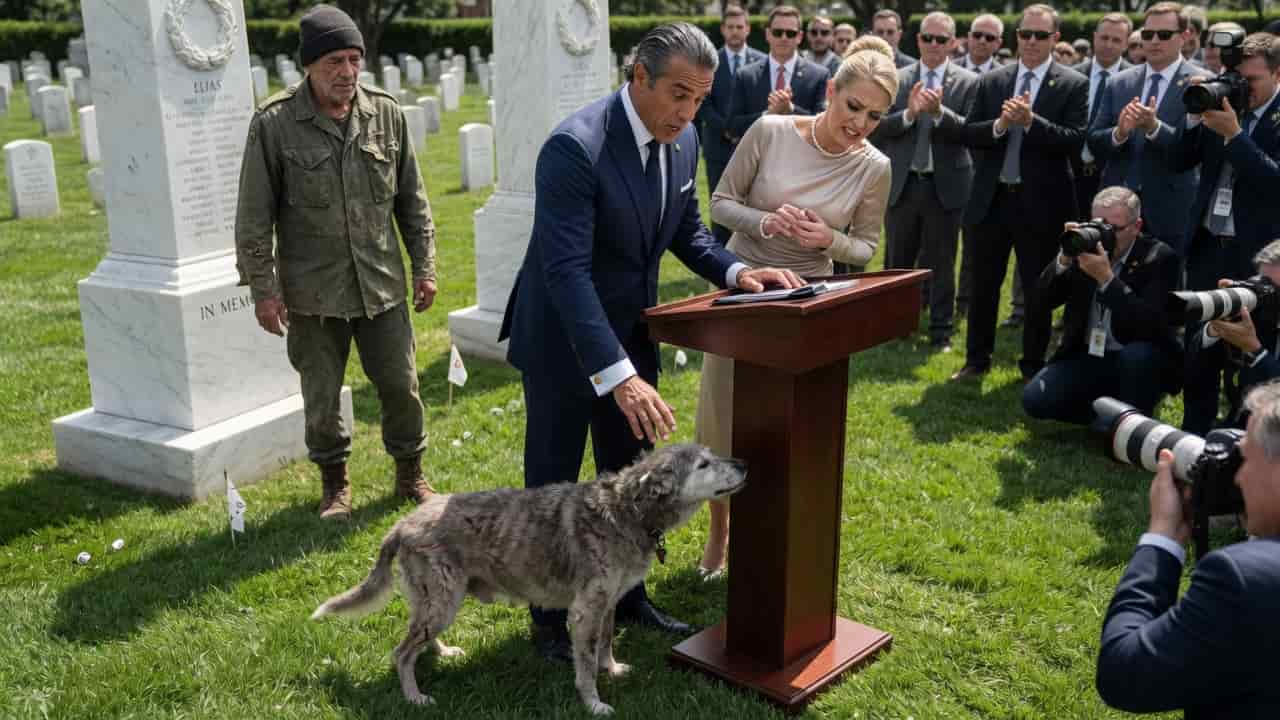
“Get that filthy thing away from us,” Brooke hissed, her voice a serrated blade in the quiet of the memorial garden.
I looked down at the dog. He was grey now, his muzzle white with age, his coat a map of scars and neglect. But I knew that heart-shaped mark on his tongue. I knew the weight of his head against my knee. It was the same weight I’d felt fifteen years ago, the night I drove him twenty miles into the deep timber and left him there because Brooke’s father told me I’d never be a “serious man” as long as I was sentimental about a stray.
“Thomas?” the Lead Investor called out from the front row, his brow furrowed. The cameras were still clicking. The city officials were frozen.
“I… I don’t know whose it is,” I lied. The words felt like ash in my throat.
The dog whimpered, a sound that broke through the wind. He didn’t bark. He didn’t growl. He just looked at me with the same devotion I’d betrayed for a corner office and a silk tie.
Then, a man in a tattered army jacket stepped out from behind the marble pillars. He didn’t look like he belonged in a million-dollar cemetery, but he looked at me with more authority than any man in a suit ever had.
“He’s been waiting for you by the highway for a long time, Thomas,” the man said, his voice carrying across the lawn. “I think he’s finally finished.”
Brooke’s hand tightened on my arm, her nails digging into my sleeve. “Ignore him. He’s a lunatic. Security!”
But the whole room had gone silent. Because everyone saw it. I hadn’t just abandoned a dog. I had built a whole world on a lie, and the truth just put its head on my shoe.
Chapter 1
The marble wasn’t just white; it was a blinding, aggressive shade of Pearl Carrara that seemed to vibrate under the Georgia sun. Thomas stood at the edge of the “Garden of Memories,” watching the masons hoist the centerpiece—a twelve-foot angel with wings that looked soft enough to flutter. To the world, this was Thomas’s masterpiece. A luxury cemetery for the elite, a place where the wealthy could buy a version of eternity that didn’t include weeds or cracked headstones.
“It’s a bit much, isn’t it?”
Thomas didn’t turn around. He knew the voice. It was Sterling, the lead investor whose family had owned half of Atlanta since the reconstruction. Sterling didn’t like “much.” He liked “established.”
“It’s exactly what the market wants, Sterling,” Thomas said, his voice smooth, professional, and entirely devoid of the scrap and hustle that had defined his twenties. “People don’t want to think about the dirt. They want to think about the monument. They want to feel like their legacy is too heavy for the earth to swallow.”
Sterling stepped up beside him, the smell of expensive tobacco and cedarwood trailing him. “You’ve done well for yourself, Thomas. From a project manager in a hard hat to the man standing over the Garden. Brooke’s father would be proud. If he were still here to see the merger.”
The mention of Brooke’s father sent a familiar, sharp needle of anxiety through Thomas’s chest, though he didn’t let it reach his face. He’d spent a decade and a half purging the “trash” from his identity—the accent, the habit of checking his bank balance twice a day, the dirt under his fingernails. He was the CEO of Vanguard Development now. He was three weeks away from marrying Brooke, a woman who treated social standing like a structural load-bearing wall.
“The merger is contingent on the opening gala,” Thomas reminded him. “Everything has to be perfect. No loose ends.”
“No loose ends,” Sterling echoed. “I like that. It’s a rare quality in men these days. Everyone has a closet full of rattling bones. But you? You’re like this marble. Solid. Clean.”
Thomas smiled, but his eyes stayed on the angel. He felt the sweat prickling under the collar of his three-thousand-dollar suit. He wasn’t solid. He was a hollow shell held together by high-tensile vanity.
Later that evening, the penthouse apartment was silent except for the rhythmic clack-clack-clack of Brooke’s heels on the polished concrete. She was moving through the living room, checking the seating charts for the memorial service they were holding for the city’s founders—the “pre-opening” event that would cement their status.
“We have a problem with the guest list,” Brooke said, not looking up from her tablet.
Thomas loosened his tie, the silk sliding through his fingers. “What kind of problem?”
“The Mayor wants to bring his sister. She’s… vocal. About the ‘gentrification’ of the East Side. She thinks the Garden is an insult to the historic district.” Brooke finally looked at him, her blue eyes sharp and calculating. “I told him it was a private event. We can’t have anyone there who makes us look like we’re taking something away from the ‘common man,’ Thomas. We are the aspirational standard. Do you understand?”
“I understand,” Thomas said. He always understood. Brooke didn’t speak in suggestions; she spoke in requirements. She had been the one to refine him. She’d taught him which fork to use, which charities to fund, and how to look at people as if they were either assets or obstacles.
He walked over to the floor-to-ceiling window, looking out over the city. Below, the lights of Atlanta blurred into a sea of gold. Somewhere out there, in the dark patches between the skyscrapers, was the world he’d come from. A world of rusting trucks and dogs tied to porch railings.
“You’re thinking about it again,” Brooke said, her voice softening but losing none of its edge. She walked over and slid her arms around his waist from behind.
“Thinking about what?”
“The old life. The ‘humble beginnings’ story you tell at board meetings to sound relatable. Don’t go too deep into it, Tom. People like a rags-to-riches story, but they don’t actually want to smell the rags.”
Thomas felt a coldness settle in his stomach. “It wasn’t that long ago, Brooke.”
“It was a lifetime ago,” she corrected him, stepping around to face him. She adjusted his lapel, her fingers precise. “The man who lived in that trailer in the woods is dead. You killed him to become this. Don’t let him haunt the Garden. This deal goes through, and we’re set for twenty years. No more proving ourselves. We’ll finally just… be.”
She kissed him then, a kiss that felt like a contract. It was efficient, rewarding, and lacked even a hint of warmth. When she left the room to take a call from her stylist, Thomas sat on the edge of the leather sofa and put his head in his hands.
He thought of his grandfather’s house. The smell of woodsmoke and wet fur. The way the old man had handed him a squirming, warm ball of brown hair and said, “This is Buster. He’s yours. That means his hunger is your hunger. His cold is your cold. You don’t ever turn your back on what’s yours, Tommy.”
Thomas had been twelve. He’d promised.
He stood up and walked to the small, hidden safe in his office. He punched in the code and pulled out a single, dog-eared photograph. It was a polaroid of a younger Thomas, grinning like an idiot, with a lanky brown mutt jumping up to lick his face. In the photo, you could see the dog’s tongue—extended in a joyful slobber—and the distinct, dark, heart-shaped birthmark right in the center of the pink muscle.
He hadn’t thought about Buster in years. Not really. He’d buried him under layers of spreadsheets and social calendars.
But tonight, the air felt thin. The marble of the Garden felt like it was pressing against his ribs. He tucked the photo back into the dark of the safe and locked it.
“No loose ends,” he whispered to the empty room.
He didn’t see the shadow moving in the park across the street from his building. He didn’t see the man in the army jacket, sitting on a bench with a tattered grey-muzzled dog at his feet. The man wasn’t looking at the penthouse. He was looking at the dog, who was staring up at the glowing glass towers with a strange, ancient patience.
The dog let out a low, rattling sigh, his breath blooming in the cool night air. He didn’t look like a dog who was finished. He looked like a dog who was just beginning to remember a scent.
Chapter 2
The memory of the woods always smelled like pine needles and shame.
It was fifteen years ago, a summer so humid the air felt like a wet wool blanket. Thomas had been twenty-nine, a man on the precipice of a life he didn’t quite know how to earn. He was dating Brooke then, the “ambitious intern” at her father’s firm. He was a junior project manager, a guy who still had a slight drawl and wore boots that were too heavy for the office.
Brooke’s father, Richard, had invited them to a weekend at the “Cabin”—which was actually a five-thousand-square-foot cedar mansion on a private lake. Thomas had brought Buster. It hadn’t even occurred to him not to. Buster went everywhere.
They were sitting on the wrap-around porch, the sound of crickets a deafening thrum in the trees. Richard was drinking a twenty-year-old scotch, looking out at the water.
“Thomas,” Richard had said, his voice like gravel. “Brooke tells me you’re a hard worker. That you’ve got a head for numbers.”
“I try to be, sir,” Thomas had answered, his hand resting on Buster’s head. The dog was leaning against his thigh, his tail thumping rhythmically against the floorboards.
Richard looked at the dog. Not with anger, but with a clinical, detached kind of distaste. “That’s a lot of dog for a man who wants to move into the city. Brooke says you’re looking at that condo on Peachtree.”
“I was thinking Buster would like the park,” Thomas said.
Richard let out a short, dry laugh. “The park? In that neighborhood? People don’t walk mutts in the park, Thomas. They walk pedigrees. They walk symbols of their success. A man with a dog like that… it tells people where he came from. It tells them he hasn’t quite let go of the dirt. It makes you look sentimental. And sentimental men are a liability in this business.”
Thomas felt a flush of heat crawl up his neck. He looked at Brooke. She was sipping her wine, her eyes fixed on the sunset. She didn’t say a word. She didn’t defend the dog that had slept at the foot of their bed for the last three years.
“You’ve got a choice to make, son,” Richard continued, swirling his ice. “You want to be the guy who manages the job site, or the guy who owns the land? Because the guy who owns the land doesn’t carry his childhood around on a leash. He leaves it behind. He moves forward.”
That night, the air in the bedroom was thick with unspoken tension. Brooke was sitting at the vanity, brushing her hair.
“He’s right, you know,” she said quietly.
Thomas was lying on the bed, staring at the ceiling. “He’s a dog, Brooke. He’s my dog. My grandfather gave him to me.”
“And your grandfather died in a house with a dirt floor, Thomas,” Brooke said, turning around. Her face was beautiful, but her eyes were hard. “Do you want that? Do you want to be ‘loyal’ to a memory, or do you want to be loyal to us? My father is looking for a partner. Someone to take over the Vanguard projects. He won’t give it to a man he doesn’t respect. And he doesn’t respect a man who can’t make a hard decision over a stray.”
“He’s not a stray!” Thomas snapped.
“He looks like one,” Brooke replied coolly. “Make a choice, Thomas. The life we talked about—the travel, the influence, the security—or the dog. You can’t have both.”
Thomas didn’t sleep that night. He watched the moonlight crawl across the floor. Buster was snoring softly, his paws twitching as he dreamt of chasing squirrels.
At 4:00 AM, Thomas got up. He didn’t wake Brooke. He grabbed his keys and whistled softly. Buster jumped up, his tail wagging, thinking it was time for an early morning run.
Thomas drove for two hours. He headed north, away from the city, away from the lake, into the deep, unmanaged timberland where the cell service died and the roads turned to gravel. He stopped the truck at a trailhead that led nowhere.
He got out. The woods were loud with the sound of awakening birds. The air was cool and sweet.
“Come on, boy,” Thomas whispered.
They walked for a mile. Buster was in heaven, sniffing every stump, his ears perked at every rustle in the undergrowth. Thomas felt like he was walking to his own execution.
He reached a clearing near a creek. He knelt down and rubbed Buster’s ears. He looked into those brown eyes—eyes that held nothing but absolute, terrifying trust.
“Stay,” Thomas said.
Buster sat. He cocked his head, waiting for the command to fetch, or the treat that usually followed.
“Stay, Buster.”
Thomas stood up. He backed away slowly. Buster’s tail wagged once, tentatively. He didn’t move. He’d been trained to stay until he was called. He was a good dog.
Thomas turned and ran.
He ran until his lungs burned, until the sound of the creek was gone. He got into the truck and slammed the door. He sat there, his hands shaking so hard he couldn’t put the key in the ignition. He looked in the rearview mirror, half-expecting to see a brown blur racing down the trail.
Nothing.
He drove away. He told himself he’d go back. He told himself someone would find him—some hunter or hiker. He told himself the dog was a survivor.
When he got back to the cabin, Richard was on the porch again. He looked at Thomas’s empty passenger seat, then at Thomas’s haunted face.
“Good man,” Richard said, nodding once. “Welcome to the firm, Thomas.”
Brooke came out a moment later, her hair perfect, her smile radiant. She kissed Thomas’s cheek. “I knew you could do it,” she whispered.
For fifteen years, Thomas had told himself it was a mercy. That the dog was free. That it was the “hard choice” a leader had to make. He’d traded a piece of his soul for a corner office, and for a long time, the trade seemed worth it.
But as the opening of the Garden of Memories approached, the silence of the woods seemed to be getting louder.
He was standing in the middle of the cemetery now, fifteen years later, looking at a row of freshly planted oaks. The sun was setting, casting long, skeletal shadows across the grass.
“Mr. Thorne?”
Thomas started. It was one of the security guards. “Yes, what is it?”
“We’ve got a vagrant hanging around the north gate. He’s got a dog with him. A real mess of an animal. We tried to move them along, but the man says he’s waiting for someone.”
Thomas felt a chill that had nothing to do with the evening air. “Tell him to leave. This is private property. We have the city council here in forty-eight hours.”
“We tried, sir. But the dog… he just sits there. Like he’s rooted to the spot. It’s eerie.”
“I’ll handle it,” Thomas said, his voice tight.
He walked toward the north gate, his heart hammering against his ribs. He told himself it was just a coincidence. There were thousands of dogs in Atlanta. Thousands of homeless men.
He reached the gate and stopped.
The man was sitting on the curb, his back against the iron fence. He was wearing an old army jacket, his face a map of hard years. But it wasn’t the man Thomas was looking at.
It was the dog.
The dog was lying at the man’s feet. He was old—so old he looked like he was made of dust and memory. His fur was patchy, his ribs showing through his skin. One of his ears was torn, and a long, jagged scar ran down his left flank.
The dog lifted his head. He looked at Thomas.
The man in the army jacket didn’t look up. He just patted the dog’s head. “He’s a traveler, this one,” the man said quietly. “Walked a long way to find a ghost.”
Thomas couldn’t breathe. He looked at the dog’s eyes. They were milky with cataracts, but there was a flicker of recognition there. A spark of something that had survived fifteen years of cold nights and empty bellies.
The dog let out a soft, rattling whimper. He opened his mouth to pant, and there it was.
In the center of the pink tongue, a dark, heart-shaped birthmark.
“His name is Buster,” Thomas whispered, the name feeling like a curse.
The man in the army jacket finally looked up. His eyes were piercingly clear. “Is it? I just call him Old Man. Found him limping along Highway 41 about six years back. He was half-dead, but he wouldn’t stop walking. Always headed south. Always looking at every truck that passed like he expected it to stop.”
The man stood up, leaning on a wooden staff. “He saw your face on one of those big signs. The ones for this place. He stopped walking then. Just sat down and started waiting.”
“He can’t be here,” Thomas said, his voice cracking. “You have to take him away.”
“I don’t own him,” the man said. “He owns his own heart. And right now, his heart says he’s home.”
The dog stood up. His legs were shaky, his joints clicking. He took a single, agonizing step toward the gate, his nose pressed against the iron bars.
“Get him out of here,” Thomas said, his voice rising in panic. “I’ll give you money. Just… take him to the other side of the city. Take him to a shelter.”
The man looked at Thomas with a profound, quiet pity. “You can’t buy your way out of a promise, son. Even an old one.”
Thomas turned and fled back into the shadows of the Garden, the sound of the dog’s whimper following him like a ghost.
Chapter 3
The morning of the memorial service arrived with a sky the color of a bruised plum.
Thomas stood in front of the mirror in his dressing room, fumbling with his cufflinks. His hands wouldn’t stop shaking. He’d barely slept, and when he did, he dreamt of the woods. He dreamt of the sound of a truck engine receding into the distance while he watched from the perspective of a dog sitting in the dirt.
“Thomas, for heaven’s sake, let me,” Brooke said, appearing behind him. She took his wrists, her touch cold and efficient. “You’re a wreck. Is it the Sterling merger? It’s a done deal, Tom. Today is just the victory lap.”
“I’m fine,” he lied. “Just a lot on the line.”
“Everything is on the line,” she corrected him, tightening the silver link. “The Governor is coming. The press will be there. This is the moment Vanguard becomes a legacy firm. Look at me.”
He looked. Her face was a mask of perfect, calculated beauty. There was no room for error in her world. There was certainly no room for an old, scarred mutt with a heart-shaped tongue.
“If that man is still at the gate…” Thomas started.
“Security handled it,” Brooke said, turning back to the mirror to check her bun. “They cleared the perimeter an hour ago. We can’t have the ‘unhoused’ ruining the aesthetic of a five-thousand-dollar-a-plot cemetery. It sends the wrong message about security.”
Thomas felt a sick lurch in his gut. “Where did they take them?”
“Who cares? Somewhere they won’t be seen.” She picked up her clutch and headed for the door. “The limo is downstairs. Don’t forget your speech. And try to look like a man who isn’t afraid of his own shadow.”
The drive to the Garden of Memories was a blur of tinted glass and high-speed silence. Thomas stared at the speech in his hand, the words about “legacy” and “honoring the past” feeling like lead weights.
As they pulled up to the north gate, Thomas looked out the window. The curb was empty. The man in the army jacket was gone. The dog was gone.
He should have felt relieved. Instead, he felt a crushing, hollow dread.
The Garden was transformed. White folding chairs were arranged in perfect rows on the lawn. A small stage had been erected in front of the Great Angel. Photographers were already positioned, their lenses glinting in the sun. The air was filled with the low hum of polite conversation and the scent of expensive lilies.
Thomas stood in the wings of the stage, watching the crowd. Sterling was there, sitting in the front row, looking like a king on a throne. The Mayor was laughing at something the Governor said.
This was it. The pinnacle. The moment he had traded everything for.
“You’re on in five,” the event coordinator whispered.
Thomas stepped onto the stage. The applause was polite, restrained—the sound of people who didn’t need to shout to be heard. He walked to the podium, the mahogany cool under his palms.
He looked out at the audience. Brooke was sitting in the front row, her back straight, her eyes fixed on him with a look that said Don’t fail me.
“Ladies and gentlemen,” Thomas began, his voice amplified by the hidden speakers. “We are gathered here today to talk about memory. We are here to talk about the things we leave behind, and the things that endure.”
He paused, his throat dry.
“A man is measured by what he builds,” he continued, following the script. “But he is also measured by the foundations he stands upon. The Garden of Memories isn’t just a place of rest. It’s a testament to the strength of our history. It’s a promise that the things we love will never be truly lost.”
He felt a movement in his peripheral vision.
At the edge of the manicured lawn, near the marble pillar where the shadows were longest, a figure emerged. It was the man in the army jacket. He wasn’t shouting. He wasn’t protesting. He was just standing there, watching.
And at his side, limping with a painful, slow dignity, was the dog.
Thomas’s voice faltered. “We… we believe that…”
The dog wasn’t looking at the crowd. He was looking at the stage. He was looking at Thomas.
He took a step onto the grass.
“Keep going,” Brooke mouthed from the front row, her eyes narrowing.
Thomas gripped the podium until his knuckles turned white. “We believe that the bonds of… of loyalty…”
The dog was closer now. He was halfway across the lawn. The audience began to notice. A few people turned their heads. A photographer shifted his lens away from the podium toward the limping animal.
A low murmur rippled through the crowd.
“Security,” Brooke whispered, looking around frantically.
But the security guards were at the perimeter, their backs to the stage. And the dog was moving with a strange, hypnotic focus. He wasn’t a stray wandering onto the grounds. He was a creature on a mission.
He reached the steps of the stage. He paused, his old muscles trembling. Then, with an effort that seemed to cost him every ounce of his remaining strength, he pulled himself up the first step.
The room went silent. The only sound was the clicking of the photographers’ shutters and the heavy, wet breathing of the dog.
Thomas stopped speaking. He couldn’t have continued if his life depended on it.
The dog walked across the stage. He didn’t look at the cameras. He didn’t look at the mayor. He walked straight to Thomas and sat down.
He leaned his weight against Thomas’s leg.
It was the same lean. The same solid, trusting pressure he’d felt fifteen years ago on a porch in the woods.
Thomas looked down. He saw the scars. He saw the notched ear. He saw the white muzzle.
“Thomas?” the Lead Investor called out, his voice sharp with confusion.
Brooke stood up. She stepped onto the stage, her face a mask of elegant fury. She walked to Thomas’s side, her perfume clashing with the smell of the dog’s wet, dirty fur.
“I am so sorry, everyone,” she said, her voice projecting with practiced grace. “It seems a stray has found its way onto the grounds. Thomas, honey, move away. He looks diseased.”
She leaned in, her mouth inches from Thomas’s ear.
“Get that filthy thing away from us,” she hissed.
The dog looked up at Thomas. He opened his mouth, his tongue hanging out in a tired, happy pant.
There it was. The heart-shaped mark.
Thomas felt the world tilting. The marble, the suits, the millions of dollars—it all felt like paper. It all felt like it was about to blow away in the wind.
“I… I know him,” Thomas whispered.
Brooke’s hand clamped onto his arm, her nails piercing the silk of his suit. “Don’t you dare. Do not touch it. You tell security to take it to the pound, or this merger is dead before I sit back down.”
The dog whimpered. He rested his head on Thomas’s shoe.
Thomas looked at the cameras. He looked at Sterling. He looked at the man in the army jacket, who was still standing at the edge of the lawn, waiting for the answer.
Fifteen years of lies were standing on a stage in front of the most powerful people in the city.
And Thomas Thorne, the man who sold the world, had to decide if he was finally ready to buy his soul back.
Chapter 4
The silence in the Garden of Memories was no longer peaceful. It was a vacuum, sucking the air out of the lungs of everyone present. A hundred pairs of eyes were locked on the podium, on the man in the navy suit, and the broken animal at his feet.
Thomas felt Brooke’s breath on his neck—hot, sharp, and smelling of expensive mints. She was a statue of social preservation, her hand a vice on his bicep.
“Thomas,” she said, louder now, her voice dripping with artificial pity for the benefit of the microphones. “The poor thing is clearly suffering. We should have security take him somewhere quiet. Somewhere… appropriate.”
She was telling him to kill it. She didn’t use the word, but it was there, vibrating in the space between them. Take it somewhere quiet. The same way her father had suggested the woods.
Thomas looked down at Buster. The dog’s eyes were cloudy, but as they met Thomas’s, a small, rhythmic thumping started.
Thump. Thump. Thump.
Buster’s tail was hitting the mahogany of the podium.
It was a sound of absolute, unearned forgiveness. It was the most humiliating thing Thomas had ever heard.
“He’s not a stray,” Thomas said. His voice was thin, but it carried. The microphone caught it and threw it out over the lawn, echoing off the marble angels and the granite monuments.
The murmur in the crowd stopped instantly.
Brooke’s face didn’t break, but her eyes went dark, the blue turning to a flat, dangerous slate. “Thomas, you’re tired. You’ve been working too hard. You don’t know what you’re saying.”
“I know exactly what I’m saying,” Thomas said. He felt a strange, cold clarity beginning to settle over him. He looked at Sterling. The old man was leaning forward, his eyes narrowed, his long-standing respect for Thomas beginning to fray at the edges.
“Whose dog is that, Thorne?” Sterling asked. It wasn’t a question; it was an ultimatum.
Thomas looked at the cameras. He could see the red lights. He was being broadcast. His face was on screens in offices, in bars, in the very homes he was trying to sell.
He thought about the photo in the safe. He thought about his grandfather’s dirt floor. He thought about the fifteen years he’d spent pretending he was better than the things he’d loved.
“His name is Buster,” Thomas said, his voice gaining strength. “And he’s mine.”
Brooke let go of his arm as if he’d suddenly turned into a leper. She took two steps back, her heels clicking sharply on the stage. “He’s lost his mind,” she said to the crowd, her voice trembling with a fake, theatrical sob. “He’s had a breakdown. The pressure of the project…”
“The only pressure,” Thomas interrupted, turning to face her, “was the pressure to be someone you and your father would find acceptable. The pressure to believe that success meant leaving everything human behind.”
He knelt.
He didn’t care about the suit. He didn’t care about the grass stains on his knees. He reached out and put his hand on Buster’s head.
The dog let out a long, shuddering sigh and leaned his entire weight into Thomas’s palm. The fur was coarse, matted with dirt and grease, but underneath, the skin was warm.
“I left him,” Thomas said, looking directly into the lens of the nearest camera. “Fifteen years ago, I drove him into the woods and I left him there because I wanted a job. Because I wanted to marry into a family that thought a dog like this was ‘trash.'”
A collective gasp went up from the crowd. The “Outrage-First” mode had fully ignited. This wasn’t a business opening anymore; it was a public execution of a reputation.
“Thomas, stop!” Brooke screamed. The mask was gone now. Her face was contorted with a raw, ugly fury. “You’re ruining everything! The merger, the Garden, us!”
“There is no ‘us,’ Brooke,” Thomas said, standing up but keeping his hand on the dog. “There’s just the image you built. And it’s built on a grave.”
He looked at the front row. “Sterling, the Garden is yours. I’m resigning as CEO of Vanguard. Effective immediately.”
Sterling stood up, his face reddening. “You think you can just walk away from this? You owe us millions, Thorne. You’ve got contracts. You’ve got obligations.”
“I have one obligation I haven’t met in fifteen years,” Thomas said.
He looked toward the edge of the lawn. The man in the army jacket, Elias, was walking toward the stage. The security guards started to move toward him, but the Mayor held up a hand, stopping them. The Mayor was a politician; he knew a viral moment when he saw one, and he wasn’t about to be on the wrong side of this one.
Elias reached the stage. He looked at Thomas, then at the dog.
“He’s tired, Thomas,” Elias said softly. “He’s been carrying that wait for a long time.”
“I’ll take him now,” Thomas said.
“You’re going to walk out of here with a homeless man and a dying dog?” Brooke laughed, a shrill, hysterical sound. “In front of everyone? Look at you! You look pathetic!”
Thomas looked at her. He realized, for the first time, that he didn’t feel any anger toward her. He felt pity. She was trapped in the marble world he’d helped build. She was the one who would have to live with the silence of the Garden.
“I’m not walking out with a dying dog, Brooke,” Thomas said. “I’m walking out with the only thing in this park that’s actually alive.”
He turned to the microphone one last time.
“The Garden of Memories is open,” he said. “But don’t come here to remember the people you loved. Come here to remember the people you were before you decided to be successful.”
He stepped off the podium. He whistled—a low, sharp sound he hadn’t used in over a decade.
Buster’s ears perked up. He stood on his shaky legs, his tail giving one final, triumphant thump against the stage.
Thomas walked down the steps. Elias fell in beside him. The photographers swarmed, the flashes like lightning in the midday sun. The crowd parted like the Red Sea, a path of stunned, silent people in suits watching a man in a ruined navy blazer walk toward the gate with a limping dog.
As they reached the iron bars of the north gate, Thomas didn’t look back at the white marble angel. He didn’t look at Brooke, who was standing on the stage, screaming into her phone.
He looked at the road ahead. It was long, and he had no idea where he was going to sleep that night, or how he was going to pay the legal fees that were surely coming.
But as he felt the dog’s wet nose brush against his hand, the air in his lungs finally felt like it belonged to him.
“Where to, Old Man?” Elias asked as they hit the sidewalk.
Thomas looked at Buster. The dog was looking at a battered old truck parked down the street. It wasn’t a luxury SUV. It was a rusted-out Chevy with a “For Sale” sign in the window.
“Home,” Thomas said. “Wherever that is.”
But as they walked away, the residue of the moment hung over the Garden. The photographers were already uploading the footage. The headlines were already being written: THE MAN WHO SOLD THE WORLD FINDS HIS SOUL IN A STRAY.
The Garden of Memories was empty of people within the hour. No one wanted to be seen in the place that had just been exposed as a monument to a man’s shame.
The angel stood alone in the sun, her wings frozen, her marble heart as cold as the legacy Thomas Thorne had finally walked away from.
Chapter 5
The reality of a life dismantled doesn’t hit all at once; it arrives in a series of small, rhythmic humiliations. For Thomas, it started with the plastic click of a deactivated keycard.
He stood outside the glass-and-steel lobby of the Vanguard building, the same building he’d owned a significant percentage of only six hours ago. The security guard, a man named Henderson whose daughter’s college tuition Thomas had once personally subsidized through a corporate scholarship, wouldn’t look him in the eye.
“I’m sorry, Mr. Thorne,” Henderson said, his voice thick with a mixture of pity and professional distance. “Orders from the board. Your access has been revoked. All personal items are being boxed and sent to the address on file.”
“The address on file is the penthouse, Henderson,” Thomas said. He felt a bead of sweat roll down the back of his neck. He was still wearing the navy suit, though the trousers were stained at the knees with the green blood of the Garden’s manicured grass. “Brooke has already changed the locks there. I checked twenty minutes ago.”
Henderson shifted his weight, his hand resting uncomfortably near his belt. “I can’t help you, sir. I’ve got my instructions.”
Thomas looked past the guard at the marble lobby, the waterfall feature that cost more than most people made in a decade. It felt like a stage set he’d been kicked off of mid-performance. He turned away, walking back to the curb where Elias stood waiting.
Buster was lying on a piece of cardboard Elias had scavenged from a nearby alley. The dog’s breathing was heavy, a wet, rattling sound that seemed to vibrate against the pavement. He looked smaller now that the adrenaline of the stage had worn off. He looked like a collection of bones held together by habit and a few patches of grey fur.
“They shut you out,” Elias said. It wasn’t a question. He leaned on his staff, his eyes scanning the street for the black SUVs that usually preceded trouble.
“They shut me out,” Thomas echoed. He reached into his pocket and pulled out his phone. The screen was a chaotic blur of notifications. Missed Call: Sterling (12). Missed Call: Brooke (24). News Alert: Vanguard CEO Resigns in Public Meltdown.
He hit the power button and shoved the device back into his pocket. He didn’t want the world. He wanted a place to sit down where the ground didn’t feel like it was moving.
“Where’s your truck?” Thomas asked, looking at the rusted Chevy he’d seen earlier.
“Ain’t mine,” Elias said. “Belongs to a guy I know. He lets me sleep in the bed sometimes if I keep the pigeons off it. But we can’t stay here. The police have already circled the block twice. They’re waiting for an excuse to move us along, and ‘disturbing the peace’ is a real easy one to write when you’re standing in front of a billion-dollar tower.”
Thomas looked at the dog. “He needs a vet, Elias. He’s not doing well.”
“He needs a rest first,” Elias countered. “He’s walked from the mountains to the city. He’s done his job. Now he needs a quiet corner and a bowl of water that doesn’t taste like gasoline.”
They ended up at a motel on the edge of the city, a place where the neon sign flickered with a desperate, dying buzz and the air smelled of stale cigarettes and industrial-grade lemon cleaner. The clerk, a woman with skin like parchment and a name tag that read Darlene, didn’t recognize Thomas from the news. Or if she did, she didn’t care. To her, he was just another man in a ruined suit with a dog that looked like it was ten minutes away from a taxidermist.
“Fifty bucks a night. Cash only. No dogs allowed,” she said, her eyes fixed on a small television in the corner playing a game show.
Thomas reached for his wallet, his fingers brushing the fine leather of his Prada cardholder. He pulled out a crisp hundred-dollar bill—one of the last physical remnants of his wealth.
“The dog stays with me,” Thomas said, his voice flat. “Another fifty for the trouble. No questions.”
Darlene looked at the hundred, then at Buster, then back at Thomas. She slid a key across the counter. “Room 114. If it barks, you’re out. If it dies, the disposal fee is on you.”
The room was small, the walls painted a shade of beige that felt like a personal insult. Thomas laid Buster on the moth-eaten bedspread, and for the first time in fifteen years, he sat on the floor beside him. Elias had refused the room, choosing instead to stay with the truck, promising to check in at dawn.
Thomas took off his blazer, balled it up, and used it as a pillow for the dog’s head. He found a plastic cup by the sink, filled it with lukewarm water, and held it to Buster’s muzzle. The dog lapped at it feebly, his heart-shaped tongue moving slow and heavy.
“I’m sorry, Buster,” Thomas whispered.
The dog’s tail gave a single, weak thump against the mattress.
Around 2:00 AM, the phone in the room rang. Thomas stared at it for a long time before answering. There were only three people who could have tracked him here—the police, a private investigator, or Brooke.
“Where are you, Thomas?”
It was Brooke. Her voice was terrifyingly calm, the voice she used when she was negotiating a contract she knew she was going to win.
“I’m nowhere, Brooke. I’m exactly where I should be.”
“Don’t be dramatic. My father is talking to the DA. They’re looking into ‘corporate sabotage’ and ‘mental incompetency.’ They want to freeze your personal accounts to protect the Vanguard stakeholders. If you come back now—tonight—we can spin this. We can say it was a performance piece. A radical marketing stunt for the Garden’s ‘Legacy’ campaign. We can fix it.”
Thomas looked at the dog. Buster was watching him, his eyes reflecting the flickering light of the motel’s outdoor sign.
“You can’t fix a ghost, Brooke,” Thomas said. “You and your father taught me that you can bury anything if you use enough marble. But the dirt always moves. Eventually, the thing you buried finds the surface.”
“You’re throwing away your life for a stray!” she snapped, her composure finally breaking. The vitriol in her voice was a physical thing, sharp and jagged. “That thing is going to be dead by morning, and then what will you have? You’ll be a punchline. You’ll be the man who lost a kingdom for a bag of bones.”
“I already lost the kingdom,” Thomas said quietly. “I lost it fifteen years ago when I drove away from a trailhead in the North Georgia woods. I’ve just been pretending to be the king ever since.”
“You’re pathetic,” she hissed. “Don’t bother calling. My lawyers will handle the rest.”
She hung up. Thomas held the receiver for a moment, listening to the dial tone, before setting it back on the cradle. He felt a strange lightness, as if he’d just stepped off a ledge and realized he was floating.
He spent the rest of the night talking to Buster. He told him about things he hadn’t thought about in a decade—the smell of his grandfather’s pipe tobacco, the way the creek used to sound after a heavy rain, the secret place behind the shed where he’d hidden his comic books. He apologized for every year, every month, every second of the silence he’d left the dog to survive in.
He didn’t talk like an AI. He didn’t use flowery words about redemption or the soul. He talked like a man who was finally admitting he was a coward.
“I thought if I was rich enough, I wouldn’t feel the shame,” Thomas said, his hand resting on Buster’s scarred flank. “I thought if I built enough monuments, the world would forget the boy who left his best friend in the dark. But the world didn’t forget. You didn’t forget.”
As the grey light of dawn began to creep under the motel door, Buster’s breathing changed. It became shallower, more deliberate. The rattling stopped, replaced by a soft, rhythmic whistling in his chest.
Thomas didn’t call a vet. He knew, with a certainty that reached deep into his marrow, that a vet wasn’t what was needed. This wasn’t a medical problem; it was a completion.
Elias knocked on the door at 6:30. He looked at the scene—the ruined millionaire on the floor, the dying dog on the bed—and simply nodded. He walked to the sink, wet a washcloth, and handed it to Thomas.
“Clean his face,” Elias said. “A man should look his best when he’s going home.”
Thomas wiped the dust of the city from Buster’s muzzle. He cleaned the crust from the dog’s eyes. As he did, Buster leaned his head into Thomas’s hand one last time. He gave a soft, almost imperceptible huff of breath, his tail gave a final, tiny twitch, and then he was still.
The silence that followed wasn’t “deafening.” It was just silence. It was the sound of a room where a long, fifteen-year-old noise had finally stopped.
Thomas sat there for a long time. He didn’t cry. He didn’t scream. He just held the dog’s paw, feeling the warmth slowly leave the pads.
“He’s done,” Elias said softly from the corner.
“He’s done,” Thomas agreed.
He stood up, his joints popping. He looked at his reflection in the cracked mirror over the dresser. He saw a man with deep circles under his eyes, a stained suit, and no future. But the man in the mirror was also the first person Thomas had recognized in years.
He picked up his blazer and put it on. He smoothed the lapels. He looked at Elias.
“I don’t have any money left that they won’t take,” Thomas said. “And I don’t have a place to bury him. Not in the Garden.”
Elias looked at the dog, then back at Thomas. “The Garden is for people who want to be remembered by strangers. Buster doesn’t need that. He just needs the woods.”
“The woods?” Thomas asked, a flicker of old pain rising in his chest.
“The real woods,” Elias said. “Where things grow. Where nobody builds angels.”
They wrapped Buster in the moth-eaten bedspread. Thomas carried him out of the motel, past Darlene who didn’t even look up from her game show, and laid him in the back of the rusted Chevy.
As they drove away from the city, the skyscrapers of Atlanta began to shrink in the rearview mirror. Thomas watched the glass and steel disappear, feeling the residue of his old life peeling away like dead skin. He was a fugitive from a world he no longer understood, heading toward a past he had finally earned the right to face.
Chapter 6
The drive north took three hours. The rusted Chevy groaned with every hill, the transmission slipping like a bad memory, but it held together. Thomas sat in the passenger seat, staring out at the changing landscape. The manicured suburbs gave way to strip malls, then to rolling pastures, and finally to the dense, unyielding green of the North Georgia mountains.
They reached the trailhead at nearly noon. It was the same spot. The gravel was grayer, the trees taller, but the smell—that sharp, clean scent of pine and damp earth—was exactly the same.
Thomas stepped out of the truck. His legs felt heavy, as if the gravity here was stronger than in the city. He walked to the back of the truck and looked at the bundle wrapped in the beige bedspread.
“You want me to help?” Elias asked, standing by the driver’s side door.
“No,” Thomas said. “I have to do this.”
He lifted the dog. Buster felt lighter in death, as if the burden of waiting had been the heaviest thing about him. Thomas started up the trail.
He didn’t stop at the clearing where he’d left him fifteen years ago. He kept going. He climbed higher, pushing through the thick undergrowth, past the point where the trail disappeared and only the deer paths remained. He climbed until his lungs burned and the sweat soaked through his shirt, until the noise of the world was replaced entirely by the wind in the hemlocks.
He found a spot beneath an ancient, sprawling oak. The roots were massive, gnarled like the hands of an old man, creating a natural hollow in the earth.
Thomas knelt. He didn’t have a shovel. He used a sharp rock and his own hands, tearing at the soil, pulling back the layers of mulch and clay. He worked until his fingernails were broken and his palms were bleeding. The dirt was cool and dark. It didn’t smell like the sterilized topsoil of the Garden of Memories; it smelled like life.
When the hole was deep enough, he laid Buster inside. He didn’t say a prayer. He didn’t give a speech. He just reached out and touched the heart-shaped mark on the dog’s tongue one last time.
“You’re home, boy,” he whispered. “You don’t have to stay anymore.”
He covered the dog with the earth he’d moved. He smoothed it over, then covered the spot with stones and fallen leaves until it looked like nothing had ever been disturbed. He sat there for a long time, his back against the oak, watching the light filter through the leaves in shifting patterns of gold and shadow.
When he finally walked back down to the truck, his suit was a total loss. The navy fabric was torn at the shoulder, covered in mud and leaf litter. He looked like a man who had been through a war.
Elias was leaning against the fender, carving a piece of wood with a small pocketknife. He looked up as Thomas approached.
“You find the right spot?”
“I did,” Thomas said. He wiped his hands on his trousers, but the dirt was stubborn. It stayed in the creases of his skin.
“So, what’s next, Mr. Thorne? You going back to fight the lawyers? Or you going to hide out until the news cycle finds a new villain?”
Thomas looked down the gravel road. “I don’t think there’s anything left to fight for, Elias. Brooke and her father will take the assets. The board will take the title. By the time they’re done, I’ll owe them more than I ever made. That’s how that world works. You don’t just leave; you get erased.”
“Hard to erase a man who’s already standing in the dirt,” Elias said, snapping his knife shut. “Most people are terrified of being nothing. Once you’re there, though… it’s a lot quieter than you’d think.”
They drove back toward the city, but they didn’t go to the motel. They went to a small, independent garage on the South Side where Elias’s friend worked. Thomas spent the last of his physical cash on a 1998 Ford Ranger that looked like it had been through a hail of bricks and a few bad winters.
It was the most honest thing he’d ever owned.
A week later, Thomas was sitting in a diner in a small town two counties over. He’d changed his name back to his grandfather’s—Thomas Miller. He was working as a day laborer for a local contractor, hauling lumber and mixing mortar. His hands were calloused, his back ached every night, and he slept in the back of the truck on a foam mattress.
He was drinking a coffee, reading a discarded newspaper from two days ago. There was a small blurb on page four: Vanguard Merger Collapses; Garden of Memories Facing Foreclosure.
The article mentioned Brooke. It said she was suing her father’s estate and Thomas Thorne for emotional distress and breach of contract. There was a photo of her leaving a courthouse, her face hidden behind oversized sunglasses, her jaw set in that familiar, hard line of aristocratic fury.
Thomas felt a flicker of something—not joy, exactly, but a profound sense of relief. The marble world was crumbling. The angel’s wings were probably already starting to crack.
“More coffee, Tom?”
The waitress, a woman named Martha who had a kind face and a permanent scent of bacon grease, hovered over his cup.
“Please,” Thomas said.
“You look tired today. That roof job over on Second Street giving you trouble?”
“Just old bones, Martha,” Thomas said, smiling. “Nothing a little sleep won’t fix.”
He walked out to his truck. The afternoon sun was warm on his face. He reached into the glove box and pulled out the polaroid. He looked at the young man and the brown dog. He looked at the heart-shaped tongue.
He realized then that the residue of the Garden wasn’t the shame or the money or the lawsuits. It was the knowledge that for fifteen years, he had been a ghost. He had built a life out of things that couldn’t be felt, around people who couldn’t be loved.
He tucked the photo back into the glove box. He didn’t need to look at it anymore. He knew what the dog looked like. He knew what the woods smelled like.
He started the engine. The Ford roared to life with a puff of blue smoke and a rattle that shook the steering wheel. He drove toward the job site, passing a local park where a young boy was playing fetch with a golden retriever.
Thomas slowed down as he passed. He watched the boy throw the ball, watched the dog race across the grass with a singular, joyful purpose. He watched the boy fall to his knees and bury his face in the dog’s neck when it returned.
Thomas didn’t feel the urge to cry. He didn’t feel the weight of what he’d lost. He just felt the steering wheel under his hands, the grit of the day’s work under his fingernails, and the slow, steady beat of a heart that finally belonged to the man who was beating it.
He drove past the park and turned onto the highway. He didn’t look back. There was a deck that needed building, a roof that needed shingling, and a long, quiet life ahead of him that didn’t require a single piece of marble.
The man who had sold the world had finally stopped counting the cost.
He was just a man in an old truck, driving into the afternoon sun, carrying nothing but the dirt of the mountains and the memory of a dog who had waited fifteen years just to say goodbye.
The road ahead wasn’t certain, and it wasn’t beautiful, but for the first time in his life, Thomas Miller was exactly where he wanted to be.
He shifted into fourth gear and kept driving.



