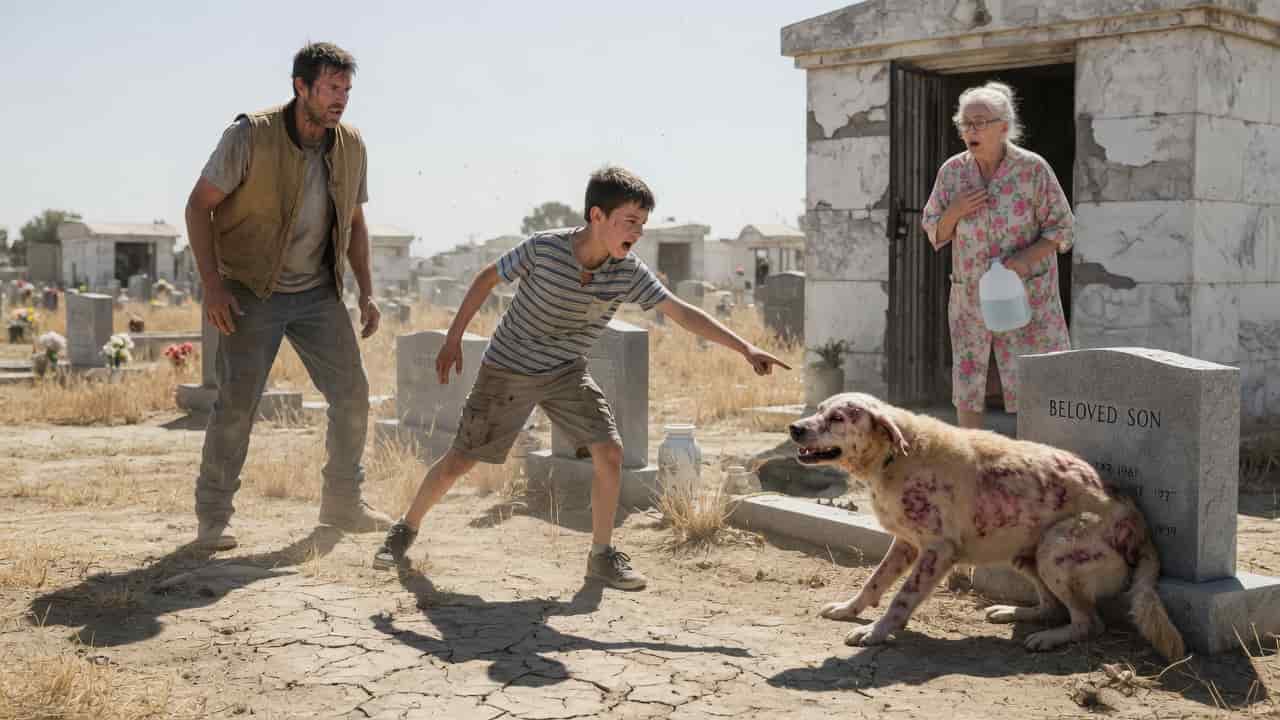
“Dad, look! It’s him! He’s back!”
Gabe froze, the heavy plastic gas can slipping from his grip and thudding into the parched grass. He didn’t want to look. For six months, he’d told his eight-year-old son that Buster had gone to a better place—that the fire had been too fast, too hungry. He’d watched the boy cry himself to sleep in the back of a FEMA trailer, whispering the dog’s name into a pillow that smelled like smoke.
But as Gabe turned his head, his heart hit the floor.
There, huddled against the cool marble of Sarah’s headstone, was a creature that looked more like a ghost than a dog. His fur was gone in jagged, angry patches of pink scar tissue. One ear was curled like a dried leaf. But the eyes—those deep, amber eyes—were unmistakably Buster’s.
“Don’t go near him, Leo,” Gabe rasped, his voice cracking.
He wasn’t worried about the dog biting the boy. He was worried about the way Buster was looking at him. The dog wasn’t wagging its tail. It wasn’t whining for a treat. It was staring at Gabe with a terrifying, silent judgment.
Buster remembered the moment the heat became unbearable. He remembered the smell of the cedar siding igniting. And he remembered the exact second Gabe’s fingers had uncurled, letting the leather leash slip away so Gabe could run faster toward the truck.
Gabe had saved himself. He’d told everyone it was an accident. But as the scarred dog bared its teeth in front of his son, the lie began to crumble in the hot California sun.
Chapter 1: The Weight of the Dust
The heat in the Oakhaven Cemetery didn’t just sit on you; it pushed. It was a heavy, invisible hand pressing against Gabe’s shoulder blades, forcing him to hunch as he navigated the rows of grey and white markers. He carried a plastic gallon of water in each hand, the handles biting into his calloused palms. Behind him, Leo trudged along, his small sneakers kicking up puffs of fine, orange-tinted dust that settled on the boy’s shins like a second skin.
Gabe stopped at the plot. It was a simple slab of granite, still relatively new, the edges not yet softened by the elements. Sarah Miller. 1991–2025. Below the dates, it read: Beloved Wife and Mother.
It didn’t say Victim of the Santa Ana Winds. It didn’t say Taken by the Fire That Gabe Couldn’t Outrun. Gabe set the water down with a dull thud. He didn’t look at the name yet. He couldn’t. Instead, he looked at the weeds—stubborn, yellowish stalks of crabgrass that had dared to sprout in the cracks of the parched earth. He knelt, the grit of the soil grinding into the denim of his work jeans, and began to pull them.
“Is she thirsty, Dad?” Leo asked. The boy was standing a few feet back, his shadow stretching long and thin across the neighboring grave of a man named Silas who had died in the forties.
“The flowers are, Leo. Grab the jug.”
Gabe watched his son struggle with the weight of the water. Leo was eight, but since the fire, he’d become smaller, more fragile. His ribs showed through his striped t-shirts, and his eyes always seemed to be searching the horizon for something that wasn’t there. Gabe felt a familiar, sharp pang of inadequacy. He was a builder. He spent his days framing houses, driving nails, making sure things were level and plumb. But he couldn’t fix the hollowed-out look in his son’s face. He couldn’t build a roof over the boy’s grief.
“I saw the lady again,” Leo whispered, pouring the water into the built-in vase at the head of the stone.
“What lady?”
“The one who feeds the cats by the back fence. She said she saw a ghost.”
Gabe grunted, wiping sweat from his forehead with the back of a dusty glove. “People in this town have been seeing ghosts since the sky turned orange, Leo. It’s just the heat playing tricks. Or grief.”
“She said this ghost has four legs.”
Gabe’s hand froze on a particularly stubborn weed. He felt a sudden, cold needle of panic stitch its way up his spine, despite the hundred-degree sun. He forced his breathing to stay rhythmic. In. Out. The sound of a distant lawnmower hummed in the air, a mundane, suburban sound that felt like it belonged to a different life.
“Don’t listen to her,” Gabe said, his voice coming out harsher than he intended. “Mrs. Gable is old. She spends too much time in the sun. Go get the other jug from the truck.”
Leo hesitated, his lower lip wobbling just a fraction. It was a tiny movement, but it hit Gabe like a sledgehammer. The boy wasn’t just talking about a ghost. He was talking about Buster. He was talking about the third member of their family who hadn’t made it out of the canyon that night.
“Go on,” Gabe urged, more gently this time.
As Leo scrambled off toward the rusted F-150 parked near the gate, Gabe finally looked at Sarah’s name. He remembered the way she’d laughed when Buster had tried to jump into the inflatable pool they’d set up in the backyard. He remembered the smell of her shampoo—something like coconut and lime—and the way it had been replaced, in the end, by the acrid, metallic stench of smoke.
He reached into his back pocket and felt the coiled leather of the leash. He’d found it in the blackened rubble of their mudroom three days after the evacuation orders were lifted. It was charred, the brass clip fused shut by the heat, but he kept it with him. It was his penance.
He had told Leo that Buster had run off into the woods to find safety. He’d told the insurance adjusters that the dog had slipped his collar in the panic. He’d told himself a thousand different versions of the story, but they all ended the same way: with the image of his own hand opening.
The fire had been a wall of roaring, sentient heat. The air had turned into liquid glass. Gabe had been holding Leo in his left arm, the boy’s face tucked into his chest, and his right hand had been clamped onto Buster’s leash. The dog had been frantic, yelping and spinning, his paws scorching on the driveway.
Gabe had reached the truck. He’d thrown Leo into the cab. And then, he’d looked back at the house. The roof was already beginning to sag. The heat was peeling the skin off Gabe’s own neck. Buster had lunged the other way, toward the backyard, toward the only home he knew.
Gabe’s fingers had burned. The leather was hot enough to melt.
He didn’t pull the dog back. He didn’t fight. He just… let go.
He’d slammed the truck door and driven through a tunnel of flame, leaving the dog behind. He’d told himself it was a choice between his son and the animal. It was the only logical choice. But logic didn’t stop the way his hand felt empty every single day since.
“Dad!”
The scream wasn’t a call. It was a jagged rip in the silence of the cemetery.
Gabe spun around, his heart hammering against his ribs like a trapped bird. Leo wasn’t at the truck. He was twenty yards away, near the edge of the older section where the grass gave way to scrub brush and leaning headstones. He was pointing at a cluster of overgrown oleander bushes.
“Dad, look! It’s him! Dad!”
Gabe started running. His boots thudded heavily on the dry turf. He expected to find a coyote, or maybe a stray shepherd from one of the neighboring farms. He expected to find anything other than what he saw.
A shape emerged from the shadow of a marble mausoleum. It moved with a hitching, painful limp. At first, it looked like a mangled coyote—thin, skeletal, its skin a patchwork of grey and raw, angry pink. There was almost no fur left on its left side, just a sheen of thickened scar tissue that looked like melted candle wax.
But then the creature stopped. It lifted its head.
Gabe skidded to a halt, the orange dust swirling around his ankles. His breath hitched in his throat, a dry, sobbing sound.
The dog’s face was a map of trauma. One eye was clouded over with a milky film, and the right ear was nothing but a shriveled nub. But the other eye—the clear, amber one—locked onto Gabe with a terrifying, piercing intensity.
“Buster?” Leo whispered, his voice a mix of awe and heartbreak. He took a step forward, his hand reaching out. “Buster, come here, boy!”
The dog didn’t move toward the boy. It didn’t wag its tail. Instead, its upper lip curled back, revealing yellowed teeth. A low, vibrating growl started deep in its scarred chest—a sound of pure, unadulterated loathing.
And it wasn’t aimed at the boy. It was aimed directly at Gabe.
Chapter 2: The Ghost in the Frame
The circular saw screamed through a length of two-by-four, sending a plume of sweet-smelling pine dust into the air of the construction site. Gabe pulled the trigger, the blade slowing to a whine, and tossed the cut piece onto the stack. His arms were vibrating from the tool’s kick, but the physical exertion was the only thing keeping the images at bay.
It had been three days since the cemetery. Three days since the dog had snarled and vanished back into the scrub brush, leaving Gabe standing in the dust with his son’s confused, tear-streaked face burned into his memory.
“Miller! You’re an eighth off on those rafters!”
Gabe looked up. Mike, the foreman, was standing on the second-story rim joist, his face reddened by the sun and a lifetime of cheap beer. Mike was a man who believed in two things: the building code and the idea that any problem could be solved with enough shouting.
“I’ll recut ’em,” Gabe said, his voice flat.
“What’s wrong with you lately? You’re daydreaming. This isn’t a hobby, Gabe. We’re behind schedule because of the rain last week. I need you here.”
“I’m here,” Gabe muttered, reaching for another board.
But he wasn’t. He was back in the driveway. He was feeling the heat of the leather leash as it slid through his palm.
He’d spent the last three nights sitting on the edge of his bed in the small, rented apartment they’d moved into after the insurance check cleared. It was a sterile place—white walls, beige carpet, furniture that felt like it belonged in a hotel. There were no photos of Sarah on the walls yet. He couldn’t bring himself to hammer nails into the plaster. Every time he picked up a tool at home, his hands started to shake.
Leo wasn’t sleeping. Gabe could hear him through the thin walls, whispering to the empty air. The boy had convinced himself that Buster was a guardian angel sent by his mother. He didn’t understand the growl. He didn’t understand why the dog had looked at his father like he was a monster.
“He was just scared, Dad,” Leo had said at breakfast that morning, pushing a soggy spoonful of cereal around his bowl. “The fire hurt him. He just needs to know it’s us.”
He knows it’s us, Gabe had thought, staring at his own scarred knuckles. That’s the problem.
Gabe picked up the saw again, but his mind drifted to the Cat Lady, Mrs. Gable. She’d been watching from the mausoleum doorway when it happened. He’d seen the look on her face—the pity, the curiosity. She was the town’s unofficial record-keeper of misery. She knew whose husband was drinking again, whose daughter had run off to Vegas, and apparently, which ghosts were haunting the cemetery.
He needed to go back. Not because he wanted to see the dog, but because he needed to know if Buster was suffering. The image of those pink, raw scars made Gabe’s stomach churn. How had the animal survived? How had he lived for six months in the scorched canyons, eating rats and drinking from stagnant pools, only to find his way to Sarah’s grave?
It was a miracle that felt like a curse.
“Hey, Gabe.”
A younger guy named Tyler stepped up to the saw horse, wiping grease from his forehead. Tyler was twenty-two, full of easy energy and the kind of unearned confidence that only comes from never having lost anything that mattered.
“Hear you’re having some trouble with a stray,” Tyler said, leaning against a pile of plywood. “My cousin works for Animal Control. Says there’s a report of a ‘mangled beast’ tearing up trash cans near the old cemetery. Scaring the kids.”
Gabe felt a surge of irrational anger. “He’s not a beast. He’s a dog.”
Tyler raised his eyebrows. “Whoa, easy. Just saying. If it’s the same one people are talking about, he’s probably rabid. Or just mean. A dog that goes through a fire like that… something breaks in their head. They don’t come back right.”
“He didn’t break,” Gabe said, his grip tightening on the saw handle until his knuckles turned white. “He was left.”
Tyler blinked, the smile fading from his face. “Whatever, man. Just a dog. If he’s suffering, someone ought to just put a round in him and call it a day. It’s the merciful thing.”
Gabe didn’t answer. He turned the saw back on, the roar drowning out Tyler’s voice, drowning out the world. He cut through the wood with a violent, jagged motion, the blade biting deep.
Mercy. The word tasted like ash.
He thought about the night of the fire. The neighbors had been screaming, piling suitcases into SUVs. The sky had been a bruised, pulsing purple, lit from beneath by the advancing orange line of the fire front. Sarah had been at the grocery store. She’d called him, her voice frantic, saying the roads were blocked, that she was trying to get home.
“Stay there!” Gabe had yelled over the roar of the wind. “I’ve got Leo! I’ve got the dog! Just go to the high school! I’ll meet you there!”
He’d lied to her, too. He’d told her he had everything under control.
He’d spent the next four hours huddled in a gymnasium with Leo, watching the news reports as their neighborhood was erased from the map. He’d waited for Sarah’s car to pull into the parking lot. He’d waited for the text that never came.
Later, they told him her car had been found on the canyon road. She’d tried to get back to them. She’d driven straight into the heart of it because she thought they were still in the house. She thought she could save them.
And all the while, Gabe had been sitting on a bleacher, the empty leather leash still gripped in his hand, watching the clock.
He finished his shift at the site in a daze. The sun was beginning to dip toward the horizon, casting long, bloody shadows across the skeletal frames of the new houses. He didn’t go home. He drove straight to the hardware store and bought two large cans of high-quality dog food and a gallon of fresh water.
He drove to the cemetery, the truck’s engine ticking in the cooling air. The gate was technically closed, but the chain was loose. He slipped through, the plastic bags of dog food heavy in his hands.
The cemetery was different at dusk. The heat had retreated, replaced by a dry, restless wind that rattled the leaves of the eucalyptus trees. The shadows were deep and deceptive.
He walked toward Sarah’s grave, his footsteps muffled by the grass. He didn’t see Leo’s “ghost” at first. He reached the headstone and knelt, opening the cans of food. The smell was pungent, cloying in the still air.
“Buster?” he whispered. “I know you’re here.”
A twig snapped in the darkness near the mausoleum.
Gabe didn’t move. He stayed on his knees, his head bowed. “I know what I did, boy. I know you remember. I carry it every day. I see that driveway every time I close my eyes.”
A low growl rumbled from the shadows. It wasn’t the sound of an animal guarding its territory. It was the sound of a witness.
The scarred dog stepped into the moonlight. In the silver glow, the pink tissue of his burns looked like old silver. He looked even thinner than he had three days ago, his ribs casting stark shadows against his skin. He didn’t come for the food. He stopped ten feet away, his amber eye fixed on Gabe.
“I saved him,” Gabe said, his voice breaking. “I saved Leo. I couldn’t hold both of you. The heat… it was too much.”
The dog took a step forward, his head low. He sniffed the air, but ignored the food. He walked past the cans, his gaze never leaving Gabe’s face, and lay down directly on top of the grave. He curled his mangled body over the spot where Sarah’s heart would be, his chin resting on the cold granite.
He wasn’t there for the food. He wasn’t there for Gabe. He was there for the only person who had never let him go.
Gabe felt a wave of shame so thick it felt like he was drowning. He stood up slowly, his legs shaking. He left the food and the water and walked back to his truck, the sound of the dog’s heavy, labored breathing following him through the dark.
Chapter 3: The Broken Contract
The following morning, the heat returned with a vengeance, turning the valley into an oven. Gabe was back on the rafters, his skin slick with sweat, but his mind was in the cemetery. He couldn’t stop thinking about the dog lying on the grave—a living, breathing monument to everything Gabe had failed to protect.
“Dad?”
Leo was waiting for him in the truck when Gabe finished his shift. The boy had been staying with a neighbor, but today he’d asked to come along to the site. He was sitting in the passenger seat, his face pressed against the window, watching the other workers leave.
“Hey, buddy. You okay?” Gabe asked, climbing in and cranking the AC.
“Can we go see him? Mrs. Gable said he’s still there. She said he’s guarding Mama.”
Gabe sighed, leaning his head back against the headrest. “Leo, that dog is hurt. He’s not the same Buster we had. You saw him. He’s… he’s angry.”
“He’s not angry at me,” Leo said softly.
The simplicity of the statement hit Gabe like a physical blow. It was true. The dog’s growl had been a surgical strike, aimed only at the man who had failed him.
“Okay,” Gabe said. “We’ll go. But we stay back. Do you hear me? If he growls, we leave.”
When they arrived at the cemetery, the light was that harsh, golden-hour glare that made everything look fragile. They walked toward the back, Gabe carrying a fresh bag of supplies.
Mrs. Gable was there, as expected. She was standing by the mausoleum, her floral duster fluttering in the breeze. She looked like a sentinel of the dead.
“He hasn’t moved,” she said as they approached. Her voice was thin and reedy, like wind through dry grass. “He doesn’t eat the food you leave, Mr. Miller. He just watches the gate. Waiting for someone.”
“He’s waiting for Mama,” Leo said, his voice bright with a tragic kind of hope.
Gabe didn’t say anything. He led Leo toward the grave.
Buster was there, draped across the granite slab like a tattered rug. At the sound of their footsteps, his head snapped up. The growl started instantly—a deep, rhythmic thrumming that seemed to vibrate the very ground they stood on.
“Buster, it’s okay,” Leo said, stepping out from behind Gabe.
The dog’s growl shifted. It didn’t stop, but the pitch changed. He looked at Leo, and for a second, the amber eye softened. The curled lip relaxed. But then his gaze shifted to Gabe, and the hatred returned, sharp and cold.
“Leo, get back,” Gabe commanded, reaching for his son’s shoulder.
But Leo was faster. He broke Gabe’s grip and ran forward. “Buster! It’s me! I missed you!”
“Leo! No!”
Gabe lunged after him, but his work boots caught on a protruding root. He stumbled, his heart leaping into his throat as he watched his son dive toward the scarred, snarling animal.
Buster stood up, his hackles—what was left of them—rising. He bared his teeth, a terrifying display of yellowed ivory and pink gums. He looked like a creature from a nightmare, a demon born of fire and neglect.
Leo didn’t stop. He threw his arms around the dog’s neck, burying his face in the patchy, scarred fur.
Gabe froze, his breath locked in his lungs. He waited for the snap. He waited for the scream. He waited for the final, irreversible consequence of his cowardice to play out in his son’s blood.
The silence that followed was deafening.
Buster didn’t bite. He didn’t snarl. He stood perfectly still, his body rigid as a board. And then, slowly, agonizingly, the tension drained out of him. He let out a long, shuddering whine—a sound of such profound grief that even Mrs. Gable turned away. He leaned his weight into Leo, his scarred head resting on the boy’s shoulder.
Leo was sobbing now, his small hands clutching the dog’s matted fur. “I’m sorry, Buster. I’m sorry we didn’t find you. I’m sorry.”
Gabe stood ten feet away, a ghost in his own life. He watched the reunion and felt a cold, hollow emptiness opening up inside him. The dog had forgiven the boy who had done nothing. But the dog would never, ever forgive the man who had made the choice.
“Look, Dad!” Leo cried, his face wet with tears but glowing with joy. “He remembered! He’s okay!”
Gabe took a step forward, his hand trembling. “Buster?”
The transformation was instantaneous. The second Gabe’s voice reached the dog, Buster’s head snapped up. The whine turned back into a snarl. He stepped away from Leo, positioning himself between the boy and Gabe, his teeth bared in a silent, lethal warning.
He wasn’t just guarding Sarah’s grave anymore. He was guarding the boy. From Gabe.
“He thinks you’re going to hurt him again,” a voice said.
Gabe turned. Mrs. Gable had moved closer, her water jug dangling from her hand. She was looking at Gabe with a frighteningly clear-eyed intensity.
“Dogs don’t understand ‘logical choices,’ Mr. Miller,” she said. “They only understand the hand that holds the leash. And they remember when that hand lets go.”
Gabe felt the air leave his lungs. “It was a fire. I had to save my son.”
“I’m sure you did,” she said, her voice devoid of comfort. “But that dog doesn’t see a hero. He sees the man who drove away while he was burning. And now he’s making sure you don’t drive away with that boy.”
Gabe looked at his son, who was reaching out to touch Buster’s scarred flank. He looked at the dog, who was watching Gabe with the unwavering judgment of the damned.
He realized then that the fire hadn’t ended six months ago. It was still burning. It was burning right here, in the middle of a peaceful cemetery, and it was finally coming for the rest of his life.
Chapter 4: The Public Rupture
The incident at the cemetery didn’t stay between the three of them. In a small town still reeling from the loss of an entire neighborhood, gossip was the only thing that moved faster than the fire. By the next afternoon, people at the construction site were whispering.
“Heard you found your dog, Miller,” Mike said, leaning against the bed of Gabe’s truck during the lunch break. “Heard he’s a real mess. People are saying he tried to take a piece out of you.”
Gabe kept his head down, unwrapping a sandwich he didn’t want. “He’s just traumatized, Mike. It’s been a long time.”
“Traumatized is one thing. Dangerous is another. My wife saw you guys at the cemetery. Said the dog looked like something out of a horror movie. Said your kid was all over it, and you were just standing there like you were scared of your own shadow.”
Gabe’s grip on his sandwich tightened. “It’s complicated.”
“Ain’t nothing complicated about a dog that growls at its owner. Usually means the owner did something to deserve it.” Mike spat a glob of tobacco juice into the dirt. “Just watch yourself. The county doesn’t take kindly to aggressive animals, especially with a kid involved. Someone’s gonna call it in.”
The pressure was mounting. Gabe felt like he was walking through chest-high water, every movement requiring an exhausting amount of effort. He went home to find Leo sitting on the floor of the living room, surrounded by old photos he’d pulled from a box in the closet.
“We have to bring him home, Dad,” Leo said, not looking up. “He’s lonely. And his owies look real bad.”
“We can’t, Leo. The apartment doesn’t allow dogs. Especially not… not like him.”
“Then we find a house! You build houses every day! Why can’t we have one?”
“It’s not that simple!” Gabe shouted.
The silence that followed was sharp. Leo flinched, his eyes wide and glassing over. Gabe immediately felt the familiar, crushing weight of regret.
“I’m sorry,” Gabe whispered, sitting down on the edge of the couch. “I’m just tired, Leo. Everything is… it’s a lot.”
“You don’t want him back,” Leo said, his voice small and dangerously perceptive. “You’re afraid of him.”
“I’m not afraid of him.”
“Yes, you are. You look at him like he’s a monster. But he’s just Buster.” Leo stood up, clutching a photo of the three of them—Sarah, Gabe, and a fluffy, unscarred Buster—to his chest. “I’m going back to see him. With or without you.”
Gabe knew he couldn’t let the boy go alone. He also knew he couldn’t keep the truth buried much longer. The dog was a living witness, and every time Buster growled, it was like he was telling the whole world what Gabe had done in that smoke-filled driveway.
They went back that evening, just as the sun was beginning to bleed into the horizon. But they weren’t alone.
A white van with County Animal Control on the side was parked near the cemetery gate. Two men in tan uniforms were standing near the mausoleum, talking to Mrs. Gable. One of them was holding a long control pole with a wire loop at the end.
Gabe’s heart stopped. “No.”
He scrambled out of the truck, Leo right at his heels. They ran through the graves, the dust choking them.
“Wait!” Gabe yelled. “Stop!”
The officers turned. One was an older man with a tired face; the other was young, probably Tyler’s age, looking bored and slightly disgusted as he looked toward the bushes.
“Mr. Miller?” the older officer asked. “We got a report about a dangerous stray. Mrs. Gable here says he belongs to you.”
Gabe looked at Mrs. Gable. She didn’t look away. Her face was set in a mask of grim necessity. “He’s suffering, Gabe,” she said quietly. “Look at him.”
Buster had retreated into the oleander bushes. His growl was audible from twenty feet away—a jagged, terrifying sound of a creature pushed to its limit.
“He’s not a stray!” Leo screamed, lunging toward the bushes. “He’s mine! Leave him alone!”
The younger officer stepped in front of Leo, blocking him. “Stay back, kid. That thing’s got half its face missing. It could have rabies. We’re just gonna take him in, get him checked out.”
“You’re going to kill him!” Leo wailed, struggling against the officer’s arm. “Dad! Do something! Tell them he’s our dog! Tell them!”
Gabe stood frozen. The officers were looking at him, waiting for his authority. Mrs. Gable was watching, her eyes boring into him. And from the bushes, the amber eye of the dog was fixed on him, waiting.
“Is he yours, sir?” the older officer asked. “Because if he is, you’re responsible for his behavior. And right now, he’s a public menace.”
Gabe looked at the control pole. He looked at the scarred, shivering animal in the bushes. If he claimed the dog, he’d have to admit everything. He’d have to explain why the dog hated him. He’d have to face the judgment of the town, of the law, and most importantly, of his son.
But if he let them take Buster… the problem would go away. The witness would be silenced. The shame would go back to being a secret he only had to keep from himself.
“Dad?” Leo’s voice was a frantic plea. “Dad, please!”
The dog stepped out of the bushes. He didn’t growl this time. He looked exhausted, his head drooping, his breath coming in ragged gasps. He looked at Gabe, and for the first time, there was no anger in his eyes. There was only a profound, heartbreaking weariness. He was tired of running. He was tired of being a ghost.
Gabe reached into his back pocket and pulled out the charred leather leash. The brass clip was still fused shut. He looked at it, then at the dog.
“He’s mine,” Gabe said, his voice barely a whisper.
“Excuse me?” the officer asked.
“He’s mine!” Gabe roared, stepping forward. “He’s my dog! His name is Buster! And you’re not touching him!”
“Sir, he’s aggressive. He’s already snarled at us—”
“He’s not aggressive! He’s hurt!” Gabe was shaking now, the heat of the fire finally catching up to him. He walked toward Buster, ignoring the officers, ignoring the warning growl that started to rumble in the dog’s chest.
“Gabe, stay back,” Mrs. Gable warned.
Gabe didn’t stop. He knelt in the dirt, five feet from the dog. He held out the charred leash.
“I’m sorry,” Gabe sobbed, the words finally tearing free from his throat. “I’m sorry I let go, Buster. I’m sorry I was a coward. I’m sorry I left you in the dark.”
The crowd of witnesses—the officers, the old woman, his son—went silent. The only sound was the wind and Gabe’s ragged sobbing.
Buster watched him. The growl died down. The dog took a hesitant step forward, his nose twitching as he caught the scent of the old leather. He looked at the leash, then at Gabe’s tear-streaked face.
And then, with a sound that was half-moan, half-whimper, Buster collapsed. Not in a heap, but forward, his scarred head landing heavily in Gabe’s lap.
Gabe wrapped his arms around the dog, burying his face in the matted, burnt fur. He didn’t care who was watching. He didn’t care about the rumors or the law. He just held on. He held on as if his life depended on it, because for the first time in six months, it finally did.
But as he looked up, he saw the look on Leo’s face. The joy was gone, replaced by a devastating, precocious realization. The boy had heard his father’s confession. He had heard the word coward. The dog was back. But the father Leo thought he had was gone.
Chapter 5: The Residue of Truth
The silence that followed Gabe’s confession in the cemetery didn’t feel like peace; it felt like the air had been sucked out of a vacuum. The older Animal Control officer, a man named Henderson whose face was etched with the weary lines of a thousand difficult calls, let the control pole dip toward the parched grass. He looked at Gabe, then at the mangled dog weeping into Gabe’s lap, and finally at Leo.
Leo hadn’t moved. He stood as still as the marble markers surrounding them, his hands still curled into small, tight fists. The joy that had illuminated his face moments before had been replaced by something sharp and old—a look of profound, adult-sized betrayal.
“You let go?” Leo’s voice was so quiet it was almost lost to the dry wind rattling the eucalyptus leaves.
Gabe couldn’t look up. He kept his hands buried in Buster’s matted, scarred fur. The dog was shivering, a rhythmic, violent trembling that Gabe could feel in his own marrow. “Leo, the fire… it was moving so fast. I couldn’t breathe. I couldn’t see.”
“You told me he ran away,” Leo said. It wasn’t a question. It was a ledger entry. “You told me he was too fast for you to catch. You said he chose to go to the woods.”
“I was trying to protect you,” Gabe rasped. It was the same lie he’d told himself a thousand times, but out here, in the cold light of the cemetery with witnesses watching, it sounded pathetic. It sounded like the whine of a man trying to bargain with a debt he couldn’t pay.
“Look, Mr. Miller,” Henderson said, stepping forward. His voice was softer now, but it still carried the weight of the law. “We’ve got a situation here. Technically, this animal is a public safety risk. He’s unlicensed, unvaccinated, and he’s shown aggression in a public space.”
“He’s not a risk,” Gabe said, his voice hardening as he finally looked up. He tightened his hold on Buster, and for the first time, the dog didn’t recoil. Buster let out a long, shuddering breath, his head heavy on Gabe’s thighs. “He’s mine. I’ll take him to a vet. I’ll pay the fines. Just don’t take him.”
The younger officer shifted his weight, looking bored. “He belongs in a shelter, man. Look at those burns. That’s animal neglect on top of everything else.”
“I didn’t neglect him!” Gabe roared, the sound echoing off the stone mausoleums. “I lost him! I lost my house! I lost my wife! Do you want to check my scars, too? Do you want to see where the heat peeled the skin off my back while I was trying to get my kid to the truck?”
The younger man flinched. Henderson put a hand on his partner’s shoulder, a silent command to back off. He looked at Gabe with a mixture of pity and professional caution. “The law doesn’t care about your grief, Miller. It cares about the paperwork. If you want to keep this dog, he needs to be contained. He needs medical clearance. And he needs to stay off the streets. If I get one more call about him snarling at a kid, I won’t have a choice.”
“I’ll take him,” Gabe said. “Now.”
He stood up, or tried to. His legs felt like they were made of wet cardboard. He gathered Buster into his arms. The dog was heavier than he remembered, a solid weight of bone and scar tissue. Buster groaned, a low, pained sound, but he didn’t fight.
Gabe walked past Mrs. Gable. She was standing by the stone mausoleum, her hands folded over her floral duster. She didn’t say a word, but her eyes followed him with a terrifying, silent judgment. She had been the one to witness the moment the lie broke, and she looked like she was memorizing the shape of Gabe’s shame.
“Leo,” Gabe called out. “Get the door.”
Leo didn’t answer. He walked toward the truck, his head down, his sneakers kicking up the orange dust. He opened the passenger door but didn’t climb in. He stood there, waiting, his face a blank mask that Gabe didn’t recognize.
The drive back to the apartment was a study in sensory deprivation. The only sounds were the hum of the tires on the asphalt and the wet, labored breathing of the dog on the floorboards. The smell was overwhelming—the metallic tang of old blood, the musky scent of a wild animal, and the lingering, ghostly odor of woodsmoke that seemed to have been baked into Buster’s very skin.
Gabe kept his eyes on the road, his hands gripped so tight on the steering wheel that his knuckles were white. He wanted to explain. He wanted to tell Leo about the way the sky had turned into a solid wall of orange. He wanted to describe the sound of the wind—a roar like a jet engine that drowned out everything, including his own conscience. He wanted to say that in that moment, when the heat was melting the plastic trim on the truck, he hadn’t been a man or a father. He had just been a biological entity trying to survive.
But he knew none of that mattered. To an eight-year-old, there is no nuance in betrayal. There is only the hand that stays and the hand that lets go.
When they reached the apartment complex—a beige, two-story box near the highway—Gabe felt a new wave of panic. No Pets. The sign was bolted to the fence near the manager’s office. He’d signed a lease that explicitly forbade animals of any kind.
“We have to be quiet,” Gabe whispered as he lifted Buster out of the truck. “We’re going to the back stairs.”
Leo didn’t nod. He just followed, his footsteps heavy.
They made it into the apartment without being seen by the manager, a sharp-featured woman named Mrs. Higgins who spent most of her time monitoring the parking lot from behind her blinds. Gabe carried Buster into the small, cramped living room and laid him down on an old moving blanket.
The dog looked even worse under the harsh fluorescent lights of the kitchen. The scars were jagged and raised, pulling the skin tight around his ribs and shoulders. One of his paws was swollen, the nails worn down to the quick from months of scratching at the dry earth of the canyons.
“He needs a bath,” Leo said. It was the first time he’d spoken since the cemetery. His voice was flat, devoid of the melody it usually carried.
“We can’t get him too wet yet, buddy. The skin might be infected. We need to wait for the vet.”
Gabe went to the kitchen and returned with a bowl of water and a clean rag. He knelt beside the dog, his heart thumping. Buster watched him, the clear amber eye tracking every movement. There was no growl now, just a profound, unsettling stillness.
As Gabe began to dab at the dirt around the dog’s ears, Buster flinched. He didn’t snap, but his body went rigid. Gabe froze, the rag trembling in his hand.
“I’ve got it,” Leo said, stepping forward. He took the rag from Gabe’s hand. His touch was light, confident. He began to wipe the dust from Buster’s face, murmuring in a low, steady tone that Gabe hadn’t heard before. It was the voice Sarah used to use when she was calming a crying baby.
Gabe sat back on his heels, his hands empty. He watched his son tend to the dog he had abandoned, and the irony was a bitter, choking thing in his throat. He felt like an intruder in his own home.
“Leo,” Gabe started, “about what I said…”
“Don’t,” Leo said, not looking up. “You said you let go. I heard you.”
“I was scared, Leo. People do things they aren’t proud of when they’re that scared.”
Leo stopped wiping the dog’s face. He looked at Gabe, and for a second, Gabe saw Sarah in the boy’s eyes—the same unwavering honesty, the same refusal to accept a half-truth.
“You let him burn,” Leo said. “And you told me he was a hero for finding his way to the woods. But he wasn’t a hero. He was just… alone.”
Leo went back to the dog. He didn’t say another word for the rest of the night.
Gabe spent the hours after Leo went to bed sitting on the floor beside the moving blanket. The apartment was quiet, save for the occasional roar of a semi-truck on the highway and the rhythmic click-click of Buster’s breathing.
He reached out and touched the dog’s scarred flank. The skin was hot, feverish. Buster didn’t move. He lay there, a broken thing that had somehow survived the impossible, and Gabe realized that the dog wasn’t the only one who had been hollowed out by the fire.
He thought about his job. He thought about Mike and the rafters that were an eighth of an inch off. He thought about the houses he built—sturdy, level, designed to withstand the wind. He could build a house that wouldn’t fall down, but he couldn’t build a version of himself that his son could look at without shame.
Around three in the morning, Buster lifted his head. He looked at Gabe, then at the door, then back at Gabe. He let out a soft, mourning whine.
“I know,” Gabe whispered, the tears finally coming. “I know. I’m still here. I’m not going anywhere this time.”
Buster didn’t wag his tail. He didn’t lick Gabe’s hand. He just closed his eyes and drifted back into a fitful, pained sleep, leaving Gabe alone with the residue of a truth that had taken six months to surface and might take a lifetime to clean.
Chapter 6: The Unbroken Line
The eviction notice was taped to the door three days later. It was a crisp, white sheet of paper that seemed to vibrate with the hum of the air conditioner. Violation of Lease Agreement: Unauthorized Animal.
Gabe stood in the hallway, the paper crinkling in his hand. He could hear Mrs. Higgins’s television through the door of the manager’s office—some game show where people were cheering for things they hadn’t earned. He felt a slow, cold anger beginning to coil in his gut, but beneath it was a weary kind of acceptance. He had known this was coming. You couldn’t hide a ghost in a beige apartment forever.
“Dad?” Leo was standing behind him, holding Buster’s new nylon leash. The dog was standing on trembling legs, his head low. They had been to the vet the day before. The diagnosis was a laundry list of trauma: second-degree burn scarring, malnutrition, a respiratory infection from smoke inhalation, and a deep-seated anxiety that the vet said might never go away.
“We’re moving, Leo,” Gabe said, not looking back.
“Where?”
“I don’t know yet. But we’re going.”
Gabe walked into the manager’s office. Mrs. Higgins didn’t look up from her desk. She was a woman who lived by the fine print, her life a series of checked boxes and late fees.
“I saw the dog, Mr. Miller,” she said, her voice like a dry pen scratching on paper. “That animal is a liability. It looks diseased. The neighbors are complaining about the smell.”
“He’s not diseased,” Gabe said, leaning over her desk. “He was in the fire. He’s a survivor.”
“He’s a violation,” she countered. “You have twenty-four hours to remove the animal or vacate the premises.”
Gabe looked at the woman—at her tidy desk, her perfectly coiffed hair, her life that had never been touched by anything more violent than a spilled cup of tea. He felt a sudden, sharp clarity. He had spent his whole life trying to be the man who stayed inside the lines, the man who did the logical thing, the man who built things that looked right from the street. And it had cost him everything that mattered.
“We’ll be out by tonight,” Gabe said.
He walked back to the apartment and started throwing things into boxes. He didn’t pack with care. He shoved clothes, kitchen utensils, and Sarah’s remaining things into cardboard containers with a frantic, desperate energy.
“Where are we going to sleep, Dad?” Leo asked, watching from the doorway. He was holding Buster’s water bowl.
“In the truck. For now. We’ll find a spot.”
They loaded the F-150 in the fading light of the afternoon. The truck was cramped, filled with the remnants of their life, but Buster seemed to find comfort in the chaos. He climbed onto the back seat and curled into a ball, his head resting on a box of Sarah’s old sweaters.
Gabe drove. He didn’t have a destination, so he drove toward the only place that felt real. He drove back toward the canyon, toward the blackened hills where the fire had started. The air changed as they climbed—the suburban humidity giving way to a dry, sage-scented wind.
He pulled over at a turnout overlooking the valley. Below them, the lights of the town were beginning to flicker on, looking like fallen stars in the purple haze. To the east, the hills were still scarred—vast swaths of grey ash and skeletal trees that looked like charcoal drawings against the sky.
Gabe killed the engine. The silence was absolute.
“I lied to you about your mom, too,” Gabe said.
He didn’t look at Leo. He stared out at the blackened hills.
Leo didn’t move. “What do you mean?”
“I told you she died because the roads were blocked. And that’s true. But she was on those roads because of me. I told her I had everything under control. I told her we were safe. If I had told her the truth—that I was scared, that the fire was already at the fence—she would have stayed at the high school. She would have been safe.”
Gabe felt the steering wheel under his hands. It felt solid. Real.
“I’ve spent my whole life trying to look like I know what I’m doing, Leo. I wanted you to think I was a hero. I wanted your mother to think I was the man who could protect you both. But when the fire came… I was just a man. And I was terrified.”
He finally turned to look at his son. Leo was watching him, his small face illuminated by the dashboard lights. There were no tears in the boy’s eyes now. There was something else—a heavy, quiet understanding that felt like a bridge being built across a chasm.
“Are you still terrified?” Leo asked.
Gabe looked at the dog in the back seat. He looked at the boxes of their life. He thought about the job he might lose and the house he didn’t have.
“Yeah,” Gabe said. “I am. But I’m not letting go of the leash this time.”
Leo reached across the center console and put his hand over Gabe’s. His skin was warm, a living contrast to the cold memory of the fire. “Okay,” Leo whispered. “Me neither.”
They spent the night in the truck. It was uncomfortable and cramped, and the smell of the dog was a constant reminder of their loss. but for the first time in six months, Gabe didn’t dream of smoke. He dreamed of wood. He dreamed of framing a house on a hill, a place with a big yard and a porch that faced the sunrise.
The next morning, they drove to the cemetery one last time.
The heat hadn’t arrived yet. The air was cool and crisp. They walked to Sarah’s grave, the three of them—a man, a boy, and a scarred dog.
Gabe knelt by the headstone. He took the charred leather leash out of his pocket. It was a useless thing now, the brass fused shut, the leather brittle and black. He laid it on top of the granite slab, right over Sarah’s name.
“I’m here,” Gabe whispered. “We’re all here.”
Buster walked forward. He didn’t growl at Gabe. He didn’t whine. He sat down next to Leo, his scarred flank pressing against the boy’s leg. He looked at the grave, then he looked at Gabe. And then, slowly, Buster lowered his head and rested his chin on Gabe’s knee.
It wasn’t a perfect reconciliation. There were still fines to pay, a home to find, and a son whose trust would have to be earned back one day at a time. The scars on the dog’s back would never grow fur, and the memory of the fire would always be a shadow in the corner of the room.
But as Gabe reached out and stroked the dog’s head, he felt a shift in the world. The line wasn’t broken anymore. It was jagged, and it was burnt, and it was painful to hold, but it was there.
Gabe stood up, offering his hand to Leo. The boy took it, and together, they turned away from the grave. They walked back toward the truck, their shadows stretching out before them, three survivors moving through the dust toward a life that was finally, painfully, true.